Introduction
British rock band Queen released ‘Bohemian Rhapsody’ on 31 October 1975. As the lead single from their fourth album A Night at the Opera (released three weeks later), it brought the group greater commercial success than they had previously experienced. It went to no. 1 on the British singles charts where it remained for nine weeks; slightly less popular in America, ‘Bohemian Rhapsody’ only reached no. 9 on the Billboard singles chart. Nonetheless, when re-released in 1991 and 1992, following Freddie Mercury's death and its appearance in the popular film Wayne's World (1992), ‘Bohemian Rhapsody’ returned to the top of the British charts and ascended to second position on the Billboard charts. Nearly forty years after its release, ‘Bohemian Rhapsody’ remains one of rock music's most famous and beloved songs, on account of its striking and enigmatic lyrics, operatic references, and stylized music video, amongst other features.Footnote 1
Despite Queen's marginalized presence in rock criticism and academia, generally,Footnote 2 there has been much written by critics and academics about ‘Bohemian Rhapsody’, specifically. From an academic perspective, authors have cumulatively provided a rich tapestry of information concerning the operatic influences on the song,Footnote 3 the potential links between the lyrical narrative and Mercury's biographical circumstances,Footnote 4 and the form of ‘Bohemian Rhapsody’.Footnote 5 In a recent thesis, Promane draws on all these strands in a single chapter dedicated to ‘Bohemian Rhapsody’: he discusses extra-musical genre issues, Mercury's biography, and presents a detailed outline of how the song unfolds.Footnote 6 From outside academia, two DVD documentaries and other interviews with the song's producer Roy Thomas Baker provide further insight into the making of the song from a recording and production perspective.Footnote 7 It is fair to say, then, that there exists a wealth of insightful information regarding ‘Bohemian Rhapsody’. The various authors and commentators view the song, however, predominantly from a synchronic perspective. While ‘Bohemian Rhapsody’ is often tied into wider contextual trends in popular music (e.g. Zak's ‘epic’ song forms of the 1970s), the musical components of the song are rarely considered from a diachronic perspective – in other words, it is much less evident from the analytical literature how ‘Bohemian Rhapsody’ sits within Queen's wider output.
It is in the critical and biographical accounts of the band that this issue is addressed to varying degrees. To start, a number of writers hold up ‘Bohemian Rhapsody’ as Queen's greatest triumph and Mercury's songwriting masterpiece, almost solely on account of the ambitious formal, stylistic, and studio techniques underpinning the song.Footnote 8 ‘Bohemian Rhapsody’ also occupies an important position in the career narrative of the group, as told through various biographies and documentaries.Footnote 9 In 1975, the band was on the verge of breaking up, courtesy of a bad record deal that left them with little money from their modest successes of the previous years.Footnote 10 Queen hired Elton John's manager John Reid, who said to them, ‘You go away and make the best record you can make; I'll take care of the business.’Footnote 11 It was not easy for the group to make their ‘best record’ – A Night at the Opera was the most expensive album ever recorded at the time, and involved four painstaking months in the studio, refining thirty-eight minutes of music. As May put it, ‘We always go for perfection in the face of financial disaster.’Footnote 12 By the end of the following year, 1976, the situation had changed drastically for the group: Queen had scored two no. 1 albums (A Night at the Opera and A Day at the Races) and three Top 10 singles in Britain (‘Bohemian Rhapsody’, ‘You're My Best Friend’, and ‘Somebody to Love’Footnote 13), toured the world, and performed to over 100,000 fans in a free ‘thank you’ concert at Hyde Park, London. The transformation from potential rock and roll also-rans to global superstars was complete. At the centre of this narrative lies ‘Bohemian Rhapsody’. It musically embodies the band's gamble in producing the ‘perfect’ album, and it was also the group's greatest commercial achievement at the time. Put simply, in the context of Queen's career, ‘Bohemian Rhapsody’ stands as the turning point from failure to success.
The problem with the discourse surrounding ‘Bohemian Rhapsody’ is that contrasting ideas and perspectives are conflated. On the one hand, the critical and biographical appraisals work from a diachronic perspective, in terms of locating ‘Bohemian Rhapsody’ within the group's corpus and as part of an unfolding career trajectory. On the other hand, such appraisals rarely address the music of ‘Bohemian Rhapsody’ in relation to other Queen tracks, focusing instead on the song's features on their own terms, much like the academic work. Accordingly, the diachronic view of ‘Bohemian Rhapsody’ rests (implicitly and explicitly) on evidence gathered from a synchronic perspective. This is not to diminish the importance of the work that has previously been conducted on the song, but it seems necessary to adjust the analytical focus somewhat so that there is greater alignment between the critical and the analytical standpoints. To be sure, my aim below is not to use musical analysis to explain why the song was commercially successful, or why it deserves to be regarded as a masterpiece. Rather, if we are to understand ‘Bohemian Rhapsody’ as a dominant point on the Queen landscape, and as the fulcrum of their career in commercial terms, then it pays to also understand how the song sits in relation to the band's output in musical terms. Was ‘Bohemian Rhapsody’ representative of Queen? Did the song follow the musical trends of the group's early years? Did it introduce a new and divergent stylistic path? Or, perhaps, was it simply a remarkable, one-off piece of songwriting?
Methodology I: idiolect analysis
Idiolect analysis offers an appropriate framework for answering such questions. The term ‘idiolect’ derives from the discipline of structural linguistics, where it refers to the speaking patterns (tone, pronunciation, vocabulary, discursive organization, etc.) of an individual, as opposed to a ‘dialect’, which concerns the speaking patterns of individuals bound by, for example, a geographical region or social class.Footnote 14 Although various analysts have employed different terminology,Footnote 15 the same types of ideas are upheld in musical contexts. Thus, an idiolect ‘refers to the individual stylistic fingerprints [. . .] of a performer or group of performers’.Footnote 16 In theoretical terms, Moore notes that ‘style refers to the manner of articulation of gestures [. . .] at various hierarchical levels, from the global to the most local’.Footnote 17 An idiolect is a level of style, operating at the ‘local’ end of the spectrum.
Over the past two decades, a number of popular music analysts have contributed to our understanding of artists’ idiolects by documenting the common traits or ‘fingerprints’ of the artists in question. The various analyses demonstrate that in practical terms an idiolect may be understood as comprising any number and type of musical details. Moore, for example, emphasizes the consistent juxtaposition of electric and acoustic textures in Jethro Tull's output, as well as the group's use of contrasting rhythmic layers.Footnote 18 Endrinal and Spicer both highlight the importance of instrumental playing techniques in their studies of U2 and The Police, respectively. In the former instance, one of U2’s defining traits is the arpeggiated rhythm guitar figuration;Footnote 19 in the latter instance, each band member employed instrumental techniques from contrasting styles, as heard in Sting's punk-derived bass guitar playing, Andy Summers’ fusion-influenced guitar chords, and Stewart Copeland's ‘upside-down’ reggae grooves.Footnote 20 The idiolect of The Police thus developed from the confluence of these stylistic ingredients. The methodological approach in each case is rather straightforward: to identify the common musical details from a corpus of songs. To paraphrase Meyer, idiolect analysis is similar to statistical sampling insofar as one is concerned with ‘observed correlations and repeated concatenations of traits’.Footnote 21 One can understand, therefore, how idiolect analysis may be useful for assessing ‘Bohemian Rhapsody’ in the context of Queen's career. Analysis of the wider corpus reveals the common features of the group's output, or Queen's idiolect; analysis of ‘Bohemian Rhapsody’ reveals whether the song's features correlate with this idiolect.
This is the fundamental approach taken below; however, I have limited the analysis in two ways, and made a small, but significant adjustment to the analytical apparatus. First, the scope of the idiolect analysis has been limited such that the ‘sample’ of songs comprises only those that precede or were written concurrently with ‘Bohemian Rhapsody’ in Queen's output.Footnote 22 This creates a corpus of forty-five songs from the group's first four albums: Queen (1973), Queen II (1974), Sheer Heart Attack (1974), and A Night at the Opera (1975). The primary reason for this limitation is that it allows one to address in greater detail the idea of ‘Bohemian Rhapsody’ as a fulcrum or turning point in the career path of Queen. That is, it is necessary to have a clear conception of what occurred musically both before and after this point in time. Given the potential scope of such a task, this article only tackles the former issue, in terms of addressing how ‘Bohemian Rhapsody’ related, in musical terms, to the early career output of Queen. There would be merit in developing a further study that considers issues of idiolect after ‘Bohemian Rhapsody’ in order to gain insight into how the song may have shaped Queen's music post-1975.
The second analytical limitation concerns the musical details addressed below. Again primarily for reasons of space, I examine and discuss seven salient features of ‘Bohemian Rhapsody’: the formal template; the key structure; Brian May's guitar arrangements; the operatic references; aspects of the vocal arrangement structure; a surface harmonic gesture; and the spatial arrangement of voices in the sound-box. For each feature, the underlying consideration is whether the traits of ‘Bohemian Rhapsody’ are consistent with the treatment of the corresponding traits in the forty-five other songs of the corpus. Thus, in the section on form, I outline the structure of ‘Bohemian Rhapsody’ and place this structure alongside other Queen tracks, with the implicit question: is the structure of ‘Bohemian Rhapsody’ similar to the structures of previous Queen songs? With both these limitations in mind, it is necessary to note that the analysis does not aim to provide readers with a complete understanding of either ‘Bohemian Rhapsody’ or Queen's idiolect; that said, the material below does offer significant insight on both counts, as discussed in the conclusion of this article.
There is a final methodological hurdle that requires an adjustment to the analytical apparatus. It was noted above that idiolect analysis is concerned with identifying consistent musical traits across a given corpus of songs. The problem in this context is that one can observe different types of musical consistency across this selection of Queen's output. This kind of issue is not unique to Queen. In their study of Radiohead, Moore and Ibrahim identify several structural features that recur in various guises across the band's career: AAB formal templates; development within songs via variations on this template; and the presence of ‘breakdown’ sections. But the authors’ most striking conclusion is this: ‘it is the unpredictability of the band's recordings that is arguably the only real constant . . . it is in this respect that Radiohead problematizes the specification of idiolect’.Footnote 23 Moore makes a similar point regarding progressive rock band Gentle Giant. Having surveyed the material from their 1972 album Octopus, he concludes: ‘This album then forms part of a changing Gentle Giant idiolect, an idiolect which I suspect retains few constant features across its lifespan.’Footnote 24 If we consider the nature of the idiolects discussed in this article, there is a clear tension: on the one hand, the idiolects of The Police and U2 were marked, above all, by consistent instrumental techniques; on the other hand, the idiolects of Radiohead and Gentle Giant were marked, above all, by constant change. In the case of Queen, both sides of this issue come to the fore, thus raising the question of how to assess the group's idiolect when some elements constantly change, and some elements stay the same.
Methodology II: sonic patterns and compositional strategies
In order to resolve this issue, I propose a distinction between the different types of traits that comprise an artist's idiolect. The analysis below suggests that a richer understanding of Queen and ‘Bohemian Rhapsody’ (and, indeed, other artists’ output) may be possible if one distinguishes between sonic patterns and compositional strategies. Both categories encompass common elements of a group's output, and thus may be considered subservient to the overarching idiolect of a group. That is, Queen's idiolect – what allows us to ‘recognize their [Queen's] work as their work individually’Footnote 25 – may be construed as comprising the sum total of the group's sonic patterns and compositional strategies.
What, then, do the terms mean? To adopt the terminology from Moore's definition of style (noted above), there are gestures or musical details that are ‘articulated’ in the same ‘manner’ from song to song. These constitute Queen's sonic patterns. There are also gestures or musical details that are ‘articulated’ in a different ‘manner’ from song to song, but one can understand the corresponding gestures as sharing a common musical kinship or identity. These constitute Queen's compositional strategies. To use Meyer's terminology,Footnote 26 sonic patterns comprise musical details that are replicated across an artist's output, and are realized in the same way at the individual levels of intraopus style; compositional strategies are musical features replicated across an artist's output, but realized in different ways at the individual levels of intraopus style. Ultimately, the naming of the particular labels is arbitrary; however, I have attempted to use terms with appropriate connotations. ‘Sonic patterns’ have been designated thus because the musical gestures sound the same across songs; ‘compositional strategy’ suggests a general plan on the songwriters and musicians’ behalves that may result in numerous musical outcomes.Footnote 27
Although the sections on Queen should help to clarify this methodological distinction, several examples from the wider popular music repertoire may be useful in the first instance. It is important to note that the following paragraphs are based on ad hoc analytical sketches of the artists in question; however, they should suffice to illuminate several initial points. To start, a good example of a sonic pattern can be found in the songs of Jerry Lee Lewis – one of his trademarks was the long glissando across the piano. This appears as part of the accompaniment and as part of his piano solos in early career tracks, such as ‘Great Balls of Fire’, ‘Whole Lotta Shakin’ Going On’, ‘Boogie Woogie Country Boy’, ‘Wild One’, as well as in ‘Rock and Roll’, ‘I Saw Her Standing There’, and ‘Trouble in Mind’ from Last Man Standing (2006), an album of covers in collaboration with other artists. The point is that the piano glissando, as a musical gesture, appears in much the same form across all of these examples as a marker of Jerry Lee Lewis's idiolect. In other words, his idiolect (what distinguishes his output) is defined, in part, by this particular sonic pattern.
The Beatles’ output provides a good example of a compositional strategy. Particularly in the latter half of the 1960s, one can note the following features in their records: artificial double-tracking of the lead vocal (‘Love To You’); running the lead vocal through a rotating Leslie speaker (‘Tomorrow Never Knows’); recording the bass guitar through Direct Input (‘Sgt Pepper's Lonely Hearts Club Band’); close miking of instruments (‘Eleanor Rigby’), and playing back the tapes in reverse (‘Rain’).Footnote 28 These examples clearly showcase a range of gestures arising from different production techniques. And yet, it is possible to understand these varying sounds as deriving from the group's overarching aim of experimenting and innovating in the studio, which is often regarded as a key feature of The Beatles’ output or idiolect. Everett, for instance, talks of the ‘tape manipulations and studio effects that were to become de rigeur for them [. . .] in the coming years [post-1965]’.Footnote 29 Compared with the case of Jerry Lee Lewis's glissandi, however, this component of The Beatles’ idiolect may be regarded as a compositional strategy insofar as the feature identified from the group's output (i.e. experimentation in the studio) has a variety of musical outcomes in individual songs.
The above comparison between sonic patterns and compositional strategies draws attention to the level of analysis for each category. Jerry Lee Lewis's glissandi are essentially decorative gestures, while The Beatles’ production techniques could shape the overall sound of a part of a track; indeed, the discussion of Queen below draws a similar distinction between the sonic patterns, which play out on the musical surface, and the compositional strategies, which operate at the structural levels of the musical texts. It is not imperative, however, that sonic patterns and compositional strategies align with pre-determined levels of a musical text. In hard rock band AC/DC's output post-1980, many of their songs are in verse–chorus form with the verses underpinned by a repeating rhythm guitar riff. Lead guitar solos tend to be played over the same riff patterns, although in a number of songs one hears an instrumental bridge section, which begins with either a power chord on or a new rhythm guitar riff based around the subdominant (e.g. ‘Shoot to Thrill’, ‘What Do You Do For Money Honey?’, ‘Givin’ the Dog a Bone’, ‘Shake a Leg’, ‘Heatseeker’, ‘Thunderstruck’, ‘Wheels’). In terms of the riffs themselves, there is considerable variety in the riff construction (chords vs scalar passages vs arpeggiated figuration), rhythmic design, and harmonic patterns; nonetheless, they tend to be built around notes of the pentatonic minor scale, which, I would argue, provides the riffs with a common musical identity. AC/DC's idiolect can thus be defined in part by sonic patterns that create a sense of structural regularity (consistent verse–chorus forms and bridges starting on IV), and in part by a compositional strategy (guitar riffs built on pentatonic minor scale) that produces a range of surface gestures across their output.
In outlining the examples thus far, I have proceeded as if the musical gestures of an artist's idiolect fall easily into the category of sonic patterns and compositional strategies. In practice, this is not the case, as one can often identify gestures that reside in a grey area relative to the definitions of the categories set out above – not identical from one instance to the next, and yet not completely dissimilar. A good example of this in relation to AC/DC is the song ‘Have a Drink on Me’, which is also in verse–chorus form and has an instrumental bridge, this time opening on the dominant chord. In terms of a structural gesture, the starting point of the bridge in ‘Have a Drink on Me’ is different to ‘Shake a Leg’ (i.e. not IV), but clearly the pair is related by virtue of the respective bridge sections beginning off-tonic. Does this mean that ‘Have a Drink on Me’ presents a subtle variation on the sonic pattern evident from the other songs? Or, perhaps, are all these songs bound by the compositional strategy of beginning the bridge section on a non-tonic chord? Does the answer to either question even matter?
With respect to the last question, I would suggest the answer is ‘no’. It is necessary to remember, as Moore notes, that any category (style, idiolect, sonic pattern, compositional strategy, etc.) simply ‘tells us something different about how we organize the sequence of sounds issuing from instruments or speakers’; as listeners and analysts, we develop such categories as an ‘an aid to our organizing that sequence of sounds’.Footnote 30 These ideas are important when it comes to idiolect analysis and distinguishing between sonic patterns and compositional strategies. Neither is a pre-facto category that shapes and determines how the sounds unfold through time; instead, they are concepts ‘imposed’ on the music by the listener or analyst, when one listens to specific elements of a song (and other songs) in a certain way.Footnote 31 That is, in identifying sonic patterns across an artist's output, the analyst chooses to hear and highlight the similarities of gestures across different songs; in identifying compositional strategies across an artist's output, the analyst chooses to hear the differences between songs, while still recognizing a shared musical relationship across these examples. Indeed, as is explored below, the richness of this method stems from identifying different types of musical continuity within the same temporal span, according to the analytical focus at any given point in time.
To provide a summary of this method, then, it is best to conceive of sonic patterns and compositional strategies as idealized categories that sit at opposite ends of a continuum of relative musical similarity between songs of an artist's output. What is important in this kind of analysis is recognizing and understanding the different types of similarity between songs, and then being able to communicate and illuminate these ideas through close attention to the musical texts. Maintaining a distinction between sonic patterns and compositional strategies provides the requisite framework for undertaking this kind of analysis; and in turn, these distinctions allow one to reach richer conclusions regarding an artist's idiolect.
The formal and harmonic structures of ‘Bohemian Rhapsody’
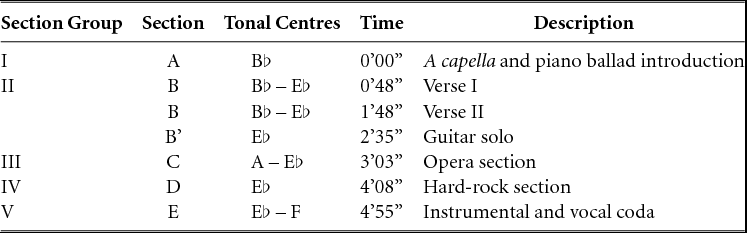
I begin the analysis by considering the formal and harmonic structures of ‘Bohemian Rhapsody’ because they provide good instances of compositional strategies that marked Queen's output between 1973 and 1975. Much of the analytical intrigue of ‘Bohemian Rhapsody’ derives from the unusual formal and harmonic plan of the song. Boss has argued that ‘Bohemian Rhapsody’ follows the processes of sonata form insofar as the primary motivic ideas are introduced in the opening third of the song, juxtaposed and fragmented in the opera section, and recapitulated in the coda section.Footnote 32 While his analysis is accurate, the motivic continuity is offset by the high degree of thematic contrast across the song. In sectional terms, ‘Bohemian Rhapsody’ seems close to Osborn's ‘Multi-Part Monothematic’ through-composed form, wherein distinct thematic ideas may be repeated within a ‘sectional group’ but are not recapitulated later in the song.Footnote 33 Adopting Osborn's formal terminology, Table 1 outlines the formal and tonal plan of ‘Bohemian Rhapsody’. There are five main sectional groups, each of which contains its own thematic ideas. One could further subdivide the opera section, given the frequent changes of motivic content and texture; for the current discussion, however, finer distinctions are not necessary. Similarly, the tonal plan only accounts for those tonal centres emphasized through cadences and overlooks the numerous tonicizations that occur within sections, such as E♭ major in the introduction or C minor in the coda.
Queen, ‘Bohemian Rhapsody’, formal and tonal structure.

I will address the formal and harmonic dimensions of the song separately. An appropriate starting point may be to note that there is no other Queen song written between 1973 and 1975 that follows the same structure, in terms of the specific succession of thematic ideas. However, aside from the succession of ideas, we may point to three striking elements about the formal design of ‘Bohemian Rhapsody’: it avoids the conventions and templates of rock music (no chorus, lack of recapitulating material), it contains multiple thematic sections, and it is through-composed. One may suggest then that ‘Bohemian Rhapsody’ unfolds an unconventional and expansive formal structure. It is in this regard that one finds consistency with prior Queen songs. Indeed, this was one of the prominent features of the group's early output: of the forty-four songs that precede ‘Bohemian Rhapsody’, ten present some type of expansive formal structure, with many more subverting the formal conventions of popular music.
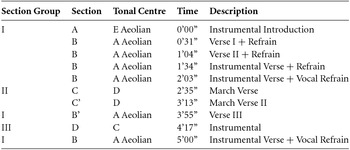
This initial idea may be considered one of Queen's prime compositional strategies that underpin the group's early output; that is, a number of songs follow the same structural approach (i.e. unconventional and expansive forms), but realize this idea in different structural patterns. Three consecutive songs from the debut album Queen (1973) neatly illustrate this point. ‘Great King Rat’, a Hendrix- and Clapton-inspired hard rock track, divides into three primary sections (the introduction is brief and non-recapitulatory), and unfolds an overarching structure that hovers between a ‘compound’ form and rondo form.Footnote 34Table 2 outlines the structure of ‘Great King Rat’. The foundation of the song is a seventeen-bar section [B], which could either be viewed as an extended verse–refrain or as a verse–chorus pair (the chorus starting after eight bars). Either way, these seventeen bars are heard four times in succession, twice with vocals, twice as guitar solos with vocals added for the final refrain. Subsequently, the groove, harmonic content, and texture change tack; Roger Taylor shifts from his hard rock drumming (as evident from hitting the bell of the ride cymbal) to a tom drum-oriented march pattern. Brian May on guitar and John Deacon on bass guitar also offer a new accompaniment: they shift from a three-chord Aeolian loop (i–VII–v) to alternating I and V chords, with the harmonic rhythm slowing to one chord change per eight-bar phrase. May also moves from a driving rhythm guitar pattern to sustained power chords that ring through each bar. This material provides the basis for two new verse-like sections, before a return to the original verse material. The recapitulation is short-lived, however, as the band segues into another new chord pattern, this time alternating between I and IV. This material underpins a guitar solo for twenty-five bars before ‘Great King Rat’ concludes with final recapitulation of the verse–refrain pair. Thus, one can identify an overarching ‘A’ section (Section Group I), which makes up the outer sections of the song; there is a loosely organized ‘B’ section as well (Section Groups II–I–III combined); both these macro sections further subdivide into two and three parts, respectively, hence the ‘compound’ nature of the structure. Alternatively, the recurring verse–chorus material creates a rondo-like template.
Queen, ‘Great King Rat’, formal and tonal structure.

‘My Fairy King’ and ‘Liar’ are related structurally to the examples discussed so far, while still unfolding unique structures. The form of ‘My Fairy King’ can be mapped out thus: ABCB'CB”BB'DB”’E, where B represents a harmonic riff, i–iv or I–IV, and C represents a verse-like section. Like ‘Bohemian Rhapsody’, there is the continual introduction of new material as the song progresses, such that the instrumental coda offers a new harmonic progression and guitar melody. There are also parallels with ‘Great King Rat’ in terms of the repeated sections within the structure, namely the harmonic riff; unlike the preceding song, however, the nature of the repetition is rather irregular. The verse section succeeds the instrumental version of B twice, but then disappears, as it were, from the song; further, the B section progresses through two variations in the first half of the song, but then promptly returns to its original form.
‘Liar’ unfolds a structure that is again comparable but different to the previous examples. Its lengthy formal plan can be conceived thus: AA'BBACC'DD'C”C’”C””C””’, where A comprises an instrumental riff, B comprises a verse–chorus pair, and the initial C section comprises three repeated harmonic progressions: I–IV, I–V, and a static vi chord over a descending Aeolian bass line, all realized with a consistent texture. At later stages in the song, the band adopts, extends, and varies these harmonic fragments individually. Thus, like ‘My Fairy King’, the song abandons the early material halfway through the song, while also offering multiple variations on basic harmonic ideas. Like ‘Great King Rat’, there is frequent recapitulation of material; and like ‘Bohemian Rhapsody’, there is the presence of sectional groups, in which several thematic ideas are repeated – on this occasion, the song's verse and chorus.
If one continued in the same vein through the songs preceding ‘Bohemian Rhapsody’, one would reach much the same conclusions regarding the form of Queen's large-scale songs: there are elements of continuity in terms of presenting multiple thematic ideas in a song, and in terms of unfolding these ideas in an unconventional and, at times, irregular order. But, there is no fundamental pattern that underpins the structure of these songs; the specific presentation of thematic ideas in ‘Bohemian Rhapsody’ is distinct from any other of the preceding songs in the corpus. It is for these reasons that the formal structure of ‘Bohemian Rhapsody’ can be considered consistent with Queen's prior output in terms of a compositional strategy. The large-scale songs from these years do not unfold the same structural patterns, but they share a musical relationship or common identity of expanding upon the formal conventions of popular songs.
The large-scale harmonic structure of ‘Bohemian Rhapsody’ can also be understood in terms of compositional strategies. Returning to Table 1, ‘Bohemian Rhapsody’ shows the group modulating between keys across and within sections; specifically, the modulations are between keys that are either adjacent on the circle-of-fifths, closely related, or a tritone apart. These observations are highly consistent with pre-‘Bohemian Rhapsody’ songs. ‘The March of the Black Queen’ offers a prior example of frequent modulations within and across sections. In the first thirteen bars of the song, four tonal centres or modes are suggested: E Aeolian, via a prolonged dominant chord; G major, via a local vi–V–I progression; A harmonic minor, intimated by a local vii° chord; and, A Dorian, intimated by a local IV63 chord. This structural progression underpins the subsequent verse sections: each starts in G major, before tonicizing A minor and then hinting at A Dorian in the song's refrain. The similarities with ‘Bohemian Rhapsody’ are twofold: both repeat modulation patterns by virtue of repeating sections, and both modulate between closely related tonal centres. But the actual key relationships explored within these repeating sections are different, with ‘The March of the Black Queen’ shifting between major and minor keys and modes. In further distinction to ‘Bohemian Rhapsody’, ‘The March of the Black Queen’ explores greater harmonic ground following the repeated verse and refrain sections. Here, the subsequent episodes (which move through a number of tempi and textures) are in F major, C major, E♭ major, A minor, E major, and C major; the overall tonal structure is thus much more expansive, both in terms of the number of keys moved through, and the tonal distance between those keys.
A more appropriate point of comparison with ‘Bohemian Rhapsody’ may be ‘Killer Queen’. Both songs predicate their harmonic relationships, above all, on several closely related keys. Indeed, ‘Killer Queen’ moves between E♭ major, B♭ major, and F major, which, on the surface, bears a striking resemblance to the tonal movement in ‘Bohemian Rhapsody’. There are further similarities in that the modulations between the related keys take place within sections, before returning to a harmonic starting point when the verse material returns. One could reasonably argue that ‘intra-sectional modulations between adjacent circle-of-fifth keys’ represents one of Queen's sonic patterns; indeed, this pattern is evident to varying degrees also in, for example, ‘My Fairy King’, ‘The Fairy Feller's Master-Stroke’, and ‘Love of My Life’, all Freddie Mercury-penned songs that precede ‘Bohemian Rhapsody’ in Queen's output.
Viewed from another perspective, however, it can be argued that the description above captures the shared identity of a range of different surface harmonic gestures; even when the key relationships are consistent between songs, the actual modulations are realized in different orders and with different harmonic progressions. Thus, in ‘Killer Queen’, the movement from E♭ major to B♭ is achieved through a sequence of secondary dominants, which results in iii of E♭ acting as a pivot chord (i.e. vi of B♭ major). The subsequent movement to F major is also sequentially derived and dependent on an obscure pivot; VI of B♭ doubles as V/V of F. ‘My Fairy King’ covers the same harmonic ground as ‘Killer Queen’, between G major and D major, but does so via a temporary tonicization of A minor, and then via an unusual IV–♭VII–I cadence into the new key. The flattened leading-note chord comes into play also in ‘Love of My Life’, but this time as a means of reversing the modulation trajectory – the B♭ major chord that appears midway through the verse in C major doubles as the subdominant of the destination key, F major. ‘Love of My Life’ is harmonically closest to ‘Bohemian Rhapsody’ in terms of modulating towards the flat key areas, but in the latter song we find yet another variation in the modulation process: the movement from B♭ major to E♭ major is undertaken in the verse via a descending chromatic bass line from C (harmonized as C minor) that simply arrives at the new tonic. At the conclusion of ‘Bohemian Rhapsody’, the shift upwards from E♭ major to F major effectively compresses the overall harmonic movement of ‘Killer Queen’ into two bars: from the tonic chord, the bass line descends to the submediant and is harmonized as VI7, which doubles as the dominant of the destination key to conclude the song.
Similar kinds of points can be made about the tritone modulations in ‘Bohemian Rhapsody’. The song is not unique in terms of shifting between tonal centres a tritone apart; the exact movement between E♭ and A is found in ‘The March of the Black Queen’ (major to Aeolian) and ‘Lazing on a Sunday Afternoon’ (major to major), the latter also from A Night at the Opera. In the former example, the tritone distance is traversed via a melodic sequence; the latter example features a direct modulation across sectional bar lines; in ‘Bohemian Rhapsody’, the modulation into the opera section is effected via a descending chromatic line that concludes on the new tonic.
Compared with the formal structures, there is a much greater degree of similarity between Queen's early songs in terms of the common modulatory ground. The key relationships explored in ‘Bohemian Rhapsody’ were not unique in Queen's output by 1975; in some prior cases, one finds replicas of the specific tonal centres. That said, I would argue that the songs mentioned above do not ‘articulate’ particular modulation gestures in the same way. ‘Modulations to related keys’ can be regarded as another compositional strategy for Queen given that the order and scope of the modulations differ from song to song; that is, the actual procession of tonal centres in ‘Bohemian Rhapsody’ is different to preceding songs. Similarly, even the precise modulation relationships, such as ‘modulations to adjacent keys on the circle-of-fifths’ or ‘modulations by a tritone’, can be considered compositional strategies given that the surface harmonic progressions used to effect the modulations differ between songs. From an overall structural perspective, then, ‘Bohemian Rhapsody’ unfolds a unique formal and harmonic plan within Queen's output from 1973 to 1975. At the same time, one can understand ‘Bohemian Rhapsody’ as sharing common approaches to form and harmony with its predecessors, as accounted for by the compositional strategies listed above.
Brian May's guitar arrangements
Compared with the structural elements of ‘Bohemian Rhapsody’, the textural elements of Brian May's guitar arrangements are excellent examples of sonic patterns. There are three textural gestures worth considering in this regard. The first two gestures – sustained power chords on the downbeat and doubling the bass line – are conflated in the second verse of ‘Bohemian Rhapsody’. When Mercury sings the line, ‘Got to leave you all behind to face the truth’, May's overdriven electric guitar enters suddenly into the song's piano-based texture. He plays a C power chord that punctuates the downbeat and rings for two beats of the bar. Thereafter, May shifts from the power chord accompaniment to single notes, doubling Freddie Mercury's piano left-hand and John Deacon's bass guitar as the bass line descends into E♭ major. One only has to return to the closing track of the previous album, ‘In the Lap of the Gods. . .Revisited’ from Sheer Heart Attack, to find a near-identical textural gesture. In the five-bar pre-chorus phrase, May joins the piano when the dominant chord is heard for the first time, playing an A major chord that sustains for two bars; the chorus begins with another chromatic progression, I–I642–VI, and May doubles the bass line, D–C–B.
The two components of this textural gesture can be found separately in a number of other songs preceding ‘Bohemian Rhapsody’. In ‘Flick of the Wrist’, the two gestures demarcate the sections of the verse. The bass line doubling is heard at the start of the verse as part of a monophonic texture – all the accompaniment instruments (electric guitars, bass guitar, and piano) double the two-part melody (also in octaves); May changes to a ringing power chord accompaniment after eight bars. In ‘Seven Seas of Rhye’, the power chord gesture is used to punctuate the introductory piano riff: the textural combination is thus very similar to ‘Bohemian Rhapsody’, and the guitar chords fall on the downbeat. Later in the song, May doubles Deacon's bass line as it ascends towards the dominant via the progression ii–I63–IV–II63–V; this bass line is clearly divergent, in harmonic terms, from the chromatic descent ‘Bohemian Rhapsody’, but in both contexts the textural arrangement remains consistent.
May's third textural gesture occurs in the coda section of ‘Bohemian Rhapsody’ and is highly consistent in its articulation with the prior songs in Queen's output. When the band returns triumphantly to the ballad tempo after the hard rock section, May provides the primary melodic lines on electric guitar, above the piano, bass, drums, and backing vocals accompaniment. After three bars, May's call-and-response lines give way to twin guitars playing a third apart. From a textural perspective, the key detail here is that May has overdubbed single electric guitar lines, as opposed to playing two notes on the one guitar. This technique was one of May's trademarks and can be found in many other songs by Queen. There are variations in the number of guitar parts in each arrangement (‘Father to Son’ features six guitar lines; ‘Seven Seas of Rhye’ and ‘Killer Queen’ feature three), as well as in the harmonic language of each phrase; nonetheless, each arrangement has a consistent sound because single melodic lines on the guitar are arranged in close position.
These textural gestures can all be regarded as sonic patterns because their articulation is the same from song to song. While the gestures occur in different places within songs and within different harmonic contexts, the ways in which May plays his guitar parts – the ringing power chords, the doubled bass lines, and the close position harmonies – remain the same. The sonic consistency of May's playing is emphasized further given that he almost exclusively used his hand-made Red Special guitar from the outset of Queen's career; while the guitar had different settings, its general timbre is constant across the corpus. One may thus draw a tentative conclusion that where the structural elements of ‘Bohemian Rhapsody’ reflect the group's compositional strategies, May's guitar playing reflects three prominent sonic patterns from the early stages of Queen's career.
The opera section
The discussion thus far has focused on three sets of gestures pertaining to form, key relationships, and guitar textures. These gestures overlap to a certain extent – May's guitar playing obviously takes place within the song's form, and his bass line doubling gesture occurs at a point of modulation – but, it is easy to draw distinctions between the gestures: the former two were primarily large-scale in their focus, while the guitar gestures were small-scale in their focus. In this final section, I take a comparatively mid-range view, focusing on the different gestures that unfold concurrently within a short timespan. The segment in question is the opera section of ‘Bohemian Rhapsody’, a sixty-second musical fragment that is among the most celebrated and famous in rock music history. What makes this section so intriguing within the context of Queen's early output is that the different gestures reflect the group's compositional strategies and sonic patterns at the same time. The importance of this observation will be addressed further in the conclusion of this article.
Let us start with the most obvious characteristic of the opera section: the fact that there are references to operatic music in the middle of a ‘rock’ song. McLeod argues that a number of thematic and stylistic references are juxtaposed, such that ‘the confused context of these terms serves both to highlight the foreign intrusion of opera in a rock anthem and parody the lack of understanding of foreign language opera common to most rock fans’.Footnote 35 Indeed, when asked about the opera influences, Mercury was rather coy: ‘I did some research’ was his enigmatic response.Footnote 36 Nonetheless, two stylistic references are most apparent. The first is to the light operatic works of Gilbert and Sullivan. This is evident through the call-and-response dialogue between the lead vocalist and the vocal chorus, the sudden changes in dynamics accompanying this dialogue, and the light, homophonic instrumental parts that accompany the voices. A number such as ‘I am the Captain of the Pinafore’ from Gilbert and Sullivan's H.M.S. Pinafore serves as a useful point of comparison. Where Mercury was reluctant to divulge his sources, May has been open about the second primary influence on the section. The a capella vocal line ‘Magnifico’ features the voices in a staggered, descending arpeggio. This was intended as an homage to Mantovani's cascading strings.Footnote 37 Thus, within this section there are two general references to musical styles beyond the world of rock music.
By 1975, Queen had started to highlight their stylistic proficiency and virtuosity. Spicer's notion of a ‘Universe of Style’ – where each musical style is represented by a different ‘planet’ – is useful for understanding this element of the group's output in the early years.Footnote 38 It was clear that the band members were adept at travelling between ‘planets’ located in close proximity to one another, namely, the various styles of 1970s rock music (compare the glam rock of ‘Now I'm Here’ with the hard rock of ‘Son and Daughter’, and with The Beatles-inspired folk rock of ‘The Night Comes Down’). At the same time, the group also showcased an ability to undertake longer journeys within the musical universe to style planets of pre-1970s popular music. Prior to A Night at the Opera, the most conspicuous examples of these adventures were ‘Killer Queen’ (the planet of British music hall, à la The Beatles’ ‘Penny Lane’), ‘Bring Back That Leroy Brown’ (1940s jazz, à la the Andrews Sisters), and ‘Funny How Love Is’ (Phil Spector's 1960s wall-of-sound production). On A Night at the Opera, in the tracks leading up to ‘Bohemian Rhapsody’, Queen made five more voyages, in the form of ‘Lazing on a Sunday Afternoon’ (music hall à la The Beatles’ ‘Maxwell's Silver Hammer’), ‘Seaside Rendezvous’ (vaudeville), ‘Love of My Life’ (Bach-inspired piano playing), ‘39’ (skiffle), and ‘Good Company’ (1920s Dixieland jazz).
Because of their continual stylistic movement, it is easy to hear the opera section of ‘Bohemian Rhapsody’ as consistent with Queen's output from 1973 to 1975. One could reasonably argue that this section is further consistent with Queen's compositional strategy of travelling to distant style planets outside the sphere of 1970s rock. As the examples demonstrate above, one may regard Queen's stylistic voyages as reflective of a compositional strategy precisely because they made regular trips through the musical universe, but did not visit the same planet twice. Equally, however, one should not overlook the degree of surprise that listeners (and even the most devoted Queen fans) must have felt upon hearing ‘Bohemian Rhapsody’ for the first time. For ‘Bohemian Rhapsody’ not only marked the group's most audacious journey to date, in terms of venturing into the realm of classical music, but it also marked the first occasion on which the group moved away from the rock planets and returned home within the same song. That is, other songs structured around highly contrasting episodes (e.g. ‘Father to Son’) operated within a consistent rock framework; different sections tended to move along a soft–hard rock textural spectrum.Footnote 39 And when Queen travelled further to pre-1970s style planets, they remained at their destination for the full song. In this regard, one can hear the opera section within ‘Bohemian Rhapsody’ as representing an innovative and rather extraordinary moment in the early stages of Queen's career.
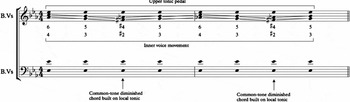
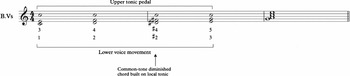
And yet, it is not entirely the case that the opera section was a radical and innovative move by Freddie Mercury and Queen. If one delves a little deeper into the musical details of this episode, the picture becomes somewhat more interesting. First, one may consider the voicing structure of the operatic chorus arrangement. Contrary to de Boer's assertion that Queen employed a SATB structure,Footnote 40 the chorus vocals of ‘Bohemian Rhapsody’ are based around three- or four-part close position harmonies in the octave above middle C, with one or two voices an octave below tending to sing either the tonic, root, and/or fifth of the chord. Example 1 highlights the arrangement and voice-leading structure of the backing vocals as they sing through the line ‘He's just a poor boy from a poor family’. The lower voices double the local tonic note (E♭), while the upper three voices sing in close position. It was comparatively unusual for Queen to add extra voices in the tenor and bass register, and thus again, one can note a degree of divergence here from previous songs. That said, almost without exception, Queen's vocal arrangements in other songs adopted the same structure as the upper parts in ‘Bohemian Rhapsody’ – three- or four-voices arranged in close position with predominantly arpeggiated or stepwise movement. Example 2 highlights the arrangement and voice-leading structure of an excerpt from ‘Killer Queen’, where the group sings punctuating ‘baahs’ behind Freddie Mercury's line ‘Guaranteed to blow your mind’. Example 3 highlights the same arrangement features of an excerpt from the verse of ‘Bring Back That Leroy Brown’, where the group sings ‘woohs’ and ‘yeah’ in between phrases. As with Brian May's guitar arrangements, the vertical construction of the backing vocal parts is highly consistent from one example to the next, and thus, it is easy to regard three- or four-part close position vocal harmonies as a sonic pattern that marks this segment of Queen's output.
Queen, ‘Bohemian Rhapsody’, opera section, backing vocal structure, 3’26”–3’29”.

Queen, ‘Killer Queen’, chorus, backing vocal structure, 0’33”–0’36”.

Queen, ‘Bring Back That Leroy Brown’, verse, backing vocal structure, 0’14”–0’17”.

Example 1 also draws attention to two harmonic gestures, both of which appear in songs before ‘Bohemian Rhapsody’. Specifically, one can note the presence of an embellishing common-tone diminished chord built on the local tonic note, and the movement of two or more voices underneath an upper pedal. The two gestures appear separately in other Queen songs. Example 2 from ‘Killer Queen’ neatly highlights the use of an upper pedal in the vocal arrangement, under which the lower two voices ascend by step. The chorus of ‘Flick of the Wrist’ features a similar voicing arrangement, as well as presenting a common-tone diminished chord on the tonic, albeit in Mercury's piano introduction. The common-tone diminished chord is rife also through the introduction and verse of ‘In the Lap of the Gods’. In ‘Bring Back That Leroy Brown’ (Example 3), not only does one hear the close position vocal harmonies, but also one may observe the use of an upper pedal, and the appearance of a common-tone diminished chord. This example acts almost as a direct precedent for ‘Bohemian Rhapsody’. Like the structure of the vocal arrangement, one may regard these two gestures – ‘upper pedal voicing’ and ‘common-tone diminished chord built on tonic note’ – as sonic patterns, due to the fact that both exhibit consistent articulation across the songs. That is, in spite of, for instance, the change of instrumentation between ‘Flick of the Wrist’ (piano) and ‘Bohemian Rhapsody’ (voices), the harmonic sonority of the common-tone diminished chord is the same.
There is a final gesture pertaining to the voices of the opera section, which reflects another sonic pattern from Queen's early years. As the ‘characters’ and chorus members call and respond to each other, the voices are placed in different positions within the sound-box. On several occasions, one hears alternating voices panned to the extreme left and right edges of the stereo image. This feature is best observed on the repeated chants of ‘Galileo’, as well as when the chorus argues with the narrator – the chorus, in the left channel, state ‘We will not let you go’, which is answered immediately in the right channel, ‘Let me go’. The result of this panning is a series of short spatial gestures in which the antiphonal voices draw the listener's attention back and forth between the opposing horizontal boundaries of the sound-box. Queen's prowess in the recording studio was evident by the time the group recorded ‘Bohemian Rhapsody’. While their studio experimentation (like The Beatles) is best understood as a compositional strategy articulated in a variety of ways,Footnote 41 the antiphonal voices of ‘Bohemian Rhapsody’ reflect a sonic pattern: one can identify the same structural (call-and-response) and spatial (left–right) arrangement gestures in a number of songs from the first three albums, including ‘In the Lap of the Gods’, ‘My Fairy King’, ‘Killer Queen’, ‘The March of the Black Queen’, ‘The Fairy Feller's Master-Stroke’, ‘Brighton Rock’, ‘Nevermore’ and ‘Now I'm Here’, amongst other examples.
This part of the analysis has thus reached a position where one can hear the opera section in terms of multiple musical gestures. On the one hand, the references to operatic and other classical styles reflect Queen's compositional strategy of moving outside the stylistic world of 1970s rock. On the other hand, within the opera section, one can identify a range of gestures relating to the structure and voicing of the vocal arrangements, the harmonic content of the arrangement, and the spatial treatment of the voices. These latter gestures can be found in almost identical form in other Queen songs written before ‘Bohemian Rhapsody’; thus, they reflect a number of the group's sonic patterns from the early years of their output.
Conclusions: the nature of Queen's sonic patterns and compositional strategies
‘I don't want to keep playing the same formula over and over again, otherwise you just go insane. I don't want to become stale. I want to be creative.’Footnote 42 This is what Mercury told an interviewer in 1977, and to a certain extent the analysis above reflects these sentiments. What was evident in this segment of Queen's corpus (1973–75) is that the structural elements of their songs – namely, the formal templates and the tonal relationships – were best understood in terms of two compositional strategies, which give rise to a variety of distinct formal and harmonic patterns. The first compositional strategy was a tendency towards expansive and unconventional song forms; the actual unfolding of these structures differs greatly from one song to the next, in terms of the number of themes and the degree of repetition, variation, and recapitulation of ideas. The second compositional strategy was the use of modulation schemes between closely related keys; again, the unfolding order of the modulations differed between songs, as did the surface harmonies used to realize such key changes. Mercury was thus correct: it is extremely difficult to point to a formula that governs the order of ideas within a Queen song, and the harmonic setting in which those ideas unfold.Footnote 43
But it is equally important to temper Mercury's comments with two further observations. First, despite the overt variations between the structural elements of Queen's songs from 1973 to 1975, the identification of compositional strategies (expansive forms, modulations to related keys) reflected the fact that there was marked consistency in the nature of these structural differences. Brian May suggested that Queen was fortunate to have begun their career at the tail end of The Beatles’ and Jimi Hendrix's careers – he noted that these two artists served as ‘role models’ and ‘it was like finding a rule book on how to break the rules’.Footnote 44 This speaks to the fact that while elements of Queen's songs could be regarded as experimental, the group was experimental in much the same way from song to song. Perhaps unlike their progressive rock contemporaries, Queen did not expand the stylistic boundaries of rock music, per se, but rather followed the ‘rules’ for experimentation that had been passed down to them by their predecessors.
Second, many of the sounds heard within the structures of Queen's songs were highly consistent across their output from these years. One can observe a number of sonic patterns that recur through the group's early career – the construction of the vocal and guitar arrangements, the use of the common-tone diminished chord, and the spatial placement of voices (amongst others) all contributed to the legendary ‘Queen sound’.Footnote 45 These sonic patterns tended to comprise short and striking gestures that could provide any musical setting and structure with a Queen-like musical flavour. This idea becomes particularly important in the context of Queen's references to musical styles beyond the context of 1970s rock. While the stylistic reference points varied from song to song, every reference tended to be marked by some or other of Queen's sonic patterns. The opera section of ‘Bohemian Rhapsody’ encapsulates these ideas. The actual evocation of classical music styles is distinctive within the group's repertoire from 1973 to 1975; the uniqueness of this reference, however, is balanced by the vocal arrangement and the harmonic and production techniques that were highly consistent with earlier Queen songs.
To offer a broad analytical conclusion regarding Queen's idiolect and the group's approach to making records in the early stages of their career, one might say that they struck a fine balance between precise musical similarities and consistent musical differences. Accordingly, through the years 1973 to 1975, Queen's overall idiolect was very well defined, in terms of both compositional strategies and sonic patterns. Put another way, where songs differed structurally or stylistically, they could often be reconciled with other songs through common compositional strategies. Despite ‘Bohemian Rhapsody’ unfolding a unique structure in relation to songs that preceded it in Queen's output, we might be tempted to remark something along the lines of, ‘It was the type of thing Queen would do’, given that it provided another example of an expansive song form featuring modulations to related keys. And even at their most experimental, as is surely the case with ‘Bohemian Rhapsody’, Queen's songs rarely sounded unfamiliar, courtesy of their well-defined sonic patterns. This methodological distinction, within the framework of idiolect analysis, allows one to develop this richer and more nuanced conclusion.
Finally, then, what of ‘Bohemian Rhapsody’ in relation to Queen's wider output? Can the song be considered a musical turning point as viewed through the lens of the group's idiolect? As noted above, one would need to investigate the post-1975 Queen songs in greater detail to answer this question; however, if we cast our eye briefly over the subsequent albums, one may note the continuation of many idiolect traits identified above. The compositional strategy of moving to different pre-1970s popular styles was evident in ‘Somebody to Love’ (gospel), ‘Long Away’ (1960s folk rock), and ‘My Melancholy Blues’ (cabaret). The compositional strategy of modulating between related keys also appeared frequently in subsequent years (e.g. ‘Millionaire Waltz’, ‘Jealousy’, ‘Save Me’). Furthermore, a number of the sonic patterns identified above remained in use in the years after ‘Bohemian Rhapsody’ – May's guitar textures and the structures of the vocal arrangements were consistent in their articulation post-1975, while the common-tone diminished chord and upper pedal voicings made a number of appearances in later tracks (e.g. ‘You Take My Breath Away’, ‘Millionaire Waltz’, ‘Bicycle Race’, ‘Sail Away Sweet Sister’). From this perspective, one may suggest that ‘Bohemian Rhapsody’ does not act as a turning point for the group, but does serve to crystallize many of the key features (in terms of both compositional strategies and sonic patterns) of Queen's idiolect.
The main issue, however, concerns the musical relationships between ‘Bohemian Rhapsody’ and the preceding material of Queen's corpus. The analysis demonstrated that many of the notable features of ‘Bohemian Rhapsody’ were highly consistent with the various strands of Queen's idiolect through their first four albums. This observation is congruous with what Mercury said to Sounds magazine in 1976: ‘I'm going to shatter some illusions. It [‘Bohemian Rhapsody’] was just one of those pieces I wrote for the album: just writing my batch of songs.’Footnote 46 The analysis would suggest that, yes, ‘Bohemian Rhapsody’ is just another manifestation of Queen's sonic patterns, and presents another distinct formal and harmonic template, and references another pre-1970s style. It is easy to view ‘Bohemian Rhapsody’ as ‘just one of those songs’ that continues the idiolect trends established by the group in their early years.
Well, not quite. I would argue that the most remarkable aspect of ‘Bohemian Rhapsody’ is not that it is consistent with Queen's idiolect, but that it presents all of the primary compositional strategies and sonic patterns that had marked Queen's output up to 1975. ‘Killer Queen’, for instance, featured a typical modulation scheme, a wider stylistic reference, as well as numerous sonic patterns (close position voices and guitar harmonies), but within a pared-back formal structure; ‘The March of the Black Queen’ had an expansive structure and featured close position vocal and guitar arrangements, but did not really venture from the stylistic world of rock music. Thus, while ‘Bohemian Rhapsody’ is viewed as the commercial fulcrum in the group's career trajectory, from a musical perspective, the song acts as a summary of Queen's output from 1973 to 1975. It epitomized Queen's idiolect at this point in the group's career; if one wished to know what defined Queen's music between 1973 and 1975, ‘Bohemian Rhapsody’, by itself, would probably provide more than a few answers. Much of the literature invariably highlights the ambitious musical techniques and subsequent commercial success of ‘Bohemian Rhapsody’. It is worth pausing, however, to acknowledge another achievement of Mercury, May, Taylor, and Deacon: in 1975, they distilled the musical essence of Queen into six minutes of operatic rock music.