

Domestic dogs (Canis familiaris) filled many important roles in past Native American communities: They assisted in hunting tasks and camp security, their hair was harvested for cordage, and they were even a food source (Schwartz Reference Schwartz1997; Snyder Reference Snyder, Purdue, Klippel and Styles1991, Reference Snyder1995). Perhaps most importantly, however, they pulled or carried cargo in the Arctic, the Intermountain West, the Great Plains, and the Southwest (Allen Reference Allen1920; Crockford Reference Crockford1997; Latham Reference Latham2016). Unfortunately, although ethnographic accounts clearly demonstrate the dog's importance in transporting resources, belongings, and trade goods during the historic period (Haines Reference Haines1938:116), the antiquity of the animal's involvement in North American transport activities remains unknown.
It is generally accepted that dogs were domesticated sometime before 15,000 BP in Europe and 12,500 BP in East Asia (Frantz et al. Reference Frantz, Mullin, Pionnier-Capitan, Lebrasseur, Ollivier, Perri, Linderholm, Mattiangeli, Teasdale, Dimopoulos, Tresset, Duffraisse, McCormick, Bartosiewicz, Gál, Nyerges, Sablin, Bréhard, Mashkour, Balasescu, Gillet, Hughes, Chassaing, Hitte, Vigne, Dobney, Hänni, Bradley and Larson2016; Larson et al. Reference Larson, Karlsson, Perri, Webster, Ho, Peters, Stahl, Piper, Lingaas, Fredholm, Comstock, Modiano, Schelling, Agoulnik, Leegwater, Dobney, Vigne, Vilà, Anderson and Linblad-Toh2012; Pionnier-Capitan et al. Reference Pionnier-Capitan, Bemilli, Bodu, Célérier, Ferrié, Garcià and Vigne2011), and some authors place initial domestication events even earlier (Germonpré et al. Reference Germonpré, Lázničková-Galetová and Sablin2012). Direct evidence of dog sledding has been recovered from contexts in Siberia dating to 9,000 BP (Pitulko and Kasparov Reference Pitulko and Kasparov2017). Though some have speculated about the roles dogs provided in Paleoindian migration and North American megafaunal extinction (Fiedel Reference Fiedel2005), evidence for dog-based transport in the Americas is limited, at times disputed, and generally relatively recent. Here we integrate datasets drawn from ethnographic, archaeological, and biological sources to explore the antiquity of dogs used as beasts of burden in North America.
Historic accounts clearly document the significance of dogs in Native American mobility. There is, however, limited and widely accepted archaeological evidence for the antiquity of these roles in North America. Driver and Massey (Reference Driver and Massey1957:298) have argued that there was an intimate link between the development of the travois and the tipi, events Brasser (Reference Brasser1982) believes occurred in the northern plains or to the northeast of the plains sometime before AD 900. Possible travois fragments have been reported from sites in Wyoming and Montana (Gebhard et al. Reference Gebhard, Agogino and Haynes1964; Grey Reference Grey1963), but these are neither common nor definitively linked to travois technology. Dog skeletal modifications associated with hauling loads include intentionally broken canines (similar to those seen in Arctic sled dogs [Walker and Frison Reference Walker and Frison1982]) and the deformation of vertebral spinous processes or limb bones. The latter modifications date to at least 3,000 to 5,000 BP (e.g., Millar Reference Millar1978:365–369). Vertebral deformations, however, have also been found in many wolf populations, which were never used in draught roles (Latham Reference Latham2016; Lawler et al. Reference Lawler, Widga, Rubin, Reetz, Evans, Tangredi, Thomas, Martin, Hildebold, Smith, Leib, Sackman, Avery and Smith2016). Additionally, though ethnographic reports assert that dogs were abundant in Intermountain West and Plains Indian communities (Brackenridge Reference Brackenridge, Thwaites and Clark1906; Catlin Reference Catlin1973; Hultkrantz Reference Hultkrantz1954, Reference Hultkrantz1956, Reference Hultkrantz1967; Irving Reference Irving1837; Kurz Reference Kurz1937; Lowie Reference Lowie1963; Russell Reference Russell and Haines1964 [1914]; Wilson Reference Wilson1924), a limited sample of archaeological specimens have been recovered from the Intermountain West and neighboring Great Basin sites (but see Haag Reference Haag1956; Lawrence Reference Lawrence1967, Reference Lawrence1968; Lupo and Janetski Reference Lupo and Janetski1994; Swanson Reference Swanson1972; Yohe and Pavesic Reference Yohe, Pavesic and Crockford2000). Furthermore, many dog remains from the plains clearly date to the historic period (e.g., Bozell Reference Bozell1988; Morey Reference Morey1986). Genetic evidence indicates that interbreeding between Native American and European dogs has resulted in the widespread replacement of Native dog lines, though the timing of interbreeding events remains unknown (Leonard et al. Reference Leonard, Wayne, Wheeler, Valadez, Guillén and Vilà2002).
In this paper, we report on the domestic dog remains from two sites in the Birch Creek drainage of Idaho, the Veratic (10CL3) and Bison (10CL10) Rockshelter sites. Others have previously reported on canid remains from Veratic Rockshelter, a deeply stratified site in the Birch Creek Valley (Lawrence Reference Lawrence1967, Reference Lawrence1968; Swanson Reference Swanson1972; Figure 1). Our reanalysis of the Birch Creek faunal materials housed at the Idaho Museum of Natural History (IMNH) identified a large collection of canid remains that could provide a better understanding of the roles dogs played in human lifeways in the Intermountain West. We asked two questions: Did the dogs represented in the Birch Creek assemblages possess the physical characteristics necessary to transport travois and pack load capacities reported in ethnographic studies? If they did, can the antiquity of such characteristics be used to assess changes in dog size and potentially the animal's role in transport?
A map depicting the location of sites used in this analysis. 1. Veratic Rockshelter 2. Braden site 3. Jaguar Cave 4. Fishing Bridge Campground 5. Stillwater Marsh 6. Pyramid Lake 7. Vista site 8. Hogup Cave 9. Danger Cave 10. Caldwell Village 11. Pharo Village 12. Larson site 13. Lower Grand site 14. Potts site 15. Pretty Head site 16. White Buffalo Robe site 17. Big Hidatsa site 18. Barcal site 19. Bellwood site 20. Burkett site 21. Clarks site 22. Gray site 23. Hill site 24. Horse Creek site 25. Linwood site 26. Palmer site 27. Write site.

Identifying domestic dogs from Birch Creek and similar archaeological contexts and estimating dog body size is important, especially if those remains predate ethnographic observations. If the Birch Creek canid remains derived from domestic animals, then this information can build on ethnographic accounts of dog use in Native American communities and can provide further understanding on the lifeways of associated prehistoric peoples. Tracing the development of large dogs adapted to haul travois and carry packs could provide clues on the invention and intensification of transport technology, changes in mobility, and the integration of the Intermountain West's occupants into trade networks that moved obsidian, sometimes across great distances (Griffin et al. Reference Griffin, Gordus and Wright1969; Hatch et al. Reference Hatch, Michels, Stevenson, Scheetz and Geidel1990). Conversely, if prehistoric dogs lacked the robusticity of their more recent counterparts, then their presence in archaeofaunal collections points to other roles, such as hunting assistance or camp protection. In this paper, we explore the simple but unevaluated idea that prehistoric dogs could have hauled loads similar to those documented in ethnographic accounts.
To test this hypothesis, we first evaluated the collection of canid remains from Veratic and Bison shelters for the presence of domestic dogs. We did so by analyzing characteristics commonly used to distinguish domestic dog remains from those of coyote (Canis latrans) and wolf (Canis lupus). These include tooth and root structure, the congenital absence of mandibular first premolar (P1), length of mandibular first molar (M1), the shape of the ascending ramus, and tooth crowding (see Benecke Reference Benecke1987; Clark Reference Clark1996; Crockford Reference Crockford1997; Haag Reference Haag1948; Krantz Reference Krantz1959; Lawrence Reference Lawrence1968; Lawrence and Bossert Reference Lawrence and Bossert1967; Morey and Wiant Reference Morey and Wiant1992; Olsen Reference Olsen1985; Young and Jackson Reference Young and Jackson1951). We estimated body mass for domestic dog remains identified in the Birch Creek assemblage using a regression formula developed by Losey and colleagues (Reference Losey, Osipov, Sivakumaran, Nomokonova and Diatchina2015; Reference Losey, McLachlin, Nomokonova, Latham and Harrington2017). Experimental data on travois travel (Henderson Reference Henderson1994) and modern pack dogs were then used to discern whether the Birch Creek dogs possessed the physical characteristics necessary to pull the travois loads reported in ethnographic and historic accounts or otherwise serve as beasts of burden. Here, we discuss our results within the context of body mass estimates for domestic dogs from other Intermountain West, Great Basin, and western Great Plains archaeological sites.
Domestic Dog Morphology, Mobility, and Labor
Domestic dogs were multifunctional contributors to prehistoric and historic Native American communities. Ethnographic sources for the region indicate three important factors: at least two types of dog, large and small, were present in the Intermountain West and the Great Plains; both assisted in hunting tasks and guarding camps; and the larger type was most commonly employed in transport activities. Although there are numerous ethnographic accounts of dogs as beasts of burden, middle-range studies are lacking that could link archaeological remains with their transport capacities and the availability of dog labor in past communities. Below we provide an overview of what is known about Native American dogs as well as a series of studies documenting the animal's transport capacity. Information from ethnographic sources allowed us to model a range of body masses expected for dogs used as pack animals. We used data drawn from various recreational or experimental transport activities to determine the relationships between body mass and expected load capacity. These data, combined with body mass estimates from prehistoric dog remains, allowed us to evaluate the possibility that prehistoric animals performed transport tasks in the same ways as their ethnographically recorded counterparts.
As mentioned, ethnographic information and recovered faunal material from the Intermountain West and the plains suggest dogs in these regions came in two sizes. Small dogs assisted in hunting small game, and large dogs hauled travois, carried packs, and chased down or directed mountain sheep (Ovis canadensis), antelope (Antilocapra americana), and bison (Bison bison) into corrals and traps following vocal commands (Hultkrantz Reference Hultkrantz1967; Kurz Reference Kurz1937; Murphy and Murphy Reference Murphy, Murphy, D'Azevedo and Sturtevant1986; Scheiber and Finley Reference Scheiber, Finley, Scheiber and Mitchell2010; Shimkin Reference Shimkin1937–1938). Russell (Reference Russell and Haines1964 [1914]) reported seeing more than two dogs for every individual in a Shoshone band he encountered in Yellowstone National Park in 1834. Similarly, between four and six dogs have been reported for Plains Indian families (Brackenridge Reference Brackenridge, Thwaites and Clark1906; Buffalo-bird-woman in Wilson Reference Wilson1924; Catlin Reference Catlin1973; Irving Reference Irving1837; Kennedy and Stevens Reference Kennedy and Stevens1972; Lowie Reference Lowie1963).
Allen's (Reference Allen1920) ethnographic and historic descriptions of dogs used by the Plains Indians and the Sioux documented wolflike animals with erect ears and tawny, black, gray, or white coloration. Allen (Reference Allen1920) indicated prehistoric dogs in these regions fell into two “breeds,” a small-to-medium-sized “Plains-Indian” dog found widely distributed from the plains to the Pacific coast and Canada and as far south as Mexico (Allen Reference Allen1920) and a larger “Sioux” dog found primarily on the northern plains. Morphometric investigation of archaeological specimens, including two dog skeletons recovered from the Fishing Bridge Campground in Yellowstone National Park, shows that, in size, some Intermountain West dogs fell between coyotes and wolves, with crania similar in width to wolves but with shortened muzzles and massive jaws (Haag Reference Haag1956; Lawrence Reference Lawrence1967, Reference Lawrence1968; Yohe and Pavesic Reference Yohe, Pavesic and Crockford2000). Data from specimens in Wyoming (Walker and Frison Reference Walker and Frison1982) and the plains (Bozell Reference Bozell1988; Morey Reference Morey1986) also support the presence of at least two dog types differentiable by size.
Ethnographic accounts also provide a window into the management and labor capacities of Native American domestic dogs. Great Plains foragers, for example, adapted dogs to specialized roles by culling smaller pups, preferentially keeping castrated male dogs for transport purposes, and reportedly breeding domestic animals with wolves (Buffalo-bird-woman in Wilson Reference Wilson1924; MacFarlane Reference MacFarlane1905). Doing so facilitated the development of dog populations characterized by their large body size and capable of pulling significant loads on simple drag sleds (travois) and carrying folded rawhide pannier-style packs. Estimates for dog load capacity using travois vary widely from as little as 13.61 kg (30 lb) to as much as 45.36 kg (60-100 lb; Grinnel Reference Grinnell1962; Harman Reference Harman1957; Hind Reference Hind1971; Maximilian Reference Maximilian, Thwaites and Clark Company1906; Wolf-chief in Wilson Reference Wilson1924; Weltfish Reference Weltfish1965; Winship Reference Winship1896). Similar observations document pack weights of 15.88 to 22.68 kg (35-50 lb) for Plains Indian dogs (Castañeda Reference Castañeda, Parker and Barnes1904; Kurz Reference Kurz1937). In the Intermountain West, the Shoshone, the Nez Perce, and other Native groups kept small dogs that assisted in hunting small mammals and larger dogs that reportedly served as beasts of burden. Ethnographic accounts imply the latter could haul travois weighing 31.75 kg (70 lb) across level terrain and could carry paired parfleche-style packs weighing 22.68 kg (50 lb) through mountainous territory (Hultkrantz Reference Hultkrantz1954, Reference Hultkrantz1956, Reference Hultkrantz1967; Kurz Reference Kurz1937; Lowie Reference Lowie1955; Nabokov and Loendorf Reference Nabokov and Loendorf2004; Russell Reference Russell and Haines1964 [1914]).
We located only one directly relevant experimental study investigating the potential for dogs as beasts of burden. Henderson's (Reference Henderson1994) experimental replication of travois travel using a modern Alaskan husky indicates a 25.4 kg (56 lb) dog could haul at least 27.2 kg (59.97 lb), or 107% of its body mass, over a few kilometers but was more comfortable with loads ranging from 11.8 to 13.6 kg (26.01-29.98 lb), 40% to 50% of body mass, on longer trips and could cover as much as 27 km in seven hours. Henderson's (Reference Henderson1994) recreation of travois travel gives the available ethnographic data context and supports a distinction between long- and short-distance loading strategies documented by those sources (Bradley Reference Bradley1923; Wolf-chief in Wilson Reference Wilson1924). Ethnographic reports indicate that travois loads were also affected by environmental conditions, being lighter in summer than in winter because cooler temperatures kept dogs from overheating and snow both reduced friction on the travois and provided dogs with water (Buffalo-bird-woman in Wilson Reference Wilson1924; Wolf-chief in Wilson Reference Wilson1924). Henderson's (Reference Henderson1994) experiment further highlights the difficulties of employing travois in densely vegetated environments that frequently entangled the sled or sloped environments that forced the dog to tack side to side when going uphill and caused the travois to ride over the dog's head when descending.
Whereas archaeological research into dog labor is scarce, several studies tied to different goals provided useful data, especially for sled dogs. One study demonstrated that sled dogs averaging 39 kg (85.98 lb) in body mass and acting as a group could pull as much as 115 kg (253.53 lb) each but required frequent rests (Taylor Reference Taylor1955; cited by Bostelmann Reference Bostelmann1975). Loads of 45 kg (99.21 lb) per animal (115% of body mass) were found more reasonable (Taylor Reference Taylor1955; cited by Bostelmann Reference Bostelmann1975), and the most efficient load for rapid-transport sled dogs was only 23 kg (50.71 lb, 58.97% of body mass; US War Department 1994). These data indicate sled dogs can move extremely large loads (e.g., 115 kg, 253.53 lb or 294.87% of body mass) but do so in teams and in snowy or icy conditions, which reduce friction. As with Henderson's (Reference Henderson1994) findings, these data also document two loading strategies, one maximizing load size (115% of body mass) and another intended to maximize transit speed (60% of body mass). Notably, the load capacities of individual dogs in both strategies are reasonably close to those identified by Henderson (Reference Henderson1994) for travois travel.
Modern data are also available for dogs carrying packs. A survey of dog-related backpacking guides, blogs, advertisements, and equipment found that many recommend a dog pack no more than 25% to 30% of its body mass (Balogh Reference Balogh2017; Green Reference Green2017; Samoyed Club of America 2017; Terrill Reference Terrill2012). The US War Department (1994) reported pack dogs that average 35 kg or more are capable of carrying loads up to 23 kg (50.71 lb, 65.71% body mass) for a few days without harm, but it recommended loads average 16 kg (35.27 lb, 45.71% of body mass). Notably, modern recommendations may be tempered by notions about humane treatment and animal abuse. Dogs in the Intermountain West reportedly carried as much as 22.68 kg (50 lb) in packs (Kurz Reference Kurz1937) while those on the plains carried 15.88–22.68 kg (35-50 lb; Castañeda Reference Castañeda, Parker and Barnes1904). Though reports of 22.68 kg (50 lb) packs may suggest loads exceeding modern recommendations, smaller loads reported on the plains may indicate that load size was again linked to distance, speed, or environmental conditions.
These data present insight into the role of dogs as a source of labor and an opportunity to evaluate the likelihood that ethnographic and historic accounts accurately document these animals’ transport capabilities. Dogs would likely only have pulled travois in certain circumstances, such as over open ground. Other circumstances—such as rugged, densely vegetated terrain—would have prompted the use of packs. Regardless of the apparatus used to facilitate load transport, Henderson's (Reference Henderson1994) experimental data, various ethnographic sources, and modern reference data present a set of parameters for linking dog body mass with load capacity, one we explore through analysis of the Birch Creek canids and a broader dataset drawn from published accounts of dog remains from the Intermountain West and adjacent regions.
Henderson's (Reference Henderson1994) experimental data and the modern data reviewed above provide a useful frame of reference for understanding the prehistoric labor utility of dogs as a ratio of load weight to total body mass. Given Henderson's (Reference Henderson1994) study and the research on sled- and pack-dog load capacities, we used 107% and 45% of body mass as reasonable estimates for dogs’ short- and long-distance travois load capacities. A load of 30% of body mass recommended by modern backpackers was used as a reasonable estimate of a dog's pack load capacity since the entire load is carried on the animal's back rather than braced on the ground (Balogh Reference Balogh2017; Green Reference Green2017; Samoyed Club of America 2017; Terrill Reference Terrill2012). Notably, modern estimates of dog load capacity, especially concerning packs for which no experimental data was available, may be influenced by current notions regarding the humane treatment of animals, and higher loads may have been achieved in the past. Nonetheless, to test prehistoric dog labor capacity against ethnographic observations, we estimated travois and pack load capacities using the empirically informed ratios of 107%, 45%, and 30% from body mass estimates generated using the methods outlined below.
Data and Methods
The methods employed in this analysis address two goals: 1) to identify domestic dog remains in the Bison and Veratic Rockshelter assemblages and evaluate whether the Birch Creek dogs, as well as a sample of dogs from a broader regional context, could have hauled ethnographically recorded travois and pack load sizes; and 2) to determine whether these data can be used to assess when travois or pack transport developed in these regions. The Bison Rockshelter and Veratic Rockshelter assemblages were excavated between 1960 and 1961 (Swanson Reference Swanson1972). Deeply stratified deposits from these rockshelters reflect intermittent occupations since at least 9950–9500 cal BP (Keene Reference Keene2016) and have contributed to the development of well-dated regional projectile-point chronologies (Butler Reference Butler1978; Holmer Reference Holmer, Condie and Fowler1986, Reference Holmer2009; Keene Reference Keene2016).
Swanson's excavations recovered a large faunal assemblage containing a number of canid specimens. Lawrence (Reference Lawrence1967, Reference Lawrence1968) reported on a subset of the Birch Creek canids including a cranium (IMNH-19613), maxillary fragments (IMNH-18425 and IMNH-18802), and mandibles (IMNH-18803, IMNH-18418, IMNH-19636, and IMNH-19637). These were identified based on tooth size, paracone and metacone development, and relatively weakly developed tooth roots (Lawrence Reference Lawrence1968). In these analyses, Lawrence identified at least two types of domestic dogs distinguished mostly by size in Jaguar Cave and the Veratic Rockshelter (Lawrence Reference Lawrence1967, Reference Lawrence1968). Both types exhibit characteristically short, broad muzzles and massively deep mandibles (Lawrence Reference Lawrence1967, Reference Lawrence1968).
In this study, we revisited Lawrence's (Reference Lawrence1968) identifications and catalogued new findings on five specimens she did not evaluate. Canid remains from the Bison and Veratic Rockshelter sites were analyzed to verify taxonomic identification and collect morphometric measurement data. All measurements were taken following Von den Driesch (Reference Von den Driesch1976), and we identified the specific metrics by element and dimension number as presented in this reference. In our reanalysis, we employed four lines of complementary evidence from the Birch Creek canid remains that others have used to distinguish domestic dogs from wolves and other wild canids. The congenital absence of a first premolar was observed in 82% of domestic dog mandibles examined by Crockford (Reference Crockford1997). Consequently, zooarchaeologists often use this attribute to identify North American domesticated dogs (Allen Reference Allen1920; Haag Reference Haag1948; Lupo and Janetski Reference Lupo and Janetski1994). M1 length has also been used to identify domestic canids (Lupo and Janetski Reference Lupo and Janetski1994). M1 in wolf populations from the Western United States are commonly at least 25.1 mm in length for females and 26 mm for males (Nowack Reference Nowack1979), whereas coyotes exhibit M1 lengths of 18.5 mm for females and 19.6 mm for males (Nowack Reference Nowack1979). Domestic dog M1 lengths commonly fall between those for wolves and coyotes, though some overlap is possible (Crockford Reference Crockford1997; Lupo and Janetski Reference Lupo and Janetski1994). A specific mandibular morphology, in this case a notable caudal curvature of the ascending ramus, often presents in domestic dogs but not in wild canids (Benecke Reference Benecke1987; Olsen Reference Olsen1985). Finally, although Ameen and colleagues (Reference Ameen, Hulme-Beaman, Evin, Germonpré, Britton, Cucchi, Larson and Dobney2017) have recently questioned the reliability of tooth crowding, such indexes for both mandibles and maxilla containing full adult dentition have also shown utility in sorting wild from domestic canids (Clark Reference Clark1996; Clutton-Brock Reference Clutton-Brock, Brothwell and Higgs1963; Degerbøl Reference Degerbøl1963; Van Wijngaarden-Bakker Reference van Wijngaarden-Bakker1974). Tooth crowding indexes are generated by dividing the summed length of the permanent premolars by the length of the permanent premolar row measured from the anterior surface of the P1 to the posterior surface of P4 in mandibles or P1 to P3 in maxilla. This metric indicates that crowding values for domestic dogs fall between 86.3 and 103 in mandibles and 79.4 and 109 in maxilla, whereas scores below this range are most commonly found in wild canids (Clark Reference Clark1996; Clutton-Brock Reference Clutton-Brock, Brothwell and Higgs1963; Degerbøl Reference Degerbøl1963; Van Wijngaarden-Bakker Reference van Wijngaarden-Bakker1974).
We evaluated the size and load capacity of the Veratic Rockshelter canids through estimation of their body mass in kilograms. Zooarchaeologists have developed several methods for investigating the size of archaeological dogs, including shoulder height (Harcourt Reference Harcourt1974) and body mass (Wing Reference Wing, Stark and Voorhies1978; Van Valkenburgh Reference van Valkenburgh, Damuth and MacFadden1990). Unfortunately, the skeletal landmarks selected, the way the distance between selected landmarks are measured under various morphometric measurement systems (e.g. Von den Driesch Reference Von den Driesch1976; Haag Reference Haag1948; Lawrence Reference Lawrence1967, Reference Lawrence1968), and the differential preservation of specimens mean that data compiled from the literature are often difficult to compare. Furthermore, techniques for estimating body mass have been hampered by small sample sizes and, in some cases, the lack of domestic dog specimens in study collections (see Wing Reference Wing, Stark and Voorhies1978; Van Valkenburgh Reference van Valkenburgh, Damuth and MacFadden1990).
Body mass, the amount of matter an organism is composed of, may be estimated from skeletal remains, a method biologists and paleobiologists frequently use to approximate body size (Anyonge and Roman Reference Anyonge and Roman2006; Campione and Evans Reference Campione and Evans2012; Damuth and MacFadden Reference Damuth and MacFadden1990; Legendre and Roth Reference Legendre and Roth1988; Thackeray and Kieser Reference Thackeray and Kieser1992). Body mass has been strongly correlated with a variety of ecological characteristics, including life history aspects , home range size, population density and growth, functional morphology, and metabolism, and as a result, it has been widely used in studying both extant and extinct species (see Anyonge and Roman Reference Anyonge and Roman2006; Campione and Evans Reference Campione and Evans2012; Damuth and MacFadden Reference Damuth and MacFadden1990; Legendre and Roth Reference Legendre and Roth1988; Thackeray and Kieser Reference Thackeray and Kieser1992). Such studies frequently test for proportional relationships between the metrics of interest and the body masses of various species. Prior studies revealed that elements involved in biomechanical loading and functional stressors, especially long bones, provide some of the most reliable estimates of body mass (Campione and Evans Reference Campione and Evans2012; Figuerido et al. Reference Figuerido, Pérez-Claros, Hunt and Palmqvist2011). Studies have also found strong correlations between mandibular characteristics, including dimensions of the tooth row and carnassial tooth and body mass (e.g. Legendre and Roth Reference Legendre and Roth1988; Losey et al. Reference Losey, Osipov, Sivakumaran, Nomokonova and Diatchina2015; Thackeray and Kieser Reference Thackeray and Kieser1992).
Because body mass can be calculated from morphometric data collected on a variety of skeletal elements, it provides an avenue for studies of archaeological remains inhibited by small sample sizes or differential preservation. Losey and colleagues (Reference Losey, Osipov, Sivakumaran, Nomokonova and Diatchina2015) have developed a set of logarithmic regression formulae for 20 cranial, 20 mandibular, and 29 long-bone dimensions (Losey et al. Reference Losey, McLachlin, Nomokonova, Latham and Harrington2017) that generate estimates of body mass in kilograms from a sample of 36 domestic dogs (including 22 Inuit sled dogs) and 108 wolves of known body mass. In the case of archaeological canids, high similarity in post-cranial skeletal anatomy in wild and domestic canids means that archaeologists are often forced to rely on crania and mandibles to identify domestic dog remains. As with previous studies, Losey and colleagues (Reference Losey, Osipov, Sivakumaran, Nomokonova and Diatchina2015, Reference Losey, McLachlin, Nomokonova, Latham and Harrington2017) found that mandibular dimensions frequently generate reliable and accurate estimates of body mass but that individual dimensions predict wolf and dog body mass with different levels of accuracy. We calculated body mass estimates in kilograms using morphometric measurement data following Von den Driesch (Reference Von den Driesch1976) and regression formula shown by Losey and colleagues (Reference Losey, Osipov, Sivakumaran, Nomokonova and Diatchina2015; Reference Losey, McLachlin, Nomokonova, Latham and Harrington2017) to most accurately predict body mass in domestic dogs. The generic formulas and associated regression coefficients are found in the Supplemental Datafile and Supplemental Table 1. Finally, we use the resulting datasets to calculate capacities for short-distance (107% body mass) and long-distance (45% body mass) travois loads, and packs (30% body mass) to situate prehistoric dogs within the ethnographic observations reviewed above.
Results
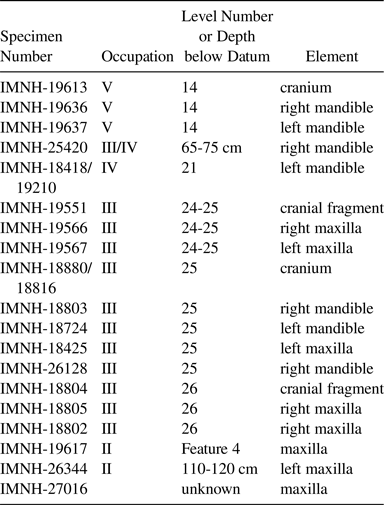
Nineteen specimens representing at least four adult domestic dogs were identified in the Veratic Rockshelter assemblage. No specimens clearly belonging to domestic dogs were identified in the Bison Rockshelter materials, and no juvenile remains were recovered from either site. The 19 domestic dog specimens identified here include pieces of at least three crania, eight maxillae, and seven mandibles (Table 1). An additional 68 specimens were identified as coyote (Canis latrans), and another 67 represent unidentified canids. We do not report any further on the coyote and other canid specimens here. Four of the domestic dog specimens were directly dated and returned median ages ranging from 5,226 to 387 cal BP (Table 2), indicating dogs were part of the local adaptation from at least the middle Archaic to the protohistoric periods in the Birch Creek Valley (Plew Reference Plew2016).
Veratic Rockshelter Domestic Dog Specimens.

Radiocarbon Data for Dated Specimens.

Note: All samples processed by Direct AMS, University of Utah. All dates provided in years BP.
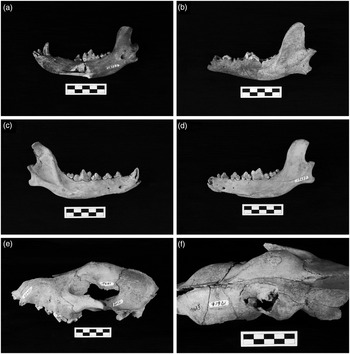
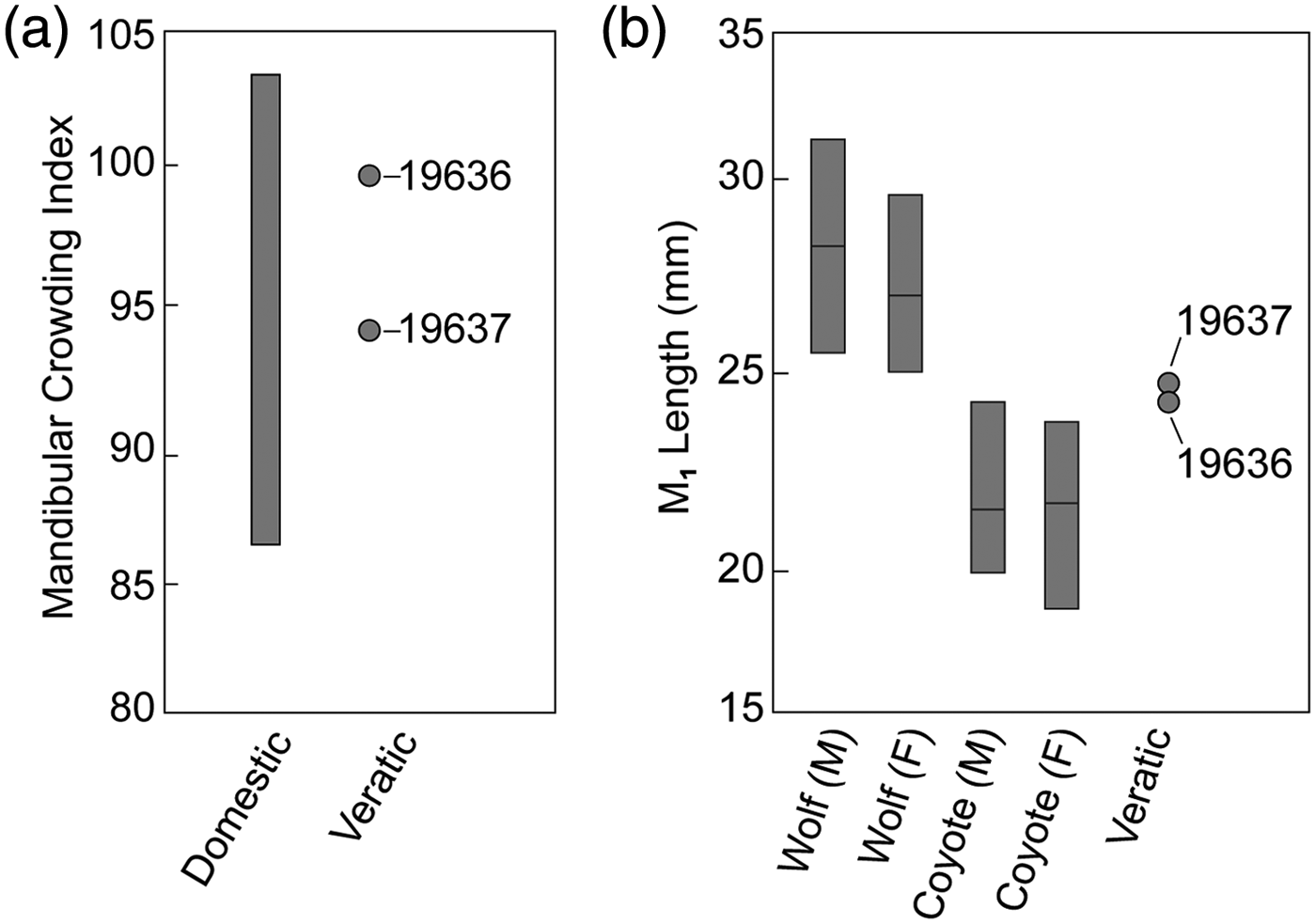
Several characteristics were used in identifying domestic dog remains in the Birch Creek assemblages. The first premolar was congenitally absent in mandibles IMNH-18803 and IMNH-18724, a characteristic common to Native American domestic dogs (Crockford Reference Crockford1997; Supplemental Table 1; Figure 2a-b). M1 lengths in mandibles IMNH-19636 and IMNH-19637 (Supplemental Table 1; Figure 2c-d) were larger than the known range for coyotes but smaller than that for wolves, indicating that these specimens derived from domestic animals (Figure 3a). Mandibular tooth crowding indexes calculated for IMNH-19636 (99.648) and IMNH-19367 (93.798) also fell well within the range for domestic dogs (Clark Reference Clark1996; Clutton-Brock Reference Clutton-Brock, Brothwell and Higgs1963; Degerbøl Reference Degerbøl1963; Van Wijngaarden-Bakker Reference van Wijngaarden-Bakker1974; Figure 3b). Additionally, caudal curvature was observed on the ascending ramus of these mandibles, further supporting their identification as domestic dogs (Benecke Reference Benecke1987; Olsen Reference Olsen1985). With a M1 length of 27.88 mm, mandible IMNH-26128 could represent a wolf but was nonetheless morphologically similar to other domestic dogs identified in the assemblage.
A panel of photos depicting mandibles (a) IMNH-18803, (b) IMNH-18418/IMNH-19210, (c) IMNH-19636, (d) IMNH-19641, and reconstructed crania (e-f) IMNH-19641, which exhibits an unhealed cranial fracture. Photographs by D. Byers.

(a) Mandibular crowding indexes for archaeologically reported domestic dogs (see Clark Reference Clark1996), (b) M1 lengths for the Veratic Rockshelter dogs and reported values for male (MNI = 62) and female (MNI = 47) wolves and male (MNI = 99) and female (MNI = 99) coyotes (Nowak Reference Nowack1979).

The Birch Creek specimens displayed several cultural modifications. While no cut marks were identified on any of the bones, several domestic dog, coyote, and unidentified canid specimens were recovered from features interpreted as large earth ovens (Swanson Reference Swanson1972) and exhibited burning (NISP = 32, 20.78%) and spiral fractures (NISP = 12, 7.79%), indicating that these animals may have been processed as food (Snyder Reference Snyder, Purdue, Klippel and Styles1991, Reference Snyder1995). An unhealed depressed fracture in the right frontal bone of cranium IMNH-19613 (Figure 2f) suggests the prehistoric inhabitants of the Veratic shelter dispatched at least one of the animals in our sample. Similar injuries to the frontal bone of canid crania have been reported at the Vore site (Walker Reference Walker1975; Walker and Frison Reference Walker and Frison1982), sites on the Great Plains (Morey Reference Morey1986), and elsewhere in North America and Russia (Losey et al. Reference Losey, Jessup, Nomokonova and Sablin2014; Park Reference Park1987). These studies have revealed that healed and unhealed fractures to the frontal bone, like that found on cranium IMNH-19613, are significantly more common in domestic dogs than wolves and are attributed to blows from humans or fights with other dogs (Losey et al. Reference Losey, Jessup, Nomokonova and Sablin2014; Park Reference Park1987).
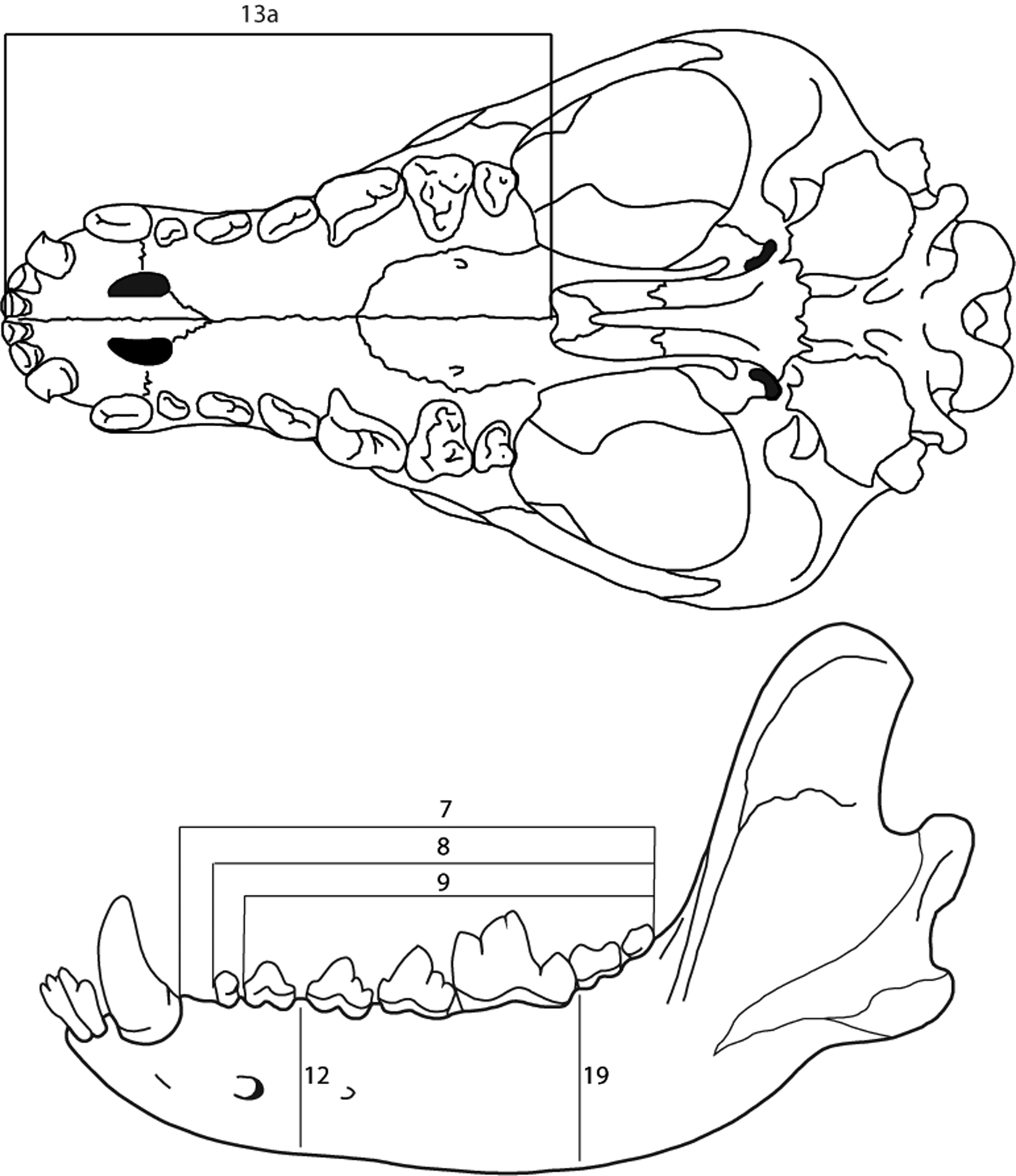
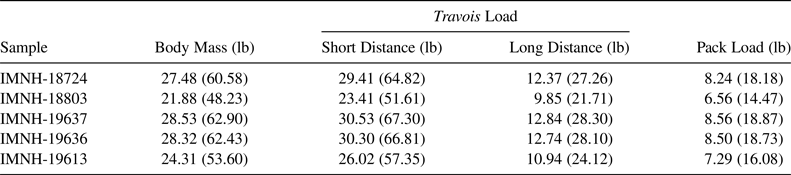
Only domestic dog cranium IMNH-19613 and mandibles IMNH-18724, IMNH-18803, IMNH-19636, and IMNH-19637 could be used to generate body mass estimates using the methods described by Losey and colleagues (Reference Losey, Osipov, Sivakumaran, Nomokonova and Diatchina2015; Reference Losey, McLachlin, Nomokonova, Latham and Harrington2017). Table 3 presents these data. Occupational level 25 produced both larger (IMNH-18724) and smaller (IMNH-18803) dogs. Mandibular dimension 12 (Figure 4) for the former specimen resulted in a body mass estimate of 27.48 kg (60.58 lb), while mandibular dimension 7 (Figure 4) for the latter generated a body mass estimate of 21.88 kg (48.24 lb). Dogs from the level 25 assemblage averaged 24.68 kg (54.41 lb).
The dimensions most commonly used for estimating body mass in this analysis based on Von den Driesch (Reference Von den Driesch1976).

Veratic Rockshelter Dog Body Mass Estimates, Short- and Long-Distance Travois and Pack Load Capacities, in kg.

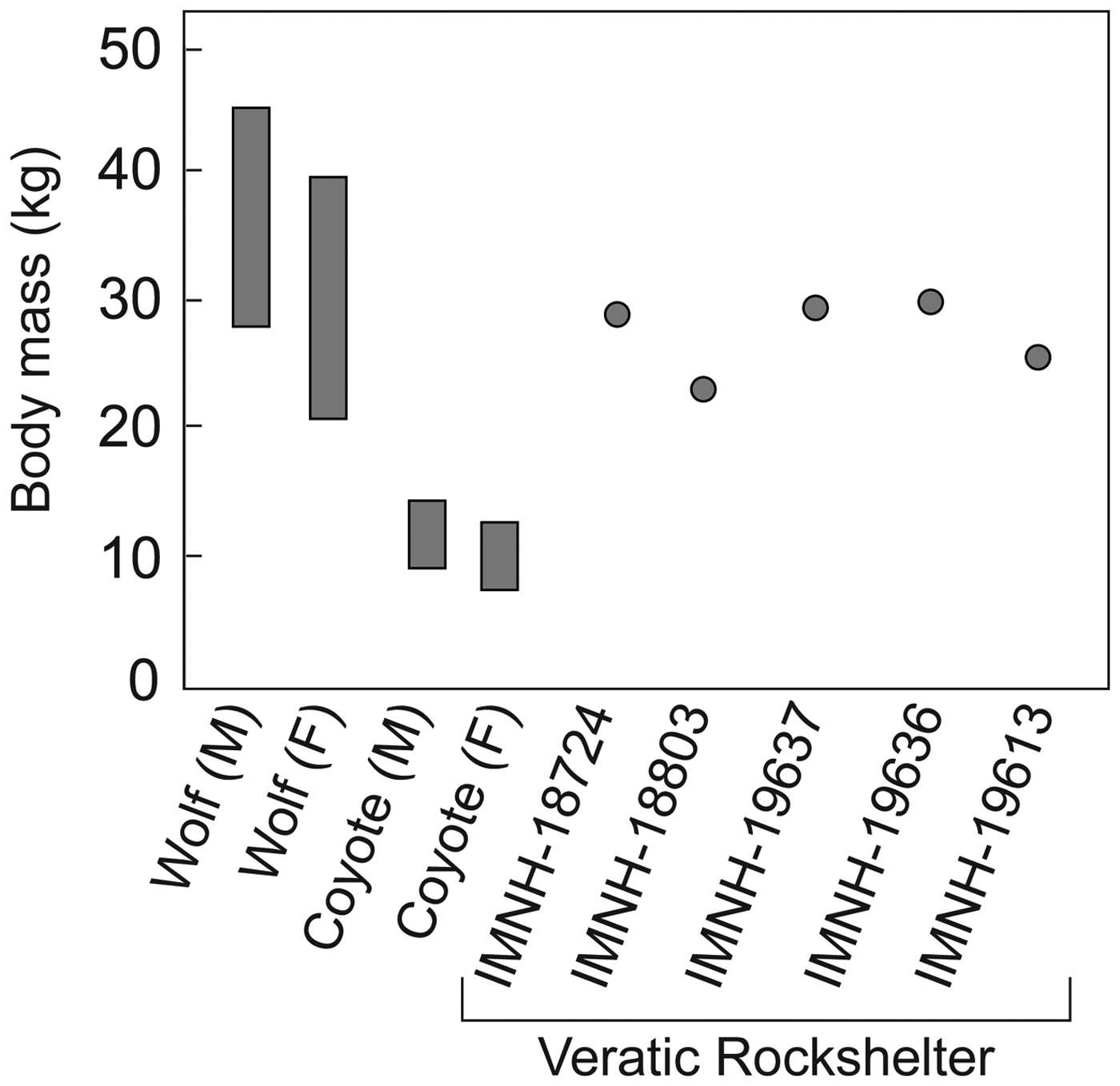
Three additional body mass estimates were generated for specimens recovered from level 14. These include one cranium (IMNH-19613) and two mandibles (IMNH-19636, IMNH-19637). The latter two specimens likely represent one individual. Cranial dimension 8 (Figure 4) taken on IMNH-19613 resulted in a body mass estimate of 24.31 kg (53.59 lb). Finally, mandibular dimension 7 (Figure 4) produced body mass for mandibles IMNH-19636 and IMNH-19637 of 28.32 kg (62.43 lb) and 28.53 kg (62.90 lb), respectively. Together, these data indicate the dogs from the Veratic Rockshelter ranged between 21.88 and 28.53 kg (48.24-62.90 lb; Table 3; Figure 5), making them similar in body mass to modern Siberian huskies (American Kennel Club 2017). Dogs recovered from Veratic shelter occupational level 25 averaged 24.68 kg (54.41 lb). Dogs recovered from occupational level 14 averaged 27.05 kg (59.64 lb) and were typically larger animals than those found in the older level 25 sample.
Body mass in kg for the Veratic Rockshelter dogs, male (MNI = 24) and female (MNI = 25) wolves (Mech Reference Mech2006), and an unknown number of male and female western coyotes (Way Reference Way2007).

The Birch Creek dogs displayed a range of body masses that can be interpreted in at least two ways. First, the presence of both small and large dogs could reflect different types or breeds, as identified in the ethnographic literature. If this was the case, the smaller bodied of these populations likely assisted hunting parties while larger animals served in transport activities (Hultkrantz Reference Hultkrantz1954, Reference Hultkrantz1956, Reference Hultkrantz1967). Notably, this interpretation might imply a relatively recent origin for dogs’ draught roles. Alternatively, the size differences may represent sexual size dimorphism. Canids generally adhere to patterns of sexual dimorphism measured by comparing adult male and female shoulder height and body mass (Frynta et al. Reference Frynta, Baudyšová, Hradcová, Faltusová and Kratochvíl2012). Though wolves, the progenitor species for domestic dogs, exhibit the most sexual dimorphism of any wild canid (Frynta et al. Reference Frynta, Baudyšová, Hradcová, Faltusová and Kratochvíl2012), the degree of sexual dimorphism in domestic dogs is highly variable (Bidau and Martinez Reference Bidau and Martinez2016; Frynta et al. Reference Frynta, Baudyšová, Hradcová, Faltusová and Kratochvíl2012). Male domestic dogs are generally 1.10–1.46 times larger than females, but across most breeds, males average only 1.15 times larger (Bidau and Martinez Reference Bidau and Martinez2016). Comparison of body mass estimates generated on dogs from the Veratic Rockshelter site revealed that the largest dog (28.53 kg, 62.90 lb) was 1.30 times larger than the smallest (21.88 kg, 48.24 lb), indicating that body mass differences could reflect sexual dimorphism but would be on the high end of the known range for domestic dogs. A student's t-test reveals no statistically significant difference between these samples (t = 0.8670; df = 3; p = 0.4497). Together, we take these data to indicate that the dogs from the Veratic Rockshelter site likely represent one sexually dimorphic population.
These body mass estimates allowed us to estimate the loads the Birch Creek dogs might have transported in prehistoric settings. Assuming prehistoric dogs had capabilities similar to modern dog breeds, including the husky used in Henderson's (Reference Henderson1994) analysis, the dog from level 25 possessing a body mass of 24.68 kg (54.41 lb) would have been capable of pulling 26.41 kg (58.22 lb) over short distances and 11.11 kg (24.49 lb) over long distances and carrying 7.41 kg (16.34 lb) by pack (Table 3). Dogs from level 14 averaging 27.05 kg (59.64 lb) would have been capable of pulling 28.95 kg (63.82 lb) over short distances and 12.17 kg (26.83 lb) over longer distances and carrying 8.12 kg (17.90 lb) by pack. The largest body mass estimates (IMNH-19637 and IMNH-19636, possibly one individual) approximate the travois loads reported by Kurz (Reference Kurz1937) for dogs in the Intermountain West and are also consistent with short-distance load limits derived from our literature review. These data suggest this individual would have been able to move relatively heavy loads for a few kilometers across level and open terrain. No estimates of pack load capacity reached 22.68 kg (50 lb), the weight recorded by European observers (Kurz Reference Kurz1937), implying either ethnographic observers overestimated pack load sizes or loads carried by Native American dogs exceeded modern recommendations.
Discussion: The Birch Creek Dogs in a Broader Context
Our analyses identified at least four domestic dogs in the Birch Creek collections. We also found some Birch Creek dogs were consistent in size with ethnographically documented animals capable of pulling short distance travois loads of more than 22.6 kg (50 lb). Finally, the radiocarbon dates for the Birch Creek dogs suggest that dogs large enough to pull travois were present in the Intermountain West as early as 3,000 years ago.
To place the Birch Creek dogs into a broader context and investigate archaeological load capacities of prehistoric dogs more generally, we compared calculated body masses and load capacities for the Birch Creek animals with similar values calculated for domestic dog remains from archaeological contexts in nearby regions (Figure 1; Supplemental Table 2-3; see also Supplemental Data 1). These include 10 dogs from the Intermountain West (including the Birch Creek dogs), 10 from the Great Basin, and 115 from Great Plains contexts. Here, again, we use Losey and colleagues’ (Reference Losey, Osipov, Sivakumaran, Nomokonova and Diatchina2015; Reference Losey, McLachlin, Nomokonova, Latham and Harrington2017) regression formulae to derive body mass estimates for the specimens in our regional sample. We once again set short- and long-distance travois loads and pack load capacities, respectively, to 107%, 45%, and 30% of calculated body mass. Cranial dimension 13a and mandibular dimensions 8, 9, and 19 were most commonly used in generating body mass estimates for the comparative sample.Footnote 1
Archaeological specimens are rarely reported from Intermountain West and Great Basin contexts (but see Lupo and Janetski Reference Lupo and Janetski1994; Yohe and Pavesic Reference Yohe, Pavesic and Crockford2000), and this situation limits our comparative sample for these regions (Supplemental Table 2). In addition to the Birch Creek dogs, the Intermountain West sample includes six dogs from the Braden site, Jaguar Cave in Idaho, and the Fishing Bridge Campground in Yellowstone National Park (Haag Reference Haag1956; Lawrence Reference Lawrence1967, Reference Lawrence1968; Yohe and Pavesic Reference Yohe, Pavesic and Crockford2000). Ten specimens derive from Great Basin contexts, including Stillwater Marsh, the Vista site, and Pyramid Lake in Nevada, as well as Danger and Hogup Caves and the Caldwell and Pharo Village sites in Utah (Dansie and Schmitt Reference Dansie, Schmitt, Zeier and Elston1986; Grayson Reference Grayson1988; Haag Reference Haag and Ambler1966, Reference Haag and Marwitt1968, Reference Haag and Aikens1970; Schmitt and Sharp Reference Schmitt, Sharp, Janetski and Madsen1990). In contrast, the Great Plains sample includes dogs from 10 sites in Nebraska associated with protohistoric–historic Pawnee occupations (the Burkett, Gray, Wright, Barcal Hill, Horse Creek, Linwood, Bellwood, Palmer, and Clarks sites; Bozell Reference Bozell1988) and six prehistoric–historic village sites in North and South Dakota (the Larson, Lower Grand, Potts, Pretty Head, White Buffalo Robe, Big Hidatsa sites; Morey Reference Morey1986).
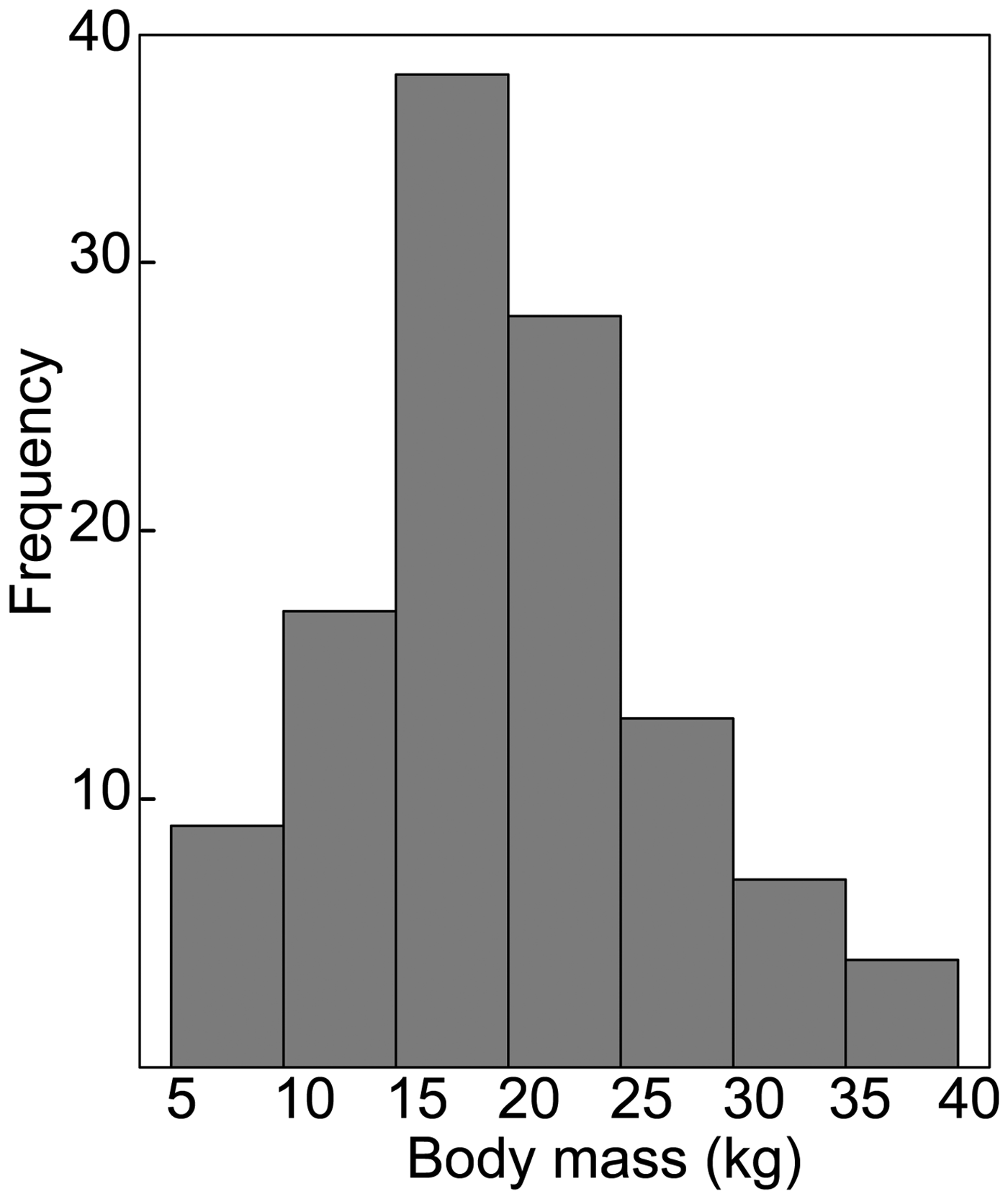
The Birch Creek dogs, ranging from 21.87 to 28.53 kg (21.87-62.90 lb), represent animals larger than dogs from other Intermountain West sites, which ranged from 11.01 to 20.78 kg (24.27-45.81 lb) in our sample. Great Basin dogs closely resembled the smaller Intermountain West dogs (9.63–21.09 kg, 21.23-46.50 lb), averaging only 15.18 kg (33.47 lb). While Great Plains dogs demonstrated high variability (5.31–39.47 kg) and included the largest and smallest dogs in the comparative sample (Figure 6), the overall sample did not exhibit the bimodal distribution as predicted by ethnographic accounts (Figure 7). Smaller dogs in all three regions resembled Plains Indian dogs (Bozell Reference Bozell1988) in size, regardless of whether these animals reflected regionally specific breeds. Dogs from the Intermountain West and Great Plains exhibited a similar average body mass (Figure 6; Supplemental Table 3); however, the largest dog from the Intermountain West was nearly 10 kg smaller than the largest plains dog (Supplemental Table 3).
A boxplot showing the range of body mass calculated for dogs found in each region following Losey and colleagues (Reference Losey, Osipov, Sivakumaran, Nomokonova and Diatchina2015, Reference Losey, McLachlin, Nomokonova, Latham and Harrington2017). Dotted lines depict the upper and lower limits of body mass estimates generated for mandibles from sites in Nebraska, which Bozell (Reference Bozell1988) attributed to the smaller “Plains-Indian dog.”

A histogram showing the distribution of body mass estimates generated for archaeological dog remains from the Great Plains.

Though regional populations appear distinct based on size, statistical analyses failed to find any significant size differences between these samples. An analysis of variance (ANOVA) test for difference found no statistically significant between-group differences in body mass (F = 2.138; df = 133; p = 0.122) (Figure 6). A Tukey honest significance difference (HSD) test that compares all possible combinations of mean values from the previous ANOVA analysis also found no statistically significant difference in mean body mass between the Great Plains and Great Basin (p = 0.102), Intermountain West and Great Basin (p = 0.273), or the Intermountain West and Great Plains (p = 1.000). Though these results suggest that dogs from the three regions could derive from one highly variable population as defined by size alone, the largest dog included in this sample is 4.15 times larger than the smallest dog, far exceeding the known range of sexual dimorphism in domestic dogs (Bidau and Martinez Reference Bidau and Martinez2016; Frynta et al. Reference Frynta, Baudyšová, Hradcová, Faltusová and Kratochvíl2012). Bozell (Reference Bozell1988) has shown that mandibles from sites in Nebraska cluster in several size-based classes he interprets as a combination of sexual dimorphism and breed differences. More detailed analyses may detect further divisions within and between these datasets.
Though we were unable to statistically identify different populations within our sample, we nonetheless could sort these animals based on load capacity. Only the largest plains and Intermountain West dogs, accounting for 21.43% of the sample (n = 27 dogs), were found capable of hauling ethnographically recorded travois loads of 27.22 to 45.36 kg (60-100 lb) for short trips and 13.61 kg (30 lb) on longer ones (Supplemental Table 3). Although Allen (Reference Allen1920) states that smaller Plains Indian dogs were employed in travois transport, the average Plains Indian dog identified by Bozell (Reference Bozell1988) would have had a short-distance load of only 14.18 kg (31.26 lb). These data imply European observers accurately estimated travois loads observed in Native American communities but frequently emphasize more impressive 27.22–45.36 kg (60-100 lb) loads transported over relatively short distances. No regional sample reached pack load estimates found in ethnographic observations, indicating that the pack loads carried by Native American dogs likely exceeded modern recommendations. The US War Department (1994) reports dogs can carry loads exceeding 45% or even 65% of body mass, though it is unclear how far these loads were carried. If loads of 45% of body mass were achieved in Native American societies, the largest archaeological plains dog would meet ethnographic expectations with a load of 17.76 kg (40 lb; Supplemental Table 3).
The fact that only the largest dogs in the Veratic Rockshelter and Great Plains samples could pull long- and short-distance travois loads of the size reported in ethnographic accounts, combined with the absence of large dogs from the Great Basin where the travois was not used, has implications for understanding the place of dogs in Native American societies. Adapting dog populations to travois, pack, or sled transport involves a variety of physiological changes associated with increased size and stamina that are difficult to observe in the archaeological record. Of these, body size is the most visible. Although body size is influenced by several variables (see White et al. Reference White, Morgan Ernest, Kerkhoff and Enquist2007), selective management was likely important in adapting dogs to regionally specific transport goals. Native American communities may not have intentionally bred large male and female dogs together, but they did remove small pups from litters and castrate male dogs not wanted for breeding purposes (Buffalo-bird-woman in Wilson Reference Wilson1924). Removing the smaller pups from litters could translate into selecting for largeness by increasing the frequency of large animals within the breeding population. Notably, dogs kept by hunter-gatherer communities are often largely self-sufficient (e.g., Lupo Reference Lupo, Albarella and Trentacoste2011). Removing small pups from litters may also have encouraged large body size by decreasing competition for food. Unfortunately, sampling and methodological limitations inhibit our ability to document when Native American societies began using the travois or other dog-based transport strategies.
Though it is possible that European dogs influenced or contributed to historic period dog populations on the plains, historic accounts document travois transport was already established on the southern plains by 1540 (Castañeda Reference Castañeda, Parker and Barnes1904). Previous analyses (e.g., Brasser Reference Brasser1982; Driver and Massey Reference Driver and Massey1957) placed the advent of travois technology in the northern plains or northeast of the plains sometime before AD 900. Millar (Reference Millar1978) reports at least some dogs from northern plains sites dating 3,000–5,000 BP exhibit long-bone pathologies he associated with travois use. Direct dating of dog bone from the Veratic Rockshelter shows that several large dogs date to 3,000 BP or older, indicating that dogs capable of pulling or carrying ethnographically recorded loads have existed in this region for several thousand years. Together, these lines of evidence imply that travois use likely predated European arrival by several hundred years, if not significantly more.
Conclusions
Despite more than a century of research, many questions linked to Native American dogs, changes in dogs’ physical characteristics through time, and the initiation and influence of selective pressure on dogs capable of hauling larger loads have yet to be fully explored. Though such studies have at times categorized Native American dogs into breeds (e.g., Allen Reference Allen1920; Crockford Reference Crockford1997; Gleeson Reference Gleeson1970; Olsen Reference Olsen1976; Worthington Reference Worthington2008), such efforts have been critiqued for oversimplifying population diversity (Lawler et al. Reference Lawler, Widga, Rubin, Reetz, Evans, Tangredi, Thomas, Martin, Hildebold, Smith, Leib, Sackman, Avery and Smith2016). This research has revealed that archaeological dogs fulfilled diverse roles within Native American societies, including labor, hunting, and even fiber exploitation (Allen Reference Allen1920; Crockford Reference Crockford1997; Worthington Reference Worthington2008). Here we have attempted to contextualize archaeological remains within ethnographic and biological data regarding the roles and the capabilities of dogs within Intermountain West, Great Plains, and Great Basin communities. These ethnographic sources indicate at least two types of dog were present in the Intermountain West (Hultkrantz Reference Hultkrantz1954, Reference Hultkrantz1956, Reference Hultkrantz1967). The largest of these specimens was used for transporting goods and provisions using travois and packs (Hultkrantz Reference Hultkrantz1954, Reference Hultkrantz1956, Reference Hultkrantz1967) and was likely under some level of selective pressure for the size and stamina needed to transport heavy loads. Smaller dogs were used predominantly for hunting rodents and other small game (Hulkrantz Reference Hultkrantz1956; Lowie Reference Lowie1924, Reference Lowie1939; Steward Reference Steward1933).
Our findings provide important insight into the load capacities of prehistoric dogs.
Assuming that the frame of reference we constructed from ethnographic and experimental accounts provides a reasonable analogy for the load capacities of prehistoric dogs, our results indicate that at least some Intermountain West and Great Plains dogs were capable of transporting load sizes reported in ethnographic sources. Ethnographic accounts report that Intermountain West and Great Plains families frequently owned between five and 30 dogs (Brackenridge Reference Brackenridge, Thwaites and Clark1906; Catlin Reference Catlin1973; Irving Reference Irving1837; Lowie Reference Lowie1963; Russell Reference Russell and Haines1964 [1914]; Wilson Reference Wilson1924), meaning the animals could provide a large pool of collective labor for historic societies.
Additional morphometric data on dogs are needed to improve our understanding of dog populations in the Intermountain West, Great Plains, and Great Basin. Although numerous archaeological dogs from the Great Basin and the Intermountain West regions are known, they are often incompletely documented (e.g., Cressman Reference Cressman1950; Stanford Reference Stanford1978). Similarly, dogs of greater antiquity are needed from the Great Plains to assess when selection was initiated for large-bodied dogs capable of hauling and carrying useful loads. Identifying when large-bodied dogs appear within the archaeological record may provide an avenue for identifying the origins and antiquity of dog use in transport activities. Consequently, existing collections warrant further investigation and more detailed publication. We hope to pursue such lines of research in the future.
Acknowledgments
We would like to thank the Bureau of Land Management Idaho Falls Field Office and the Idaho Museum of Natural History for permitting access to the Birch Creek site assemblage. We give further thanks to Rob Bozell for providing us with the original morphometric data on Plains dogs, Penn State undergraduate Madie Daisley for her assistance in data entry, and Dr. Sarah McClure for her input in the development of this analysis. Finally, we are grateful for the insightful critiques and suggestions provided by R. Lee Lyman, Elizabeth Moore, and other anonymous reviewers.
Data Availability Statement
The faunal materials used in this analysis are housed at the Idaho State Museum. Morphometric data reported may be found in the supplemental datafile associated with this manuscript or accessed through Penn State's digital data repository Scholar Sphere (https://scholarsphere.psu.edu/).
Supplementary Materials
For supplementary material accompanying this paper, visit https://doi.org/10.1017/aaq.2018.81. This includes a datafile documenting the measurements used in estimating body mass, body mass estimates, loading estimates, and other relevant information for individual dogs included in the sample populations used in this analysis. In addition, Supplemental Tables 1, 2, and 3 provide additional data regarding the metrics used in identifying dog remains, the sites and number of individuals employed in the comparative analysis, and the estimated body mass and load size of dogs from the Intermountain West, Great Basin, and Great Plains.
Supplemental Table 1. Identifying Metrics for Domestic Dog Specimens.
Supplemental Table 2. Sites Used in the Comparative Analysis.
Supplemental Table 3. Comparative Sample Body Mass Estimates and Travois and Pack Load Capacity Estimates.
Supplemental Datafile.
Supplemental References Cited.