Textiles have played an important role in virtually every culture of world history. They are functionally important as protection against environmental elements such as weather; they are culturally significant for the communication of social information; and they are a valued commodity exchanged commercially and as tribute. Among the Postclassic Nahua of central Mexico, textiles were even used as a standard of value, like currency. Economic anthropologists such as Fred Hicks (Reference Hicks, Hodge and Smith1994) and Frances Berdan (Reference Berdan1987) have studied the commercial exchange of textiles within the Aztec empire. The tribute lists of the Codex Mendoza (Reference Mendoza, Berdan and Anawalt1992) clearly indicate that cloth was one of the major items of exchange. Other studies have considered the relationship of spinning and weaving to female ideology because prominent female supernaturals were often associated with textile production (McCafferty and McCafferty Reference McCafferty, McCafferty and Sweely1999; McCafferty and McCafferty Reference McCafferty, McCafferty, Schevill, Berlo and Dwyer1991; Sullivan Reference Sullivan and Boone1982; Tate Reference Tate and Sweely1999). In fact, Mesoamerican cosmology incorporates weaving metaphors to describe such aspects as order versus chaos (Klein Reference Klein, F. Aveni and Gary1982).
Archaeologists have begun to place more significance on artifacts associated with spinning and weaving in order to infer pre-Columbian textile production while using ethnohistoric sources to interpret the social significance of cloth and its production (Brumfiel Reference Brumfiel, Gero and Conkey1991, Reference Brumfiel1996; Hendon Reference Hendon, Claassen and Joyce1997; McCafferty and McCafferty Reference McCafferty and McCafferty2000; Parsons Reference Parsons, Parsons, Spence and Parsons1972; Smith and Hirth Reference Smith and Hirth1988; Stark et al. Reference Stark, Heller and Ohnersorgen1998; Voorhies Reference Voorhies and Voorhies1989). This has been particularly relevant to studies of female gender roles, since textile production was strongly correlated with female identity in ancient Mesoamerica (Brumfiel Reference Brumfiel, Gero and Conkey1991; McCafferty and McCafferty Reference McCafferty, McCafferty, Schevill, Berlo and Dwyer1991). From a more economic perspective, Elizabeth Brumfiel (Reference Brumfiel1996) has attempted a nuanced interpretation of spindle whorl data to infer the relative value of tribute cloth in Postclassic Morelos. In all, textile production has become a valuable area of investigation into the Mesoamerican cultural system.
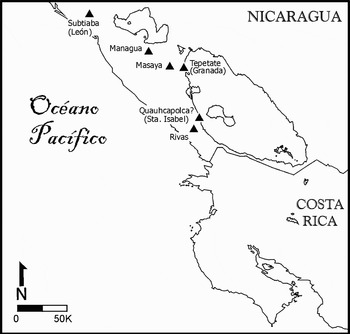
Our recent research focuses on the Greater Nicoya region of the southern Mesoamerican periphery (Figure 1). According to ethnohistorical sources, Nahuat-speaking immigrants known as the Nicarao settled on the Pacific coast of Nicaragua and northern Costa Rica, arriving in the final centuries before European contact (Oviedo y Valdés Reference Valdés and Gonzalo1976; Torquemada 1978–1983 [1615]; discussed in Abel-Vidor Reference Abel-Vidor and Benson1981; Fowler Reference Fowler1989; Healy Reference Healy1980; Lange Reference Lange1992–1993). Prior to that, an earlier migration of Oto-Manguean speakers, known as the Chorotega, occupied the region beginning in about a.d. 800. Thus, for the 700 years prior to the Spanish Conquest, Mesoamerican groups allegedly occupied the Greater Nicoya region (Fowler Reference Fowler1989). Historical sources even suggest that Cholula, in the central highlands of Mexico, was the point of origin for these migrant groups and, in fact, may be the root of the term “Chorotega.” The Colonial chronicler Gonzalo Fernández de Oviedo y Valdés (Reference Valdés and Gonzalo1976) described the fine clothing of the Nicaraguan natives, who used cotton and maguey fibers for their textiles, with the specific qualifier that the women “dressed like Mexicans.”
Map showing location of Santa Isabel in Greater Nicoya, prepared by Larry Steinbrenner.

Since 2000, archaeologists from the University of Calgary have explored the site of Santa Isabel, an Early Postclassic (Sapoa phase) center on the shore of Lake Nicaragua, investigating domestic life at Santa Isabel through the excavation of a variety of residential areas across the site (McCafferty Reference McCafferty2008). One surprising discovery was that the site was not Late Postclassic, as initially suspected based on the existing ceramic sequence. Instead, occupation spanned a.d. 900–1250 (McCafferty and Steinbrenner Reference McCafferty and Steinbrenner2005), more likely associating the Chorotega than the Nicarao with Santa Isabel, although other cultural elements suggest a more “native” Chibchan population. The research was designed to sample a range of archaeological house lots to approximate a demographic profile of the community. After four seasons of fieldwork, we have identified numerous house floors, cooking areas, and midden deposits, along with hundreds of thousands of artifacts. While the inference of Mesoamerican ethnicity remains problematic, we are developing an excellent database with which to discuss domestic life.
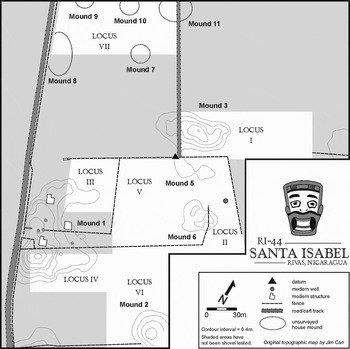
Previous work at Santa Isabel was directed by Gordon Willey and Albert Norweb in 1959 and 1961 and published by Paul Healy (Reference Healy1980). More recently, Karen Niemel (Reference Niemel2003) included the site in a regional settlement-pattern survey in which Santa Isabel was identified as the paramount center during the Postclassic period. In 2000, we conducted a brief season at Mound 3 (Locus 1) in the site center, with five stratigraphic pits. From 2003 through 2005, we continued at Mounds 1, 3, 5, 6, and 8 to open a total of 110 m2. Additionally, a 10 m grid of shovel tests provided contextual data over about 5 ha and served to identify promising excavation areas (Figure 2).
Santa Isabel site plan, prepared by Larry Steinbrenner.

Locus 1 consists of Mound 3, a low but extensive residential mound that featured the only evidence of a plaster floor, as well as objects of exotic material and craftsmanship. Locus 2 includes Mound 6, not previously identified by Willey's original investigation. It includes several superimposed floors of packed earth and remains of wattle-and-daub walls. Mound 1 (Locus 4) is the tallest mound sampled, about 3 m high, and is very large in area, although modern housing inhibits extensive exploration. Locus 5 was minimally tested but featured a cluster of shoe-pot urn burials and two extended burials of an adult male and child. Locus 7 features several low mounds, including Mound 8, where several excavation units were placed, and featured a hearth with charred jocote seeds.
As a result of these excavations, we have recovered a rich assemblage of domestic artifacts, including many objects related to spinning and weaving. This study will consider spindle whorls and bone tools.
SPINDLE WHORLS
Spindle whorls are one of the prominent artifact classes found in Postclassic Mesoamerica. A working assumption is that the dimensions and shape of whorls are related to their function as flywheels during the act of twisting raw fiber into thread (McCafferty and McCafferty Reference McCafferty and McCafferty2000). In an extensive study of approximately 1,000 whorls from the central Mexican site of Cholula, we have developed a methodology for measuring whorls, including diameter, height, shape (defined as the ratio of height to diameter), weight, and hole size. These different parameters result in a typology that has been used across cultures to infer the type of fiber spun and the spinning method employed (Beaudry-Corbett and McCafferty Reference Abel-Vidor and Benson2002; McCafferty and McCafferty Reference McCafferty and McCafferty2000).
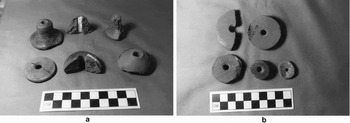
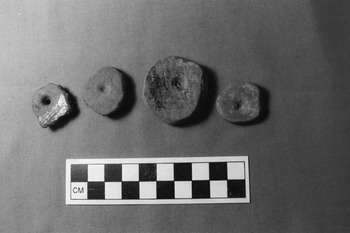
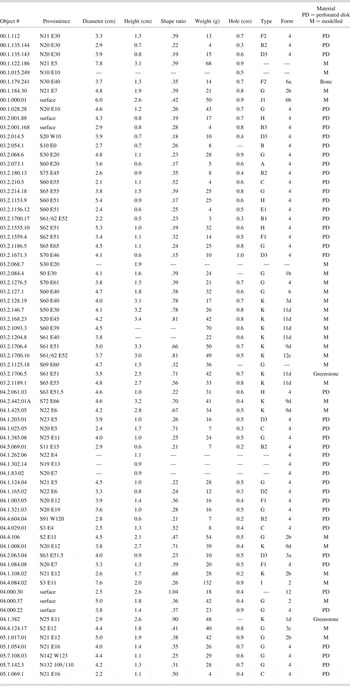
Seventy-three whorls have been recovered during the four field seasons, resulting in a density estimate of .45 per m2 of excavation (Table 1). The Santa Isabel materials included both perforated disks (n = 44 [60%]) and modeled whorls (n = 26 [36%]; Figure 3). Two additional whorls were made of greenstone, and a large bone whorl was recovered. The perforated disks were created by reworking a potsherd into a circular form by chipping, drilling, and then grinding the edges to a smooth finish. Numerous unfinished whorls were found showing stages in the production process, either with roughly chipped sides or incomplete drilling of the center hole (Figure 4). Other whorls were modeled from clay to the desired form and often slipped. No molds for spindle whorls were found, and the relative lack of evidence for ceramic production at the site suggests that the modeled whorls may have been produced elsewhere.
Santa Isabel spindle whorls.

Production sequence of perforated disc whorls.

Santa Isabel spindle whorls

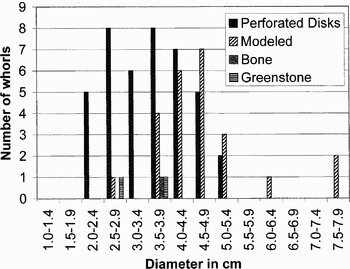
The diameter of the perforated worked sherd whorls ranged from 2.1 cm to 5.4 cm, with the greatest concentration between 2 cm and 4.9 cm. The modeled whorls, by contrast, were clustered between 3.5 cm and 5.4 cm in diameter, indicating that they were generally larger than the perforated disks (Figure 5). The greenstone whorls measured 2.9 cm and 3.5 cm in diameter, while the bone whorl measured 3.7 cm.
Graph of spindle whorl diameters.

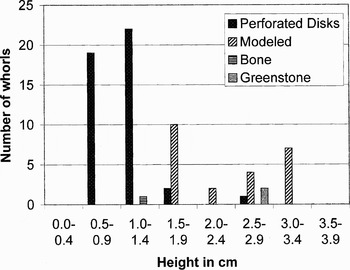
The perforated disk whorls were very consistent in their height measurement of between .5 cm and 1.4 cm—obviously limited by the thickness of the ceramic vessels from which they were modified (Figure 6). The modeled whorls ranged in height from 1.5 cm to 3.4 cm, with distinct concentrations between 1.5 cm and 1.9 cm and another between 2.5 cm and 3.4 cm. The heights of the greenstone whorls were 2.5 cm and 2.6 cm, while the bone whorl measured 1.3 cm in height.
Graph of spindle whorl heights.

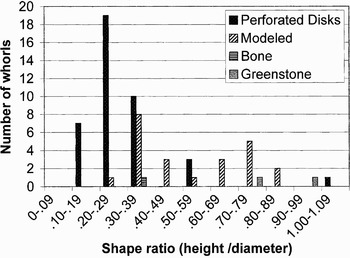
The perforated sherd disk whorls had a distinctively shallow shape (calculated as the height divided by diameter) of between .10 and .39, with the mean at a ratio of about .25 m (Figure 7). One perforated disk was made from a jar rim, with the greatest shape ratio of 1.04 m; it may, however, have been a bead rather than a whorl. The modeled whorls tended to be higher, with the strongest node at .30–.39, but with shape ratios continuing steadily to .80. Technical analysis indicates that a shallow whorl tends to produce a relatively slow rotation of the spindle, while a taller whorl spins faster but for a briefer period of time. The greenstone whorls had very high shape ratios of .90 and .71, indicating that they were used for specialized spinning. The bone whorl had a shape ratio of .35.
Graph of spindle whorl shape ratios.

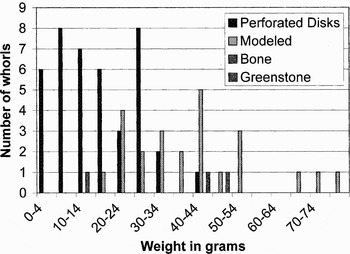
Weight was measured for all whorls; fragmentary whorls were estimated by dividing the percentage of the fragment into the existing weight. For example, if a whorl fragment weighed 2 g and was estimated to represent 40% of the original whorl, then 2 was divided by .4 to obtain a total of 5 g. Weights for the perforated sherd disks ranged from 3 g to 43 g, while the modeled whorls clustered between 20 g and 54 g, with outliers as high as 132 g (Figure 8). The greenstone whorls weighed 42 g and 48 g, while the bone whorl weighed only 14 g.
Graph of spindle whorl weights.

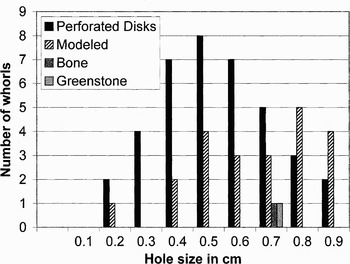
Hole size relates to the diameter of the spindle, so that the whorl can be snugly attached. Measurements were taken for both top and bottom holes, if available. The hole sizes varied from 2 mm to 10 mm, with most perforated sherd whorls' holes measuring between 4 mm and 7 mm, while the holes in modeled whorls varied from 5 mm to 9 mm (Figure 9).
Graph of spindle whorl hole sizes.

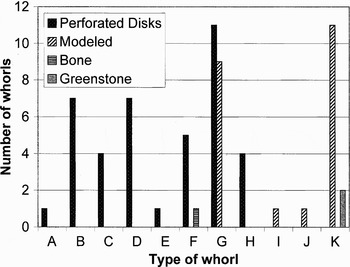
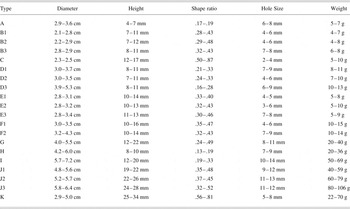
Taking all of these measurements into consideration, the Santa Isabel whorls can be related to a typology established from Cholula, Mexico, using the different variables discussed (McCafferty and McCafferty Reference McCafferty and McCafferty2000; Table 2). Perforated sherd disk whorls corresponded to numerous types, with the most common being types B, C, D, F, G, and H (Figure 10). Types B, C, and D are very lightweight and shallow and were likely used for supported spinning of short staple fibers such as cotton or feathers. Type G was also important as a modeled whorl and was the most abundant type overall. Type G has a medium weight and diameter, is medium to tall in height, has a medium to high shape ratio, and has a large hole; it is a versatile whorl for both supported and drop spinning to create a variety of thread qualities using a range of fiber types. The greatest number of modeled whorls did not correspond to an established type using the Cholula classification, so a new type, type K, was defined as having a medium diameter and weight, but ultra-high height and shape ratios.
Graph of spindle whorl types.

Spindle whorl typology

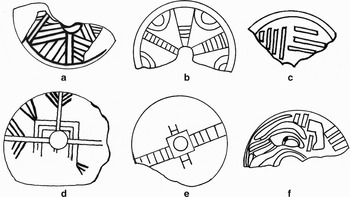
Both plain and polychrome sherds were used to fabricate the perforated worked sherd disk whorls, so decoration does not seem to have been a consideration. The modeled whorls were occasionally decorated with crude incising on the flat surface (Figure 11). Incised decorations included geometric patterns and circle motifs. Two whorls had a woven motif, identical to the Mixteca-Puebla stylistic representation for textiles (McCafferty and McCafferty Reference McCafferty, McCafferty, Robertson, Seibert, Fernandez and Zender2006). Another whorl fragment may depict the eye and upturned snout of a reptile. Others use a “ladder” motif to divide the whorl into quadripartite spaces.
Incised designs on modeled spindle whorls.

Three of the modeled whorls show wear marks on the edges, a possible indication that they were used in a spinning bowl. All three were of type K.
The most detailed discussion of spindle whorls from Nicaragua is found in Healy's analysis of Willey's materials excavated from the Rivas region (Healy Reference Healy1980:266–268). Only two modeled whorls were recovered, of which one was from Santa Isabel. They represent what would be types G and K, with the type G whorl featuring incised decoration on the flattened surface. In contrast, Healy identified 97 “perforated potsherd discs” and 20 “partially drilled potsherd discs.” While this ratio of modeled to reworked sherd whorls is considerably different from that identified in our analysis, it may be due in part to the inclusion of perforated disc pendants within the count, as suggested by Healy (Reference Healy1980:267). Perforated disc pendants are usually oval in shape, are somewhat larger than whorls, and may have one or two perforations near the edge for suspension. In our Santa Isabel analysis, perforated disc pendants were approximately 10 times more common than perforated disc whorls. However, even reducing the number of “perforated potsherd discs” by 90% still results in a disproportionate ratio of modeled to perforated sherd whorls, perhaps relating to the more regional database analyzed by Healy.
A rescue project at the Ometepe phase site of San Pedro Malacatoya, in the Granada district north of Santa Isabel, reports and illustrates six whorls from primary contexts such as burials and middens (Espinoza et al. Reference Espinoza Perez, Vasquez and Suganuma1999). Note that the name “Malacatoya” derives from the Nahuatl word “malacatl,” which means spindle whorl. No descriptions were reported for the whorls, but in the publication they appear to include both reworked sherds and modeled whorls. Incising was the main decorative element. Designs included woven motifs and quadripartite patterns similar to patterns found at Santa Isabel.
Spindle whorls have also been reported from the site of Papagayo, located just over 50 km south of Santa Isabel in Costa Rica (Baudez et al. Reference Baudez, Nathalie, Sophie and Valerie1992:254–255). Two modeled whorls were found, one with incised decoration around the central hole. Perforated sherd discs were also found, although Claude-François Baudez et al. did not consider them whorls because of their irregular shape. Interestingly, one of the illustrated discs has the same “textile” motif on the polychrome surface as found on some of the incised whorls from Santa Isabel and on polychrome figurines, where it likely represents a costume element.
Spindle whorls have also been excavated in Cihuatan, El Salvador, an Early Postclassic site associated with the Pipil, a group of Nahua immigrants (Fowler Reference Fowler1989). Twenty-nine whorls were found, both mold-made and modeled, and with mold-impressed designs and black paint (Kelley Reference Kelley1988). No measurements were reported.
Twelve ceramic whorls were recovered from the Classic-period site of Joya de Ceren, El Salvador, which ranged from 2.2 cm to 3 cm in diameter, from 1.2 cm to 2 cm in height, from 8.5 g to 18.3 g in weight, and with a hole diameter from 5 mm to 10 mm (Beaudry-Corbett and McCafferty Reference Beaudry-Corbett, McCafferty and Traci2002). “From the average measurements the Ceren whorls can be described as being of very small diameter, very light weight, and high with a consistently large hole size” (Beaudry-Corbett and McCafferty Reference Beaudry-Corbett, McCafferty and Traci2002:60). Marilyn Beaudry-Corbett and Sharisse McCafferty concluded that the Ceren whorls were consistent with cotton-spinning whorls, and, in fact, a cotton string was found attached to the skeleton of a duckling. A very lightweight whorl fabricated of coyol palm may indicate more specialized spinning, and a carbonized wooden spindle and bone needles rounded out the spinning-and-weaving tool kit. Carbonized remains of maguey plants suggest that maguey fiber may have also been available for spinning.
Since one of the hypotheses being tested in the Santa Isabel project relates to migration from central Mexico—and, specifically, the site of Cholula—a comparison with the Cholula whorls is appropriate. In comparison with Cholula spindle whorls, the Nicaraguan assemblage represents a far higher number of reworked sherd disks. Perforated sherds are occasionally present in Cholula assemblages, representing between 5% and 10% of all whorls. The great majority of whorls at Cholula are mold-made, with mold-impressed designs. This manufacturing technique is not found at Santa Isabel. The type K modeled whorls do not fit into any of the whorl types defined at Cholula, suggesting that a different material was being spun or that the thread was being used for a different purpose (such as fishing nets). These whorls correspond more closely to whorls from the Toluca area, known from the Codex Mendoza as an area that produced palma-fiber textiles for tribute (Berdan Reference Berdan, Berdan and Anawalt1992:1:99–100). The incised designs appear on the flattened area of the Santa Isabel modeled whorls, the same design field used on the Toluca whorls.
BONE TOOLS
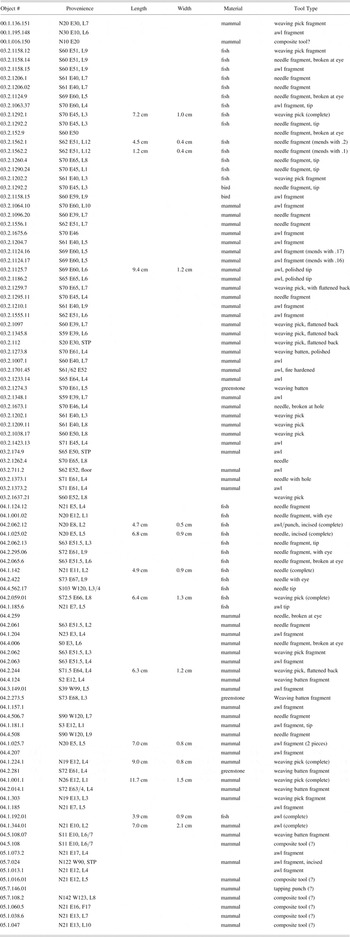
Exceptional conditions at Santa Isabel have preserved dozens of bone tools that cover a wide range of activities. This includes evidence for the manufacture of bone tools—for example, deer bones that were cut perpendicularly to produce tiny fish hooks (McCafferty Reference McCafferty2008). One hundred bone objects are interpreted as tools for textile production, including needles, small and medium-size awls, picks, and battens (Table 3). Bone weaving tools were made of fish, mammal, and bird bone.
Santa Isabel bone weaving tools

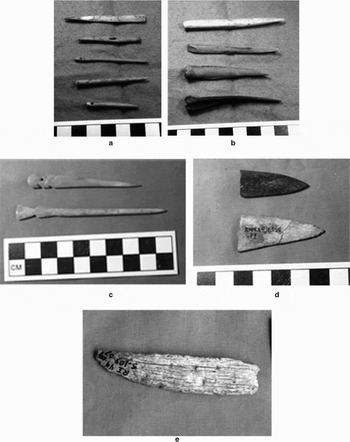
Needles are defined as having a small, cylindrical shaft that ranges from 2 mm to 6 mm in diameter (Figure 12). The complete needles ranged from 3.6 cm to 7.1 cm in length. Several included a complete eyelet. Small awls are defined as having a shaft diameter between 7 mm and 10 mm. Complete examples ranged from 5.7 cm to 8 cm in length, and none included an eyelet. Medium awls range in diameter from 1.1 mm to 1.6 mm. One complete example was recovered, which measured 9.4 cm in length. Needles and awls were highly polished and frequently heat-treated for added strength. Picks were generally flattened on one side and were used in weaving to lift the warp to create intricate patterns. They may also have been used as spacers for netted products. One pick measured 6.3 cm in length by 1.2 cm in width. Several fragments of bone battens were recovered. They are very flat and taper to a point. Although no complete battens were found, their sizes suggest that they were small and probably used to weave sashes or hair ribbons. Several fragments of greenstone battens were also found and were similar in size and form to the bone battens.
Bone weaving tools.

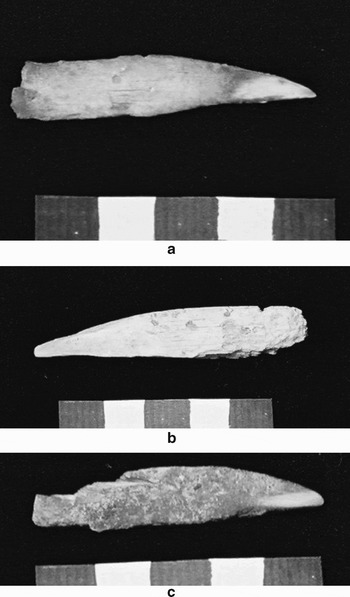
An unusual artifact class may be part of a composite tool, with a highly polished tip and a rectangular shaft (Figure 13). These artifacts have a uniform shape, but the distinctive polished tip looks like a tooth or claw. Evidence of a substance on the shaft may be remnants of glue, suggesting that the object was attached to a handle. We have tentatively identified these as another kind of awl, but until a better interpretation can be reached, this is simply called a composite tool.
Composite tools.

A final tool type, designated a punch, was made out of the scapula of a midsize mammal. One end was sharpened to a point, and the thicker bone allowed for the application of force. Two were found, with the complete example measuring 9.1 cm in length and 3.3 cm in width. Other punches were made from deer antler tines.
Bone tools are rare in the archaeological record, and we have not found detailed descriptions from other sites in Central America. In their ethnoarchaeological study of the Maya, Brian Hayden and Aubrey Cannon (Reference Hayden and Cannon1984) describe and illustrate some bone tools that may correspond to the medium awls, and they identify them as corn scrapers used to remove the kernels from the cob. If this association is correct, these may not be textile instruments at all. However, to date no evidence for maize has been found among the macro-botanical remains from Santa Isabel. More detailed research is needed to further evaluate the function of these artifacts.
DISCUSSION
The material culture of the Santa Isabel site includes a wide variety of artifact classes, including ceramic spindle whorls and bone tools. In part due to the exceptional preservation at the site, bone tools form a potentially important resource rarely found in pre-Columbian sites.
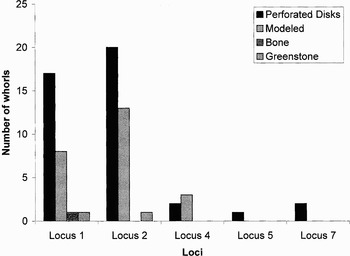
When plotted spatially, interesting patterns emerge. The 73 spindle whorls found were relatively evenly distributed among all site loci (Figure 14), proportional to the amount of excavated area. Further, 17 of the whorls were found in shovel test pits, and six were surface finds, so nearly one-third of the whorls came from outside the excavation areas. Locus 2 at Mound 6 had the greatest number of whorls but was also the site of the most intense excavation. Mound 3 (Locus 1) had the second-highest quantity and the second-highest amount of excavation. Similarly, there was no great distinction between areas with perforated disk whorls and modeled whorls, indicating no evidence for functional specialization in spinning technique or the quality of thread produced based on this distinction. Nine of 13 type K whorls were found at Locus 2, with the remainder at Locus 1, so some degree of specialization may exist if the type K whorls were used for a distinctive fiber type.
Distribution of spindle whorls by locus.

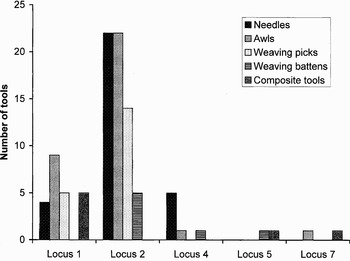
In contrast, bone tools were heavily localized, with Mound 6 (Locus 2) having the highest concentration of tools (Figure 15). It had 22 of 28 needles (79%), 24 of 37 awls (65%), 75% of all picks, and 100% of the battens. Mound 6 was clearly the center for textile production, while all mound areas participated in thread production.
Distribution of bone tools by locus.

In contrast, five of the seven composite tools (71%) were found at Mound 3 (Locus 1), while another was found in association with the adult burial of a possible lapidary from Mound 5. The dissimilarity in distribution pattern suggests that these composite tools were not part of the textile production tool kit and may have been used for some other specialized production.
Whorl types B, D, G, and K were the most common. Type B likely would have been used in supported spinning of short staple fibers such as cotton to produce thin, tightly spun thread, perhaps for warp threads or fishing nets. Type D would produce a softer and more loosely spun thread of short staple length such as cotton or feathers. While feathers do not spin well by themselves, when blended with cotton they produce a soft and brightly colored thread (McCafferty and McCafferty Reference McCafferty and McCafferty2000). Type G whorls are the most versatile of whorl types, useful for either drop or supported spinning, to produce a variety of twist qualities. The newly defined type K whorls do not correspond well to whorl types associated with spinning maguey, since they are lighter than maguey whorls from central Mexico (Nichols et al. Reference Nichols, McLaughlin and Benton2000; Parsons Reference Parsons, Parsons, Spence and Parsons1972). The possible association with whorl types from Toluca, perhaps used for yucca, is intriguing, but since yucca is a highland, arid-environment plant, it is probably not useful for identification of the fiber material. The morphological characteristics of type K whorls are suited for drop spinning of long stable fibers, so these whorls perhaps were used for a species of agave or a similar plant.
An unusual group of artifacts found at Santa Isabel are greenstone whorls and battens. The whorls correspond to functional types G and K, and polish on the battens may indicate use wear. However, the exotic material of these objects, including the additional labor needed to produce them, suggests that they may have been valuable objects, perhaps indicative of an elevated social status ascribed to spinners and weavers. While clear evidence of spinning and weaving as gendered activities has not been established for Postclassic Nicaragua, following a Mesoamerican model, it is likely that women were the primary producers of textiles (McCafferty and McCafferty Reference McCafferty, McCafferty, Schevill, Berlo and Dwyer1991). If these greenstone tools do indicate high status, this would correspond to ethnohistorical accounts that women held high social position among the Chorotega (Werner Reference Werner2000). Greenstone weaving battens are known from Costa Rica (Lange Reference Lange and Frederick1993:283–284, Figure 21.17a, b), including some with incised decoration reminiscent of the carved bone battens from Monte Alban's Tomb 7 (McCafferty and McCafferty Reference McCafferty and McCafferty1994).
While the analysis of the material culture from the Santa Isabel project is ongoing, the rich material record that has been recovered is providing some of the most detailed information yet found for domestic life in the Greater Nicoya area and, particularly, Nicaragua (McCafferty Reference McCafferty2008). In addition, we now have an opportunity to discuss Nicaraguan textile production at Santa Isabel and put it into a context for comparison with other sites in Central America and Mesoamerica.
RESUMEN
La vestimenta es una de las formas más importantes de la cultura material en contextos etnográficos. Sin embargo debido a su limitada preservación, los restos arqueológicos de tela son escasos en la mayoría de sitios explorados. De manera recurrente, los artefactos asociados a la producción textil encontrados en contextos arqueológicos incluyen malacates para hilar y utensilios de hueso tallado. Este artículo presenta los resultados del análisis de material en una muestra de malacates y utensilios de hueso del periodo postclásico temprano del sitio de Santa Isabel en Nicaragua. Las fuentes etnohistóricas identifican varios grupos culturales mesoamericanos en la región durante este periodo. El grupo lingüístico otomangue, llamado también chorotega, es probablemente el grupo cultural que ocupó el sitio de Santa Isabel, Nicaragua. Los textiles probablemente fueron hechos de algodón, entre otras fibras vegetales. Además de la producción textil para vestimenta, consideramos la posibilidad de la fabricación de hamacas y redes para pescar.
ACKNOWLEDGMENTS
Funding to support the Santa Isabel Project was provided by the Social Sciences and Humanities Research Council of Canada and the University of Calgary. Permission to conduct this research was granted by the Department of Cultural Patrimony, Managua, was exceptionally helpful throughout the project. Additional logistical support by the National Museum and the Rivas Museum of Anthropology and History was of tremendous help. Many people participated in the project as consultants, including Dr. Silvia Salgado (Universidad de Costa Rica), Jorge Zambrana (Universidad Nacional Autonóma de Nicaragua), and Dr. Karen Niemel. Sharisse McCafferty, and Larry Steinbrenner served as field and lab supervisors throughout the project, while Diana Carvajal, Ulises Chávez, Celise Chilcote, Jolene Debert, Ruth Edelstein, Deepika Fernández, Denise Gibson, Bryanne Hoar, Alyssa Lamb, Jenn Lapp, Angélica López-Forment Villa, Juan Bosco Moroney Ubeda, Marco Ortega, Oscar Pavón, Citlalli Reynoso Ramos, and Nora Zambrana assisted with field and lab projects. Many students from the Escuela Nacional de Antropología e Historia (Mexico), the Universidad Nacional Autónoma de Nicaragua, and the University of Calgary worked hard while gaining valuable field experience. Finally, thanks for the kindness and hard work (and mangos) of the community members of Tolesmaida and the warm hospitality of Johana and the staff at CIVITE (Centro Integral de la Vida y la Tecnología).