Hollywood is ruled by conventional wisdom—or, as it's known when it takes off its coat and tie, magical thinking. Certain factors, they say, make for a surefire hit; certain others mean you'll never make a buck. Some of the rules sound silly, but, really, why tempt fate? Listen to director Bill Condon as he slips one of these showbiz credos into a recent interview: “You know, they say for a great performance you need a great telephone scene.”Footnote 1 To the uninitiated, this may sound strange—surely an outlying tenet of the faith!—but Hollywood's belief in the “telephone scene” is curiously devout. And unlike other Tinseltown lore, with its murky past and fractured provenance, this tale of the telephone is easy to track to a single event nearly eighty years ago.
In 1937, Luise Rainer won an Oscar for her performance in MGM's lavish biopic The Great Ziegfeld. The role was smallish and had little to recommend her for such an honor. In fact, Louis B. Mayer nearly forbade her to accept the role at all. Too piddling a part, he scoffed, for his next Greta Garbo!Footnote 2 But whatever it lacked in size or substance, it made up for in one exquisite scene: a conversation by telephone.Footnote 3 As legend has it, not only did this two-minute scene clinch the Oscar for Rainer, it inexplicably won her the Best Actress Oscar for what was clearly a supporting role. In short, the telephone magnified her—first in the short-term memories of those who saw the film and then in the enduring lore of Hollywood.
Just search for the phrase “telephone scene” in the archive of any newspaper and you can watch the legend grow and change over time.
1953, Rome: Edmond O'Brien swallows his pride and accepts low billing for The Barefoot Contessa, but only after his director points out the parallels between O'Brien's predicament and Luise Rainer's.Footnote 4 Ten years later, O'Brien would confess with a sigh, “I had already read the script and I knew what that frantic telephone scene could do for me.”Footnote 5 Well, at least he won an Oscar for his troubles.
1963, Hollywood: Geraldine Page gets an Oscar nomination for Sweet Bird of Youth, thus fulfilling one commentator's prediction: “She does a telephone scene that has Academy Award written all over it.”Footnote 6
1974, Los Angeles: Valerie Perrine turns heads with her performance in the biopic Lenny. One journalist remarks, “When a lovely actress, with her face seemingly ravaged by drugs and liquor, starts sobbing into a telephone, it is time to start dusting off the gold statuette.”Footnote 7
The more examples I found, the more I was reminded of that old parlor game—the one where you whisper a message around the circle, then laugh at how much it changed as it went around. As those whispered messages go, so went this legend—turning weirdly specific and utterly vague by turns—until finally it arrived at the generalizations of Bill Condon and his ilk. By 2000, the phrase was a dead metaphor altogether, at least for one major studio executive: “You really get recognized” in Hollywood, he said, “if you have what's called the telephone scene, a big emotional scene that everybody remembers.”Footnote 8 And this is the most startling development of all: that, in the end, a “telephone scene” might have no telephone in it.
At this point, we could throw up our hands and simply laugh at what passes for wisdom in the movie biz, except for one inconvenient fact I haven't yet shared. The notion that telephone scenes are an actor's dream or that phones draw the very greatest performances from our actors didn't start with Luise Rainer. In fact, it predates The Great Ziegfeld by many years, and it emerged not in Hollywood, but in Paris, London, and New York—that is, in the theatre. Writing in 1923 about recent British theatre, Petre Mais mused, “Perhaps it is easier to act with a telephone than a man. I at any rate have never seen anyone fail to ‘get away’ with a telephone scene.”Footnote 9 American theatre critic George Jean Nathan concurred in 1928. There has never been an actor, he confidently declared, “who didn't seem completely convincing in a telephone scene. If I could figure out the reason, I'd write an essay on the subject.”Footnote 10 Both writers delivered these remarks not with a provocateur's wink and nudge but with the casual shrug of a man who knows you'll agree. A full decade before Hollywood found its faith in the phone, the theatre was already full of devotees.
Luise Rainer, for one, knew all this. By the time MGM put her on the big screen, she had long been a star of the stage. She had toured widely around Europe and read deeply in drama, so she knew what Mais and Nathan knew and what Louis B. Mayer did not. When she pled with Mayer for a crack at The Great Ziegfeld, she insisted she knew how to “do something with” that long scene on the telephone, and what she did, in the end, was make sure it resembled a play.Footnote 11 With her director's permission, she literally “rewrote [the scene], stealing a bit from Jean Cocteau's Beloved Voice [La Voix humaine (1930)],” a play made entirely of a single telephone call.Footnote 12 Variant drafts of the Great Ziegfeld script have not survived, so it's difficult to know just what Rainer took from Cocteau, but it's easy to see why this scene made her think of that play. Like La Voix humaine, her scene features a woman speaking to an ex-lover by phone. Like that play, this scene trains our attention entirely upon this woman; we neither see nor hear the man's side of the conversation.Footnote 13 And in both, there's a notable gap between what she says—especially about her own feelings—and what we, in the audience, suspect to be true. We feel we know (because we see) the truth, as the man on the line cannot. Imagining his limited perspective, even as we enjoy the fullness of our own, we marvel at the gap between voices and bodies, between language and the truth it conveys. La Voix humaine is a hit with scholars nowadays. In fact, it's frequently offered as a definitive statement on the telephone.Footnote 14 Eckart Voigts-Virchow, whose essay on stage telephony takes as its title a line from this play, gives strong voice to the party line on this subject: “The telephone conversation is the ideal way to expose a lie and discredit the illocutionary dimension of a speech act,” he says. “The telephone is an ideal medium to destabilize identities and initiate verbal role-playing.”Footnote 15 Cocteau was avant la lettre before it was cool.Footnote 16
It can be unsettling, then, to encounter early responses to this play—among which I count Luise Rainer's reuse of it. The Great Ziegfeld, you may be surprised to learn, does little to explode the West's metaphysics of presence. And while we may be wowed by La Voix humaine, with its ostensibly unsettling perspective on identity and mediation, most critics of the time were neither thrilled nor appalled. La bourgeoisie, I'm afraid, was not the least bit épatée. Instead, they nodded knowingly and filed their reviews: in a word, ho-hum! “Theatrically, the piece is a very ingenious monologue,” wrote one critic for The New York Times, “but, after all, the various devices by which an author can suggest to an audience what the character before them is supposed to be hearing have all been used before.”Footnote 17 From this critic's perspective, La Voix humaine was simply continuing a tradition—by then, already half a century old—of putting a telephone where you might otherwise need a scene partner. Cocteau acknowledged as much in his preface to the play. In writing this play, he limited himself strictly to the most mundane materials: the theme of “love and that banal property of modern plays, the telephone.”Footnote 18 In other words, La Voix humaine wasn't avant-anything. It was normcore.
In this essay, I tell the history of the stage telephone, from its fresh-faced theatrical debut in the late nineteenth century to its Oscar-clinching role in The Great Ziegfeld. Although I begin with tales of how the telephone first stole the spotlight, my true interest lies in what happens when it fades into the background—when it has so sedimented itself into the mainstream of performance that its effects go unnoticed or are attributed to something else altogether.Footnote 19 This something else, evidently, is most often an actor's performance. How else can we explain the critical consensus—first in theatre, then in film—that the mere presence of a telephone guarantees that great acting will occur? Since the effects I'm highlighting are, above all, mundane and pervasive, I will not let classic stage telephones steal the scene. Instead, I will insist that they share the boards with their more forgettable contemporaries. I do this in the spirit of what Franco Moretti calls “distant reading”—pushing beyond the familiar canon and into a greater totality of culture.Footnote 20 Something remarkable lies concealed in this shared banality, in these routine thrills.
As I look for a solution to this mystery of the telephone's power, I may at times seem to echo the common refrain that telephones deconstruct or destabilize the apparent simplicity of an actor's presence. In fact, I want to turn this argument on its head. Far from demystifying stage presence or unsettling the ideal of coherent character, the telephone played a crucial role in mystifying these things in the first place. With the telephone's help, actors discovered a new approach to their craft. They learned to signify invisible realities, to be varied yet coherent characters, to be present onstage “subconsciously,” as one actress would put it. In other words, telephones were the training wheels that steadied their first wobbly attempts at realism. If this is true, then it's no wonder critics found actors “completely convincing” on the telephone: after all, this device had helped create what we call “convincing” in the first place.
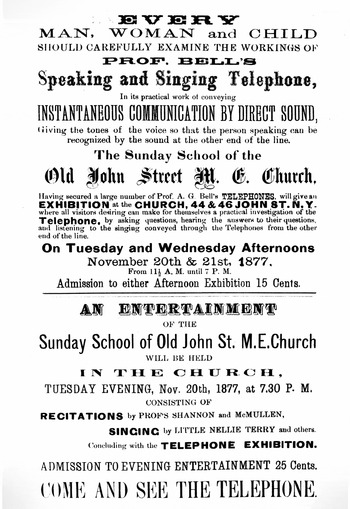
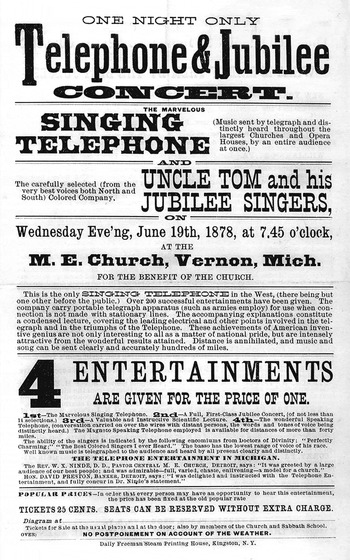
Critics' darling, matinee idol, star of stage and screen: what more could a young technology desire? But it hadn't always been this way. Like many an actor before and since, the phone worked its way up painstakingly, from sideshow to legitimate theatre and from thankless cameos to the roles that define a career. In Figures 1 and 2, you see two pamphlets from those earliest days: the first announcing an appearance at a New York church by “Prof. Bell's Speaking and Singing Telephone,” the other revealing that “The Marvelous Singing Telephone” will open for some jubilee singers in the Midwest. These were cheap and wholesome entertainments. There wasn't any future in them.Footnote 21
An 1877 handbill advertises a performance by “Prof. Bell's Speaking and Singing Telephone.” Courtesy of AT&T Archives and History Center.

An 1878 leaflet announces that “The Marvelous Singing Telephone” will open for a group of jubilee singers. Source: Advertising leaflet published by the Daily Freeman (Kingston, NY), 1878.

We know that the phone then moved into the popular theatre, but this phase of its career is rather thinly attested. Presumably, it cut its teeth on parts once played by the telegraph (e.g., having its wires cut by the villain and patched by the hero)Footnote 22 and those ancient roles once played by the messenger (going off for help, coming back with news)Footnote 23—but it was awfully hard to break out of those old lines of business. Rather than use the telephone for novel effects, most playwrights simply spruced up the old tried and true. Is eavesdropping getting a bit threadbare as a plot point? Then why not tap a telephone?Footnote 24 Does the ticking telegraph send your audience into throes of suspense? Then how much more will they quiver when the telephone rings onstage?Footnote 25 This was, in essence, the telephone's role in most comedy: whether stressing out stage clowns, exposing adulterers, or enabling meddlesome schemers, the phone was just one more squirt of nitro in the engine of farce.
The first opportunities the phone had to originate roles came in burlesque, vaudeville, and low comedy. It had a knack, it turned out, for playing the implacable straight man, so it quickly won esteem by mocking hotheads and ethnic outsiders. In 1880, for instance, the telephone got big laughs for making a fool of the title character in Our German Senator.Footnote 26 No script of the play survives, but it surely resembled later bits that mocked Swedish secretaries, old cranks, Jewish tenants, and “suburban ‘simp[s]’” for their failure to use the telephone properly.Footnote 27 Time and again, we find, these characters are too stupid to use the phone and too alien to be understood once they figure it out. Far juicier roles came the telephone's way in the more romantic sort of comedy: as a rival in love or a yenta for wire-crossed lovers. Take as an early example the 1893 one-act Per Telephone, the first of many plays to pose the exact same sexist joke: a woman is so busy gabbing on the telephone, she never realizes that the man right in front of her is trying to propose.Footnote 28 As in all of these comedies (the most famous being Menotti's operetta The Telephone), the man discovers a way to win his phone-addled sweetheart's attention. He leaves the room, of course, and rings her up.
It's against this backdrop of tired roles and frantic gags that a classic of telephone drama first appeared, André de Lorde's Grand Guignol thriller Au téléphone (1901). I call it a classic not merely because the phone was central to its plot (and its title)—one could say as much, after all, for Per Telephone—but because in this play, for the very first time, theatre and telephony transformed one other. In short, the telephone extended what theatre could do, while the theatre strained at the limits of real-world telephony.
The play's plot is simple and vivid. Scene 1: the wind howls and the rain pours down as André Marex prepares to leave his wife, Martha, and their child. He has business to conduct in Paris, and although his country house is isolated and the region a bit unsavory, he leaves with confidence, knowing that a male servant will stay with them, that a loaded revolver is at the ready, and that their newly installed telephone will keep them all in touch. As he leaves, he promises to call from a friend's house along the way. As the night wears on, though, strange things begin to happen. A tramp arrives with a letter that calls Blaise, the male servant, away. As Martha and her maid await his return, strange noises outside begin to spook them, and to assuage their mounting fears they call André. As the curtain falls, they wait anxiously for the call to go through. Scene 2: the curtain rises on another house, where a telephone is ringing. It's Martha Marex on the line, and, as luck would have it, André has just arrived. He calms her fears, but as soon as he has, events take a dire turn. The women hear new “noises—steps—creakings” just outside their door. Danger seems imminent; the revolver is missing; the shutters rattle and crack. André begs them to run, but it's already too late: they are raped and killed as he listens in impotent terror. “Help!—Murder!—Murder!—Help!” he cries, and he “continues to scream as the curtain falls” one last time.Footnote 29
The French public was thrilled—and so was the American telephone industry. Most scholars who have written about this play argue that Au téléphone makes a mockery of technological man—that it destroys, in the person of André Marex, our smug confidence in such toys.Footnote 30 The industry's unbridled enthusiasm, though, should point us in another direction. In The American Telephone Journal, for instance, amid articles with titles like “Something about Repeating Coils” and “Telephone Finance: An Illustration from Wisconsin,” you can find breathless reports on the Paris premiere of Au téléphone.Footnote 31 When, two months later, the play hit the stages of London in an English translation, these US telephone industry insiders could barely contain their excitement:
Presumably after this London success the telephone drama will very shortly make its appearance on these shores. So far the telephone has only been shown on the stage as a vehicle for very inferior comic opera or burlesque, or merely as a more or less badly carried-out detail … of some broker's or merchant's office. As the keynote of a stirring drama it will be quite a novelty.Footnote 32
In a cynical mood, I'd feel compelled to point out that they had their reasons for feeling pleased. American phone companies were, at precisely this moment, making their first big push into rural markets, and home security, naturally, was a key talking point for salesmen.Footnote 33 (Consider the Bell ad in Figure 3 from a few years later, which basically follows the plot of Au téléphone—except that rape and murder have slipped between the lines.) But let's fend off this easy cynicism and consider why else industry officials might have thrilled at this play.
This 1910 advertisement for the Bell Telephone System asks rural folks to imagine a moment when they might have “a real vital need for” a telephone—for instance, when a mother is alone at home or when a husband is far away on business. Source: Theatre Magazine 10.105 (November 1910), ix.

During the telephone's apprenticeship in the theatre, its earliest job was to perform communication failure. Au téléphone, by contrast, presents an almost science fiction vision of the telephone's incredible powers. As our trade-journal reviewer is quick to point out, the short story that lent Au téléphone its plot “paid a wholly undeserved compliment to the French long-distance telephone service, for the clearness with which the husband in Paris heard everything that was going on in … the suburbs of Marseille.”Footnote 34 De Lorde did shorten the distance of the call, this reviewer approvingly notes, by setting scene 2 not in Paris but a mere carriage ride away. But this telephone remains, for all that, an astonishing machine. As André soothes his wife over the phone, for instance, he can't help but enthuse over its clarity:
Don't you think it's wonderful? You are close to me—I hear the slightest inflection in your voice—almost every movement—can very nearly see you—yes, I see you, little wife.Footnote 35
The em-dashes here don't just break up his speech; they deliberately fragment his meaning. A “movement,” of course, you might hear, see, or feel, but André's grammar leaves us guessing just which he has done.Footnote 36 This ambiguity quickly gives way to outright synesthesia: “I see you,” he says, with no “virtually,” “practically,” or “as if” to qualify the claim. In the very next line, he nearly touches her, too. As he makes kissing noises at his wife through the phone, his blushing friends exclaim,
Rivoire: If we had not been here—
Madame Rivoire: To what lengths might they not have gone! (398)
De Lorde's title character, then, is no mere telephone: it has televisual, nearly teletactile powers. How's that for an “undeserved compliment” to French telephony?
If de Lorde's audience does come to accept this phone's extraordinary powers, it's because he methodically trains them into this belief. The whole play takes place in the chamber of an ear as miraculous as the phone gives André. The dark and stormy night, for instance, is not merely a horror cliché; it's also an excuse for the sound-effects man to empty his bag of tricks.Footnote 37 But even amid such clamor, de Lorde persuades us to hear—or to think we hear—faint noises impossibly well (384). The play's very first line sets the pattern de Lorde will follow:
André: (stopping and listening) Is that the carriage? (383)
We in the audience immediately crane our necks forward to see what we can hear, and this straining to hear becomes the play's chief activity—onstage and among the audience.
The true star of scene 1, then, and perhaps the telephone's true costar, is a character I haven't yet bothered to name: Nanette, the female servant who is always standing by Martha's side. This early exchange, as they await André's carriage or “fly,” sets the tone for the women's interactions.
Nanette: (listening) I hear wheels.
Martha: Yes, it's the fly this time (A noise of hail heard.)
Nanette: It's coming through the wood. (386)
Not only has Nanette heard—through wind, rain, and woods—the faint sound of clattering wheels, she has also, by merely saying so, caused Martha to hear it too and to supply the inevitable interpretation: the carriage will soon arrive. Later, as the women's fears mount, this will happen again and again—except that as the sounds Nanette hears point to ever-more-unthinkable conclusions, Martha takes longer and longer to admit that she hears them and to supply their horrible meaning.
Nanette: (Stops suddenly.) Madame, what's that? Don't you hear—?
Martha: What? Again?
Nanette: Someone whistling.
Martha: (dryly) No, nothing; it's the wind howling. (Nanette takes up her knitting.) Did you pay the laundress?
Nanette: (rises, puts her knitting on the arm-chair, and crosses to the door.) There, again! That's not the wind. Don't you hear it?
Martha: (going to her—listening.) The dogs—they're growling. Well? […] They often bark like that. You are too absurd!
Nanette: Not like that. They're rushing about.
Martha: (listens—beginning to get nervous) Yes.
Nanette: Ah, Madame, they're coming nearer—they are chasing someone—they are quite close; now they're further off. Ah, the footsteps are coming nearer! I hear them on the gravel.
Martha: Nanette! Nanette! (393)
Imagine the vortex of aural attention around Nanette; feel it grow stronger over the course of this scene. Watch it pull Martha in and push her around as she nears her breaking point. And then feel how de Lorde unleashes this force, at last, on the audience. As flies to wanton boys are we to de Lorde! There's no reason, after all, for the sounds to come close, then go farther away, then draw nearer once more—no reason, that is, but to make us feel helpless as Nanette's grip tightens around our minds. She brings a phantom world to life for us, something just beyond that door; she pulls us out, then in, then out of the obscured middle distance. And the very moment de Lorde makes us feel this imaginary momentum, he's ripped a tiny hole in the fabric of theatrical space. With those final, frantic repetitions of her name, Nanette has won. Martha is now in her thrall, as surely as the telephone will enthrall André.
When, in the second scene, the telephone gives Nanette-like ears to the otherwise feckless André, the phone takes over her role and is invested with her powers—or better yet, it casts André as his own Nanette, both vortex and victim simultaneously. As the first scene taught us to do, we sign our senses over to André, and with the help of the phone, he repays us in phantom action. “It's cracking! Being forced! Impossible! The shutters are solid,” he shouts on a static stage (400). We're on the edge of our seats, peering into this invisible world, but just as we lean out furthest over the abyss, André blows us back into our seats with “a piercing cry” (401). Michel Chion once insisted that certain films are entirely designed to unleash a single scream. In the theatre, the same could be said of the Grand Guignol.
Nothing is spared in order to reach the screaming point. Twenty-story gorillas are invented, a thousand-foot-tall building is set ablaze, deluges of fireworks, symphony orchestras, the most ingenious and sophisticated details of production. … For, in these films, at a certain moment, all disparate plot lines converge and break at … the woman's scream.Footnote 38
Except in this case, de Lorde denies us the woman's scream. What we get is André's “piercing cry” instead. Reading this scene, however, I can't help feeling that somehow her scream has just issued from his mouth. The very next thing he says is, “Oh! who was that who screamed!” (401). No doubt this is a delayed response to whatever he just heard on the telephone, but it's also his horrified reaction to his own uncontrollable voice.
Is a woman's scream so powerful a thing that it transcends all mediation? Has André been so absorbed by the scene he overhears that he becomes a flesh-and-bones amplifier of it? Or is something still more uncanny happening here? The more I mull over this scene's climactic scream, the less I can banish these words of Yeats from my mind,
In Yeats's play, it's a goddess who has possessed this woman, making her suddenly screech like a hawk. André, too, is possessed; he shivers with a terrible life. Whose? Well, if a human actor can perform in a mask, why shouldn't the telephone wear André Marex's face?
At long last, here is a play that seems to justify the praise we've heard heaped on the telephone scene. With the telephone putting a vivid reality just beyond our reach, the actor has the flattering task of bringing it near. And because we depend on him utterly—since we need his every word, his every twitch to mean so much, we may surprise even ourselves with the attention we pay to his performance. In the end, we may lose all ability to distinguish between our need and his skill, crediting his performance for the lushness of our own dark imaginings. In a play like this, the depths of which are so teasingly withheld, what actor alive could fail to seem profound?
But there's a problem with concluding too much on the basis of a play like this. Like La Voix humaine, this is an exceptional play, and what our critics proposed was, instead, a general rule. Even controlling for glibness or hyperbole, one thing is clear from Mais's and Nathan's remarks: they are thinking of scenes far more common, less extraordinary than what we saw in Au téléphone. If we want to solve this mystery, we need to adjust our habits of mind. Refusing to limit ourselves to the trailblazing or the exquisite, we must attend to the mass of unremarkable plays. Fortunately, these have never been in short supply—least of all in the opening decades of the twentieth century.
One sociologist has claimed that “few Americans found the telephone dramatic beyond about 1910.”Footnote 40 At precisely that moment, when the phone grew less “dramatic” it was suddenly everywhere in drama. And precisely because it was always onstage its presence was scarcely noticed at all. Only its rare absence from the stage was worthy of comment. One American critic, reviewing the now-forgotten Avery Hopwood play Sadie Love (1915), joked that “its manuscript should be placed under a glass case in some world-famed museum as being the only telephone-proof modern play in existence.”Footnote 41 The next year, a writer for Puck cracked a similar joke: “Are there any novel features in this play of yours?” a producer asks. Well, the playwright replies, “there isn't a telephone scene … in the entire show.” “That's enough,” says the producer, “… I've been waiting all season for something that offered a startling innovation.”Footnote 42 But my favorite evidence of the telephone's overexposure is this anonymous poem first published in the Evening World in 1916, then eagerly reprinted in the trade journal The Telephone Review:
From its 1901 debut as “the keynote of a stirring drama,” the phone had fallen already to the status of a playwright's cheat—a way of dodging the difficulties involved in establishing a plot, then moving it along.
Nowhere does this critique land harder than in J. M. Barrie's A Slice of Life (1910), a hilarious parody of contemporary drama written as a curtain-raiser for John and Ethel Barrymore. As the play begins, a maid enters and goes straight to the phone: “Are you there? No, it does not matter who you are … I want you to ask me who I am.” With the help of this nobody-in-particular, she sets the scene in no time flat. The next character to enter makes another beeline for the phone: “Is that you, Mama? I am Mrs Hyphen-Brown—your daughter—do you remember?” To judge from the speech that follows, her mother remembered practically nothing about her. But Barrie's satire cuts deepest when Mr. Hyphen-Brown enters and by mistake speaks into the “tassel of [the] curtain.”Footnote 44 What does the phone itself matter, after all, to the playwrights whom Barrie is mocking in this play? If they value it only as a shortcut past the stern demands of dramaturgy, then they might as well address their plays to the draperies.
Even playwrights who used the phone a bit more wisely felt defensive against this (evidently common) line of attack. One British playwright, for instance, basically apologized in the opening stage direction of his 1922 play: “Close to the desk, on a little table, the inevitable telephone,” he writes. Sure enough, the play then begins with three pages of telephone calls.Footnote 45 Even George Jean Nathan, champion of the telephone scene, had to acknowledge the absurd cliché to which it had devolved. In his 1933 book parodying recent popular theatre, Nathan listed among the achievements of the modern stage “the farce in which an ingénue … reaches to pick up the … receiver and picks up a banana instead,” the melodrama where the heroine “nervously jiggl[es] the telephone hook in a desperate effort to get the District Attorney's office,” and “One-character plays in which, instead of presenting the venerable scenes between the mistress and her keeper, … the author causes his lone actress to conduct them over the telephone, occasionally varying the procedure by having her tell what happened either to her pet dog or French doll… .”Footnote 46 (Note that this last entry begins as an obvious send-up of Cocteau's La Voix humaine, which had premiered three years earlier—a helpful reminder of that play's ostentatious normality.) Comedy! Suspense! Startling revelation! Even Nathan can tell how thin this all is wearing.
Critics nonetheless insist that within these writerly ruts there is fertile ground for actors. For instance, Petre Mais's celebration of telephone scenes comes amid his lukewarm review of a justly forgotten play, Clemence Dane's A Bill of Divorcement. On its surface, this play's brief telephone scene is wholly unprepossessing. If you didn't happen to be obsessed with telephones onstage, you'd surely skim right past it. Sure, the content of the call packs a melodramatic punch—on the morning of her mother's remarriage, the speaker's father has escaped from an asylum where he's been held against his will for ten years—but the call itself is notable for just how little its words evoke.
Sydney: [She takes off the receiver] Hullo! Hullo! … Yes … Yes … Yes … [To her aunt] It's a trunk call.
Miss Fairfield: Who on earth—?
Sydney: Yes … Hullo! … Yes … Mrs. Fairfield's out. Shall I take a message? … This is Miss Fairfield speaking … All right. I'll hold on … [To her aunt] Auntie, it's from Bedford. It's about Father. [Into the telephone] Yes … This is Miss Fairfield speaking … What? … Good Lord!
Miss Fairfield: Sydney, don't say “Good Lord!”
Sydney: But you should have let Mrs. Fairfield know! … Only this morning? Oh, I see … No, we've heard nothing. When did you find out? … What makes you—? I see … No, he's not here … Of course we'd let you know … Then you'll let us know at once if anything … yes … Miss Fairfield. Mrs. Fairfield is going away very soon … Thank you … Good-bye.
[Sydneyhangs up the receiver and turns around]
Miss Fairfield: Well?
Sydney: Father's got away.Footnote 47
Mais calls this telephone scene “certainly one of the best,” but it's difficult at first to understand precisely why. The playwright seems to relish whatever is least substantial in the scenario. Her faithful adherence to the long protocols involved in connecting a long-distance “trunk call,” all those yes's and I see's and ellipses that pepper Sydney's speech, all the half-revealing (but still inscrutable) remarks that fill the body of the call make for a stubbornly unrevealing scene. But to quote Jean Cocteau's proud assessment of La Voix humaine, perhaps there's some value in this text being “unreadable”: its very thinness makes it an excellent “pretext for an actress.”Footnote 48 In fact, this speech was written with a particular actress in mind—one whose special skill was to perform what Dane left unwritten. Meggie Albanesi was renowned in London for her “repose and depth” onstage.Footnote 49 “Silence louder than tumult,” one poem about Albanesi begins, before meditating upon “the secret of [her] vast restraint.”Footnote 50 A scene at the phone—yes, the thinner the better—was just the thing to showcase such skills.
The deeper I press into the history of the telephone scene, the more I confront this explanation for their appeal. No matter how well or how poorly they may have been written, these scenes are ripe with the pleasures we take in realist acting: talk foregrounded, action deferred, reaction and interaction privileged, depths withheld, the sources of behavior rendered unconscious or automatic. Indeed, it seems like more than a coincidence (though less-than-direct causation) that the telephone and realist acting emerged together.
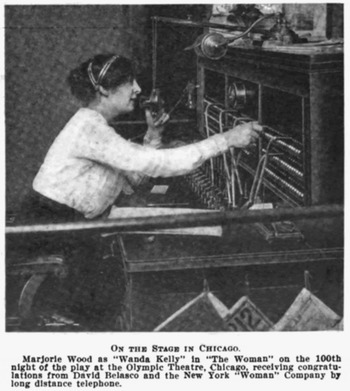
Oh, perhaps it's not a bridge too far to say that the telephone caused realist acting. One actress, at least—Marjorie Wood—claimed to have learned from the phone a new way of being onstage, a mode of performance we'd surely want to label realist. She was playing Wanda Kelly, the lead role in David Belasco's production of William C. deMille's The Woman (1911), which happened to be the role of a telephone operator, when she got this note from Belasco at an early rehearsal: “You are the telephone girl to the life, only you will have to learn how to listen.”Footnote 51 So she did. As she reports in an article about the experience, she began to visit the central exchange each morning before rehearsals:
I studied the expression of their eyes, nostrils and above everything else of their mouths and chins … and little by little I began to observe that the girl who made her living at the switchboard listens in a way which, while it is alert and spirited in one sense, is at the same time mechanical in another. In other words, she listens subconsciously, automatically. … The times in the first act when I just sit there like a “bump” on a log … it was agony until I had learned to do it “subconsciously.”Footnote 52
She finally arrived at this “subconscious” state with the help of a Belasco trick. He “had the telephone I used in the play connected with the switchboard in the Belasco offices upstairs. … This obviated the effects on the ear of the ‘dead’ telephone because you know there's all the difference in the world between the feel of … an open wire … and a merely dead and unattached instrument.”Footnote 53 A live wire zaps the actor's interiority to life.
Whether as a metaphor or a practical experience, telephony had helped Marjorie Wood achieve a deep state of reactive presence to the world onstage—the very state most valued (in different guises) by every realist acting theory to come.Footnote 54 And she wouldn't be the last to take a telephonic shortcut to this state, either. Consider Uta Hagen, whose influential Respect for Acting (1973) recommends the telephone as a tool for building the “fourth wall” of the realist stage. “Watch yourself for a few days every time you are at home at your phone,” she instructs her readers, in order “to see where your outer, secondary focus goes while your inner attention seems to be given totally to the content of the phone call.”Footnote 55 This sphere of soft, “secondary” focus, she says, is the stage world, and it will replace your debilitating awareness of your audience. You'll be “relieved,” she swears, of the “burden of audience intrusion.”Footnote 56 In fact, they'll intrude further, but you'll no longer feel a thing.
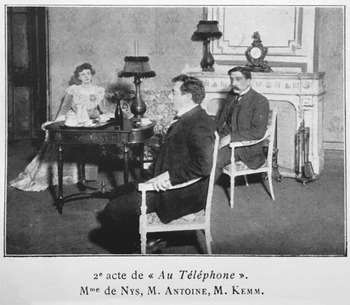
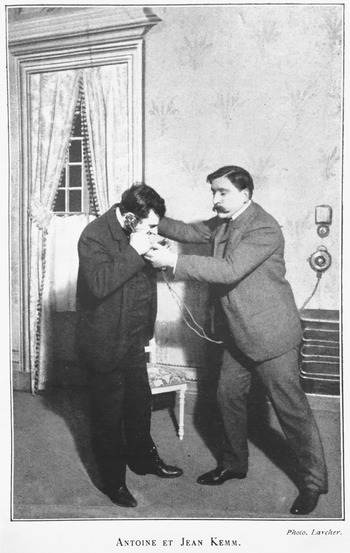
How fitting, then, that the man who originated the role of André in de Lorde's Au téléphone was the world's first master builder of “fourth walls”: iconic naturalist actor André Antoine (Figs. 4 and 5). “Naturalist” might seem a strange term to attach to the Grand Guignol and “realist” likewise, but when de Lorde gave up the gore and turned to the telephone, this was the style his theatre began to cultivate. Not only there, but throughout popular performance culture in the West, a new consensus in acting was emerging under the sign of realism. To emphasize the breadth and demonstrate the range of what I mean by “realist acting,” I want to end by comparing Au téléphone to two American plays, each as distant from the Grand Guignol in genre as in geography. The first will show how compatible Au téléphone might be with emerging ideas of realist character; the second will demonstrate that the broad-based consensus I'm calling “realist” extends beyond any narrow definition of that term.
André Antoine, in the role of André Marex, builds a fourth wall by striking one of his famous audience-spurning poses. Source: De Lorde and Foley, Au téléphone (Paris: Tallandier, 1910), 49.

Monsieur Rivoire (Jean Kemm) tries to rip the telephone away from a horrified André Marex (Antoine) late in scene 2. Source: De Lorde and Foley, Au téléphone (Paris: Tallandier, 1910), 61.

Comparison 1: The brief telephone scene in the first quote below, from James Herne's play Margaret Fleming (1890), generally considered the first example of Ibsenite realism on the American stage, precisely matches the telephone scene in the second quote, from one of Au téléphone's least spectacular passages.
Philip: (The telephone rings.) Excuse me, doctor. Hello. Oh, is that you, Margaret? How is Lucy now? Good! I knew she'd be all right. Yes, of course. Do bring her. (To the Doctor) She's bringing baby to the 'phone. Hello, Lucy. Many happy returns of the day. Good-bye. Yes, I'll be home at twelve sharp. Apple pie? Yes, of course, I like it. That is, your apple pie. (He leaves the phone with a joyous air.)Footnote 57
André: Has he gone to bed? No? You're waiting for Blaise?—That will be better—Ah!—he's asleep—the bell woke him up. Bring him and let him say good-night to me.—Good-night my pet, were you asleep? If you have been very good when I go back (Turns to the Rivoires, laughing.) He doesn't know how to hold the receiver. (Into the telephone.) Tell him he shall perhaps have his little sister. I have been thinking it over, I think I can promise him one—(Laughs.)Footnote 58
Both passages show us, for a moment, the man of business as a family man. Both stage a conversation with wife, then child, then wife again, evoking the clamor of domestic life. Both go out of their way to give us a sampler-ready image of pure patriarchal bliss: de Lorde ends with intimations of motherhood, Herne sees that and raises him “apple pie.” And the light comedy in each—Philip's ironic formality with his uncomprehending daughter, André's delighted reaction when his toddler can't use the phone—is meant to draw from the audience a single, climactic sound. To paraphrase Michel Chion, all plot lines converge and break at the sound of an audience going Aww! But in each case, this reaction gives way quickly to shock. You already know where de Lorde is heading next. (A few sentences later he takes another step that way: “What's the matter? Nanette hears something else?” [397].) Likewise, in Margaret Fleming, the very next line will expose Philip as an adulterer with a bastard child. What the telephone accomplishes, then, in both of these cases, is to vividly sketch what the playwright aims soon to destroy. These are the writerly uses of these scenes, but there are actorly ones as well. By bringing a vivid elsewhere onstage for a moment, the phone permits the actor to unleash other sides of his character. He might usually do this laterally, from scene to scene. Now they nest inside each other like matryoshka dolls: the indulgent father, the teasing husband lie latent in the tense businessman. All the variety inherent in a realist understanding of character—psychologically deep and socially contingent—is played here in polyphonic counterpoint.
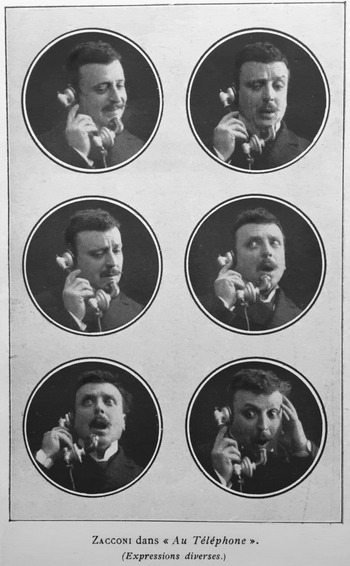
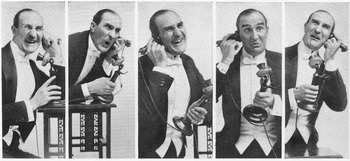
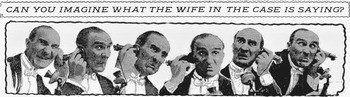
Comparison 2: Proust once wondered why no artist “had yet painted … [a] scene … entitled ‘At the Telephone’ [i.e., Au téléphone] in which there would come spontaneously to the lips of the listener a smile all the more genuine in that it is unconscious of being observed.”Footnote 59 This is the other main pleasure—adjacent to realist acting—that Au téléphone (and other telephone scenes) supplied. In Figure 6, you see collectible images of the first Italian actor to play Marex, Ermete Zacconi. The mere existence of such images suggests that when audiences delighted in telephone scenes, they were enjoying the play of expression on a listener's face. A telling comparison, just because it shares so little else with de Lorde's play, are these images of an actor from a minor Victor Herbert musical comedy, The Only Girl (1914) (Figs. 7 and 8). “The main business of the telephone,” generalized one American journalist, “is to call into play, on the mobile face of the actor, every emotion which the exigencies of the plot or the delight of the audience may demand.”Footnote 60 And this, perhaps, is the only thing Antoine the Frenchman or Zacconi the Italian ever shared with Scottish comedian Ernest Torrence: his “face is so versatile,” wrote one critic of Torrence, “that it can suggest an entire situation and express any emotion without even moving.”Footnote 61 The phone, then, was something like a bridge from melodrama to realism—from burlesque comedy to legitimate drama. The world offstage and the world inside became inseparable when the phone was at hand. The reach of one was taken to portend the depth of the other. Thus, the phone gave audiences all the depthless detail of melodrama's revealing starts and asides, now layered over something else, something happening on a separate plane. As Cocteau wrote in his preface to La Voix humaine, scenes on the phone give the actor “the chance to play two parts: one when she speaks, the other when she listens and limns the person who speaks only in silence.”Footnote 62 That person, of course—the one who speaks in silence—is the secret sharer of the one who speaks in words. It is the actress, after all; it is the character herself, talking to herself forever.
Images of Ermete Zacconi's “expressions diverses” in the role of André Marex. Source: De Lorde and Foley, Au téléphone (Paris: Tallandier, 1910), n.p.

Ernest Torrence in The Only Girl (1914). Source: The Theatre 21.168 (February 1915): 87.

Ernest Torrence in The Only Girl (1915). Source: The Washington Post, 16 March 1916, 3.

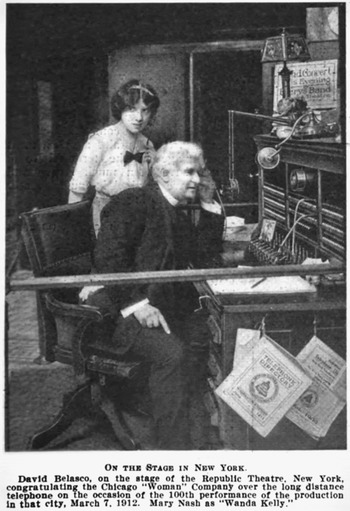
This may sound mystical or farfetched, but it actually happened one night to Marjorie Wood, the actress who claimed that the telephone taught her to exist “subconsciously” onstage. She was celebrating her 100th performance as Wanda Kelly in The Woman at the Olympic Theatre in Chicago, when suddenly her switchboard was patched through to the stage of the Republic Theatre in New York. There, at an identical desk, sporting an identical outfit and hairstyle, was her secret sharer: the Wanda Kelly of the New York production, Mary Nash (Figs. 9 and 10). Marjorie found herself at the end of act 1 and Mary had reached the end of act 2, but they were in perfect sync on the telephone wire. As the audience watched in wonder, they chatted with each other for five minutes, until Belasco himself strolled onto the New York stage. Grabbing the telephone himself, he began to address both audiences. “Mr. DeMille,” he proclaimed, “has sensed the essential poetry of Bell's invention.”Footnote 63I have sensed it, he might have said in a franker mood. It is the poetry of a double meter uniting Chicago and New York. It is the poetry of rhyming persons, held in a couplet by the telephone.
Marjorie Wood, midperformance, speaks by telephone with her double and her director in New York. The Woman, Olympic Theatre, Chicago, 7 March 1912. Source: “Some Significant Long Distance Talking,” Telephone Review 3.3 (March 1912): 61.

Mary Nash, midperformance, listens on as David Belasco speaks with Marjorie Wood and her audience in Chicago. The Woman, Republic Theatre, New York, 7 March 1912. Source: “Some Significant Long Distance Talking,” Telephone Review 3.3 (March 1912): 61.

We're ready now to circle back to the scene with which this all began: Luise Rainer's famous, Oscar-winning performance. What might have seemed at first like an example of classical Hollywood's melodrama looks in this light like a transitional example of film realism. As the scene begins, Rainer's character, performer Anna Held, has just read news of her ex-husband's sudden remarriage to another woman. She asks her maid to put in a call—wanting to congratulate him (she says)—but she almost immediately regrets the impulse. Too late: he's standing by. Shaking the ragged edges off her voice, she takes a deep breath, then exclaims in bell-like tones: “Oh, it's all so wonderful! I'm so happy—Yes, and I hope you are happy, too.” The very instant she speaks these words, however, her body belies their meaning. With stiff smiles, choked sobs, and maniacal glares, her face performs a fevered melodrama. (Her voice barely manages to deny it.) It's Cowardesque dialogue, but it's coming from a Grand Guignol body. On the other end of the line, the man surely hears a wide range of emotions in her voice, but the one he doesn't quite hear (so we're meant to believe) is her utter devastation. She may look to us like a woman with minutes to live, but on the line she sounds like polished silver.
This may sound like a scene of simple, melodramatic ironies (she's distraught but manages to sound glad, or she says one thing but embodies another) but the scene's power, in fact, is much weirder than that. As the conversation wears on, we begin to slip (and so does Rainer) into a more ambiguous realm, one where drawing-room sentiments and gallows passions seem difficult to wrench apart. The more times I watch this scene, the less certain I feel when assigning emotions or intentions to Anna's lines. At one point Rainer exclaims, in a tone I still can't place, even after a hundred viewings, “Oh, I'm so glad for you, Flo!” It's emphatic but exhausted. It brims with despair—and with relief. There may even be some erotic pleasure in it. In short, it's a line reading that compels our belief precisely by staying a few inches beyond our understanding.
In a TDR interview from 1964 called “Working with Live Materials,” Lee Strasberg told a story about the rehearsal tactics of director Bertolt Brecht: Brecht's wife, Helene Weigel, had a telephone scene in which she was meant to receive tragic news. But when she picked up the phone, there was Bertie on the line—telling her corny jokes, of all things! Brecht's hope, Strasberg suggested, was to draw out of Weigel a more complex affect in performance.Footnote 64 Again and again, we find, the telephone is the key to inventing such layered complexities. Not only does it drive a wedge between inside and out, onscreen and offstage; it also blurs the line between the self one simply is and the self one is variously hailed to be by others—man or machine.
For the moment, I can't think of a better definition of what realist acting achieves.