


1. INTRODUCTION
The research about future options for controlled generation of fusion energy for power stations received an essential turning point by interaction of picosecond laser pulses of powers above terawatts with plasmas resulted in ultrahigh acceleration of plasma layers with a thickness of dielectric increased skin depths (Hora et al., Reference Hora, Badziak, Boody, Hopfl, Jungwirth, Kralikova, Krasa, Laska, Parys, Perina, Pfeifer and Rohlena2002). These plasma blocks contained directed energetic ions with extremely high ion current densities opening a new way of ignition of fusion by direct laser generation of a fusion flame in uncompressed solid fuel (Hora et al., Reference Hora, Badziak, Read, Li, Liang, Liu Hong, Zhang, Osman, Miley, Zhang, He, Peng, Glowacz, Jablonski, Wolowski, Skladanowski, Jungwirth, Rohlena and Ullschmied2007). This reaction as a kind of side-on ignition was considered before as the following described hydrodynamic Chu-model but only the new experimental results of the plasma blocks provided the necessary conditions for a plane geometry interaction for fusion of deuterium-tritium.
Subsequently, it turned out surprisingly that the p-11B reaction seems to be not very much more difficult with this the side-on ignition. This all seems to be feasible next by using laser pulses with dozens of petawatt power and picoseconds duration. It may lead to generation of nuclear fusion energy generating less radioactivity during the reaction, in the reactor and with the helium as end product than burning coal. This refers to the fact that burning coal produces comparable radioactivity per generated energy due to its contents of the 2 ppm uranium. The following reported results using p-7Li fuel may arrive at similar negligible radioactivity generation with nuclear energy production.
Simultaneously with the thermo-kinetic interaction of lasers with plasmas at irradiation of solid targets, higher laser intensities generate highly directed low temperature plasma blocks with very high energies of ions and ion current densities exceeding 1010 A/cm2 moving mostly against the laser or into the target interior (Hora et al., Reference Hora, Badziak, Boody, Hopfl, Jungwirth, Kralikova, Krasa, Laska, Parys, Perina, Pfeifer and Rohlena2002, Reference Hora, Badziak, Read, Li, Liang, Liu Hong, Zhang, Osman, Miley, Zhang, He, Peng, Glowacz, Jablonski, Wolowski, Skladanowski, Jungwirth, Rohlena and Ullschmied2007). This block generation is caused by the nonlinear (pondermotive) force where the dielectric plasma properties are essential (Hora et al., Reference Hora1969, Reference Hora1985, 1991) and the direction is mostly perpendicular to the plasma surface as a general hydrodynamic result (Chen et al., Reference Chen and Wilks2005). This directivity has been confirmed also by particle in cell (PIC) computations that model is a generalized multi-particle description discovered by Wilks et al. (Reference Wilks, Kruer, Tabak and Landgon1992) where similar to the hydrodynamic result (Hora et al., Reference Hora1969, Reference Hora1985, 1991, Reference Hora, Badziak, Boody, Hopfl, Jungwirth, Kralikova, Krasa, Laska, Parys, Perina, Pfeifer and Rohlena2002, Reference Hora, Badziak, Read, Li, Liang, Liu Hong, Zhang, Osman, Miley, Zhang, He, Peng, Glowacz, Jablonski, Wolowski, Skladanowski, Jungwirth, Rohlena and Ullschmied2007) the target normal sheath acceleration (TNSA) was resulting (Klimo et al., Reference Klimo and Limpouch2006; Dean, Reference Dean2008) with modifications measured by Badziak et al. (Reference Badziak, Glowacz, Jablonski, Parys, Wolowski and Hora2005).
For these general theoretical and numerical evaluations it is essential, that a plane geometry for the plasma surface has to be guaranteed at the necessary high laser intensities. This was never possible until the measurements by Sauerbrey (Reference Sauerbrey1996) using TW laser pulses of 0.5 ps duration where the observed Doppler shift fully agreed with the nonlinear force acceleration (Hora et al., Reference Hora, Badziak, Read, Li, Liang, Liu Hong, Zhang, Osman, Miley, Zhang, He, Peng, Glowacz, Jablonski, Wolowski, Skladanowski, Jungwirth, Rohlena and Ullschmied2007). The result of Sauerbrey could be considered as an anomaly because any laser-plasma interaction at similar intensities never provided the conditions of the plane geometry, instead, the pre-pulses of the laser produced a plasma plume in front of the target where the beam was shrinking to wave length diameter by relativistic self-focusing — known since 1975 (Hora (Reference Hora1991) section 12.2) — and where the very high laser intensity in the filament produced highly charged very energetic ions. To avoid this relativistic filamentation, Sauerbrey had to suppress any pre-pulse by a factor 108 (contrast ratio) for times less than dozens of ps before the main pulse arrived. The same was measured with respect to X-ray emission (Zhang et al., Reference Zhang, He, Chen, Li, Zhang, Wong, Li, Feng, Zhang, Tang and Zhang1998) and from the fact that fast ions had 0.5 MeV energy only (Badziak et al., Reference Badziak, Kozlov, Makowksi, Parys, Ryc, Wolowski, Woryna and Vankov1999) while relativistic self-focusing would have predicted 22 MeV. On top, the fixed number of fast ions at varying laser power led to the conclusion (Hora et al., Reference Hora, Badziak, Boody, Hopfl, Jungwirth, Kralikova, Krasa, Laska, Parys, Perina, Pfeifer and Rohlena2002) that their origin was from the skin-layer in the plasma. The generated highly directed plasma blocks had ion current densities above 1010 A/cm2 all in full agreement with nonlinear force acceleration (Hora et al., Reference Hora, Badziak, Boody, Hopfl, Jungwirth, Kralikova, Krasa, Laska, Parys, Perina, Pfeifer and Rohlena2002, Reference Hora, Badziak, Read, Li, Liang, Liu Hong, Zhang, Osman, Miley, Zhang, He, Peng, Glowacz, Jablonski, Wolowski, Skladanowski, Jungwirth, Rohlena and Ullschmied2007).
These extraordinary high ion current densities produced by the laser pulses of TW or PW power and ps duration offered a come-back of the side-on laser ignition of fusion fuel at solid state density as calculated by Chu (Reference Chu1972), however where ps long energy flux densities above 108 J/cm2 were needed for a deuterium tritium (DT) reaction. Because of these exoribitant numbers, side-on ignition was given up and the spherical compression of DT to 2000 times the solid state for laser fusion was followed up, just ready for demonstrating the historical first controlled ignition of DT to be achieved in near future with the NIF-laser (Moses et al., Reference Moses, Miller and Kauffman2006).
The observed anomaly of PW-ps laser interaction (Hora et al., Reference Hora, Badziak, Boody, Hopfl, Jungwirth, Kralikova, Krasa, Laska, Parys, Perina, Pfeifer and Rohlena2002, Reference Hora, Badziak, Read, Li, Liang, Liu Hong, Zhang, Osman, Miley, Zhang, He, Peng, Glowacz, Jablonski, Wolowski, Skladanowski, Jungwirth, Rohlena and Ullschmied2007) opened the possibility of the side-on ignition of solid DT (Chu, Reference Chu1972) and the updating led to encouraging results (Ghoranneviss et al., Reference Ghoranneviss, Malekynia, Hora, Miley and He2008; Hora et al., Reference Hora, Malekynia, Ghoranneviss, Miley and He2008; Hora, Reference Hora2009) for DT laser fusion within comparably compact reactors in the future. Another question was the use of the p-11B fusion reaction producing three alpha particles only of equal energy (2.888 MeV). This was favored from the beginning because it produced less radioactivity per generated energy than burning coal due to its 2 ppm content of uranium (Deutsch et al., Reference Deutsch, Bret, Firpo, Gremillet, Lefebvre and Lifshitz2008). In contrast to a spherical laser driven ignition of p-11B needing a compression to 100.000 times, the solid state and low efficiencies excluding any use. The side on ignition with nonlinear force driven plasma blocks (Hora et al., Reference Hora, Badziak, Boody, Hopfl, Jungwirth, Kralikova, Krasa, Laska, Parys, Perina, Pfeifer and Rohlena2002, Reference Hora, Badziak, Read, Li, Liang, Liu Hong, Zhang, Osman, Miley, Zhang, He, Peng, Glowacz, Jablonski, Wolowski, Skladanowski, Jungwirth, Rohlena and Ullschmied2007) arrived at a very different result (Eisenbarth et al., Reference Eisenbarth, Rosmei, Shevelko, Blazsevic and Hoffmann2007; Malekynia et al., Reference Malekynia, Hora, Ghoranneviss and Miley2009; Eliezer et al., Reference Eliezer and Hora1989). Working strictly only with the assumptions of Chu (Reference Chu1972) before further optimization (Hora et al., Reference Hora, Malekynia, Ghoranneviss, Miley and He2008), it turned out that this scheme of laser ignition of uncompressed fuel was only about 10 times more difficult than igniting DT. This was a first step to show the possibility of controlled producing nuclear fusion energy with negligible generation of radioactivity by the reaction, within the reactor and with the helium as waste.
2. HYDRODYNAMIC CALCULATIONS
The hydrodynamic equations are used as close as possible on the same assumptions of Chu (Reference Chu1972) based on the DT reaction. The equations of continuity and reactions (D + T → α+ n) may be combined to yield as equations of mass conservation

and

where ρ is the mass density, u is the plasma velocity, and Y is the fraction of material burned, defined by

W is the reaction rate function, given by

It is obvious that (1) is the same as the mass conservation equation, due to the small percentage (about 0.35%) of mass transformed into energy. In the equation for Y, the n's are the particle densities, and the subscripts are for the different particle species. In the equation for W, the n stands for the total number density of the ions.
The equation of motion expressing the conservation of momentum is
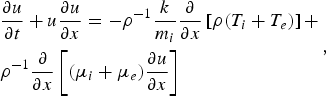
where pressure and viscosity terms are included and the viscosity coefficients whose values are taken to be

where  is the Spitzer logarithm.
The ion and electron temperature equations are expressing the conservation of energy

and

were included on the right-hand side are the pressure, viscosity, conductivity, thermonuclear energy generation, equilibration terms, and energy transfer terms W 1 and W 2 following Chu (Reference Chu1972). The last term on the right-hand side of (6) is the bremsstrahlung term.
For the following reported computations the bremsstrahlung is based on the electron temperature T e working with Eq. (15) of Chu (Reference Chu1972) with the maximum at x = 0, thus,

The α particles are assumed to deposit their energy in the plasma. They have a mean free path for plasma of solid state density DT was used in the initial calculations of Chu (Reference Chu1972, Eq. (7)) following the Winterberg approximation of the binary collisions from the Bethe-Bloch theory. This theory is for low density plasmas only where the stopping of energetic ions by electrons is described by binary interactions. For high density plasmas the stopping is determined by collective effects which results in drastically different stopping lengths as elaborated before (Hora, Reference Hora2009). This case for the collective effect was then used in the new calculations for DT as well as for p-11B (Hora, Reference Hora2009) and has been used correctly for our computations. Only exceptionally, we used the (pessimistic) binary collision case for p-7Li for showing the difference to the DT case of Chu (Reference Chu1972).
For the calculation of the collective effect we added a term to the right hand of Eq. (6) Thus

Where P is the thermonuclear heating rate per unit time obtained from the burn rate and the fractional alpha particle deposition:


where the energy of the alpha particles is used and f is the fraction of alpha particle energy absorbed by electrons or ions, given by

In the equations after (6), the temperatures of the electrons and of the ions were used to be equal T as used in Eq. (9) for the following numerical evaluations.
Figure 1 reproduces the results of Chu (Reference Chu1972) for the temperature T within the generated fusion flame in the irradiated solid state DT target depending on time where the most characteristic case is for the ignition energy flux density E* = 4.3 × 10¹⁵ erg/cm2 = 4.3 × 10⁸ J/cm2 and where the curve merges into a constant temperature T on time. This E* is then the ignition threshold E t* as explained in more details by Chu (Reference Chu1972) in full agreement with Bobin (Reference Bobin, Schwarz and Hora1974).
Charcteristics of the dependence of the temperature T on time t for parameters E* of energy flux density in ergs/cm2 for ignition of fusion at solid state DT reproduced from Figure 2 of Chu (Reference Chu1972).

These results were fully reproduced (Ghoranneviss et al., Reference Ghoranneviss, Malekynia, Hora, Miley and He2008) by a repetition of the computation of Chu (Reference Chu1972) for DT. Using the fusion cross sections for p-11B arrived at the results reported before (Eisenbarth et al., Reference Eisenbarth, Rosmei, Shevelko, Blazsevic and Hoffmann2007; Malekynia et al., Reference Malekynia, Hora, Ghoranneviss and Miley2009; Eliezer et al., Reference Eliezer and Hora1989).
3. RESULTS FOR THE P-7LI REACTION
It was then interesting to check another candidate for this kind of safe, low cost and comparably clean nuclear power generation from the reaction of p-7Li fuel. The fusion reaction rates <σv(T)> with the velocity averaged reaction cross sections depending on a Maxwellian temperature T are updated values shown in Figure 2. For best comparison with the results of Chu, for DT, Figure 1, the same dimensions are used. The results for p-7Li under the simplified and pessimistic conditions of Chu are reported following the analog plots of Figure 3. We derive that the threshold for the side-on ignition for the energy-flux density E* with an ignition temperature T ign is given where the curve in Figure 3 for a long time of interaction is not longer decaying but merging into a constant value

where again the necessary value of E* is within the range of 10 times higher difficulties than for DT that was estimated to be reached with few dozens of PW-ps laser pulses very close to the case of p-11B (Hora et al., Reference Hora, Badziak, Read, Li, Liang, Liu Hong, Zhang, Osman, Miley, Zhang, He, Peng, Glowacz, Jablonski, Wolowski, Skladanowski, Jungwirth, Rohlena and Ullschmied2007; Hora, Reference Hora2009; Eisenbarth et al., Reference Eisenbarth, Rosmei, Shevelko, Blazsevic and Hoffmann2007; Malekynia et al., Reference Malekynia, Hora, Ghoranneviss and Miley2009; Eliezer et al., Reference Eliezer and Hora1989). As in the case of DT of Chu (Reference Chu1972), for higher energy flux densities E than E*, the plots are further increasing on time T as an expression of ignition.
Fusion reaction rates for DT and p-7Li depending on the temperatures T used in the computations.

Characteristics of the side-on ignition of solid state p-7Li with the dependence of the temperature T of the ignition front on time t for various energy flux density of incident radiation of about ps long pulses E* (units are the same as in Figure 1 (Chu, Reference Chu1972) for comparison). The threshold for ignition is given where E* arrives at a constant temperature at later times.

It can be concluded that this result of not too much higher difficulty for the clean fusion energy generation than for DT fuel can be stated with certainty. This does not depend on minor modifications and corrections from further studies of numerous details to be gained in further studies. One modification may be due to the fact that the ignition temperatures for all the considered fuel are above the energy loss by bremsstrahlung as known since the computations by Chu for DT and as it was repeatedly confirmed in the present treatments (Chu, Reference Chu1972; Hora, Reference Hora2009; Malekynia et al., Reference Malekynia, Hora, Ghoranneviss and Miley2009). However, this emission was based on thermal equilibrium functions <σv> with the fusion cross sections σ averaged over a Boltzmann distribution of the electron velocity v. The side-on ignition is a process in a shock front with energy production from the ions and the generated alpha particles. It may well be that the Boltzmann distribution is strongly disturbed and only details with the PIC method of Wilks et al. (Reference Wilks, Kruer, Tabak and Landgon1992) and followers (Sauerbrey, Reference Sauerbrey1996; Roth et al., Reference Roth, Brambrink, Audebert, Blazevic, Clarke, Cobble, Geissel, Habs, Hegelich, Karsch, Ledingham, Neely, Ruhl, Schlegel and Schreiber2005) or what was gained from the “peripheral ignition” (Winterberg, Reference Winterberg2008) may lead to more detailed evaluations apart from several more parameters to be studied. A distinguishing is necessary between the double layer processes (Hora, (Reference Hora1991) Sections 8.8; 8.9; 10.7; 10.8) defined by internal electric fields in plasmas known form the genuine two-fluid computations (Hora et al., Reference Hora, Lalousis and Eliezer1984; Evans, Reference Evans2008) determining the TNSA (Klimo et al., Reference Klimo and Limpouch2006; Wilks et al., Reference Wilks, Kruer, Tabak and Landgon1992; Dean, Reference Dean2008; Badziak et al., Reference Badziak, Glowacz, Jablonski, Parys, Wolowski and Hora2005) and between physically different skin-layer mechanisms (Hora et al., Reference Hora, Badziak, Boody, Hopfl, Jungwirth, Kralikova, Krasa, Laska, Parys, Perina, Pfeifer and Rohlena2002, Reference Hora, Badziak, Read, Li, Liang, Liu Hong, Zhang, Osman, Miley, Zhang, He, Peng, Glowacz, Jablonski, Wolowski, Skladanowski, Jungwirth, Rohlena and Ullschmied2007; Badziak et al., Reference Badziak, Glowacz, Jablonski, Parys, Wolowski and Hora2005) which are optically determined by dielectrically increased blocks (Hora, Reference Hora1991, section 10.5) or skin depths (Hora, Reference Hora2007b).
Figure 3 reports the results with the same simplified assumption of Chu (Reference Chu1972) for DT for comparison. We have studied the change of the results when using the collective stopping power in contrast to the usually used binary collision stopping of the Bethe-Bloch theory. In contrast to the cases with DT with a strong dependence on the stopping power model (Hora et al., Reference Hora, Malekynia, Ghoranneviss, Miley and He2008) with changes of the temperature of the ignition threshold by few keV, a similar difference for p-7Li is again by a few keV but this is comparably small in view the rather high ignition temperature of 69 keV, Eq. (11). The difference of the binary and the collective stopping was elaborated before (Hora et al., Reference Hora, Malekynia, Ghoranneviss, Miley and He2008) in view of the usually preferred Bethe-Bloch theory in contrast to the Denis Gabor collective model which was elaborated at nearly the same time in a project at the University of Greifswald (Gabor, Reference Gabor1933) and re-formulated later (Gabor, Reference Gabor1952). It should be mentioned that the experiments with the stopping of 2 MeV electron beams in deuterated polyethylene by few mm diameter beams of 0.5 MA electron currents (Kerns et al., Reference Kerns, Rogers and Clark1972) resulted in the extremely short stopping length of 3 mm. This could be immediately reproduced by the collective stopping theory (Bagge et al., Reference Bagge and Hora1974) for the similar high plasma densities considered here for the side-on block ignition for fusion. Moreover, for more reading, review about acceleration of plasma by nonlinear forces from picoseond laser pulses and block generated fusion flame in uncompressed fuel, Ultrahigh acceleration of plasma by picosecond terawatt laser pulses for fast ignition of fusion and Relativistic acceleration of micro-foils with prospects for fast ignition were elaborated in (Hora et al., Reference Hora, Miley, Flippo, Lalousis, Castillo, Yang, Malekynia and Ghoranneviss2011; Lalousis et al., Reference Lalousis, Foldes and Hora2012; Eliezer, Reference Eliezer2012), respectively.
ACKNOWLEDGEMENT
This project was supported by the International Atomic Energy Agency in Vienna by the Coordinated Research Program C.R.P. No. 13011 on controlled nuclear fusion energy. One author (H.H.) gratefully acknowledges guest contact with the C.R.P. No. 13011 thanks to invitation by the IAEA Director of Physics, Dr. G. Mank and Prof. M. Kalal (Techn. Univ. Prague) and for cooperation with the International Centre on Theoretical Physics in Trieste for contacts with Prof. Reza Amrollahi and Prof. Rasoul Sadighi-Bonabi in Tehran.



