Adult and adolescent CHD patients frequently have some level of renal function impairment, although they are relatively young.Reference Agras, Derbent and Ozcay 1 This is particularly common in cyanotic patients whose long-standing hypoxaemia contributes to the appearance of microalbuminuria and proteinuria,Reference Inatomi, Matsuoka, Fujimaru, Nakagawa and Iijima 2 , Reference Martínez-Quintana, Rodríguez-González, Fábregas-Brouard and Nieto-Lago 3 two risk factors related to renal dysfunction, cardiovascular disease, and mortality not only in diabetic and hypertensive patients but also in the general population.Reference Kovesdy, Lott and Lu 4 In fact, lowering the normal threshold level for microalbuminuria, as it has been accomplished for glucose, lipid, and blood pressure levels, may allow an earlier and more aggressive approach for the prevention of adverse outcomes.Reference Zamora and Cubeddu 5 Nonetheless, other findings such as age, erythrocytosis, pulmonary arterial hypertension, and heart failure may contribute to the progression of renal disease in CHD patients.
The aim of the study was to evaluate those clinical and analytical factors that may contribute to 24-hour proteinuria in CHD patients and determine the association of proteinuria, with the appearance of thrombotic and mortality events.
Methods
For this study, a total of 251 CHD patients were recruited from the Adolescent and Adult Congenital Heart Disease Unit of the Complejo Hospitalario Universitario Insular-Materno Infantil of Gran Canaria. The inclusion criteria specified patients older than 14 years with a structural CHD. The patients were classified into diagnostic groups according to their underlying cardiac anatomy. Patients with more than one defect were classified according to the prevalent lesion from a clinical or haemodynamic point of view. We also created two additional clinical subgroups of CHD patients: patients with hypoxaemia who did not undergo surgery or remained cyanotic, despite cardiac surgery and patients with pulmonary arterial hypertension. Patients were identified as hypoxaemic if their haemoglobin oxygen saturation was 93% or less. Oxygen haemoglobin saturation was measured with a digital oximeter (Model 512 Handheld Pulse Oximeter; Novametrix Medical Systems Inc., Wallingford, Connecticut, United States of America).
CHD patients were examined in an outpatient setting. After an overnight fasting period of at least 10 hours, blood samples were collected to measure serum levels of creatinine, bun, uric acid, cholesterol, and N-terminal pro–B-type natriuretic peptide. In addition, a 24-hour urine test was determined with the patients on their usual diet except that they had to avoid alcohol intake and strenuous exercise. Serum creatinine, blood urea nitrogen, cholesterol, and 24-hour urine test were measured by spectrophotometry with Olympus AU 2700 equipment (Olympus Diagnostic, Hamburg, Germany). Determination of N-terminal pro–B-type natriuretic peptide was measured by immunoassay using the Siemens Stratus CS Acute Care Diagnostic System (Siemens Healthcare Diagnostics Inc., Newark, Delaware, United States of America).
Body weight and height were measured with the patients wearing light clothes and barefoot, and body mass index was determined as weight (kg)/[height (m)×height (m)]. Glomerular filtration rate was estimated in all patients with Modification of Diet in Renal Disease formulae (186×[creatinine (mg/dl)]−1.154×[age (years)]−0.203×[0.724 if female]).Reference Levey, Greene, Kusek and Beck 6 , Reference Stevens, Coresh, Greene and Levey 7 The diagnosis of pulmonary arterial hypertension was made if there was a resting mean pulmonary artery pressure ⩾25 mmHg. Pulmonary artery pressure was calculated invasively by means of cardiac catheterisation or non-invasively using Doppler echocardiography.Reference Quiñones, Otto, Stoddard, Waggoner and Zoghbi 8 None of the patients had received angiotensin-converting enzyme inhibitor and/or angiotensin receptor antagonist for at least 6 months before the blood/urine test. A 24-hour proteinuria was established if urine protein concentration was higher than 0.15 g, which was considered our upper normal reference range.
Thrombotic complications were determined after reviewing the clinical histories of all patients, considering only those complications that required hospitalisation. Meanwhile, survival status and time of death were obtained from the National Health Service computer system or after reviewing the medical history of the patients who died at the hospital. All the patients were Caucasian, and all of them or their tutors gave their informed consent for participation in the study. The hospital’s Ethics Committee approved the protocol of the study.
The values are expressed as mean±standard deviation or median and quartile values (Reference Zamora and Cubeddu5, 95). The association between non-hypoxaemic and hypoxaemic CHD patients was evaluated using the Fisher’s exact test for categorical variables, and the Student’s t-test for continuous data. Non-parametric test, such as the Mann–Whitney test, was used to compare independent groups of sampled data when the assumption of normality or equality of variance was not met. Analysis of variance was used for comparing means of three or more variables. Meanwhile, the Pearson correlation coefficient was used to measure the strength of the linear relationship between two variables. The log-rank test was used to compare Kaplan–Meier survival curves. The data analyses were performed with SPSS 20.0 (SPSS Institute, Chicago, Illinois, United States of America).
Results
Between September, 2008 and January, 2013, a total of 251 CHD patients were consecutively evaluated in the Adolescent and Adult Congenital Heart Disease Unit of the Complejo Hospitalario Universitario Insular-Materno Infantil of Gran Canaria.
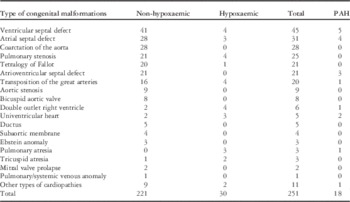
Table 1 shows the different types of congenital abnormalities and the number and type of CHD that had associated hypoxaemia or pulmonary arterial hypertension.
Types of CHDs with and without hypoxaemia and pulmonary arterial hypertension.

PAH=pulmonary arterial hypertension
Patients with atrioventricular septal defect included 11 patients with partial and 10 patients with complete defect. Patients with transposition of the great arteries included 12 patients with dextro-transposition and 8 patients with levo-transposition of the great arteries. A total of 15 patients with atrioventricular septal defect had Down’s syndrome
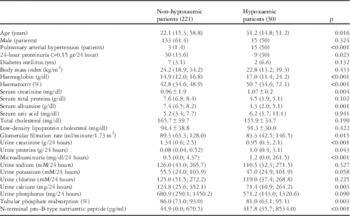
Of the 221 non-hypoxaemic patients, 30 (13.6%), and of the 30 hypoxaemic patients 9 (30%), showed 24-hour proteinuria (p=0.028). No significant differences were seen in relation to age (p=0.487), gender (p=0.081), pulmonary arterial hypertension (p=0.586), diabetes mellitus (p=0.106), and N-terminal pro–B-type natriuretic peptide levels (p=0.060) between CHD patients with and without 24-hour proteinuria. Mean oxygen saturation in hypoxaemic CHD patients was of 84.3±5.9%.
Table 2 summarises the clinical and demographic data and the laboratory test results of CHD patients with and without hypoxaemia.
Clinical and demographic data and laboratory test results from CHD patients with and without hypoxaemia.

Quantitative variables are expressed as mean±standard deviation or median and 5th and 95th (5; 95) percentiles; qualitative variables are expressed as percentages of total in non-hypoxaemic and hypoxaemic groups. Glomerular filtration rate estimated with Modification of Diet in Renal Disease formulae
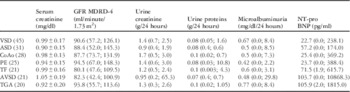
Table 3 shows serum and urine laboratory data of the most prevalent congenital heart defects in our series. Patients with atrioventricular septal defect showed higher serum creatinine concentrations than patients with atrial septal defect (p=0.048). On the other hand, patients with atrioventricular septal defect had the lowest 24-hour urine creatinine concentration (p=0.001) of the entire group. In addition, patients with atrioventricular septal defect and transposition of the great arteries exhibited the highest N-terminal pro–B-type natriuretic peptide concentrations (p<0.001) when compared with the rest of the cardiopathies. No significant differences were seen in 24-hour proteinuria and 24-hour microalbuminuria concentrations between the different subgroups of congenital heart defects.
Serum and urine laboratory data in different types of CHDs.

ASD=atrial septal defect; AVSD=atrioventricular septal defect; CoAo=coarctation of the aorta; GFR=glomerular filtration rate estimated with Modification of Diet in Renal Disease (MDRD-4) formulae; NT-pro BNP=N-terminal pro–B-type natriuretic peptide; PE=pulmonary stenosis; TF=tetralogy of Fallot; TGA=transposition of the great arteries; VSD=ventricular septal defect
Quantitative variables are expressed as mean±standard deviation or median and 5th and 95th (5; 95) percentiles
In relation to thrombotic events, during a median follow-up of 26.0 (16.9; 57.7) months, three patients had some type of thrombosis: one stroke, one superior sagittal sinus thrombosis, and one axillary arteriovenous fistula thrombosis. Of them, two had 24-hour proteinuria and one did not (p=0.014). On the other hand, five patients died – three of cardiac origin and two of non-cardiac origin – one of whom had 24-hour proteinuria and four did not (p=0.581). Meanwhile, Kaplan–Meier survival analysis showed no significant differences between CHD patients with and without 24-hour proteinuria (p=0.631).
Finally, Pearson’s correlation coefficient showed a positive correlation between 24-hour microalbuminuria and haematocrit (0.281, p<0.001) and between 24-hour microalbuminuria and N-terminal pro–B-type natriuretic peptide concentration (0.189, p=0.007).
Discussion
The prevalence of microalbuminuria has been reported to be 7.8% (6.1% in male and 9.7% in female) in the normal population, with progressively increasing prevalence in adults >40 years of age.Reference Jones, Francis and Eberhardt 9 However, in our CHD patients, the prevalence of proteinuria was higher than the expected for the general population (15.5%), with an equal distribution by gender and with the highest percentage of the cases occurring in patients with associated hypoxaemia (30%).
Hypoxia has proven to be a factor that favours glomerular damage, which ultimately leads to endothelial swelling, sclerosis, increase permeability, and proteinuria.Reference Dittrich, Haas, Bührer, Müller, Dähnert and Lange 10 , Reference Yan, Ogawa, Stern and Pinsky 11 These histological findings might be due to hypoxia itself, which decreases oxygen delivery to the kidneys, or hyperviscosity, as erythrocytosis may increase shear stress and the intraglomerular release of nitric oxideReference Perloff 12 and angiogenic factors,Reference Inatomi, Matsuoka, Fujimaru, Nakagawa and Iijima 2 which may favour renal dysfunction.Reference Jones, Francis and Eberhardt 9 , Reference Burlet, Drukker and Guignard 13 – Reference Gupte, Vaideeswar and Kandalkar 16
In addition, a low cardiac output secondary to left ventricular dysfunction and reflected in the elevated levels of N-terminal pro–B-type natriuretic peptide may identify individuals who may eventually develop heart failure and secondary maladaptive glomerular haemodynamic changes that favour renal hypoperfusionReference Elsayed, Tighiouart and Griffith 17 and the activation of the sympathetic nervous and renin–angiotensin–aldosterone system.Reference Hsu and Hsu 18 – Reference Brenner, Lawler and Mackenzie 20 Although the kidney is able to adapt to damage by increasing the filtration rate in the remaining normal nephrons, this initial benefit will finally result in long-term damage to the glomeruli of the remaining nephrons. In fact, hyperfiltration has been suggested as one of the most plausible pathological entities associated with glomerular injury in CHD patients because it increases capillary plasma flow, favours capillary dilatation, and promotes a high capillary hydraulic pressure that leads to glomerular sclerosis and proteinuria.Reference Inatomi, Matsuoka, Fujimaru, Nakagawa and Iijima 2 Similarly, passive congestion of the systemic circulation may be transmitted to the renal veins, resulting in glomerular enlargement and the onset of mesangial lesions such as mesangial-proliferative glomerulonephritis that leads to renal failure.Reference Faustinella, Uzoh, Sheikh-Hamad, Truong and Olivero 21
In addition, the type of cardiac anomaly can be a predictive factor for protein excretion ratio. In this context, Ghafari et al,Reference Ghafari and Malaki 22 and unlike us who did not find significant differences in proteinuria levels between the different types of congenital heart defects, evidenced that cyanotic children with truncus arteriosus had higher proteinuria levels than the rest of CHD patients. However, these findings could be more in relation to the haemodynamic status of the patients than to the duration of the hypoxaemia. In relation to patients with atrioventricular septal defects, it is known that this cardiac anomaly is frequently associated with Down’s syndrome,Reference Martínez-Quintana, Rodríguez-González, Medina-Gil, Agredo-Muñoz and Nieto-Lago 23 which at the same time is associated with a premature ageing of the kidneys and renal dysfunction.Reference Guzmán, Campos, López-Fernández and Casado 24
Previous studies have also suggested that moderate increases in microalbuminuria over time are an important risk factor for myocardial infarction, stroke, or cardiovascular death.Reference Gerstein, Mann and Yi 25 In fact, moderate increases in microalbuminuria seem to be an early signal from the kidney that the vasculature, particularly the endothelium, is not functioning normally. In this context, the presence and severity of proteinuria has been significantly associated with graded increases in the risk of clinical outcomes for both lower and higher estimated glomerular filtration rate.Reference Tonelli, Klarenbach and Lloyd 26 , Reference Hemmelgarn, Manns and Lloyd 27 Although our CHD patients with associated proteinuria had a significant higher incidence of thrombosis, we must keep in mind that CHD patients may present abnormal blood flow patterns, endothelial and platelet dysfunction, arrhythmias, or hypoxaemia that may increase the risk of thrombotic events and death, irrespective of proteinuria concentration.
Despite our awareness of the study’s limitations because of the small number of events and the young age of our CHD patients, taking into account that proteinuria and microalbuminuria are two powerful predictors of cardiovascular disease and mortality in adultsReference Hillege, Fidler and Diercks 28 , Reference Singh and Satchell 29 and that there is actually a tendency to use lower microalbuminuria levels to start medical treatment,Reference Zamora and Cubeddu 5 routinely microalbuminuria and proteinuria should be recommended in CHD patients with associated hypoxaemia and/or heart failure.
Acknowledgement
None.
Financial Support
This research received no specific grant from any funding agency, commercial, or not-for-profit sectors.
Conflicts of Interest
None.