Introduction
Adenoid hypertrophy is the most common cause of nasal obstruction in children.Reference Bluestone1 Macleod Yearsley performed the first adenoidectomy in 1842.Reference Stevenson and Guthrie2 Conventionally, adenoidectomy is performed with a curette, without visualising the nasopharynx. The use of a laryngeal mirror to visualise the nasopharynx has been mentioned in the literature; however, the use of an endoscope has revolutionised the technique of adenoidectomy. This was popularised by Canon et al.Reference Canon, Relogle and Schenk3 Multiple other methods have evolved since the inception of curettage adenoidectomy, such as a suction diathermy, laser ablation and radiofrequency ablation, using equipment including a molecular resonance tool, a coblation wand and a microdebrider. The aim of adenoidectomy is complete adenoid removal, with minimal morbidity and quick recovery. In 1996, David S Parsons described the use of powered instruments in the paediatric population and explained the precision of the microdebrider system.Reference Parsons4
Given the range of methods available, there is a quest for the most optimal method for complete adenoid removal and better relief of symptoms, with the least number of post-operative complications. This study aimed to compare endoscopic assisted powered adenoidectomy with conventional adenoidectomy on the basis of surgical time, intra-operative bleeding, post-operative pain and completeness of adenoid removal.
Materials and methods
A randomised controlled trial was designed to carry out this comparative study. It was conducted from October 2014 to March 2016, on patients visiting the ENT department at a tertiary care teaching hospital. Fifty patients (aged 4–12 years) with nasal and/or aural signs and symptoms due to adenoid hypertrophy, who required adenoidectomy, were chosen. The selection also included patients who required tonsillectomy or myringotomy (with or without grommet insertion) along with adenoidectomy. Patients with congenital anomalies, submucosal cleft palate and bleeding diathesis were excluded from the study.
Patients were examined clinically and radiologically. The adenoidal–nasopharyngeal ratio was calculated from the lateral radiograph of the neck.Reference Fujioka, Young and Girdani5 Endoscopic assessment was conducted and the adenoid tissue graded according to the scale by Clemens et al.Reference Clemens, McMurray and Willging6 Grade I signifies adenoid tissue filling one-third of the vertical height of the choana, grade II up to two-thirds, grade III from two-thirds to nearly complete obstruction of the choana, and grade IV reflects complete choanal obstruction. Patients were scheduled for surgery after complete systemic examination and evaluation of fitness for general anaesthesia.
The patients were divided into 2 groups of 25 each. A computer-generated randomised table was used with random numbers from 0 to 49. An odd number represented allocation to group A, while an even number represented assignment to group B. The two-digit number was chosen as per the order of presentation for surgery. Patients in group A underwent conventional curettage adenoidectomy and those in group B underwent endoscopic assisted powered adenoidectomy. The principal author and the co-author could not be blinded to the procedures, as they performed all the surgical procedures themselves.
The procedures were carried out under general anaesthesia, with orotracheal intubation and a laryngeal pack in situ. Tonsillectomy was performed after the completion of adenoidectomy (i.e. after achieving complete haemostasis in the nasopharynx). Patients were discharged on the 1st post-operative day and followed up every week for a month, and then monthly for the next 3 months. Post-operative lateral neck radiography and nasal endoscopy were conducted three weeks after surgery to evaluate for any residual adenoid tissue.
Under general anaesthesia, a Boyle–Davis mouth gag with an appropriately sized tongue blade was used to open the mouth. The adenoids were palpated with the index finger to rule out any abnormal pulsation and then medialised.
In the conventional method, the patient was laid in the Rose position. A St Clair Thompson adenoid curette of appropriate size was used to complete adenoid curettage, with no attempt to visualise the tissue. However, the nasopharynx was palpated to ensure adequate removal. A maximum of three attempts were made. Care was taken to avoid injury to the surrounding structures and the posterior pharyngeal wall. Roller gauze was kept in the nasopharynx for 5 minutes to achieve haemostasis.
Endoscopic assisted powered adenoidectomy was carried out under vision using a 4 mm or 2.7 mm diameter, 0-degree endoscope (Karl Storz Hopkins® II Optik endoscope, 18 cm length). This was used together with a microdebrider (Stryker® Core Powered Instrument Driver Console 5400-50), with saline irrigation, in an oscillating mode of up to 2000 revolutions per minute. Patients were placed in a supine position. The mouth was opened with Boyle–Davis mouth gag with an appropriately sized tongue blade. The 0-degree endoscope was inserted through the nasal cavity to visualise the adenoid tissue after decongesting the nasal cavities with 1:30 000 adrenaline xylocaine rinsed cotton pledgets. The angled microdebrider adenoid blade (40-degree, 4 mm diameter, 11 cm length) was then introduced through the oral cavity. The suction drew the adenoid tissue in and the rotating blade shaved it under constant endoscopic vision. The adenoidectomy was started high in the nasopharynx, from the upper limit of adenoid tissue, and continued in a side-to-side fashion to the inferior edge of the adenoid tissue. Simultaneous saline irrigation and aspiration in the field removed the shaved adenoid tissue and blood, providing a clear field. Haemostasis was achieved by placing a nasopharyngeal pack for 5 minutes. If not controlled, suction diathermy and nasal packing (Merocel®) were used.
The first parameter measured was surgical time, defined as the time taken for completion of the procedure. It was measured from the time the patient was handed over to the surgeon by the anaesthetist to the time when the adenoidectomy procedure was completed and haemostasis was achieved. The surgical time period included instrument set-up, nasal decongestion, packing and bleeding control. The time taken for additional procedures such as tonsillectomy and grommet insertion was not included.
The second parameter was intra-operative blood loss, which was calculated as the volume of suctioned blood and saline, minus the irrigation solution in the endoscopic method. The amount of blood in the suction container was measured. Additionally, the number of gauze pieces used to pack the nasopharynx was counted. The weight of these gauze pieces was measured pre-operatively and deducted from the weight of these soaked gauze pieces post-surgery, and the difference added to the blood volume in the suction container.
Completeness of adenoid removal was the third parameter. It was assessed via post-operative lateral neck radiography and nasal endoscopy three weeks after surgery in both groups. It was graded as complete removal if there was less than 20 per cent residual tissue and as partial removal if there was more than 20 per cent of tissue left behind.
The last parameter was post-operative pain, which was assessed using a visual analogue scale (where 0 = no pain and 10 = intolerable pain).
The collected data were entered into and analysed with Microsoft Excel® spreadsheet software, and statistically evaluated using SPSS® version 17 software. The data obtained for each group were compared, and the proportion or mean in the two groups was statistically analysed using the chi-square test for significance, and the Mann–Whitney U test and Wilcoxon signed-ranked test when there was a skewed distribution. P-values of less than 0.05 were considered significant.
Results
Twenty-five subjects underwent conventional curettage adenoidectomy (age range of 5–12 years, mean age of 7.97 years; 8 females and 17 males; group A) and 25 patients underwent endoscopic assisted powered adenoidectomy (age range of 4–12 years, mean age of 8.48 years; 7 females and 18 males; group B). There was no statistical difference between the groups regarding age or sex (baseline characteristics).
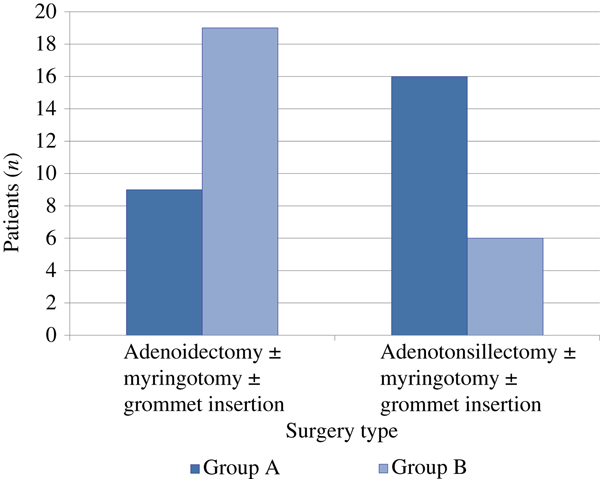
Fifty-six per cent of patients, with an equal distribution across groups, had some abnormality on anterior rhinoscopic examination, which included a deviated nasal septum and/or turbinate hypertrophy. Radiographic evaluation revealed enlarged adenoids in 100 per cent of patients with an adenoidal–nasopharyngeal ratio of equal to or more than 0.7. These findings were corroborated by endoscopic evaluation, which revealed grade III adenoid hypertrophy in 76 per cent of patients and grade IV in 16 per cent, according to the grading of Clemens et al.Reference Clemens, McMurray and Willging6 The procedures conducted were adenoidectomy, with or without tonsillectomy, with or without myringotomy and grommet insertion, as shown in Figure 1.
Distribution of types of surgery performed. Group A = conventional curettage adenoidectomy group; group B = endoscopic assisted powered adenoidectomy group

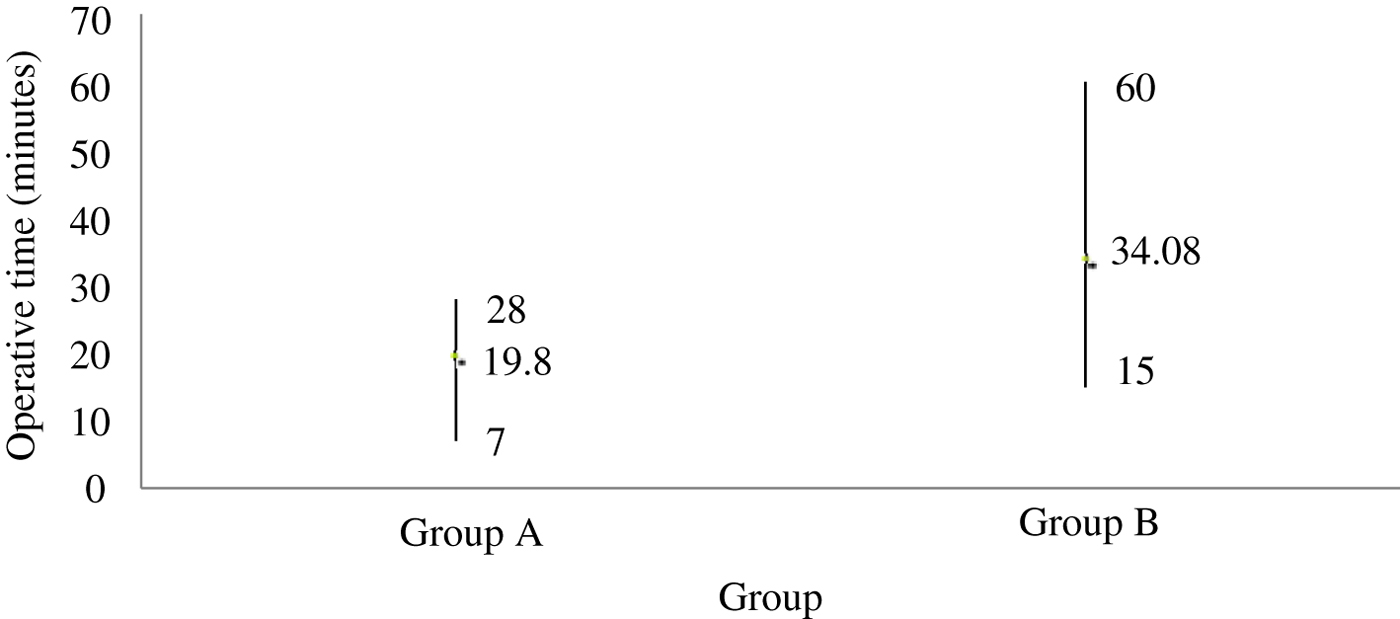
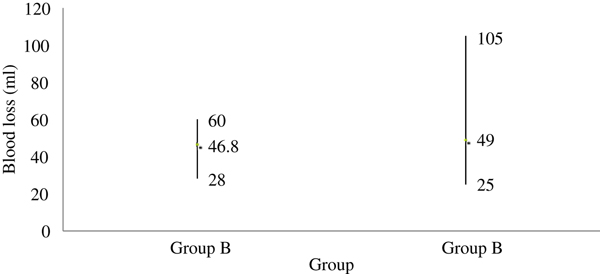
The mean operative time was 19.80 minutes (range, 7–28 minutes) in group A and 34.08 minutes (range, 15–60 minutes) in group B (Figure 2). The difference between the two groups was statistically significant (p < 0.05). The mean blood loss was 46.80 ml (range, 28–60 ml) in group A and 49.00 ml (range, 25–105 ml) in group B, with a p-value of more than 0.05 (Figure 3). Hence, the difference in intra-operative blood loss between the two groups was not statistically significant.
Comparison of time taken for adenoidectomy. Group A = conventional curettage adenoidectomy group; group B = endoscopic assisted powered adenoidectomy group

Comparison of blood loss during adenoidectomy. Group A = conventional curettage adenoidectomy group; group B = endoscopic assisted powered adenoidectomy group

None of the patients in group B had residual adenoid tissue, indicating complete removal in all patients. In group A, 22 patients showed residual tissue on radiography (an adenoidal–nasopharyngeal ratio of less than or equal to 0.4) and on nasal endoscopy (80 per cent had grade I and 8 per cent had grade II residual adenoid tissue), with less than 20 per cent residual tissue in only 3 patients. The p-value calculated using chi-square test was less than 0.005, which was significant.
The mean pain score was 6.20 (range, 3–8) in group A and was 4.24 (range, 2–8) in group B. The difference between the groups was significant (p < 0.05).
Most of the patients achieved haemostasis with saline-soaked nasopharyngeal gauze packs. Three patients in group B required additional procedures such as suction diathermy and nasal packing using Merocel. In group A, none of the patients required any additional procedure for haemostasis (Table 1).
Group comparison for each parameter assessed

*Statistically significant. †Where 0 = no pain and 10 = intolerable pain
Discussion
Adenoidectomy is one of the most common procedures performed in the paediatric age group.Reference Curtin7 It is carried out alone, or in conjunction with tonsillectomy and/or myringotomy. The principal indication for adenoidectomy in our study was nasal obstruction causing sleep difficulties, mouth breathing, snoring and so on. The procedure primarily aimed to remove the enlarged adenoid tissue filling up the nasopharynx and obstructing the Eustachian tube, to maintain the patency of the nasopharyngeal airway.
Conventionally, a curette is used to complete adenoidectomy. Curettage is a blind procedure that mainly targets the central portion of the adenoid mass. The lateral tissue abutting the Eustachian tube opening and the tissue in the superior-most part of the nasopharynx remain inaccessible to the curette. Furthermore, the risk of collateral damage remains high as curettage is carried out without direct visualisation of the area to be worked on.
The ideal procedure to remove the adenoid mass should involve removal of the entire mass under direct visualisation, and should be minimal in terms of operative time, blood loss, damage to surrounding tissues, complications and pain.Reference Bradoo, Modi, Joshi and Wahane8
In terms of symptoms, adenoid enlargement has the greatest impact on 4–12-year-olds. This was confirmed by the present study, and those conducted by Datta et al.,Reference Datta, Singh and Deshpal9 Somani et al.Reference Somani, Naik and Bangad10 and Prakash et al.Reference Prakash, Mallikarjunappa and Samuel11
The surgical time was significantly longer for endoscopic assisted powered adenoidectomy than for the conventional technique. Patients undergoing transnasal endoscopic visualisation of adenoids require nasal decongestion with adrenaline-soaked cotton pledgets, which adds to the total surgical time. Endoscopic assisted powered adenoidectomy also requires the setting up of additional instruments, more technical skills and involves the complete removal of adenoids under vision, which takes more time than conventional adenoidectomy. Moreover, removal of the adenoids from all nasopharyngeal areas creates a wider raw area, which bleeds more, and this requires more time to control the bleeding. The microdebrider blade, being a powered instrument, can damage underlying muscle while attempting a complete adenoidectomy. This leads to excessive oozing from the injured muscle that is difficult to control, as seen in three endoscopic assisted powered adenoidectomy patients in the present series. All these factors played a role in increasing the surgical time in endoscopic assisted powered adenoidectomy. However, with each passing case, there was an increase in expertise, improved skills and greater precision. Hence, the surgical time and blood loss decreased.
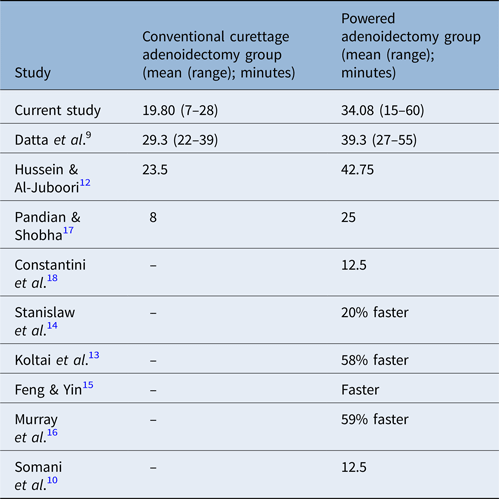
These operative time results were in accordance with those of Datta et al.,Reference Datta, Singh and Deshpal9 and Hussein and Al-Juboori.Reference Hussein and Al-Juboori12 However, the powered instruments were found to be 58 per cent faster in a study by Koltai et al. published in 1997.Reference Koltai, Kalathia, Stanislaw and Heidi13 Our findings were also dissimilar to those of Stanislaw et al.,Reference Stanislaw, Koltai and Feustel14 who reported powered adenoidectomy to be 20 per cent faster than curette adenoidectomy, and to the results of Feng and Yin.Reference Feng and Yin15 Murray et al.Reference Murray, Fitzpatrick and Guarisco16 also had dissimilar results, wherein endoscopic assisted powered adenoidectomy was found to be 59% faster (Table 2).Reference Datta, Singh and Deshpal9,Reference Somani, Naik and Bangad10,Reference Hussein and Al-Juboori12–Reference Costantini, Salamanca, Amaina and Zibordi18
Comparison of operative time with similar studies

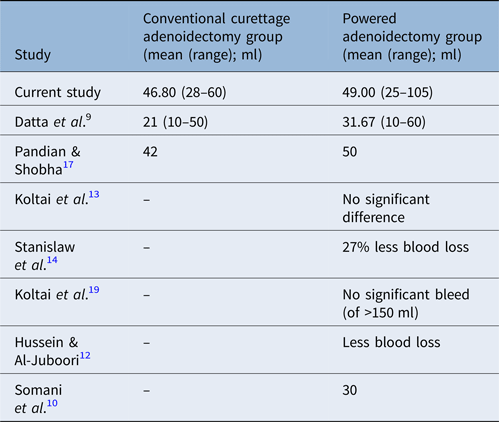
In our study, there was greater intra-operative blood loss in the endoscopic-powered group compared with the conventional adenoidectomy group, but this difference was not significant. Datta et al. reported greater intra-operative blood loss in the endoscopic-powered group.Reference Datta, Singh and Deshpal9 However, Stanislaw et al.Reference Stanislaw, Koltai and Feustel14 had contrasting results, reporting 27 per cent less blood loss in the powered procedure (Table 3).Reference Datta, Singh and Deshpal9,Reference Somani, Naik and Bangad10,Reference Hussein and Al-Juboori12–Reference Stanislaw, Koltai and Feustel14,Reference Pandian and Shobha17,Reference Koltai, Chan and Younes19
Comparison of blood loss with similar studies

In the present study, three patients in the endoscopic assisted powered adenoidectomy group required extra methods to achieve haemostasis, in addition to the gauze pack that was used for nasopharyngeal packing in all patients. These three patients had underlying muscle injury, as the microdebrider blade inadvertently damaged the underlying perimysium while attempting complete adenoid removal, which thus required additional measures to control bleeding.
The endoscopic assisted powered adenoidectomy group had lower pain scores than the curettage adenoidectomy group. The difference was statistically significant; however, higher pain scores were observed in patients who underwent tonsillectomy as an additional procedure. This is easily explainable as tonsillectomy results in extra tissue dissection and a greater raw area. Datta et al.Reference Datta, Singh and Deshpal9 and Anand et al.Reference Anand, Sarin and Singh20 also confirmed a similar result of decreased pain in the powered adenoidectomy group.
An endoscopic-powered procedure enables complete resection, as observed by Koltai et al.,Reference Koltai, Kalathia, Stanislaw and Heidi13 Stanislaw et al.,Reference Stanislaw, Koltai and Feustel14 Datta et al.,Reference Datta, Singh and Deshpal9 Hussein and Al-Juboori,Reference Hussein and Al-Juboori12 and Prakash et al.Reference Prakash, Mallikarjunappa and Samuel11 The most common site of residue is the roof of the nasopharynx and the lateral wall, as the curette is not able to reach the farthest end of the roof of the nasopharynx. Havas and Lowinger,Reference Havas and Lowinger21 Bradoo et al.,Reference Bradoo, Modi, Joshi and Wahane8 and Prakash et al.Reference Prakash, Mallikarjunappa and Samuel11 observed residual tissue in only a few patients, who underwent adenoidectomy under endoscopic vision without the use of a microdebrider.
• Transoral use of a curved microdebrider blade under endoscopic vision is safe and reliable for adenoidectomy
• It provides complete resection with tissue removal in the peritubal region and superior part of the nasopharynx, the most common sites of residual tissue
• Mean operating time and blood loss were greater for endoscopic assisted powered adenoidectomy than conventional adenoidectomy
• The endoscopic procedure involves minimal inadvertent trauma to the surrounding tissue, common in blind curettage
• Post-operative pain was less with endoscopic assisted powered adenoidectomy as compared to the conventional curettage method
• The endoscopic procedure also acts as an excellent teaching aid
More than half of the patients in the endoscopic assisted powered adenoidectomy group had nasal septum deviation, with or without turbinate hypertrophy. The introduction of the endoscope through the oral cavity allowed such patients to be included in the study, as the nasal cavity abnormalities did not have any bearing on the selection of the operative procedure. This technique eased the procedure as both nasal cavities were at the surgeon's disposal for endoscope insertion.
Another advantage of endoscopic assisted powered adenoidectomy was the ease of adenoid tissue removal with the curved blade introduced through the oropharynx. Movement of the microdebrider blade is restricted in the transnasal approach given the small size of the nasal cavity in comparison to the wide space available for the curved blade to move sideways when introduced via the oropharynx. The curved blade could also reach the most lateral portion of the nasopharynx and behind the Eustachian tube opening, which resulted in complete adenoid removal.
Endoscopic assisted powered adenoidectomy is a safe and precise method for complete adenoid removal, in comparison to the conventional curettage method. This method also proves to be excellent for teaching assistant surgeons and trainee residents, as a camera is attached to the endoscope (connected to a monitor). In addition, when the 0-degree endoscope is introduced through the nasal cavity, it gives a head-on view of the adenoids, in contrast to the angled view provided by the 70-degree endoscope inserted through the oral cavity.
Competing interests
None declared