Introduction
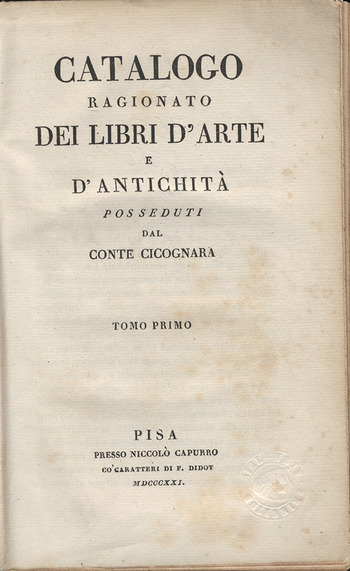
Established in 2015, The Digital Cicognara Library is an international collaborative project to recreate, in digital form, the renowned private book collection of Count Leopoldo Cicognara (1767–1834), a distinguished and highly influential Venetian art historian, critic, and bibliophile. Cicognara's legacy endures through the two-volume 1821 bibliography Catalogo ragionato dei libri d'arte e d'antichità posseduti dal Conte Cicognara Footnote 1, documenting his collection of approximately 5,000 titles covering art history and related subjects. This publication quickly became an essential tool for scholars of art and architectural history as well as ancient, Renaissance, and early modern cultural history. Three years after publishing his Catalogo, Cicognara sold his library to the Vatican, and since 1824 the original volumes have been housed in the Biblioteca Apostolica Vaticana (Vatican Library) forming the Fondo Cicognara. To this day, the Catalogo and the Fondo remain key scholarly resources for the literature of art history and allied subjects.
Reconstructing Cicognara's legacy
With the Vatican Library's approval, current project partners (Heidelberg University, Princeton University Library, The Getty Research Institute, National Gallery of Art Library, Frick Art Reference Library, Harvard University Library) are furthering a decades-long scholarly endeavour begun in the 1980s when the Samuel H. Kress Foundation sponsored a project to disseminate the full text of the Vatican Library's Fondo Cicognara in microficheFootnote 2. This initiative was led by scholars at the University of Illinois Urbana-Champaign including art historian Philip P. Fehl with his wife Raina Fehl, and librarian Elizabeth Wilson. They worked in close partnership with the Vatican Library and the firm of Chadwyck-Healey to produce a microfiche edition of every title in the Catalogo. The microfiche set was sold or donated to more than 50 libraries worldwide during the last thirty years.
In the late 1990's, the Kress Foundation funded the creation of bibliographic records for each title in the microfiche edition for inclusion in OCLC's WorldCat. As imaging technology advanced during the next decade, ideas for a digital Cicognara library began to emerge, and in 2010 a group of research libraries explored the possibility of reproducing the microfiche in digital form. The Vatican Library, however, felt it unwise to re-photograph the physical books in the Fondo because of stress to volumes endured during the microfiche project and therefore proposed the idea of reconstructing the Fondo Cicognara with digitized versions of matching editions held by other libraries.
By spring 2014, discussion of a new collaborative effort inspired by a major digitization projectFootnote 3 led by the Heidelberg University Library took shape, and in September 2015 representatives from six partner libraries met in Heidelberg to devise a plan approved by the Vatican Library to create access to digital versions of titles held by libraries outside of the Vatican's collection. The Kress Foundation further contributed to the effort by funding conservation and repair of physical copies in the Vatican's Fondo Cicognara as well as a contract to scan the entire microfiche set following up to date standards for digitization and post-production quality control. During this phase, a project website (cicognara.org) was established at Princeton University. The International Image Interoperability Framework (IIIF) was chosen for platform-neutral viewing of digital reproductions, and the Getty Research Portal was selected as the means by which libraries contribute links and corresponding metadata for their digitized copies.
Apart from the Vatican Library, the current partners collectively hold over sixty per cent of the Catalogo's corpus, and the project is actively seeking new partners to complete the collection of matching editions. By using new technology to make these key historical volumes more widely accessible, the Digital Cicognara Library will allow scholars to explore the contents of the library in innovative ways. Together, the aggregated images and text offer a potentially transformative opportunity for both art history and digital humanities research through newly created metadata. By offering high-quality scans of the original microfiche and related bibliographic metadata linked to corresponding digital versions of Cicognara's titles in an open access web-based application, the Digital Cicognara Library aims to employ 21st-century technology to advance Cicognara's Enlightenment-era ideals.
Cicognara's biography and scholarly contributions
Today, most scholarship concerning Count Cicognara focuses on the published Catalogo of his personal library that is considered the ‘model for modern art bibliography’.Footnote 4 However his early political life and subsequent long career as a scholar and bibliophile of art and archaeology has been of interest to scholars since his death in 1834. Philip P. Fehl, late professor of art history at the University of Illinois Urbana-Champaign and leader in the joint microfiche project with the Vatican Library in the 1980s, compiled an illuminating scholarly publication focusing on the personal biography of Count Cicognara. Fehl examined and utilized the earliest primary sources on Count Cicognara, including Alessandro Zanetti's Le premier siècle de la calcographie ou catalogue raisonné des estampes du cabinet de feu M. le Comte Léopold Cicognara … (1837)Footnote 5 and Patrizio Antolini's Notizie su Leopoldo Cicognara e sua famiglia (1879)Footnote 6. It was, however, Vittorio Malamani's biography Memorie del conte Leopoldo Cicognara … (1888)Footnote 7 with extensive research garnered from Cicognara’ s surviving papers that offered the most enriching details for Fehl's own scholarship.
One of the most interesting aspects of the Catalogo apart from the selection of books is the commentary on the assembled titles reflecting the author's personal connoisseurship and influences. Cicognara was born in Ferrara, Italy in 1767 to an aristocratic family and was educated, in the traditions of the time, in the arts of music, poetry, and painting at the Collegio dei Nobili in Modena. In 1788 he went to Rome upon admission to the Società dell'Arcadia, where he studied art with Domenico Corvi (1721–1803) and the German painter Jacob Philipp Hackert (1737–1807). There he gained an enthusiasm for classical ruins and contemporary art theoryFootnote 8 amid its abundant cultural treasures and gained a mentor in Abate Francesco Cancellieri, a bibliophile and renowned antiquarian who remained a life-long confidant. Through his studies with Cancellieri, Cicognara was exposed to Winckelmann's 1764 Geschichte Der Kunst Des Alterthums Footnote 9 which helped form his foundational and deep regard for Greek and Roman art. Most importantly, Cancellieri introduced Cicognara to scholar of Medieval art Jean Baptiste Louis George Seroux d'AgincourtFootnote 10, who instilled a deep and lasting work ethic and sense of liberality that characterized Cicognara's scholarship.
Fehl describes Cicognara's life as evolving in very turbulent times. Cicognara was involved in Italy's Risorgimento political and social movement in the late 18th century, and in 1795 he returned to Modena and served as councillor of state and minister plenipotentiary for the Cisalpine Republic, receiving the Iron Crown from Napoleon. Motivated by his early education, commitment to the arts, and ‘concern for the regeneration of art and society’Footnote 11 he joined Napoleon's invading French forces, serving in both military and administrative roles. Napoleon sent many works of art, book collections, and other cultural patrimony of Italy to France in order to build a collection representing a “universal history of art” with France at its center.Footnote 12 Throughout, Cicognara remained a dedicated scholar of Italy's cultural heritage and, as a result, his personal relationship with Napoleon grew tenuous.
In a recent examination of Cicognara's large corpus of personal letters written during the formation of his book collection, art historian Elena Granuzzo reveals many facets of Cicognara's collecting practices and the formation of his personal taste over timeFootnote 13. His letters document relationships formed with librarians, scholars, museum curators, private collectors, dignitaries, and other bibliophiles that he met while abroad, or solely through correspondence. The varied content of the letters addresses myriad topics including logistical issues with buying and trading books, acquiring private collections, and more profound conversations examining and critiquing individual titles, artists, theory, and bibliomania as a subject. As he was serving as the minister plenipotentiary of the Cisalpine Republic, he wrote the earliest letter confirming the beginning of his collecting and research. This evidence dates from November 1798 where he wrote to a member of the Miniscalchi family in Verona requesting a list of books on a variety of artistic subjectsFootnote 14.
In 1805Footnote 15, Cicognara abandoned his political career to follow a lifelong love of antiquities and contemporary art, and established himself as an art historian and professional academic critic. He returned to Rome where he reunited with his friend and mentor Cancellieri and sculptor Antonio Canova (1757–1822). After Cicognara secured his release from military service in 1808, he published his philosophical study Del Bello: Ragionamenti Footnote 16, dedicated to Napoleon. He then moved to Venice where he began to publish important works on sculpture and Venetian architecture. Later in 1808 he was appointed honorary president of the Accademia di Belle Arti, serving in that capacity until 1826. He championed the idea that the Accademia should serve the community and was largely responsible for opening that collection to the public in 1817. His dedication to the arts and scholarly publications produced during this period reflect his growth and commitment as a scholar, particularly in the area of sculpture.Footnote 17 The scope and depth of his growing personal library and his broad interest in the visual arts from antiquity to his own time engendered the creation of his most reputable scholarly contribution. Cicognara's Catalogo would not have been possible without years of collecting, travel, and his immense capacity for correspondence. The overall quality of his collection reflects his broad interests and precise selection of very rare editions with the highest quality illustrations.
The Catalogo and early art bibliography
The Catalogo is considered the ‘first general-purpose art bibliography’ due to its coverage of all periods of art and genres of art study. The Catalogo's popularity remained steady with a French translation first appearing in Venice (1836) and later in Vienna (1839), with numerous modern translations and reprints available throughout the late 19th and 20th centuries. In an article surveying the history of art bibliographies from 1595–1821Footnote 18 librarian and scholar Lee Sorensen presents Cicognara's work as culmination of the various bibliographies, lists, and sale catalogues of art-related books produced from the 15th to 19th centuries in Europe.
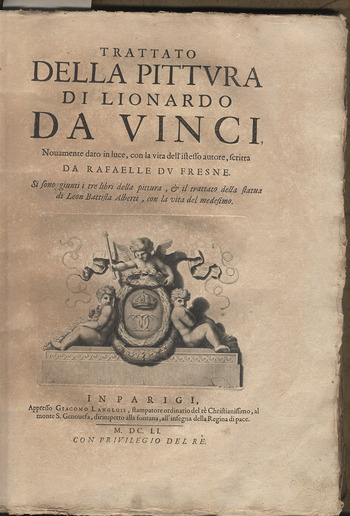
Cicognara's own collecting practice exposed him to the earliest forms of art bibliography, including what is considered the first bibliographic list with today's standard of citation for author, title, and publisher information. Raphael Trichet du Fresne's Trattato della Pittvra di Lionardo da VinciFootnote 19 (1651) includes a list of thirty-five known contemporary works about art in the blank pages between the two main sections of the book. A careful study of this first bibliography published by Kate T. Steinitz in 1972Footnote 20 examines more closely the list's presence in this early Leonardo Da Vinci publication. However, the book's inclusion in Cicognara's own library, along with all but two of the titles in Trichet du Fresne's bibliography, is most intriguing. In fact, Cicognara owned many of what are considered the most prominent early forms of art bibliography, including Antonio Possevino's Tractatio de poësi & pictura ethica humana …(1595)Footnote 21, featuring bibliographic information in the margins next to headings above artists’ biographies; Luigi Scaramuccia's Le finezze de pennelli italiani Footnote 22 …(1674), with a bibliography described as a more organized— albeit erroneous—version of Trichet du Fresne's 1651 list; and Christoph Gottlieb von Murr's Bibliothèque de peinture, de sculpture, et de gravure (1770)Footnote 23, the first known bibliography compiled by an art scholar. Cicognara's collection of these, and other, early art bibliographies certainly influenced his own collection's development, and ultimately informed the design of his more expanded and inclusive version in the 19th century.
The Catalogo was not meant to be a comprehensive list of books published in Europe during the time period covered but rather as a unique annotated bibliography intended to address the needs of art scholars and book collectors. Cicognara included commentary on varied editions, errors in publication, notable engravings, maps, and errors in translations. Another important element of the work is the inclusion of publications on both antiquity and contemporary art. He distinguishes them in the title, but the bibliography combines the two subjects in all categoriesFootnote 24. This distinction continues today with publications about antiquity or archaeology often separated in study programs as well as in specialized research collections.
By combining these two distinct disciplines, Cicognara allows scholars to examine this early art literature as a whole. His collection includes treatises, biographies, technical handbooks, manuals, and subject dictionaries in all areas of the visual arts. Also included are texts on the decorative arts, emblem and iconographic handbooks, studies on costume, theatre and public spectacles, numismatic literature, and works on aesthetics and philosophy. The archaeology section includes topographical guides and early texts on the archaeology and antiquities of Greece and Rome. The Catalogo's table of contents clearly reveals his organizational method and a range of practices that includes treaties and handbooks on material types, perspective, anatomy, proportion, and subjects related to architecture and engineering. Subsequent sections cover literary works about art, drama, poems about visual art, and aesthetics. The texts date from the 15th through the early 19th centuries and cover Latin and most modern Western European languages.
Later in the 19th and early 20th century, as universities and academies began to elevate and formalize the study of visual art, it was challenging to build libraries and collections of scholarly visual arts publications. The bibliographies found in early art literature—annotated inventories of private libraries like Count Cicognara's—and pre-19th century book sale catalogues arranged by subject were the only sources of guidance for burgeoning art scholars and art librarians.
As noted earlier, Cicognara's Catalogo became an essential tool for scholars and bibliophiles of art history as well as for contemporary private collectors in the early nineteenth century. For example, Cicognara's work inspired Sir Charles Eastlake (1793–1865), bibliophile and first director of the National Gallery in LondonFootnote 25, in building his collection of nearly 2,000 books that were the foundation of the museum's Eastlake Library. His collection of numerous early printed art books is highly regarded by scholars around the world.
Challenges in building a Digital Cicognara Library
For the Vatican, the Fondo Cicognara became a prized collection and has since profoundly informed scholars, bibliophiles, and rare book dealers. However, while consonance between the published Catalogo and the physical Fondo is close, it is not identical. Additional editions, multiple copies and, at times, imprecise descriptions or references present great challenges to automated database systems. For example, Catalogo entry 2943, a volume of Enrico Noris’ Duplex dissertatio de duobus nummis Diocletiani, et Licinii dated 1775,Footnote 26 is one of the Catalogo's few printing errors as the year should be 1675. Cicognara describes it as easily identified through other titles that are bound together and discussed with it. Cicognara also had a second, variant copy of Duplex dissertatio not listed in the Catalogo that was published by Patavii in 1676. Because the Digital Cicognara Library website follows the print publication's structure, both editions have to be linked to the same Catalogo entry and corresponding MARC record while maintaining the individual characteristics of each surrogate in the viewer.
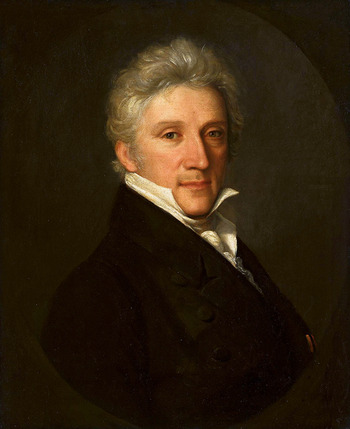
Portrait of Count Leopoldo Cicognara. Oil Painting (1824–1831) by Natale Schiavoni (1777–1858). National Museum in Warsaw (MNW).

The difficulty of consolidating the descriptions in the Catalogo with the physical objects in the Vatican Library's collection is most extreme in cases where Cicognara mentions a title more than once in the Catalogo. Since the catalogue is organized by topic, titles fitting in more than one category can reappear as references without necessarily referring to multiple or variant copies. More than 900 of these now designated ‘double numbers’ have been identified within the project. This issue is one of the characteristics in which the Catalogo transcends being simply an inventory.
This also indicates that Cicognara himself likely never affixed catalogue numbers to his collection. One can only imagine the truly gargantuan task librarians faced when twenty-seven crates containing unnumbered books arrived at the Vatican LibraryFootnote 27 in 1824. It is due to the librarians’ diligence and care in organizing nearly 5,000 titles that the collection's significance for art scholarship is undiminished nearly a century later. Any assessment of the true nature of relationships and variations in the Fondo Cicognara would not have been possible without generous access to the archives provided by the Vatican Library.
Another challenge facing the project partners is the existence of variant printings when attempting to identify correct matches in their own holdings. Here, Cicognara's remarks can provide valuable clarification. In the case of the print collection Maniere de bâtir pour toute sortes de personnes Footnote 28(Catalogo numbers 574 and 575) he already noted that an undated variant he had acquired would often falsely be referred to as ‘seconda edizione.’ Actually, he knew of multiple previous editions published since the first printing in 1623. Comparing bibliographic records at different institutions in order to determine the date of Cicognara's copy revealed suggested publication dates spanning nearly a hundred years. Access to multiple copies allowed librarians to determine that the plate numbering was reworked after 1681, while additional research into the publishers’ histories eliminated suggested publication dates into the 1720s. The Digital Cicognara Library project will allow research notes to be included in proper context with bibliographical data and multiple print examples. While finding exact matches can be difficult where no direct equivalent to Cicognara's original can be found, variations and annotations offered by the project partners and scholars will provide valuable information not only about readers, but also about collectors, publishers, and the historical dissemination and reputation of these texts.
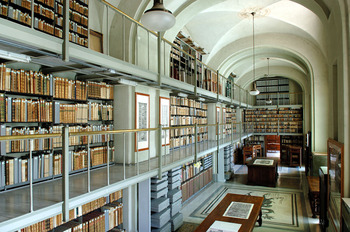
The Fondo Cicognara at the Biblioteca Apostolica Vaticana. Courtesy of The Biblioteca Apostolica Vaticana, Gabinetto della Grafica ©2017.

Cicognara, Leopoldo, Catalogo Ragionato Dei Libri D'arte e D'antichità Posseduti Dal Conte Cicognara. Pisa: N. Capurro, co'caratteri di F. Didot, 1821. Courtesy of Marquand Library of Art and Archaeology, Princeton University.

Leonardo, Leon Battista Alberti, Raphael Trichet du Fresne, and Cosimo Bartoli. Trattato Della Pittvra Di Lionardo Da Vinci. Parigi: Appresso Giacomo Langlois, … Courtesy of Marquand Library of Art and Archaeology, Princeton University.

The future of the Digital Cicognara Library
In the last four years, in-kind funding provided by the Digital Cicognara Library founding partnersFootnote 29 and other generous grants from the Samuel H. Kress Foundation and the J. Paul Getty Trust has supported the project's development. At this writing, the web site's features are largely formulated and partners are implementing plans to complete access to more than 60% of the high-resolution digital surrogates. The partners continue to strategize outreach methods and think broadly about potential users. The long-term future of the project is dependent on building an extensive user community and promoting new applications for research and relevance to emerging digital humanities projects. In 2020, the project partners are planning a formal launch of the Digital Cicognara Library website to various academic communities, complemented by a targeted outreach program, with hopes of bringing further awareness to Cicognara's legacy. The ultimate goal will be to provide, with the Vatican Library, a resource with multi-faceted uses, a variety of user communities, and a sustainable working model for a multi-institutional scholarly project.
Acknowledgments
The authors wish to thank the many individuals representing partner institutions for their time and commitment in developing the Digital Cicognara Library over the last six years.