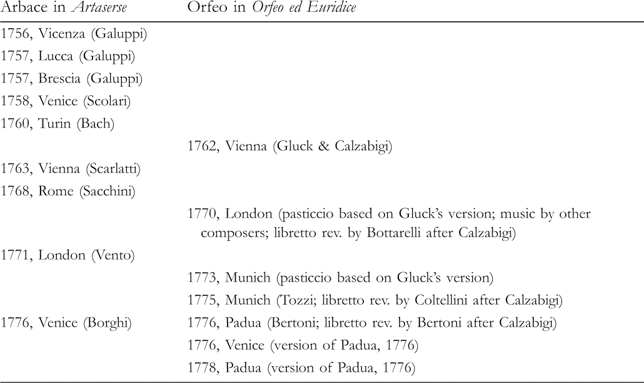
Gaetano Guadagni is one of eighteenth-century opera’s household names, thanks to his creation of the male title character in Gluck’s reform masterpiece Orfeo ed Euridice for Vienna in 1762. His many subsequent appearances as Orfeo led Patricia Howard, the author of several studies on the singer (including a recently published biography), to state that he was one of the first to build his career through identification with a single role.Footnote 1 Indeed, seminal studies by Daniel Heartz and Bruce Alan Brown had already established the significance of Guadagni’s portrayal of Orfeo within its Viennese context.Footnote 2 However, Guadagni began to build his career not with Orfeo, but with Arbace in Metastasio’s Artaserse, the most popular opera seria of the century since its creation in 1730. As shown in Table 1, he performed Arbace in settings of Artaserse nine times by seven different composers – more times than he performed Orfeo ed Euridice and over a longer period (twenty years for Arbace against sixteen for Orfeo). His identification with Arbace was so strong that it was probably the reason Turin’s Teatro Regio chose Artaserse’s libretto for carnival 1761, after Guadagni was hired; Guadagni himself might have suggested the opera to the theatre’s administrative directors.Footnote 3 Johann Christian Bach then set the libretto for Turin, as his first opera seria.
Guadagni’s performances of Arbace and Orfeo.

Note: Compiled from librettos as in Claudio Sartori, I libretti italiani a stampa dalle origini al 1800, 7 vols. (Cuneo, 1990–94) 1: 308–31 and elsewhere, scores as in RISM, Roberto Verti, Un Almanacco drammatico: Indice de’ teatrali spettacoli, 2 vols. (Pesaro, 1996), and Patricia Howard, The Modern Castrato: Gaetano Guadagni and the Coming of a New Operatic Age (Oxford, 2014), 177, 213–18.
An unusual piece evidently became linked with Guadagni’s interpretation of Arbace. At its core is an aria text, ‘Vivrò se vuoi così’, which represents a remarkable transformation: initially deriving from Metastasio’s duet ‘Tu vuoi ch’io viva, o cara’, for Arbace and Mandane, in Act III, scene 7, the aria text appeared in different guises as it moved among different singers. Eventually it reached the form in which it was set at least three times during the century: by an unknown composer, by Baldassare Galuppi and by Johann Christian Bach. Its poet is unknown. Unlike a traditional insertion or substitute aria, which transplanted text and music together into a new setting, this text travelled both with and without its music. This ‘suitcase text’ and its settings by Galuppi, and then Bach, became Guadagni’s calling card in his early performances of Arbace, during which he established himself as a performer of leading opera seria roles.
The text, its settings, and their contexts demonstrate how important an aria and its evolution might be to an eighteenth-century singer as he constructed a public persona. Looking both backward and forward in time at singers and how they formed repertories, the importance of Arbace as a role in Guadagni’s career aligns with observations made by Jennifer Williams Brown and Hilary Poriss on Italian opera arias, how they were constructed, and the meanings they conveyed to audiences.Footnote 4 Williams Brown has demonstrated that seventeenth-century singers shared a central repertory of arias as a sort of community property that she likens to a ‘recycling box’, while Poriss has shown that nineteenth-century singers chose certain arias specifically to encourage associations between themselves and other performers.Footnote 5 Through permutations of its text, Guadagni’s aria links him to two other iconic singers who portrayed Arbace, Carlo Broschi (known as Farinelli) and Gioacchino Conti (known as Giziello or Egiziello).Footnote 6 Although Robert Freeman’s study of Farinelli’s interpolated arias had established that the singer possessed an evolving corpus of flexible pieces, few such examples connected to singers from the eighteenth century’s later decades have come to light.Footnote 7 Guadagni’s ‘hit’, to borrow a term used by both Brown and Poriss, seems to have functioned as a musical envoy or calling card for the singer in the mid-century, when he relaunched his career in Italy after some eight years in London, Portugal and elsewhere.Footnote 8 This piece in its multiple settings, and their contexts, therefore illuminates a crucial facet of a leading singer’s career, as Guadagni established a reputation as one of the era’s international star performers.Footnote 9
In order to appreciate the significance of this interpolated aria, it is necessary to step back and examine its emergence in the context of Guadagni’s career and the opera as a whole. Artaserse was a classic in the dramma per musica genre and, as noted above, Metastasio’s most popular libretto; after its inaugural setting by Leonardo Vinci for Rome in 1730, about eighty-five composers set it for theatres across Europe.Footnote 10 The story’s numerous conflicts and theme of injustice gave composers ample opportunities to create interesting music for characters in highly charged situations. Artabano, chief officer to Serse, King of Persia, wishes for his son to ascend the Persian throne. He murders Serse, and convinces Artaserse, one of the slain king’s sons, that the other son, Dario, is the assassin. Dario is executed. Arbace, Artabano’s son and Artaserse’s friend, is subsequently accused of Serse’s murder and sentenced to death (the scene shown in Fig. 1). Artabano tries to help his son flee, but Arbace refuses. Artaserse visits his prison cell and convinces him to escape. Mandane, Arbace’s beloved and Serse’s daughter, struggles with her feelings for Arbace, love conflicting with hatred for supposedly having murdered her father. Eventually, to keep Arbace from drinking from the poisoned cup intended for Artaserse, Artabano confesses to the murder, absolving Arbace. The lovers are reconciled, and Artaserse pardons Artabano.Footnote 11
(colour online) Artabano condemns his son to death. Act II, scene 11. Engraving from the Complete Works of Metastasio (Paris: Hérissant, 1780–2).
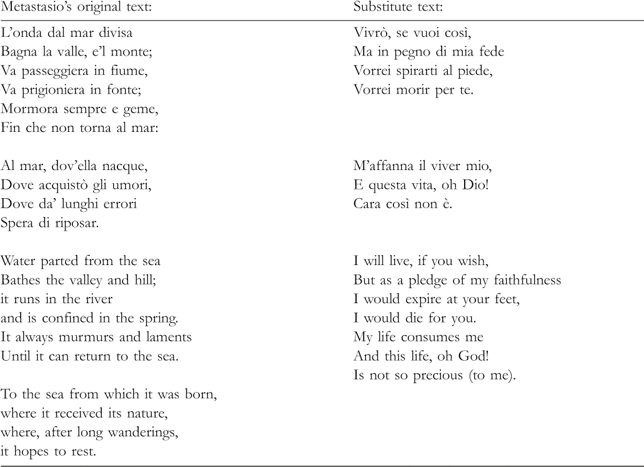
In his 1756 debut as Arbace, in Vicenza, Guadagni was starring not only in Metastasio’s most popular work, but also in a setting of it by the most popular opera seria composer at mid-century: Baldassare Galuppi. The composer set the libretto for Vienna in 1749, and a revised version opened Padua’s opera house in 1751.Footnote 12 Settings of Artaserse by Galuppi were revived around Italy for a decade thereafter.Footnote 13 Guadagni sang Arbace in three of these revivals in successive years: 1756 in Vicenza; 1757 in Lucca; and 1758 in Brescia. He also sang Arbace in Giuseppe Scolari’s setting for Venice in 1758 and Giuseppe Scarlatti’s in Vienna in 1763, before singing Bach’s for Turin in 1760. In the librettos for all three performances of Galuppi’s setting in which Guadagni sang, and in librettos and scores for Bach’s setting for Turin, the aria ‘Vivrò se vuoi così’ concludes Act III, scene 1, replacing Metastasio’s original ‘L’onda dal mar divisa’:Footnote 14
Aria for Arbace concluding act 3, scene 1, Artaserse: Metastasio’s original and substitute text.
The substitute text does not appear in Galuppi’s 1749 score or the libretto for Vienna, or in the 1751 Padua libretto, or in any other librettos for revivals of Galuppi’s settings until 1756 in Vicenza.Footnote 15 A surviving copy in Galuppi’s hand confirms its connection to the composer; presumably Galuppi wrote it for Guadagni to perform in the 1756 revival.Footnote 16 Howard notes that 1756 was a crucial year in Guadagni’s career, following his flight to Italy from Lisbon after the earthquake and consequent destruction of the court theatre there the previous year.Footnote 17 That Charles Burney referred to him as ‘Gaetano Guadagni of Vicenza’Footnote 18 confirms the importance of the engagement in this year. The aria thus seems to figure even more significantly in the development of Guadagni’s career.
The scene in which the aria appears (Act III, scene 1) opens with a cavatina in which Arbace grieves over his imprisonment, death sentence and abandonment. His friend Artaserse enters and commands him, as his king, to escape. Metastasio’s elegant verses, in which Arbace compares himself to a wave divided by the sea, are replaced with the new aria’s shorter, more direct and personal statement of loyal friendship. The sincerity and urgency of the new aria’s text seem to align perfectly with Guadagni’s reputation as a singing actor, one promulgated by Burney and others who praised the singer for his expressive performances. As Daniel Heartz has shown, Guadagni was revered for bringing the ‘naturalistic’ style of English actor David Garrick to the opera stage.Footnote 19 The critical point in Metastasio’s drama where the aria appears affords a view of the depth of Arbace’s sincerity: having been rejected by his father and his lover, he laments his fate in the cavatina, and, after Artaserse rushes in and frees him, Arbace promises to live but swears fidelity to his best friend, avowing that his friendship means more to him than his own life. This moment would have pleased any singer who cared deeply about interpreting a role, as Guadagni certainly did.
The significance of this aria in Guadagni’s career depends in part on the strength of its association with him. So far, Galuppi’s is the earliest setting I have found of this text, but the waters are muddied – in potentially productive fashion – by an attractive portrait of an eighteenth-century singer, who holds a sheet of music containing a setting of its first few lines (Fig. 2).Footnote 20 Daniel Heartz has argued that the painting’s subject is Carlo Scalzi, a castrato who enjoyed an international career during the 1720s and 1730s; he sang in Venice and other major Italian cities, and Handel engaged him for London.Footnote 21
(colour online) Charles Joseph Flipart, ‘Portrait of Signor Scalzi’, Sumner Collection Fund 1938.177, Wadsworth Atheneum, Hartford, CT. Reproduced with permission.
The labels ‘Act 3’ and ‘Arbace’ appear in the painting’s musical fragment, to which the singer gestures (see Ex. 1). A name appears in the fragment as well, although cracks in the paint almost completely obscure its spelling. According to Heartz, the name is ‘Sig. Scalzi’. Heartz claims that Scalzi sang the role of Arbace in a 1731 Roman revival of Vinci’s famous original setting, citing a letter from Metastasio to a Roman correspondent in 1731.Footnote 22 Although no libretto survives to corroborate a Roman revival in 1731, the letter’s wording strongly implies that one occurred and that Scalzi sang in it. (In addition, according to Kurt Markstrom, a collection of manuscript copies of arias labelled ‘Nell’ Artaserse 1731’ derives from this revival, although a setting of ‘Vivrò se vuoi così’ is not among them.Footnote 23) The music in the fragment does not match Vinci’s setting of the original opera nor Galuppi’s setting of this text. Heartz conjectures that Scalzi himself composed it.Footnote 24 As Heartz points out, the attractive melody is full of galant gestures: the short phrases, the third of which repeats the second in the familiar ABB’ pattern; the triplet setting of ‘vuoi’; and the rapid descent to A in the vocal line at the beginnings of bars 5 and 8.Footnote 25 The piece fits perfectly in the stylistic milieu in which Scalzi flourished.
Daniel Heartz’s transcription of musical fragment from ‘Portrait of Signor Scalzi’.
The identification of the singer as Scalzi is by no means certain, however. Its partial evidence raises numerous questions. Above all, instead of Scalzi, could the singer in the painting be Guadagni, since he holds an aria with text matching one that Guadagni sang? This seems unlikely since the subject does not appear to match other likenesses of Guadagni, although problems with the related iconographical sources leave this question open. Furthermore, the singer’s name in the painting’s musical fragment bears no resemblance to ‘Guadagni’. But is that name actually ‘Scalzi’, or something else? And might the ascription to ‘Arbace’ refer to an opera other than Artaserse? When I examined a high-resolution copy of the painting, I found that the shape of the letter ‘a’ in the name which might be ‘Scalzi’ resembles more closely the ‘o’ in ‘Atto’ and ‘Terzo’. Domenico Scogli di Senigallia (Sinigaglia) sang Arbace in Metastasio’s Catone in Utica (Pesaro, 1752), a production with music by several composers. Nowhere in the printed libretto for the Pesaro production does the text for ‘Vivrò se vuoi così’ appear, however.Footnote 26 I have found no evidence linking Scalzi to a production of Catone in Utica, and, considering the other operas in which ‘Arbace’ was a character, nor is ‘Vivrò se vuoi così’ present in sources I consulted for such works: Arbace (poetry by Gaetano Sertor) and Idomeneo (poetry by Giambattista Varesco).
Finally, I considered whether or not the aria appeared in other settings of Artaserse, ones unrelated to either Guadagni or Scalzi, and what its origins might have been. My survey of about seventy librettos and scores from between 1705 and 1789 (listed in the Appendix) yielded no additional appearances of ‘Vivrò se vuoi così’. While sources unavailable to me might eventually confirm the aria’s presence in an opera prior to 1756, up to now the only evidence for its link to Scalzi is the speculative conjunction of Flipart’s painting and Metastasio’s letter, which is admittedly inconclusive.Footnote 27 While Scalzi is one candidate for the subject’s identity, Scogli seems possible as well; the absence of ‘Vivrò se vuoi così’ in numerous librettos for Artaserse that both pre- and post-date Scalzi’s activity, along with other conjectures surrounding the painting, would suggest that further evidence is necessary for a definitive assessment of the painting’s contents. But the association of this aria text with another singer, presumably prior to Galuppi’s setting for Guadagni, also raises intriguing questions about the latter singer’s connection with the piece.
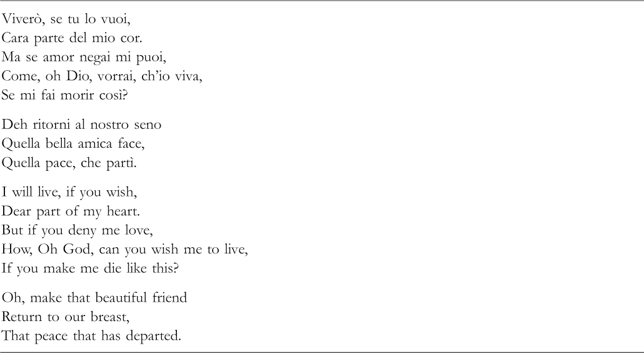
Considering the evolution of this aria text more generally, indeed, demonstrates the tradition of singers emulating others, a practice that would thereby evoke images of successful predecessors in the minds of appreciative audiences. As we have seen, the text derives from Metastasio’s original 1730 duet for Arbace and Mandane in Act III, scene 7, ‘Tu vuoi ch’io viva, o cara’.Footnote 28 An aria sung by Arbace alone had replaced the duet in two earlier Venetian settings. In both, Mandane exits in the previous scene, having urged Arbace to save himself, and Arbace sings to her longingly in her absence. The first, from 1734 (a setting by Vinci), was sung by Farinelli, whose recitative begins with a line ‘Crudel, tu vuoi ch’io viva’, which resembles the duet’s opening phrase. Another, from 1750, was Gaetano Pampani’s setting of the libretto, in which the substitute aria text seems like a link between the ousted duet and ‘Vivrò se vuoi così’:
‘Viverò se tu lo vuoi’, substitute aria text, Artaserse, act 3 scene 7 (Venice, 1750).
Pampani’s ‘Viverò se tu lo vuoi’ was sung in Venice by the great Gioacchino Conti (detto Giziello) as Arbace, whom Burney named as Guadagni’s teacher. Numerous copies survive, attesting to the aria’s popularity.Footnote 29 The possibility that Guadagni received the text from Giziello and adapted it for his own use a few years later in nearby Vicenza as ‘Vivrò se vuoi così’ is tempting to consider.Footnote 30 Whatever the pedagogic relationship between Giziello and Guadagni, the rising star might have sought to capitalise on the successes of the established one from just a few years earlier in a nearby city, with a variation on a piece for which Giziello probably received many accolades. The apparent process of adaptation involved more than a change in the aria’s poetry. In fact, the aria migrated from one spot in the drama to another, and consequently became an address to a different character. In Galuppi’s 1756 setting of the libretto for Vicenza (and in Bach’s for Turin) the duet was not cut, as it was in Venice. ‘Vivrò se vuoi così’ appears earlier in the action, and Arbace sings it to Artaserse, not Mandane. Whereas in the version Giziello sang (‘Viverò se tu lo vuoi’), Arbace asks how Mandane can bear to inflict so great a punishment on him as to deny him her love; in the version Guadagni sang (‘Vivrò se vuoi così’), Arbace pledges his love and faithfulness to his best friend. The more optimistic tone of the text is perfectly matched by Galuppi’s music.
Whatever resonances there might have been with earlier texts for other singers, for Galuppi’s aria to become Guadagni’s calling card, it had to fit its singer like a well-made suit of clothes (to paraphrase Mozart’s famous metaphor from 1778).Footnote 31 And Galuppi’s setting of ‘Vivrò’ indeed seems tailor-made for Guadagni (see Ex. 1). It foregrounds what contemporaries considered Guadagni’s strengths: its graceful, lyrical, legato lines, sung at a medium tempo, call for a sensitive and expressive delivery. The largely syllabic setting of this charming F major piece includes just one four-bar melismatic phrase, early in the reprise of the A section. The vocal line ascends above the treble stave only once, in an ornament, and never descends below c′; it lies primarily between c′ and c′′ to e′′. Obbligato flutes join the string ensemble only once, towards the end of the A section. The tessitura broadens along with the tempo in the B section, and the da capo return includes an abbreviated ritornello. Following Howard’s discussion of pieces for Guadagni by composers such as Ciampi, Piccinni, Guglielmi, Traetta and Gluck, we can see that features of ‘Vivrò se vuoi così’ correspond to those in other arias that display the singer’s strengths.Footnote 32 According to Howard, Guadagni, as a ‘romantic lead’, specialised in pieces in the categories of aria parlante (syllabic and declamatory, with no embellishment) and aria cantabile (lyrical, in simple duple or triple metre, and ‘natural and elegant’ according to Burney).Footnote 33 Galuppi’s aria cantabile for Guadagni – important especially since the singer evidently favoured it and performed it often – deserves to be considered as chief among those that illuminate his vocal profile.
Baldassare Galuppi, ‘Vivrò se vuoi così’, Artaserse (Vicenza, 1756). Author’s transcription.*
Footnote By 1760, Guadagni had sung Galuppi’s setting of the text in three different Italian cities. Such repetition suggests that the aria had become Guadagni’s signature piece in his performance of Arbace. There is no evidence he repeated any other aria in the opera as often. The possibility that Guadagni influenced its inclusion in the Turin production, which used a new setting of the opera, by J.C. Bach, is supported by evidence from a number of institutional sources. The aria text was inserted in the body of the 1760 Turin libretto at an early stage rather than being added later, at the end of the bound volume, as was often the case with insertion arias in Turinese librettos at this time. The copy of the libretto that Turin’s administrative directors sent to Bach must have included it.Footnote 34 Its incorporation into the Turin score seems to represent a compromise consistent with the Teatro Regio’s institutional practices. Guadagni had his signature aria included, but in a setting by Bach, which upheld Turin’s standard contract (see Fig. 3): composers were required to present music that was ‘entirely new and not previously heard’.Footnote 35 Nonetheless, Guadagni’s and Bach’s Turinese engagements demonstrate that in Turin as elsewhere, singers generally enjoyed greater prominence than most other creative personnel in the hierarchy of eighteenth-century Italian operatic production.Footnote 36 The administrative directors of the Teatro Regio hired the internationally recognised Guadagni to perform the leading male roles in the theatre’s two operas for carnival 1761 on 16 February 1759 – almost two years before the premiere of Bach’s Artaserse on 27 December 1760.Footnote 37 At that point, the twenty-five-year-old Bach had never composed a full-length opera; the directors hired him at the last minute, sometime in June 1760, as their second choice when Johann Adolph Hasse declined, after a long delay.Footnote 38 Bach’s payment – 130 zecchini gigliati, a unit of currency common in northern Italy at that time – was less than half what Guadagni earned for his performance in Artaserse alone. Singers were paid by the season, and Guadagni took in 800 zecchini gigliati for both operas, the top of Turin’s pay scale. Given these circumstances, it is hard to imagine Guadagni giving up the known setting of ‘his’ aria in favour of one by an unknown composer. Perhaps Bach’s represented a placeholder in the score for Galuppi’s, added when Guadagni arrived in Turin. Extensive evidence in production materials linked with the Teatro Regio attest to the practice, so an addition such as this one would have been entirely consistent with Turinese tradition.Footnote 39 Which musical setting of ‘Vivrò’ Turin audiences actually heard is an open question.
(colour online) Johann Christian Bach’s contract for Turin’s Teatro Regio. Reproduced with permission of the Archivio Storico della Città di Torino (duplication prohibited).
Whether Bach’s aria was performed or not, the composer was diligent in suiting his music to the singer’s vocal style (see Ex. 3). Like Galuppi’s setting, Bach’s highlights Guadagni’s strengths. While in length, lyricism and tempo they are comparable, in orchestration and aspects of the text setting they vary. To the basic string group Bach adds oboes and horns, and an obbligato bassoon and cello – a clear sign that Bach intended this aria to command special attention. A showy, extended passage on ‘fede’ towards the end of the reprise of A culminates in a four-bar sustained G (which the solo cello and bassoon decorate), before a final sequence and cadenza-like flourish. The B section’s contrasting affect is created not so much through tempo (the Andantino in 2/4 switches to an Allegretto in 3/8) as in the straightforwardness of the syllabic setting. Bach’s C major setting is slightly more elaborate and extroverted than Galuppi’s, though not significantly more difficult. Bach’s is deeper in range; it never ascends above the treble stave (f′′), and generally lies a little lower than Galuppi’s. Both settings bear hallmarks of what Heartz terms ‘the Guadagni style’: grace, lyricism and simplicity pervade, and neither is particularly demanding.Footnote 40 Pieces that Handel revised for Guadagni, earlier in the singer’s career, likewise provided opportunities for displays of agility that resemble the ones in Bach’s setting.Footnote 41 If Guadagni sang Bach’s setting in Turin, the Teatro Regio’s public heard an aria that demonstrated the singer’s flexibility, in a piece that combined some passages that are slightly more virtuosic than most of Galuppi’s, with the expressive, legato phrases that were Guadagni’s trademarks. Might the attention Bach lavished on this aria indicate a spirit of emulation with the senior, feted Galuppi – a demonstration to Guadagni that Bach’s aria, too, was worthy of being sung by the great musico? At the very least, it suggests the young composer’s desire to ensure the success of his first opera for a leading Italian theatre by presenting the Footnote directors with an aria for the primo uomo that showcased not just the singer, but also the Teatro Regio’s orchestra. This ensemble was among the largest of Italy’s theatrical orchestras (together with those of Milan and Naples) and considered one of its best.Footnote 42 By highlighting the soloistic abilities of two of its members (cello and bassoon), Bach went one step further in displaying it to greatest effect.
Johann Christian Bach, ‘Vivrò se vuoi così’, Artaserse (Turin, 1760). Author’s transcription.**
Whichever setting Guadagni performed, his aria was apparently appreciated in Turin, judging from evidence associated with the libretto. Turin’s 1760 libretto includes the duet in its usual placement in Act III, scene 7. The cavatina, which opened Act III in Metastasio’s original, was cut from the 1760 Turin revision. Its excision shortened the scene and placed the focus firmly on the longer, concluding aria.Footnote 43 Indeed, one copy of the Turin libretto exhibits manuscript marks in pencil and crayon indicating elimination of the B sections of almost all of the arias.Footnote 44 The final scene of Act I in this copy is completely cut by means of a pencilled-in bracket. Evidence from other Turin librettos strongly suggests that these marks reflect actual performances or plans for at least one of them; Artaserse’s content was therefore significantly shortened (or was intended to be) in at least one Turinese performance.Footnote 45 ‘Vivrò se vuoi così’ is one of the few arias left untouched in this copy of the libretto. Turin audiences might have heard only fractions of Bach’s other pieces, but they heard all Guadagni’s signature aria, whether in Galuppi’s setting or Bach’s.Footnote 46
Guadagni continued to sing Arbace for Italian theatres after his creation of Orfeo in Gluck’s opera. He recreated Arbace twice more, for Rome in 1768 (in a setting by Sacchini) and Venice in 1776 (in a setting by Borghi), although his signature song does not appear in librettos for these productions. Perhaps by that time Galuppi’s setting of some ten years earlier seemed old-fashioned and Guadagni abandoned it for stylistic reasons. Both Arbace and Orfeo are characters that summoned forth Guadagni’s special strengths as an interpreter of pathetic roles. That he sang Arbace in Italy more frequently than he did Orfeo probably derived in part from basic difficulties Italian theatres experienced in producing reform operas on their stages, difficulties that often had more to do with conventions of their institutional practices than with aesthetic issues.Footnote 47 In fact, all performances of Gluck’s Orfeo in which Guadagni participated, subsequent to the original Viennese production, were in some modified form.
Orfeo and Arbace coexisted as iconic roles in Guadagni’s repertory, his signature aria in the latter contributing to his rise to celebrity status. More importantly, this intriguing piece in its multiple settings and contexts demonstrates that arias represented more than opportunities for a singer to put his or her personal stamp on a role. Arias communicated not just a singer’s individuality, but also membership and participation within a community, with a range of meanings as potentially broad and rich as the community itself.
Appendix:
Librettos and scores for selected settings of Artaserse, 1705–1789 RISM sigla are used. Other abbreviations: IC=Internet Culturale: www.internetculturale.it Items mentioned in the essay are marked in bold below. Relevant aria texts when present appear in the “notes” column.