




No CrossRef data available.
INTERACTION AND SYNTACTIC PRIMING: English L2 Speakers' Production of Dative Constructions
Published online by Cambridge University Press: 21 April 2006
Abstract
Interaction research about the role of language production in second language (L2) development has focused largely on modified output, specifically learners' responses to negative feedback (Iwashita, 2001; Loewen & Philp, in press; Mackey & Philp, 1998; McDonough, 2005; McDonough & Mackey, in press; Nobuyoshi & Ellis, 1993; Pica, 1988; Shehadeh, 2001). However, other processes involved in language production might help account for the beneficial relationship between interaction and L2 development. This paper reports the findings of two experiments that examined the occurrence of syntactic priming—a speaker's tendency to produce a previously spoken or heard structure—during interaction between L2 English speakers. Both studies used confederate scripting to elicit dative constructions from advanced English L2 speakers. In experiment 1, the participants (n = 50) were exposed to both prepositional and double-object dative primes. The linear mixed-model analysis indicated that syntactic priming occurred with prepositional datives only. In experiment 2, the English L2 participants (n = 54) received double-object dative primes only; results showed no evidence of syntactic priming. The implications are discussed in terms of the potential role of syntactic priming in driving L2 development in interactive contexts.This research was supported by grants (03135 and 04184) from the campus research board at the University of Illinois at Urbana-Champaign. I am grateful to Nick Ellis, Susan Gass, Alison Mackey, and Pavel Trofimovich for their insightful comments on this paper and to Ron Crawford for his assistance with the coding. Any errors, of course, are my own.
Information
- Type
- Research Article
- Information
- Copyright
- © 2006 Cambridge University Press
The interaction hypothesis of SLA (Gass, 2003; Long, 1996; Mackey, in press; Pica, 1994) states that interaction facilitates second language (L2) development by bringing together input features (e.g., negative feedback), internal learner capacities (e.g., attention), and language output. Empirical studies have demonstrated the positive effect of interaction on L2 development for several linguistic forms, including adverb placement in Spanish (Long, Inagaki, & Ortega, 1998), noun-adjective gender agreement in Spanish (Leeman, 2003), past tense in English (Han, 2002; Mackey, 2000), past tense and subjunctive in French (Ayoun, 2001), verbal morphology in Japanese (Iwashita, 2003), and question development in English (e.g., Mackey, 1999, 2000; Mackey & Oliver, 2002; Mackey & Philp, 1998; McDonough, 2005; McDonough & Mackey, in press). Researchers have proposed various reasons for why interaction facilitates L2 development: It provides negative feedback (Long; Schachter, 1986, 1991), enhances the salience of positive evidence (Leeman, 2003), raises learners' awareness of language form (R. Ellis, 1991; Gass, 1997, 2003; Long; Mackey, in press; Pica, 1994; Schmidt, 1995, 2001; Swain & Lapkin, 1995), and creates opportunities for learners to produce the target language and modify their inappropriate or ungrammatical utterances (Swain, 1985, 1993, 1995, 2000).
Interaction research into the role of language production in L2 development has focused primarily on modified output, specifically learners' responses to negative feedback (Iwashita, 2001; Loewen & Philp, in press; Mackey & Philp, 1998; McDonough, 2005; McDonough & Mackey, in press; Nobuyoshi & Ellis, 1993; Shehadeh, 2001). However, other processes involved in language production might be beneficial for L2 development as well. For example, Swain (1985) argued that producing language might encourage learners to move from semantic processing to syntactic processing. She claimed that although it is possible to comprehend input without analyzing its syntactic features, producing output “may be the trigger that forces learners to pay attention to the means of expression” (p. 249) necessary to successfully encode their intended meaning. For example, when comprehending language, a learner might understand the meaning of the utterance “my sister played tennis” without analyzing the form or function of the past tense morphology. However, when producing language, the learner might be more likely to pay attention to that morphology in order to communicate their intended meaning. Similarly, in a discussion about models of speech production, Bock (1995) proposed that a speaker might deploy syntax differently in comprehension and production. Whereas listeners might ignore structural features that are not crucial to understanding message content, speakers need to encode structural features in order to produce utterances that convey their intended meaning while satisfying the constraints of the target language. Although a common representational system might underlie the production and comprehension of syntactic forms, the processing mechanisms involved in production and comprehension might differ (Huttenlocher, Vasilyeva, & Shimpi, 2004). Bock (1990) also suggested that language production might involve distinct processing mechanisms that create either meaning or form. Using evidence from psycholinguistic research that involved speech errors, she argued for a dissociation of meaning-oriented and structure-oriented processes. She pointed out that speech errors are constrained by structural conditions that remain in place despite disruptions in meaning (e.g., errors that involve substitution occur between members of the same grammatical form class, which preserves the structural integrity of the utterance even when the meaning is ill-formed). She concluded that the production processes that create sentence structure might not be identical to the processes that create meaning.
Based on the findings of syntactic priming research, Bock (1990) also argued for a uniquely structural component of language production. Syntactic priming (also referred to as structural priming) is a phenomenon that is characterized by a speaker's repeated production of a previously spoken or heard structure across successive utterances (Bock, 1995).1
The term syntactic priming has also been used to refer to facilitation in the processing of a word due to compatibility of that word with a preceding syntactic context (Friederici, Schriefers, & Lindenberger, 1998; Nicol, 1996).
The overall focus of syntactic priming research is to demonstrate that when speakers have a choice between alternative structures, they produce the structure that was previously produced or heard. The example given in (1) (from the current study) illustrates syntactic priming that involves a structure previously produced by a speaker. The speakers (nonnative speakers [NNSs] of English) were carrying out a picture description and matching activity in which they took turns describing a picture and listening to their partner's picture description (turn numbers are provided in brackets). In this phase of the activity, speaker A had pictures that illustrated dative verbs, but speaker B did not. Speaker A produced a double-object dative to describe a picture of a boy pouring juice for his friend (turn 20). Several turns later, she produced another double-object dative when describing a scene involving a waiter and a little girl (turn 26).

The number in parentheses after each example refers to the participant number and the letter refers to either production priming (P) or comprehension priming (C).
In this example, speaker A had a choice: to describe the actions depicted in both pictures using either a prepositional dative or a double-object dative. Her initial production of a double-object dative in turn 20 was followed by the production of that same structure when she described a completely different picture in turn 26.
In (1), syntactic priming involved speaker A, whose initial utterance was followed by a subsequent utterance with the same structure; this behavior did not appear to be influenced by speaker B, who had not produced any dative constructions. However, a speaker might produce a structure that was initially used by an interlocutor, as shown in (2). The speakers (NNSs of English) were carrying out the same picture description and matching activity, except that in this phase of the activity both speakers had pictures that illustrated dative verbs. Speaker A used a double-object dative to describe a picture of a man showing a boot to a woman, immediately after which, speaker B used a double-object dative to describe a picture of a woman teaching a game to some children. Speaker B could have expressed the actions depicted in his picture by using either a prepositional dative or a double-object dative, but he used the same form as his interlocutor.

The repeated use of a particular structure—despite the availability of other structures that can express the same meaning—is the focus of syntactic priming research.
The findings of syntactic priming studies have shown that speakers repeatedly use syntactic structures that were previously heard or produced, even when the initial and subsequent utterances have different content words, closed-class elements, and thematic compositions and share no topical or pragmatic similarities (Bencini, Bock, & Goldberg, 2003, cited in Gries & Wulff, 2005; Bock, 1986, 1989, 1990; Bock & Loebell, 1990; Bock et al., 1992; Hare & Goldberg, 1999). Thus, speakers are sensitive to repeated experiences with a syntactic structure, rather than to repeated experiences with surface-level features. Consequently, syntactic priming does not occur when the initial and subsequent utterances have different syntactic structures, even if they have similar words, syllables, and lexical stress patterns. For example, Bock and Loebell showed that speakers produced more datives after dative sentences (e.g., “Susan brought a book to Stella”) than after sentences with infinitives (e.g., “Susan brought a book to read”), even though the two sentence types were very similar in terms of their word order and stress pattern. Whereas early syntactic priming research attributed syntactic priming to mental processes that involve syntactic phrase structure, more recent work has adopted a construction grammar approach (Chang, Bock, & Goldberg, 2003; Goldberg & Bencini, 2005; Gries & Wulff; Hare & Goldberg), which attributes syntactic priming to mental processes that involve abstract argument-structure constructions.
Finally, several studies have shown that syntactic priming in L1 spoken production occurs even when the initial and subsequent utterances are separated by intervening material and time (Bock & Griffin, 2000; Branigan, Pickering, Stewart, & McLean, 2000; Hartsuiker & Kolk, 1998; Huttenlocher et al., 2004). For example, the participants in Bock and Griffin's study used the same dative construction in successive utterances even when the initial and subsequent utterances were separated by up to 10 unrelated intervening sentences (intransitives and predicate adjective constructions). Syntactic priming also persists when intervening time separates the initial and subsequent utterances, ranging from a 1-s delay (Hartsuiker & Kolk) to a 20-min interval (Boyland & Anderson, 1998). The persistence of syntactic priming across intervening material and time has led some researchers to suggest that it might represent a form of implicit learning (Chang, Dell, Bock, & Griffin, 2000). Although all syntactic priming research investigates speakers' subsequent production of previously spoken or heard structures, researchers have used a variety of data elicitation techniques, described in the following section.
TECHNIQUES IN SYNTACTIC PRIMING RESEARCH
One commonly used method to elicit syntactic priming is a sentence repetition and picture description task (Bock, 1986, 1989; Bock & Griffin, 2000; Bock & Loebell, 1990; Bock et al., 1992; Hartsuiker & Kolk, 1998; Hartsuiker, Kolk, & Huiskamp, 1999; Loebell & Bock, 2003). In this task, participants carry out a running recognition-memory task in which they hear and repeat a sentence (the prime) and make a recognition decision as to whether they have heard it previously. Then they describe a picture that provides a context for the same structure (the target) and make a recognition decision about whether they have seen the picture previously. The recognition decisions are presented as the primary task goal, which serves to minimize the degree to which the participants consciously attend to their picture descriptions. The participants are tested individually, with the sentences presented by computer, and their repetitions and picture descriptions are audio-recorded. Syntactic priming is demonstrated when the participants describe the pictures using the same structures that they just heard and repeated.
Another common technique is a sentence completion task, which has been used to elicit syntactic priming effects in written production (Branigan, Pickering, & Cleland, 1999; Hartsuiker & Westenberg, 2000; Pickering & Branigan, 1998; Pickering, Branigan, & McLean, 2002; Scheepers, 2003) and spoken production (Branigan, Pickering, Stewart, et al., 2000; Hartsuiker & Westenberg, 2000). In written sentence completion, participants are presented with a test book that contains sentence fragments and are told to write a completion for each sentence. Some sentence fragments (primes) have been manipulated so that the participants are induced to produce a particular structure when they complete the sentences. The priming fragments are followed by shorter fragments (targets) that can be completed using one of two alternative structures. In spoken sentence completion, the sentence fragments are presented by computer and the participants read the fragments aloud and say the completions, which are audio-recorded. Syntactic priming is shown when the participants complete the target fragments using the same structures that they produced when they completed the prime fragments. Although most sentence completion research has focused on L1 speakers, Gries and Wulff (2005) elicited syntactic priming from German L1, English L2 speakers using the written sentence completion task.
Finally, sentence recall is another technique often used in syntactic priming research, particularly for structures that are difficult to elicit through picture description or sentence completion (Chang et al., 2003; Fox Tree & Meijer, 1999; Griffin & Weinstein-Tull, 2003; Lombardi & Potter, 1992; Potter & Lombardi, 1990, 1998). In this technique, participants silently read a sentence from a computer screen that shows only one word at a time at a fast rate, which is referred to as rapid serial visual presentation. They subsequently perform a distracter task and then repeat the original sentence aloud. Because of the difficulty associated with remembering the surface form, the high speed of presentation, and the intervening distracter task, participants often change the structure of the sentence when they recall it. Rather than reproduce the structure of the sentence they read most recently, participants might recall and produce the structure of an earlier sentence. The distracter task includes a lure verb in some studies; the purpose is to determine whether the participants' recall of the sentence is affected by the lure verb. For example, a speaker might be shown a sentence with a double-object dative but then perform a distracter task with a verb that only occurs in the prepositional dative form (such as donate). When asked to recall the original sentence, the participant might produce a prepositional dative rather than the double-object dative, due to the influence of the lure verb. In other studies, the participants read both a target and prime sentence and then recall either the prime or the target. The purpose of the task is to determine what factors lead participants to incorrectly recall or paraphrase the target constructions.
Although these techniques have been used to identify the constraints on syntactic priming, determine the persistence of priming, and test models of sentence production, they are unable to provide insight into the occurrence of syntactic priming during interaction because they target individual speakers. However, a more recent line of research has adopted a methodology that explores syntactic priming during dyadic interaction. This technique, referred to as confederate scripting, was created by Branigan and colleagues (Branigan, Pickering, & Cleland, 2000) to investigate whether speakers coordinate syntactic structure during conversation. They argued that speakers tend to use a grammatical form that their interlocutors just employed because coordination reduces the computational load associated with syntactic processing. Syntactic consistency between the interlocutors' adjacent utterances is not due to repetition of particular lexical expressions, and it might occur without the speakers' conscious intent or awareness. As a result, speakers might produce a particular syntactic structure repeatedly, simply because they heard their interlocutors use that structure.
To test these claims, Branigan, Pickering, and Cleland (2000) devised confederate scripting—a technique in which a participant carries out a picture description and matching activity with an interlocutor who, unbeknownst to the participant, is a confederate of the researcher.3
The role of the confederate in confederate scripting research is very similar to the role of a paid interactor or research assistant in task-based interaction research. In both research traditions, the true purpose of the study typically is withheld from the participant. However, confederate scripting includes an additional degree of deception in that the participants are led to believe that the confederate is also a participant in the study. Additionally, the researcher gives instruction and feedback to both the confederate and the participant and remains in the room while they interact.
APPLICATION TO L2 LEARNING
Previous research examined the occurrence of syntactic priming when a speaker can produce one of two equally acceptable alternatives, such as prepositional or double-object datives and active or passive sentences. However, a more interesting scenario for L2 learning involves a learner's choice between developmentally simple and advanced L2 forms, or between a nontargetlike form and the more appropriate L2 form. When a learner hears or produces a developmentally advanced form, he or she might produce that same structure in subsequent utterances. An example of syntactic priming in an interactive context is illustrated in (3) (data from McDonough & Mackey, in press). In this task, the learner (L) asked the native speaker (NS) about an experience she had trekking in Thailand, when she broke her arm. In turn 1, the learner produced the question “where you break it?” which is a stage 3 question in Pienemann and Johnston's (1987) developmental sequence for English as a second language (ESL) question formation. In turn 2, the NS provided a recast (“where did you break it?”)—a stage 5 question—and answered the question. After the learner clarified where the accident occurred and the NS replied, the learner used the developmentally advanced question form that the interlocutor had provided in the recast to ask a subsequent question in turn 5 (“why did you go there?”).

Although the learner did not immediately repeat or incorporate the recast, she used the developmentally advanced question form provided in the recast when she produced a subsequent utterance. In this case, the L2 learner might have some knowledge of the developmentally advanced question form, and syntactic priming might encourage subsequent use of that form as opposed to the less advanced form.4
The input available to L2 learners might contain exemplars of the stage 3 and stage 5 questions illustrated in (1). Although native English speakers are unlikely to produce stage 3 questions of this type, other L2 learners at the same developmental level are likely to produce such forms.
PURPOSE OF THE STUDY
As described previously, researchers are currently investigating various explanations for the empirically demonstrated positive relationship between interaction and L2 development. The purpose of the present study is to contribute to this line of research by exploring whether syntactic priming has potential to play a role in L2 development through interaction. Although previous interaction research has shown that learners use syntactic structures repeatedly across successive utterances (Mackey, 1999; McDonough, 2005; McDonough & Mackey, in press), empirical research to date has not systematically documented the occurrence of syntactic priming during interactive L2 speech production. Thus, as a necessary first step, this study explores the occurrence of syntactic priming during interaction between L2 English speakers and its impact on their subsequent production of target structures. The first research question was: Does syntactic priming occur during interaction between L2 English speakers? Because syntactic priming was found during interaction between L1 English speakers (Pickering et al., 2000) and between bilingual Spanish-English speakers (Hartsuiker et al., 2004), it was predicted to occur during L2 English interaction as well. The second research question was: Do English L2 speakers show increased use of the target structure following exposure to the confederate's primes? Given that previous research showed that syntactic priming persists in spoken sentence production (Bock & Griffin, 2000; Branigan, Pickering, & Cleland, 2000; Hartsuiker & Kolk, 1998), it was predicted that the L2 speakers would show increased production of the target structures immediately following exposure to the confederates' primes. These research questions were investigated in two experiments that targeted dative constructions. Whereas experiment 1 investigated syntactic priming for both prepositional and double-object datives, experiment 2 focused exclusively on double-object datives.
EXPERIMENT 1
Method
Participants
The participants were English L2 speakers (n = 50) enrolled in graduate-degree programs at a large public university in the Midwest. There were 26 women and 24 men who ranged in age from 23 to 39 years (M = 27.9). Most of the participants (36/50) spoke Chinese as their L1, whereas the others were NSs of Korean (7), Farsi (1), Portuguese (1), Serbian (1), Sinhala (1), Spanish (1), Thai (1), and Turkish (1). Their amount of previous English study ranged from 6 to 20 years (M = 13.1 years) and their length of residence in the United States ranged from 3 to 48 months (M = 17.1 months). They reported TOEFL scores ranging from 550 to 653 (M = 608.1, SD = 22.3), and the 35 participants who had taken the institutional speaking proficiency English assessment kit (SPEAK) test reported scores ranging from 40 to 50 (M = 44.7, SD = 2.7). They were recruited during ESL oral communication courses for international graduate students and were paid $20 to participate.5
Most of the students enrolled in the oral communication courses were preparing for teaching assistant positions in their home departments. The university required that all international teaching assistants obtain a score of 50 on the institutional SPEAK test. Students who scored lower than 50 were required to demonstrate effort to improve before taking the test again, and enrolling in these oral communication courses was an officially recognized way to demonstrate effort to improve. However, some of the students elected to take the oral communication course as a way to improve their pronunciation and academic speaking skills, such as teaching and giving oral presentations.
Target Structure
The target structure was dative alternation, which refers to alternation between the two syntactic environments in which certain dative verbs can occur—namely, as a double-object dative or as a prepositional dative. Considerable research has identified semantic, morphological, and discourse constraints that limit the productivity of dative alternation in English and has provided various theoretical explanations for alternation (Arnold, Wasow, Losongco, & Ginstrom, 2000; Goldberg, 1992, 1995; Goldberg & Bencini, 2005; Groefsema, 2001; Gropen, Pinker, Hollander, & Goldberg, 1991; Gropen, Pinker, Hollander, Goldberg, & Wilson, 1989; Jackendoff, 1990; Larson, 1988; Pinker, 1989; Sawyer, 1996; Williams, 1994; Wolfe-Quintero, 1998). L1 acquisition researchers have argued that double-object datives typically emerge before prepositional datives (Campbell & Tomasello, 2001; Huttenlocher, Vasilyeva, Cymerman, & Levine, 2002; Snyder, 2001; Snyder & Stromswald, 1997; Stromswald & Synder, 1995). In adult L2 acquisition, however, prepositional datives tend to emerge sooner and receive higher acceptability ratings than double-object datives (Hawkins, 1987; Mazurkewich, 1984; Pienemann & Johnston, 1987). The difference in acquisition orders might be related to the frequent occurrence of pronouns with the double-object dative verbs typically acquired first by children. L1 researchers adopting a construction-based approach have argued that high-frequency pronoun combinations might facilitate the transition from lexically specific to lexically general constructions (Childers & Tomasello, 2001; Dodson & Tomasello, 1998). L2 researchers have explored how dative alternation in learners' native languages—including Chinese, Korean, and Japanese—impacts their acquisition of dative alternation in English (Bley-Vroman & Yoshinaga, 1992; Inagaki, 1997; Izumi & Nishimura, 2002; Whong-Barr & Schwartz, 2002). For example, the most common L1 background in the current study was Chinese, which has constructions that are roughly equivalent to the prepositional and double-object dative forms in English. Like English, some verbs in Chinese can occur in either the double-object dative or prepositional dative form, whereas others can occur in only one of those forms (Chung & Gordon, 1998).
Design
This study used a modified confederate scripting technique (Branigan, Pickering, & Cleland, 2000; Hartsuiker et al., 2004) to explore whether syntactic priming occurs during interaction between L2 English speakers. Because confederate scripting has been used to elicit comprehension priming only, it was modified to elicit production priming as well, in order to determine whether both types of priming occur in L2 speech production. Priming type differed according to whether the participants repeated the confederates' picture descriptions (primes) before they described their own pictures (targets), as repetition of the prime was used previously in experiments testing production priming, such as spoken sentence completion and sentence recall techniques. Participants in the comprehension priming group listened to the confederate's primes and then described their targets, as shown in (4).

Participants in the production priming group repeated the confederates' primes before they described their targets, as illustrated in (5).

The participants were divided equally between the two priming groups through random assignment. The confederate scripting technique was also modified by including baseline and postpriming picture descriptions. Although baseline production has been elicited as part of the spoken sentence production technique (Hartsuiker & Kolk, 1998; Hartsuiker et al., 1999; Hartsuiker & Westenberg, 2000), it has not been elicited in confederate scripting studies, and syntactic priming studies have not elicited postpriming data.
Materials
The materials consisted of two sets of 60 picture cards. Each card had a verb printed in the corner and an illustration of people, animals, or both carrying out the action of the verb. As shown in Table 1, the participant picture set had 5 datives for the baseline phase, 12 datives in the priming phase, and 5 datives in the postpriming phase, whereas the confederate picture set had 12 datives in the priming phase only. All of the pictures that illustrated dative verbs depicted an animate agent, an inanimate patient, and an animate recipient/beneficiary. The participants' filler cards included two or three nonalternating datives (such as supply, push, shout, claim, pick) in order to create contexts for overgeneralization.6
The participants' picture descriptions for nonalternating datives were not considered in the analysis because there were no instances of overgeneralization.
Materials

The pictures and verb prompts were pilot tested with native (n = 25) and nonnative (n = 24) English speakers studying at the same university. Datives that did not consistently elicit sentences with both a patient and a recipient/beneficiary were revised by changing either the picture or the verb.
Procedure
The participants met with a researcher and a confederate for a 60-min session during which they carried out a picture-matching activity with the confederate.7
The participants also completed an aural grammaticality judgment task. However, they reported so much difficulty comprehending and rating the items orally that the grammaticality judgment data were not analyzed.
After they finished the practice cards, the researcher gave each participant and confederate a set of 60 cards (see Table 1) and told them to take turns describing their pictures. The researcher always instructed the confederate to speak first in order to ensure that the primes were delivered immediately before the targets. The goal of the activity, as described to the participants, was to find the picture that corresponded to their interlocutor's description among the set of pictures displayed on the table in front of them. Matching pictures were then placed in a box that was provided. For the comprehension priming group, participants were instructed to listen to their interlocutor's picture description and search for a matching picture. For the production priming group, the participants were instructed to repeat their interlocutor's sentences in order to help them remember while they were searching for matching pictures. If either the confederate or the participant failed to repeat a sentence or repeated it incorrectly, the researcher reminded them to repeat the sentence exactly. The entire session was audio-taped using a portable cassette recorder and external microphone attached to the barrier that separated the confederate and the participant.
Analysis
The audiotapes were transcribed by research assistants and the transcripts were analyzed for the participants' production of dative constructions. Their picture descriptions for all of the cards with dative verbs were classified as prepositional dative or double-object dative. Prepositional datives were defined as constructions in which the patient immediately followed the verb and the recipient/beneficiary was expressed in a prepositional phrase, as illustrated in (6).

Double-object datives were defined as constructions in which the verb was followed by the recipient/beneficiary and then by the patient, as shown in (7).

All other types of response were classified as other, which included datives with only one complement (either patient only or recipient/beneficiary only), as illustrated in (8).

Morphosyntactic errors, such as subject-verb agreement, verb tense, and nontargetlike use of to and for, were not considered in the analysis. An independent rater coded a subset of the data (25%) for dative constructions; simple percentage agreement with the researcher's coding was 100%. Alpha was set at .05 for all statistical tests.
Results
Occurrence of Syntactic Priming
The targets produced by the participants in the comprehension and production priming groups are presented in Table 2. The participants in the comprehension priming group produced more prepositional targets following prepositional primes (M = 4.56) than following double-object primes (M = 3.80). They produced only slightly more double-object datives in response to double-object primes than prepositional primes (0.64 and 0.60, respectively). Overall, they produced more targets following prepositional primes (n = 129) than following double-object dative primes (n = 111) because the latter were followed by more other responses.
Production of targets by prime

The same pattern was found in the production priming group. They produced more prepositional targets following prepositional primes (M = 4.40) than following double-object primes (M = 3.64). They produced only slightly more double-object targets following double-object primes (M = 0.68) than prepositional primes (M = 0.60). They also produced more targets following prepositional primes (n = 125) than double-object primes (n = 108), due to a greater number of other responses after double-object primes.
To address the first research question, which asked about the occurrence of syntactic priming, the data were analyzed using a linear mixed model with priming as a between-subjects, two-level factor (comprehension or production), prime as a repeated two-level factor (prepositional dative or double-object dative), and target as a repeated two-level factor (prepositional dative or double-object dative). Participants were included as a random factor. As shown in Table 3, priming type was not a significant factor (p = .674), which indicates that there were no significant differences between the comprehension and production priming groups. Prime was a significant factor, (p < .05), which was not surprising because the participants produced more targets following prepositional primes than double-object primes. Target was also significant (p < .05), which was expected because the participants produced prepositional targets more frequently than double-object targets. Most important, there was significant interaction between prime and target (p < .05).
Linear mixed-model results

To further explore the interaction between prime and target, a separate analysis for each level of prime was carried out using a paired-samples t-test, with an adjusted alpha level of .025. As priming type was not found to be a significant factor, the data from the comprehension and production priming groups were combined. The t-test revealed that participants produced significantly more prepositional targets after prepositional primes than after double-object primes, t(49) = 2.51, p < .05. However, there was no significant difference in their production of double-object targets after double-object primes and prepositional primes, t(49) = .394, p = .695. Thus, as predicted, syntactic priming occurred in the interaction between L2 English speakers, although this prediction was only borne out for prepositional datives.
Subsequent Production
The second research question, which asked whether English L2 speakers show increased use of the target structures following exposure to the confederate's primes, was addressed by comparing their production of prepositional datives over time. Because syntactic priming occurred with prepositional datives only, the participants' production of double-object datives was not considered in the analysis. Priming type was not a significant variable, so the data from the comprehension and production priming groups were combined. As illustrated in Figure 1, the participants produced an average of 2.54 prepositional datives (SD = 1.18) for the baseline pictures (n = 5). In response to the confederates' prepositional primes (n = 6), they produced an average of 4.48 prepositional datives (SD = 1.22). For the postpriming pictures (n = 5), they produced an average of 3.74 prepositional datives (SD = 0.97). Paired-samples t-tests indicated that the increased production of prepositional datives from baseline to priming and from baseline to post-priming were significant, t(1, 49) = 8.15, p < .05 and t(1, 49) = 6.06, p < .05, respectively. Thus, the results for the second research question indicate that the participants' production of prepositional datives increased immediately following exposure to the confederate's primes.

Experiment 1: mean number of prepositional datives produced over time.
Summary of the Findings
To summarize the findings of experiment 1, the interaction between these L2 English speakers showed evidence of syntactic priming for prepositional datives but not for double-object datives. Additionally, they showed increased production of prepositional datives immediately following exposure to the confederate's primes. Interestingly, experiment 1 failed to find evidence of syntactic priming for double-object datives, which had been found in previous confederate scripting research that involved L1 English speakers (Branigan, Pickering, & Cleland, 2000) and in previous written sentence completion research that involved German L1, English L2 speakers (Gries & Wulff, 2005). One possible explanation is that these L2 English participants had not acquired the complex semantic and morphological rules associated with the double-object dative. Previous research adopting a rule-based approach (Bley-Vroman & Yoshinaga, 1992; Inagaki, 1997) suggested that L2 learners might not be sensitive to all of the narrow-range rules (Gropen et al., 1991; Pinker, 1989) that specify the subclasses of verbs that can alternate. Instead, they might rely on item-based learning, which is sensitive to how frequently a specific verb occurs in the double-object dative form. In usage-based approaches to acquisition (see Tomasello, 2000, and N. Ellis, 2002a, for reviews), development proceeds from formulaic expressions to a limited-scope pattern and, finally, to abstract representations. These L2 speakers might not have reached the abstract representation stage, in which case their production of double-object datives would be limited to specific lexical items. For example, they produced over half (63%) of the double-object targets with only two verbs, ask and teach, and did not produce any double-object targets with eight of the given verbs (bring, cook, cut, knit, make, pass, pour, and toss), which suggests that their use of the double-object dative form might be item-specific (see Table A2 in the Appendix for the complete list of targets produced by the participants).
Additionally, previous research has indicated that L2 learners might use the double-object dative form with pronouns before they use it with lexical noun phrases (Hawkins, 1987; LeCompagnon, 1984), and L1 researchers have argued that high-frequency items such as pronouns might drive the formation of abstract representations (Childers & Tomasello, 2001; Dodson & Tomasello, 1998; Lieven, Pine, & Baldwin, 1997; Matthews, Lieven, Theakston, & Tomasello, 2005; Pine, Lieven, & Rowland, 1998). Because the picture description task did not create contexts for pronouns, the resulting use of lexical noun phrases might have encouraged the production of prepositional datives. In other words, the participant's knowledge of dative alternation might have been limited to individual lexical items or restricted to a specific discourse context. As a result, the confederate's double-object primes might not have activated the abstract syntactic information that would facilitate the participants' subsequent production of double-object datives.
A follow-up experiment was carried out to investigate whether syntactic priming for double-object datives would occur if participants were exposed to double-object primes exclusively. Given that double-object datives are a developmentally more advanced form and are typically dispreferred by English L2 speakers, additional exposure to double-object datives might be necessary for syntactic priming to occur. An increase in the number of double-object primes would serve as an input flood (Trahey, 1996; Trahey & White, 1993), which could draw the L2 speakers' attention to the fact that the double-object form can occur with a variety of verbs and with lexical noun phrases. Thus, the purpose of experiment 2 was also to investigate the occurrence and persistence of syntactic priming, but with a narrower focus on double-object datives. The research questions were the same as in experiment 1, repeated here for convenience: (a) Does syntactic priming occur during interaction between L2 English speakers? and (b) Do English L2 speakers show increased use of the target structure following exposure to the confederates' primes? Given that previous confederate scripting research (Branigan, Pickering, & Cleland, 2000) found syntactic priming with double-object datives during interaction between L1 English speakers, it was predicted that priming would occur during interaction between L2 English speakers. Also, because experiment 1 demonstrated that exposure to the confederates' primes led to increased production of prepositional datives, it was predicted that a similar increase would occur for double-object datives.
EXPERIMENT 2
Method
Participants
The participants for experiment 2 (n = 54) were recruited from the same oral communication courses for international graduate students as the participants in experiment 1 and were also paid $20 to participate. There were 22 women and 32 men ranging in age from 22 to 37 years (M = 27.7). The majority of the participants (32/54) spoke Chinese as their L1, whereas the others were NSs of Korean (13), Portuguese (4), Spanish (2), Italian (1), Telegu (1), and Thai (1). Their amount of previous English study ranged from 5 to 18 years (M = 11.1 years) and their length of residence in the United States ranged from 2 to 58 months (M = 18.1 months). They reported TOEFL scores ranging from 550 to 677 (M = 614.4, SD = 22.27) and the participants who had taken the institutional SPEAK test (40/54) reported scores ranging from 35 to 60 (M = 44.7, SD = 2.70). The confederates were the same as those who participated in experiment 1.
Target Structure
As in experiment 1, the target structure was dative alternation. However, only double-object datives were used as primes.
Design
Experiment 2 followed the same modified confederate scripting technique used in experiment 1. The variables were the same except that prime was not included as a factor because all of the primes were double-object datives.
Materials
The same materials used in experiment 1 were used in experiment 2, except that the confederates were scripted with double-object primes only. In other words, whereas the confederates in experiment 1 were scripted with 6 double-object primes and six prepositional primes, the confederates in experiment 2 were scripted with 12 double-object primes only.
Procedure
The procedure followed in experiment 1 was also followed for experiment 2.
Analysis
As in experiment 1, the participants' picture descriptions for cards with dative verbs were classified as prepositional datives, double-object datives, or other. An independent rater coded a subset of the data (25%); simple percentage agreement with the researcher's coding was 100%. Alpha was set at .05 for all statistical tests.
Results
Occurrence of Syntactic Priming
The participants in the comprehension priming group produced a total of 47 double-object targets (M = 1.74, SD = 1.63) and 200 prepositional targets (M = 7.41, SD = 2.17). Similarly, the participants in the production priming group produced a total of 50 double-object targets (M = 1.85, SD = 1.61) and 179 prepositional targets (M = 6.63, SD = 2.02). The data were analyzed using a linear mixed model with priming as a between-subjects, two-level factor (comprehension priming or production priming) and target as a repeated two-level factor (prepositional dative or double-object dative). Participants were included as a random factor. Priming type was not a significant factor, F(1, 97.77) = 0.854, p = .358, which indicates that there were no significant differences between the production priming and comprehension priming groups. Target, however, was a significant factor, F(1, 97.77) = 209.57, p < .05. The interaction between priming type and target was not significant, F(1, 97.77) = 1.52, p = .221. A pairwise comparison of the participants' prepositional targets and double-object targets using a Bonferonni adjustment indicated that the participants produced significantly more prepositional targets than double-object targets (p < .001). Thus, there was no evidence of syntactic priming, as the participants produced significantly more prepositional targets than double-object targets despite being exposed to double-object primes exclusively.
Subsequent Production
Although there was no evidence of syntactic priming for double-object datives, the participants produced more double-object datives during the priming phase than they did during the baseline and postpriming phases. Due to differences in the number of pictures in each phase (n = 5 in the baseline and postpriming phases, but n = 12 in the priming phase), the participants' production of double-object datives was calculated as a proportion. As illustrated in Figure 2, the average proportion of double-object datives for the baseline pictures was .06 (SD = 0.11). In response to the confederates' double-object primes, the average proportion of double-object datives increased to .15 (SD = .13), but for the postpriming pictures, it decreased to .03 (SD = 0.08).

Experiment 2: mean proportion of double-object datives produced over time.
Paired-samples t-tests indicated that the increase of double-object datives from baseline to priming was significant, t(1, 53) = 7.50, p < .05, but the decrease from baseline to postpriming was not significant, t(1, 53) = 1.48, p = .146. Thus, whereas the participants produced significantly more double-object datives in response to the confederates' primes than they did for the baseline pictures, their subsequent production was not significantly affected by their exposure to the confederates' primes.
Summary of the Findings
To summarize the findings of experiment 2, the interaction between these L2 English speakers showed no evidence of syntactic priming, as the participants produced significantly more prepositional datives than double-object datives. Additionally, although the participants produced more double-object datives during the priming phrase than during the baseline phase, exposure to the confederates' primes had no significant effect on their subsequent production. A general discussion of the findings of both experiments follows.
GENERAL DISCUSSION
As pointed out in the introduction to this article, interaction research to date has explored the relationship between language production and L2 development by focusing on learners' production of modified output. The purpose of the current study was to explore whether other speech production processes that occur during interaction, specifically syntactic priming, have the potential to play a role in L2 development. Adopting the confederate scripting technique used by Branigan and colleagues (Branigan, Pickering, & Cleland, 2000; Hartsuiker et al., 2004), these experiments revealed that syntactic priming occurred during dyadic interaction between L2 English speakers. Additionally, priming type was not a significant variable; this suggests that both comprehension priming and production priming occur in L2 speech production, which confirms the findings of child L1 speech production studies that reported no differences in priming type (Huttenlocher et al., 2004; Savage et al., 2003). However, the current study found evidence of syntactic priming involving prepositional datives only.
Thus, an important question raised here concerns the reason why syntactic priming did not occur with double-object datives. As mentioned previously, one possible explanation is that these L2 participants might not have had complete knowledge of the morphological, semantic, and discourse constraints on dative alternation. Instead, they might have associated the use of the double-object dative form with specific lexical items or with specific discourse contexts. In other words, they might have lacked the abstract syntactic information that could have been activated by the confederates' primes. Some support for this explanation is provided by the results of a study that explored the occurrence of syntactic priming with children (Savage et al., 2003). In this study, both lexical and syntactic priming occurred with older children (5–6 years), but only lexical priming occurred with younger children (3–4 years). Unlike the older children, the younger children produced targets that matched the primes (active and passive transitives) only when the primes and targets shared lexical items. The authors concluded that the linguistic representations that underlie young children's early syntactic constructions might be lexically specific and gradually become more abstract over time. In terms of the current experiments, the L2 English speakers might have acquired a lexically specific double-object dative form and, thus, syntactic priming might not have occurred because the materials did not target those specific lexical items and the prime/target pairs did not have lexical overlap.
L1 acquisition researchers have argued that children acquire grammatical constructions through a developmental sequence from a formula to a limited-scope pattern and, finally, to abstract representations (for a review, see N. Ellis, 2002a, and Tomasello, 2000). If a similar developmental sequence influences L2 acquisition, then L2 speakers who have acquired the double-object dative form with specific lexical items might be more susceptible to syntactic priming than L2 speakers who have yet to acquire the form. To explore this possibility further, the participants in each experiment were divided into groups based on whether they had produced a double-object dative when describing the baseline pictures, which was taken as an indication that a participant had acquired the double-object dative form with at least one lexical item. Their production of double-object targets following the confederates' double-object primes were then compared using independent samples t-tests. As shown in Table 4, the participants in experiment 1 with a double-object dative at the baseline produced significantly more double-object targets (M = 0.96) than the participants who had not produced a double-object dative at the baseline (M = 0.41). Similarly, the participants in experiment 2 with a double-object dative at the baseline also produced significantly more double-object targets (M = 2.85) than those who had produced only prepositional datives at the baseline (M = 1.46). Thus, the L2 speakers who had produced the double-object form with at least one lexical item at the baseline were more likely to produce double-object targets than those L2 speakers who had produced only prepositional datives at the baseline.
Production of double-object targets by group and experiment

If L2 speakers use a syntactic form as a formula or as a limited-scope pattern, syntactic priming might lead them to produce that form with new lexical items, which could facilitate the acquisition of more abstract representations. As reported previously, the participants in experiment 1 produced 63% of their double-object targets with only two verbs, ask and teach, and never produced a double-object target for eight of the given verbs (bring, cook, cut, knit, make, pass, pour, and toss; complete data in Table A2 in the Appendix). However, the participants in experiment 2 were exposed to double-object primes exclusively, which provided them with greater type frequency, an indication of how many different lexical items can be applied to a certain syntactic pattern (N. Ellis, 2002a). The participants in experiment 2 produced only 49% of the total double-object targets with the verbs ask and teach and produced at least one double-object target for all but two verbs (knit and toss; complete data for experiment 2 are provided in Table A3 in the Appendix). Thus, the increased type frequency provided in experiment 2 might have helped these L2 speakers recognize that the double-object dative form is a general category rather than a lexically specific construction.
In terms of L2 learning, the essential test case for syntactic priming involves situations in which an L2 speaker has a choice between an interlanguage form and a more appropriate target language form. Empirical research to date has only examined syntactic priming in contexts in which speakers have a choice between two equally acceptable forms, such as dative constructions or active/passive constructions. Consequently, future studies need to investigate the occurrence of syntactic priming in contexts in which an interlanguage system provides a L2 speaker with a choice between structures that are not equally acceptable. For example, the learner in (9) and (10) was trying to solve a riddle by asking a NS questions (data from McDonough & Mackey, in press). Throughout the conversation she alternated between two forms of wh-questions: questions with a fronted wh-word and canonical word order and questions with a fronted wh-word and an auxiliary verb (stage 3 and stage 5 questions, respectively, in Pienemann & Johnston's, 1987, developmental sequence for ESL question formation).

Future studies should explore whether syntactic priming can encourage learners, such as the one in (9) and (10), to produce the developmentally advanced forms, or discourage learner production of the less advanced forms, or both.
Another important issue for L2 development concerns the long-term persistence of syntactic priming. Previous studies have shown that syntactic priming persists even when unrelated material or time intervenes between the prime and target (Bock & Griffin, 2000; Boyland & Anderson, 1998; Branigan, Pickering, & Cleland, 2000; Hartsuiker & Kolk, 1998; Huttenlocher et al., 2004), and experiment 1 showed that syntactic priming had an impact on L2 speakers' subsequent production of the primed form. However, future studies need to measure whether interaction with syntactic priming facilitates learners' production of the target structures over a longer period. These issues are addressed in ongoing empirical research that tests whether syntactic priming during learner-NS conversation facilitates ESL question development for Thai English as a foreign language (EFL) learners.
This study was submitted to the special issue on methodological advances in interaction research because it adopts a new methodology in syntactic priming research (viz. confederate scripting) while adopting a new methodology in interaction research (viz. syntactic priming). Confederate scripting is a methodological innovation in syntactic priming research because researchers have primarily targeted individual speakers and have only recently begun to investigate dyadic interaction. The confederate scripting technique created by Branigan and colleagues (Branigan, Pickering, & Cleland, 2000) has great promise for syntactic priming studies because it allows researchers to carefully control participants' exposure to and production of specific syntactic structures under the guise of a meaning-oriented, goal-based activity. By manipulating various features of the prime-target pairs, such as intervening material or shared lexical items, researchers can gain insight into the long-term persistence of syntactic priming as well as the speakers' syntactic representations.
Additionally, the two experiments presented here also adopted a new methodology in interaction research by exploring the potential role of syntactic priming in L2 development. Several researchers (Bock & Griffin, 2000; Pickering & Garrod, 2004a, 2004b) speculated that syntactic priming might play a role in language acquisition, but little empirical research to date has tested this relationship. Syntactic priming provides a new framework for exploring two features of interaction that have previously been investigated in empirical research. First, as pointed out in the introduction to this article, interaction research has focused on the benefits of language production by examining learners' immediate responses to implicit negative feedback only. Syntactic priming research suggests that learners might repeatedly produce a syntactic structure that was provided through an interlocutor's feedback across successive utterances, even if they do not have an opportunity to respond immediately. Consequently, future studies should explore whether learners use the linguistic structures provided in an interlocutor's feedback beyond the third turn. Second, previous interaction research suggested that positive evidence might contribute to L2 learning by providing models of target language morphosyntactic forms (Iwashita, 2003; Leeman, 2003; Long et al., 1998). However, the findings of syntactic priming research suggest that positive evidence might also contribute to L2 learning by triggering target language output. Consequently, future studies should examine the conditions under which learners respond to positive evidence by producing the modeled structure in their subsequent utterances.
LIMITATIONS
The current study focused on dative alternation, which, in hindsight, might not have been the most appropriate target because these L2 English speakers preferred prepositional datives and might have possessed only item-specific knowledge about the double-object form. Even though the majority of the participants were L1 speakers of Chinese, which has the double-object dative form, they rarely produced double-object datives in English. Future studies should investigate syntactic priming with other structures, particularly those that have been shown to be affected by interaction, such as the ones mentioned in the introduction to this article. By targeting a form previously tested in interaction studies, syntactic priming research can contribute to ongoing efforts to understand how interaction facilitates L2 development.
Another limitation concerns the amount of baseline and postpriming data. The post hoc analysis indicated that the speakers who produced a double-object dative while describing the baseline pictures produced more double-object targets. Consequently, syntactic priming might be more likely to occur when L2 speakers have acquired at least formulaic or limited-scope usage of a particular structure. Therefore, future studies should collect more extensive baseline data from each participant in order to identify which developmentally advanced forms might be appropriate targets. Furthermore, both immediate and delayed postpriming production data are necessary to determine whether syntactic priming impacts long-term development. By using a pretest-posttest design and targeting developmentally appropriate forms, researchers can compare confederate scripting research with previous interaction research that explored the impact of other interactional features, such as negative feedback and modified output, on L2 development. For example, previous research demonstrated that modified output in response to clarification requests (McDonough, 2005) and subsequent production of the question forms provided in recasts (McDonough & Mackey, in press) are predictive of ESL question development for Thai EFL learners; ongoing research in that same context will test whether syntactic priming is also associated with subsequent development.
Finally, another limitation concerns the operationalization of production priming. In the sentence repetition and picture description technique, as well as in the modified confederate scripting technique used here, production was operationalized as repetition of the prime. However, production in the form of repetition might differ from production in the form of spontaneous speech. Production priming might exert a more powerful effect than comprehension priming in situations in which the prime has been generated by the speaker, as illustrated in (1), rather than by the interlocutor or the research materials. Future empirical studies could address this issue by comparing production priming elicited through spontaneous production with (a) production priming elicited through repetition and (b) comprehension priming.
CONCLUSION
To conclude, these experiments employed confederate scripting to investigate whether syntactic priming occurs during conversation between English L2 speakers. The findings indicated that syntactic priming occurred for prepositional datives but not for double-object datives. Thus, these experiments provide further empirical support for the occurrence of syntactic priming during dyadic interaction (Branigan, Pickering, & Cleland, 2000; Hartsuiker et al., 2004) and highlight its potential role in L2 learning. Clearly, many remaining issues warrant continued empirical efforts. In particular, it will be important for future research to determine whether syntactic priming facilitates L2 development and to identify the specific linguistic representations and production processes that separately or in combination cause syntactic priming.
APPENDIX
Dative verbs targeted in materials

Targets produced in experiment 1

Targets produced in experiment 2

References
REFERENCES
Arnold, E.,
Wasow, T.,
Losongco, A., &
Ginstrom, R.
(2000).
The effect of structural complexity and discourse status on
constituent ordering.
Language,
76,
28–55.Google Scholar
Ayoun, D.
(2001).
The role of negative and positive feedback in the second language
acquisition of the passé composé and imparfait.
Modern Language Journal,
85,
226–243.Google Scholar
Bley-Vroman, R., &
Yoshinaga, N.
(1992).
Broad and narrow constraints on the English dative alternation: Some
fundamental differences between native speakers and foreign language
learners.
University of Hawai‘i Working Papers in ESL,
11,
157–199.Google Scholar
Bock, K.
(1986).
Syntactic persistence in language production.
Cognitive Psychology,
18,
355–387.Google Scholar
Bock, K.
(1989).
Closed-class immanence in sentence production.
Cognition,
31,
163–186.Google Scholar
Bock, K.
(1990).
Structure in language: Creating form in talk.
American Psychologist,
45,
1221–1236.Google Scholar
Bock, K.
(1995).
Sentence production: From mind to mouth. In
J. Miller &
P. Eimas (Eds.),
Speech, language & communication (pp.
181–216).
San Diego, CA:
Academic Press.
Bock, K., &
Griffin, Z.
(2000).
The persistence of structural priming: Transient activation or
implicit learning?
Journal of Experimental Psychology: General,
129,
177–192.Google Scholar
Bock, K.,
Loebell, H., &
Morey, R.
(1992).
From conceptual roles to structural relations: Bridging the
syntactic cleft.
Psychological Review,
99,
150–171.Google Scholar
Boyland, J., &
Anderson, J.
(1998).
Evidence that syntactic priming is long-lasting. In
M. Gernsbacher (Ed.),
Proceedings of the 20th annual meeting of the Cognitive Science
Society (p. 1205).
Mahwah, NJ:
Erlbaum.
Branigan, H.,
Pickering, M., &
Cleland, A.
(1999).
Syntactic priming in written production: Evidence for rapid
decay.
Psychonomic Bulletin & Review,
6,
635–640.Google Scholar
Branigan, H.,
Pickering, M., &
Cleland, A.
(2000).
Syntactic co-ordination in dialogue.
Cognition,
75,
B13–B25.Google Scholar
Branigan, H.,
Pickering, M.,
Liversedge, S.,
Stewart, A., &
Urbach, T.
(1995).
Syntactic priming: Investigating the mental representation of
language.
Journal of Psycholinguistic Research,
24,
489–506.Google Scholar
Branigan, H.,
Pickering, M.,
Stewart, A., &
McLean, J.
(2000).
Syntactic priming in spoken production: Linguistic and temporal
interference.
Memory & Cognition,
28,
1297–1302.Google Scholar
Campbell, A., &
Tomasello, M.
(2001).
The acquisition of English dative constructions.
Applied Psycholinguistics,
22,
253–267.Google Scholar
Chang, F.,
Bock, K., &
Goldberg, A.
(2003).
Can thematic roles leave traces of their places?
Cognition,
90,
29–49.Google Scholar
Chang, F.,
Dell, G.,
Bock, K., &
Griffin, Z.
(2000).
Structural priming as implicit learning: A comparison of models of
sentence production.
Journal of Psycholinguistic Research,
29,
217–229.Google Scholar
Childers, J., &
Tomasello, M.
(2001).
The role of pronouns in young children's acquisition of the
English transitive construction.
Developmental Psychology,
37,
739–748.Google Scholar
Chung, T., &
Gordon, P.
(1998).
The acquisition of Chinese dative constructions.
Proceedings of the Annual Boston University Conference on Language
Development,
22,
109–120.Google Scholar
Dodson, K., &
Tomasello, M.
(1998).
Acquiring the transitive construction in English: The role of
animacy and pronouns.
Journal of Child Language,
30,
797–821.Google Scholar
Ellis, N.
(1998).
Emergentism, connectionism, and language learning.
Language Learning,
48,
631–664.Google Scholar
Ellis, N.
(2002a).
Frequency effects in language acquisition: A review with
implications for theories of implicit and explicit language
acquisition.
Studies in Second Language Acquisition,
24,
143–188.Google Scholar
Ellis, N.
(2002b).
Reflections on frequency effects in language acquisition: A response
to commentaries.
Studies in Second Language Acquisition,
24,
297–339.Google Scholar
Ellis, N.
(2005).
At the interface: Dynamic interactions of explicit and implicit
language knowledge.
Studies in Second Language Acquisition,
27,
305–352.Google Scholar
Ellis, R.
(1991).
The interaction hypothesis: A critical evaluation. In
E. Sadtano (Ed.),
Language acquisition and the second/foreign language
classroom (pp.
179–211).
Singapore:
Regional English Language Centre.
Fox Tree, J., &
Meijer, P.
(1999).
Building syntactic structure in speaking.
Journal of Psycholinguistic Research,
28,
71–92.Google Scholar
Friederici, A.,
Schriefers, H., &
Lindenberger, U.
(1998).
Differential age effects on semantic and syntactic priming.
International Journal of Behavioral Development,
22,
813–845.Google Scholar
Gass, S. M.
(1997).
Input, interaction, and the second language learner.
Mahwah, NJ:
Erlbaum.
Gass, S. M.
(2003).
Input and interaction. In
C. Doughty &
M. H. Long (Eds.),
Handbook of second language acquisition (pp.
224–255).
Oxford:
Blackwell.
Goldberg, A.
(1992).
The inherent semantics of argument structure: The case of the
English distransive construction.
Cognitive Linguistics,
3,
37–74.Google Scholar
Goldberg, A.
(1995).
Constructions: A construction grammar approach to argument
structure.
Chicago:
University of Chicago Press.
Goldberg, A., &
Bencini, G.
(2005).
Support from language processing for a constructional approach to
grammar. In
A. Tyler,
M. Takada,
Y. Kim, &
D. Marinova (Eds.),
Language in use: Cognitive and discourse perspectives on language
and language learning (pp.
3–18).
Washington, DC:
Georgetown University.
Gries, S., &
Wulff, S.
(2005).
Do foreign language learners also have constructions? Evidence from
priming, sorting and corpora.
Annual Review of Cognitive Linguistics,
3,
182–200.Google Scholar
Griffin, Z., &
Weinstein-Tull, J.
(2003).
Conceptual structure modulates structural priming in the production
of complex sentences.
Journal of Memory and Language,
49,
537–555.Google Scholar
Groefsema, M.
(2001).
The real-world colour of the dative alternation.
Language Sciences,
23,
525–550.Google Scholar
Gropen, J.,
Pinker, S.,
Hollander, M., &
Goldberg, R.
(1991).
Affectedness and direct objects: The role of lexical semantics in
the acquisition of verb argument structure.
Cognition,
41,
153–195.Google Scholar
Gropen, J.,
Pinker, S.,
Hollander, M.,
Goldberg, R., &
Wilson, R.
(1989).
The learnability and acquisition of the dative alternation in
English.
Language,
65,
203–257.Google Scholar
Han, Z.
(2002).
A study of the impact of recasts on tense consistency in L2
output.
TESOL Quarterly,
36,
543–572.Google Scholar
Hare, M., &
Goldberg, A.
(1999).
Structural priming: Purely syntactic? In
M. Hahn &
S. Stones (Eds.),
Proceedings of the 21st annual meeting of the Cognitive Science
Society (pp.
208–211).
Mahwah, NJ:
Erlbaum.
Hartsuiker, R., &
Kolk, H.
(1998).
Syntactic persistence in Dutch.
Language and Speech,
41,
143–184.Google Scholar
Hartsuiker, R.,
Kolk, H., &
Huiskamp, P.
(1999).
Priming word order in sentence production.
Quarterly Journal of Experimental Psychology,
52A,
129–147.Google Scholar
Hartsuiker, R.,
Pickering, M., &
Veltkamp, E.
(2004).
Is syntax separate or shared between languages?
Psychological Science,
15,
409–414.Google Scholar
Hartsuiker, R., &
Westenberg, C.
(2000).
Word order priming in written and spoken sentence production.
Cognition,
75,
B27–B39.Google Scholar
Hawkins, R.
(1987).
Markedness and the acquisition of the English dative alternation by
L2 speakers.
Second Language Research,
3,
20–55.Google Scholar
Huttenlocher, J.,
Vasilyeva, M.,
Cymerman, E., &
Levine, S.
(2002).
Language input and child syntax.
Cognitive Psychology,
45,
337–374.Google Scholar
Huttenlocher, J.,
Vasilyeva, M., &
Shimpi, P.
(2004).
Syntactic priming in young children.
Journal of Memory and Language,
50,
182–195.Google Scholar
Inagaki, S.
(1997).
Japanese and Chinese learners' acquisition of the narrow-range
rules for the dative alternation in English.
Language Learning,
47,
637–669.Google Scholar
Iwashita, N.
(2001).
The effect of learner proficiency on interactional moves and
modified output in nonnative-nonnative interaction in Japanese as a
foreign language.
System,
29,
267–287.Google Scholar
Iwashita, N.
(2003).
Negative feedback and positive evidence in task-based
interaction.
Studies in Second Language Acquisition,
25,
1–36.Google Scholar
Izumi, S., &
Nishimura, A.
(2002).
Accuracy and explicit knowledge in second language performance: The
case of dative alternation for Japanese ESL learners.
Sophia Linguistica: Working Papers in Linguistics,
49,
161–189.Google Scholar
Jackendoff, R.
(1990).
On Larson's treatment of the double-object construction.
Linguistic Inquiry,
21,
427–456.Google Scholar
Larson, R.
(1988).
On the double object construction.
Linguistic Inquiry,
19,
335–391.Google Scholar
LeCompagnon, B.
(1984).
Interference and overgeneralization in second language learning: The
acquisition of English dative verbs by native speakers of French.
Language Learning,
34,
39–67.Google Scholar
Leeman, J.
(2003).
Recasts and second language development: Beyond negative
evidence.
Studies in Second Language Acquisition,
25,
37–63.Google Scholar
Lieven, E.,
Pine, J., &
Baldwin, G.
(1997).
Lexically-based learning and early grammatical development.
Journal of Child Language,
19,
287–310.Google Scholar
Loebell, H., &
Bock, K.
(2003).
Structural priming across languages.
Linguistics,
41,
791–824.Google Scholar
Loewen, S., &
Philp, J.,
(in press).
An in-depth analysis of recasts in the adult L2 classroom.
Modern Language Journal.
Lombardi, L., &
Potter, M.
(1992).
The regeneration of syntax in short term memory.
Journal of Memory and Language,
31,
713–733.Google Scholar
Long, M. H.
(1996).
The role of the linguistic environment in second language
acquisition. In
W. Ritchie &
T. K. Bhatia (Eds.),
Handbook of language acquisition: Vol. 2. Second language
acquisition (pp.
413–468).
San Diego, CA:
Academic Press.
Long, M. H.,
Inagaki, S., &
Ortega, L.
(1998).
The role of implicit negative feedback in SLA: Models and recasts in
Japanese and Spanish.
Modern Language Journal,
82,
357–371.Google Scholar
Mackey, A.
(1999).
Input, interaction, and second language development: An empirical
study of question formation in ESL.
Studies in Second Language Acquisition,
21,
557–587.Google Scholar
Mackey, A.
(2000, March).
Interactional feedback on L2 morpho-syntax: Learners'
perceptions and developmental outcomes.
Paper presented at the American Association of Applied Linguistics
conference, Vancouver, British Columbia, Canada.
Mackey, A.,
(in press).
Interaction and second language development: Perspectives from SLA
research. In
R. DeKeyser (Ed.),
Practice in second language learning: Perspectives from linguistics
and psychology.
New York:
Cambridge University Press.
Mackey, A., &
Oliver, R.
(2002).
Interactional feedback and children's L2 development.
System,
30,
459–477.Google Scholar
Mackey, A., &
Philp, J.
(1998).
Conversational interaction and second language development: Recasts,
responses, and red herrings?
Modern Language Journal,
82,
338–356.Google Scholar
Matthews, D.,
Lieven, E.,
Theakston, A., &
Tomasello, M.
(2005).
The role of frequency in the acquisition of English word
order.
Cognitive Development,
20,
121–136.Google Scholar
Mazurkewich, I.
(1984).
The acquisition of the dative alternation by second language
learners and linguistic theory.
Language Learning,
34,
91–109.Google Scholar
McDonough, K.
(2005).
Identifying the impact of negative feedback and learners'
responses on ESL question development.
Studies in Second Language Acquisition,
27,
79–103.Google Scholar
McDonough, K., &
Mackey, A.,
(in press).
Responses to recasts: Repetitions, primed production, and linguistic
development.
Lanaguge Learning.
Nobuyoshi, J., &
Ellis, R.
(1993).
Focused communication tasks and second language acquisition.
ELT Journal,
47,
203–210.Google Scholar
Pica, T.
(1988).
Interlanguage adjustments as an outcome of NS-NNS negotiated
interaction.
Language Learning,
38,
45–73.Google Scholar
Pica, T.
(1994).
Research on negotiation: What does it reveal about second-language
learning conditions, processes, and outcomes?
Language Learning,
44,
493–527.Google Scholar
Pickering, M., &
Branigan, H.
(1998).
The representation of verbs: Evidence from syntactic priming in
language production.
Journal of Memory and Language,
39,
633–651.Google Scholar
Pickering, M.,
Branigan, H.,
Cleland, A., &
Stewart, A.
(2000).
Activation of syntactic information during language
production.
Journal of Psycholinguistic Research,
29,
205–216.Google Scholar
Pickering, M.,
Branigan, H., &
McLean, J.
(2002).
Constituent structure is formed in one stage.
Journal of Memory and Language,
46,
586–605.Google Scholar
Pickering, M., &
Garrod, S.
(2004a).
The interactive-alignment mode: Developments and refinements.
Behavioral and Brain Sciences,
27,
212–219.Google Scholar
Pickering, M., &
Garrod, S.
(2004b).
Toward a mechanistic psychology of dialogue.
Behavioral and Brain Sciences,
27,
169–226.Google Scholar
Pienemann, M., &
Johnston, M.
(1987).
Factors influencing the development of language proficiency.
In
D. Nunan (Ed.),
Applying second language acquisition research (pp.
45–141).
Adelaide, Australia:
National Curriculum Resource Centre, AMEP.
Pine, J.,
Lieven, E., &
Rowland, C.
(1998).
Comparing different models of the development of the English verb
category.
Linguistics,
36,
807–830.Google Scholar
Pinker, S.
(1989).
Learnability and cognition: The acquisition of argument
structure.
Cambridge, MA:
MIT Press.
Potter, M., &
Lombardi, L.
(1990).
Regeneration in the short-term recall of sentences.
Journal of Memory and Language,
29,
633–654.Google Scholar
Potter, M., &
Lombardi, L.
(1998).
Syntactic priming in immediate recall of sentences.
Journal of Memory and Language,
38,
265–282.Google Scholar
Savage, C.,
Lieven, E.,
Theakston, A., &
Tomasello, M.
(2003).
Testing the abstractness of children's linguistic
representations: Lexical and structural priming of syntactic constructions
in young children.
Developmental Sciences,
6,
557–567.Google Scholar
Sawyer, M.
(1996).
L1 and L2 sensitivity to semantic constraints on argument
structure.
Boston University Conference on Language Development
Proceedings,
20,
646–657.Google Scholar
Schachter, J.
(1986).
Three approaches to the study of input.
Language Learning,
36,
211–225.Google Scholar
Schachter, J.
(1991).
Corrective feedback in historical perspective.
Second Language Research,
7,
89–102.Google Scholar
Scheepers, C.
(2003).
Syntactic priming of relative clause attachments: Persistence of
structural configuration in sentence production.
Cognition,
89,
179–205.Google Scholar
Schmidt, R.
(1995).
Consciousness and foreign language learning: A tutorial on the role
of attention and awareness in learning. In
R. Schmidt (Ed.),
Attention and awareness in foreign language learning
(Tech. Rep. No. 9, pp.
1–63).
Honolulu:
University of Hawai‘i Press.
Schmidt, R.
(2001).
Attention. In
P. Robinson (Ed.),
Cognition and second language instruction (pp.
3–32).
New York:
Cambridge University Press.
Shehadeh, A.
(2001).
Self- and other-initiated modified output during task-based
interaction.
TESOL Quarterly,
35,
433–457.Google Scholar
Snyder, W.
(2001).
On the nature of syntactic variation: Evidence from complex
predicates and complex word-formation.
Language,
77,
324–342.Google Scholar
Snyder, W., &
Stromswald, K.
(1997).
The structure and acquisition of English dative
constructions.
Linguistic Inquiry,
28,
281–317.Google Scholar
Stromswald, K., &
Synder, W.
(1995).
The acquisition of datives, particles, and related constructions:
Evidence for a parametric account.
Boston University Conference on Language Development
Proceedings,
19,
621–628.Google Scholar
Swain, M.
(1985).
Communicative competence: Some roles of comprehensible input and
comprehensible output in its development. In
S. M. Gass &
C. Madden (Eds.),
Input in second language acquisition (pp.
235–253).
Rowley, MA:
Newbury House.
Swain, M.
(1993).
The output hypothesis: Just speaking and writing aren't
enough.
Canadian Modern Language Review,
50,
158–164.Google Scholar
Swain, M.
(1995).
Three functions of output in second language learning. In
G. Cook &
B. Seidlhofer (Eds.),
Principle and practice in applied linguistics: Studies in honour of
H. G. Widdowson (pp.
125–144).
Oxford:
Oxford University Press.
Swain, M.
(2000).
The output hypothesis and beyond: Mediating acquisition through
collaborative dialogue. In
J. Lantolf (Ed.),
Sociocultural theory and second language learning (pp.
97–114).
Oxford:
Oxford University Press.
Swain, M., &
Lapkin, S.
(1995).
Problems in output and the cognitive processes they generate: A step
towards second language learning.
Applied Linguistics,
16,
371–391.Google Scholar
Tomasello, M.
(2000).
Do young children have adult syntactic competence?
Cognition,
74,
209–253.Google Scholar
Trahey, M.
(1996).
Positive evidence in second language acquisition: Some long term
effects.
Second Language Research,
12,
111–139.Google Scholar
Trahey, M., &
White, L.
(1993).
Positive evidence and preemption in the second language
classroom.
Studies in Second Language Acquisition,
15,
181–204.Google Scholar
Whong-Barr, M., &
Schwartz, B.
(2002).
Morphological and syntactic transfer in child L2 acquisition of the
English dative alternation.
Studies in Second Language Acquisition,
24,
579–616.Google Scholar
Williams, R.
(1994).
A statistical analysis of English double object alternation.
Issues in Applied Linguistics,
5,
37–58.Google Scholar
Wolfe-Quintero, K.
(1998).
The connection between verbs and argument structures: Native speaker
production of the double object dative.
Applied Psycholinguistics,
19,
225–257.Google Scholar
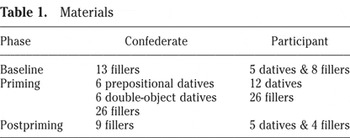
Materials
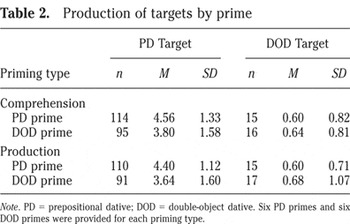
Production of targets by prime
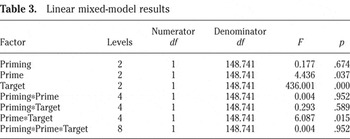
Linear mixed-model results
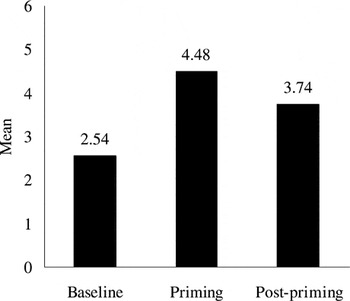
Experiment 1: mean number of prepositional datives produced over time.
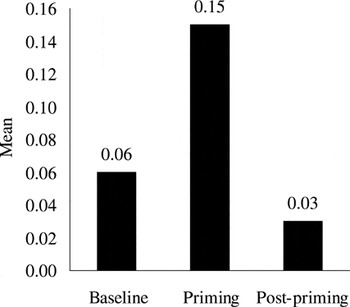
Experiment 2: mean proportion of double-object datives produced over time.
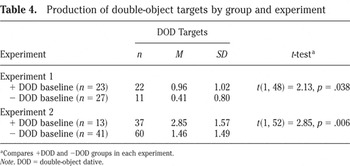
Production of double-object targets by group and experiment

Dative verbs targeted in materials
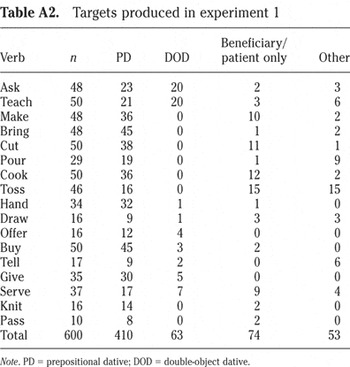
Targets produced in experiment 1
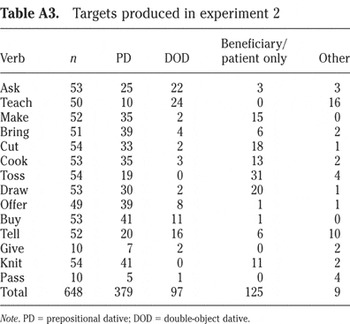
Targets produced in experiment 2
 You have
Access
- 97
- Cited by