

1. Introduction.
Reduction and loss is a common fate of the gender systems of Indo-European languages. When overt gender marking on the noun is absent and syncretism reduces adjective and determiner paradigms, languages may lose the means to distinguish certain genders in the noun phrase. In the Dutch spoken in the Netherlands (excluding the dialects of Limburg and Brabant), this development has reduced the original three-way gender system of masculine, feminine, and neuter to a two-way system.1
The Limburg and Brabant dialects have preserved the traditional three-gender system to some extent, as has Flemish.

The clitic ie originates from the common gender demonstrative die, which in specific environments became assimilated to a preceding verb (zegt die > zegt ie ‘says he’). The reanalyzed form ie then entered the personal pronoun paradigm as a suppletive weak form of the masculine nominative pronoun hij. In terms of distribution, ie is closer to hij than to die because die also accepts female referents for which ie cannot be used.
The conflation of formal markers for masculine and feminine has thus started in the articles and the relative pronouns, but has not (yet) reached the personal and possessive pronouns. While this order of attrition is crosslinguistically expected (Priestly 1983, Corbett 1991:143), it poses problems for gender agreement as anaphoric pronouns derive their gender specification from their antecedent nouns. This dependency can be regarded as an agreement relation with the antecedent noun as the controller and the pronoun as the target.3
Some linguists argue that anaphoric dependencies fall outside the domain of agreement. The arguments in favor of including them are discussed in Barlow 1988, Corbett 1991:112, and Corbett, to appear.
Agreement is often defined as “some systematic covariance between a semantic or formal property of one element and a formal property of another” (Steele 1978:610). In the straightforward instances, the controller and the target share the same values from the same value set for the property in question. Thus, a singular noun canonically triggers singular agreement on its agreeing verb and a plural noun triggers plural agreement, while for both noun and verb, singular and plural are the only available number values. In Dutch, this simple calculation fails. Dutch nouns do not carry overt gender markers, so the gender of a noun is traditionally deduced from the gender of agreeing adnominal elements.4
This is not an unproblematic approach, as the number and nature of Dutch genders differs with each agreement target. When agreeing adnominal elements are taken as prime evidence for the gender of Dutch nouns, the language has two genders: common and neuter. When the personal pronouns are considered, the language has three: masculine, feminine, and neuter. When demonstrative pronouns in anaphoric use are added, there are four genders: masculine, feminine, neuter, and common. Finally, when all attested combinations of adnominal elements and pronouns are considered, Dutch can be said to have six or eight genders. For yet another analysis, also yielding six genders, see de Vries 2001:92ff. The issue is addressed as “the maximalist problem” in Corbett 1991:161ff. In this paper, I use the terms nominal gender (as reflected in adnominal elements) and pronominal gender (as marked on personal pronouns and demonstrative pronouns in anaphoric use).
In theoretical terms, the mismatch is twofold. First, Dutch articles only distinguish two genders as opposed to the pronominal three. If pronouns agree in gender with their antecedent nouns, this means that the agreement controller has a smaller number of values than its dependent element, the pronominal target. Second, the gender values themselves differ between pronominal and nominal gender. Strictly speaking, common gender is not the same as masculine and feminine together, and the neuter in a bipartite system has a different status than the neuter in a tripartite system. In practical terms, speakers have lost the knowledge about masculine and feminine nouns, while common gender nouns in Dutch are unable to govern pronoun choice in the usual way, as there is no personal pronoun corresponding directly to a common gender noun.5
As an alternative, the common gender demonstratives deze ‘this’ or die ‘that’ can be used in anaphoric function. This option will be discussed below.
2. Pronoun Usage.
At a superficial glance, pronominal reference in spoken Dutch appears to be in a chaotic state. Common gender nouns take masculine, feminine, and neuter pronouns, and neuter nouns can combine with common, masculine, or feminine pronouns.6
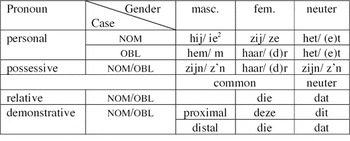
At this point, we leave aside simple matches of a neuter noun with a neuter pronoun, or a common noun with the common demonstrative pronoun deze ordie.

Following Dutch spelling conventions, pronominal clitics are written with an apostrophe. The hyphen indicates change of speaker.
It is my impression that all these cases can be accommodated in a uniform analysis. The key to this analysis is the notion of semantic agreement.
3. Semantic Agreement.
Steele's (1978) definition of agreement captures the fact that agreement is not always a matter of an exact match between formal features. For example, English collective nouns such as committee can take singular or plural agreement.

The option exemplified by 2b and c is known as SEMANTIC AGREEMENT. In 2b, the predicate agrees with a semantic property of committee, namely its conceptual plurality, rather than the formal singularity of the noun. Restrictions apply on the type of target that allows semantic agreement. Attributive modifiers to committee must be singular. A plural form such as these would make the sentence ungrammatical. This observation is related to a typological agreement hierarchy proposed by Corbett (1979):

This hierarchy gives a structural classification of a number of possible agreement targets, and it captures the crosslinguistic constraints on semantic and syntactic agreement. Elements in the left part of the hierarchy are more likely to agree syntactically, that is, with the formal properties of the controller. Targets to the right show an increasing likelihood of semantic agreement. The increase is monotonic, that is, without intervening decrease.
This generalization applies across languages. Agreement constraints can be manifested in the grammar of a language as categorical rules or as mere preferences, and they are visible on both sentence and corpus level. That is, in sentences with a relative and a personal pronoun, semantic agreement will be found more often with the latter than with the former. On corpus level, there will be more personal pronouns than relative pronouns that agree semantically with their antecedent.
Within types of agreement target, DISTANCE EFFECTS have been observed. This again has sentence and corpus level application. When an utterance contains two personal pronouns with the same antecedent, the one that is closer to the antecedent noun is more likely to agree syntactically, that is, with the noun's formal or lexical properties. Similarly, the overall distance between semantically agreeing pronouns and their antecedents in a corpus will be greater than for syntactically agreeing pronouns.
In 2, the determiner represents the leftmost (attributive) position of the hierarchy. As predicted, it needs to agree syntactically. The predicate is further to the right in the hierarchy and allows semantic agreement for some nouns, as in 2b. Further to the right, semantic agreement should become even more likely. In English, the prediction cannot be validated for the relative pronouns because they are not specified for singular or plural—but the personal pronouns are, and sentence 2c is perfectly acceptable.
Since semantic agreement occurs with gender as well as with number, we can apply the notion of semantic agreement to the gender mismatch in Dutch.8
Dahl (2000a) points out that the term semantic agreement poses difficulties when applied to gender. He argues that lexical gender, here referred to as syntactic and contrasted with semantic, can also have a semantic basis. Moreover, semantic misleadingly seems to refer to the meaning of the noun instead of to the properties of the referent. He recommends the terms lexical and referential gender instead. I agree with his position but use the more established terms in this paper.
4. Semantic Gender Agreement in Animate Reference.
Semantically motivated agreement patterns are apparent for nouns that denote persons and (other) animates. In person reference, common gender nouns always take the pronoun whose gender corresponds to the natural, that is, biological gender of their referents, and many neuter nouns do the same. We have seen an example in 1e, and two more are given in 4.

This usage is widely acknowledged (see, for example, Kruisinga 1924, van Haeringen 1936, Dekeyser 1980, Verhoeven 1990, de Vries 2001) and it is mentioned in the Algemene Nederlandse Spraakkunst (ANS), the standard reference grammar (E-ANS §5.1.2.1.b).
A trickier and much less discussed question is what governs pronoun choice when the referent is inanimate and does not have natural gender. Most traditional Dutch research in this area has been concerned with the distribution of masculine and feminine pronouns for common gender nouns. With the conflation of masculine and feminine determiners, the “gender feeling” (“genusgevoel” E-ANS §3.3.3.5) of the speakers disappeared as the knowledge of the former masculine or feminine gender of nouns was lost. Many formerly feminine nouns are now pronominalized as masculine. Despite normative efforts, only the written language has preserved the grammatical (that is, not semantically motivated) feminine to some degree, primarily in nouns with certain suffixes and in reference to collective entities (for the latter, the spoken language prefers plural pronouns; Geerts 1995b).
Unless the dialect of a speaker has a grammatical feminine that gets transferred into the standard language, feminine pronouns are used only for female persons and animals.9
Educated and watchful language users, in a sense “native speakers of written Dutch” (Jaap van Marle, p.c.), use the grammatical feminine occasionally, mainly for nouns whose suffix reveals their feminine past, such as universiteit[C] ‘university’ or partij [C] ‘party’. Sometimes, this usage overlaps with another, more typical for written language: in reference to collective authorities or institutions, feminine pronouns are often used, especially in journalistic texts. They even occur with neuter nouns such as bestuur [N] ‘administration, management’, or volk [N] ‘people’. Also, abstract concepts associated with great value, such as liefde [C] ‘love’ or natuur [C] ‘nature’, are likely to be referred to by the feminine pronoun. However, this phenomenon is different in many respects from the innovative pronoun usage discussed here. First of all, it is largely restricted to the possessive pronoun haar. Other feminine gender pronouns rarely occur in this context. Importantly, the weak feminine possessive (d)r does not occur in this particular environment. A full form, however, is highly unlikely to be the most progressive. All other innovations are clearly more frequent with weak (clitic) pronouns. Finally, the spontaneous spoken language prefers non-feminine pronouns in all relevant cases. An investigation of roughly 1,500 feminine (personal and possessive) pronouns in the Corpus Gesproken Nederlands yielded only animate and female referents. This shows that the feminine possessives are a phenomenon of a different sort than what is discussed in this paper.
5. Semantic Gender Agreement in Inanimate Reference.
A fact often overlooked is that speakers of Dutch pronominalize certain common gender nouns not by a masculine, but by a neuter pronoun. Moreover, neuter nouns do not consistently take neuter pronouns, but masculine and common gender pronouns can be found with neuter antecedents. As many studies of pronoun usage focus on the contrast between masculine and feminine pronouns, the distribution of masculine and neuter pronouns in inanimate reference has not received much attention in the literature. However, the few discussions that address this issue reveal very interesting patterns. Van Haeringen (1936) observes and recommends in a report to the Dutch Ministry of Education that any OBJECT (“voorwerp”, thing) may be pronominalized by a masculine pronoun (1936:20). In a later article, the same author mentions that the neuter pronoun is used for “stofnamen,” or MASS NOUNS (van Haeringen 1951:10). Maljaars (1979) observes that the use of the neuter pronoun may extend to non-neuter nouns, provided that they are, again, mass nouns (1979:14, 105). Yet, he links “the collective, abstract, non-concrete, uncountable, vague” (122, translation mine) to feminine gender. Finally, Romijn (1996) reports in her study of the neuter pronoun het that it can occur with non-neuter antecedents when these refer to SUBSTANCES or HETEROGENEOUS COLLECTIONS such as rommel [C] ‘junk’, but also to ABSTRACTS such as haat [C] ‘hate’, pijn [C] ‘pain’, kou[C] ‘cold’, or waarheid [C] ‘truth’.
The first systematizations of these sketchy observations are Fletcher 1987 and de Vries 2001. These studies link the distribution of the pronouns to a conceptual parameter related to the referent and referred to as COUNTABILITY (“telbaarheid”, de Vries 2001:102) or INDIVIDUATION, the “relative degree of salience as an individual” (Fletcher 1987:61). In their accounts, the masculine pronoun for object-reference and the neuter pronoun for substance-reference constitute opposite ends of a continuum, on which the two genders are associated with particular conceptual properties. The first aim of this paper is to take up this very interesting but largely ignored claim and verify the—mostly anecdotal—evidence in the literature.
6. Corpus Evidence.
This paper is based on a study conducted on the Corpus Gesproken Nederlands (CGN), a nine million word corpus of spoken Dutch and Flemish. A customized subcorpus was searched according to the following criteria. First, different pronouns (demonstrative, personal, and possessive pronouns in all available forms, that is, nominative and oblique as well as strong and weak forms of each gender) were identified, and all cases were selected where the antecedent differed in gender from the pronoun.10
In order to obtain the most natural data and to avoid influences from the standardized written language, the search was limited to spontaneous speech in face-to-face and telephone interactions, as well as recordings of lessons in the classroom. Also, the Flemish data were excluded, as were data from the dialects of Limburg and Brabant, since these varieties often still have three nominal genders and therefore lack the mismatch this research focuses on. These restrictions yielded a subcorpus of around three million words.
Second, a number of nouns from several semantic classes (discussed below) was searched for and all agreeing pronouns were collected, whether of matching gender or not (numbers are given in section 10).
The first search clearly confirms the distribution of pronouns according to the criteria introduced above. The masculine pronoun is used for common and neuter nouns when they refer to countable items. Alternatively, the common gender demonstrative die is used, an interesting pronoun to be discussed separately below. Neuter pronouns, in turn, appear with neuter nouns, but also with common gender nouns in reference to uncountables, substances, or materials. Examples illustrating typical pronoun usage are given in 5 and 6.

The utterances in 5 show neuter nouns combining with a masculine pronoun. The referents of boek ‘book’ and apparaat ‘machine’ are clearly countable objects. Note that apparaat takes a syntactically agreeing (neuter) pronoun first, before the other speaker switches to masculine gender. Other neuter nouns that appear in the corpus with masculine pronouns or the common gender demonstrative die are, for example, ding ‘thing’, gordijn ‘curtain’, masker ‘mask’, lampje ‘lamp (diminutive)’, huis ‘house’, broodje ‘bun’, beeld ‘sculpture’, tafeltje ‘table (diminutive)’, and glas ‘(drinking) glass’.
In contrast, the utterances in 6 illustrate common gender nouns that appear with neuter pronouns. Here, the referents are foodstuffs and thus substances.

Other common gender nouns that appear in the corpus with neuter pronouns are kaas ‘cheese’, soep ‘soup’, spinazie ‘spinach’, suiker ‘sugar’, gel ‘gel’, kleding ‘clothing’, koffiemelk ‘coffee milk’, and vloerbedekking ‘carpeting’. Going back to the introductory examples in 1c, repeated here for convenience as 7 and 8, it is evident that they conform to the same pattern. Example 7 shows a common gender noun in mass reference, and the pronoun is neuter as expected.

Conversely, examples 1a, d, and f, repeated here as 8a–c, show neuter nouns referring to count items and taking the masculine or the common gender pronoun.

The last utterance, 8c, illustrates a case of special interest. The pronoun is a demonstrative, a type of pronoun that has the same gender pattern—common and neuter—as the nouns (recall the paradigms in table 1). Syntactically, a common gender demonstrative easily agrees with common gender nouns. As such, it could provide a simple solution to the mismatch problem.11
It is likely that the demonstrative is often used as an avoidance strategy when speakers feel uncertain about the choice of personal pronoun (E-ANS §3.3.3.6).
In fact, there are other languages that, confronted with a similar problem, have promoted the demonstratives to main pronouns. In Swedish, for example, the former demonstrative pronouns den [C] and det [N] refer to common and neuter nouns, respectively, while the original personal pronouns han [M] and hon [F] are now limited to person reference. However, 8c shows that the Dutch common gender demonstrative also appears after neuter gender antecedents. Two more examples are given in 9.

This usage is frequent in spontaneous speech, though considered substandard by educated speakers. Regardless of attitude, such use of the common gender demonstrative is restricted to countable referents.
Relative pronouns are another interesting case. These pronouns should be the prime candidates for syntactic agreement not only because they distinguish common and neuter gender, just as the nouns do. They are structurally closer to the noun than personal pronouns and therefore are more likely to agree syntactically. This is predicted by the Agreement Hierarchy given in 3 above. However, there is a substantial number of cases where the relative pronoun does not match the gender of its antecedent. Two examples are given in 10.

Again, this usage is restricted to countable referents.
The reverse situation, neuter gender demonstratives or relative pronouns in combination with common gender nouns, is also attested, although it occurs more rarely with the relative pronoun. Two examples for each scenario are given below. Examples in 11 show common gender nouns with neuter gender demonstrative pronouns, and those in 12 show common gender nouns with neuter gender relative pronouns.

Apparatuur [C] ‘equipment’ is occasionally regarded as a neuter noun, but this particular speaker uses the word with a common gender relative pronoun in an earlier utterance made during the same conversation. This shows that apparatuur is at least potentially a common gender noun in this speaker's lexicon.
In all cases, the referents are mass nouns. Differences in agreement preferences of relative and personal pronouns are discussed in section 10 below.
Despite the variation we have seen, the findings so far allow clear predictions as to which combinations of noun and pronoun should NOT occur. Neuter nouns in mass reference should never select a masculine pronoun, nor should common gender nouns referring to objects combine with a neuter pronoun. Exceptions to this pattern occur very rarely. Two cases are given in 13.

Example 13a contains a switch from common to neuter without mass reference. Native speakers asked for judgment accept this sentence, so this usage seems to reflect a different function of the neuter demonstrative. In this case, the pronoun has an unspecific or generic referent. A particular work permit, say yours or mine, could not be referred to by dat. This generic dat can be used for nouns of any semantic class, even for humans, as long as no specific referent is involved. Compare the constructed examples under 13a'.

The normal (that is, non-demonstrative) neuter gender personal pronoun can not be used in either 13a or 13a’. Thus, the distal demonstrative dat has the particular function of referring to unspecific or generic referents. If non-specificity is viewed as an instance of low individuation, the example supports rather than undermines the analysis proposed here. Note also that the speaker in 13a uses the masculine pronoun for the same referent two sentences later.
The utterance in 13b contains another unexpected switch. It could be attributed to an overgeneralization of die, a pronoun that is very frequent due to its huge domain in the system (it can, after all, be used for all common gender nouns, for all animates, and for all countable inanimates).
So far, I have collected about 700 cases of gender mismatch in spontaneous spoken language, eight of which are unexpected given the account discussed above. Considering the fact that we are looking at spontaneous speech, subject to a variety of confounding influences, these results provide robust evidence in favor of the proposed analysis.
7. Semantic Agreement and the Individuation Hierarchy.
The results of the corpus study indicate that the distribution of Dutch pronominal gender is indeed governed by the conceptual properties of the referent. This makes it a good case of semantic agreement, as introduced above. Apparently, pronominal gender in Dutch has partly emancipated itself from the nominal or lexical gender system, and has developed a new organization based on general conceptual patterns that became associated with particular genders. This functional reinterpretation of the genders enables the speaker to choose a pronoun where structural motivations fail, thus providing a straightforward solution for the mismatch problem independent from the lexical gender of the noun. Such a new development of a semantic base for gender is known as RESEMANTICIZATION (Wurzel 1986). In Dutch, resemanticization can be said to involve the parameter pairs [male/female] and [count/mass].
Alternatively, Fletcher's (1987) suggestion provides a useful characterization of the situation. Referents can be ordered in a hierarchy according to their DEGREE OF INDIVIDUATION. A possible individuation hierarchy is given under 14.13
This hierarchy is an offspring of the Animacy Hierarchy, which appears in many variants in the literature (for example, Silverstein's Animacy Hierarchy (1976), Givon's Topicality Hierarchy (1979), Sasse's Continuum of Individuality (1993:659), or Lehmann's Empathy Hierarchy (Lehmann 1998, see Kuno 1987). Some modifications have been necessary. First of all, the highest classes that are sometimes included in the Animacy Hierarchy—“1st person pronoun” and “2nd person pronoun” (or both together as “local person”)—are excluded here, as there is no gender agreement with local person referents in Dutch. Second, “kin” is regarded as being a separate class in many hierarchies. Indeed, kinship or familiarity between speaker and referent can influence pronominalization, as discussed below. However, the influence shows only indirectly, namely in the favoring of pronouns that match the natural gender of the referent. Persons familiar or of high significance to the speaker, whether kin or not, are most likely to be differentiated according to male and female. For emotionally or socially more distant referents, the lexical gender of the noun may prevail, even if contradicting natural gender. With children and animals, natural gender often loses out when put against the lexical gender of the noun or the masculine for countable entities. On the right side, the Animacy Hierarchy ends with the class “inanimate,” which needs to be subdivided for the present purposes. The three inanimate subclasses are motivated by decreasing degree of individuation.

This hierarchy refers to entities and concepts as objects of nominal reference. Entities are high in individuation when they are animate, capable of movement or independent action, and/or characterized by a clearly bounded shape that perceptually marks them as being singulative. Entities low in individuation have wide or fuzzy boundaries, or are unbounded. They have the characteristics of masses.
Several semantic classes can be distinguished within the hierarchy. Most highly individuated are (adult) humans. Next are other animates, followed by objects and abstracts with a conceptually clearly bounded shape such as a book, a word, or a problem. Lowest in the hierarchy are substances (here called unspecific mass) such as snow or honey, and unbounded abstracts such as love, pain, or growth. An intermediate position is occupied by a class labelled here as specific mass. This class contains entities such as those referred to in a (sort of) wine, a (cup of) coffee, her tea, or the soup my mother makes. These are specific instantiations, that is, types, sorts, or portions of substances having properties both of masses and objects, which cannot simply be included in either of the two neighboring classes.
In the animate realm, the distinction of biologically masculine and feminine crosscuts the hierarchy. The two are related in that this subdivision is crosslinguistically more likely for higher animates, primarily humans, but extendable to pets and other domestic animals, to mammals, or to larger animals in general. These are clearly more individuated than, say, ants or bees, and their natural gender may be more salient to the speaker (see note 14 below).
Replacing the binary property COUNTABILITY with the graded property DEGREE OF INDIVIDUATION allows for a better account of the pronoun distribution in spoken Dutch. The language shows a polarization of the masculine and the neuter gender in alignment with the hierarchy. A high degree of individuation is associated with masculine, a low degree of individuation with neuter gender. Furthermore, entities at the top end of the hierarchy are subdivided into male and female and are pronominalized accordingly. This gives us the following distribution of pronominal genders along the hierarchy.

The common and the neuter gender demonstratives in anaphoric use show a similar polarization: the more to the left, the higher the likelihood of a semantically motivated common gender pronoun. The neuter gender demonstratives pattern roughly with the neuter personal pronouns, except for the special case of dat [N] ‘that’ in unspecific or generic reference (discussed above).
A further advantage of this hierarchy is that it accounts for the nonuniform behavior of abstract nouns. They may differ in boundedness or individuation in the same way as concrete objects and substances do. A name is a bounded abstract entity, whereas happiness is not. This division is also apparent in the difference in syntactic countability of these nouns in English. More importantly, however, the hierarchy captures the fact that boundaries between the classes are not strict. There is variation, overlap, and ambiguity, which are discussed in the next section.
8. Variation
As already mentioned, animals having a high significance for the speaker, such as dangerous or useful animals, can be promoted on the hierarchy and can be referred to as hij [M] or zij [F], depending on their sex. Otherwise, the masculine is used for animates, even for female animals such as cows, sheep, or chickens. Example 16 illustrates that speakers have different preferences with regard to the pronominal gender of female animals. Here we see a rare case of explicit negotiation between speakers (for clarity, speakers are marked as A and B here).

Conversely, neuter nouns for persons such as meisje ‘girl’ or mannetje ‘man (diminutive)’ can take pronouns of neuter gender, but this is less likely for persons the speaker knows well. While this is hard to verify empirically, some support can be obtained. The Animacy Hierarchy, which has inspired the Individuation Hierarchy, sometimes has a subclass “kin,” which is higher than other humans. Kinship terms are therefore more likely to appear with pronouns of the gender that corresponds to the sex of the referent.
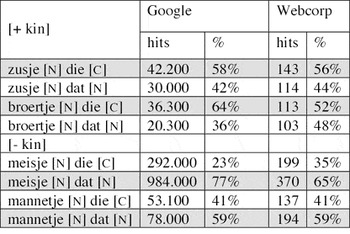
I conducted two internet searches, one with Google (www.google.com), and the other with Webcorp (www.webcorp.org.uk). The search item was a neuter gender noun immediately followed by a relative pronoun. This setup limits the investigation to one type of pronoun and the adjacency condition excludes the influence of distance factors. The nouns searched for were meisje [N] ‘girl’, zusje [N] ‘sister (diminutive)’, mannetje [N] ‘man (diminutive)’, and broertje [N] ‘brother (diminutive)’. Meisje is neutral with regard to familiarity with the referent, whereas zusje is a kinship term and, being diminutive, also more familiar than the base word zus [C] ‘sister’. The same is true for broertje (as opposed to broer [C] ‘brother’). Mannetje, in turn, is much like meisje in that it can refer freely to people one does not know.
In the Webcorp results, I manually filtered out repetitions, pronouns that refer to a different entity, and the string mijn mannetje ‘my little man’, which is a way of addressing a male lover or a young son, and would influence the familiarity bias. I then compared the occurrences of common and neuter relative pronouns for each of the four nouns. Expected were more common gender relative pronouns in the [+kin] condition, that is, with zusje and broertje, than in the other condition. The results are given in table 2.

The shaded cells show that the common gender pronoun, associated with higher individuation, is indeed used more often in the [+kin] condition. In the [-kin] condition, the neuter pronoun is more frequent. Even though both the material and the search are coarse, the prediction is borne out.14
The standard reference grammar ANS seems to implicitly hint at the same correlation between familiarity and pronoun choice, when it contrasts the sentences in a and b below:

Moving on to inanimate referents, many are ambiguous with regard to their countability. In such cases, we expect variability in pronoun usage. A particularly illustrative example is given in 17, where the two speakers talk about yoghurt, and in quick succession use the masculine, the common, and the neuter pronoun. The referent can alternatively be the substance yoghurt, a particular sort of yoghurt, or a pot of yoghurt. The latter two have a higher degree of individuation than the first.

Note that speaker B keeps using the masculine despite several occurrences of neuter pronouns in the speech of his interlocutor.
Crucially, countability is not only a graded property, but also one that depends on the construal of the situation by speaker and hearer. In this light, variations such as illustrated by the dialogue in 17 are expected and can be accounted for. In this case, as in those involving a weaker conceptual parameter such as familiarity, we see that—better than a simple division into count and mass—a graded hierarchy can account for the special properties of the system.
9. Parallels in Germanic.
While the Dutch facts may look exotic at first sight, they fit well with observations on other Germanic languages and dialects. Generally, it has been observed (for example, Siemund 2002a, b, and forthcoming) that languages with semantic gender systems often organize their genders according to a kind of conceptual map or hierarchy. The interesting point here is that genders typically do not align to disconnected areas on the scale. Thus, we do not expect languages to have gender X for male humans and substances, while female humans and objects have gender Y. This phenomenon is discussed in other typological literature under the name CONNECTIVITY HYPOTHESIS (Croft 2001, Haspelmath 2001, 2004), saying that “any relevant language specific and construction specific category should map onto a CONNECTED REGION in conceptual space” (Croft 2001:96).
This expectation is borne out in Dutch as the alignment of genders and semantic classes produces only one continuous domain for each gender (recall the schema in 15). However, languages vary in the number and place of the gender related cut off points they make on the conceptual scale. The semantics of the animate or human referent is a crosslinguistically widespread motivation for gender assignment in general and pronoun choice in particular, while splits amongst the inanimates rarely occur in the Indo-European languages. However, there is a growing body of evidence that the Dutch count/mass-split is neither exotic nor accidental.
Siemund (forthcoming) provides data from varieties of English as well as other languages and dialects within and outside Europe, where pronoun distribution is sensitive to degree of individuation. Parallels in dialects of Danish and Frisian are mentioned by Wahrig-Burfeind (1989). Rohdenburg gives related facts from Low German dialects (Rohdenburg 2004a, b, 2006). Ponelis (1979) mentions countability (“massanaamwoorde” as opposed to “soortnaamwoorde”) as a co-determining factor of pronoun choice in Afrikaans. Enger (2004) and Josefsson (in press) provide relevant evidence from predicate agreement in Scandinavian. These parallels suggest that associations between countability and gender may be a Germanic trait rather than an idiosyncratic property of Dutch. In fact, Indo-Europeanist research sees correlations between the neuter and low individuation in reconstructions of Proto-Indo-European nominal gender. Matasović (2004:134) states that “on the lowest end of the animacy hierarchy, we consistently find neuter nouns: these include all of the nouns for masses and fluids.” In a mismatch situation, as in present day Dutch, such tendencies may surface in gender agreement.
10. System Interaction.
The agreement behavior of the Dutch pronouns has several other interesting aspects. We have seen that the semantic reinterpretation, though particularly visible in the context of a conflict involving common-gender nouns, also affects the pronominalization of neuter nouns, many of which now choose a pronoun based on the semantic criteria identified above (1d–f, 4a–b, 5a–b, 9a–b, and 10a–b). Similarly, semantic agreement is found with the demonstrative (1f and 9a–b) and the relative pronouns (10a–b and 12a–b), although both types of pronoun could have agreed syntactically with any common gender noun (see section 6). This suggests that the resemanticization of the genders, probably originating in personal pronoun distribution, is spreading to agreement targets unaffected by the original mismatch.
This confirms the observation that semantically driven changes in agreement systems often originate in targets low on the Agreement Hierarchy, from which they may then spread leftwards to targets higher on the scale (Corbett 1991:250ff). In the case of Dutch, this development produces interesting complications. The unfolding semantic system of pronominal gender agreement impinges on the traditional syntactic agreement system, which also still exists. This last section discusses the interaction of the two systems and the different behavior of the various agreement targets.
Pronoun usage is subject to much inter- and intra-speaker variation, and gender switches occur not only between, but also within utterances. Generally, as mentioned above, the likelihood of gender switching to semantic agreement increases with distance, as demonstrated in 18.

Here, the two agreement targets are both personal pronouns. The one adjacent to the antecedent noun agrees syntactically with the common gender of the antecedent noun; the other, belonging to the reply of the interlocutor, is neuter. This is an example for a distance effect as predicted in connection with the Agreement Hierarchy (repeated from 3 above).

More than by “real” distance, agreement behavior is influenced by STRUCTURAL DISTANCE in that some targets take semantic agreement more readily than others. The Agreement Hierarchy predicts that the likelihood of semantic agreement increases from the relative pronoun to the personal pronoun. This prediction can be tested on utterance level and on corpus level. On utterance level, a personal pronoun occurring after a relative pronoun with the same antecedent should be more likely to agree semantically than the relative pronoun, as demonstrated in 20.

Context makes clear that die refers to the table and not to the shop (otherwise, this would not be a switch, as winkel ‘shop’ has common gender). The form wat is a wh-element (‘what’), which can replace the neuter gender relative pronoun dat.
Even though the corpus study is as yet incomplete, I have so far found 23 utterances containing a relative pronoun and a personal or possessive pronoun for the same antecedent. Of these, 15 cases showed either purely semantic or purely syntactic agreement of both relative pronoun and personal/possessive. In the eight remaining cases, the relative pronoun agreed syntactically, while the personal pronoun showed semantic agreement. The reverse situation has not been attested so far.
On the corpus level, any personal pronoun should be more likely to agree semantically than any relative pronoun, whether alone or in combination with other pronouns. Again, preliminary numbers can be given. In a part of the corpus study, mentioned in section 6, I collected all pronominal references for particular nouns. The test items were neuter gender nouns high in individuation (human, animate, or object) and common gender nouns of low individuation (specific and unspecific mass). This setup was chosen because other combinations of referent semantics and lexical gender do not lead to gender switches, that is, semantic agreements in pronouns. However, syntactically agreeing pronouns were also recorded. Of the 49 relative pronouns in this sample, only 17 agreed semantically. This is 35% of the whole number.16
The low number of relative pronouns compared to personal pronouns is due to the fact that the former have a much lower frequency in spoken language.
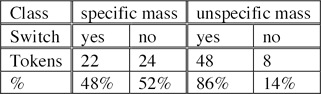
The same search produced another interesting result. When the likelihood of semantic agreement of personal pronouns (relative pronouns are excluded because of the small number of tokens available at this stage) is compared individually for each semantic class on the Individuation Hierarchy, a clear pattern emerges. Nouns at the extreme ends of the hierarchy show the strongest inclination to agree semantically. The likelihood of semantic agreement decreases monotonically towards the centre of the hierarchy and is lowest in the most ambiguous category, the class “specific mass.” table 3 and 4 give the numbers for common and neuter antecedents.


Together, these numbers give the following pattern of likelihood for semantics governing agreement in personal pronouns:

This pattern contains two clines. As we move leftwards and up the hierarchy, the syntactic preference for neuter pronominal gender is overruled more often by a semantic preference for masculine, feminine, or common gender. Lower down the hierarchy, the pattern is reverted, and common gender pronouns make way for neuter gender pronouns with increasing likelihood. Switching in the opposite direction is very rarely found. The high motivation for semantic agreement at the extremes of the hierarchy is a plausible scenario given the polarization of the genders along conceptual parameters. At the left end of the hierarchy, the semantics of a neuter gender pronoun are perceived as conflicting with the semantics of the referent. The more highly individuated the referent, the stronger the tension between syntactic and semantic gender. With adult humans as referents, this leads to almost exclusive use of non-neuter personal pronouns. The same holds for the right end of the hierarchy. Referents with low individuation are felt to be incompatible with masculine or feminine pronouns, and the neuter pronoun is often chosen instead. The class containing specific instances of masses has the lowest inclination to switch. Here, referents can often be construed either as substance or as object. Because both options are often possible, the syntactic gender is not perceived as conflicting and is often retained in pronominal gender. A more extensive search involving more data should confirm these preliminary results.
11. Conclusion.
This paper presents a uniform account of several sorts of mismatch between nominal and pronominal gender in Dutch. Developed to account for common gender nouns that have no corresponding pronoun but need to agree, the analysis also covers neuter nouns taking non-neuter pronouns and gender-mismatching demonstrative anaphors. It is demonstrated that the distribution of personal pronouns in spoken Dutch is governed by the conceptual properties of the nominal referent. This is a case of gender resemanticization, as originally the Dutch gender system was not primarily organized according to semantic criteria. Presumably, this pronominal emancipation was boosted by the need to compensate for the reduced paradigms, which left many nouns with less specification than necessary to determine the choice of an agreeing pronoun. The new semantic system rests on the degree of individuation of the referent. It associates a high degree of individuation with masculine gender and a low degree of individuation with neuter gender. The female pronoun is only used for female persons and a few feminine animals.
Functional reinterpretation of pronominal genders is familiar from languages that have lost their nominal gender altogether but have kept gender distinctions in the pronominal paradigm. English is an obvious example. While the nominal genders of Old English had as little semantic justification as those of the other Indo-European languages, the pronominal gender system of Modern English shows a clear semantic division into male rational, female rational, and residue. This system emerged as the lexical gender of the nouns was lost. In Dutch, the situation is more complex because nominal gender still exists and the two systems compete. Where there is a choice between the original syntactic and the new semantic system, we find much variation.
However, this variation is not random; rather, it obeys the constraints captured by the Agreement Hierarchy, confirming various typological regularities. Other intralinguistic factors influencing variation not discussed in this paper are regional (dialectal) influence, register, and degree of monitoring. Also, pronoun usage differs between the spoken and written modality. Extralinguistically, the age of the speaker and his or her level of education might be relevant. The individual contribution of each of these factors must be left to future research.