1. Introduction
China ranks as the second largest supplier of seafarers for world shipping fleets, accounting for 11% of the total sea-based workforce (Drewry, 2018). By the end of 2018, the number of Chinese seafarers serving under foreign flags had reached 128,000, including 51,000 officers (CMOT, 2019). Chinese officers serve on ships of more than 20 flags, including Hong Kong (China), Panama, Singapore, Liberia, the Marshall Islands and the Bahamas (CMOT, 2019). They have effectively eased qualified officer shortages worldwide. Sustainable growth of the Chinese seafarer population is pivotal for the sustainability of the global shipping industry. China, however, continues to face the challenge of young seafarer outflow, a term used to describe the process of qualified seafarers leaving employment aboard ships (BIMCO/ISF, 2015). The annual average outflow rate of Chinese officers at the operational level in the last five years (2016–2020) is conservatively estimated at approximately 6%, much higher than the 2⋅4% per annum estimate provided by the Baltic & International Maritime Council /International Shipping Federation (BIMCO/ISF, 2015; CMOT, 2016, 2017, 2018, 2019, 2020). Also, the China Ministry of Transport (CMOT) (2020) disclosed that the average annual percentage of graduates in the years of 2017–2019 engaged in seafaring was as low as 30% from the top 10 Maritime Education and Training (MET) schools, which indicates that the attraction of seafaring has been decreasing among Chinese cadets. This lack of interest has a negative influence on the supply of qualified officers worldwide, and might even exacerbate the global shortage of seafarers in the future. To help employers take countermeasures to slow down the outflow rate, this study singles out empirical evidence from young Chinese seafarers as a means of exploring the factors which contribute to the outflow of young officers.
According to BIMCO/ISF estimates (2015), an 11⋅7% shortage of officers is expected worldwide by 2020; this shortage is projected to reach 18⋅3% by 2023 (this study's benchmark is the supply number of officers in 2015). This estimate agrees with Drewry's recent manning study report, which claimed that the officer shortage would theoretically continue through 2023 due to the slowdown in officer supply growth (Drewry, 2018). Drewry also expected that available officer pool growth would continue to slow down to an average annual rate of just 0⋅5%, much lower than the previous estimate of 2⋅5% from 2014 to 2018. Meanwhile, several scholars also pointed out chronic officer shortages (Lu et al., Reference Lu, Weng, Huang, Leung and Wang2018; Kartal et al., Reference Kartal, Uğurlu, Kaptan, Arslanoğlu, Wang and Loughney2019). Young seafarers at the operational level are the backup manpower for senior officers at the management level, the backbone of the shipping industry.
There are various thresholds defining the point of separation between youth and middle age. In Erik Erikson's theory of age, Stages of Human Psychosocial Development, youth refers to people above 20 years old and below 40 (Erikson, Reference Erikson1959). In China, youth is defined as people aged from 15 to 34 (Yuan, Reference Yuan2017). In the field of seafaring, young seafarers under the age of 30 are generally engaged in operation-level work (BIMCO/ISF, 2015). According to recent statistics, the average age of Chinese seafarers holding certificates of competency is 36, with seafarers under the age of 40 constituting 70% of the seafarer population (CMOT, 2019). To explore the key factors influencing the outflow of young Chinese seafarers, this study will focus on seafarers who are above 25 and below 40 years old. This group constitutes the majority of the Chinese seafarer population.
This paper uses multiple analysis techniques to present the findings of semi-structured interviews and questionnaire surveys. The authors have in turn identified 19 contributing factors, grouped into five themes, which lead to the outflow of young seafarers. The remainder of the paper is presented as follows: Section 2 provides a literature review regarding occupation satisfaction and hypotheses. Section 3 describes methods and data statistics. Section 4 focuses on data analysis. In Section 5 a discussion is presented, and conclusions and suggestions are given in Section 6.
2. Literature review and hypothesis
2.1 Factors affecting turnover intention
The term ‘turnover’ refers to the process of employees leaving an organisation for a variety of reasons (Turker and Er, Reference Turker and Er2007). Turnover intention has been widely discussed in various industries, given its vital role in business. The earliest research on turnover intention was in the field of psychology. Mobley (Reference Mobley1977) insisted that there is a significant and consistent relationship between job satisfaction and turnover. Alfonso and Fred (Reference Alfonso, S and Fred2004) proposed that the main determinants of turnover intentions are subjective, mainly including job satisfaction, job security, perceived labour market opportunities and pride in one's firm. Jiang and Shen (Reference Jiang and Shen2018) showed that a supportive organisational environment, trust and work-life enrichment directly affected practitioners’ turnover intention. Kim (Reference Kim2016) proved that job demands and social support affected the turnover intent of music therapists. Moreover, scholars concluded that the working stress caused by working ostracism leads to higher turnover intention (Koon and Tee, Reference Koon and Tee2019). Zhang et al. (Reference Zhang, Ma, Xu and Xu2018) insisted that improving employees’ engagement and organisational commitment can improve job satisfaction and reduce their turnover intention. Zhu et al. (Reference Zhu, Cai, Buchtel and Guan2019) showed that career adaptability influences turnover attempts, but both career satisfaction and perceived organisational support mitigate the effect of poor career adaptability on turnover intention. Employment status, family income, achievement motivation, perceived security, and work ethic are identified as key elements with significant impacts on the professional commitment of young officer seafarers (Jia, Reference Jia2021).
In the field of economics, the turnover intention has also drawn the attention of many scholars. By using multinomial probit estimates, Royalty (Reference Royalty1998) found that both gender and level of education affect turnover intention. This agrees with Booth and Francesconi's (Reference Booth and Francesconi1999) findings that there are significant differences between genders in turnover intent, particularly where union coverage, occupation and the presence of young children are concerned. Beatrice et al. (Reference Beatrice, Maria, Pascale and Breukelen2018) insisted that elderly nurses with abundant professional experience showed fewer turnover intentions. Park and Pierce (Reference Park and Pierce2019) concluded that leadership styles had a critical influence on turnover intention, and that positive leadership led to a lower probability of staff demission.
The root causes of worker turnover are also an intriguing topic of research in the transport field. Jou et al. (Reference Jou, Kuo and Tang2013) found that work environment, role conflict, and support from supervisors and colleagues directly affects air traffic controllers’ job satisfaction. Huang et al. (Reference Huang, Lee, Mcfadden, Murphy, Robertson and Cheung2016) conducted an empirical investigation of truck drivers and made the hypothesis that more positive perceptions of the company safety climate leads to a lower turnover rate, and that the company's emphasis on safety was highly related to a lower rate of employee turnover.
Moreover, several scholars proved that job satisfaction would influence turnover intention in some occupations (Zhang et al., Reference Zhang, Ma, Xu and Xu2018; Li et al., Reference Li, Zhang, Xiao, Chen and Lu2019). Tsai (Reference Tsai2018) stated that job contentment is affected by occupational factors, such as compensation policies, work conditions, coworker relationships, promotion policies and the possibility of career development, and personal factors, such as demographic characteristics, professional capability, cognitive ability, sense of achievement and personality traits. Kwona et al. (Reference Kwona, Byunb and Park2020) listed nine elements impacting the job satisfaction of bus drivers, such as driver categories, working experience, work hours, income, and work pressure. Regarding the maritime field, one of the key factors affecting seafarers’ desire to remain at sea can be summarised as the extent to which they are satisfied with life at sea (BIMCO/ISF, 2015). Yuen et al. (Reference Yuen, Loh, Zhou and Wong2018) proposed that onboard work stress and the attractiveness of monetary and nonmonetary employment benefits play a significant role in job satisfaction of seafarers.
All these factors affecting turnover intentions in diverse fields can be boiled down to three factor themes: personal factors, occupational factors and social factors. Personal factors refer to such psychological factors as employee job satisfaction, as well as other factors such as age, gender, education level and marital status. Occupational factors include salary, promotion, workload, work stress and organisational commitment. Social factors include social recognition, relationships with coworkers and external job opportunities (Tang and Zhang, Reference Tang and Zhang2019). Family factors should also be considered when exploring reasons for young seafarer outflow because seafarers work for long periods at sea away from family and fail to undertake family care responsibility. The classification of factors concerned is beneficial for denominating the factor themes in this study.
2.2 Hypotheses
Based on the literature review and the unique characteristics of seafaring as a profession, four hypotheses are formed, highlighting four factor themes affecting young seafarers’ turnover intention. Seafaring is unique in that it is highly professional and also features large personnel mobility. Working onboard takes place far away from social life and requires a long-term separation from family, which is compounded by unstable and expensive means of communication. These factors, combined with irregularities in the circadian clock brought about by onboard shift work, reduce the seafarer's willingness to remain in their profession.
2.2.1 Occupational factors
Occupational factors affecting young seafarer turnover have drawn considerable attention from scholars. Shen et al. (Reference Shen, Wang, Qian and Zhao2015) identified that working status, welfare conditions, wage levels, promotion and development were the major factors influencing seafarers’ professional satisfaction, thus affecting their turnover intention. Generally, tangible benefits, such as a high salary and job security, are a crucial pull for the young generation to take on a seafaring career (Thai et al., Reference Thai, Balasubramanyam, Yeoh and Norsofiana2013). According to the results of a survey of 116 officers from six shipping companies, stress and rewards from work are key determinants of seafarer job satisfaction and turnover intention (Yuen et al., Reference Yuen, Loh, Zhou and Wong2018). In addition, a rigid promotion mechanism can reduce the desire for career advancement among young seafarers. It takes at least 12 years for a third mate to be promoted to captain, which discourages seafarers from maintaining enthusiasm and dynamism in their work (Shen et al., Reference Shen, Wang, Qian and Zhao2015). Also, seafarers tend to be overloaded with work due to the unpredictable natural environment and inadequate resources, causing physical and psychological stress and fatigue (Robert, Reference Robert2012). Furthermore, as the ship is a seafarer's workplace and home for extended periods, their sense of happiness depends on the quality of shipboard life including the availability of recreational and communication facilities, onboard living conditions and shore leave frequency (Bhattacharya, Reference Bhattacharya2015). Caesar et al. (Reference Caesar, Cahoon and Fei2015) insisted that unfavourable shipboard working conditions have reduced young seafarers’ interest in the seafaring profession.
Hypothesis 1. Occupational factors including low salary, promotion issues, heavy workload, high work stress and an unfavourable onboard environment may lead to a higher rate of seafarer outflow.
2.2.2 Family factors
The family has a critical role to play in people's decisions about their occupation, and this is particularly true of seafarers. The attitude of seafarers’ family and friends could significantly affect their seafaring decision (Lu et al., Reference Lu, Weng, Huang, Leung and Wang2018). Especially when seafarers have young children, long-term seafaring leads to estrangement between seafarers and their children. This extended separation from partners and family is one of the most significant causes of stress for seafarers, leading to reductions in their planned sea service (Thomas et al., Reference Thomas, Sampson and Zhao2003). A large number of seafarers from China or other developing countries such as the Philippines and Thailand are from rural areas, disadvantaged towns or villages, where the principal breadwinners of the family tend to be younger (Bhattacharya, Reference Bhattacharya2015). However, Chinese seafarers’ wages are not attractive to young seafarers when compared with other professions. If their salaries cannot adequately support their families, they will consider leaving. Slišković and Juranko Reference Slišković and Juranko2019) found in an online survey of 647 Croatian seafarers that isolation from family affects job satisfaction. Likewise, Papachristou et al. (Reference Papachristou, Stantchev and Theotokas2015) revealed from an online survey of 511 seafarers that being away from home and inadequate communication with families and friends both negatively affect retention in the seafaring profession. Young seafarers in their late 20 s or early 30 s may be easily affected by external relationships, such as marriage, family or aging parents (Caesar et al., Reference Caesar, Cahoon and Fei2015).
Hypothesis 2: There is a potential link between family factors and the outflow of seafarers. The responsibilities of child rearing and supporting aging parents, and negative attitudes of family may lead to a higher outflow rate.
2.2.3 Personal factors
From the perspectives of both psychology and physiology, personal factors form a key element contributing to young seafarer outflow. For seafarers working and living with a team on board ships, interpersonal relationships are highly valued (Fan et al., Reference Fan, Fei, Schrievera and Fan2018). On a multinational crewed ship, cultural clashes or misunderstandings are inevitable (Kim, Reference Kim2016). Chinese seafarers are observed to have difficulty communicating with their foreign coworkers (Fan et al., Reference Fan, Fei, Schrievera and Fan2018). Poor English ability and cross-cultural adaptability exacerbate Chinese seafarers’ loneliness. Also, seafarers are vulnerable to various mental health disorders, anxiety and depression (Sau and Bhakta, Reference Sau and Bhakta2019). Speaking in terms of physiology, seafarers suffer higher mortality than do workers ashore. Seafaring is still recognised as a dangerous and hazardous profession, with a high risk of work-related injury (Zhang and Zhao, Reference Zhang and Zhao2017; Yuen et al., Reference Yuen, Loh, Zhou and Wong2018). Moreover, long-term seafaring work affects young seafarers’ physiological health through their immune system, sleep quality, gastrointestinal, metabolic and cardiovascular systems (Zhao et al., Reference Zhao, Wadsworth, Jepsen and Leeuwen2020). Human fatigue is recognised as a major risk factor in transportation work. Li et al. (Reference Li, Chen, Xu, Chang and Khoo2020) highlights that personnel employed in the shipping industry suffer from multidimensional fatigue, particularly physical fatigue.
Hypothesis 3: Personal factors, such as health problems and interpersonal relationships, influence seafarer turnover.
2.2.4 Social factors
Nowadays, the merchant sailing profession tends to be ignored by most people until an unfortunate accident occurs, with spectacular consequences. Since the information about these news-making accidents available to the public is incomplete, they end up with a slanted, negative impression of seafarers (Beaskoetxea and García, Reference Beaskoetxea and García2015). Although seafarers make an incredible contribution to society, the public does not yet accord them the respect they deserve (Zhang and Zhao, Reference Zhang and Zhao2017). The feeling of being respected may engage seafarers and improve their self-evaluation and their sense of belonging (Yogendra, Reference Yogendra2015). Alternatively, when seafarers feel undervalued, their sense of participation in their work is lowered, which leads to a higher possibility of outflow. Seafarers play an important role throughout civil society; however, their welfare still has not received sufficient attention (Exarchopoulos et al., Reference Exarchopoulos, Zhang, Pryce-Robertsa and Zhao2018). For example, although providing insurance for seafarers is a compulsory legal obligation, some shipowners calculate the insurance cost into wages of seafarers and let them pay for their own insurance (Wang, Reference Wang2019). In addition, external job opportunities also affect seafarers’ turnover intention. Park (Reference Park2017) concluded that the labour market for seafarers will be affected by the employment situation in other industries.
Hypothesis 4: Social factors, such as lack of social recognition, insufficient welfare protection, and external job opportunities, have a negative impact on seafarer retention.
2.3 The significance of the study
It is noteworthy that previous studies treat the entire seafarer group as a single, monolithic subject of research, ignoring the characteristic differences between varied age groups. It is considered that young seafarer retention may be affected by their cultural background, the economic development level of seafarers’ countries of residence and demographic variables. Research which divides its subject group into different age segments increases its accuracy and pertinence. Another oversimplification present in existing research is a focus on ways to improve seafarers’ happiness rather than on a consideration of the causes of their outflow. There may be differences between the factors that cause seafarer outflow and the factors affecting seafarers’ happiness. In light of this, it is necessary to examine the impact factors of seafarer turnover based on basic demographics, including age, duty, marital status and family origins.
3. Methods
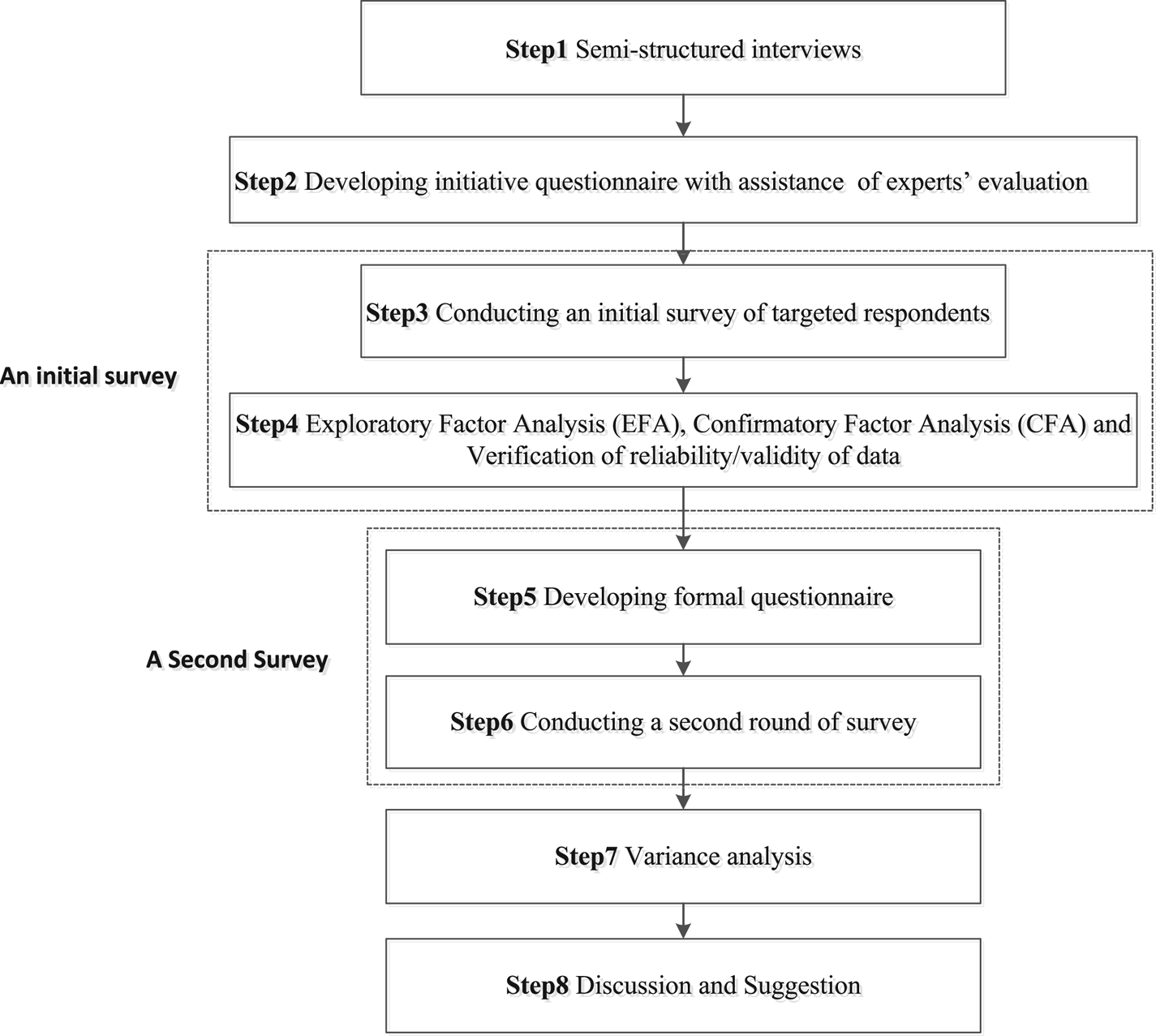
To explore the critical factors contributing to young seafarers’ outflow, multiple methods have been utilised for data collection, processing and analysis, including semi-structured interviews, exploring factors analysis, confirmatory factor analysis, independent sample t-test and one-way ANOVA. The steps followed in this study are presented in Figure 1.
The process of study

Because questionnaire investigation is the core measure of the study, this section will introduce the procedures of questionnaire design, distribution and questionnaire recycling in detail as follows.
3.1 Questionnaire design and pilot survey
In the course of questionnaire design, data collection was firstly conducted through semi-structured interviews of 25 young seafarers aged between 22 and 35 with turnover intention, from which keywords were extracted via ground analysis. Secondly, based on the literature review and the keywords extracted, a pilot questionnaire was then designed with 33 questions covering four aspects, namely occupational factors, family factors, personal factors and social factors. Thirdly, the validity of the questionnaire was discussed in a seminar with eight experts from the shipping industry, including one professor from a MET institute, an official in charge of seafarer examination and certification, two HR managers from shipping companies, two training officers from manning agencies, one senior captain and one chief engineer. Lastly, these pilot questionnaires were distributed to 400 young seafarers who were attending upgrading training at D University in China in the fall of 2019. A total of 386 valid questionnaires were retrieved. The resulting data was analysed for reliability and validity to ensure that the predetermined requirements were met.
3.2 Formal questionnaire distribution and respondents
The formal questionnaire was generated, consisting of 19 questions resulting from exploratory factor analysis (EFA) answered via a Likert five-point [1,5] scale. The six identity items used in the questionnaire are age, competence level, ship type, offspring, one-child family origin and marital status. In December 2019, a link to this study was posted on a maritime specialised website with an enrolment of nearly 200,000 Chinese seafarers. The questionnaire could be accessed free on the website. To target the respondents needed, one question was used to screen the seafarers who had left or had the intention to leave. Information was submitted directly online by respondents, thereby avoiding human errors in hard-copy questionnaire statistics and ensuring accuracy and authenticity. In total, 457 questionnaires were responded to electronically, 21 of which were disregarded due to extreme opinions and 436 of which were reserved. The rate of validity was 87⋅2%.
4. Data analysis
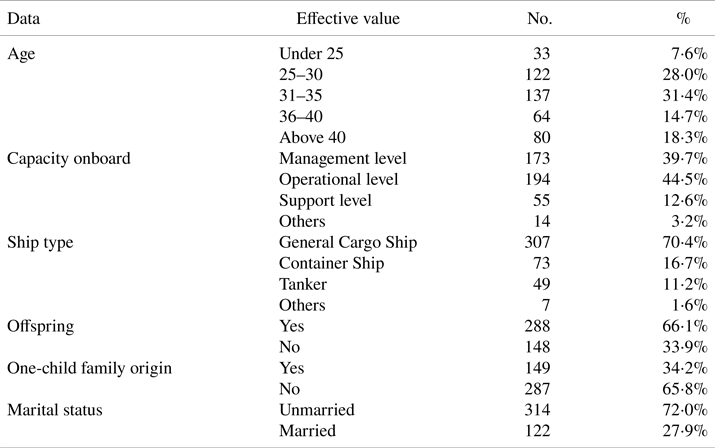
Data of 386 valid respondents from the pilot survey were randomly divided into two equal parts. One part (186 respondents) was used for EFA to extract principal components (hereafter referred to as dimensions) of factors influencing the outflow of young seafarers. The other part (200 respondents) was used for confirmatory factor analysis (CFA) aimed to explore the interaction between the influencing factors. Then 436 valid responses to the formal questionnaire were collected ( See Table 1) and given individual t-tests and variance analysis, allowing further understanding of how different factors contributing to seafarer outflow in the context of different population sample sizes were formed.
Profile of respondents

4.1 Reliability of the questionnaire
Cronbach's alpha was used to test the reliability of the internal consistency of the questionnaire. As the general score reaches 0⋅815, the questionnaire meets the reliability criteria for internal consistency. The scores of all criteria are at least 0⋅7 within an acceptable scope, which indicates an ideal result (Wu, Reference Wu2010; Pallant, Reference Pallant2013).
4.2 Exploratory factor analysis
The Kaiser-Meyer-Olkin (KMO) and Bartlett's tests have been applied to data from 186 respondents of the pilot survey. The value of the KMO test is 0⋅823. The Bartlett's test shows that the significance probability is 0⋅000, lower than 0⋅01, meaning it has reached a significant level. The pilot survey questionnaires are therefore suitable for EFA.
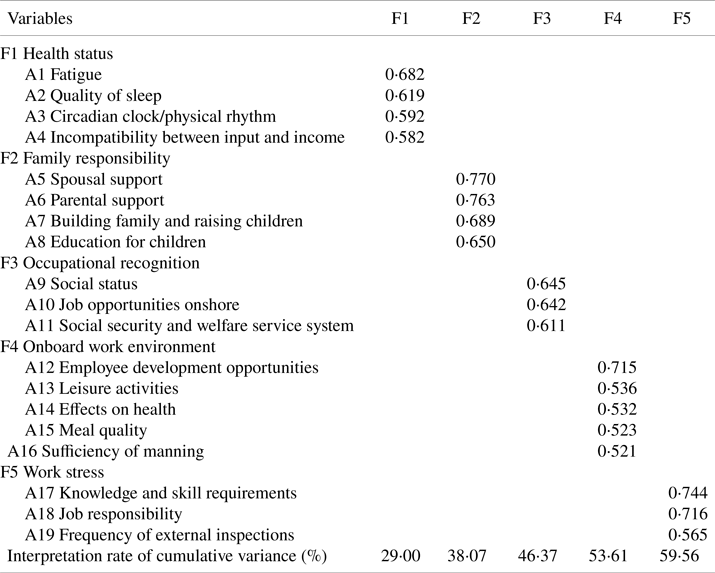
Thereafter, the items with factor load less than 0⋅5 and the main components with fewer than 3 topics were discarded, after which 19 items (see Table 2) meeting the criteria remained. These 19 items were then renumbered. Five dimensions were then extracted based on the variance analysis criteria requirements that the eigenvalue is greater than 1, and the variance contribution rate reaches 59⋅56% (Wu, Reference Wu2010; Pallant, Reference Pallant2013).
Factor analysis of measurement items (17)

Based on a review of the relevant literature and the meanings of the items in question, the five dimensions are respectively named F1 (health status) containing items A1-A4, F2 (family responsibility) containing items A5-A8, F3 (occupational recognition) containing items A9-A11, F4 (onboard work environment) containing items A12-A16 and F5 (work stress) containing items A17-A19.
4.3 Confirmatory factor analysis
To further examine the structural validity of the questionnaire, CFA was implemented based on the data from the 200 respondents of the pilot survey. The data fitting of the individual-factor mode is also presented for comparison with the five-dimension (5D) model. Table 3 shows that all fitting indexes of the 5D model are within reasonable limits and are generally superior to the individual-factor mode, indicating that the questionnaire is of satisfactory structural validity.
Indexes of model fitting

4.4 Variance analysis
An independent-sample t-test was used for two sets of independent variables. A one-way ANOVA test was used for three or more sets of independent variables. Where significant F value levels were reached, the least-significant difference (LSD) among different sets was further tested. It is assumed in this study that if the mean value under an individual dimension is more than 3⋅5, the group of young seafarers is relatively unsatisfied with the factors concerned, and, if the mean value is more than 4, the group is seriously not satisfied with the factors associated.
4.4.1 Variance by marital status
An independent-sample t-test was adopted to examine how the causes of young seafarer outflow differ by marital status.
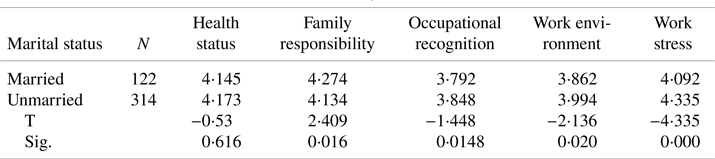
As is shown in Table 4, the significance threshold $(P\textrm{ = }0.000\mathrm{\ < 0}\textrm{.05)}$ is satisfied under four dimensions, i.e. ‘family responsibility’ (F2), ‘occupational recognition’ (F3), ‘onboard work environment’ (F4) and ‘work stress’ (F5).
Variance by marital status

In the case of F2, the mean value for the married group [4⋅27] is slightly greater than that of the unmarried. This means that taking care of family members is a greater concern for the married group than it is for the unmarried group. Regarding F3, the mean value for the unmarried group [3⋅85] is slightly greater than that of the married group, which can be interpreted to mean that separation from the onshore activities and the difficulty of establishing a partnership or family makes the unmarried group feel a lower level of occupational recognition than the married group. This result is in line with previous studies’ conclusions (Thomas et al., Reference Thomas, Sampson and Zhao2003; Papachristou et al., Reference Papachristou, Stantchev and Theotokas2015).
4.4.2 Family origins
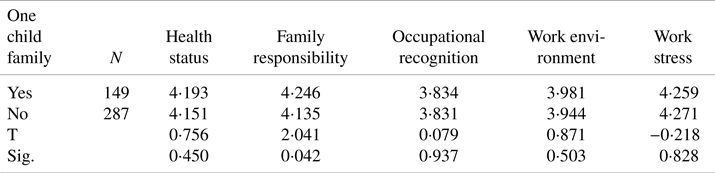
The independent-sample t-test was also adopted to examine how the causes of young seafarer outflow differ based on one-child family origin.
In Table 5, ‘family responsibility’ (F2) is the only dimension meeting the significance threshold $(P\textrm{ = }0.000\mathrm{\ < 0}\textrm{.042)}$ . The mean value of the group coming from single-child families is 4⋅25, which is slightly greater than those from multi-child families [4⋅14]. This fact indicates that both groups regard family responsibility as a crucial factor when considering continuing or ending a seafaring career. Furthermore, our empirical study has proved that young seafarers from single-child families are more likely than those from multi-child families to leave or have intentions to quit a seafaring career due to family factors. The single-child group is more concerned with taking care of or spending time with their parents, as claimed by a 48-year-old extra-master mariner who is a senior manager in a seafarer manning company in China.
Family origins

4.4.3 Variance by age group
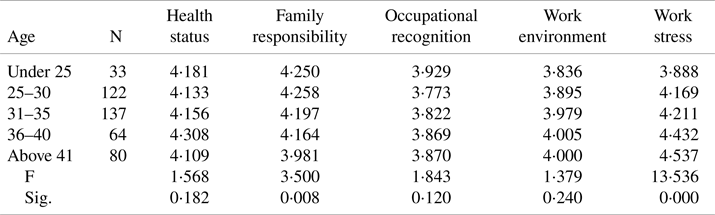
One-way ANOVA was applied to examine the variance of causes of outflow of young seafarers by groups of ages.
Table 6 shows that there is significance among different age groups $(P\textrm{ = }0.000\mathrm{\ < 0}\textrm{.05})$ under the dimensions of ‘family responsibility’ (F2) and ‘work stress’ (F5). There is no statistical significance found under the other dimensions. An LSD comparison reveals that under the dimension of ‘family responsibility’ (F2), the turnover intentions of seafarers over the age of 41 are significantly lower than those of other age groups. Under the dimension of ‘work stress’ (F5), the turnover intention of seafarers aged between 31 and 35 is distinctly lower than for those aged 36 and over.
Variance by age group

Regarding F2, the mean values for the three groups aged between 25 and 40 are all above 4, which might imply that all of them believe that family matters are a key concern when contemplating ending their careers. There is also a clear trend that as younger groups of seafarers are considered, mean values rise. This correlation could show that younger seafarers have strong demands placed on them in terms of taking care of family members. At the same time, in the ‘41 years old or above’ group, the mean value is approximately 4, which indicates that they also feel a strong need to take care of family. The mean values for all groups are all near or above 4. These figures testify that family responsibilities are a critical factor influencing young seafarer outflow.
In the respect of F5, there is a clear trend that work stress increases as rank increases. Senior officers at the management level present the highest mean value of work stress [4⋅54], followed by the ‘36–40 years old’ group, which is normally composed of chief officers or second engineers, with the mean values [4⋅21]. The mean values over 4 for all groups certify that ‘work stress’ (F5) is another important dimension of young seafarers’ outflow.
4.4.4 Variance by capacity onboard
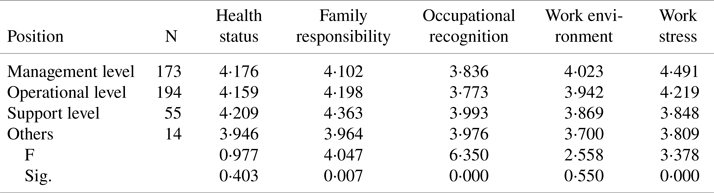
One-way ANOVA was used to study the variance of causes of young seafarer outflow by their onboard work capacities.
Table 7 shows that under the dimensions of ‘family responsibility’ (F2), ‘occupational recognition’ (F3) and ‘work stress’ (F5), there is significance in different capacities $(P\textrm{ = }0.000\mathrm{\ < 0}\textrm{.05})$ . There is no statistical significance in the other dimensions. Regarding F5, the level of work stress influence goes downwards from the management level, to the operational level and then to the support level, coinciding with duty assignment rank. After the LSD comparison, it is observed that under F5, turnover intention is significantly stronger for seafarers at management level than for those at an operational level.
Variance by capacity onboard

4.4.5 Variance by ship type
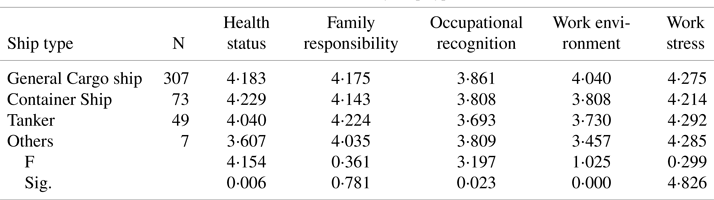
One-way ANOVA was used to study the variance of causes of young seafarer outflow by ship type.
It can be observed from Table 8 that there is significance for different ship types $(P\textrm{ = }0.000\mathrm{\ < 0}\textrm{.05})$ under the dimensions of ‘health status’ (F1), ‘occupational recognition’ (F3), and ‘onboard work environment’ (F4). There is no statistical significance in the other dimensions. LSD comparison suggests that under F1, the turnover intention of seafarers working aboard container ships is significantly stronger than those on tankers, and under F3, the turnover intention for seafarers working on general cargo ships is significantly stronger than those on tankers. Moreover, under F4, turnover intention for seafarers on general cargo ships is significantly stronger than those on tankers.
Variance by ship types

5. Discussion
Based on theoretical analysis and empirical data analysis, key factors affecting young seafarers’ outflow were studied through four dimensions.
5.1 Occupational recognition
Seafarers are indispensable players in the supply chain of human necessities, but their contribution is normally understated owing to their work taking place at a significant distance from society at large (Fenstad et al., Reference Fenstad, Dahl and Kongsvik2016). They suffer enormous emotional loneliness while sailing at sea over extended periods without proper communication with the world ashore (Exarchopoulos et al., Reference Exarchopoulos, Zhang, Pryce-Robertsa and Zhao2018). What's more, young Chinese seafarers are generally insufficiently covered by social insurance or corporate housing funds (Fu, Reference Fu2019). These factors lead to their low professional recognition and intensify the seafarers’ outflow intentions.
For the seafarers at 31–35, both ‘family responsibility’ and ‘work stress’ are crucial influential factor themes contributing to outflow, since the mean values in both dimensions approach 4⋅20 (see Table 6). Age 31–35 is identified as the peak age range in which seafarers choose to quit. This can be justified across many aspects. In terms of personal issues, seafarers in this age group are typically on their way to building families and raising children. In terms of career development, they confront a bottleneck period in promotion from the operation level to the management level. If they lack a sea career plan and have no faith in their career prospects, they may choose to quit seafaring jobs. It is noteworthy that seafarer outflow from the shipping industry is a great talent loss, given the huge amount of vocational education and training they have received (CMOT, 2019).
If young seafarers of 31–35 years old seek onshore jobs, they may be denied important positions given their lack of management experience. Additionally, some minor positions are not highly financially rewarding or beneficial to their personal development. If young seafarers establish occupational values and formulate career plans, their confidence in their profession will grow to support them through bottleneck periods, allowing them to finally become top talents in the maritime field.
Those aged between 36 and 40, however, tend to quit and transition into onshore jobs related to shipping. After accumulating sea work and life experience, they are presented with their last chance to secure an ideal job ashore. However, some seafarers may return a few years after leaving their post at sea, because of difficulties in adapting to onshore jobs, the advantages of working as a management-level officer, and family factors.
By contrast, seafarers over 40 are more inclined to continue a seafaring career, because they find it hard to find ideal jobs on shore at this age. Normally, senior officers at the management level can make comparatively handsome money, a reasonable motivation for them to retain their job in itself.
Job opportunities onshore are less relevant when discussing young Chinese seafarer outflow. Our interviews reveal that young seafarers have fewer suitable job opportunities onshore after leaving the sea, which is contrary to the authors’ expectations and literature review findings (Park, Reference Park2017). On the one hand, there are not sufficient jobs suitable for those leaving the sea at a very early stage in a seafaring career. In addition, long-term onboard work tends to degrade seafarers’ social communication skills and make them unable to adapt to onshore work. On the whole, it can be concluded that social factors such as the lack of social recognition, disengagement from society and insufficient welfare protection mentioned in Hypothesis 4 may lead to a higher rate of seafarer outflow.
5.2 Family responsibility
Through variance analysis, it is found that turnover intention of married seafarers, seafarers from one-child families, seafarers aged from 25 to 40 and those working at the operational level are more heavily affected by family responsibility. In respect of marital status, the scores of the married and the unmarried seafarers under the ‘family responsibility’ dimension are both greater than 4, with married seafarers scoring higher than unmarried ones (see Table 4). That means the married seafarers put more emphasis on family responsibility. In respect of family origins, the scores of seafarers from one-child families and those with siblings are both greater than 4, indicating both groups believe that family responsibility is an important factor affecting their outflow decisions (see Table 5). Regarding age, the scores of young seafarers aged from 25 to 40 are approximate to 4⋅2 (see Table 6), indicating that family responsibility plays a significant role in seafarer turnover. The score of those aged 41 and older, however, is lower than 4 (see Table 6), meaning they have a lower level of turnover intention. This difference is expected because those aged 25–40 are starting families or raising children while the children of seafarers aged over 40 are in high school or college and thus independent from their parents (Yu and Liu, Reference Yu and Liu2007). Lastly, regarding duties onboard, the mean value of those at the management level and those at the operational level are both greater than 4⋅1 (see Table 7), meaning all of them to hold that family responsibility is influential to their outflow.
The outflow decisions of seafarers in their late 20s and 30s are influenced by external matters, such as forming a family or caring for aging parents (Caesar et al., Reference Caesar, Cahoon and Fei2015). Due to a sense of family responsibility, young seafarers want to take more time to care for their families. With respect to parenting, they generally feel that the father's presence is indispensable for children's growth. As a 32-year-old second mate states, without the father's companionship during childhood, a child might grow up with an incomplete personality. Seafarers are obviously unable to spend time with their children while at sea, pushing them towards onshore jobs. Also, due to the one-child policy in effect from the 1970s to 2010s, a large proportion of current young seafarers are the only children in their families. Since filial piety is a highly valued virtue in China, these seafarers are inclined to leave the sea in order to support their parents. In short, we can infer that family factors such as a family's negative attitude, family establishment, support for the elderly (aging parents) and child rearing lead to a higher rate of seafarer outflow. This finding is consistent with the authors’ Hypothesis 2.
5.3 Work stress
Our empirical study has also revealed that work stress is another major contributory factor resulting in the outflow of young seafarers. Both operational and management-level officers are subject to high work stress when working onboard ships, as shown by the main value of greater than 4⋅2 for each work capacity level (see Table 7). Additionally, all groups over the age of 25 exhibit a mean value higher than 4, indicating that officer seafarers suffer severe work stress. For example, a 28-year-old third mate listed some events leading to stress, including the fear of detention by PSC officers, malfunction of critical equipment onboard and heavy workload during berthing. As officer seafarers’ rank increases, their perceived level of work stress correspondingly increases. Several sources of severe work stress include intrusive external inspections, as well as work stress from owners, charterers and management companies. The potential deduction of hire by charterers for various defects onboard during charter operation constitutes high pressure to management-level officers from shipowners. Burdensome paperwork required for fulfilling ISM Code requirements becomes another form of pressure on officers (Caesar et al., Reference Caesar, Cahoon and Fei2015). Meanwhile, the high professional qualifications required of officers working at sea make knowledge and competency updates frequent and intensive. As stated by a 28-year-old third engineer of a bulk carrier, young seafarers have to update certificates and knowledge frequently, resulting in work stress for young seafarers. What is more, insufficient manning may also lead to high work pressure (Kim, Reference Kim2016). Hence, it can be concluded that a heavy workload, high work stress, frequent external inspections, and the need for constant improvement of knowledge and skills in Hypothesis 1 are positively related to young seafarer outflow.
5.4 Health status
As is recognised in our survey, health status is also one relevant factor theme causing young seafarers to reconsider their careers at sea. Four factors are ranked in the health status dimension in Table 2. When handling cargo at berths or ports, seafarers need to continue working beyond their normal schedules, potentially causing insufficient sleep and even fatigue. They may suffer from sleep problems because of noise or their individual biological clocks (Robert, Reference Robert2012). As human beings have evolved to be diurnal, the abnormal sleeping–waking schedule demanded by 24-hour shift work constitutes an environmental factor on ships, which may also impact seafarers and thus deserves our attention (Kim, Reference Kim2016). Because young seafarers normally work at the operational level, they are subject to particularly heavy workloads at berths. As major hands on duty for cargo watch, they normally undergo stress due to a sharp increase in the rate of ship turnover in port compared with three decades ago and noncompliance with IMO rule-mandated minimum rest hours. If the natural rhythm is often disrupted, seafarers will suffer from psychological and physical problems (Zhang and Zhao, Reference Zhang and Zhao2017). Also, the authors found that the health status factors have the most significant influence on the outflow of seafarers on a container ship, as shown in Table 8. Heavy onboard workload and frequent port calls, as well as interruptions of rest at berths, might cause seafarers physical and psychological damage. Hence, we can conclude that the health problems referenced in Hypothesis 3 including fatigue, poor sleep quality and interruptions to the circadian clock, and the occupational factors referenced in Hypothesis 1, including incompatibility between input and income, are positively related to young seafarer outflow.
6. Conclusion
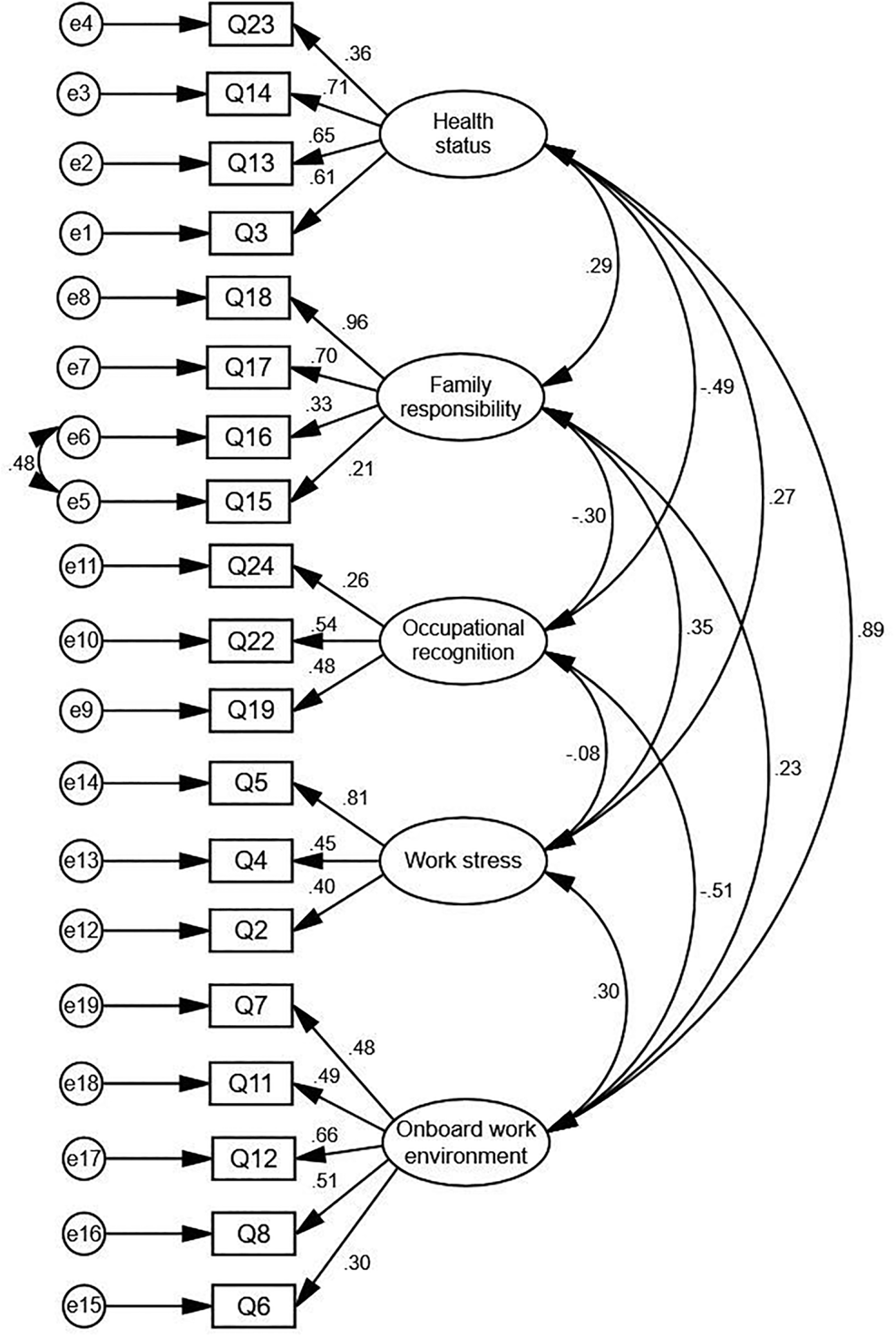
To conclude, five major contributions have been presented in this study. Firstly, through empirical evidence, the study delves into the root causes of young seafarer outflow and depicts a hierarchical structure of contributory factors with five dimensions and 19 items (Figure 2). Through confirmatory factor analysis, the author proves that the hierarchical structure constructed in this paper has an ideal structural validity, which also indicates that the data collected from the questionnaire generated from the proposed hierarchical structure accurately reflects the root causes of the outflow of young Chinese seafarers. Through variance analysis, the authors find that differences in demographics affect young seafarers’ outflow.
The result of CFA as a hierarchical structure

Secondly, this study reveals that there are differences between distinct age groups of seafarers when making outflow decisions. A low level of occupational recognition was identified to be the leading factor for all groups of seafarers between 25 and 40 years old when considering leaving the career. The period around 40 years old is seen as the watershed moment in a seafaring career. It is the key time for seafarers to be promoted to captain or chief engineer. After the age of 40, seafarers generally continue to serve in the shipping industry in a relatively stable way. Before the age of 40, however, there is a high chance that a seafarer will leave and a similarly high chance that this absence will be permanent. Seafarers between 31 and 35 years old are the most unstable, due to various causes. We suggest that further efforts should be made to help them get through this hard period. A clear career plan could be a potential solution to retain this backbone group as prospective senior officers.
Thirdly, it reveals that family responsibility factors exert a greater impact on young seafarers who are married, who come from single-child families or who work at the operational level. This can be explained by the fact that they highly value raising their young children and caring for aging parents. Company-provided humanistic care for seafarers’ families and the involvement of maritime social work may reduce the outflow of seafarers due to this factor.
Fourthly, it discovers that the high demand for knowledge and skills combined with a heavy workload leads to increased work stress among seafarers, increasing their outflow pressure. The outflow of unmarried and management-level seafarers is more heavily affected by work stress. Pre-employment training and methods of stress relief can help seafarers to reduce their experienced work stress, hence reducing seafarer outflow due to excessive work stress.
Fifthly, this study also finds that health status factors, such as fatigue, poor sleep quality and interruptions to the circadian clock, cause young seafarer outflow as well, which is worthy of further investigation to find out how these root causes influence the turnover of officer seafarers. Also, the heavy workload required by work on board container ships leads to a higher outflow rate of container ship seafarers resulting from health status factors. In the future, the shipping industry needs to pay attention to health problems among seafarers so as to reduce the outflow rate of young seafarers.
Despite the findings and discoveries previously mentioned, this paper also has some limitations. Firstly, there is potential that the respondents have not comprehensively expressed their views, as they were guided by the questions designed by the authors. More open-ended questions may be needed to elicit their thoughts thoroughly. Secondly, there may still exist some extreme opinions within the analysed sample even though some were discarded while collecting the questionnaires. Thirdly, being centred on Chinese seafarers, the findings of this survey may not be meaningful to researchers or stakeholders in other nations, given the great cultural diversity present in the world. There is a concern that young seafarers of different nationalities may have different values in their consideration of the major contributory factors of the outflow of young seafarers. Since several Asian countries are major suppliers of maritime manpower, future research can be conducted to examine the different factors contributing to seafarer outflow in these countries. Moreover, triangular fuzzy number (TFN) and fuzzy analytical hierarchy process (FAHP) can be used to rank the weights of critical factors, which is very important information for stakeholders in the shipping industry. Therefore, the application of this method in further studies is highly recommended.