

Attention Deficit Hyperactivity Disorder (ADHD) is a clinically diagnosed disorder (APA, 2013) defined by age-inappropriate levels of inattention, hyperactivity or impulsiveness that cause impairment in all areas of life (Castle et al., Reference Castle, Aubert, Verbrugge, Khalid and Epstein2007). The impairment is life-long in approximately 30% of the cases, with increased rates of comorbid mental health disorders and disability (Mannuzza et al., Reference Mannuzza, Klein, Bessler, Malloy and LaPadula1998). The world-wide prevalence rate of ADHD among children/adolescence and adults stands at 5.29% (Polanczyk, Lima et al., Reference Polanczyk, Lima, Horta, Biederman and Rohde2007) and 4.4% (Polanczyk and Rohde, Reference Polanczyk and Rohde2007) respectively. In Australia, the ADHD prevalence rate was estimated to be at 7.5% among mainstream Australian children (Graetz et al., Reference Graetz, Sawyer, Hazell, Arney and Baghurst2001). Among the mental disorders in children between six and fourteen years old, the Australian Institute of Health and Welfare (2008a) reported a prevalence rate of 13% for ADHD as compared to 3% for depressive disorder. In reviewing their educational needs, the Australian Institute of Health and Welfare (2008b) also reported that 77% of the children with ADHD in the five to nineteen-year-old age group experienced schooling restrictions and half of them required special assistance with learning.
ADHD is a serious disorder with negative life-long consequences and its correct identification and classification are critical, particularly in the Aboriginal population. In the 2012/2013 annual report from Department of Corrective Services Western Australia (WA), it is noted that while Aboriginal people are estimated to make up only 3% of the WA general population, they also made up around 40% of the adult prison population and 60% of the juvenile detention population. Moore et al. (Reference Moore, Sunjic, Kaye, Archer and Indig2013) reported an elevated prevalence of ADHD in correctional facilities in the state of New South Wales in Australia. Given that one third of the participants reported by Moore et al. were identified as Aboriginal or Torres Strait Islander, such finding suggest that ADHD may be an important factor to consider in relation to the incarceration of Aboriginal and Torres Strait Islander people. Further support came from a study examining mental health problems among Aboriginal children in Western Australia (Zubrick et al., Reference Zubrick, Silburn, Lawrence, Mitrou, Dalby, Blair, Griffin, Milroy, De Maio and Cox2005). Zubrick et al. found that the risk of experiencing hyperactivity problems for Aboriginal children stood at 15.8% while for non-Aboriginal children the risk was at 9.7%. They also reported that this risk was the highest in metropolitan areas as opposed to rural regions.
Like many other mental health disorders, identifying ADHD is a challenge. There are no visible biomarkers available to indicate the presence of the disorder and diagnosis is made solely based on the interpretation of behaviours. This challenge is more pronounced in a non-Western culture, and there is ongoing debate as to whether ADHD is a cultural construct (e.g., Timimi & Taylor, Reference Timimi and Taylor2003). The concept of ADHD and its interpretation of normal and pathological behaviours stem from a Western perspective, and cultural factors are largely ignored in its diagnostic methodology. However, a systematic review and meta-regression analysis of over 300 articles from all world regions failed to find any evidence that ADHD is a culturally based construct (Polanczyk et al., Reference Polanczyk, Lima, Horta, Biederman and Rohde2007).
For Aboriginal people, many aspects of Aboriginal life such as the land, kinship obligation and religion are interconnected with health (Elkin, Reference Elkin1994). Hence health, for the Australian Aboriginal people, is viewed in terms of harmonised interrelations between spiritual, environmental, ideological, political, social, economic, mental and physical domains (Zubrick et al., Reference Zubrick, Silburn, Lawrence, Mitrou, Dalby, Blair, Griffin, Milroy, De Maio and Cox2005). It is this interconnectedness between the different domains that helps to provide the explanatory model for the cause of the ill health for Indigenous Australians (Maher, Reference Maher1999). Such a worldview on health was considered responsible for the disparity in understanding the symptomology of the mental disorder between the mainstream community and Australian Aboriginal communities in the Kimberley and urban Perth areas of Western Australia (Vicary & Westerman, Reference Vicary and Westerman2004). However, it is through this understanding of the Indigenous descriptions and perceptions of mental health that a two-way understanding between Indigenous peoples’ construct of wellness and Western biomedical diagnostic labels and their treatment pathways can be established (Ypinazar, Margolis, Haswell-Elkins & Tsey, Reference Ypinazar, Margolis, Haswell-Elkins and Tsey2007). Therefore, understanding this difference and how health issues are explained are necessary steps in assisting the interaction between Western health professionals and Aboriginal peoples (Maher, Reference Maher1999).
A number of authors have emphasised the importance of incorporating a cultural framework in diagnosing psychiatric disorders (e.g., Alarcon, Reference Alarcón2009; Dingwall & Cairney, Reference Dingwall and Cairney2010; Hunter, Reference Hunter2007; Jiloha, Kandpal & Mudgal, Reference Jiloha, Kandpal and Mudgal2012; Loh et al., Reference Loh, Hayden, Vicary, Mancini, Martin and Piek2016; Maher, Reference Maher1999; Vicary & Westerman, Reference Vicary and Westerman2004). The establishment of the social and emotional wellbeing (SEWB) health framework in Australia was a result of this recognition (Kowal, Gunthrope, & Baili, Reference Kowal, Gunthorpe and Bailie2007; Zubrick et al., Reference Zubrick, Silburn, Lawrence, Mitrou, Dalby, Blair, Griffin, Milroy, De Maio and Cox2005). Likewise, to some extent, the widely used DSM-IV, the latest DSM-V and the ICD-10 classification for psychiatric disorders have also emphasised such an approach, focusing on understanding the strong cultural biases that may influence the understanding of certain behaviours (Alarcon, Reference Alarcón2009). However, a cultural framework is lacking in the diagnosis of ADHD and only Western oriented behaviours are used in helping to identify inattention, hyperactivity and impulsivity. This presents an issue in diagnosing ADHD as different cultures have different definitions of what constitutes normal or abnormal expressions of behaviour (Ardila, Reference Ardila1996). In addition, different symptomatology may be expressed for the same psychiatric disorder (Thomas, Cairney, Gunthrope, Paradies & Sayers, Reference Thomas, Cairney, Gunthorpe, Paradies and Sayers2010). Hence, the diagnostic approach to ADHD should include not only the presence of behavioural symptoms, but also should recognise and integrate the person's cultural beliefs in the diagnosis. The current diagnostic approach for ADHD therefore raises the issue of cultural sensitivity and appropriateness for the Aboriginal community.
Cultural sensitivity and appropriateness not only impact on diagnosis but can also result in deterring help seeking behaviour and treatment compliance. Overall, mental ill health ranks second in its contribution to the total disease burden for Indigenous Australians (Vos, Barker, Stanley & Lopez, Reference Vos, Barker, Stanley and Lopez2007). Burdekin (Reference Burdekin1994) reported that mental illness among Aboriginal and Torres Strait Islander peoples is a common and crippling problem and often they are undiagnosed, unnoticed and untreated. The rate of Indigenous adults experiencing high to very high levels of psychological distress was reported to be more than double compared to that of non-Indigenous Australians (Australian Bureau of Statistics, 2006). However, only less than one third of Indigenous people were reported to access any form of mental health service (Slade et al., Reference Slade, Johnston, Oakley Brown, Andrews and Whiteford2007). The under-usage of mental health services may reflect the cultural differences in how mental health problems are understood, experienced and reported by Indigenous people (Dobia & O'Rourke, Reference Dobia and O'Rourke2011). By extension, this low rate of accessing mental health services among Indigenous Australians also raised the question of acceptance of Western-based diagnoses by the Australian Indigenous community. Such a disparity in worldviews about mental health beliefs that exist between the two cultures may also influence the early detection and help-seeking behaviour of Indigenous Australians.
Another issue relating to diagnosis is treatment intervention. Making an accurate diagnosis of ADHD, but failing to follow through with the treatment intervention will not be helpful for the individual affected by the disorder. Any effective intervention requires it to be culturally attuned to the people to whom it is being offered (Carey, 2013). Among Indigenous Australians, the cultural sensitivity of interventions is especially important (Hunter, Reference Hunter2007). Mental health programmes developed within the individual communities have to ensure that interventions are appropriate and meaningful to the local culture. The involvement of the local community members is critical to its success. It has been shown that resources will be well accepted if they are developed or contributed to by Indigenous people (Campbell, Pyett, McCarthy, Whiteside, & Tsey, Reference Campbell, Pyett, McCarthy, Whiteside, Tsey, Anderson, Baum and Bentley2007). Moreover, culturally sensitive delivery and location of services have also been found to be important factors for achieving effective intervention. A successful example is the Aboriginal youth mental health partnership programme that provides accessible and culturally appropriate mental health services for Indigenous youth involved or at risk of involvement in the juvenile justice system. Over a three-year period, the metropolitan Child and Adolescent Mental Health Services (CAMHS) saw an increase of 44.6% in service usage by the youths and their families, and an increase in 117% in the number of Indigenous youth receiving a service from the Country Services (Dobson & Darling, Reference Dobson and Darling2003). This increase in the rate of service usage suggests that incorporating a culturally appropriate mental health programme led to an increase in the willingness of the youths and their families to utilise the services. In recognition of the importance of cultural sensitivity, a national Cultural Respect Framework for Aboriginal and Torres Strait Islander Health 2004–2009 was set up by the Australian Health Ministers’ Advisory Council to guide services and practitioners working with Aboriginal and Torres Strait Islander peoples. Despite such development, setting up and implementing such culturally appropriate mental health services is not widespread nationwide and it remains an ongoing challenge in the Australian mental healthcare system (Walker, Schultz & Sonn, Reference Walker, Schultz, Sonn, Dudgeon, Milroy and Walker2014).
Like many developed countries such as the United States and the United Kingdom, Australia faces issues with limited healthcare funding and resources. At the same time, government reports and healthcare research focusing on Indigenous health have emphasised that current mental health services are not adequately addressing the mental health issues experienced by the Aboriginal community. To address these constraints, it is vital that healthcare funding and resources allocated to Aboriginal mental health services are used to provide effective programmes that can meet the needs of the Aboriginal community and ensure that programmes will be well utilised. To ensure such an outcome in relation to ADHD, the logical initial step would be to understand the Aboriginal worldview of the concept of ADHD. Such data could then be used to inform the development of an effective diagnostic and intervention programme that is culturally appropriate and relevant for Aboriginal children with ADHD. Hence, the current study aimed to examine how people from the Aboriginal community explain the Western concept of ADHD and its symptomatology, and their approach to managing these ADHD symptoms. This study adopted a qualitative approach using a reiterative process of data collection.
Method
Research design
The present study employed a qualitative research design, in order to gain an in-depth understanding of the participants’ experiences and understanding of ADHD. A phenomenological methodology using a combination of in-depth, one-on-one interviews and focus groups containing no more than five participants per session was used to gain insight into the participant's understanding of ADHD. These interviews were transcribed with a thematic analysis employed as the chosen method of qualitative investigation.
Participants
The present study included a purposive sample of 27 Australian Aboriginal participants, given that the objective of the present study was to obtain an Indigenous Australian perspective of ADHD. Participants ranged from 22 to 52 years of age and comprised 19 females (mean age = 39.1 years), and eight males (mean age = 41.0 years). Level of education varied from completion of eighth grade to completion of tertiary (university) education. All participants reported having children of their own. Five participants were either the parent or grandparent of a child with ADHD; eight participants knew someone with ADHD. In order to meet eligibility criteria, participants were required to be aged 18 years and above, and free of any neurodevelopmental or psychiatric orders that would interfere with their ability to provide informed consent.
A snowball method of recruitment was adopted in this study where participants were recruited through word of mouth. The recruitment process began with the Aboriginal Cultural consultant making contact with the Aboriginal community in Perth, Western Australia, through Aboriginal agencies and individual Aboriginal community members who acted as contacts for the community. All participants were located within the metropolitan area of Perth, Western Australia, at the time of the study; however it became evident during the interview process that a substantial proportion of these participants had also lived in rural and other urban parts of Australia.
Procedure
Ethics approval was obtained from the University's Human Research Ethics Committee and the Western Australian Aboriginal Health and Ethics Committee. Prior to recruitment of participants, an Aboriginal reference group comprising four Aboriginal academics, two Aboriginal health professionals, and one Aboriginal community member was established. The six members that comprised this reference group were also active members of Western Australia's Aboriginal community. The purpose of this reference group was to work closely with the individuals involved in the recruitment and interview process, to guide the present study in a manner that upheld cultural sensitivity and appropriateness for prospective participants, and to assist in the validation of research methods and findings. In addition to this six-member reference group, a male Aboriginal consultant (second author) provided further expertise and assistance with the recruitment and interview process, and interpretation of the data.
Information sheets were provided to Aboriginal agencies within the Perth metropolitan area for distribution among peers. Prospective participants were able to obtain further information through contact with the researcher, the Aboriginal consultant, or through the agency from which the information sheet was provided. A second recruitment method was through presentations at Aboriginal centres to disseminate information and answer any questions about the study. Information provided in the information sheet presented descriptions of behaviours or difficulties associated with ADHD symptomatology such as poor concentration and over-activity, without mentioning the terminology “ADHD”. Prospective participants were also informed that the study was aiming to understand any cultural differences in managing these behaviours. Recruited participants could choose to be interviewed individually or in a group, at their discretion.
All participants were provided with an information sheet detailing the purpose of the study, the extent of their involvement and their right to withdraw. Any outstanding queries or comments held by participants were answered prior to giving their informed consent to take part in the present study. A debriefing session with the principal researcher and Aboriginal consultant was also made available to participants, should they have any comments or issues following the study.
Interviews were scheduled at a time and place that was convenient and comfortable to participants. In both the individual and focus group interviews, the issues of confidentiality were discussed. In addition, participants in focus groups were informed that anonymity of participants was not possible within the group. All interviews were audio recorded for the purpose of transcription. Once data were transcribed and validated by participants, all audio recordings were destroyed. All transcribed data were de-identified in order to ensure the anonymity of participants.
The data collection phase of the study comprised two stages. The first stage involved the semi-structured interview process (either individually, or in groups). Interview sessions with no more than two participants lasted for approximately one hour, where the larger focus group sessions ranged from 90 to 180 minutes. In total, the present study included five individual interviews and seven interviews involving more than one participant at a time. Data collection ceased when saturation was achieved. The second stage of the study involved the validation of initial themes by participants in order to ensure the accuracy of information. This was done by providing participants with the interview transcripts; any information deemed as inaccurate by participants was amended to their satisfaction. Data were then thematically analysed in order to identify the prominent themes pertaining to the present research question, which was to obtain an Indigenous Australian perspective of ADHD. Participants were informed that they could request a copy of the findings upon study completion.
Data analysis
Data were thematically analysed using version 10.0 of qualitative analysis program, NVIVO. Thematic analysis was selected as the most appropriate method for analysing the information obtained through the interviews in the present study. Thematic analysis reflects the participant's own point of view, descriptions of experiences, beliefs and perception of a phenomenon (Luborsky, Reference Luborsky1994); in the present study, it pertains to ADHD. Resonating with all types of qualitative analysis, the purpose of thematic analysis is to identify the lived experiences and meanings of participants. This process is particularly beneficial within the context of Indigenous populations; thematic analysis is able to give a ‘voice’ to the minority populations whose opinions are usually silenced (Benoit, Carroll & Chaudhry, Reference Benoit, Carroll and Chaudhry2003).
Results and discussion
The questions formulated for the semi-structured interview broadly focused on (1) typical child behaviour in school, in community and at home; (2) any gender differences in child behaviour; (3) behaviour that suggests possible problems in a child and its negative impact, focusing on ADHD symptoms; (4) belief system around the Western concept of ADHD, the symptoms, diagnosis and treatment; (5) management of a child with ADHD or having ADHD-like symptoms in the Aboriginal community; (6) any knowledge of and/or experiences with health services or agencies that assist with Aboriginal children diagnosed with ADHD; and (7) existing resources and healthcare practices meeting the needs of Aboriginal families and children diagnosed with ADHD or having ADHD-like symptoms. Thematic analysis identified several prominent themes (some with sub-themes) that emerged as commonly discussed topics among the 12 interviews that were conducted.
Hyperactive behaviour
The first theme identified in the interviews related to hyperactive behaviour. It is important to note that this hyperactive behaviour included, but was not limited to, ADHD. Participants shared their experiences, understanding, and interactions with ADHD. Responses were varied, as some participants had direct contact with family members with ADHD, while others were aware of members in their community who had the disorder (for example, they knew of people whose children have ADHD). All participants were aware (to varying degrees) that ADHD is typified by hyperactive behaviour; therefore many participants provided a focus on broader hyperactivity, rather than specific to ADHD. Two prominent sub-themes were identified.
Hyperactive behaviour is problematic
Hyperactive behaviour was seen by all participants to be problematic and undesirable in a number of circumstances. This hyperactive behaviour was recognised to be problematic in a variety of domains. This included at home, at school, and in public (e.g. shopping). For example, “My daughter just likes everything all at once and she just goes from one toy to the other and pulls out all her clothes and then goes to the kitchen and pulls out all the food and then tips out all the milk, and while I'm trying to clean that up she is already in her room doing something else or trying to get into [sister]’s room, putting all the washing powder on the floor and stuff like that”. This problematic behaviour not only affects the individual with ADHD but also affects those around the individual. Some of the parents reported that they implemented strategies such as going shopping while their children were at school so as to avoid allowing their children to display hyperactive behaviour in public.
Participants generally agreed that this hyperactive behaviour has implications in many domains or areas relevant to the child. Understanding such implications is best achieved using an ecological systems perspective such as Bronfenbrenner's ecological theory of development which identifies five environmental systems or domains crucial to the individual (Bronfenbrenner, Reference Bronfenbrenner1992). In particular, the microsystem identifies peers, school and family, all of which were reported by participants to be impacted negatively by the child's hyperactive behaviour. On an individual level, the child's hyperactive behaviour was reported to impact on his/her ability to concentrate and learn. Several participants were caregivers of children with ADHD and provided invaluable insight into the negative implications on wellbeing of the caregiver as a result of the child's hyperactive behaviour. For example, “Sometimes there is conflict between me and my fourteen year old, or me and my eleven year old, because of their condition. And it stresses me out to the max, where I can't put up with it”. Some participants also disclosed secondary stressors as a result of the child's hyperactive behaviour in public settings, such as feelings of judgment; parents of hyperactive children felt that their child's behaviour was a reflection on their parenting ability, “I'm sick of people trying to judge. . .you don't have to look after my child”. Hyperactive behaviour was also associated with externalising behaviours such as aggression and destructive behaviours. Several participants reported that the hyperactive child would get into both verbal and physical conflicts with other children, teachers and caregivers, or would cause damage to property, “Well, when they get angry, they punch a hole in the door, and verbally abuse, swearing at one another”.
This subtheme reflects the general consensus among participants, which was that hyperactive behaviour is problematic, and these problems extend beyond the hyperactive individual and to those surrounding them as well.
Desired behaviour
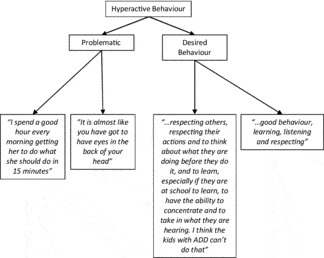
The second subtheme within the domain of hyperactive behaviour related to desired behaviour, or how participants believed children with hyperactive behaviour should be acting. Participants recognised the association between the presence of hyperactive behaviours, reduced capacity to concentrate and learn and disruption to others. Hence, they expressed a general desire for a reduction in these children's hyperactive behaviours in school. Associated with this theme is a frequently occurring subtheme, that of the concept of “respect”. Participants frequently used the term respect to explain the types of behaviours that are desirable. To the participants, reducing hyperactive behaviours was desirable but many also recognised that children should not be sedentary and should live active lives, “And it is, it is being kids but being respectful while being kids, doing what kids should be doing”. Participants generally agreed that certain behaviours were required in certain situations, and although children should be active and play, this behaviour is not suitable in different circumstances. This subtheme reflects the general belief that children should be able to know, for example, that different behaviour is required for concentrating in class, as opposed to playing in the playground. At all times, the child should demonstrate respect for self and for others. Other examples of participant statements related to the theme of ‘Hyperactive Behaviour’ are provided in Figure 1.
Examples of responses indicative of the theme of hyperactive behaviour

ADHD
The second theme emerging from the interviews was related to perceptions of ADHD. With the exception of two participants, ADHD was widely recognised to be a real mental disorder, although participants often disclosed that they were unsure what the exact causes were. This consensus is best summarised by one participant's statement, “I think it is a genuine condition because, you know, like you see it. And not all kids present with it. So, it is just a handful of them that might present with it, so you know there is something going on there but you really don't know what”. Within this theme, three distinct sub-themes emerged.
Typical ADHD behaviours
When discussing ADHD specifically, participants often reported the symptoms that were indicative of a disorder. This subtheme shared some overlap with the previous theme regarding hyperactive behaviour; however, participant responses to this present subtheme were used to describe symptoms of ADHD specifically, as opposed to hyperactivity in general. Within this subtheme, ADHD was most commonly thought to manifest primarily in terms of hyperactive behaviours (“He couldn't sit down. He was climbing on the roof of the school, throwing chairs around, and all that stuff, you know, very aggressive, you know; especially when he wasn't on his medication”), but also within the context of inattentiveness (“. . .their minds still keep ticking over and it is like they are still trying to do more than one thing at a time. They can't just do one thing. . . they are still thinking about the show that they were doing this morning or what they are going to do next and stuff like that instead of just focusing on the one thing”). The participant's perceptions of what typical ADHD behaviours were (i.e., restlessness and inattentiveness) resonate with the nosological classification symptoms of the disorder. Hyperactivity was more frequently mentioned than inattentiveness, which could be attributed to the consequences of hyperactivity being more easily noticed than inattention.
Causes of ADHD
As previously mentioned, a general consensus among nearly all participants was that ADHD was understood to be a legitimate disorder; participants frequently provided insight into what they believe causes ADHD. The most frequently cited cause of ADHD, as discussed by the participants, was attributed to diet. The sugar, preservatives and additives in food were widely perceived by participants to contribute to ADHD. One participant elaborated on this commonly held belief, emphasising the cultural differences between a traditional Indigenous diet and non-Indigenous diet; “And really like we have a much shorter span of time for our bodies to adapt and change to that compared to other societies, because they have had those diets for a lot longer. So it makes you wonder what it does to our bodies, you know. Like, diabetes is a huge one. So maybe it is a similar thing”. The notion that diet was a primary factor in the formation of ADHD was also reinforced by several participants who reported marked changes in hyperactive children after their diets were modified, “. . .he was on medication and then we stopped the medication and started the fresh diet, and that really helped him”.
Participants also attributed the role of environmental factors in ADHD (“. . .it is up to the environment and the parenting and the caregivers that are there. If those parents are not focused on the kids, well then they are going to be diagnosed because the kid will just keep acting out. . .”). Some participants provided further insight into what they believed were the causes of ADHD, recognising the interaction between biological and environmental factors, “I think there would be a number of things. Maybe certainly environmental, maybe there is some sort of chemical, not imbalance, but, you know, environmental, physical, emotional, you know, there are things maybe happening in the family or the environment that the child is in, and also too I think there are kids probably being misunderstood. So it might be a kid that say is really bright, but the school can't give them what they need so they are sort of acting up, so they are therefore seen as naughty and whatever and the next minute they are diagnosed as that. . . if you go back into the family and you can see where the root problem comes from. . .”.
Attitudes towards treatment
Discussion on the treatment of ADHD resulted in a range of views by the participants. The most frequent mode of treatment discussed by the participants was that of medical treatment (e.g. taking dexamphetamine or Ritalin). Some participants expressed positive outcomes as a result of medical treatment (“No word of a lie, ever since he has been on his medication, his school work is up”). However, most participants expressed negative experiences with medication. Participants were generally hesitant or doubtful in using medication as a means of treatment for children with ADHD (“I think medication should only be used as a last resort, as a very last resort”); participants believed that medication drastically reduced the energy level of these children so that they would not be disruptive in class, but this effect compromised their wellbeing. “. . .they were saying that they didn't want their child to go on the medication because it made them drowsy and they were just zombied out. In the classroom they would just sit there and you couldn't really get a lot of feedback”. As a result, most participants did not support a pharmacological approach unless it was supported by non-medical treatments “No, I would rather see that, say if it was my child diagnosed as that, there would have to be a balance of medication and some therapy as a program. You know, yeah, medication is not just the answer. We have got to look at the whole thing around that child that can support it”. Participants recognised the need to treat ADHD, but believed that medication is an insufficient strategy to address this issue.
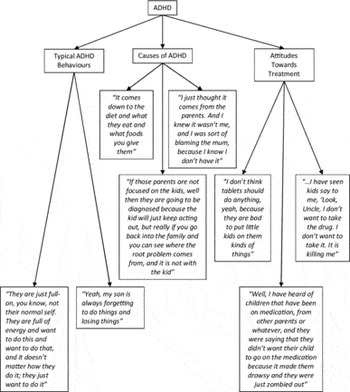
Figure 2 provides additional statements made by participants related to the theme of ADHD.
Examples of responses indicative of the theme of ADHD

Experiences with current services
The access to current services related to diagnosis and treatment of ADHD was explored with the participants. In general, participants’ experiences with the current available services were negative. Three sub-themes within this theme were identified.
Current services are culturally inappropriate
Those interviewed provided valuable insight into the diverse cultural beliefs of Indigenous Australian people, compared to non-Indigenous Australians. Several of these cultural differences were important in understanding how current services were inappropriate for Indigenous Australian children with ADHD. One participant provided an example of how the cultural difference may have implications for ADHD. “It needs to be more visual for Aboriginal kids because they are very, very visual kids. A lot of our kids that sat NAPLAN, there is one particular boy, he is so knowledgeable in here, he is brilliant, but he cannot put it down to paper. He cannot write it, but he can give you the answers if you actually read it out to him, and that is another thing that the Department needs to look at because the marking needs to be done differently”. Participants raised concerns about the use of Western-based standardised testing on Aboriginal children. They questioned if this would disadvantage Indigenous Australian children given that the assessments are developed within a non-Indigenous framework. As a result, Indigenous children may not be demonstrating their actual capabilities because of this cultural bias.
The Western understanding of mental illness was also implicated to be detrimental to Indigenous Australian children; “. . .you get the school psychs and they are white focused and, yeah, it is very difficult”. This has implications for the entire school environment, as was recognised by several participants; “. . .they [Indigenous Australian children] are very verbal, because they want to have a yarn with one another. They want to talk to each other, but you are not allowed to do that because this is the way the classroom is set up. There is a time when you can talk and there is a time when you can't”. This subtheme, in conjunction with the previously discussed ‘Attitudes towards treatment’ subtheme contributed to participants’ beliefs that a culturally appropriate intervention should be implemented.
Need for culturally appropriate treatment
Participants often expressed a need for intervention programmes that recognised the differences in cultural needs for Indigenous Australian children. One participant had described the ineffectiveness of the current “one-size fits all” approach to treatment of ADHD; “There are all different types of people out in the community and they are all trying to make it be like one. There is A, B, C and D, and they are all trying to make it look like Z. There needs to be certain services for certain people”. While most participants indicated a need for such programs (“I think my personal opinion is that if you have got plenty of Aboriginal kids in a region that have got ADHD you need to have special programs in place for them”), other participants provided advice on how these programmes should be developed. For example, one participant proposed a checklist of questions that the participant believed would be necessary to facilitate an effective service; “So, in terms of its location, is it in a place where Aboriginal people would go? It is no good having a facility, you know, where Aboriginal people won't be able to go to. Is it welcoming when people come in? Are the staff that are working there, are they getting trained in Aboriginal culture? Have they got connections with the Aboriginal community that they are working in? Are there partnerships with Aboriginal organisations?” Given the strong family values embedded within the Indigenous Australian culture, the wider family should be an important target to maximise the effectiveness of treatment; “Again, therapy, you need to have therapy where you help the whole family. You can't just fix the child up. You know, you might have five kids and only one kid has got AHDH or ADHD. They might have that one child, but you got to end up that you got to fix up the whole family to help the brothers and sisters understand why this one kid is carrying on the way they are carrying on, help the mum and the nanna and whoever is living in the house to understand and think, ‘Well, okay, something is wrong with this child. They are not just naughty. There is something really medically wrong with them, because it has been after test, after test, after test”. This statement reflects the general beliefs of participants, where a need for culturally sensitive intervention was implicated.
Other participants suggested ways in which the cultural appropriateness of current treatments could be modified, for example, “I think if you haven't got any trained Aboriginal person then a non-Aboriginal trained person going with an Aboriginal person into that home. So then you are breaking down that barrier because they will feel safe if there is one of their own kind, if you like, as well as a professional there working with them”, and “. . .if there is a non-Aboriginal person going in there a lot of them will just - - The whole family will sometimes clam up and say, ‘Oh, you know.’ They will listen to you but when you go away they might be thinking, ‘No, I am not going to go with that one’, whereas if an Aboriginal person is present and said, ‘Look, we are going to help you and this is what we can do with you and work with your family’ I think they would be much more accepted than a non-Aboriginal. Because, I don't know what it is, but they just relate better to their own”.
The information pertaining to this present subsection that was acquired through the interview process has important ramifications to inform future policy and practice; improving the cultural sensitivity of existing programmes, or tailoring new programmes that are tailored to the specific needs of Indigenous Australian children will increase the effectiveness of engagement and treatment.
Lack of information
“Like I said, I have got a diabetes educator. Why can't there be an ADHD educator?” When discussing the availability of resources about ADHD, participants identified a considerable lack of information, perpetuating the problems related to the diagnosis and intervention treatment due to an individual's limited knowledge of the disorder. Participants suggested that, rather than a disorder, the child's hyperactivity could be perceived as mischievous behaviour. The lack of information extends beyond disorder-specific information, and also into a lack of information pertaining to where help can be sought. This is best exemplified by the following quote “A lot of Aboriginal people probably wouldn't know about mainstream services that could probably help. They probably think like the health clinic or the AMSs are the ones that would be able to help, so it is a lack of awareness or knowledge about what is there. . .where they can go for help apart from those ones”. A desire for more information was also expressed, for example, “But that is like ADHD. We don't understand it. We know it is a sickness and we know it can make you feel bad and that, but we don't understand it. We need more educating about it”, or “Therapy, yeah, like, to talk to the parents because the parents don't know what it is. You know, maybe the nurse would be able to tell the parents how that child is feeling, you know, because to hold a sick child all the time is very, you know, like, you are holding the child but you just want them to get better, and you need that knowledge from the research and for people to put it down for Noongar people in plain English so they can understand”. Access to information specifically about the disorder, but also about what agencies exist to provide information on the disorder was regarded as important amongst participants.
Limited resources
As well as a lack of resources, access to facilities providing assessment and treatment of ADHD was also identified as an issue. There were several issues highlighted by participants. For example, participants reported difficulty in obtaining consultation with appropriate healthcare professionals. This is best exemplified by one participant's experience, stating “There is a 15-month waiting list, and he starts school next year”. This statement illustrates how current services are ineffective in being able to meet the demand for treatment. This waiting-list alone can be detrimental to the child who was being discussed. Despite needing this treatment prior to school commencing, the child will have to go through the first year of schooling without this, placing the child at a disadvantage in later years. This is further supported by another participant's experience, who advocated for the need for early intervention in order to prevent more costly treatments later in life “. . .it cost her $5,000 to be able to teach him what they should have done back in year 1 when he couldn't read and write. . .he just could not get it, and my mum pushed and pushed and no one listened”. The location of certain professionals/treatments, and cost were also commonly cited as additional issues that are barriers to treatment for ADHD.
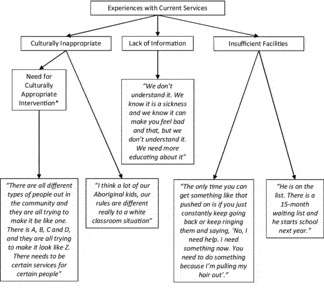
Additional comments related to this theme are provided in Figure 3.
Examples of responses indicative of the theme Experiences with Current Services

Conclusion
Through discussion within the community, we were able to investigate ADHD from an Aboriginal perspective and thus have a better understanding of the issues involved in the assessment and treatment of this disorder in the Aboriginal community. Most participants in this study agreed that ADHD is a bona fide mental disorder as opposed to a cultural construct. They believe that ADHD has a biological or neurological origin, and that intervention is necessary to address this disorder. Such a finding is in line with studies conducted by Azevedo, Caixeta, Andrade and Bordin (Reference Azevedo, Caixeta, Andrade and Bordin2010) and Azevedo and Caixeta (Reference Azevedo and Caixeta2009) examining a similar issue in the Amazon Indigenous communities. These findings suggest that Aboriginal culture is no different from the Western culture in viewing ADHD symptoms. The inability to self-regulate one's behaviour and to focus on task when the situation warrants are problematic for both cultures. However, the main difference between the two cultures lies in the approach to address these symptoms.
Participants clearly support the notion that current treatment approaches may be inappropriate for the Aboriginal community, and that successful treatment rests on designing a more culturally appropriate assessment and intervention for Aboriginal children with ADHD. In addition, a lack of information about ADHD, the presence of culturally biased assessment, and culturally inappropriate facilities and treatment were flagged. These factors appear to be impacting on early identification, treatment and retention. Even when parents and the child were on board with treatment initially, compliance with treatment was short lived. When concerns for accurate diagnosis, side effects of medication, and that cultural self and identity appeared to be compromised in the treatment process, attrition from treatment occurred. Hence, it seems a sensible approach to incorporate cultural sensitivity and appropriateness into the ADHD assessment and treatment programme in ensuring that Aboriginal children affected by ADHD are receiving effective treatment.
With such findings revealed, it should be noted that the sample only included participants residing in Perth and that more than half of the participants have had direct contact with someone with ADHD prior to their participation in the study. The exposure to urban living and having prior experience with ADHD may likely have rendered them to be more accepting of Western concepts of disorders. Hence, the sample is not representative of the wider Aboriginal communities in Australia. The views elicited from these participants only represent a subset of the Aboriginal people in Western Australia. Moreover, only one community within the Australian Indigenous population was involved in this study. Further research is needed to determine whether similar views in assessment and treatment of ADHD are held by other Indigenous communities both within Australia and overseas. In addition, some of the ADHD symptomatology such as hyperactivity and impulsivity can also be noted in other psychiatric disorders such as bipolar disorder. In this case, although both disorders present different distinctive features in symptomatology, age onset and course of development, the overlapping symptomatology is likely to raise question about misdiagnosis between ADHD and bipolar disorder within any community. Although not explored in the current study, it is suspected that such concern may likely contribute to non-compliance of treatment. Future research should also explore this aspect to further consolidate our understanding in the effort to provide a more comprehensive approach to addressing Indigenous mental health.
Nevertheless, despite its preliminary and limited nature, the findings in the current study were able to capture some pertinent issues relating to assessment and treatment of ADHD in this Australian Aboriginal community, particularly regarding cultural appropriateness of mental health programmes. The authors of this study hope that such findings will give health policy makers a better informed position from which to make decisions concerning the allocation of resources to assist Aboriginal people to appropriately manage ADHD. Findings arising from this study can also inform future research direction, particularly in areas of designing culturally appropriate mental health programs. In understanding ADHD symptomatology from a cultural perspective, this approach can assist healthcare professionals in identifying appropriate interventions, which will hopefully engage and retain Aboriginal people in treatment.
Acknowledgements
This work has been funded by an NHMRC capacity building grant (533547) and a Curtin University Internal Research Grant. The authors would like to thank the members of the Building Mental Wealth team for their guidance and assistance. They would also like to thank the Aboriginal Reference Group for its support and advice, and a special thank you to all participants who took part in this study.