Introduction
Executive impairments using the Wisconsin Card Sort Test (WCST) are one of the most frequently replicated findings in people with schizophrenia (Nieuwenstein et al. Reference Nieuwenstein, Aleman and de Haan2001) and have been shown to persist across depressed, manic and euthymic phases in bipolar disorder (Martinez-Aran et al. Reference Martinez-Aran, Vieta, Reinares, Colom, Torrent, Sanchez-Moreno, Benabarre, Goikolea, Comes and Salamero2004). The WCST consists of a series of rule changes, involving the learning of new stimulus–reward associations based on different types of stimuli [extra-dimensional set shifting (EDS)] and shifting attention to a new but previously irrelevant stimulus [reversal learning (RL)]. The intra-dimensional/extra-dimensional (IDED) set-shifting task, part of the Cambridge Neuropsychological Test Automated Battery (CANTAB; Cambridge Cognition, Cambridge, UK), has been developed to test each of these component processes separately. Subsequent work suggests that these processes are associated with dissociable patterns of neural activity involving the ventrolateral prefrontal cortex (VLPFC) and orbitofrontal cortex (OFC) (Hampshire & Owen, Reference Hampshire and Owen2006).
Schizophrenia and bipolar disorder have been previously investigated using the IDED task (Clark et al. Reference Clark, Iversen and Goodwin2001, Reference Clark, Iversen and Goodwin2002; Clark & Goodwin, Reference Clark and Goodwin2004; Waltz & Gold, Reference Waltz and Gold2007). Patients with schizophrenia show impairments in both EDS and RL whereas patients with remitted bipolar disorder have shown deficits in EDS only. The presence of RL errors in a single study of manic patients suggests that, where present, these errors are secondary to residual symptoms (Clark et al. Reference Clark, Iversen and Goodwin2001). As these tasks involve potentially separable neural systems, the specificity of the findings could have important implications for the aetiology of each disorder. As no direct comparison of these disorders has been made to date, we sought to assess this issue in a study of patients with schizophrenia, bipolar disorder and unaffected controls.
Method
Participants
Individuals with bipolar I disorder or schizophrenia were identified from the case loads of consultant psychiatrists across Edinburgh and the Lothians. All patients had at least one affected first- or second-degree family member with the same diagnosis. After informed consent had been given, case-note diagnoses of bipolar I disorder were established using the Operational Criteria (OPCRIT) symptom checklist (McGuffin et al. Reference McGuffin, Farmer and Harvey1991) and confirmed at face-to-face interview using the Structured Clinical Interview for DSM-IV (SCID). Unaffected controls were identified from the same regions and communities as the patients themselves and their diagnostic status was also confirmed using the SCID. To reduce selection bias, we preferentially chose controls from the non-genetic relatives and social networks of the patients themselves. All study procedures were approved by the Local Research Ethics Committee.
All participants were rated by a trained psychiatrist (A.M.) using the Young Mania Rating Scale (YMRS), the Hamilton Depression Rating Scale (HAMD) and the Positive and Negative Symptoms Scale (PANSS). Patients with a score of ⩽8 on both the YMRS and the HAMD were considered euthymic, in accordance with previous papers using the IDED. Neuropsychological testing took place on the day of the clinical assessment.
Neuropsychological testing
All participants were first assessed using the National Adult Reading Test (NART) as a measure of pre-morbid intellectual function. The IDED task from the CANTAB was then administered to all participants. The task consists of nine stages, including four reversal stages (simple discrimination reversal, compound discrimination reversal, intra-dimensional reversal, and extra-dimensional reversal) and an EDS stage. At each stage, two sets of stimuli are presented, and subjects must acquire a stimulus–reward association. After six consecutive correct responses, the task proceeds to the next stage. Should the participant be unable to reach this standard after 50 trials, on any stage, the test comes to an end. Reversal stages involve a reversal of contingencies, whereby the previously rewarded stimulus becomes irrelevant and the previously irrelevant stimulus is rewarded. Extra-dimension shifts involve shifting attention from one type of stimuli to another (e.g. from a solid shape to a line).
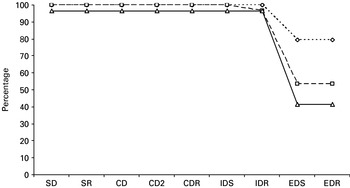
The total number of reversal errors was analysed from the first three reversal stages combined (RL errors). The results of the final (fourth) reversal stage were not used because it is preceded by the EDS phase, which several people failed (see Fig. 1, the extra-dimensional stage of the task). EDS errors were also used in the subsequent analysis.
Graph showing the percentage of subjects in each group passing subsequent stages of the intra-dimensional/extra-dimensional (IDED) set-shifting task. CTR, control group (- -◊- -); BPD, bipolar disorder group (– –□– –); SCZ, schizophrenia group (—▵—); SD, simple discrimination; SR, simple reversal; CD, compound discrimination 1; CD2, compound discrimination 2; CDR, compound discrimination reversal; IDS, intra-dimensional shift; IDR, intra-dimensional reversal; EDS, extra-dimensional shift; EDR, extra-dimensional reversal.

Statistical analysis
Total RL and total EDS errors were the primary measures of interest and were compared between groups. NART-estimated full-scale IQ was included as a covariate to ensure that the differences could not be simply attributed to differences in general intellectual ability. Euthymic patients with bipolar disorder were then compared to controls and to patients with schizophrenia to ensure that the results were not driven by residual affective symptoms in the bipolar patients. The association between EDS and RL transformed error scores and rating scale measures of current psychotic and affected symptoms was examined using Pearson's bivariate correlation coefficient in each group. Pairwise group contrasts were conducted using Tukey's HSD test. Finally, the relationship of EDS and RL error scores to medication was addressed comprehensively by (a) comparing individuals prescribed and not prescribed each medication class (lithium, antidepressants, antipsychotics) within each patient group, (b) comparing individuals prescribed second- versus first-generation antipsychotics and (c) examining the relationship between antipsychotic dose and error scores within each group.
The distribution of residuals from each analysis was inspected at each stage to ensure that it conformed to an approximately normal distribution. Where this assumption was not met, transformations were applied to the data until a suitable approximation could be found. Subsequently, the negative inverse of RL errors and the square root of EDS errors were used in the analyses as their residuals most closely resembled a normal distribution.
Results
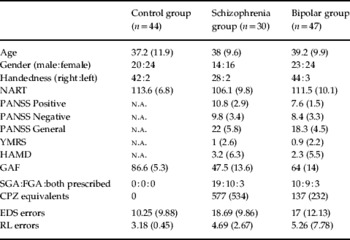
Forty-seven bipolar I patients, 30 schizophrenia patients and 44 control participants completed the IDED subtest of the CANTAB and the NART (Table 1). The groups were matched closely on age, gender and pre-morbid IQ. NART IQ was imputed for five missing values using the appropriate mean for the group.
Descriptive statistics and IDED results for each group

IDED, Intra-dimensional/extra-dimensional; NART, National Adult Reading Test; PANSS, Positive and Negative Symptoms Scale; YMRS, Young Mania Rating Scale; HAMD, Hamilton Depression Rating Scale; GAF, Global Assessment of Functioning; SGA, second-generation ‘atypical’ antipsychotics; FGA, first-generation antipsychotics; ‘both’ refers to subjects regularly prescribed both SGA and FGA; CPZ, chlorpromazine; EDS, extra-dimensional set-shifting; RL, reversal learning; n.a., not applicable.
A significant difference in RL errors was found between the groups [F(2, 118)=6.68, p<0.05]. Pairwise comparisons showed significant differences between control and schizophrenia participants (p<0.05), and between control and bipolar participants (p<0.05). A similar pattern was also found for EDS errors [overall F test: F(2, 117)=4.21, p<0.05]. Pairwise comparisons demonstrated a significant difference between control and schizophrenia participants (p<0.05) and between control and bipolar participants (p<0.05). There was no significant difference between schizophrenia and bipolar participants for either RL or EDS errors and neither measure was associated with rating scale measures of current psychotic or affective symptoms.
Significant between-group differences in EDS and RL errors remained when the bipolar group was reduced to the 40 (40/47) individuals meeting criteria for euthymia (controlling for IQ, EDS errors: F=5.93, p=0.004; reversal errors: F=7.25, p=0.001). Furthermore, when euthymic and non-euthymic bipolar subjects were compared directly, there were no significant differences in either variable (EDS errors: t=0.62, p=0.54; reversal errors: t=–1.03, p=0.31). Within the bipolar group alone, EDS and RL errors showed no relationship with residual affective or psychotic symptoms and no differences were found in either measure when bipolar patients with and without a past history of psychotic symptoms were compared (32 previously psychotic versus 15 non-psychotic).
Finally, no relationship was found between either measure of set shifting and the prescription of any class of medication (lithium, antidepressants, antipsychotics). Furthermore, no differences were found between individuals prescribed first- and second-generation agents, and no relationship was found with antipsychotic dose, defined in antipsychotic equivalents, within either group.
Discussion
Patients with schizophrenia or bipolar disorder show common deficits in both EDS and RL. These deficits could not be accounted for by differences in either IQ or residual symptoms. Furthermore, they did not differentiate bipolar patients with and without psychotic symptoms and remained significant when the bipolar group was restricted to only euthymic individuals.
RL and EDS have been shown in both animal models and human functional magnetic resonance imaging (fMRI) experiments to involve dissociable neural systems (Dias et al. Reference Dias, Robbins and Roberts1996; Hampshire & Owen, Reference Hampshire and Owen2006). In humans, RL is associated with activity in the OFC and ventral striatum, whereas EDS is associated with activity in the VLPFC (Hampshire & Owen, Reference Hampshire and Owen2006). The common neuropsychological deficits shown in the current study are also supported by functional imaging studies showing involvement of these regions across both conditions (Lawrence et al. Reference Lawrence, Williams, Surguladze, Giampietro, Brammer, Andrew, Frangou, Ecker and Phillips2004; Ragland et al. Reference Ragland, Gur, Valdez, Turetsky, Elliott, Kohler, Siegel, Kanes and Gur2004; Malhi et al. Reference Malhi, Lagopoulos, Sachdev, Ivanovski and Shnier2005; Schneider et al. Reference Schneider, Habel, Reske, Kellermann, Stocker, Shah, Zilles, Braus, Schmitt, Schlosser, Wagner, Frommann, Kircher, Rapp, Meisenzahl, Ufer, Ruhrmann, Thienel, Sauer, Henn and Gaebel2007). Further work is required to clarify whether the underlying deficits are secondary to structural and/or neurochemical abnormalities and the role of medication and duration of illness.
Previous studies have demonstrated deficits in EDS but not RL in patients with bipolar disorder (Clark et al. Reference Clark, Iversen and Goodwin2002), and one study found no differences in EDS errors (Sweeney et al. Reference Sweeney, Kmiec and Kupfer2000). Although our findings initially seem to be at odds with this earlier work, bipolar patients in the study by Clark et al. (Reference Clark, Iversen and Goodwin2002) also showed a greater number of RL errors, albeit to a non-significant degree. The observed number of EDS errors in the study by Sweeney et al. (Reference Sweeney, Kmiec and Kupfer2000) were also in the same direction as our results (mean=4.4 EDS errors in controls, mean=5 to 8 in symptomatic bipolar subjects), but did not meet statistical significance. The apparent inconsistency may be due to differences in statistical power or the clinical characteristics of bipolar subjects (e.g. family history, medication or severity of illness). The current study broadly replicates previous studies of individuals with schizophrenia (Waltz & Gold, Reference Waltz and Gold2007) and children with bipolar disorder (Gorrindo et al. Reference Gorrindo, Blair, Budhani, Dickstein, Pine and Leibenluft2005; Dickstein et al. Reference Dickstein, Nelson, McClure, Grimley, Knopf, Brotman, Rich, Pine and Leibenluft2007), but significantly extends these findings by confirming that they are present in adults with bipolar disorder and are not diagnostically specific. The current investigation provides further evidence of common neuropsychological impairments in both disorders (McIntosh et al. Reference McIntosh, Harrison, Forrester, Lawrie and Johnstone2005). Unlike the majority of neuropsychological tasks, however, each task component can be dissociated anatomically and neurochemically. This task may therefore provide a means of identifying the precise neural mechanisms common to each disorder.
Several limitations to the current work should be considered. First, the study is not sufficiently large to exclude a differential impairment between patients with schizophrenia and those with bipolar disorder. Nevertheless, it is currently one of the largest using the IDED task, and the only study to compare these disorders directly. Second, the profile of prescribed psychotropic medication was clearly different between each patient group and may have confounded the results. Although it is not possible to rule out an effect of medication, no relationship of error score with drug class, second- versus first-generation antipsychotic medication or dose equivalence was found in the current study. Third, although common impairments suggest common neural mechanisms, this hypothesis cannot be confirmed without functional imaging. Studies of these disorders using existing tasks based on the IDED may provide further fruitful avenues for investigation.
Here, in a relatively large sample of people with schizophrenia and bipolar disorder, we have shown that patients with both disorders show common deficits in RL and EDS that transcend conventional diagnostic boundaries. These findings may provide a basis for investigating the functional correlates of psychosis common to both conditions.
Acknowledgements
We thank all of the participants without whom this study would not have been possible. This study and two of the investigators (A.M.M. and S.M.L.) were supported by the Dr Mortimer and Theresa Sackler Foundation during the period of data collection. Dr Hall is supported by the Medical Research Council and Dr McIntosh is supported by the Health Foundation.
Declaration of Interest
None.