Childhood anxiety disorders are common, debilitating conditions associated with significant impairment (Bittner et al., Reference Bittner, Egger, Erkanli, Costello, Foley and Angold2007; Verduin & Kendall, Reference Verduin and Kendall2007) and increased risk for later psychopathology (Pine, Cohen, Gurley, Brook, & Ma, Reference Pine, Cohen, Gurley, Brook and Ma1998). Furthermore, high comorbidity exists among childhood anxiety disorders, and between anxiety disorders and other psychiatric disorders, especially depressive disorders (Kashani & Orvaschel, 2000).
Cognitive-behavioural therapy (CBT) is a first-line treatment for childhood anxiety disorders (see Rapee, Schniering, & Hudson, Reference Rapee, Schniering and Hudson2009) that includes psychoeducation, somatic management, cognitive restructuring and exposure therapy (e.g., Kendall, Reference Kendall1994; Manassis et al., Reference Manassis, Mendlowitz, Scapillato, Avery, Fiksenbaum, Freire and Owens2002; Silverman et al., Reference Silverman, Kurtines, Ginsburg, Weems, Lumpkin and Hicks-Carmichael1999; Spence, Donovan, & Brechman-Toussaint, Reference Spence, Donovan and Brechman-Toussaint2000). Indeed, exposure therapy is a key component of CBT (e.g., Kendall et al., Reference Kendall, Robin, Hedtke, Suveg, Flannery-Schroeder and Gosch2005) and involves systematic, repeated exposure to the anxiety-provoking object/situation (in vivo exposure) or the memory of it (imaginal exposure) until anxiety declines. Although CBT is an effective treatment, between 35–45% of anxious children continue to experience significant disability following treatment (James, Soler, & Weatherall, Reference James, Soler and Weatherall2006), and many who do respond still exhibit residual symptoms that predict high rates of relapse at long-term follow-up (Ginsberg et al., Reference Ginsburg, Becker, Keeton, Sakolsky, Piacentini, Albano and Kendall2014). These modest treatment outcome rates highlight the need for closer examination of individual difference factors that influence outcomes and inform ways to optimise treatments.
One such line of investigation has focused on the role of attention towards versus away from threat in predicting treatment outcomes. Learning models emphasise that fear acquisition and extinction (i.e., exposure therapy) requires the allocation of attention resources to the feared object/situation (e.g., Craske, Treanor, Conway, Zbozinek, & Vervliet, Reference Craske, Treanor, Conway, Zbozinek and Vervliet2014; Mitchell, De Houwer, & Lovibond, Reference Mitchell, De Houwer and Lovibond2009; Mackintosh, Reference Mackintosh1975). Fear reduction is achieved through the incorporation of new information that violates information stored in the fear structure (Craske et al., Reference Craske, Kircanski, Zelikowsky, Mystkowski, Chowdhury and Baker2008; Foa & Kozak, Reference Foa and Kozak1986). Therefore, fear structures can only be activated and changed when the individual attends to the threatening stimulus. One may therefore expect fear reduction to be stronger when attention is directed towards rather than away from threat or cues thereof. Attention biases for threat stimuli have long been assessed using the visual probe task (MacLeod, Mathews, & Tata, Reference MacLeod, Mathews and Tata1986), in which a threat and a neutral stimulus pair are simultaneously presented for approximately 500 ms followed by a visual probe presented in the spatial location of the neutral stimulus or the threat stimulus. Faster reaction times when the probe follows the threat stimulus indexes an attention bias towards threat, and conversely, faster reaction times when the probe follows the neutral stimulus indexes an attention bias away from threat.
Several studies have shown that pretreatment attention bias towards threat (compared to bias away from threat) predicts better treatment outcomes following exposure-based treatments in anxious adults and children (Niles, Mesri, Burkland, Lieberman, & Craske, Reference Niles, Mesri, Burklund, Lieberman and Craske2013; Price, Tone, & Anderson, Reference Price, Tone and Anderson2011; Waters, Mogg, & Bradley, Reference Waters, Mogg and Bradley2012). Similarly, anxious individuals with the greatest readiness to acquire an attentional bias favouring threat in response to experimental contingencies making a threat bias adaptive also experienced greater decreases in anxiety following CBT (Clarke, Chen, & Guastella, Reference Clarke, Chen and Guastella2012). However, some studies found mixed results, with better initial response to low-intensity CBT associated with pretreatment avoidance of severe threat, while subsequent response to more intensive CBT was associated with greater pretreatment threat vigilance (Legerstee et al., Reference Legerstee, Tulen, Kallen, Dieleman, Treffers, Verhulst and Utens2009; Legerstee et al., Reference Legerstee, Tulen, Dierckx, Treffers, Verhulst and Utens2010). However, studies to date have differed in the type of threat stimuli used (i.e., severe threat pictures vs. angry facesFootnote 1 ), the components of attention bias that were assessed (i.e., towards and away from threat vs. engagement and disengagement), and the outcome measures utilised (i.e., diagnosis free vs. symptom reduction). Moreover, findings from the broader attention bias literature indicate that the 500-ms stimulus exposure duration primarily utilised in treatment outcome studies to date has produced mixed results, and may be tapping into early automatic and/or controlled attention processes (Waters, Bradley, & Mogg, Reference Waters, Bradley and Mogg2014). Such inconsistencies require that further research is undertaken on attention bias as a predictor of treatment outcomes following CBT using consistent methodology.
Other studies have found that greater emotional variability experienced during exposure tasks predicts lower symptom levels after treatment (Culver, Stoyanova, & Craske, Reference Culver, Stoyanova and Craske2012; Kircanski et al., Reference Kircanski, Mortazavi, Castriotta, Baker, Mystkowski, Yi and Craske2012). The experience of more ‘ups and downs’ during exposure therapy could enhance outcomes by serving as a retrieval cue of extinction as well as providing corrective information about tolerance and coping (Kircanski et al., Reference Kircanski, Mortazavi, Castriotta, Baker, Mystkowski, Yi and Craske2012). To date, emotional variability during within-session exposure activities that are incorporated into group-based CBT programs for anxious children has not been examined. Thus, pretreatment attention bias towards threat and greater emotional variability during exposure tasks may both predict treatment outcomes. To date, no studies have examined emotional variability during exposure tasks in anxious children receiving CBT. Such investigations are important for clarifying factors that contribute to poorer response to CBT in some anxious children (Rapee et al., Reference Rapee, Schniering and Hudson2009). Furthermore, the association between threat attention bias and emotional reactivity during exposure therapy has not been examined in previous research. One possibility is that by enhancing the processing of threat stimuli during exposure therapy, pre-existing threat attention biases might increase overall fear levels during exposure tasks. Attending to threat during exposure therapy might also enhance the accumulation of disconfirming evidence regarding stimulus-outcome expectancies and the reappraisal of threat in more objective terms, thereby influencing emotional variability during exposure tasks.
Thus, the major goal of this study was to examine whether the direction of pretreatment threat attention bias and greater emotional reactivity during within-session exposure activities were associated with greater reductions in anxiety symptoms in anxious children receiving group-based CBT. We examined whether pretreatment attention bias towards threat and the extent of emotional reactivity experienced during weekly, within-session exposure activities completed by anxious children during a group-based CBT program (e.g., Waters, Ford, Wharton, & Cobham, Reference Waters, Ford, Wharton and Cobham2009; Waters, Wharton, Zimmer-Gembeck, & Craske, Reference Waters, Wharton, Zimmer-Gembeck and Craske2008) were associated with greater declines in anxiety symptoms and differentiated treatment responders from non-responders. Since exposure to a variety of stimuli and contexts associated with anxiety enhances extinction learning and/or treatment outcomes from exposure-based treatments (e.g., Bandarian Balooch, Neumann, & Boschen, Reference Bandarian Balooch, Neumann and Boschen2012; Lang & Craske, Reference Lang and Craske2000; Rowe & Craske, Reference Rowe and Craske1998), five different exposure tasks were included that are associated with different anxiety concerns experienced by anxious children (i.e., darkness, meeting a new person, taking a test, wearing someone else's dirty clothing, and giving a speech). We assessed subjective units of distress (SUDS) ratings before, during and after each within-session exposure activity as well as clinician-, parent-, and child-report measures before the CBT program, at the mid point (prior to children commencing the weekly exposure activities), and after group-based CBT.
We hypothesised that pretreatment attention bias towards threat would be associated with greater declines in anxiety symptoms from pre- to post-treatment (Niles et al., Reference Niles, Mesri, Burklund, Lieberman and Craske2013; Price et al., Reference Price, Tone and Anderson2011; Waters et al., Reference Waters, Mogg and Bradley2012). We hypothesised that greater emotional variability experienced during within-session exposure tasks would be associated with better treatment outcomes following treatment (Culver et al., Reference Culver, Stoyanova and Craske2012; Kircanski et al., Reference Kircanski, Mortazavi, Castriotta, Baker, Mystkowski, Yi and Craske2012). Finally, we examined whether pretreatment attention bias towards threat was associated with greater emotional reactivity (overall fear level and/or emotional variability) during exposure tasks.
Method
Participants
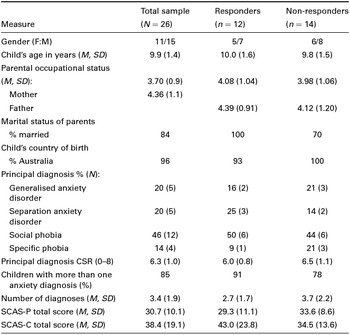
Participants included 26 clinically anxious children referred to the Griffith University Childhood Anxiety Disorders Research Program following referrals from parents, guidance counsellors, paediatricians and general practitioners for assessment and treatment in response to community advertisements about research projects focused on cognitive markers of childhood anxiety and predictors of outcomes following exposure-based CBT (e.g., Waters et al., Reference Waters, Mogg and Bradley2012). A similar number of boys and girls were included and children were 10 years of age on average (range: 7 years, 7 months to 12 years, 10 months). Most children were born in Australia, were living with parents who were married and of average occupational prestige for Australian families. Children's principal anxiety diagnoses were rated as moderate-severe on average and parent and child reports of anxiety severity were within the clinical range previously reported for anxious children (see Table 1).
Socio-Demographic and Pre-Treatment Diagnosis and Symptom Information

Note: Parental occupational status determined by the Daniel Prestige Scale (Daniel, Reference Daniel1983); scores range from 1 (high) to 7 (low). CSR = clinician severity rating.
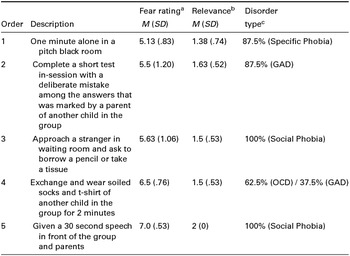
Description of Each Within-Session Exposure Task and Descriptive Statistics From Pilot Testing With Eight Postgraduate Clinical Psychology Students

Note: aFear ratings scale: 0 = not at all to 8 = very much. bRelevance of the activity to children with anxiety disorders: -2 = strongly disagree to +2 = strongly agree. cRefers to the percentage of postgraduate students endorsing the expected type of disorder.
All participants satisfied the following criteria: (1) principal diagnosis of generalised anxiety disorder, social phobia, separation anxiety disorder or specific phobia with a clinician severity rating of 4 or greater (see Measures section), in the absence of developmental disorders, intellectual and learning disabilities, psychosis, organic brain damage, vision or hearing impairments (externalising and depressive disorder were not reasons for exclusion providing they were not the principal diagnosis, 8% had comorbid externalising disorders; 12% had comorbid depressive disorders); (2) no current or past CBT or pharmacological treatment; (3) completion of the CBT program, defined as at least 8–10 child sessions and 4–6 parent sessions. Data from 14 of these children were included in Waters et al. (Reference Waters, Bradley and Mogg2014; i.e., 3% of that sample). However, that study addressed different research questions and only reported pretreatment attention bias data. The study was approved by the Griffith University Human Research Ethics Committee. Parents and children provided informed consent/assent.
Materials
Diagnostic status
Children's diagnostic status was determined using the parent interview schedule of the Anxiety Disorders Interview Schedule for DSM-IV (ADIS-C/P-IV; Silverman & Albano, Reference Silverman and Albano1996) in which a clinician severity rating (CSR) of 4 or greater (scale 0–8) for their principal diagnosis (i.e., most severe) is used to determine clinical significance. Only the parent interview schedule was used, to avoid overburdening children who completed questionnaires and experimental session while their parents were interviewed. The ADIS-C/P-IV was administered by graduate clinical psychology students trained by clinical psychologists experienced in anxiety assessment and ADIS-C/P-IV administration. Different diagnosticians were used at each time point and were blind to children's attention bias scores at all time points. Twenty per cent of interviews were audiotaped and coded by an independent rater blind to children's diagnostic status. Interrater reliability showed excellent agreement (principal diagnosis κ = .85; second diagnosis κ = 0.87; third diagnosis κ = 0.83).
Symptom measures
Child and parent measures of anxiety symptoms were obtained using the Spence Children's Anxiety Scale (SCAS-C, SCAS-P; Nauta et al., Reference Nauta, Scholing, Rapee, Abbott, Spence and Waters2004; Spence, Reference Spence1998) The SCAS-P, a 39-item parent report measure, and the SCAS-C, a 45-item child self-report measure (six positive filler items), both contain 4-point response scales (0 = never true to 3 = always true), yield total scores reflecting symptom severity, and possess sound psychometric properties (Nauta et al., Reference Nauta, Scholing, Rapee, Abbott, Spence and Waters2004; Muris, Schmidt, & Merckelbach, Reference Muris, Schmidt and Merckelbach2000; Spence, Reference Spence1998).
Attention bias
The visual probe task was programmed using E-prime v1.1 (Psychology Software Tools, Inc) and presented on a Dell Optiplex computer with a 17” 75 Hz CRT colour monitor. The same stimuli were used as in previous studies (Price et al., Reference Price, Tone and Anderson2011; Roy et al., Reference Roy, Vasa, Bruck, Mogg, Bradley, Sweeney and Pine2008; Waters, Mogg, Bradley, & Pine, Reference Waters, Mogg, Bradley and Pine2008). Briefly, the main stimuli were photographs of face-pairs from 64 different actors (half male, half female), each presenting a neutral and either an angry or happy expression. This resulted in 32 angry-neutral and 32 happy-neutral face-pairs, plus an additional 16 neutral-neutral face-pairs used on filler trials.
The procedure for the visual probe task was the same as in previous studies (e.g., Price et al., Reference Price, Tone and Anderson2011; Roy et al., Reference Roy, Vasa, Bruck, Mogg, Bradley, Sweeney and Pine2008; Waters, Mogg et al., Reference Waters, Mogg, Bradley and Pine2008). Each trial began with a 500-ms fixation point followed by two simultaneously presented faces on the left and right of the screen for 500 ms. The face-pair was replaced with an asterisk (probe) for 1100 ms, which was centred in the spatial location previously occupied by one of the faces and always appeared at the same location on either the left or right side of the screen. Participants were instructed to press one of two keys labelled ‘left’ and ‘right’ as quickly as possible while avoiding mistakes, to indicate whether the asterisk appeared on the left or right. The inter-trial interval varied randomly from 750 to 1250 ms. The task began with 10 random practice trials, followed by a block of 80 trials. On critical trials (i.e., angry-neutral or happy-neutral face-pairs), the emotional face and the asterisk appeared on either the left or right side on the screen with equal frequency, so that on half the trials the probe appeared in the same spatial location as the emotional face (congruent trials), and on the other half of trials the probe appeared in the opposite location to the emotional face (incongruent trials). The order of trials was randomly determined for each participant.
Treatment program and emotional reactivity during exposure activities
Children (and parents) participated in a 10-week group-based CBT program called The Take ACTION Program (see Waters et al., Reference Waters, Ford, Wharton and Cobham2009; Waters et al., Reference Waters, Mogg and Bradley2012; Waters, Wharton et al., Reference Waters, Wharton, Zimmer-Gembeck and Craske2008). Treatment was conducted in a group format and consisted of 10 weekly one-hour child sessions and 6 one-hour parent sessions. The acronym ‘ACTION’ is used to identify the program modules, which include: (a) psycho-education (‘be AWARE’); (b) training in relaxation techniques (‘keep CALM’); (c) identifying anxious self-talk and assisting children to use coping statements and calm thoughts (‘THINK strong thoughts’); (d) between- and within-session exposure to situations that produce anxiety (‘INITIATE action’); (e) the development of ‘strength’ cards, problem-solving skills, and identification of a ‘strong team’ (‘use my OPTIONS’); and (f) social skills training, assertiveness, and strategies for dealing with bullying (‘NEVER stop taking action’). Therapists followed a detailed therapist manual, completed adherence checks after each activity, and received weekly supervision throughout the program.
Exposure activities started in week 6 with the Initiate Action step and continued every week up to and including week 10. They were designed to target situations/stimuli related to the major anxiety disorders experienced by children and so that more than one might be relevant to children, given high rates of comorbidity among anxiety disorders in children (e.g., Waters et al., Reference Waters, Mogg and Bradley2012). Within-session exposure activities (see Table 1) were piloted with eight postgraduate clinical psychology students to assess (1) their relevance to 7- to 12-year-old children with an anxiety disorder (-2 = strongly disagree to +2 = strongly agree); (2) the level of fear each activity would produce for children (0 = not at all to 8 = very much); and (3) the type of anxiety disorder that each activity corresponded to. The exposure tasks were rated as highly relevant to anxious children, moderate-highly fearful and strongly representative of major anxiety diagnoses (see Table 1).
Children provided 0–8 SUDS ratings at seven time points; three serving as control measures to confirm that emotional distress did not differ at baseline (Pre-Exposure Baseline) (before children were informed about each exposure task) and 5 and 10 minutes after each task (to confirm that differences in emotional responding were specific to the exposure activity and not beyond; Post-Exposure). The four critical exposure SUDs ratings were taken after the exposure activity had been explained and immediately before commencing the exposure activity (Before Task); at two time points during (During A; During B), and immediately after the exposure activity (After Task).
Between-session exposure activities were completed via individualised graded exposure hierarchies called Action Plans that children and parents developed between sessions in weeks 5 and 6. Children completed steps in their Action Plan between weeks 6 and 10 and progress was reviewed during each child and parent session. As between-session exposure activities and level of parental assistance differed between children, they were not instructed to obtain SUDS ratings during between-session exposure activities.
Children and parents received individual workbooks containing session handouts and homework exercises. Therapists checked homework completion at the start of each session.
Parent sessions included (a) psycho-education about child anxiety, (b) parent strategies for managing child anxiety and improving parent-child relations, (c) coverage of the Take ACTION steps children complete each week, (d) promotion of positive parental coping, and (e) training in communication and problem-solving skills.
A booster session was held 4 weeks after the final session. This included a review of progress, problem-solving and reinforcement of the strategies covered in treatment.
Procedure
After informed consent, an initial phone screen was completed and the ADIS-C-IV-P was administered over the telephone. Children meeting diagnostic criteria for at least one anxiety disorder attended an assessment session at Griffith University where they completed the visual probe task and questionnaires with a research assistant in a laboratory while parents completed questionnaires in another room.
Six groups of five to eight children per group received the CBT program, which were co-facilitated by four of eight clinical psychology graduate students blind to children's diagnoses and attention bias scores: two per child and parent sessions. Mean attendance was 9.1 of 10 sessions for children (SD = 1.2), 4.4 of 5 of the exposure sessions (SD = 1.0), and 4.9 of 6 sessions (SD = 1.3) for parents; that is, 91%, 88% and 82% attendance, respectively.
Within-session exposure activities were completed in the order presented in Table 1. Children were informed about the exposure activity and each child in random order was asked individually for their Before Task SUDS ratings.
For the dark exposure activity, the therapist knocked on the door after 20 seconds to prompt the child to provide their During A SUDS rating. After another 20 seconds, the therapist knocked again and the child provided their During B SUDS rating. They provided their After Task SUDS rating immediately upon leaving the room.
For the meeting a new person activity, children rated their During Task A SUDS before asking the person a question and the During Task B SUDS after they thanked the person for the pencil/tissue. They returned to the room, told the therapist their two within-task ratings, and provided their After Task SUDS rating.
For the making a mistake activity, children completed a short test on the acronym ACTION in which they made a deliberate mistake. Parents joined the session and each child handed their work to the parent of another child to be marked. Children provided their During A SUDS rating while parents were ushered into the room. Parents handed back children's tests with ticks for correct answers and crosses and corrections for incorrect answers. Upon receiving their tests, children provided their During B SUDS rating and their After Task SUDS rating once parents left the room.
In the exchanging dirty clothes activity, each child swapped with another child their dirty socks and a previously worn t-shirt brought into session. Children wore the dirty clothes for 2 minutes and provided their During A SUDS rating immediately after putting on the clothes, their During B SUDS rating at the last 30 seconds of the 2 minutes, and the After Task SUDS rating after they removed the dirty clothes.
In the speech activity, each child recited a 30-second speech in front of children, parents and therapists. Children gave their During A SUDS rating when the child immediately preceding them began speaking. When the child preceding them had finished, children recorded their During B SUDS rating, performed their speech, and then provided their After Task SUDS rating.
Post-treatment diagnostic interviews were conducted within 2 weeks after the final treatment session by independent clinical psychology graduate students trained in the ADIS-C-IV-P who were blind to children's diagnostic status and attention bias scores.
Therapists attended weekly supervision in which homework compliance, therapist adherence to session plans and within-session exposure activities were reviewed, individual cases were presented, and treatment planning was completed with the first author who was blind to children's pretreatment attention bias scores throughout treatment and assessment.
Response Definitions and Data Screening
Attention bias
Attention bias scores were derived from reaction times (RTs) to probes in ms. RTs from trials with incorrect responses were excluded. Outliers were identified as RTs less than 200 ms or more than 3 SDs above each participant's mean, and were excluded. RTs to probes were averaged separately for congruent and incongruent trials. Bias scores were calculated separately for angry and happy faces by subtracting the average RT on congruent trials from the average RT on incongruent trials. Positive bias scores indicate attention toward emotional relative to neutral faces, whereas negative values indicate attention away from emotional faces. One child was identified as an outlier on error rate (38%) and overall mean RT (851 ms) (both were >3SD above mean of rest of sample), and their data were excluded from the analyses of attention bias scores. The error rate of the remaining sample of 25 anxious children was low (overall M = 3%, SD = 6) and the mean RT was 555 ms (SD = 97).
Emotional responses during within-session exposure activities
Several indices of emotional responding were examined based on definitions operationalised in previous research (e.g., Culver et al., Reference Culver, Stoyanova and Craske2012; Kircanski et al., Reference Kircanski, Mortazavi, Castriotta, Baker, Mystkowski, Yi and Craske2012). The pre-exposure baseline measure of emotional distress was the initial 0–8 SUDS rating (averaged across all five exposure activities) taken before children were informed about each exposure activity. Peak distress level was defined as the highest of the four critical exposure SUDS ratings which were taken immediately before, during and immediately after each exposure. Within-session habituation was defined as the difference between the peak SUDS rating and the SUDS rating immediately after each exposure activity, averaged across the five exposure activities. Average emotionality was defined as the mean of the four critical exposure SUDs ratings for each exposure activity, averaged across the five exposure activities. Emotional variability was defined as the standard deviation of the four critical exposure SUDS ratings for each exposure activity, averaged across the five exposure activities. The post-exposure measure of emotional distress was the mean 0–8 SUDS rating made at 5 and 10 minutes after the exposure activities.
Symptom improvement
Symptom improvement was defined by subtracting post-treatment symptom scores from pretreatment scores (i.e., after vs. before the 10-week group CBT) for SCAS-P, SCAS-C and the ADIS-C/P-IV CSR for children's principal diagnosis. For analyses examining whether emotional variability during exposure predicts symptom improvement over the exposure sessions (sessions 6–10 of group CBT), symptom improvement was defined by subtracting post-treatment scores from mid-treatment scores taken just before the start of the exposure sessions.
Treatment success
Treatment success was defined as being free from any anxiety disorder (CSR <4) diagnosed with the ADIS-C/P-IV at post-treatment assessment (cf. Legerstee et al., Reference Legerstee, Tulen, Kallen, Dieleman, Treffers, Verhulst and Utens2009).
Results
Associations Between Pretreatment Threat Bias, Emotional Variability and Symptom Change
Threat bias and symptom change
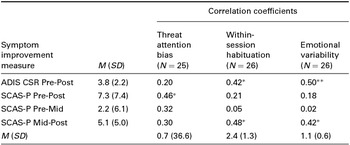
Table 3 presents correlations between pretreatment attention bias scores, within-session emotional responses, and symptom improvement. The hypothesis that pretreatment threat attention bias would be associated with pre- to post-treatment symptom decline was supported by a significant correlation between threat bias and SCAS-P improvement scores, r = .46, p < .05. This reflected that larger pretreatment attention bias towards threat significantly predicted greater declines in parent-reported child anxiety symptoms. Correlations between threat bias and child- or clinician-rated symptom improvement measures were not significant (SCAS-C or ADIS-C/P-IV CSR).
Descriptive Statistics and Correlations Between Pre-Treatment Threat Attention Bias, Exposure Measures and Symptom Improvement Measures

Note: *Correlation significant at .05 (2-tailed); ** Correlation significant at .01 (2-tailed). Emotional variability is the standard deviation of SUDS (subjective units of distress) ratings during exposure activities, averaged across sessions; within-session habituation is the difference between peak SUDS and SUDS immediately after exposure activities, averaged across exposure sessions. Pre–postsymptom improvement scores reflect change over the 10-week CBT program. Mid postsymptom improvement scores reflect change during the exposure sessions, which occurred in the second half of the CBT program (weeks 6–10 inclusive).
Emotional responses and symptom change
Correlational results provided support for the hypothesis that emotional responses during within-session exposure activities would be associated with greater symptom decline (see Table 3). Greater reduction in clinician-rated symptom severity (i.e., pre- to post-treatment change in ADIS-C/P-IV CSRs) was significantly predicted by greater emotional variability during exposure sessions, r = .50, p < .01, and by greater within-session habituation, r = .42, p < .05. Furthermore, parent-report of improvement in children's anxiety over the exposure sessions (i.e., mid- to post-treatment improvement in SCAS-P) was significantly predicted by greater within-session emotional variability and greater within-session habituation, r = .42 and .48 respectively, both ps < .05. There were no significant correlations involving other exposure measures (baseline, peak distress level, average emotionality) or with SCAS-C (all rs < .24, ns).
Moreover, partial correlations indicated that pretreatment threat attention bias scores significantly predicted pre- to post-treatment SCAS-P improvement scores when controlling for within-session emotional variability, habituation, and pretreatment anxiety severity (SCAS-P; r = .48, p < .05). Similarly, when controlling for threat attention bias and pretreatment anxiety severity (SCAS-P and clinician-rated symptom severity respectively), within-session emotional variability and habituation significantly predicted mid- to post-treatment SCAS-P improvement scores (r = .43, p < .05 and r = .51, p < .01 respectively) and pre- to post-treatment change in clinician-rated symptom severity (i.e., ADIS-C/P-IV CSRs; r = .40, p = .05 and r = .41, p < .05 respectively).
Treatment Response
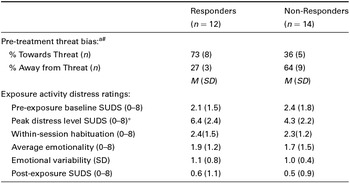
Sixty-five per cent of children were free of their principal anxiety disorder and 46% were free of all anxiety disorders at post-treatment. Treatment responders (i.e., free of all anxiety disorders) and non-responders did not significantly differ on pretreatment demographic or symptoms characteristics (all ps > .51; see Table 3). As shown in Table 4, treatment responders compared to non-responders had significantly larger peak distress scores during within-session exposures, t(24) = 2.26, p = .03, and tended to include more children with pretreatment attention bias towards (n = 8) compared to away from threat (n = 3) relative to treatment non-responders (n = 5 bias towards threat; n = 9 bias away from threat; p = .06, Fisher's exact test).
Descriptive Statistics for Pretreatment Threat Attention Bias and Exposure Measures as a Function of Treatment Response

Note: aAttention bias data missing for one treatment responder. *significant difference at p = .03; #marginal difference at p = .06. SUDS = subjective units of distress ratings: 0 (low) to 8 (high); Peak level is highest SUDS rating during exposure activities; Within-session habituation is the average difference between peak SUDS and SUDS immediately after exposure activities, averaged over sessions. Average emotionality is the mean of SUDS ratings during exposure activities, averaged across sessions; Emotional variability is the standard deviation of SUDS ratings during exposure activities, averaged across sessions. Post-exposure is the mean SUDS ratings taken 5 and 10 minutes after exposure activities.
Associations Between Pretreatment Attention Bias and Emotional Responses
The final hypothesis that pretreatment threat attention bias and exposure activity emotional reactivity measures would be significantly related was not supported. There were no significant correlations (all rs < .07, ns).
Discussion
This study examined whether pretreatment attention bias to threat and emotional responses during within-session exposure activities were associated with greater declines in anxiety symptoms in anxious children receiving group-based CBT. Overall, treatment outcome rates of 65% of children free of their principal diagnosis and 46% free of all anxiety diagnoses at post-treatment are consistent with outcomes rates from large-scale trials of group-based CBT for anxious children (see Rapee et al., Reference Rapee, Schniering and Hudson2009 for a review). In terms of the specific hypothesis regarding attention bias, larger pretreatment attention bias towards threat was significantly associated with greater improvement in parent-report of children's anxiety from pre- to post-treatment, although correlations with child and clinician ratings of symptom change were not significant. Moreover, treatment responders (46% of the sample), defined as no longer meeting criteria for any anxiety disorder (cf. Legerstee et al., Reference Legerstee, Tulen, Kallen, Dieleman, Treffers, Verhulst and Utens2009), showed a near-significant trend to have a pretreatment attention bias towards rather than away from threat relative to non-responders. These results add to prior studies that have shown that pretreatment attention bias towards threat predicted better treatment outcomes from exposure-based interventions in anxious adults and children (e.g., Clarke et al., Reference Clarke, Chen and Guastella2012; Niles et al., Reference Niles, Mesri, Burklund, Lieberman and Craske2013; Price et al., Reference Price, Tone and Anderson2011; Waters et al., Reference Waters, Mogg and Bradley2012). Results contrast with some prior research suggesting that a better initial response to low-intensity CBT was associated with pretreatment avoidance of severe threat (Legerstee et al., Reference Legerstee, Tulen, Kallen, Dieleman, Treffers, Verhulst and Utens2009). However, a subsequent study showed that successful response to more intensive CBT, akin to the treatment utilised in the present study, was associated with greater pretreatment threat vigilance (Legerstee et al., Reference Legerstee, Tulen, Dierckx, Treffers, Verhulst and Utens2010). Thus, methodological differences might contribute to the conflicting findings.
Regarding the underlying mechanisms, enhancing the salience of the feared stimulus (Pearce & Hall, Reference Pearce and Hall1980) and ensuring that fear structures are fully activated during exposure therapy are thought to be critical determinants of treatment outcomes (Craske et al., Reference Craske, Treanor, Conway, Zbozinek and Vervliet2014; Rauch & Foa, Reference Rauch and Foa2006). Therefore, exposure activities may be more salient and fear structures more extensively activated in children who direct attention towards threat. As exposure therapy aims to decrease anxiety by encouraging the acquisition of new extinction learning to compete with the original fear learning (Bouton, Reference Bouton2002), attention directed towards threat or cues thereof (i.e., conditioned stimulus) might enhance the processing of the changing conditioned stimulus–unconditioned stimulus/no unconditioned stimulus contingency and stimulus reappraisal based on objective threat value (Rescorla & Wagner, Reference Rescorla, Wagner and Prokasy1972; Waters & Kershaw, Reference Waters and Kershaw2015). Thus, children with pretreatment attention biases away from threat may require a longer course of exposure therapy or specific attention training to encourage attention to threat during exposure (Waters et al., Reference Waters, Mogg and Bradley2012).
The present study found that more ‘ups and downs’ (emotional variability; cf., Kircanski et al., Reference Kircanski, Mortazavi, Castriotta, Baker, Mystkowski, Yi and Craske2012) and greater declines in emotional distress (within-session habituation) across the exposure activities were associated with greater improvement in parent and clinician reports of children's anxiety symptoms. Moreover, the maximum rating of distress experienced during the exposure activities (peak level measure) was significantly greater in children who were subsequently diagnosis-free at post-treatment. Together, these findings extend previous studies that have found beneficial effects for a range of emotional responding indices during exposure therapy to enhance treatment outcomes (e.g., Culver et al., Reference Culver, Stoyanova and Craske2012; Kircanski et al., Reference Kircanski, Mortazavi, Castriotta, Baker, Mystkowski, Yi and Craske2012). Kircanski et al. (Reference Kircanski, Mortazavi, Castriotta, Baker, Mystkowski, Yi and Craske2012) found that greater within-session habituation and emotional variability during exposure tasks predicted lower post-treatment self-report symptoms and SUDS ratings during a post-treatment behavioural avoidance task (BAT) in adults with contamination fears. Culver et al. (Reference Culver, Stoyanova and Craske2012) found that maximum SUDS (i.e., peak level distress) and greater emotional variability throughout exposure tasks predicted lower SUDS ratings during a post-treatment BAT, but did not on self-report symptom measures. The reasons for the conflicting findings between various indices of emotional responding and outcome measures (both continuous and dichotomous) are unclear but may be due to differences in methodology between the few studies conducted to date. Therefore, several underlying mechanisms might contribute to these findings. As noted earlier, greater emotional variability might enhance the salience of the feared stimulus (CS), which is critical to extinction learning (Pearce & Hall, Reference Pearce and Hall1980). Emotional variability might also strengthen the violation of outcome expectancies by enhancing children's understanding that they can cope with and tolerate exposure to feared stimuli and the reappraisal of the feared stimulus in objective terms (see Kircanski et al., Reference Kircanski, Mortazavi, Castriotta, Baker, Mystkowski, Yi and Craske2012).
However, pretreatment attention bias for threat and indices of emotional responding during exposure activities were not significantly related. Moreover, when controlling for within-session variability and habituation, pretreatment threat attention bias remained a significant predictor of treatment outcomes and vice versa. Thus, threat attention bias and emotional variability during exposure activities may be independent contributors to treatment outcomes. Further studies with larger sample sizes are required before firm conclusions can be made. For example, the additive effect of pretreatment attention bias towards threat and emotional variability during exposure could not be assessed relative to each measure alone. Furthermore, specifically directing attention towards versus away from threat features during exposure would expand knowledge about the associations between these variables.
Results should be considered in regard to limitations. The sample size was small (N = 26), although on par with similar studies and sufficient to detect significant results (i.e., Price et al., Reference Price, Tone and Anderson2011; N = 24). This was due to the preliminary nature of this study, which prevented disorder-specific effects and interactions with other predictors from being examined. However, it encourages studies with larger samples to examine the robustness of results obtained from these small-scale studies to date. Future studies should include parent and child diagnostic reports, if this does not overburden children when they are also completing experimental tasks. Including a longer-term, follow-up assessment will be important in future work for examining whether change in child report of anxiety emerges after treatment, and whether immediate treatment outcomes are vulnerable to mechanisms such as spontaneous recovery (Woods & Bouton, Reference Woods and Bouton2008). Within-session exposure activities were standardised for completion in a group format, but may have produced lower levels of distress than individually tailored activities. The relevance of these exposure activities to each child's distress should be assessed in future studies. Furthermore, emotional variability and within-session habituation each predicted better outcomes. As habituation reflects on the decline in distress, it may be a component of emotional variability. Although the response definitions in the present study replicated those used in previous research (Kircanski et al., Reference Kircanski, Mortazavi, Castriotta, Baker, Mystkowski, Yi and Craske2012), they may benefit from further consideration in future research. Furthermore, as attention bias was not reassessed at mid-treatment along with symptoms, future studies should do so in order to assess associations between the degree of symptom change and attention bias change before and after the exposure component of treatment commences.
In summary, pretreatment attention bias towards threat and greater emotional variability during exposure therapy may be important predictors of treatment outcomes for anxious children receiving CBT. This study extends previous research with anxious adults and children. Moreover, a novel feature is that this study provides evidence that these variables each independently relate to treatment outcome. These data provide support for further research with larger samples to identify mechanisms that underlie attention biases and emotional variability in enhancing treatment outcomes.
Acknowledgments
This research was supported by funding from the Australian Research Council (Grant DP1095536) awarded to Dr Allison Waters. The authors declare no conflicts of interest.