

The regulation of food choice is governed by internal factors, such as a specific subconscious desire for the food, an overt liking, and/or habit (for a review, see Mela(Reference Mela1)), and by environmental factors, such as serving size and social context (for a review, see Wansink(Reference Wansink2)). Whatever has prompted the choice, as soon as food enters the mouth, the taste and smell of food generate the first triggers of satiation, through their action on sensory receptors(Reference Blundell, Green and Burley3). Sensory-specific satiation (SSS) results from continued sensory stimulation and has been defined as the decline in wanting or liking of a food relative to uneaten foods(Reference Rolls, Rolls and Rowe4). SSS has been shown to contribute to food intake control (for a review, see Sørensen et al. (Reference Sørensen, Møller and Flint5)).
Factors thought to influence food intake and the degree of SSS for a food are its intensity(Reference Weijzen, Zandstra and Alfieri6) and the duration(Reference Zijlstra, Mars and De Wijk7) of oro-sensory exposure. The shorter oro-sensory exposure to liquids could explain the low satiating power of liquid energy as compared with energy from solid foods(Reference Haber, Heaton and Murphy8, Reference Hulshof, De Graaf and Weststrate9), and the weak compensatory response after consumption of liquid energy(Reference Mattes10–Reference Mattes12). Also the bite or sip size by which a given food is consumed influences the duration of oro-sensory exposure. When consumed with smaller bites or sips, a smaller amount per chew(Reference Spiegel and Jordan13, Reference Spiegel14) or per swallow(Reference German, Crompton and Owerkowicz15) is ingested, which results in a longer oro-sensory exposure per consumption.
Another factor that potentially influences SSS is the energy content of food. Although some studies showed that the degree of SSS increased when the energy content or amount of solid foods ingested increased(Reference De Graaf, Schreurs and Blauw16, Reference Johnson and Vickers17), studies that dissociated the sensory properties of fat or sugar from the energy they provided, while matching the food stimuli for taste and texture, found that the degree of SSS did not depend on energy content(Reference Rolls, Hetherington and Burley18–Reference Miller, Bell and Pelkman21).
The present study tested whether (1) consumption of orangeade with smaller sips leads to a lower ad libitum intake and a higher degree of subjective SSS, and whether (2) orangeade intake and the degree of subjective SSS are affected by the energy content of similarly sweet orangeades.
Subjects and methods
Subjects
Subjects were fifty-three healthy adults (twenty-one male, thirty-two female), aged 18–29 (mean 21·9) years. The mean BMI was 21·5 (sd 1·7) kg/m2. Subjects were recruited from a consumer database of the division of Human Nutrition of Wageningen University. A pre-screening questionnaire was performed by eligible subjects to confirm that they had normal weight (BMI 18·5–25·0 kg/m2), their weight was stable (no weight change of more than 5 kg during the previous 6 months), did not smoke, did not have a gastrointestinal illness, an illness of the thyroid gland or diabetes, did not have a food allergy, were not pregnant or lactating, did not use medication likely to affect taste perception or appetite, were not highly dietary restrained according to the norm tables of the Dutch Eating Behaviour Questionnaire (DEBQ)(Reference Van Strien22), and were consumers of soft drinks (at least 1 d/month). Subjects were naive to the aim of the research and blind concerning the treatments. Subjects provided informed consent and were reimbursed for participation. The protocol of the study was approved by the Medical Ethical Committee of Wageningen University.
Study design
The study design was a balanced 2 × 2 (sip size × energy) single-blind cross-over design. For each subject the time between two sessions was at least 48 h. Each session, one of two types of orangeade (regular-energy or no-energy orangeade) was consumed in one of two sip size conditions (large or small sips). The regular-energy orangeade was sweetened with sucrose, while the no-energy orangeade was sweetened with synthetic sweeteners. The orangeades were consumed through a silicon tube (length 1·5 m; diameter 5 mm) that was connected to a peristaltic pump (HR flow inducer, MHRE 200; Watson-Marlow Ltd, Falmouth, Cornwall, UK), whereby the sip size, the delivery rate, and the interval between the sips were controlled. In the large sip condition, large sips (20 g/sip) were delivered at a high rate (600 g/min) for 2 s, and with large intervals between sips (6 s). In the small sip condition, small sips (5 g/sip) were delivered at a low rate (300 g/min) for 1 s, and with small intervals between sips (1 s). In both conditions the ingestion rate was 150 g/min. Subjects were instructed to swallow immediately after each sip. Therefore, in the small sip condition the duration of oro-sensory exposure per consumption, i.e. the interval between the food entering the mouth and swallowing, was higher than in the large sip condition ( ± 30 s/min in the small sip condition v. 15 s/min in the large sip condition). In a pilot study performed before the outset of the study in a small group of subjects not participating in the study (n 10) it was ensured that subjects perceived a clear difference in the duration of oro-sensory exposure between the two sip size conditions, while it was reasonably pleasant to consume the orangeades in each of the conditions.
The study design was similar to that of previous SSS studies (for example, Rolls et al. (Reference Rolls, Rolls and Rowe4)). During each session, subjects first rated their appetite. Then, they tasted small samples ( ± 15 g) of three stimuli, one of the two orangeades, and two reference stimuli, semi-skimmed milk and tomato juice. Milk and tomato juice were chosen as reference stimuli, because they clearly differed in taste from the orangeades. Subjects rated the stimuli on four measures: two measures of wanting, i.e. desire to eat and prospective consumption, one measure of liking, i.e. pleasantness, and sweetness intensity. Subsequently, they consumed an ad libitum amount of the rated orangeade in one of the two sip size conditions. They received no visual cues on the amount ingested. Next, they gave appetite ratings again. Finally, they once more tasted small samples of the same three stimuli and rated them on the same four measures (Fig. 1).
Schematic overview of the design of each of the four experimental sessions for a subject. The ad libitum consumed orangeade was either no-energy or regular-energy orangeade, and was either consumed with small (5 g) or with large (20 g) sips.

Stimuli
The orangeades were prepared from orange-flavoured syrups. These were diluted with water (1:5 g). The syrups were specifically prepared for the study by United Soft Drinks (Utrecht, The Netherlands), and were matched for sweetness, viscosity and appearance. One of the syrups was sweetened with sucrose (per 100 g orangeade: 10·4 g sucrose, 177 kJ); the other syrup was sweetened with a combination of synthetic sweeteners (per 100 g orangeade: 0·011 g aspartame, 0·011 g acesulfame K, 0·0058 g sodium cyclamate, 0·0015 g sodium saccharin, ± 0 kJ).
The two reference stimuli of the rating set were chosen to clearly differ in taste from the orangeades. These stimuli were tomato juice (Appelsientje Zontomaat; Riedel®, Ede, The Netherlands) and ultra-heat-treated sterilised semi-skimmed milk (Langlekker; Friesche Vlag®, Nijkerk, The Netherlands). All stimuli were consumed at room temperature.
Procedure
On the test days subjects came to the sensory laboratory. They were instructed to eat a normal breakfast and lunch, and not to eat anything for 2 h before a test session (except for water, and tea or coffee without added milk or sugar), to make sure that feelings of hunger were comparable among test days. This was confirmed by baseline measures of appetite on each test day.
The study was performed in tasting booths. As soon as the subjects arrived at a test session they received oral and written instructions concerning the procedure of the test session. Next, they completed an appetite questionnaire of five items (hunger, thirst, fullness, desire to eat, desired amount to eat). The items were rated on nine-point scales, labelled ‘not at all’ (1) and ‘extremely’ (9). In order to determine their habitual sip size, subjects were asked to drink three sips of water. Subsequently, subjects were presented with a tray containing small samples of the three stimuli. They were asked to taste and rate the stimuli from left to right. The presentation order of the samples on the tray was randomised across subjects and across sessions. Subjects evaluated each stimulus with respect to their desire to consume the stimulus, pleasantness, prospective consumption, and perceived sweetness. These items were also rated on nine-point scales, labelled ‘not at all’ (1) and ‘extremely’ (9). Subjects were instructed to rinse their mouth with water between tasting the different stimuli.
Next, subjects were instructed to take the tip of the tube in their mouth, and to start the pump. This started the delivery of orangeade. They were instructed to consume the orangeade until they felt they had had enough. They were allowed to stop and re-start the pump whenever they wanted. To avoid subjects from terminating consumption because of time reasons, the time for consumption was held constant at 10 min for all participants. After 10 min, subjects repeated completion of the appetite questionnaire, and subsequently the same tasting and rating procedure as before consumption of the orangeade.
Statistical analysis
Statistical analyses were performed using SPSS (version 12.0.1; SPSS, Inc., Chicago, IL, USA). Effects were considered statistically significant at a value of P < 0·05.
For data analysis subjects' habitual soft drink consumption was categorised in three categories: (1) regular-energy soft drink consumers, indicated to consume regular-energy soft drinks more often than no-energy soft drinks (37 %); (2) both regular-energy and no-energy soft drink consumers, indicated to consume regular-energy and no-energy soft drinks equally often (28 %); (3) no-energy soft drink consumers, indicated to consume no-energy soft drinks more often than regular-energy soft drinks (35 %). The average habitual sip size of each subject was categorised into two categories, (1) large ( ≥ 23·3 g) or (2) small ( < 23·3 g), on the basis of a median split of the average sip size of water of all subjects.
Ad libitum intake was compared among the four experimental conditions by the repeated-measures procedure of the general linear model (GLM) with sip size and energy as within-subject factors, and sex, habitual sip size, and soft drink consumer type as between-subjects factors. The analysis was corrected for multiple comparisons by a Fisher's least significant difference (LSD) test.
Initial appetite ratings were compared among the four experimental conditions by the repeated-measures procedure of the GLM, for each of the five ratings. Changes in appetite ratings were compared among the four experimental conditions by the repeated-measures procedure of the GLM with sip size and energy as within-subject factors. The analysis was corrected for multiple comparisons by a Fisher's LSD test.
Initial ratings of wanting, liking, and perceived sweetness, averaged over the experimental conditions, were compared among each of the orangeades and each of the reference stimuli (milk and tomato juice) through the repeated-measures procedure of GLM. The analysis was corrected for multiple comparisons by a Fisher's LSD test.
To test whether the ratings of sweetness of the orangeades had changed after orangeade consumption for each of the four experimental conditions the pre-consumption ratings were compared with the post-consumption ratings by Student's t tests for dependent samples.
Changes in ratings of wanting and liking from before to after orangeade consumption were compared between the consumed orangeades and each of the reference stimuli (milk and tomato juice), for each of the four experimental conditions (post-consumption – pre-consumption). This was done by the repeated-measures procedure of the GLM. The analysis was corrected for multiple comparisons by a Fisher's LSD test.
Subjective SSS was calculated by subtracting the changes in ratings of wanting (two measures) and liking (one measure) of orangeade from before to after orangeade consumption from the corresponding average changes in ratings of the reference stimuli (milk and tomato juice). Thus, for each of the four experimental conditions three measures of subjective SSS were calculated: (1) based on ratings of desire to drink, (2) based on pleasantness ratings, and (3) based on prospective consumption ratings. The more negative scores were, the higher subjective SSS was.
The degree of subjective SSS was compared for each of the three measures among the four experimental conditions by the repeated-measures procedure of the GLM with sip size and energy as within-subject factors, and sex, habitual sip size, and soft drink consumer type as between-subjects factors. The analysis was corrected for multiple comparisons by a Fisher's LSD test.
Results
The results were not statistically different between male and female subjects and between those who normally consumed beverages with small or large sips. Therefore, only the results of the uncorrected models (no between-subjects factors included) will be shown. The association between subjective SSS based on the desire to drink and orangeade type was different for regular-energy and no-energy soft drink consumers (i.e. orangeade type × normal soft drink consumer type interaction). For that outcome the results of the corrected model (corrected for normal soft drink consumer type, sex, and habitual sip size) will be shown.
Ad libitum intake
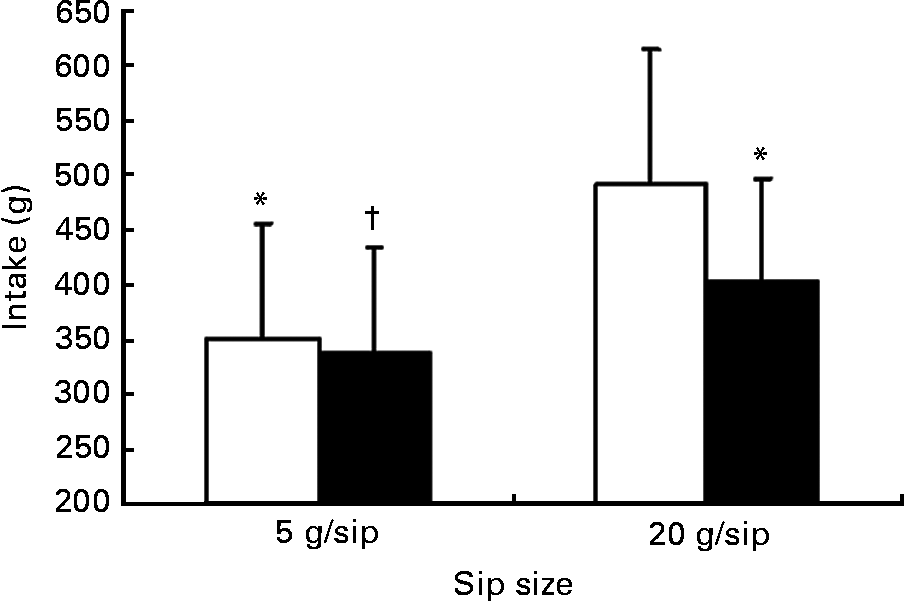
Figure 2 shows that when consumed with small sips, the mean intake of the orangeades was lower than when consumed with large sips (main effect sip size: F(1,49) 40·0; P < 0·001). The effect of sip size was larger for the regular-energy orangeade than for the no-energy orangeade (regular-energy: mean intake 141 g (29 %) lower in small sip condition; no-energy: mean intake 66 g (16 %) lower in small sip condition (intake × energy interaction: F(1,49) 3·7; P = 0·06)). This means that in the large sip condition mean intake was 88 g (18 %) lower for the no-energy orangeade than for the energy-containing orangeade, while in the small sip condition intake was comparable between the two orangeade types.
Ad libitum intake (g) of the two types of orangeade (□, regular-energy; ■, no-energy) in the two sip size conditions. Values are means, with standard deviations represented by vertical bars. Fisher's least significant difference (LSD) multiple comparisons were made among the four experimental conditions. * Mean value was significantly different from that of the regular-energy, 20 g/sip condition (P < 0·05; Fisher's LSD test). † Mean value was significantly different from that of the no-energy, 20 g/sip condition (P < 0·05; Fisher's LSD test).
Initial ratings of wanting, liking and sweetness
The initial ratings of wanting, liking and perceived sweetness did not differ between the two orangeade types, and were higher for the orangeades than for the milk and the tomato juice (Table 1).
(Mean values and standard deviations)
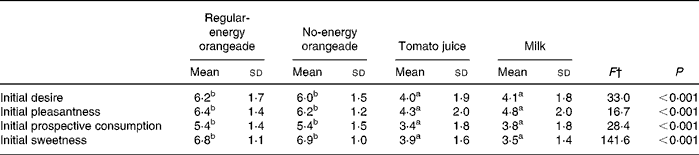
a,b Mean values within a row with unlike superscript letters were significantly different (P < 0·05).
* Ratings on a nine-point scale anchored from 1 = not at all desire/pleasant/much/sweet to 9 = extremely desire/ pleasant/much/sweet.
† F value of the ANOVA comparing the initial subjective ratings for each stimulus. All tests have 3, 156 df.
Subjective sensory-specific satiation
Table 2 shows that the decline in subjective ratings of desire to consume and prospective consumption from before to after orangeade consumption was in each of the four conditions larger for the consumed orangeade than for the non-consumed reference stimuli. A similar pattern was observed for subjective ratings of pleasantness, except for in the small sip condition, in which the decline in pleasantness was comparable between the regular-energy orangeade and the non-consumed reference stimuli. Thus, sensory satiation was perceived for each of the orangeades in each of the sip size conditions, except for when based on ratings of pleasantness.
(Mean values and standard deviations)

a,b Mean values within a row with unlike superscript letters were significantly different (P < 0·05).
* Ratings on a nine-point scale anchored from 1 = not at all desire/pleasant/much to 9 = extremely desire/pleasant/much.
† F value of the ANOVA comparing the decline in subjective change ratings of wanting and liking after orangeade consumption for each stimulus. All tests have 2, 104 df, except for the tests in the regular-energy, 20 g/sip condition, which has 2, 98 df.
Subjective SSS (based on desire to drink, pleasantness, prospective consumption) did not significantly differ between the two sip size conditions. This applied for both types of orangeade (Fig. 3). In the small sip condition, but not in the large sip condition (F(1,49) 4·8; P = 0·03), subjective SSS based on the desire to drink was higher (i.e. more negative score) for the no-energy orangeade than for the regular-energy orangeade. A significant effect was found for the energy × soft drink consumer type interaction (F(1,49) 4·3; P = 0·05), which means that this was specifically the case for the no-energy soft drink consumers, while for the regular-energy soft drink consumers perceived sensory satiation was similar for both types of orangeade. The other measures of subjective SSS were in both sip size conditions comparable between the two types of orangeade (Fig. 3).
Subjective sensory-specific satiation (SSS) for each of the three measures (desire (a), prospective consumption (b), liking (c)) in each sip size condition of the two types of orangeade (□, regular-energy; ■, no-energy). For each of the measures perceived sensory satiation was calculated as the decline in the rating of the consumed orangeade – average decline in the rating of the reference stimuli (tomato juice and milk). Values are means, with standard deviations represented by vertical bars. Fisher's least significant difference (LSD) multiple comparisons were made among the four experimental conditions. * Mean value was significantly different from that of the regular-energy, 5 g/sip condition (P < 0·05; Fisher's LSD test).

Initial ratings of appetite and changes in appetite after orangeade consumption
All initial ratings of appetite (including thirst ratings) were comparable across the four experimental conditions. For declines in ratings of hunger and desired amount to consume from before to after ad libitum orangeade consumption, significant sip size × energy effects were found (hunger: F(1,49) 5·1, P = 0·03; desired amount to consume: F(1,49) 8·4, P = 0·01). This means that for the energy-containing orangeade, but not for the no-energy orangeade, the declines in hunger (P = 0·03) and desired amount to consume (P = 0·02) were larger in the large sip condition than in the small sip condition. This is probably due to the larger difference in amount consumed between sip sizes for the energy-containing orangeade than for the no-energy orangeade. Moreover, in the large sip condition, ratings of desired amount to consume declined more for the regular-energy than for the no-energy orangeade (P = 0·01). This is probably due to the larger amount consumed of the energy-containing orangeade compared with the no-energy orangeade in that condition (Table 3).
(Mean values and standard deviations)
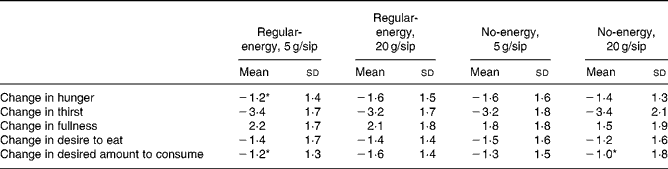
* Mean value was significantly different from that of the regular-energy, 20 g/sip condition (P < 0·05; Fisher's least significant difference test).
† Ratings on a nine-point scale anchored from 1 = not at all to 9 = extremely.
Changes in ratings of sweetness after orangeade consumption
The ratings of perceived sweetness of the orangeades did not change after consumption of the orangeades, except for the perceived sweetness of the no-energy orangeade in the 20 g/sip condition, which increased after consumption (mean increase 0·4; t(52) 3·7; P = 0·001).
Discussion
In line with our expectations, we found that subjects consumed less of the orangeades when consumed with small sips. This was especially the case for the regular-energy orangeade. Despite the lower intake associated with small sips, subjective SSS was comparable between the two sip size conditions. Thus, the present results show that beverage consumption with small sips can lower intake, while the subjective sensory satiation remains high.
The effect of sip size may be explained by the duration of oro-sensory exposure (i.e. longer oro-sensory exposure for small sips). This may also explain the results of previous studies. Some of these demonstrated that chewing time was positively associated with SSS(Reference Hetherington and Boyland23) or negatively with ad libitum intake of a subsequent meal(Reference Lavin, French and Ruxton24). Others showed that viscous drinkable foods provide higher satiety ratings or a lower ad libitum intake than more liquid foods(Reference Zijlstra, Mars and De Wijk7, Reference Mattes and Rothacker25–Reference Harper, James and Flint27). One study showed that soups, which were consumed with a spoon, elicited stronger feelings of satiety than beverages, which were drank normally(Reference Mattes28).
Apart from the duration of oro-sensory exposure, the differences in intake and/or perceived satiation between conditions in each of these previous studies could also be explained by other factors, such as a difference in chewing effort(Reference Oka, Sakuarae and Fuijse29), or differences in the cognitive impression that the stimuli impart to consumers (i.e. learned satiation: consumers expect thicker foods to be more satiating than more liquid foods, or soups to be more satiating than beverages)(Reference Tournier and Louis-Sylvestre30, Reference De Castro31). A clear strength of the present study was that in none of the sip size conditions was chewing effort required for consumption, and that the orangeades imparted the same cognitive impression about energy content to the subjects in each of the sip size conditions. Thus, a difference in the duration of oro-sensory exposure is left as the only likely explanation for the difference in intake between sip size conditions. Yet, an independent effect of a difference in the number of exposures (i.e. the number of sips) per min on the difference in intake cannot be ruled out.
In the large sip condition, intake of the regular-energy orangeade was higher than intake of the no-energy orangeade, while subjective SSS was comparable between the two types of orangeade. In the small sip condition, on the other hand, subjective SSS based on the desire to drink was lower for the regular-energy than for the no-energy orangeade (in no-energy soft drink consumers only), while intake was comparable between the two orangeade types. These results both suggest that the development of SSS is attenuated for regular-energy orangeade compared with no-energy orangeade. This is not supported by most previous studies, which found that the degree of SSS of sweet stimuli is not dependent on the energy content(Reference Rolls, Hetherington and Burley18, Reference Rolls, Laster and Summerfelt19, Reference Raben, Vasilaras and Møller32). However, in support of the present results, a recent human neuroimaging study showed differential brain responses to energy-containing (sucrose) and no-energy sweeteners (sucralose). Only sucrose engaged activation of dopaminergic midbrain areas in correlation with subjective ratings of pleasantness(Reference Frank, Oberndorfer and Simmons33). A recent study showed that mice that lack the ability to taste sweetness developed a robust preference for energy-containing sweet stimuli over water, but not for no-energy sweet stimuli. This suggests that energy content can be detected even when no taste transduction is present(Reference De Araujo, Oliveira-Maia and Sotnikova34). Thus, backed up by these findings(Reference Frank, Oberndorfer and Simmons33, Reference De Araujo, Oliveira-Maia and Sotnikova34), the present results suggest that individuals are able to distinguish the sensory properties of energy-containing sweet foods from those of no-energy sweet foods and adjust their intake on the basis of that information.
The finding that subjective SSS (in the small sip condition) was lower for regular-energy orangeade than for no-energy orangeade among no-energy soft drink consumers only (not for regular-energy soft drink consumers) suggests that the ability to distinguish between sucrose and no-energy sweeteners requires repeated experience with no-energy sweet foods (i.e. learning of a combination of sweet taste and subsequent metabolic consequences). In support of these results, a human study(Reference Appleton and Blundell35) showed that regular consumers of beverages sweetened with synthetic sweeteners lacked the increase in appetite in response to sweet taste, which was found in low consumers of beverages sweetened with synthetic sweeteners. On the other hand, previous rat studies suggested that a sensory distinction between energy-containing and no-energy sweet foods cannot be made, and that therefore eating sweet no-energy substances may degrade the predictive relationship between sweet taste and energy, leading to deficits in energy regulation(Reference Davidson and Swithers36–Reference Swithers and Davidson38).
In the large sip condition perceived sweetness of the no-energy orangeade increased. This could therefore be an alternative explanation for the lower intake of no-energy orangeade compared with regular-energy orangeade. However, although significantly different from zero, the mean increase in perceived sweetness was only 0·4 on a nine-point scale. Therefore, it seems unlikely that the increased perceived intensity can explain the lower intake of no-energy orangeade.
In conclusion, we showed that small sip size, i.e. an increased duration of oro-sensory exposure, can diminish the intake of soft drinks. Moreover, the results suggest that with large sip size only the intake of energy-containing sweet beverages is higher than of no-energy sweet beverages. This underpins the importance of oral exposure time and SSS for meal termination. It may be that consumption of beverages with devices that reduce sip size, such as narrow straws or bottles with limited openings, may help to promote satiation, and thus to limit energy intake.
Acknowledgements
The present study was financially supported by Suikerstichting Nederland (The Netherlands Sugar Foundation). We gratefully acknowledge United Soft Drinks for producing and donating the syrups.
The main investigator of the present study was P. W., who wrote the study protocol and carried out the main body of the work, interpreted the results and wrote a large part of the manuscript. P. A. M. S. contributed to protocol writing, processing the results and writing the manuscript. Protocol writing, data collection and writing the manuscript were done under general supervision of C. de G.
The authors had no conflicts of interest.



