Introduction
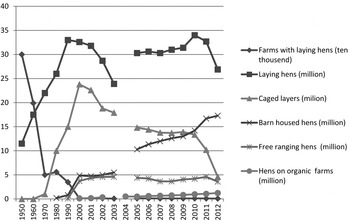
The Netherlands is a major exporting country of agricultural produce, predominantly to neighbouring countries. Of the total annual domestic production of eggs, 70% are exported, making The Netherlands a main exporter of eggs (compare Figure 1).
The poultry industry in The Netherlands evolved in a period when government, industry and the private sector had a shared focus on improving production efficiency and largely neglected risks and effects on the environment and in society. This paper describes a deliberate attempt to introduce a sustainable laying hen system into The Netherlands by a combination of design and stakeholders processes. The trajectory was started by a project named Keeping and loving hens (KLH) formulated in 2003 in anticipation of the ban in European Union (EU) of conventional cages for laying hens in 2012 (Directive, Reference DIRECTIVE1999a). The main question was how meaningful contributions in terms of outcome and learning for sustainable development could be obtained. Innovation literature indicates that incremental improvements of existing systems do not solve the problem, but that system innovations are needed, which in addition to technical changes, require reconfiguration of actors involved (Grin et al., Reference GRIN, ROTMANS and SCHOT2010). The project therefore adapted ideas of system innovation (Bos and Grin, Reference BOS and GRIN2008) and interactivity by applying methodologies from social and innovation sciences (Van Mierlo et al., Reference VAN MIERLO, REGEER, VAN AMSTEL, ARKESTEIJN, BEEKMAN, BUNDERS, DE COCK BUNING, ELZEN, HOES and LEEUWIS2010). In this paper, the ambition, methodology and outcome of this trajectory are reported. An overall description of the analytical frameworks of the Multi-Level Perspective (Geels, Reference GEELS2004) and its refinement by De Haan and Rotmans (Reference DE HAAN and ROTMANS2011) are introduced.
Analytical framework
A well known analytical framework in system innovation is the Multi-Level Perspective (MLP), which connects the rearrangement of actors in a socio-technical regime (Geels, Reference GEELS2004) to external changes, i.e. in the enveloping surroundings (‘landscape level’), and innovation initiatives (‘niche level’). The core idea of the MLP is that system innovations, i.e. the nature of production and its institutions, are shaped by interaction between three levels: the socio-technical landscape, the socio-technical regimes and niches. Socio-technical systems are characterised as regimes because a set of shared rules guide and constrain the work of actors within a production and consumption system, and their embedment in society. Niches emerge when a novelty in a local practice obtains a network of actors that share certain expectations about the future success of the novelty, and are willing to invest in further development. Niches may emerge and develop in response to serious problems in an existing regime. Such problems can be either internal to the regime itself (such as distribution of power in a supply chain) or come from the socio-technical landscape (e.g. changing societal norms on animal welfare). Supported by actors willing to invest in the new concept (industries, R&D organisations, government) and protected from competition in the market place, the technology is improved within the innovation niche, broader networks are formed around it, and more is learned about technical directions for improvement and functions it may fulfil. De Haan and Rotmans (Reference DE HAAN and ROTMANS2011) refined the MLP framework by categorising the nature of friction between the different levels and the resulting ‘patterns’ of rearrangements. Friction between regime and landscape, referred to as ‘tension’ by these authors, leads to emergence of niches and the emergence of alternative systems, internal friction within a regime (‘stress’) leads to adaptation by incorporating alternative functioning from outside or from within the societal system (‘adaptation’), and friction between regime and niche (‘pressure’) leads to empowerment of the niche. This addition allows describing the paths of change in time in a sector and could be used to help analyse which policy measures are effective in transition management.
Development of the Dutch laying hen sector between 1950-2000
The KLH project started in 2003 in response to the tension between the ways egg were produced and societal demands that had arisen in the preceding period. To get an understanding of the situation around 2000, a description of the development of the Dutch laying hen sector was used, based on the History of the Dutch poultry sector by Ketelaars (Reference KETELAARS1992) and data from the Dutch commodity board on poultry and eggs (www.pve.nl). Figure 1 gives an overview of the development of number of hens and housing systems.
Development of laying hen systems in The Netherlands.
NB. No reliable data for 2004 are present because of an outbreak of high pathogenic avian influenza. Data 2012 are preliminary figures per 30th June 2012. Sources: Ketelaars (Reference KETELAARS1992) and PVE, Koppelinformatiesysteem pluimvee.

After 1945, governmental regulation of egg production was confined to a source of income for 300 000 smallholders with a maximum of 600 hens per farm. After lifting this regulation in 1961, the introduction of a uniform pricing for wheat and the liberation of trade for feed and eggs within the European Economic Community (EEC; six countries) in 1967 increased the speed of rationalisation of production. Rationalisation included the introduction of new genotypes (hybrids), battery cages (from 1962 onwards), manure handling and a rapidly developing compound feed industry. The previous situation of maintaining a relationship between the number of hens and farm acreage reversed and resulted in the development of landless farms, relying on purchased compound feed and conveyance of manure. Civic protests against rationalised animal production started around 1970, initially focusing on environmental effects. During the 1980's, emphasis shifted to animal welfare, and battery cages received criticism from animal welfare organisations, who advocated free range and barn housing. In 1977, the production and supermarket retailing of barn eggs started and during the eighties, aviary systems were introduced in combination with aerated manure conveyor belts to reduce ammonia emissions, improve manure handling, lower costs and improve general management as compared to barn housing (Blokhuis and Metz, Reference BLOKHUIS and METZ1992). Stimulated at first by the EU regulation on organic production (Regulation, Reference REGULATION1991) and subsequent amendments, free ranging and organic systems were introduced from about 1990. Around 2000, the Dutch laying hen sector was still export-oriented with predominantly caged layers. The number of farms for laying hens stabilised at about 1100. Cage eggs were rarely sold by Dutch retailers, but were rather exported or used in the national egg processing industry. Although, in response to consumer criticism, technical improvements and alternative husbandry systems had been introduced, the tensions between production methods and society had not been resolved. On the contrary, new issues entered the agenda as well as further regulation by the European Union. To comply with the EU directive on nitrate (Directive, Reference DIRECTIVE1991) production rights for poultry were introduced in The Netherlands in 1998 based on the excretion of phosphate (Henkens and Van Keulen, Reference HENKENS and VAN KEULEN2001; Van den Ham and De Hoop, Reference VAN DEN HAM and DE HOOP2007). In 1999 the EU accepted a directive (Directive, Reference DIRECTIVE1999a) to ban conventional cages to become effective from January 2012. The latter prompted the Dutch government to commission research to develop alternative layer systems which formed the basis of the KLH project in 2003. Since the year 2000 several events contributed to further intensifying the national discussion on animal production. These included an outbreak of Foot and Mouth disease in 2001 and, directly affecting the poultry sector, an outbreak of highly pathogenic Avian Influenza (AI) H7N7 in 2003 (Tacken et al., Reference TACKEN, VAN LEEUWEN, KOOLE, VAN HORNE, DE VLIEGER and DE BONT2003). In line with EU regulations, animals in all affected areas were culled. As a consequence the number of layers decreased dramatically, but reliable figures are lacking (Figure 1). Public health concerns associated with the threat of an outbreak of an Avian Influenza H5N1 epidemic led to the obligation to confine poultry indoors during the autumn of 2003 and spring of 2004. This obligation posed the challenge of bridging the gap between the important consumer demand for outdoor ranging and the need to safeguard public health by confining birds (Groot Koerkamp et al., Reference GROOT KOERKAMP, VAN HIERDEN and MEERBURG2006).
The entry of the political Party for the Animals with two seats (out of 150) in the lower house of parliament in 2006 is an exponent of the societal discussion that had arisen. As other political parties became more outspoken on animal welfare issues, this urged the Dutch government to take additional policy measures for improvements. This situation was not unique for The Netherlands, as demonstrated by the unilateral early ban on conventional cages for layers introduced in Germany in 2009 and the ban on enriched cages in Germany and, from 2021, in The Netherlands, making colony cages the minimum acceptable level in these countries (compare Van Horne and Achterbosch, Reference VAN HORNE and ACHTERBOSCH2008). Towards the end of the decade new items appeared on the agenda, including the contribution of livestock production to global warming, the (excessive) use of resources and limits to fine dust concentrations in the air (Directive, Reference DIRECTIVE1996;1999b).
The project: Keeping and loving hens
The goals of the KLH project were to develop a laying hen husbandry system that would meet the following demands:
• Provide space and conditions for a productive and a ‘happy life for hens’
• Have a lay-out that meets the resistance from parts of society, including free ranging
• Is resilient to market disturbances and animal diseases.
• Have a positive societal image
the interactive design process
The research approach consisted of two combined basic elements. Firstly, methodological designs approach which started by formulating and quantifying the basic needs of the main ‘actors’ in the husbandry system: the hen, the farmer and the citizen. Secondly, interaction and communication with stakeholders was organised based on stakeholder analysis and action research (Van Mierlo et al., Reference VAN MIERLO, REGEER, VAN AMSTEL, ARKESTEIJN, BEEKMAN, BUNDERS, DE COCK BUNING, ELZEN, HOES and LEEUWIS2010). This included involvement of stakeholders in design workshops, papers in the national poultry farmers’ magazine, a brochure (Houden van Hennen, Reference HOUDEN VAN HENNEN2004), DVD and supporting website (www.duurzameveehouderij.wur.nl), which in addition generated free publicity in professional and general media, radio and television. The design approach, later dubbed Reflexive Interactive Design (RIO, in a Dutch acronym), as applied in KLH has been described by Groot Koerkamp and Bos (Reference GROOT KOERKAMP and BOS2008).
The main results at the end of the design process can be summarised as:
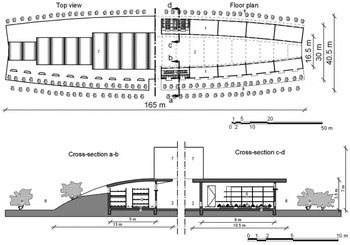
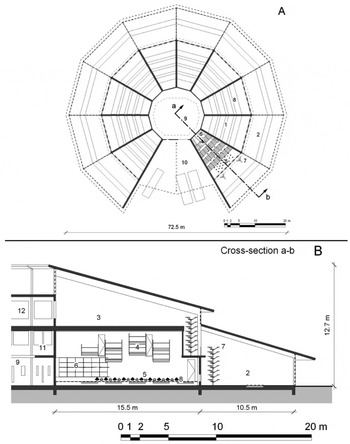
A well-documented, systematically under-pinned vision of a husbandry system for layers based on requirement briefs from the three actors: animal, farmer and citizen. For purposes of communication the briefs were developed into two different designs, named Plantation and Roundel. Artist's impressions of these designs were used in various communication outlets (see Figures 2 and 3).
A heterogeneous network of actors including farmers, industry, NGO's, government and researchers who felt connected with the designs presented.
The Plantation vision. Top view (top left), floor plan (top right) and cross-sections (middle) of the two houses of one unit of the Plantation design. 1: unit for 3000 hens; 2: inner foraging area; 3: perches (for resting) over manure belts; 4: water and feed supply; 5: laying nests; 6: manure belts at floor level; 7: roof of semicircles covered with plastic foil that can be opened and closed; 8: shrubs & trees (from Groot Koerkamp and Bos, Reference GROOT KOERKAMP and BOS2008).

Top view (A) and cross-section (a-b) of one segment (B) of the Roundel design. 1: unit for 3000 hens; 2 & 3: foraging areas; 4: perches (for resting) over manure belts; 5: water and feed supply; 6: laying nests; 7: artificial trees; 8: manure belts at floor level; 9: room for collection eggs; 10: expedition; 11: visitors and control gallery; 12: technical installations (from Groot Koerkamp and Bos, Reference GROOT KOERKAMP and BOS2008.

Entrepreneurial initiatives elicited by the project Keeping and loving hens
In 2004, the interactivity during design workshops and the ensuing communication resulted in four poultry farmers expressing their interest in a follow up by investing in new laying hen facilities based on the principles of KLH, or by participation in developments of concepts for marketing.
The four poultry farmers formed a network within a governmental extension programme (June 2005) with support from a research scientist to further develop their innovative ideas (Wielinga and Vrolijk, Reference WIELINGA and VROLIJK2009). The learning history of this network (Bos, Reference BOS2007) revealed that individual plans to build new facilities, and the time-consuming procedures to obtain municipal building permits and subsidies to mitigate excessive entrepreneurial risks, hampered collective planning and learning and led to discontinuation of the network activities in 2006. In the summer 2006, however, an egg packing station showed interest in further development as well as building and exploiting a Roundel-like housing and started building its own innovation network. Below is described the development of the five initiatives.
Initiatives 1 and 2
Initiatives 1 and 2 (I1, I2) were taken by laying hen farmers that remained formally active in the network up to summer 2006. Both adapted features of the original project, such as housing roofed by plastic sheeting, on farm sales of eggs (I1) and production in compliance with the German KAT quality certification label for organic and free range production systems (I2).
Initiative 3
Initiative 3 (I3) concerned the planning and realisation of a poultry house based on the Roundel. However, the municipal authorities denied permission because of a presumed lack of compliance with environmental regulations. After two years of legal action, the highest administrative court in The Netherlands (Raad van State) decided in favour of the farmer. In September 2011, a facility for 54,000 laying hens was opened. Of the originally anticipated features, a lower stocking density (3.8 hens/m²) was realised. Others, such as a winter garden and outdoor runs, had been abandoned because of fear for additional administrative procedures. In addition, the originally agreed premium price of 0.01 €/egg could not be realised because the egg packing station involved had been taken over by another company.
Initiative 4
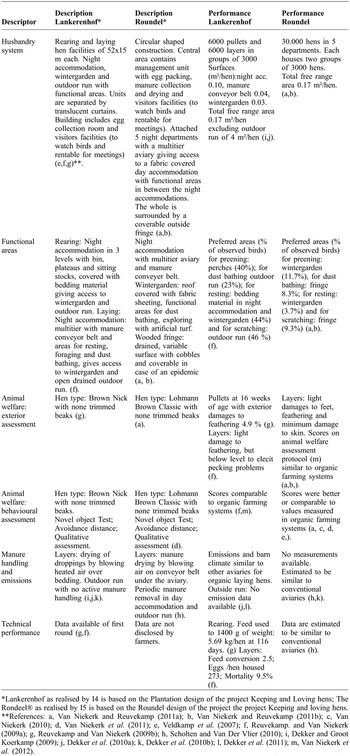
Initiative 4 (I4) was an organic laying hen farmer who, based on the concept of the Plantation, invested in pullet rearing and laying hen facilities (Lankerenhof; www.lankerenhof.nl). After participation in the network he obtained financial support via a provincial and a national government fund. The building of the facilities for 6000 hens (in two compartments of 3000 each) was finished in 2007 (Figure 2). Characteristic features included animal management (including choosing a more robust genotype of hen), health care (including natural infection to sustain disease resistance), and admitting daylight in the housing system and an area allowing visitors to observe the hens (Veldkamp et al., Reference VELDKAMP, GROOT KOERKAMP and BORREN2007). The farmer continued to deliver his eggs to the existing supply chain for organic eggs. The higher investment in the housing facility was compensated for by lower demand for labour, so the cost price of egg production was comparable to that of standard organic eggs (Vermey, Reference VERMEY2011). Measured ammonia, methane and carbon dioxide emissions, and mineral excretion of the laying hen housing system were similar to two other organic farms using aviary systems with collection of the manure on aerated conveyer belts (Dekker et al., Reference DEKKER, AARNINK, DE BOER and GROOT KOERKAMP2010a), although excretion in the outdoor run caused an overload of N and P (Dekker et al., Reference DEKKER, DE BOER, VERMEY, AARNINK and GROOT KOERKAMP2010b). Animal welfare assessments by Reuvekamp and Van Niekerk (Reference REUVEKAMP and VAN NIEKERK2009a; Reference REUVEKAMP and VAN NIEKERK2009b) showed that the different functional areas were well used by the birds. Damage due to feather pecking was restricted to a minimum in the rearing facility as well as in the laying hen facility and did not raise appreciable problems (Table 1).
Initiative 5
Initiative (I5). The possibility of a new marketing concept based on sustainability and the round form of the housing, appealed to an egg packing station. They acquired the trade mark of the Rondeel® in 2005 and started co-operation with a company specialising in housing equipment. The consortium achieved co-financing from Transforum, an organisation aiming to match governmental and private resources in co-innovation projects (Veldkamp et al., Reference VELDKAMP, VAN ALTVORTST, EWEG, JACOBSEN, VAN KLEEF, VAN LATESTEIJN, MAGER, MOMMAAS, SMEETS, SPAANS and VAN TRIJP2009), however in 2007, the egg packing station withdrew from the consortium. The remaining partners, i.e. the equipment firm and a number of poultry farmers, established a separate firm, ‘Rondeel® B.V. (www.rondeel.org). It successfully acquired municipal building permission, and acquired the highest label standard for animal welfare from the Dutch Society for the Protection of Animals, based on a comparison of expected performance with published animal welfare criteria (De Mol et al., Reference DE MOL, SCHOUTEN, EVERS, DROST, HOUWERS and SMITS2006). A contract was obtained with a major Dutch retailer to market the eggs within its newly introduced range of premium sustainable food products. Yet, the participants in the Rondeel® firm, retailers and bank considered the entrepreneurial risks too high for sufficiently long contracts, so realisation only occurred after a security bond had been obtained from the national government for a bank guarantee (Klerkx et al., Reference KLERKX, AARTS and LEEUWIS2010). In 2009 the first Roundel laying hen facility was opened. It contains five units for 6000 laying hens each (Figure 3). In mid-2012 two other Roundels were in operation and more planned. After the opening of the first Roundel several evaluations have been made. In an overall sustainability comparison of the Roundel with current aviary and free range systems in The Netherlands by Scholten and Van der Vlier (Reference SCHOLTEN and VAN DER VLIER2010), the Roundel compared favourably for animal welfare, notably by offering variation in environment to the hens with no beak trimming required, community involvement by its high transparency and accessibility by public viewing areas and meeting rooms, and financial security for the farmer including a contract between farmer and retailer, with compensation for fluctuations in feed costs to the farmer built in. Environmental criteria, such as ammonia and phosphorous emissions, energy and land use, the Roundel scored somewhat lower when expressed per egg and somewhat higher when expressed in added value per egg. The main weaknesses of the Roundel were the double investment costs compared to a standard multitier aviary system and the uncertainty as to whether consumers would be willing to pay a premium for the eggs, which was needed to compensate for the higher investment. Animal welfare assessment was performed in the first round of laying hens and included behavioural studies and comparisons between compartments with hens with trimmed or intact beaks on pecking and feather cover. The results were similar to the results obtained for the Lankerenhof mentioned above. Evaluation data are summarised in Table 1.
Features and performances of Lankerenhof and Roundel.

*Lankerenhof as realised by I4 is based on the Plantation design of the project Keeping and Loving hens; The Rondeel® as realised by I5 is based on the Roundel design of the project the project Keeping and loving hens. **References: a, Van Niekerk and Reuvekamp (Reference VAN NIEKERK and REUVEKAMP2011a); b, Van Niekerk and Reuvekamp (Reference VAN NIEKERK and REUVEKAMP2011b); c, Van Niekerk (Reference VAN NIEKERK2010); d, Van Niekerk et al. (Reference VAN NIEKERK, REUVEKAMP and GUNNIK2011); e, Veldkamp et al. (Reference VELDKAMP, GROOT KOERKAMP and BORREN2007); f, Reuvekamp. and Van Niekerk (2009a); g, Reuvekamp and Van Niekerk (Reference REUVEKAMP and VAN NIEKERK2009b); h, Scholten and Van Der Vlier (Reference SCHOLTEN and VAN DER VLIER2010); i, Dekker and Groot Koerkamp (Reference DEKKER and GROOT KOERKAMP2009); j, Dekker et al. (Reference DEKKER, AARNINK, DE BOER and GROOT KOERKAMP2010a); k, Dekker et al. (Reference DEKKER, DE BOER, VERMEY, AARNINK and GROOT KOERKAMP2010b); l, Dekker et al. (Reference DEKKER, AARNINK, DE BOER and GROOT KOERKAMP2011); m, Van Niekerk et al. (Reference VAN NIEKERK, GUNNIK and VAN REENEN2012).
Learning process 2000-2012
Against the background of increasing tension between society and egg producers, the process of learning for actors involved in KLH was examined. In 2005, interviewees from the target group within the project (farmers, representatives of industry, NGO and governments), praised the approach of interactive design and communication strategy, but expressed doubts on feasibility and acceptance by partners other than themselves (Geerling-Eiff and Groot Koerkamp, Reference GEERLING-EIFF and GROOT KOERKAMP2005). In 2006, key persons involved in the KLH project were interviewed and a questionnaire was send to others involved. The reported learning benefits included (in descending order of frequency mentioned): new insights (45% of respondents), change in attitude (37%), network learning (35%), direct application (30%), new research (25%), new networking (20%), change in policy (15%) and change of strategy (8%). The overall conclusions were (translated from Van Der Meulen and Cuijpers, Reference VAN DER MEULEN and CUIJPERS2007): ‘The data indicated that the project has been successful in two main aspects. Firstly, the KLH project created new husbandry concepts which led to tangible plans for improvements. The actors involved showed an important consensus on the values behind the concepts, notably on the importance of animal welfare and of societal acceptance, although the respondents valued the feasibility of the system as ‘relatively low’ (with more well-informed respondents scoring feasibility higher). Secondly, publicity targeting this sector has led to new networks of farmers and an increased awareness in the sector of the possibilities surrounding sustainable livestock production’.
In an inventory of news items in the press, Pot and Termeer (Reference POT and TERMEER2010) analysed frameworks that were used in relation to the discussion on livestock production and in particular in reporting on the Roundel. Coverage in farmers’ media, within research groups, government representatives, animal welfare organisations and retailers regarded the Roundel as a positive step on the way to sustainability. Coverage in the general press, as well as in professional agricultural media, was positive or neutral. The authors concluded that public perceptions in terms of industrial large-scale production, often referred to as mega farms (Van Lieshout et al., Reference VAN LIESHOUT, DEWULF, AARTS and TERMEER2011), could hamper further development.
Rearrangement of key players in the regime
The MLP depicts mutual rearrangements of actors as a key characteristic of niche developments as a precursor to system innovation. Initiatives 1, 2 and 4 realised rearrangements on the level of the husbandry systems concerning housing, equipment, management, the type of hen and egg delivery through existing supply chains. In the case of I3, institutional barriers hindered realisation of the original plans, so that, in the end, only additional space per hen was realised, with no extra income for the farmer or enhanced societal trust.
In the case of the Roundel (I5), several changes took place outside the poultry farm itself, i.e. in the wider sector or, in MLP terms, the egg regime. To sum up the most important changes:
1. The Dutch Society for the Protection of Animals, a large and influential NGO, decided to award Roundel-eggs with the maximum three stars quality label for better animal welfare, originally reserved for organic production only. Assessment of the Roundel measurements using the criteria of Welfare Quality® (Van Niekerk et al., Reference VAN NIEKERK, GUNNIK and VAN REENEN2012) and the Fowel model (De Mol et al., Reference DE MOL, SCHOUTEN, EVERS, DROST, HOUWERS and SMITS2006) by Reuvekamp and Van Niekerk (Reference REUVEKAMP and VAN NIEKERK2009a; Reference REUVEKAMP and VAN NIEKERK2009b) revealed that animal welfare in the Roundel met the animal welfare standard set for organic farming.
2. A leading Dutch retailer decided to develop its own ‘Pure and fair’ sustainability label and within it adopted the star system of the Society for the Protection of Animals and started to market Roundel eggs.
3. The local municipality where the farm was located made an exception for building regulations, which limits the area of a farm that can be covered by buildings like animal houses and machinery sheds.
4. The farmer became the packing station.
5. The farm adopted an ‘open door’ attitude and now receives visitors and has meeting facilities (which also provides an additional source of income).
6. The farm equipment firm invested in the system with the perspective of selling elements on larger scale.
7. The national government reviewed the effectiveness of subsidy instruments and opened its existing Small Business Innovation and Research (SBIR) programme for the livestock sector, including farmers.
8. The national government experimented with a security bond to underwrite the high investment risks of the private partners. This was instrumental in allowing the learning process to continue.
9. An egg price was agreed between retailer and farmer, which was dependent on feed price, thus increasing resilience in the supply chain regarding fluctuations in price of feed ingredients.
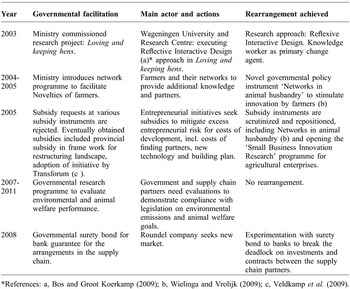
The role of the government is worthwhile analysing in some further detail. It is apparent that some elements fitted into previously developed governmental routines, mainly based on a linear model of innovation, presuming development of new technologies by research institutes and diffusion into practice (Godin, Reference GODIN2006). The original research question commissioned by the research institute was to develop an alternative system for laying hen husbandry and subsequently assure knowledge transfer into practice. The approach of co-creation, i.e. interactive joint development of stakeholders and research, did not fit into the governmental evaluation system and required a different approach from policy workers. During the trajectory, the national government, i.e. the Ministry of Agriculture, allowed interactive and trans-disciplinary research, which were largely unprecedented approaches in this field, and introduced new policy instruments to stimulate innovation. Table 2 shows the most important changes at the level of the national government.
Entrepreneurial initiatives met obstacles on the level of local (mainly municipal) governments. These included various regulations on spatial functionality, including building sites, functional zoning and maintaining environmental regulations.
Overview of governmental (Dutch Ministry of Agriculture) activities in the Keeping and loving hens trajectory from 2003-2010.

*References: a, Bos and Groot Koerkamp (Reference BOS and GROOT KOERKAMP2009); b, Wielinga and Vrolijk (Reference WIELINGA and VROLIJK2009); c, Veldkamp et al. (Reference VELDKAMP, VAN ALTVORTST, EWEG, JACOBSEN, VAN KLEEF, VAN LATESTEIJN, MAGER, MOMMAAS, SMEETS, SPAANS and VAN TRIJP2009).
Discussion
The KLH project suffered some constraints from the beginning. Firstly, the scope for solutions was limited to egg production by hens (Gallus gallus domesticus), inspired by the foreseen EU ban on caged layers. Thus, the option of fulfilling human needs for eggs by other birds or egg substitutes was excluded. Such an approach could have opened up new sustainability perspectives, which, by being ‘alien’ to the present regime, would presumably have been met with too much resistance to contribute to innovations on a term relevant for governmental policy.
Secondly, the level of development of the RIO approach at the time did not allow for the inclusion of more than three ‘actors’ in the design process (the farmer, the hen and the citizen). Furthermore, at the time societal and political emphasis was on animal welfare and less on other issues. Notably, the absence of the representation of environmental issues (including the interests in maintaining biodiversity and limiting emissions of greenhouse gases) in the design process is an importance omission, considering the current problems of global warming and loss of biodiversity. This also applies for human health, and, although risks of Avian Influenza were represented in the design process and led to the concept of coverable free range areas, other risks including antibiotic resistance as the result of treatment of pullets and fine atmospheric dust control were not considered.
As previously mentioned, a philosophy on how to address the increasing complexity of including more actors (such as farm worker, neighbours and environment) and their needs in the brief of requirements in the design process was not developed. Also, the original projects ambition of developing a more resilient hen in the system appeared to be out of reach. The underlying concepts and common language could not be mastered by the trans-disciplinary project team. In later projects, systems analysis was introduced to identify multiple systemic faults that had become stabilised in the past, and deficiencies in the innovation system to obtain a certain focus for the design process both in topic and for stakeholders (Van Mierlo et al., Reference VAN MIERLO, REGEER, VAN AMSTEL, ARKESTEIJN, BEEKMAN, BUNDERS, DE COCK BUNING, ELZEN, HOES and LEEUWIS2010).
Thirdly, the project focused on redesigning the husbandry system, while being aware that substantial contributions to sustainable development would require reconfiguration of mutual relationships of stakeholders outside the husbandry system. However, the overall evaluations show that, by the interactivity in the design process and entrepreneurial activities, stakeholders outside the direct husbandry sphere did become involved. So the focus on husbandry systems in the design process was compensated for by the influence of stakeholders in the design process and by the entrepreneurs and their innovation partners in realising the value of new husbandry systems, and especially the Roundel, in the supply chain. This is in line with the analysis of Bos et al. (Reference BOS, SPOELSTRA, GROOT KOERKAMP, DE GREEF and VAN EIJK2011), who concluded that the design approach worked as a mediator between regime and niche.
Outcome
Did the KLH project and its follow up contribute to learning and change for sustainability in the egg-producing sector in The Netherlands? We cannot claim that all observed changes can be attributed to the project. The project took place during a period of a strong debate on animal production. The debate and its translations in government and institutional policies were important for the observed changes. However, to solve social tensions, images and examples of alternatives can be instrumental. During the period of analysis, KLH was the only project in the egg-producing sector within The Netherlands that provided and communicated a clear vision of a consistent, trustworthy, radical and realisable alternative. Moreover, from the beginning it was part of governmental policy to stimulate innovation for sustainable development in the livestock sector. Follow up activities were capable of attracting resources and were backed up with considerable political power and financial support. The various published evaluations show that the project and its activities had important influences on the thoughts and actions of stakeholders. Based on the reconstruction above, the outcome can be discussed on three levels: the husbandry system, supply chain and governance system.
Changes in the level of husbandry system included changes within the regular system of barn egg production (I3), free range production (I1 and I2) and organic production (I4). These changes will probably be continued on the farms involved, and could have spin-off impacts to other farms.
Technical evaluations of the Lankerenhof (I4) and Roundel (I5) showed animal welfare improvements (Van Niekerk and Reuvekamp, 2010; Table 2) and environmental performances similar to other organic multi-tier systems (Dekker et al., Reference DEKKER, AARNINK, DE BOER and GROOT KOERKAMP2011; Table 2). Additional model calculations showed improved overall sustainability and technical performance of the Roundel (Scholten and Van der Vlier, Reference SCHOLTEN and VAN DER VLIER2010). Admittedly not all technical evaluations are conclusive. Animal welfare evaluation considered the first rounds of production only. The fact that no improvement on the environmental aspects has been reported comes as no surprise, because in the design approach environmental aspects were not included. This applies also for other aspects, including the production of fine dust and its health consequences for farmers, use of antibiotics in pullet rearing and consequences for human health from antibiotic resistance in bacteria, use of resources such as phosphorous and imported proteins for feed. Ideally these associated long term risks should be retained in the husbandry system to prevent these risks.
Of the five entrepreneurial initiatives discussed, only the Roundel contributed to rearrangements of key players in the supply chain. The leadership of the housing equipment firm was quintessential in these developments. Their main interest in the development of new systems was an expected increase in demand for alternative systems in connection with the EU ban on cages per 2012.
It is unlikely that farmers could have realised the Roundel supply chain on their own. Farmers in The Netherlands are generally independent and not integrated with feed or other companies. Farmers have set up short supply chains from farm to consumer but, in general, they lack the networks, financial means and organisational power required to negotiate with more powerful organisations - as in this case- retail, animal welfare organisation, banks and the government. Learning took place via actors in the Dutch egg producing regime embedded in their larger environment, but the conclusion that a powerful influential partner, which also may be a dominant partner of an integration, is needed, may be broadly applicable. However, the role of innovator could be at odds with the role of such a partner in the incumbent regime. The number of Roundel farms has so far been slowly increasing along with the market penetration of the resulting eggs. The Roundel system of egg production, in its present stage, is not fully exposed to market forces as the government bank assurance bond still applies, and research on performance and the innovation process are largely publicly financed.
In line with the theory of Strategic Niche Management (Kemp et al., Reference KEMP, SCHOT and HOOGMA1998) the project should be considered as ‘innovation niche’. In this approach a ‘novelty’ (innovation) initially receives protection from market forces to allow essential learning. Major learning issues are 1. whether the promises of the vision (c.q. design) can be realised in practice, 2. to detect and resolve arising unforeseen problems and 3. to get an idea whether new externalities are likely to be produced. The last form of learning has not taken place so far.
To accelerate learning for sustainability, the creation of more parallel innovation niches might be advantageous. The innovation niches elicited by design process such as KLH could be supplemented with selected novelties on the farm, supply chain and other levels, as proposed by Elzen and Spoelstra (Reference ELZEN and SPOELSTRA2012).
government
European Union. Emphasis in this paper is on the Dutch egg production sector. We treated this sector as being a Dutch socio-technical regime. The choice for these regime boundaries seem to be justified. The interdependencies and connectivity between farmers, industry, NGO's, governmental bodies, politics and research institutes predominately have a national character; despite the orientation on exports and dependency on imported feedstuffs. The European Union had prime importance by exerting tension via regulations which should be transferred in national legislation, and conversely creating openings for new developments. As such, the EU is considered as part of the landscape of the Dutch socio-technical egg producing regime to which it must align.
Throughout Europe, mainstream egg production, by having adopted common modernisation technologies, bears many similarities. The tension caused by the sustainability discourse and subsequent legislation, such as the ban on conventional cages, has led to various responses. Notably regional cultural values regarding the position of the animal seems to be important and dominant in the search for alternatives than the environment, as was the case in this study. This has been exemplified by Freedom Foods in the United Kingdom (McEachern et al., Reference MCEACHERN, SCHRODER, WILLOCK, WHITELOCK and MASON2007 ) and ‘Freiland Eier’ in Germany. In contrast, the French ‘Label Rouge’ system values of local involvement and taste are dominant (Westgren, Reference WESTGREN1999). The present project deviated from these in that it deliberately focused on alternatives for industrial egg production as opposed to more extensive means of production.
Dutch Ministry of Agriculture. During the project, the national government i.e. the Ministry of Agriculture, was a major player. They financed most of the initial research. In white papers, policy goals were presented in overall terms of sustainable development. In practice, the policy focus changed over time, involving compliance with EU directives or dealing with national issues such as human safety in relation to outbreaks of animal diseases, environmental footprint and (prominently) animal welfare. In the course of time, the government attitude and activities started to deviate from the model of linear innovation, in which it was presumed that innovations develop from basic research to applied research to development by diffusion into practice (Godin, Reference GODIN2006) to social learning. This deviation is exemplified by the KLH project and associated projects and by the institutional changes to enhance innovation for sustainable development, although in combination with stimulation of entrepreneurship. In the government view, the Roundel supply chain is an example of what is known as ‘plus-segment’ in livestock production supply chains. The core idea is that societal demands that exceed the legal minimum should be realised by the market and civil society and not by governmental legislation, basically meaning that consumers should be willing to pay a premium for such products. Though this was identified as a major vulnerability by Scholten and Van der Vlier (Reference SCHOLTEN and VAN DER VLIER2010), it seems not unrealistic when compared with the process of banning cage eggs from Dutch supermarkets which started in the 1980's.
Possible future developments
The MLP model implies that many innovative initiatives in niches will eventually have little effect on the regime. At present the Roundel is still protected from market forces. When this protection is lifted in the near future, further developments will depend on how well the innovation niche will answer to the tension within the enveloping landscape, whether it solves internal stresses within the regime and gains power. From the possible pathways of change suggested by the De Haan and Rotmans (Reference DE HAAN and ROTMANS2011), adaptation seems most likely, i.e. that existing regular barn, free range and organic farming incorporate elements of KLH. The observation that initially involved entrepreneurs which have incorporated elements of the project in their farms points in this direction.
This leaves the question whether Roundel production could attain the position of a stable market niche or even gain power to fill the space caused by the ban on conventional cages, replacing barn production, or alternatively replace the present free range and organic market niches. Other alternatives to conventional cages include enriched cages (banned in Germany from 2009 and in The Netherlands from 2021) and colony cages. The latter offers hygienic and productivity advantages over cages, but the cage principle is likely to add to social tension in The Netherlands. In other European countries, these alternative cage systems have been introduced as replacements for conventional cages. For the longer term the question of consumer acceptability remains unanswered.
On the one hand the Roundel has not resolved all societal issues. Existing and new frictions within society will require further attempts to incorporate externalities in the production system. From this point of view the Roundel type of production, as it is now stands, is unlikely to become a major method of production, because it does not address these other frictions as well. However, the means of production was not the main outcome of the KLH project. At this stage, the changes in the positions of actors represent a more important outcome. This applies to the rearrangements in the supply chain (i.e. farmer, housing equipment firm, no egg packing station, retail, animal welfare organisation and their mutual agreements) as well in the innovation and research system (i.e. interactivity in the design process, new policy instruments to support innovation). These rearrangements seem able to sustain further development, as it aligns with the development of supply chains of animal produce with improved sustainability supported by NGO's. The ‘plus-segment’ supply chain is characterised in The Netherlands by government endorsement of its development as an active policy goal, and that citizens of this producing and exporting country predominately exercise force, less being exerted by consumers of the importing country. This may be explained by interwoven spatiality of rural and urban areas and activities in a country with a relatively large human population and high density of animal production. The presently emerging structure could allow Roundel, as well as other types of sustainability production systems, to expand and incorporate new elements.
Conclusions
KLH and its follow up led to learning of the actors involved, and to entrepreneurial initiatives in a situation of multiple tensions between the egg producing sector and its socio-political environment. Of these initiatives, it was only the Roundel that contributed significantly to changes in key players and formation of an innovation niche which could become an alternative for present egg production systems. On the farm level, major improvements have been achieved in animal welfare, including restricting beak trimming, while technical and environmental results are comparable to existing aviary systems. There are other tensions, however, evident from the climate and biodiversity debate and from human health risks, which will require further leaps in sustainability performance. Concerning the societal embedding of Roundel-like systems, important improvements were achieved locally as well as by representation in the media. Concerning the supply chain, novelties were introduced by omitting the egg packing station, agreements on revenues between partners, and marketing under a sustainability premium labels in retail, supported by an important animal welfare organization. The robustness of the market, however, is uncertain. The assumption in the KLH project is that, by optimising the needs of key players, part of the externalities of today's livestock production can be captured in the production system and thus reduce tension with the surrounding social system. This has been achieved to a certain extent, but at a higher cost price of egg production. We assume it is unlikely that cost reduction due to a learning process, up scaling and further improvements will lead to price competitiveness with prevailing systems that focus on production efficiency and take advantage of the underpriced common goods. The challenge remains that consumer trust regarding production systems must be translated into a market that compensates for the additional costs. This evaluation indicates that the rearrangement of actors, including farmers, agricultural (supply and processing) industries, non-governmental organizations and retail could provide such a constellation.
Acknowledgements
The authors thank Izak Vermey for providing economical and statistical data. This research was financially supported by the Dutch Ministry of Economic Affairs, Agriculture and Innovation as part of project KBVI: KB-16-002.05-007.