In the spring of 1919, a newly crowned amir in Afghanistan led a motley crew of irregular troops and tribal levies against the British Raj's imperial army. Stunningly, the smaller and less organized party prevailed. Although the Third Anglo–Afghan War of 1919 lasted scarcely three months and resulted in a military stalemate, the negotiations that followed brought a historic political victory for the Afghans. By declaring his amirate to be an unconditionally free and independent state, the twenty-six-year-old Amir Aman Allah Khan defied Afghanistan's status as a British protectorate, a legal relic of the Second Anglo–Afghan War of 1878–80. Although Aman Allah's assertiveness was met with one of the first sustained aerial bombardments in history by Britain's Royal Air Force, ultimately it was London that yielded by recognizing Afghanistan's independence in the Treaty of Rawalpindi of 8 August 1919. Soon thereafter Kabul signed bilateral treaties with countries across Europe, Asia, and the Middle East.
Having secured Afghanistan's sovereignty abroad, Aman Allah Khan turned his attention inward, and launched a determined state-building program aimed at centralizing governance in a constitutional monarchy. Within a year of his coronation he had recruited an elite team of Afghan, Ottoman Turkish, and Indian Muslim jurists to whom he had assigned a single mandate: in his own words, to establish a “government by law” in the country.Footnote 1 By 1923, the king's commission had promulgated scores of original statutes collectively titled the Nizamnamihha-yi Amaniyyih (Aman Allah Codes) in Dari and Pashtu. The expansive campaign comprised civil and criminal law codes, judges’ manuals, and a broad range of government-issued texts, including school syllabi and training exercises for cadets in a newly reorganized Afghan army. Notably, the reforms also mandated universal primary education, the opening of public schools for girls in Afghanistan, and teachers’ colleges for preparing instructors of both sexes.Footnote 2 The most prominent text of all, however, was the Qanun-i Asasi (Basic Code) of 1923, the country's first written constitution.
Outward resemblances to international development and reconstruction policies generated for Afghanistan in more recent years have led many observers, including some scholars, to describe Aman Allah Khan's reign (1919–29) in nostalgic terms. The young monarch was “progressive,” “charming,” and a “champion of modernization ahead of his time”; more specifically, he was a “revolutionary ruler” who pushed for women's empowerment, minority rights, and “secularization” of Afghan law, among other initiatives of “a Western flavor.”Footnote 3 What these readings often elide, however, is the monarch's resolve that Afghanistan's constitutional reforms spring from within Islamic legal and ethical traditions, or the shariʿa.Footnote 4 As enshrined in Articles 4, 16, and 21 of the 1923 Constitution, the king and his courts were to “rule in accordance with the principles enunciated in the shariʿa.”Footnote 5
The abundant references to upholding shariʿa in Aman Allah Khan's reforms may come as a surprise to those accustomed to associating the Afghan king with his more famous contemporaries, Mustafa Kemal Atatürk (1881–1938) of Turkey and Reza Shah Pahlavi (1878–1944) of Iran. In light of the amir's friendship with both leaders—warm receptions he received in Ankara and Tehran are commonly cited as evidence in this regard—it is often assumed that Aman Allah simply emulated his Turkish and Iranian counterparts, in effect completing a triad of Middle Eastern “westernizing, secularizing reformists” at the time.Footnote 6 Such framings, this article argues, give short shrift to modern Afghan legal history and Aman Allah Khan's distinctive style of rule, especially during the pivotal years of 1919–23 when the juridical foundations of a fully sovereign Afghanistan were laid. In contrast to Kemalist Turkey in particular, Amani Afghanistan's model of reform stressed continuity rather than rupture with the predominant Islamic-Hanafi jurisprudential traditions of the country, and negotiation with the Afghan ulema establishment rather than confrontation.Footnote 7 These traits also distinguish Aman Allah Khan and his jurists from the founders of the modern salafiyya movement, Jamal al-Din al-Afghani (d. 1897), Muhammad ʿAbduh (d. 1905), and Rashid Rida (d. 1935), as well as their intellectual and political heirs in the 20th and 21st centuries. “Salafists” or “Salafis,” as they are often labeled, forsake adherence to one school of law, yet continue to attract the lion's share of scholarly attention when it comes to Islamic modernism—in its legal dimensions, or any other domain.Footnote 8
A historical rebrushing of Aman Allah Khan and his policymakers as Islamic legal modernists hinges upon questions that have not received adequate attention. Does the role of Islamic law in Afghanistan's founding national charter transcend mere claims to be based on the shariʿa? Is there evidence of constructive conversations, debates, and collaborations between diverse strands of Muslim legal thought in the production of Afghanistan's Nizamnamihha-yi Amaniyyih? This article argues that, far from a simulation of Europe or Kemalism, or another variety of diffusionist legal change, Afghanistan's Aman Allah Codes should be considered one of the 20th century's first episodes of Islamic legal modernism in power, defined as a statist project by Muslim jurists to promulgate a uniform body of national laws via the codification of Islamic jurisprudence (fiqh). A hallmark of Islamic legal modernism is the willful resistance to “transplanting” European legal codes to Muslim-majority societies, instead opting for a synthesis of the Islamic jurisprudential heritage with the requirements of modern statehood, legality, and governance. As a case in point, this article examines how the architects of the Aman Allah Codes relied on the Hanafi madhhab—the predominant school of Islamic law in the Ottoman Empire, India, and greater Central Asia—for the substantive legal rulings that they codified into Afghanistan's first corpus of nation-state law. In so doing, Aman Allah's lawgivers reflected jurisprudential continuity and innovation simultaneously. That scholars of modern Islamic legal history have overlooked Afghanistan's Nizamnamihha-yi Amaniyyih is surprising in light of it being the most ambitious—and arguably successful—codification of Hanafi fiqh since the Ottoman Mecelle (Civil Code).
The article's argument is grounded in a discussion of two features of the Nizamnamihha-yi Amaniyyih codification project in particular: the sources of its substantive law, and a social biography of its drafters. In the first section, the article examines specific instances of canonical Hanafi works cited in the single most important text of the Aman Allah Codes after the Constitution itself—Tamassuk al-Quzat al-Amaniyyih (1921–22), or the Handbook for Aman Allah's Judges. The latter was a comprehensive primer on Afghanistan's criminal laws intended for judicial personnel across the country. The government printed 2,000 copies to be distributed to and implemented in every criminal court of first instance (maḥkamih-i ibitidāʾī) and higher appellate court (maḥkamih-i marāfiʿ jazāʾ) in the country. Designed as a user-friendly handbook, Tamassuk al-Quzat was the chief instrument in Aman Allah's plan to establish a judicial grid for the country. Apart from the Basic Code, it is also the only statute that focuses on substantive law—including definitions of crimes and stipulation of punishments—rather than more mundane procedural or municipal matters subsumed within the Islamic legal category of administrative law/public policy (siyāsa sharʿiyya). For these reasons the handbook acted as a companion text to the 1923 Constitution, and as the amir's implementation of the “rule by shariʿa” clauses in Articles 4, 7, 16, 21, and 72 in particular.
As for the source of its rulings, the handbook is unequivocal in its reliance on canonical texts and authors of the Hanafi school of Islamic jurisprudence, from the Hidaya (Guidance) of medieval Transoxian jurist al-Marghinani (d. 1197) to Radd al-Muhtar (Answer to the Perplexed) of the late Ottoman mufti of Damascus, Ibn ʿAbidin (d. 1836). Given the existence of an alternative path—translating French, Belgian, Swiss, or German codes, as was done in neighboring Muslim-majority countries, for example—the actual legal content of the Aman Allah Codes serves as a reminder that building a state judiciary involves profoundly political choices.
Framing legislative policies as Islamic legal modernism in power also requires information about the authors themselves.Footnote 9 The article's next section describes the “framers” of Afghanistan's first constitution. In their ranks were Afghan ulema trained in Deobandi madrasas, radical members of the Young Afghan republican movement, an Indian Muslim physician, and an Ottoman Turkish lawyer who was appointed to the very helm of the drafting commission. Apart from their common religion, the only characteristics tying the authors of Afghanistan's first constitution together were that they hailed from highly literate professional classes and graduated from educational institutions in Afghanistan, India, or the Ottoman Empire. The section concludes with biographical snapshots of three leading, but very different, contributors to Afghanistan's Nizamnamihha-yi Amaniyyih. Subsumed within this treatment of the Aman Allah Codes, therefore, is a recognition of the diversity of Muslim thought and politics undergirding Islamic legal modernism in Afghanistan at this time.
THE NIZAMNAMIHHA-YI AMANIYYIH (AMAN ALLAH CODES): SALIENT FEATURES AND SOURCES
Far from a stand-alone text, the Nizamnamihha-yi Amaniyyih includes Afghanistan's first national constitution, also known as the Basic Code or Fundamental Law in Persian and Pashtu, in addition to over seventy separately bound statutes, courtroom manuals, and administrative regulations covering a broad range of civil, criminal, and military matters.Footnote 10 The supplementary texts introduce foundational pillars of modern bureaucracy, including the organization of ministries and municipalities, the collection of revenue and regulation of state employees, a standard system of measurements, registration of marriages and children, as well as identity cards and passports for the increased legibility of subjects in and outside the country.Footnote 11 Together, the topics covered in the Aman Allah Codes are vast in scope, signaling the most ambitious attempt by any governing regime in Afghanistan to extend a single writ of authority and uniform law to the country as a whole up to that point in time.
As mentioned, the most prominent text promulgated during Aman Allah Khan's reign was the Basic Code of 1923. The document was ratified before a Loya Jirga assembly on 9 April 1923, and most scholars consider it the country's first constitution. Ludwig Adamec, for example, described the text as a Bill of Rights for Afghans and the “first written document dealing [with] the prerogatives of the ruler and the rights of the ruled.”Footnote 12 The charter served as a blueprint for organizing the state's financial, political, and military organs, including limits on the authority of central, provincial, and municipal governments. It laid the seeds for a national parliament by establishing a State Council (Shura-yi Dawlat), half of whose members were to be “identified and appointed by the people.”Footnote 13 The formation of a vertically integrated network of law courts headed by a Supreme Court (Diwan-i ʿAli) in Kabul with a mandate for judicial review also speaks to a nascent separation of powers.Footnote 14 Notably, the document's name (Qanun-i Asasi) is identical to that of the Ottoman Constitution of 1876 (Kanun-ı Esasi in Turkish) and the Iranian Constitution of 1906.Footnote 15
THE AFGHAN CONSTITUTION OF 1923: ORGANIZATION AND CONTENT
Containing seventy-three articles, Afghanistan's Constitution of 1923 can be divided into three thematic sections: first, the king's duties and powers; second, the cabinet's duties and powers; and third, the fundamental rights of citizens. At the heart of the first section is Article 4. In exchange for allegiance to the king and to the royal succession of his male line, the king pledges to protect the independence of the country and “to rule in accordance with the principles enunciated in the shariʿa and in this Constitution.” In pursuit of the aforesaid duties, the king's powers are divided into four branches—executive, legislative, judicial, and military—each being defined in Article 7. Executive powers of the king comprise the appointment, dismissal, and transfer of government ministers, including the prime minister. The king's legislative powers comprise the promulgation, ratification, and preservation of public laws (qānūn) and the “laws of the shariʿa,” while his judicial powers include the pardoning and commuting of punishments. Military powers of the king include declaring war, serving as commander-in-chief of the armed forces, issuing and enforcing military regulations, and signing treaties. Notably, Article 7 also reserves a pair of ceremonial distinctions for the king: his mention in Friday prayers throughout Afghanistan and the minting of coins in his name. Both were hallmark symbols of Muslim dynasties that have been attributed to the early caliphs of Islam. The 1923 Constitution represents one of the first historical instances of both practices being nationalized and constitutionalized in a modern, territorially defined state.
The duties and powers of the cabinet (Articles 25–49) include those pertaining to state ministers, members of provincial councils, and even some municipal officials. In general, the cabinet is responsible for the execution of the king's laws and the laws of the shariʿa. Regulations concerning this generic mandate, however, are detailed in separate niẓāmnāmihs governing each respective ministry—highlighting the interdependent relationship between the Basic Code and over seventy other Aman Allah Codes (a theme we will return to later).
As for the fundamental rights of citizens, the Basic Code does not contain a singular section devoted to this theme in one place; rather, relevant provisions are dispersed throughout the text. Article 8, for example, states categorically that “all persons residing in the Kingdom of Afghanistan” are citizens of the state, thereby shelving ethnocentric approaches to “who is an Afghan” and Pashtun chauvinism in favor of territorial nationalism. Article 10, Afghanistan's due process clause, declares the personal freedoms of all citizens to be guaranteed. Article 16, an equal protection clause, describes all subjects of Afghanistan to have “equal rights and duties to the country in accordance with shariʿa and the laws of the state.”Footnote 16
SUPREMACY OF AFGHAN STATE COURTS
Among the remarkable aspects of Afghanistan's 1923 Constitution is that it was published and distributed in the first place. Committing to paper the fundamental laws of the state in a bound leaflet containing seventy-three articles, the Basic Code performs the modern constitutional function of “announcing the law.” It is important to remember, however, that in a majority-illiterate society such as Afghanistan, state officials—judges, administrators, and other government elites—rather than ordinary citizens were the primary consumers of the text. The written character of the charter therefore speaks more to a centralizing impetus on the part of Aman Allah's government than to liberalist ideology per se. Specifically, the Constitution of 1923 and supplemental Aman Allah Codes were part and parcel of Kabul's goal of consolidating the myriad provincial, non-state-sponsored “customary” legal systems operating de facto across Afghanistan into a more legible judicial grid from Kabul's viewpoint.Footnote 17
Perhaps no other article of Afghanistan's 1923 Constitution provides a glimpse of the politics of centralization at play behind the charter than Article 55, which states categorically that “no special court to hear and adjudicate a special case or issue may be established outside the framework of the regular judiciary.” Similarly, Articles 33–34 and 56–57 stipulate that Afghanistan’s new judicial system would operate under a central legal authority represented by a Supreme Court, the members of which would be appointed by the amir himself. Here it must be emphasized that drafting constitutions and codifying laws need not signify liberal-participatory politics as much as the politics of centralization in modern administrative states. In this sense, by “fixing” legal outcomes via constitutions and codes, the Afghan government shared in global processes of modern state formation, but in a language and genealogy of its own.Footnote 18
SOURCES OF AFGHAN STATE LAW
The handful of scholarly works on Afghanistan's modern legal and constitutional history suggest that Aman Allah Khan relied on Western, especially French, advisors and legal codes in the process of building a newly independent state in Kabul.Footnote 19 Such accounts reflect diffusionist models of historical change in which European legal cultures and colonial practices were exported to a passively receiving Asia, Africa, and Latin America through the forces of imperial administration. Applying this model to Afghanistan is a curious choice, however, not least because the Constitution of 1923 and scores of niẓāmnāmih codes promulgated alongside it declare unambiguously their rootedness in shariʿa. This is also true of some other countries in the region that drew heavily on modern European legal codes. One way of reconciling this discrepancy is to consider such language as mere “Islamic window dressing,” endowing state legislation with desired cultural legitimacy in Muslim-majority societies. This perspective assumes, however, that references to shariʿa in the Aman Allah Codes are merely “feigning religion,” providing a thin veneer to an essentially secular-liberal text of Western inspiration. Meanwhile, a fundamental question remains unanswered: from where did the architects of the Aman Allah Codes derive their laws in substance? Nearly a century after the first niẓāmnāmihs were published in Kabul, historians have yet to establish reliable answers to this question.
A partial explanation for this surprising lacuna is that no records of the drafting commission appear to have been found. However, this dearth of records does not preclude us from scrutinizing the codes themselves. From in-text references and allusions we can glean the kinds of sources upon which the commission members drew in producing these remarkably understudied legal texts. In particular, a close examination of the foremost lawbook of Aman Allah’s reign after the Basic Code—a manual on criminal law compiled by Aman Allah Khan's chief jurist—indicates a firm anchoring in the Hanafi madhhab, the predominant school of Islamic law in Afghanistan, India, the Ottoman Empire, and Central Asia.
COMPANION TO THE CONSTITUTION: THE HANDBOOK FOR AFGHAN JUDGES
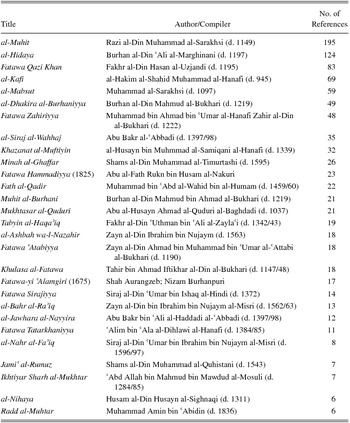
Completed roughly a year before the Basic Code, Tamassuk al-Quzat al-Amaniyyih (1921–22), or the Handbook for Aman Allah's Judges, is a comprehensive primer on criminal law compiled by the amir's chief jurist, Mawlawi ʿAbd al-Wasiʿ Qandahari, of whom we will have more to say in the next section. As is evident from the work's breadth and scope—comprising two volumes of fourteen chapters each and a total of 1,113 articles—the Handbook for Aman Allah's Judges was intended to be a “one-stop” reference for Afghan judges presiding over criminal cases in the newly created network of state courts. While the Aman Allah Codes are replete with statements that say legislation is in conformity with shariʿa according to the Hanafi school, Tamassuk al-Quzat is unique in being the only text to cite the jurisprudential sources for virtually the entirety of its articles. Of the 1,113 rules in the handbook, 1,082 provide an explicit jurisprudential source. Without fail, every single reference cites a canonical work of Hanafi fiqh (Table 1). These works include over two dozen of the most well-known juristic treatises, glosses, and commentaries familiar to any advanced law student of the Hanafi school. Notably, references to European sources of law are entirely absent in the Aman Allah Codes.Footnote 20
References to Works of the Hanafi School of Islamic Jurisprudence in Tamassuk al-Quzat al-Amaniyyih (1921–22)

Source: ADL-0317 (Muhammad ʿAbd al-Wasiʿ Qandahari. Tamassuk al-Quzat al-Amaniyyih. Kabul: Dar al-Saltanih, 1300/1921–22).
Skeptics might note that a single code, even an extremely significant one, does not establish beyond a doubt that all of Aman Allah's codes drew only from “Islamic,” much less Hanafi legal sources.Footnote 21 Yet to downplay Tamassuk al-Quzat as exceptional or unrepresentative of the Aman Allah Codes as a whole misses a crucial point. Apart from the Basic Code, the Handbook for Aman Allah's Judges, and the 1920 Marriage Code discouraging polygamy and child marriage,Footnote 22 the niẓāmnāmihs contain administrative regulations of a procedural nature rather than restatements of substantive law. Addressing such issues as the organization of government ministries, tax collection, national holidays, grazing zones, the standardization of measurements, identity cards and conscription, and spending caps on wedding parties, the vast majority of the Aman Allah Codes belong to the Islamic legal-administrative genre of siyāsa sharʿiyya (public policy–related ordinances).Footnote 23 Meanwhile, the Handbook for Aman Allah's Judges is the only niẓāmnāmih to summarize the substantive criminal laws of Afghanistan for application in state courts, making it the country's first national criminal law code. There is no equivalent civil law code for Afghanistan in this period. While it hardly seems necessary to describe ordinances on measurement or zoning as reflecting “Western” or “Islamic” legal traditions, the same cannot be said for substantive law such as a criminal law code.
While this study does not reject the concept of legal borrowing—or rather, adaptation—wholesale, what it seeks to highlight is how the Nizamnamihha-yi Amaniyyih bears a more complex genealogy than has conventionally been assumed by the extant literature on Afghanistan. As one of the 20th century's first examples of Islamic legal modernism in power, the Afghan Constitution of 1923 and supplemental codes displayed a remarkably adaptable approach to shariʿa-based legislation, drawing from canonical works of the Hanafi school of fiqh for jurisprudence, but also modern notions of political sovereignty, territorial nationalism, and the general will as embodied in a national constitution and the bounded legal code.Footnote 24 The latter signified a creative endeavor by Muslim jurists to develop a theory of the modern nation-state governed by shariʿa.
Still, by themselves, the legal sources cited in the Nizamnamihha-yi Amaniyyih corpus do not provide us with a clear picture of Islamic legal modernism in action in Kabul during this era. This picture only emerges through an examination of the sociolegal history behind the Aman Allah Codes, particularly the individuals who actually wrote them.
THE FRAMERS OF AFGHANISTAN'S 1923 CONSTITUTION
Historical scholarship on Afghan constitutionalism (mashrūṭiyyat) has focused not on the legal reforms of Aman Allah Khan, but on the revolutionary politics of an underground network that emerged in the capital prior to his rule. The Young Afghans (Jawanan-i Afghan), as this network is best known, was a secret society of intelligentsia with anti-imperial and parliamentary leanings who coalesced during the reign of Aman Allah Khan's father, the absolutist monarch Amir Habib Allah Khan (r. 1901–19). Branding themselves constitutionalists (mashrūṭa-khwāhān), and resembling parallel movements in Turkey and Iran, the Young Afghans comprised a loose association of disgruntled bureaucrats, liberal clerics, radical courtiers, and a handful of military officers united by the twin demands for a more representative government and complete independence from Britain.Footnote 25 Important as this movement was in generating momentum for parliamentary politics as well as Pan-Islamic and Pan-Asian sentiments in Afghanistan, the attention that has been devoted to it has caused it to overshadow the committee of jurists who actually wrote Afghanistan's first constitution and supplemental codes after the country gained independence in 1919.
One noteworthy exception is the Afghan historian ʿAziz al-Din Fufalzai's magnum opus, Dar al-Qazaʾ dar Afghanistan (The Judicial System of Afghanistan), published in Kabul on the heels of the Soviet withdrawal from Afghanistan.Footnote 26 Based on rare government records from the early 20th century, many of which are lost, destroyed, or have disappeared, Fufalzai's work provides the most exhaustive list of jurists who participated in lawmaking projects in Afghanistan since World War I. According to Fufulzai, within months of Aman Allah Khan's ascent to the Kabul throne, the amir personally organized a Codification of Laws Commission (Mahfil-i Wazʿ-i Qawanin, hereafter CLC) to promulgate a comprehensive body of laws for the newly independent state.Footnote 27 The CLC was comprised of distinguished Afghan scholars and civil servants, who were joined by a coterie of Muslim professionals recruited from Ottoman and British Indian domains.
While the CLC was established with a singular purpose—to lay the judicial foundations for a newly independent Afghan state—the internal dynamics of its formation and final roster were complex. Structurally, the commission was bicameral, comprising two separate but complimentary divisions. Each division represented distinct classes of legal experts. The first, named here as the Islamic Scholars Division, comprised leading Afghan clerics selected from the High Religious Council (Hayʾat-i Tamiz) in Kabul, the most prominent association of ulema in the country.Footnote 28 The Islamic Scholars Division performed a supervisory function by ensuring that all drafts submitted to the king for ratification were “in conformity with the laws of shariʿa,” a condition later enshrined in Article 72 of the 1923 Constitution. In effect, the Islamic Scholars Division exercised a form of judicial prereview over all legislation to be promulgated with Aman Allah's seal. Notably, with the exception of one Indian Muslim, all members of this division were Afghan nationals.Footnote 29
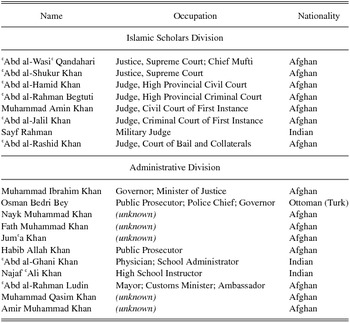
By contrast, the second branch of the CLC—here named the Administrative Division—was made up of a body of technocrats with diverse backgrounds (Table 2). Though most were Afghan bureaucrats, others were professionals recruited from the Ottoman Empire and British India, some of whom had been appointed to leading roles on the commission. In nationality and profession these members embodied Aman Allah Khan's vision of a dynamic and cosmopolitan commission that would bring both a familiarity with Islamic jurisprudence of the Hanafi order and administrative expertise in a centralized, bureaucratic state such as British India or Ottoman Turkey. The strategy delivered. For the vast majority of Nizamnamihha-yi Amaniyyih codes, the Administrative Division was the body of experts that initially drafted the laws before they were submitted to the Islamic Scholars Division for review. In this way, the reformist king's legislative agenda placed a premium on synthesizing different registers of legal expertise, namely the interpretive fiqh tradition of the Hanafi school with modern bureaucratic practice. This synthesis was crucial to establishing a national legal system that served not only to resolve local disputes between private parties, but also to engineer “macrolegal” policies shaping the social and economic life of the country as a whole.
Members of Afghanistan's Codification of Laws Commission (Mahfil-i Wazʿ-i Qawanin), 1919–23

Source: BOA-DH.SAİDd 110/493 (1298 Z 29); BOA-İ.AZN 72/1325Ca-28 (1325 Ca 15); BOA-EV.VKF 4/12 (1313 Z 29); IOR-R/12/197 (1930), 6–9; IOR-R/12/LIB/107 (1928), 19; ADL-0642 (Nizamnamih-i Jaza-yi ʿUmumi. Kabul: Matbaʿ-i Daʾirih-i Tahrirat-i Majlis-i ʿAliyyih-i Vuzaraʾ, 1302/1923), 92; Who's Who in Afghanistan (Simla: General Staff of India, 1920), 47, 129, 178; Who's Who in Afghanistan, (Simla: Government of India Press, 1930), 60, 205; Aziz al-Din Fufalzai, Dar al-Qazaʾ dar Afghanistan (Kabul: Markaz-i Tahqiqat-i ʿUlum-i Islami, 1369/1990–91), 518–19; Ghulam Muhammad Ghubar, Afghanistan dar Masir-i Tarikh (Qum: Payam-i Muhajir, 1980), 717–19; Sayyid Saʿd al-Din Hashimi, Junbish-i Mashrutiyat-khwahi dar Afghanistan (Kabul: Shura-yi Farhangi-i Afghanistan, 2001), 274–76; Senzil K. Nawid, Religious Response to Social Change in Afghanistan, 1919–29 (Costa Mesa, Calif.: Mazda Publishers, 1999), 79; Masʿud Puhanyar, Zuhur-i Mashrutiyat wa Qurbaniyan-i Istibdad dar Afghanistan (Peshawar: Saba Kitabkhanih, 1375/1996–97), 54, 98–100, 106–10, 244–49.
While the roster in Table 2 identifies verified authors of Afghanistan's 1923 Constitution and Aman Allah Codes by name, we have not as yet considered the personal backgrounds, professional histories, and networks of learning and expertise that they brought to the committee. This inquiry leads not only to Afghanistan, but as we will see, to India and the Ottoman Empire. The following section offers brief profiles of three of the most prominent members of the CLC—representing Afghan, Ottoman Turkish, and British Indian nationalities, respectively.
MAWLAWI MUHAMMAD ʿABD AL-WASIʿ QANDAHARI (1873–1929)
Born in the southeastern city of Qandahar, Muhammad ʿAbd al-Wasiʿ Akhundzadih was the son and protégé of the distinguished 19th-century Islamic scholar of Afghanistan, Mawlawi ʿAbd al-Raʿuf Akhundzadih. The latter was chancellor of Afghanistan's most prestigious seminary, the Madrasih-i Shahi of Kabul; founder and editor-in-chief of one of Afghanistan's first national newspapers, Siraj al-Akhbar (The Lamp of the News); and according to some historians, the chief ʿālim in the royal court of Habib Allah Khan.Footnote 30 After completing a personalized course of study mainly from his father, ʿAbd al-Wasiʿ emerged as an influential mawlawī (a term used for specialists of Islamic law in Afghanistan) in his own right. He authored books in Arabic, Persian, and Pashtu in a range of Islamic sciences, including grammar, theology (ilāhiyyāt), Qurʾanic exegesis (tafsīr), jurisprudence (fiqh), and political theory (ḥukūmat).Footnote 31 He was also politically engaged and participated in constitutionalist agitation against the absolutist policies of Amir Habib Allah, including via sermons from the pulpit of Kabul's central Pul-i Khishti mosque.Footnote 32 Representing a liberal and reformist strain of ulema within the capital, ʿAbd al-Wasiʿ was eventually imprisoned, but not executed, for his dissident activities.Footnote 33
After Habib Allah Khan's assassination in 1919, the new amir Aman Allah Khan appointed ʿAbd al-Wasiʿ to the preeminent judicial post in the country, qāẓī al-quẓāt, or chief mufti of Afghanistan. Aman Allah's choice of ʿAbd al-Wasiʿ for the role reflected his esteem for the scholar's erudition and political leanings. For the same reason he also appointed ʿAbd al-Wasiʿ to Afghanistan's first Supreme Court and the Islamic Scholars Division of the CLC. Over and above the aforesaid duties, Aman Allah charged ʿAbd al-Wasiʿ with drafting a comprehensive criminal law manual for implementation in the new state courts. The result was the aforementioned judge's handbook, Tamassuk al-Quzat al-Amaniyyih.
ʿAbd al-Wasiʿ’s weighty influence on the CLC is also apparent in the Aman Allah Codes themselves; several niẓāmnāmihs conclude with the seal of the amir, followed by one other signature: “Servant of the Scholars [khādim al-ʿulamāʾ], ʿAbd al-Wasiʿ Qandahari.”Footnote 34 In addition to serving on the lawmaking commission, ʿAbd al-Wasiʿ helped establish a school of law (maktab-i qużāt) and a school of administration (maktab-i ḥukkām) in Kabul, where he served as a professor of Islamic jurisprudence.Footnote 35
OSMAN BEDRI BEY (1881–1923)
Born and raised in Istanbul, Osman Bedri Bey was a graduate of the Ottoman Empire's most prestigious high school and law school, the Mekteb-i Mülkiye Şahane and Mekteb-i Hukuk Şahane, both located in the capital.Footnote 36 The son of a civil servant in the Porte's military pension bureau, Bedri Bey's remarkable career trajectory reflected the middle-class beginnings and social mobility of late Ottoman bureaucrats and officers who burst through the glass ceiling of the Hamidian era to climb to the uppermost echelons of the new Ottoman command structure after the Young Turk Revolution of 1908. According to his profile in the Siccil-i Umumi, a central registry of the Porte's civil servants, the trained lawyer swiftly scaled the ranks of Istanbul's Nizamiye court system beginning with his assignment to a local court of first instance in September 1911. In April 1912 he was appointed public prosecutor for Beyoğlu district.Footnote 37 By the Ottoman entry into World War I in November 1914, Bedri Bey had reached the apex of the Porte's civil administration by becoming police commissioner for Istanbul. Two years later he was promoted to the governorship of Aleppo province in Syria.Footnote 38
Bedri Bey's meteoric rise to late Ottoman imperium was not to last, however. On 1 November 1918, the eve of Allied occupation, Bedri Bey and a coterie of CUP officials fled Istanbul. After a whirlwind trail of exile through Germany and Russia, Bedri Bey journeyed to Kabul in 1920 on the heels of a more notorious fugitive, the Ottoman naval minister, fourth army commander, and CUP triumvirate member Ahmet Cemal Pasha (1872–1922). The latter had arrived in Afghanistan only months earlier seeking to establish a new base of operations in geostrategic Central Asia. Cemal's plan was embraced by the staunchly Turcophile Aman Allah Khan, who entrusted the pasha with the task of training a new Afghan Army.Footnote 39 By all accounts Aman Allah was equally pleased when the Ottoman attorney and Istanbul police chief Bedri Bey arrived in his court, for the amir appointed him director of the country's first ever constitutional commission.Footnote 40
DR. ʿABD AL-GHANI KHAN (1864–1945)
Born in 1864 in the provincial town of Jalalpur Jattan, Punjab, ʿAbd al-Ghani Khan was the son of an Islamic scholar of local repute, Dosand Khan. ʿAbd al-Ghani completed his preliminary studies in the Punjab with distinction, earning a seat in the prestigious Mohammedan Anglo-Oriental College at Aligarh.Footnote 41 Soon thereafter he accepted a scholarship to further his education in England. In 1885, ʿAbd al-Ghani's arrival in London coincided with an official state visit by Nasir Allah Khan, the son of Amir ʿAbd al-Rahman of Afghanistan (r. 1880–1901). After meeting the Indian youth, Prince Nasir Allah is reported to have been so impressed that he offered to sponsor ʿAbd al-Ghani through his studies at the University of Cambridge, where he subsequently enrolled to study medicine. In 1890, “Dr. Ghani” (as Afghan sources refer to him thereafter) emigrated to Kabul where he assumed an advisory role in the court of Amir ʿAbd al-Rahman. It was a short appointment, however; British intelligence sources indicate that by the late 1890s ʿAbd al-Ghani had returned to India to serve as principal of Islamia College in Lahore, a position he held for three years.Footnote 42
Following Amir ʿAbd al-Rahman's death and the coronation of his eldest son Habib Allah Khan, ʿAbd al-Ghani returned to Afghanistan. The new amir appointed him to an array of significant posts: chief medical officer, director of public instruction, and principal of the newly established Habibiyyih academy in Kabul. Ostensibly in the amir's service, ʿAbd al-Ghani would eventually become known for his founding of an underground constitutionalist society, Sirr-i Milli (National Secret). By 1909, the Indian doctor's associations with the Young Afghans had attracted the amir's suspicions. Along with a number of followers, ʿAbd al-Ghani was arrested and imprisoned for allegedly conspiring a plot to assassinate the amir and establish a constitutional government. A decade later, the murder of Amir Habib Allah Khan in February 1919 and subsequent ascent of Aman Allah Khan led to ʿAbd al-Ghani's official pardon and release in the same year.Footnote 43
What followed was another meteoric rise in the Kabul court beginning with ʿAbd al-Ghani's appointment to the reformist king's privy council. Then-British consul in Kabul Sir Richard Machonachie writes that ʿAbd al-Ghani became “one of Amanullah's closest advisors,” not surprising given the latter's Young Afghan associations as a prince.Footnote 44 Amir Aman Allah appointed ʿAbd al-Ghani to several high-profile positions related to domestic and foreign affairs, including in the delegation representing Afghanistan at the Rawalpindi peace talks with the British in August 1919, his Indian background notwithstanding. A month later, ʿAbd al-Ghani was appointed director of public instruction, while also serving on the commission that drafted the Afghan Constitution of 1923.Footnote 45
FOR FURTHER CONSIDERATION: SALAFISM, HANAFISM, AND ISLAMIC LEGAL MODERNISM
The portraits above describe three of the most prominent members of Afghanistan's first constitutional commission. Afghan and British Indian records provide the names of additional contributors confirmed to have participated in the CLC (Table 2), none of whom were European nationals. Nationally, all members were Afghan, Indian, or Ottoman; confessionally, all were reputed Sunni Muslims of the Hanafi order.Footnote 46 Put together, the aforesaid features of the lawmaking commission reflect the premium Aman Allah Khan placed on recruiting experts who were familiar with Muslim cultures (in a broad sense and including varying approaches to Islamic law), were trained in respected educational institutions, and wielded professional experience in a modern bureaucratic setting. It is likely the monarch saw such a versatile combination of personnel as crucial to formulating state codes that resolved not only disputes between private citizens, but also broader administrative matters involving public policy for the new Afghan state. At the same time, the members of the CLC were not uniform in background or outlook. Some managed multiple appointments, indicating not only their professional versatility but also the fluidity of Kabul's transition from older patrimonial styles of governance to newer, more bureaucratically oriented politics of expertise during the reign of Aman Allah Khan.
In light of the distinguishing features of the Nizamnamihha-yi Amaniyyih project canvased in this article, it is worthy to consider the judicial reform project's importance to the study of Islamic modernism, often inaccurately conflated with modernist Salafism.Footnote 47 To begin with, Aman Allah Khan's law commission was not comprised of Salafi iconoclasts who challenged taqlīd or the monopoly of any one Sunni school of law; to the contrary, his jurists worked squarely and unapologetically within the Hanafi school. In other words, while opposed to the transplantation of European civil law to Afghanistan, the reformist king shunned puritanical campaigns to rediscover an “original” or “authentic” Islam of the 7th and 8th centuries, stripped of the voluminous commentary and gloss literature of the historical sunni madhhabs. Judging from the texts they produced, neither did Aman Allah’s jurists endorse a skeptical approach to classical conceptions of jurisprudence by calling for a new methodology to interpret Islamic theology, exegesis, or law.Footnote 48 Nor did they seek a renovation of Islamic thought based on European Enlightenment principles, as did the liberal reformers Sir Sayyid Ahmad Khan (d. 1898), Chiragh Ali (d. 1895), and Muhammad Iqbal (d. 1938) of India. Rather, the authors of the Nizamnamihha-yi Amaniyyih—at least half of whom were Afghan clerics—worked to extend the living precepts of the Hanafi school of law to the new challenges of modern governance in a fully sovereign Afghanistan, one of the first Muslim-majority nation-states in the world. As such, scholarly literature on Islamic modernism, with its focus on the iconoclastic salafiyya generation and their global interlocutors during the prior century and a half, has overlooked an important episode, arena, and cast of actors. In spite of the undoubtedly profound impact of thinkers such as Muhammad ʿAbduh and Rashid Rida, few modernists of the Salafi persuasion ever wielded political power or implemented state policies in the way Aman Allah Khan and his Hanafi jurists did in Afghanistan.
To be sure, that the Nizamnamihha-yi Amaniyyih represented a modern approach to shariʿa and the historically decentralized interpretive fiqh literature cannot be disputed. In it a sacred law tradition was instrumentalized to fulfill the prerogatives of sovereign power—capital accumulation, defining property relations, settling disputes and maintaining civil order, and supervising officials, subjects, and markets. That Aman Allah's legal codes were bound to unleash havoc on local and historically decentralized modes of dispute resolution in Afghanistan must also be acknowledged. As critical legal scholars attentive to the ruptures of colonialism and modernization campaigns in Islamicate countries have emphasized, the idea of codifying shariʿa has raised alarm for many Muslims—and not just of the liberal or secular persuasion, as some might have it. As Wael Hallaq, Talal Asad, and Iza Hussin have shown, 19th-century colonial officials from North Africa and India to Indonesia engineered a slew of “Muhammadan” digests and codes, often working in tandem with Orientalist scholars and local elites. Far from preserving Islamic legal heritage, colonially generated texts such as the Anglo-Muhammadan Law and Droit musulman-algérien produced an even bolder invention—“Shariʿa law.” The latter was a modern construct that, paradoxically, constricted the scope of Islamic jurisprudence to family and personal status law all the while dismantling a broader constellation of institutions, social norms, and juristic vocabularies associated with shariʿa as a means of centralizing rule over Muslims. Bolstered and accelerated by the modern disciplinary technologies of surveillance, bureaucracy, government schools, and incarceration, the net results were nothing short of devastating: grassroots shariʿa praxis replaced by the singular code; the ʿālim, by the magistrate; the madrasa, by the civil law school; and communal pressures, by the prison.Footnote 49
The above factors may lead some to conclude that Aman Allah's reforms were intended to produce the same paradoxical result: a dismantling of the shariʿa. In the latter view, shariʿa could never be confined to codes, constitutions, or statutory law without losing its soul—an impossible state, so to speak.Footnote 50 The modern nation-state—with its monopoly on violence and evisceration of traditional forms of knowledge transmission, mediation, and arbitration—becomes a culprit that is external to the shariʿa, irrespective of how many “Islamic laws” or “rule by shariʿa” clauses a Muslim government may produce.
As this study has suggested, however, such views imagine a premodern mold for Islamic law, whereby only the most superficial vestiges of the shariʿa survive the ruptures of colonialism and 20th-century modernization campaigns. This is certainly a tempting and, for some countries and movements, convincing assessment. When applied to our study, however, the framework wares thin. It cannot be said, for example, that Aman Allah Khan dismantled the shariʿa as a capitulation to colonial masters, as it was he who led Afghanistan to become an entirely independent and sovereign state. Nor was the reformist amir engaging in European or Kemalist mimicry by stocking the government's legislation with French legal codes. Rather, one of the most overlooked though essential dimensions of the Nizamnamihha-yi Amaniyyih was the attempt to synthesize Afghanistan's predominantly Islamic-Hanafi jurisprudential traditions with a project of modern statecraft. From this perspective, the 1923 Constitution and the Aman Allah Codes more broadly constituted a bold experiment: an attempt by Muslim jurists to develop an Islamic legal theory of the modern nation-state in a noncolonial context, through a process that cannot be dismissed as unwarranted innovations, capitulation, or misrepresentation.Footnote 51 To dismiss it as such would be to ignore the very real struggles of a group of Afghan, Turkish, and Indian jurists to render the modern state part of the moral community of Muslims—that is to say, under Islamic law and ethics. As declared in the 1923 Constitution itself, “the process of codifying laws [tanẓīm-i niẓāmāt] is to be implemented in light of the actual conditions of the people [maʿlūmāt-i ahālī] and the exigencies of the time [maqtaḍiyyāt-i zaman], with particular and careful attention to the rulings of shariʿa [makhṣūṣan aḥkām-i sharʿiyyih bi-naẓar-i diqat gariftih mi-shawad]” (Article 72). In light of the substantial strides Amir Aman Allah made toward advancing Islamic legal modernism as an operative framework for the newly independent Afghan state—by way of laws and lawmakers—constitutional language such as Article 72 can hardly be dismissed as the vacuous rhetoric of an aspiring politician.
CONCLUSION
Historical scholarship on Islam and modern state building has tended to concentrate on a handful of cases: in the 19th century, the late Ottoman Empire, Mehmed Ali's Egypt, and Qajar Persia; in the 20th century, Egypt, Saudi Arabia, Indonesia, Pakistan, and revolutionary Iran. Similarly, scholarship on Islamic modernism has tended to focus on the Arab world, the Indian subcontinent, the Malay Archipelago, as well as Turkey and Iran—predictably so, as these are the largest and most populous Muslim polities in the modern world. Yet Afghanistan, the first Muslim-majority country to gain independence after the collapse of the Ottoman Empire in World War I, was a virtual laboratory for building an “Islamic state” under the reformist king Aman Allah Khan. This article centers Afghanistan as an important player for the growth of Islamic legal modernism in the 20th century, decades before the establishment of its better-studied peers.
By highlighting transnational, Pan-Islamic legal circuits at work in the Aman Allah Codes, this study also departs from diffusionist models of literature which presume a tutorial role for European legal culture, exported to the colonized world through the forces of imperial administration. Having cast off the legal vestiges of colonialism vis-à-vis the Third Anglo-Afghan War, Aman Allah Khan's next achievement was to launch a state-building program that capitalized on juridical resources within the country, including prominent Afghan ulema and professionals who emigrated from India and the Ottoman Empire to Afghanistan following the latter's independence. The international make up of Aman Allah's lawmaking commission also demonstrates that Afghanistan's transition to a nation-state was complex and staggered, and not insular or chauvinistic, as the reformist king was more interested in Islamic legal expertise than national identification or geographical origins.
To focus on Aman Allah Khan's accomplishments in the early years of his decade-long reign and ignore the later years, however, would be to overlook critical historical developments that took place outside of the Kabul court. Behind the legalese of the Aman Allah Codes, an intensifying political battle was brewing over what it meant to be a free and independent “Islamic state” in practice. At one level, the codes pitted the king's reformist elite against powerful tribal confederations wary of Kabul encroaching on their autonomy, with each side employing Islamic discourses to promote its view of the good society. Even more lethal to Aman Allah's campaign, in 1924 fresh divisions emerged between pro-Kemalist and pro-Khilafat members of Aman Allah's court, caused by ruptures in Turkey and its transformation into a secular republic seen to have abandoned the caliphate (and presumably, shariʿa). Though thousands of miles away, many Afghan and Indian Muslim participants in the resolutely pro-Ottoman Khilafat Movement (1919–24) were dismayed by developments in Ankara, which provoked anxiety over whether Aman Allah would follow suit.Footnote 52 Without an operational bureaucracy, police, and army to enforce his laws, or a unified cabinet to amend them, Aman Allah's government collapsed as a conflagration of rebellions converged on Kabul, deposing the king in 1929.Footnote 53 No Afghan government would impose reforms of such broad scale until the decade of Soviet occupation following the communist coup d’état of April 1978.
While histories of Afghanistan during the Aman Allah era have largely focused on the second half of the reformist king's decade in power, dwelling on his overthrow at the hands of the violent revolts of 1929 falls too easily into conventional tropes of Afghanistan as the world's failed state par excellence. What has often gone unnoticed is that while some of the original provisions of the Basic Code were later amended in the face of violent revolts in the southern and eastern provinces of the country, structurally speaking the 1923 charter established a model for future Afghan constitutions.Footnote 54 Aman Allah Khan's Constitution was extensively copied in the 1931 charter passed by his successor, Nadir Shah (r. 1929–33), though no mention of the original charter was made in the document or, indeed, in Afghan historiography for decades to come. By designing new kinds of governmental institutions, including a wide-ranging bureaucracy with a multitiered cabinet, subordinate ministries, and centralized network of courts applying uniform legal codes, Aman Allah Khan laid the foundations for “government by law” in the country. As political scientist and former US envoy to Afghanistan Leon Poullada summarized, “even if Amanullah had done nothing else, the juridical base he provided for Afghanistan was of considerable importance since it gave the country the skeleton of the government it was eventually to develop. In this sense the 1923 Constitution was unquestionably a landmark document.”Footnote 55
Despite such praise, nearly a century after its promulgation, the origins of Afghanistan's first constitution and supplemental Aman Allah Codes remain obscure. In particular, the role of Islamic jurisprudence and schools of law as well as the authors themselves in the production of the codes has not been sufficiently examined. Taking the criminal law manual Tamassuk al-Quzat as a case in point, this article has argued that while the jurists who crafted the Aman Allah Codes adhered to canonical texts of the Hanafi school of fiqh for deriving substantive legal rules, the structure and aesthetic layout of the Nizamnamihha-yi Amaniyyih resemble modern legal codes such as the Ottoman Mecelle. The latter's influence is evident in the organization of every niẓāmnāmih into distinct issue-oriented sections, each containing vertically enumerated articles followed by a brief statement of the rule. Simply put, this was the most robust attempt to engineer a comprehensive fiqh code for an entire field of substantive law since the Mecelle.
Afghanistan under Aman Allah Khan, therefore, could be described as one of the first “Islamic state” projects of the 20th century. The only other fully sovereign Muslim states in the region—Kemalist Turkey, Pahlavi Iran, Hashemite Hijaz, Northern Yemen, and Oman—formally marginalized the shariʿa as a source of law, imported European codes to constitute the new state's laws, or cannot be said to have developed a comprehensive body of statutory law reflecting an Islamic theory of the nation-state in a substantial way. Far from seeing the shariʿa as “dead” after colonialism, and its custodians as passive spectators of their own marginalization, the jurists of Aman Allah's Afghanistan were skilled agents who struggled—and negotiated—to carve a space of autochthonous legal production that has largely gone unnoticed. Here, it must be emphasized, the architects of the Nizamnamihha-yi Amaniyyih pursued their goals by engaging the challenges of modern state building from within the Islamic-Hanafi legal tradition, and not outside it.
This approach was certainly not exclusive to Afghanistan's Aman Allah Codes, or the modern era for that matter. As legal scholars Baber Johansen, Sherman Jackson, and Mohamed Fadel have shown, medieval Hanafi and Maliki jurists developed moral theories of the state not only to legitimate individual sultans, but also to cultivate mutual dependency between rulers and the ruled in ways that limited and not just legitimated governments.Footnote 56 Similarly, as scholars of the early modern Ottoman Empire have warned, it is important to recognize an equally suspect counterpart to Orientalist images of Islamic decline: that of apolitical jurists “keeping the law pure from the interventions of the political authority until the European colonialists got there.”Footnote 57 Though opting for romanticism over demonization, and useful for distinguishing a sophisticated scholarly tradition from the policies of many “Islamic states” today, such frameworks preserve essentialist binaries that presume the incommensurability of shariʿa and modernity.
Ahistorical or dismissive approaches to Islamic legal modernism also fail to appreciate the human agency behind innovative, hybrid works in this genre of modern law, of which the Aman Allah Codes are not the only example. Specifically, the work of madrasa-trained jurists turned ʿālim administrators and constitutionalists—including Ahmed Cevdet Pasha (1822–95) in the late Ottoman era, Sayyid Muhammad Tabatabaʾi (1842–1920) in the Iranian Constitutional Revolution, and Mawlawi ʿAbd al-Wasiʿ Qandahari (1873–1929) in Amani Afghanistan—speaks to the dynamism of ulema as a heterogeneous class of legal actors that conventionally has been assumed to be reactionary or politically conservative.Footnote 58 Put another way, this class of legal actors is especially important for seeing modern Muslim jurists as embodying a resilient, living, and evolving tradition rather than as agents of western imperialism or apologists for oppressive regimes.Footnote 59
Situated in historical context, then, it is not surprising that Islamic legal modernism emerged at a transitional moment worldwide, as loosely governed empires and patrimonial regimes from the 18th and early 19th centuries were replaced by highly centralized, bureaucratic regimes in the 20th century. The modern nation-state, in the Middle East as elsewhere, brought new legal discourses of constitutionalism and citizenship, but also disciplinary tools such as the judge's manual and code.Footnote 60 As in the late Ottoman Empire and Egypt, Islamic legal modernism in Afghanistan shared in regional processes of centralization but also produced original contributions on its own terms. Though clearly a top-down attempt at social engineering through law, one far-sighted contribution of Afghanistan's Nizamnamihha-yi Amaniyyih must be acknowledged: its perceptive attempt to circumvent the widening gulf between “Islamic” and “secular,” a dualism whose roots were laid in several countries at precisely the same time, and have been fiercely contested ever since.
As for legacies bequeathed to Afghanistan itself, Aman Allah Khan's historic 1923 charter laid the foundations for all subsequent constitutions of the 20th century (1964, 1976, and 1990)—save one ratified under Soviet occupation by Kabul's communist regime in 1987. Of more recent note, it provided a model for Afghanistan's latest national charter adopted on 4 January 2004. While the Constitution of 2004 remains the source of both celebration and controversy in and outside Afghanistan, many observers continue to assume—quite erroneously—that it was the country's first.