INTRODUCTION
Southern rock lobsters, Jasus edwardsii (Hutton 1875) are distributed around southern mainland Australia, Tasmania and New Zealand (Smith et al., Reference Smith, McKoy and Machin1980; Booth et al., Reference Booth, Street and Smith1990). In Australia, the most northerly distribution is Geraldton in Western Australia and Coffs Harbour in northern New South Wales, however the bulk of the population can be found in the south-eastern states of South Australia, Victoria, and Tasmania where they occur in depths from 1 to 200 m. Jasus edwardsii generally inhabit bryozoan or aeolianite limestone reefs but are also found on outcrops of igneous rocks such as granite (Phillips et al., Reference Phillips, Chubb, Melville-Smith, Phillips and Kittaka2000).
The annual commercial catch of southern rock lobster in South Australia is ~2400 tonnes, representing ~60% of the total landings from the south-eastern Australian fishery (Linnane et al., Reference Linnane, McGarvey, Feenstra and Ward2006). The South Australian fishery is divided into a Northern and Southern Zone, which are each sub-divided into Marine Fishing Areas (MFAs) for management purposes (Figure 1). A total of 1900 tonnes (~50% of the total south-eastern fishery) was taken in the Southern Zone in the 2005/2006 season. The zone was managed under a range of input controls such as closed seasons, limited licence entry and spatial closures until 1993, when output controls in the form of a total allowable commercial catch (TACC) were also introduced (Sloan & Crosthwaite, Reference Sloan and Crosthwaite2007). Fishing is permitted from October to May inclusive and a minimum legal size (MLS) of 98.5 mm carapace length (CL) for all rock lobsters has been in place in the zone since 1970. Commercial fishing can only be undertaken in South Australia using standardized steel-framed pots which are set individually.
Map showing the Northern and Southern Zones of the South Australian rock lobster fishery. Numbers show location of marine fishing areas (MFAs). MFAs 51 and 55 represent the North Southern Zone (NSZ) while MFAs 56 and 58 make up the South Southern Zone (SSZ).

The focus of future management for the South Australian rock lobster fishery is a greater emphasis on fine-scale spatial assessment of the resource (Sloan & Crosthwaite, Reference Sloan and Crosthwaite2007). Specifically, future assessments will focus on key MFAs or sub-groups of MFAs rather than entire zones. An understanding of spatial differences in the reproductive biology of J. edwardsii is fundamental to this approach, especially in relation to MLS limits.
Fecundity and size of maturity estimates have been derived for J. edwardsii in New Zealand (MacDiarmid, Reference MacDiarmid1989a), Tasmania (Punt & Kennedy, Reference Punt and Kennedy1997; Gardner et al., Reference Gardner, Frusher, Barrett, Haddon and Buxton2006) and Victoria (Hobday & Ryan, Reference Hobday and Ryan1997) where geographical differences were reported. However, despite the importance of the J. edwardsii fishery to the region, estimates of these reproductive parameters have never been published from South Australia.
Similarly, the relative reproductive potential of specific size-classes have been previously estimated for a range of important commercial crustaceans worldwide such as the western rock lobster Panulirus cygnus (Morgan, Reference Morgan1972), the European spiny lobster Palinurus elephas (Goni et al., Reference Goni, Quetglas and Renones2003a), the American lobster Homarus americanus (Campbell & Robinson, Reference Campbell and Robinson1983) and the European lobster H. gammarus (Tully et al., Reference Tully, Roantree and Robinson2001; Agnalt et al., Reference Agnalt, Kristiansen and Jørstad2006). However, to date, the only published estimates of relative reproductive potential (RRP) for J. edwardsii come from the Victorian fishery, where the maximum reproductive potential came from the 105–135 mm CL size-classes (Hobday & Ryan, Reference Hobday and Ryan1997; Punt & Hobday, Reference Punt and Hobday2006) but with contrasting spatial differences between specific fishing zones.
The aim of this study is to describe and compare the relationships between size, fecundity, sexual maturity, and relative reproductive potential of J. edwardsii in two major fishing regions in the Southern Zone of the South Australian rock lobster fishery. Results are used to identify appropriate spatial scales for future management of the fishery, especially in relation to MLS limits.
MATERIALS AND METHODS
Study area and data collection
The Southern Zone rock lobster fishery runs from the mouth of the River Murray in the Coorong area of South Australia to the South Australia/Victoria border (Figure 1). The data used for the study were fishery dependent and came from four MFAs where ~99% of the commercial catch is taken annually, i.e. MFAs 51, 55, 56 and 58 (Linnane et al., Reference Linnane, McGarvey, Feenstra and Ward2006). Since 1991, scientific observers and commercial fishers from the South Australian rock lobster fishery have collaborated in an at-sea voluntary catch sampling programme. Fishers are requested to count, measure (mm CL), sex and record the reproductive condition of lobsters from up to 3 research pots per fishing trip. In total, 131,521 female rock lobsters were sampled over the period 1991–2004 in MFA 51 (N = 7848), MFA 55 (N = 48,309), MFA 56 (N = 43,011) and MFA 58 (N = 32,353).
Spatial differences in growth rates between northern and southern regions of the Southern Zone have previously been identified (McGarvey et al., Reference McGarvey, Ferguson and Prescott1999). To examine if this extended to fecundity, size of maturity and RRP, the zone was sub-divided into the North Southern Zone (MFAs 51 and 55; NSZ) and South Southern Zone (MFAs 55 and 56; SSZ) for the purpose of this study.
Fecundity (F)
The majority of J. edwardsii larvae generally hatch from September–November across the range of the species (MacDiarmid, Reference MacDiarmid1989b). In South Australia, approximately 30–40% of females caught annually in October are ovigerous (Linnane et al., Reference Linnane, McGarvey, Feenstra and Ward2006). A total of 162 ovigerous females were randomly sampled from the Southern Zone in October and November of the 2004/2005 season. Each female was individually measured, tagged, bagged and frozen after collection. On processing, the eggs were removed from the setae and pleopods and any excess water drained before oven drying for 48 h at 50oC (Hobday & Ryan, Reference Hobday and Ryan1997). Samples containing a large proportion of ruptured eggs after drying were discarded. For each egg mass sample, the total dry weight was determined. Three 0.04 g sub-samples were hydrated in 75% ethanol and enumerated under a dissecting microscope.
For each sub-sample, fecundity (F) was calculated according to the equation:

where W t is the total dry weight, W s is the sub-sample weight, and E is the egg count of the sample. Data from all sub-sample estimates were then fitted, using a SAS non-linear modelling procedure, to the equation:

where CL is the carapace length (mm) and a and b are constants.
Regional differences in fecundity were analysed using analysis of covariance where lobster size was a co-variate. Regional differences in the number of eggs · g−1 of egg mass were tested using analysis of variance.
Size at onset of maturity (SOM)
All 131,521 female lobsters from the voluntary catch sampling programme were used in the estimation of SOM. A female rock lobster was categorized as ‘sexually mature’ if it possessed either eggs or ovigerous setae (Wenner et al., Reference Wenner, Fusaro and Oaten1974). The percentage of sexually mature female rock lobsters was plotted against carapace length in each 1 mm CL size-class and then fitted, using a SAS non-linear modelling procedure, to the logistic equation:
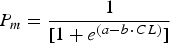
where P m is the proportion of mature female rock lobsters, CL is the carapace length, e is the inflexion point of the curve and a and b are constants.
Relative reproductive potential (RRP)
The RRP is defined by Morgan (Reference Morgan1972) and later modified by Hobday & Ryan (Reference Hobday and Ryan1997) by the relationship:

where P i is the RRP for size-class i, C fi is the sampled proportion in size-class i of females in the commercial catch, M i is the percentage of mature female rock lobsters at size-class i, and Fi is the fecundity of female rock lobsters at size-class i.
RESULTS
Fecundity
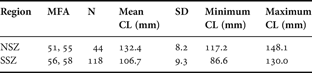
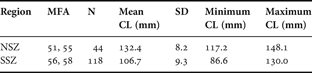
The size-range and numbers of lobsters sampled in each sub-region are provided in Table 1. F was significantly higher in the NSZ compared to the SSZ but this was attributed to the co-variate of lobster size (F 1,161 = 163.57, P < 0.001) (Figure 5) and not region (F 1,161 = 004, P = 0.949). Egg mass weight varied from 4.3 to 41.5 g with the power function relating egg mass weight to body size following the relationship: egg mass weight = (7 × 10⁻⁶) × CL3.1103, R 2 = 0.70; N = 162.
Summary statistics of lobsters used in the fecundity study for each geographical region of the Southern Zone rock lobster fishery.
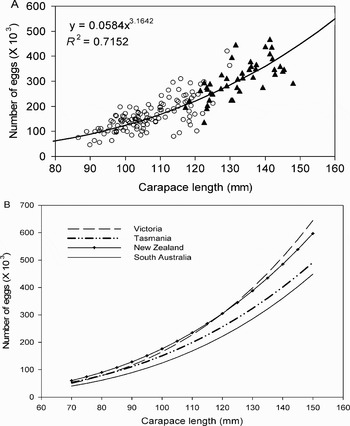
The maximum number of eggs per female ranged from 45,292 for a 90 mm CL individual to 466,800 for a 141.3 mm CL rock lobster and F was found to vary with CL according to the relationship: F = 0.0584 × CL3.1642, R 2 = 0.71; N = 162 (Figure 2A). There was no evidence of differences in size-specific fecundity between the two regions.
(A) Size–fecundity relationship with fitted power model for all regions combined within the Southern Zone; and (B) comparison of size–fecundity relationship from previous studies fitted to the length range of samples from South Australia (this study). Sources are: Victoria (Hobday & Ryan, Reference Hobday and Ryan1997), Tasmania (Punt & Kennedy, Reference Punt and Kennedy1997) and New Zealand (MacDiarmid, Reference MacDiarmid1989a).

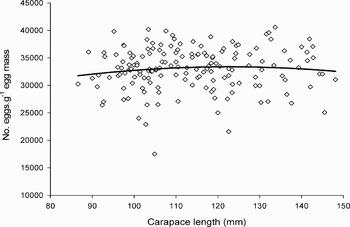
The number of eggs · g−1 of egg mass varied from 17,515–40,591 eggs · g−1 and was related to CL according to the relationship: egg · g−1 = –1.2676 · CL2+ 310.78 · CL + 14335 (Table 2; Figure 3). There was no significant difference in the number of eggs · g−1 between the NSZ and SSZ (F 1, 161 = 0.42, P = 0.51).
Number of eggs · g−1 of egg mass against carapace length for female Southern Zone lobsters. Equations of fitted line are provided in the text.

Estimates of mean eggs · g−1 egg mass for each geographical region of the Southern Zone rock lobster fishery.

Size at onset of maturity (SOM)
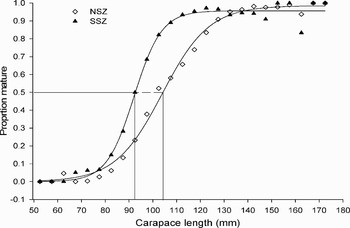
The size at which 50% of female rock lobsters were sexually mature (L50) varied spatially (Table 3; Figure 4). Within the NSZ, L50 occurred at 104.1 mm CL. Fitting of the logistic model to the proportion of mature females in each 5 mm CL size-class in the NSZ resulted in R 2 = 0.997 from 25 size-classes. More than 95% of female lobsters above 132 mm CL were mature. Based on the size–frequency of commercial catch landings (Figure 5), this suggests that approximately 20% of lobsters above the MLS of 98.5 mm CL in the commercial catch in the NSZ are under the L50 estimation.
The L50 logistic curves for the proportion of mature female rock lobsters as a function of carapace length sampled from the North Southern Zone (NSZ) and South Southern Zone (SSZ) regions of the South Australian rock lobster fishery.

Parameters for logistic function (P m = /[1 + e (a−b · CL)]) fitted to catch sampling data for each geographical region of the Southern Zone rock lobster fishery.

Within the SSZ, L50 occurred at 92.3 mm CL. Fitting of the logistic model to the proportion of mature females in each 5 mm CL size-class in the SSZ resulted in R 2 = 0.996 from 25 size-classes. More than 95% of lobsters above 114 mm CL in the SSZ were mature. Based on the size–frequency of commercial catch landings (Figure 5), ~42% of lobsters in the commercial catch are under the MLS of 98.5 mm CL but above the L50 estimation. No female lobsters were found with long setae or eggs below the 62.5 mm CL size-class in either the NSZ or SSZ regions.
Relative reproductive potential in relation to carapace length (CL) plotted with the length–frequency distribution of the commercial landings from both the North Southern Zone and South Southern Zone regions of South Australia.

Relative reproductive potential (RRP)
As with SOM, size-classes contributing to RRP differed spatially (Figure 5). In the NSZ, the maximum RRP was attributed to the 117.5 (14%) and 122.5 mm CL (14%) size-classes, whereas the maximum RRP in the SSZ was attributed to the size-classes between 97.5 (21%) and 102.5 mm CL (21%). Only, 6% of total RRP came from rock lobsters below the MLS in the NSZ, whereas 34% of RRP came from below the MLS in the SSZ.
The modal size-classes in the distributions of the commercial catches in the NSZ were 97.5–117.5 mm CL (58%). In the SSZ, it was 92.5 to 102.5 mm CL (60%).
DISCUSSION
Jasus edwardsii generally breed from April–November across their geographical range. Mating occurs from April–July, with female rock lobsters brooding eggs for approximately 3–4 months over the winter season (MacDiarmid, Reference MacDiarmid1989b). The relationship between size and fecundity of J. edwardsii in South Australia is consistent with that from other regions such as Victoria (Hobday & Ryan, Reference Hobday and Ryan1997), Tasmania (Punt & Kennedy, Reference Punt and Kennedy1997) and New Zealand (MacDiarmid, Reference MacDiarmid1989a) (Figure 2B) although estimates from South Australia were lower than other fisheries. Limitations associated with fishery dependent estimates of size–fecundity relationships however, should be noted. Specifically, lobster catchability can vary by both size and sex (Miller, Reference Miller1990; Frusher & Hoenig, Reference Frusher and Hoenig2001) depending on a variety of factors such as environmental or behavioural variability (Morgan, Reference Morgan1974; Addison, Reference Addison1995). In South Australia, female lobsters <70 and >140 mm CL are rarely caught (Linnane et al., Reference Linnane, McGarvey, Feenstra and Ward2006) which is consistent with the size selectivity of trap caught spiny lobsters in other fisheries (e.g. Goni, Reference Goni, Quetglas and Renones2003b). As a result, data required to estimate fecundity in larger size-classes (>150 mm CL) are limited. The spatial differences in fecundity observed between northern and southern regions of the Southern Zone were a function of lobster size and reflect differences in growth between these regions. Specifically, growth rates are higher in the NSZ compared to the SSZ (McGarvey et al., Reference McGarvey, Ferguson and Prescott1999) and fecundity, therefore, is greater in northern areas where females develop larger pleopods enabling them to carry more eggs.
While fecundity increased with body size in all areas, maximum reproductive yield (eggs per gram of egg mass) appeared to be reached at intermediate sizes as observed in Panulirus argus (Bertelsen & Matthews, Reference Bertelsen and Matthews2001) and Palinurus elephas (Goni et al., Reference Goni, Quetglas and Renones2003a). Egg size was not recorded in the current study but there is evidence to suggest that it increases with female size in at least some species of spiny lobster (Goni et al., Reference Goni, Quetglas and Renones2003a). This has implications for J. edwardsii larval quality where larger females appear to produce larger, more viable larvae (Smith & Ritar, Reference Smith and Ritar2007).
Spatial differences in SOM appear to be influenced by a range of factors including temperature (Annala & Bycroft, Reference Annala and Bycroft1987), growth rates (Hobday & Ryan, Reference Hobday and Ryan1997) density dependence (Beyers & Goosen, Reference Beyers and Goosen1987; MacDiarmid, Reference MacDiarmid1989b) and food availability (Melville-Smith et al., Reference Melville-Smith, Goosen and Stewart1995). In south-eastern Australia and New Zealand, SOM for J. edwardsii increases with latitude ranging from 41 mm CL in south-west Tasmania (Gardner et al., Reference Gardner, Frusher, Barrett, Haddon and Buxton2006) to ~122 mm CL in New Zealand (Annala et al., Reference Annala, McKoy, Booth and Pike1980; MacDiarmid, Reference MacDiarmid1989b). Estimates from South Australia are closest to intermediate figures from Victoria where the SOM of 90 mm CL recorded in the Western Zone of Victoria (Hobday & Ryan, Reference Hobday and Ryan1997) is comparable with that of 92.3 mm CL from the SSZ.
In spiny lobsters at least, SOM appears to be age, rather than size specific (Wenner, 1974; Beyers & Goosen, Reference Beyers and Goosen1987). Therefore, where growth rates are fast, as in the NSZ, SOM is reached at a larger size. Goni et al. (Reference Goni, Quetglas and Renones2003a) suggested that for P. elephas, lower population densities at specific sites off Corsica resulted in lower competition for food (Kanciruk, Reference Kanciruk, Cobb and Phillips1980) or shelter (Polovina, Reference Polovina1989) thereby resulting in faster growth rates and larger SOM. Similarly in the North Island of New Zealand, female SOM was higher on the lower density west coast compared to the higher density east coast (MacDiarmid, Reference MacDiarmid1989a). In South Australia, spatial differences in catch per unit of effort (CPUE) estimates provide some support for this hypothesis. Commercial CPUE rates (lobsters · potlift−1) are consistently lower in the NSZ compared to the SSZ (Linnane et al., Reference Linnane, McGarvey, Feenstra and Ward2006), suggesting that the density of rock lobsters in northern MFAs is lower than southern regions. It should be noted however that a recent study in Tasmania between fished and unfished areas found no difference in SOM between regions despite substantial differences in density (Gardner et al., Reference Gardner, Frusher, Barrett, Haddon and Buxton2006). Clearly, the effects of density on SOM in J. edwardsii are unclear and more research is warranted.
Annala (Reference Annala, Wenner and Kuris1991) and Waddy & Aiken (Reference Waddy, Aiken, Wenner and Kuris1991) suggest that variations in SOM are also environmentally driven. This can be evidenced in South Australia where local environmental and oceanographic conditions are temporally and spatially variable. Specifically, during summer the predominant south-easterly winds result in an upwelling of nutrient-rich, cold water (11–12°C) which intrudes onto the continental shelf (Schahinger, Reference Schahinger1987). This coldwater upwelling, known locally as the Bonney upwelling, tends to be confined to southern regions of South Australia and only occasionally impacts northern regions (McClatchie et al., Reference McClatchie, Middleton and Ward2006). The result is a temperature gradient, leading to higher water temperature (Lewis, Reference Lewis1981), growth rates (McGarvey et al., Reference McGarvey, Ferguson and Prescott1999) and presumably SOM in the NSZ compared to the SSZ. This supports findings from both Tasmania and Victoria where regional differences in SOM are correlated to differences in water temperature due to changes in latitude or localized upwelling events (Hobday & Ryan, Reference Hobday and Ryan1997; Gardner et al., Reference Gardner, Frusher, Barrett, Haddon and Buxton2006). However, while SOM may be positively correlated to water temperature in some regions, in others such as New Zealand, it is negatively related and appears unrelated to age (Annala et al., Reference Annala, McKoy, Booth and Pike1980). Environmental factors driving spatial variability in SOM have also been reported for clawed lobster species such as the European lobster (Lizarraga-Cubedo et al., Reference Lizarraga-Cubedo, Tuck, Bailey, Pierce and Kinnear2003), and the Norway lobster Nephrops norvegicus (Tuck et al., Reference Tuck, Atkinson and Chapman2000). In addition to population density and environmental factors, other mechanisms driving spatial variation in SOM in lobsters have been suggested but remain largely unclear. These include habitat type (Howard, Reference Howard1980), fishing pressure (Lizarraga-Cubedo et al., Reference Lizarraga-Cubedo, Tuck, Bailey, Pierce and Kinnear2003) and social interactions (Thomas et al., Reference Thomas, Carter and Crear2003).
Although there was no evidence from the current study to suggest a seasonal loss of setae, the data underpinning estimates of SOM are nonetheless fishery dependent and therefore limited to the months of October to May inclusive in South Australia. This may have implications for estimates. For example, in Tasmania SOM in two regions differed significantly between months, suggesting that a seasonal process was influencing results (Gardner et al., Reference Gardner, Frusher, Barrett, Haddon and Buxton2006). While the nature of the driving processes is unclear, suggested causes were movement or catchability, both of which vary seasonally and in relation to maturity of females (Ziegler et al., Reference Ziegler, Johnson, Frusher and Frusher2002; Gardner et al., Reference Gardner, Frusher, Haddon and Buxton2003).
Size at maturity and fecundity were utilized to estimate the RRP, as an indication of the relative contribution specific size-classes make to total egg production. RRP has direct relevance to management outcomes, especially in relation to MLS limits. It is generally accepted that limits should be set at a size that allows individuals to reproduce at least once before reaching their exploitable size (Chubb, Reference Chubb, Phillips and Kittaka2000). This study has shown that in the SSZ of South Australia, 34% of egg production is provided by size-classes below the MLS of 98.5 mm CL. Within this region, it is generally the females, which are at or above the MLS of 98.5 mm CL that provide the greatest RRP. In this situation, it is likely that some individuals will indeed reproduce at least once before entering the exploitable biomass.
The protection provided to female lobsters by the MLS was not as significant in the NSZ however. In this region, size-classes below the MLS provided only 6% of egg production, with the maximum RRP coming from size-classes within the 117–122 mm CL range. In addition, approximately 20% of lobsters in the commercial catch in the NSZ were under the size at 50% maturity. Under this scenario, few female rock lobsters will have reproduced before entering the fishable biomass and the protection afforded to them by the current MLS of 98.5 mm CL is therefore limited.
A presumption of current management strategies in relation to MLS limits, is that local population egg production contributes to local recruitment. However, J. edwardsii larvae are long lived (at least 12–22 months) and have been found at various depths and considerable distances (100 s of kilometres) away from inshore spawning sites (Booth, Reference Booth1994; Booth & Ovenden, Reference Booth and Ovenden2000). This suggests that larvae have ample opportunity to be transported from their source to other regions and questions the usefulness of different MLS limits over small spatial scales. Using a combination of biological and hydrodynamic modelling, Bruce et al. (Reference Bruce, Griffin and Bradford2007) simulated the planktonic early life history of J. edwardsii across its geographical range. In relation to sources of recruiting pueruli to the Southern Zone, the study predicted that while the most significant levels of recruitment occur from regions west of the zone, some degree of self-recruitment is predicted in most years. Importantly, the study found that the Southern Zone of South Australia had the highest levels of egg production in southern Australia and as a result, was an important source of pueruli for much of the overall south-eastern fishery.
In conclusion, the spatial differences in SOM and RRP highlighted here indicate that a review of size limits may be required if this management tool is to be utilized on a regional basis within the Southern Zone rock lobster fishery. Such an approach has potential benefits in terms of increased recruitment not just locally in the Southern Zone, but indeed in other fishery jurisdictions across the geographical range of J. edwardsii.
ACKNOWLEDGEMENTS
Jim Prescott initiated the voluntary catch sampling programme in the South Australian rock lobster fishery. We thank all the Southern Zone commercial fishers who have collaborated in the voluntary catch sampling programme over the years. Thanks also to Alan Jones, Peter Hawthorne, Matthew Hoare and Kylie Howard who worked as independent observers. Greg Rouse co-supervised Shane Penny during his BSc (Honours) degree. John Feenstra provided technical support with the map figures and Yongshun Xiao helped with the SAS modelling procedures.