Introduction
In vertebrate definitive hosts, factors regulating the gastrointestinal helminth populations are mostly density-dependent (Keymer, Reference Keymer1982; Shostak & Scott, Reference Shostak and Scott1993; Dezfuli et al., Reference Dezfuli, Volponi, Beltrami and Poulin2002). In nematodes, increases in worm burden are often accompanied by reductions in either mean worm length or mean egg output per worm (Szalai & Dick, Reference Szalai and Dick1989; Irvine et al., Reference Irvine, Stien, Dallas, Halvorsen, Langvatn and Albon2001, Richards & Lewis, Reference Richards and Lewis2001; Dezfuli et al., Reference Dezfuli, Volponi, Beltrami and Poulin2002), although there are exceptions (see Marcogliese, Reference Marcogliese1997). Density-dependent reductions in mean worm length are likely to impact on the regulation of nematode populations because of the strong positive relationship between body length or size and egg output in practically all nematodes (e.g. Mössinger & Wenk, Reference Mössinger and Wenk1986; Szalai & Dick, Reference Szalai and Dick1989; Sinniah & Subramaniam, Reference Sinniah and Subramaniam1991; Marcogliese, Reference Marcogliese1997, Irvine et al., Reference Irvine, Stien, Dallas, Halvorsen, Langvatn and Albon2001; Richards & Lewis, Reference Richards and Lewis2001; Dezfuli et al., Reference Dezfuli, Volponi, Beltrami and Poulin2002). However, sex ratios among adult nematodes are commonly female-biased (Roche & Patrzek, Reference Roche and Patrzek1966; Seidenberg et al., Reference Seidenberg, Kelly, Lubin and Ngton1974; Guyatt & Bundy, Reference Guyatt and Bundy1993) and are often observed to be density-dependent (Tingley & Anderson, Reference Tingley and Anderson1986; Haukisalmi et al., Reference Haukisalmi, Henttonen and Vikman1996; Stien et al., Reference Stien, Dallimer, Irvine, Halvorsen, Langvatn, Albon and Dallas2005). Moreover, sexual selection, i.e. the intensity of male–male competition for access to females (Ghiselin, Reference Ghiselin1974; West Eberhard, Reference West Eberhard1983), may affect the male body size (Poulin, Reference Poulin1997b, Reference Poulin2006) and may favour early maturation in male parasitic nematodes (Morand & Hugot, Reference Morand and Hugot1998). Generally, density-dependent processes, through some form of intra- or inter-specific competition, play an important role in shaping and regulating the nematode infrapopulations.
The siganid fish Siganus rivulatus Forsskål is common in the Red Sea and is parasitized by the camallanid nematode Procamallanus elatensis Fusco & Overstreet, Reference Fusco and Overstreet1979 (see Fusco & Overstreet, Reference Fusco and Overstreet1979). Females of this nematode are viviparous. In the present work, a considerable number of infrapopulations of this nematode were observed and analysed for the first time in the light of the above-mentioned information to explore some of the essential intrinsic factors acting on them under natural conditions.
Materials and methods
Collection and examination of fish for parasites
During May of 2010, a total of 32 specimens of the fish S. rivulatus Forsskål (Teleostei: Siganidae), ranging between 12 and 24.5 cm in total length, were examined for infections by nematodes. The fish were caught by hand net (by scuba-diving) in the Red Sea off the coast of Rabigh, Saudi Arabia, and identified according to Randall (Reference Randall1983); the names follow Froese & Pauly (2004/2010). To avoid parasite post-mortem or other migration along the gastrointestinal tract, the fish were killed immediately after capture by a blow to the head and examined in a field laboratory (within 30–45 min after capture). Then the entire alimentary canal of each fish was immediately removed and, to record the exact position of individual parasites, the intestine was cut into ten equal sections, to reduce the cutting of more worms. Each section was opened and its contents examined separately under a dissecting stereomicroscope. All worms found were examined alive while attached to intestinal mucosa, carefully teased out, re-examined alive in a saline solution, and the opened section was then shaken vigorously in a jar of saline to dislodge further worms and to remove mucus. Nematodes were fixed in hot 4% formaldehyde and stored in 75% ethanol for subsequent species identification. The infrapopulation collected from each individual fish host was carefully counted, and its position and distribution in the intestine were recorded. All nematodes recovered were identified, sexed and measured (body length, in millimetres) using a stereomicroscope with an eyepiece micrometer. Male worms were categorized as immature if the testes and other sexual organs were little developed and as mature if the testes and other sexual organs were fully developed. Female worms were categorized as immature if the uterus and vulva were hardly seen or little developed, as mature if the ovaries, uterus and vulva were fully developed, and as gravid if the uterus was partially or fully filled with larvae and the vulva was enlarged. Gravid female worms were dissected with a fine needle and larvae within their uteri were counted using a counting chamber under a microscope. Counting was facilitated by the use of neutral red. To determine whether larvae were released from gravid females into the intestine of S. rivulatus or not, intestinal contents were carefully examined. Some nematodes were fixed in hot 4% formaldehyde under slight coverslip pressure and cleared with glycerine for examination.
Data analysis
The term ‘mean intensity’ follows the definition of Bush et al. (Reference Bush, Lafferty, Lotz and Shostak1997) and refers to the mean number of worms found per infected host. Linear regression analyses were used to determine possible relationships between proportions of immature worms and infrapopulation size, sex ratio of immature and mature worms and infrapopulation size, overall sex ratio and infrapopulation size, sex ratio of mature worms and numbers of gravid females, numbers of immature and mature males and their mean lengths, numbers of immature and mature females and their mean lengths, mean lengths of mature males and females and infrapopulation size, mean lengths of mature females and males, and between mean lengths of gravid females and numbers of larvae within their uteri through all infrapopulations.
Results
Infection levels and worm distribution within the intestine
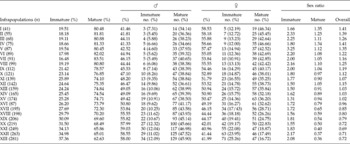
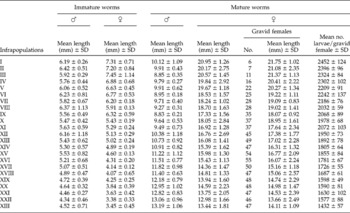
Of the 32 S. rivulatus examined, 23 (71.87%) were slightly or heavily parasitized by the intestinal nematode P. elatensis Fusco & Overstreet, Reference Fusco and Overstreet1979. Females of this nematode are viviparous and uteri of gravid females were partially or fully filled with numerous larvae, each measuring 294–332 μm in length and 9–13 μm in diameter. No other helminth parasites were observed in the intestine of examined fishes. A relatively large number of P. elatensis (3415 specimens) belonging to 23 infrapopulations, ranging from 41 to 281 individuals, were collected from the infected fishes, with a high mean intensity of 148.47 ( ± 67.13 SD) worms/host. There was no significant relationship between fish size and size of P. elatensis infrapopulation (R 2 = 0.019, slope = 5.693, P < 0.516). The entire data set corresponding to all infrapopulations is shown in tables 1 and 2.
The proportions of immature and mature worms and sex ratio in 23 infrapopulations of Procamallanus elatensis.

The mean length of immature and mature worms and the mean number of larvae per gravid female in 23 infrapopulations of Procamallanus elatensis.

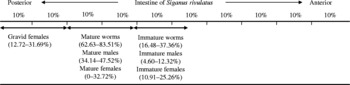
Infrapopulations of P. elatensis were found distributed along the posterior 55% of the intestine of S. rivulatus (never observed in the anterior 45%), where the immature worms were mostly found in the anterior third of this portion, while the mature worms were found in aggregations posterior to them and followed by the gravid females which were usually found in the posterior 20% of the intestine, with no males close to them (fig. 1). In these sites, the proportions of immature worms (16.48–37.36%; males 4.60–12.32%, females 10.91–25.26%), mature worms (62.63–83.51%; males 34.14–47.52%, females 0–32.72%) and gravid females (12.72–31.69%) were dependent on the infrapopulation size (see tables 1 and 2). Although no males were found dead, some dead gravid females containing living larvae within their uteri were constantly found near the fish anus, and larvae were not observed among the intestinal contents of the fish. This pattern of distribution was consistent from fish to fish; absence of other intestinal helminth parasites excludes the confounding influence of interspecific interaction. There was a strong positive relationship between proportion of immature worms and infrapopulation size (see table 1) (R 2 = 0.9330, slope = 0.84, P < 0.001), i.e. as the infrapopulation size increases the proportion of immature worms increases and consequently the proportion of mature worms decreases.
The distribution of Procamallanus elatensis along the intestine of Siganus rivulatus.

Sex ratio (female to male ratio)
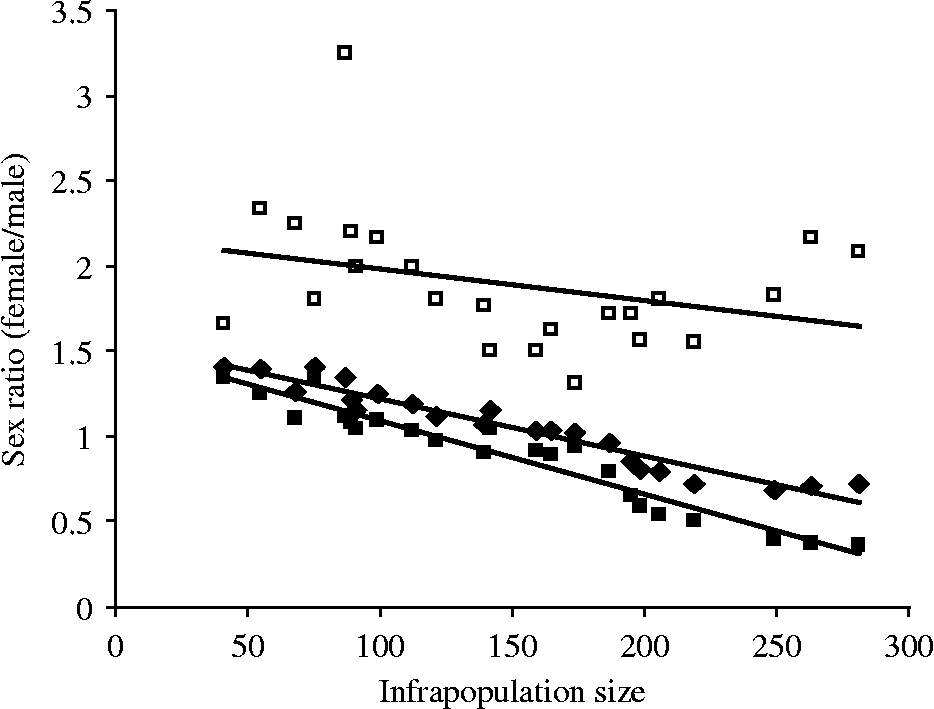
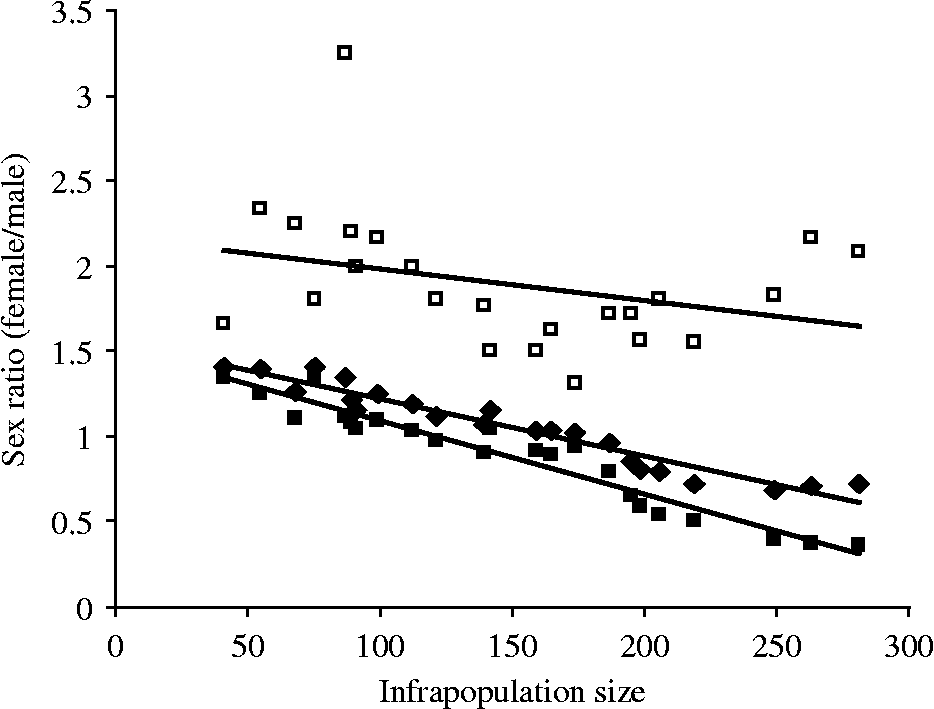
In all infrapopulations (table 1), the sex ratios of immature worms were distinctly female-biased. In small infrapopulations, the sex ratios of mature worms were distinctly female-biased, while in the larger infrapopulations these ratios were slightly or distinctly male-biased. The relationship between the sex ratio of immature worms and infrapopulation size was slightly negative (R 2 = 0.097, slope = − 0.018, P = 0.147), while the relationship between the sex ratio of mature worms and infrapopulation size was strongly negative (R 2 = 0.931, slope = − 0.043, P < 0.001) (fig. 2), i.e. as the infrapopulation size increases, the number of immature males, and consequently the number of mature males, increases relative to the numbers of immature and mature females in an infrapopulation. In addition, the relationship between the overall sex ratio and infrapopulation size was strongly negative (R 2 = 0.933, slope = − 0.034, P < 0.001) (fig. 2), i.e. as the infrapopulation size increases, the number of males significantly increases relative to the number of females in an infrapopulation. Therefore, large infrapopulations of P. elatensis are generally characterized by relatively more immature and mature males than found in small infrapopulations. There was also a significant negative relationship between the sex ratio of mature worms and numbers of gravid females through all infrapopulations (R 2 = 0.579, slope = − 38.55, P < 0.001), i.e. as the sex ratio of mature worms decreases with infrapopulation size (male proportion increases), the number of gravid females increases in the infrapopulation.
The relationship between the sex ratios of immature worms (open squares), sex ratios of mature worms (closed squares) and overall sex ratios (closed diamonds) in 23 infrapopulations of Procamallanus elatensis.
Worm length
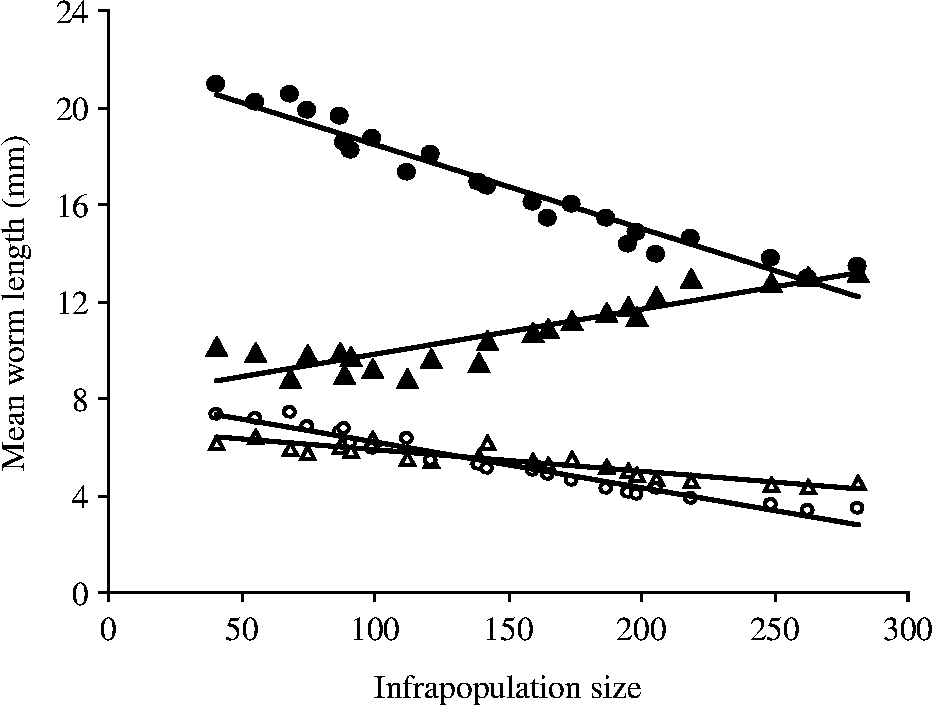
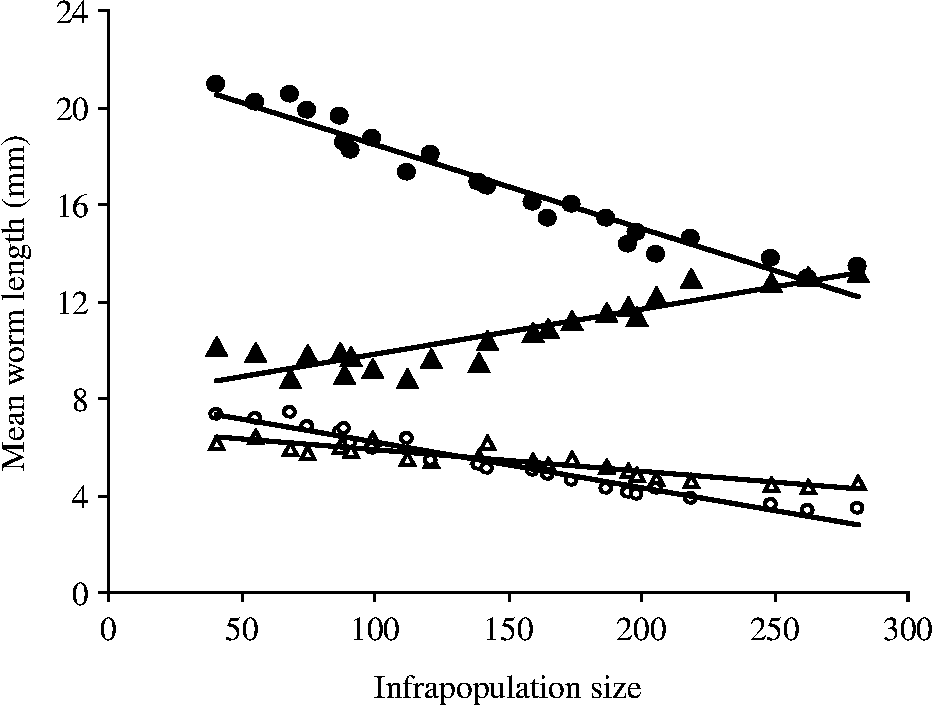
The mean lengths of immature and mature worms were separately recorded through all infrapopulations of P. elatensis (table 2). The relationship between numbers of immature males and their mean lengths was strongly negative (R 2 = 0.85, slope = − 0.061, P < 0.001), i.e. as the numbers of immature males increased in the infrapopulation their mean lengths decreased. In contrast, the relationship between numbers of mature males and their mean lengths was clearly positive (R 2 = 0.843, slope = 0.038, P = 0.002). However, the relationship between mean lengths of mature males and infrapopulation size was clearly positive (R 2 = 0.815, slope = 0.187, P < 0.001) (fig. 3), i.e. as the infrapopulation size increased the numbers of mature males and their mean lengths significantly increased. The relationship between numbers of immature females and their mean lengths was strongly negative (R 2 = 0.818, slope = − 0.659, P < 0.001). Similarly, the relationship between numbers of mature females and their mean lengths was clearly negative (R 2 = 0.565, slope = − 0.163, P < 0.001), i.e. as the number of immature and mature females increased in an infrapopulation, their mean lengths significantly decreased. However, the relationship between mean lengths of mature females and infrapopulation size was strongly negative (R 2 = 0.946, slope = − 0.035, P < 0.001) (fig. 3), i.e. as the infrapopulation size increased, the mean length of mature females significantly decreased. In addition, there was a clear negative relationship between mean lengths of mature females and males (R 2 = 0.727, slope = − 1.482, P = 0.002), i.e. as the mean lengths of mature females decreased, the mean lengths of mature males increased. Thus, as the infrapopulation size increased, the number of immature males and females increased and their mean lengths decreased, the number of mature females and their mean lengths decreased and the number of mature males and their mean lengths increased.
The relationship between the mean length of immature males (open triangles), immature females (open circles), mature males (closed triangles) and mature females (closed circles) in 23 infrapopulations of Procamallanus elatensis.
Female worm fertility
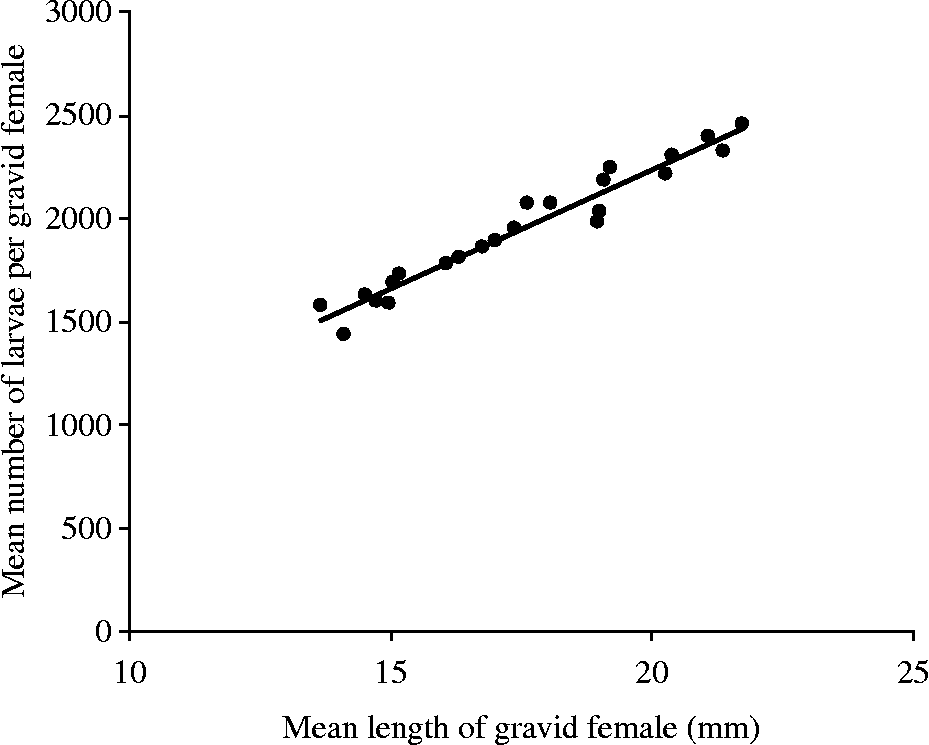
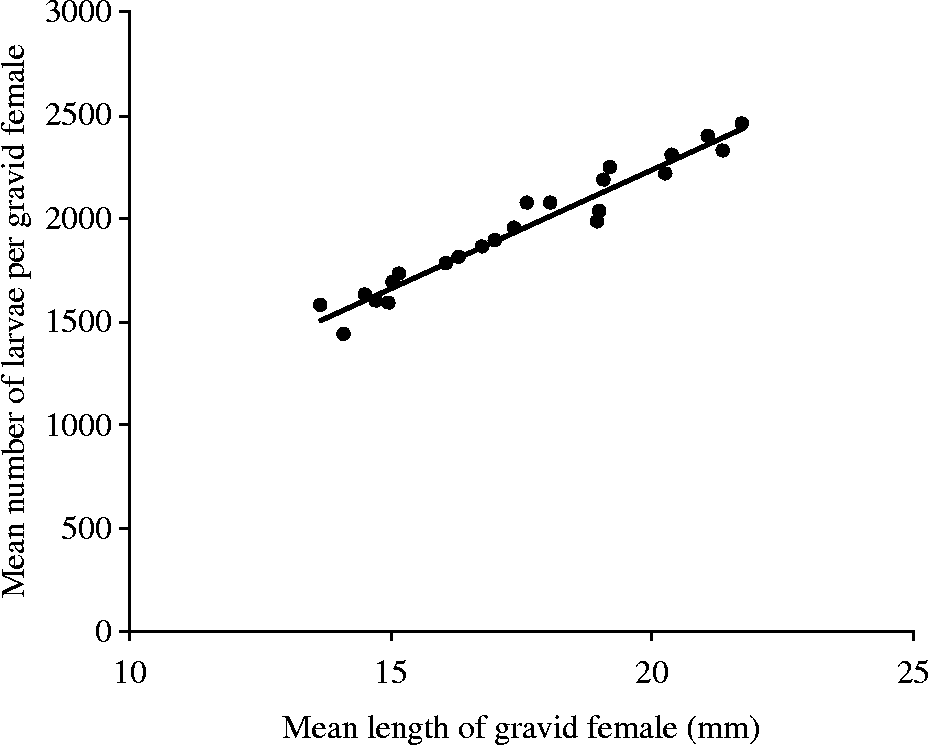
The absence of larvae among the intestinal contents of the fish suggests that they were never released from gravid females when still inside the fish. Therefore, the number of uterine larvae per gravid female was considered as a measure of female worm fertility (table 2). There was a strong positive relationship between mean length of gravid females and mean number of larvae within their uteri (R 2 = 0.9507, slope = 114.96, P < 0.002) (fig. 4), i.e. production of larvae increases with female length (or size), and the opposite is true. However, there was a strong negative relationship between mean length of gravid female and infrapopulation size (R 2 = 0.9486, slope = − 0.035, P < 0.001). Thus, larval production by female worms decreases significantly as the infrapopulation size increases, suggesting a density-dependent reduction in female worm fertility.
The relationship between the mean length of gravid females and mean number of larvae per gravid female in 23 infrapopulations of Procamallanus elatensis.
Discussion
The distribution of small and large infrapopulations of P. elatensis in the intestine of S. rivulatus followed a clear trend, consistent from fish to fish, where it was restricted to the posterior 55% of the intestine. This indicates an apparent adaptation to this site (site preference), which is probably due to physiological gradients correlated with the concentration of specific nutrients or other factors associated with the fish host. Mature worms of P. elatensis were found in aggregations between the immature worms and gravid females. Thus, P. elatensis is probably a polygamous nematode and has a well-defined fundamental niche along the intestine of S. rivulatus, in which the distribution of worms is specified; this suggests strongly that they migrate towards the posterior intestine while they mature, copulate and reproduce. In camallanids, uterine larvae are released from gravid females in two ways. In one common way, larvae are released from gravid females while in the host intestine, and then pass with the host faeces into the external water to be ingested by a crustacean intermediate host. In the other way, gravid females protrude from the fish anus, bursting under osmotic stress in the water and the released larvae are ingested by a crustacean intermediate host (see Andersson, Reference Andersson1994; Moravec et al., 1995). In P. elatensis, release of larvae from gravid females clearly follows the latter way, since some dead gravid females containing living larvae were constantly found near the fish anus and larvae were not observed among the intestinal contents of the fish.
In infrapopulations of P. elatensis, the proportion of immature worms increased relative to that of mature worms and their mean lengths (sizes) gradually or dramatically decreased as the infrapopulation size increased (see table 2). Thus, in large infrapopulations (high intensity), crowding stress may adversely affect the growth of some immature worms, retarding their normal maturation. This suggests intraspecific competition and density-dependent effects. According to Ashworth & Kennedy (Reference Ashworth and Kennedy1999) and Barse et al. (Reference Barse, Mcguire, Vinores, Elerman and Weeder2001), mature nematodes inhibit the development of immature ones in a density-dependent manner in high-density infrapopulations.
Sex ratios among adult nematodes are commonly female biased (Roche & Patrzek, Reference Roche and Patrzek1966; Seidenberg et al., Reference Seidenberg, Kelly, Lubin and Ngton1974; Guyatt & Bundy, Reference Guyatt and Bundy1993) and are often observed to be density-dependent (Tingley & Anderson, Reference Tingley and Anderson1986; Haukisalmi et al., Reference Haukisalmi, Henttonen and Vikman1996; Stien et al., Reference Stien, Dallimer, Irvine, Halvorsen, Langvatn, Albon and Dallas2005). Female-biased sex ratios are favoured at low intensities of infection to avoid inbreeding, while less female-biased or male-biased sex ratios are favoured at high intensities to increase the probability of mating (Poulin, Reference Poulin1997a, Reference Poulin2006; Stien et al., Reference Stien, Dallimer, Irvine, Halvorsen, Langvatn, Albon and Dallas2005). In female-biased infrapopulations, the greater proportion of females may be because nematode females survive longer than males following the infection of hosts (Dunn, Reference Dunn1965; Borgsteede & Hendriks, Reference Borgsteede and Hendriks1979; Watson et al., Reference Watson, Lee and Hudson1988). In male-biased infrapopulations, the lower proportion of females may be because nematode females require higher levels of nutrients for survival than males (Tingley & Anderson, Reference Tingley and Anderson1986), female recruitment is usually low in infrapopulations with old females (Stien et al., Reference Stien, Dallimer, Irvine, Halvorsen, Langvatn, Albon and Dallas2005), or because sexual selection may favour early maturation of male parasitic nematodes (Morand & Hugot, Reference Morand and Hugot1998). Generally, the exact mechanism leading to male-biased sex ratios in nematode infrapopulations is still unclear. In infrapopulations of P. elatensis, the sex ratios of mature worms agreed implicitly with these concepts, since in small infrapopulations (slight intensity) the sex ratios were distinctly female biased (as in immature worms), but in the larger infrapopulations (high intensity) these ratio were slightly or distinctly male biased, i.e. density-dependent. However, male-biased sex ratios in large infrapopulations were more probably due to the selective mortality of gravid females; when dead, they pass with the host faeces into the external water and the sex ratios tend to become male biased. Moreover, the strong negative relationship between sex ratios and numbers of gravid females throughout the infrapopulations indicates that, as the sex ratio decreases with infrapopulation size (male proportion increases), the number of gravid females increases in the infrapopulation. Thus high-density infrapopulations create male-biased operational sex ratios (probably through the selective mortality of gravid females), allowing most mature females to copulate. The strongly negative relationship between the overall sex ratio and infrapopulation size suggests a strong link between the characteristics of infrapopulations and their sex ratio.
Density-dependent reductions in mean worm length (or fecundity) is common in gastrointestinal nematodes (see Szalai & Dick, Reference Szalai and Dick1989; Shostak & Scott, Reference Shostak and Scott1993; Irvine et al., Reference Irvine, Stien, Dallas, Halvorsen, Langvatn and Albon2001; Richards & Lewis, Reference Richards and Lewis2001; Dezfuli et al., Reference Dezfuli, Volponi, Beltrami and Poulin2002; Hassanine & Al-Jahdali, Reference Hassanine and Al-Jahdali2008). Such a decrease in length (fecundity) contributes to the regulation of the parasite population by the availability of infective stages for all infrapopulations (Poulin, Reference Poulin2006). The dramatic decrease in the mean lengths of immature males and females and mature females in large infrapopulations of P. elatensis strongly suggests intraspecific competition and density-dependent effects. This suggestion is reinforced by the strong negative relationships between the numbers of these stages and their mean lengths (sizes), throughout the infrapopulations. At present, there is no plausible reason to explain the gradual increase in the mean length of mature males with infrapopulation size, it may probably be due to the decrease in sex ratio and strongly suggests intense sexual selection or male–male competition for access to females. This process is triggered when the sex ratio tends to be male biased and mainly acts on the body size of mature males via physical contests to increase their relative size (Poulin, Reference Poulin1997b), which seems to be important during mating as larger males have been shown to have greater access to females (Andersson, Reference Andersson1994). Generally, the sizes of males relative to females increase as the average sex ratio becomes less female biased among all kinds of parasitic nematodes (Poulin, Reference Poulin1997b). However, comparative data suggest that as the infrapopulation size increases, the sex ratio should become less female biased to increase the probability of mating, and at the same time the size of males relative to females should increase in response to stronger male–male competition for access to females (May & Woolhouse, Reference May and Woolhouse1993; Poulin, Reference Poulin1997b). These expected patterns were clearly observed in the present study, with significantly more and significantly larger male worms being found in large infrapopulations of P. elatensis.
In gastrointestinal nematodes, density-dependent reductions in female worm length (or size) are often accompanied by reductions in mean egg output because of the strong relationship between body size and egg output in practically all nematodes (Mössinger & Wenk, Reference Mössinger and Wenk1986; Szalai & Dick, Reference Szalai and Dick1989; Sinniah & Subramaniam, Reference Sinniah and Subramaniam1991; Marcogliese, Reference Marcogliese1997; Irvine et al., Reference Irvine, Stien, Dallas, Halvorsen, Langvatn and Albon2001, Richards & Lewis, Reference Richards and Lewis2001; Dezfuli et al., Reference Dezfuli, Volponi, Beltrami and Poulin2002). In infrapopulations of P. elatensis, there was a strong positive relationship between mean lengths of gravid females and numbers of larvae within their uteri, i.e. larval production increased with the female length and, because of the strong negative relationship between mean length of gravid females and infrapopulation size, larval production by female worms significantly decreased as the infrapopulation size increased, suggesting a density-dependent reduction in female worm fertility.
In ecological studies of gastrointestinal helminth parasites, the fundamental niche of a parasite is the precise region of the gut it inhabits when in single infections (Poulin, Reference Poulin2001). Undoubtedly this niche has a carrying capacity, i.e. has a capacity for a certain maximum number of worms that can exist within it without intraspecific competition (Hassanine & Al-Jahdali, Reference Hassanine and Al-Jahdali2008). In the present study, all infrapopulations of P. elatensis were found in a well-defined fundamental niche (posterior 55% of the intestine of S. rivulatus). In small infrapopulations, the sex ratios were female biased and density-dependent effects were not noticeable. In these infrapopulations, the numbers of worms were probably lower than the carrying capacity of the fundamental niche. In larger infrapopulations, the sex ratios were male biased and density-dependent effects were clearly noticeable. In these infrapopulations, the numbers of worms were probably higher than the carrying capacity of the fundamental niche and triggered intraspecific competition and density-dependent effects.
Generally, the results obtained strongly suggest that infrapopulation self-regulation is through density-dependent mechanisms, in which development of immature worms, infrapopulation size ( = intensity of infection), sex ratio, sexual selection and carrying capacity of the fundamental niche play essential roles in shaping and regulating infrapopulations of P. elatensis.
Acknowledgements
I am very grateful to King Abdulaziz University, Saudi Arabia, for continued encouragement and support. I should also like to extend my appreciation to the staff of Rabigh-Faculty of Science and Arts, King Abdulaziz University, for their help during the collection of the material.