Can we ever decolonise Australian institutions? Can we decolonise our minds? Probably not. But we can try to find ways to undermine the colonial hegemony. (Langton, Reference Langton1993, p. 8)
In Australia, teachers are mandated to report child abuse as part of their professional practice. Failure to do so can lead to teachers being liable for injury to children that results from this breach, and may lead to professional disciplinary consequences (Mathews & Walsh, Reference Mathews, Walsh, Hayes and Higgins2014). The laws were designed to draw on the capacity of professionals to identify the many cases of severe child abuse and neglect that occur in private that would otherwise go unnoticed by agencies who help children (Mathews & Walsh, Reference Mathews, Walsh, Hayes and Higgins2014).
The first mandatory reporting of child abuse provision in Australian law occurred in 1969 in South Australia and concluded in 2009 with Western Australia (Mathews, Reference Mathews, Mathews and Bross2015a). Evidence from overseas generated a need for mandatory reporting by teachers in Australia (Mathews, Reference Mathews, Mathews and Bross2015a). In 1990, the United Nations Convention on the Rights of the Child (United Nations, 1989) came into force in Australia. This document provided a rhetorical commitment to protect children from maltreatment, requiring the States to take ‘all appropriate legislative, administrative, social and educational measures to protect the child from all forms of maltreatment while in the care of parents or guardians’ (Mathews & Bross, Reference Mathews, Bross, Korbin and Krugman2014, p. 477).
This history provides an interesting insight into the drivers of such a change in relation to the expectations of teacher professional practice. The first set of drivers relate to policies that inform the work of teachers so that their professional actions are inclusive and ethical. In particular, the Melbourne Declaration in 2009, seeks to promote equity and excellence in Australian schooling and that all Australian governments and all school sectors must ‘provide all students with access to high-quality schooling that is free from discrimination based on gender, language, sexual orientation, pregnancy, culture, ethnicity, religion, health or disability, socioeconomic background or geographic location’ (Ministerial Council on Employment Education Training and Youth Affairs (MCEETYA), 2008, p. 8). Racism towards Aboriginal and Torres Strait Islander students has no place in schools that ‘build on local cultural knowledge and experience of Indigenous students as a foundation for learning, and work in partnership with local communities on all aspects of the schooling process, including the promotion of high expectations for the learning outcomes of Indigenous students’ (MCEETYA, 2008, p. 8).
A second driver of change comes from the increasing prominence of national teacher professional standards. The Australian Institute of Teacher Standards and Leadership (AITSL) highlights teachers need to ‘Understand and respect Aboriginal and Torres Strait Islander people to promote reconciliation between Indigenous and non-Indigenous Australians’ (Australian Institute of Teaching and School Leadership Standards, n.d.). It would be impossible for a teacher to demonstrate this standard and to simultaneously perpetuate racist relations between people.
A third driver is that of Indigenous rights. The United Nations Declaration on the Rights of Indigenous Peoples states that ‘all doctrines, policies and practices based on or advocating superiority of peoples or individuals on the basis of national origin or racial, religious, ethnic or cultural differences are racist, scientifically false, legally invalid, morally condemnable and socially unjust’ (United Nations General Assembly, 2007). Clearly, racism plays no part in furthering the rights of Indigenous peoples and schools, by their very nature, should uphold these rights of Indigenous peoples.
Racism could be argued by some to align with the general tenets of the mandatory reporting of child abuse. There are four recognised forms of child maltreatment: physical abuse, sexual abuse, emotional abuse and neglect (Mathews, Reference Mathews, Mathews and Bross2015b). A case study of Aboriginal and Torres Strait Islander students offers evidence derived from reports and studies that highlight the emotional trauma caused by racism on students.
This paper will first explore internalized, interpersonal and institutionalized racism as constructs of inequality of opportunity. The evidence of racism towards Aboriginal and Torres Strait Islanders will be provided at both a societal level and also in a school environment. Evidence of the effectiveness of mandatory reporting will then be presented. The paper concludes with the arguments for and against mandatory reporting of racism (in schools) as an antiracist practice.
Racism
Racism is a means of reinforcing division, inequality and exclusion (Dunn & Nelson, Reference Dunn and Nelson2011, p. 588). Berman and Paradies (Reference Berman and Paradies2010) argue that racism should only be associated with inequality when it is imposed or avoidable and consequently define racism as ‘that which maintains or exacerbates inequality of opportunity among ethnoracial groups’ (p. 218). Racism refers to the ways in which avoidable and unfair inequalities are perpetuated based on racial, ethnic, cultural and religious characteristics at internalized, interpersonal, institutional or societal levels (Berman & Paradies, Reference Berman and Paradies2010).
Internalized racism happens when the subordinate group accepts that the dominant group's view of them is true (Speight, Hewitt, & Cook, Reference Speight, Hewitt, Cook, Neville, Gallardo, Sue, Neville, Gallardo and Sue2016). Internalized racism ‘results in the conscious or unconscious acceptance of a racial hierarchy where the culture, values and beliefs of the dominant culture are prioritized over the culture values and beliefs of racial minorities’ (Kohli, Reference Kohli2014, p. 370). This form of racism happens when individuals incorporate ideologies that serve ‘to maintain or exacerbate the unequal distribution of opportunity across ethnoracial groups (Berman & Paradies, Reference Berman and Paradies2010, p. 218). Internalized racism is particularly important in an initiative of mandatory reporting as the perpetrators of this form of racism might not be conscious of their actions, biases and the implications these have on other groups of people.
Interpersonal racism refers to ‘episodes of race or ethnicity-related maltreatment that occur to the individual’ (Brondolo, Libretti, Rivera, & Walsemann, Reference Brondolo, Libretti, Rivera and Walsemann2012, p. 367). Kunkel (Reference Kunkel and Haltinner2014) proposes that interpersonal racism is not innate but learned through patterns that are reinforced by institutions such as school. If the mandatory reporting of racism in schools is introduced, then limiting such reporting to interactional racism may overcome some of the complexities involved with interpersonal and institutional racism.
A widely cited definition of institutional racism came from a review of racial practices in the UK police force. Institutional racism was defined as ‘The collective failure of an organisation to provide an appropriate and professional service to people because of their colour, culture, or ethnic origin’ (Macpherson, Reference Macpherson1999, para. 6.4). In a school context, institutional racism focuses on ‘the structural dimensions that result in people of color's marginalization, limitations, and lowered chances for success in schools’ (Leonardo & Grubb, Reference Leonardo and Grubb2013, p. 3). A result of institutional racism is that ‘well-intentioned actions can be said to have racist consequences if they unfairly discriminate against members of one or more minoritized groups’ (Gillborn, Reference Gillborn2008, p. 4)
The types of racism in schools are complex. As Kunkel (Reference Kunkel and Haltinner2014) identifies racism as frozen in the past while also being mobile to a range of contexts in the present which ‘silently reproduces racial certainties and foreclosures while concealing (ambushing) their enabling processes’ (p. 45). The concealing of the enabling processes of racism is highly problematic for mandatory reporting.
Evidence of Racism Towards Aboriginal and Torres Strait Islanders
Racism has existed towards Aboriginal and Torres Strait Islanders for generations. At a societal level, Australia has a history of imposing policies of inequality and exclusion on Aboriginal and Torres Strait Islander people, particularly in relation to education. Bodkin-Andrews and Carlson (Reference Bodkin-Andrews and Carlson2014, p. 3) suggest the ‘historical (and in some cases current) educational trends are that the aims and quality of education has differed drastically for Indigenous and non-Indigenous students’. Beresford (Reference Beresford, Beresford, Partington and Gower2012) identified that ‘the poor provision for Aboriginal children has resulted in generations of uneducated, or partly educated, Aboriginal people. This legacy is now manifest in widespread intergenerational educational disadvantage which has proved difficult to overcome’ (p. 85). The work of teachers in Australia is framed by the history of educational and societal policies towards Aboriginal and Torres Strait Islanders that fuel institutional racism in schools.
Pearson (Reference Pearson2000) spells out the effects of racism towards Aboriginal and Torres Strait Islanders:
Make no mistake, racism is a terrible burden. It attacks the spirit. It attacks self-esteem and the soul in ways that those who are not subjected to it would have not an inkling of. Racism is a major handicap: it results in Aboriginal people not having access to opportunities, in not recognising opportunities when they arise, in not being able to seize and hold onto opportunities when they recognise them. Australians concerned about the position of Aboriginal people in this country should not underestimate the decisive role that racism plays in the wellbeing of Aboriginal individuals and society. Australians need to stop kidding themselves that “racism isn't all that bad - black people should just get over it and on with it”. If you are black in this country, you start life with a great and crushing burden (p. 34).
The ubiquitous nature of racism towards Aboriginal and Torres Strait Islanders is well documented. Herbert (Reference Herbert2007) maintains that racism mediates all aspects of Indigenous peoples lives suggesting, 'Denying the reality that racism, both institutional and individual, [that] permeates every aspect of Indigenous people's lives, is to imply a lack of trust’ (p. 47). A 24-year old Yorta Yorta man in a Victorian Indigenous Youth Advisory Council of Victoria study identified racism as ubiquitous and to be found in everyday comments towards him, such as ‘You're doing really well for one of those’ (Victorian Indigenous Youth Advisory Council of Victoria, Youth Affairs Council of Victoria, & Victoria. Dept. for Victorian Communities, 2006). Bunda, Zipin, and Brennan (Reference Bunda, Zipin and Brennan2012) argue that dialogues amongst Indigenous people reveal a deep marginalization and deprivation of meaningful conversations with non-Indigenous agents. Dunn, Kamp, Shaw, Forrest, and Paradies (Reference Dunn, Kamp, Shaw, Forrest and Paradies2010) found that Aboriginal and Torres Strait Islanders are more likely to recognize racism and privilege than other Australians, and that this recognition of racism reflects their historic and continued experiences with racism.
There is considerable empirical quantitative evidence of the enduring social problem of racism for Aboriginal and Torres Strait Islander people. The 2008–09 National Aboriginal and Torres Strait Islander survey is a national representative survey conducted by the Australian Bureau of Statistics. Cunningham and Paradies (Reference Cunningham and Paradies2013) analysed self-reported racial discrimination data from over 7000 adult participants to find that 27% experienced racial discrimination in the past year, 30% of those who experienced this discrimination experienced racial discrimination in work settings. The researchers found that racial discrimination was commonly experienced across a number of public, legal and work settings (Cunningham & Paradies, Reference Cunningham and Paradies2013). This finding is replicated in a study conducted by the National Indigenous Unit of the National Tertiary Education Union (NTEU). A total of 172 Aboriginal and Torres Strait Islander Members of the NTEU participated in a survey that explored the members’ experience of racial discrimination, cultural respect/awareness and lateral violence in the workplace. 83% of the members surveyed strongly agreed that racial discrimination exists in Australia and less than 67% strongly agreed that racial discrimination is widespread in Australia (National Indigenous Unit of the National Tertiary Education Union, 2011).
Racism in Schools
Racism in schools towards Aboriginal and Torres Strait Islander students has been well documented. Partington (Reference Partington, Beresford, Partington and Gower2012) argues that the widespread racism towards Aboriginal and Torres Strait Islander students in and out of schools affects their affiliation with school, their self-esteem, and their motivation to succeed. In a review of Koorie education in Victoria, Koorie students were found to be alienated by schooling partly due to the racism they experienced on a day to day basis (Buckskin et al., Reference Buckskin, Hughes, Teasdale, Gregory, Clarke, Morgan and St Clair2008). Koorie students experience a ‘psychological fall-out of repeatedly hearing, sensing and seeing the reactions and negative attitudes of others, particularly teachers and continuously having to justify themselves, (which) affects their capacity to be present in the classroom, let alone to be successful at school’ (Buckskin et al., Reference Buckskin2008, p. 45). In a phenomological study of 16 staff in four private boarding schools in Perth in Western Australia, researchers found the staff reported Aboriginal students experienced prejudice, stereotypes and overt racism within their school community (Mander, Cohen, & Pooley, Reference Mander, Cohen and Pooley2015). The reflections from Partington (Reference Partington, Beresford, Partington and Gower2012) and Buckskin (Reference Buckskin2009) and the empirical study from Mander et al. (Reference Mander, Cohen and Pooley2015) highlight the problem of racism for Aboriginal and Torres Strait Islander students in schools in Australia.
The link between racial discrimination and self-esteem has been explored by researchers across Indigenous and non-Indigenous school student samples. Bodkin-Andrews, Seaton, Nelson, Craven, and Yeung (Reference Bodkin-Andrews, Seaton, Nelson, Craven and Yeung2010) surveyed 1212 year 7 participants with an average age of 13.63 years of which 22.5% (n=273) were Indigenous. As both Indigenous and non-Indigenous students reported higher levels of personal discrimination their scores on two achievement tests decreased (Bodkin-Andrews et al., Reference Bodkin-Andrews, Seaton, Nelson, Craven and Yeung2010). The researchers highlighted the negative impact one experience of racial discrimination may have on a student so the number of personal discrimination experiences might not be a good indicator of the impact of these experiences. This provides a compelling argument that every racial discrimination experience towards Aboriginal and Torres Strait Islander students should be considered as a violation towards their wellbeing that has potential implications for their school success.
Covert racism towards Aboriginal and Torres Strait Islander teachers is also identified in the literature. Subtle racist discourses were found in schools where colleagues of Aboriginal and Torres Strait Islander teachers ‘joke’ about Indigenous issues, subtly question the nature of their qualifications, or refuse to engage with or incorporate Indigenous perspective in their teaching (Santoro, Reid, Simpson, & McConaghy, Reference Santoro, Reid, Simpson and McConaghy2008, p. 5). This form of racism accounts for the limited retention of Aboriginal and Torres Strait Islander teachers in the profession. In a literature review that explores the underrepresentation of Aboriginal and Torres Strait Islanders in the profession, Patton, Lee Hong, Lampert, Burnett, and Anderson (Reference Patton, Lee Hong, Lampert, Burnett and Anderson2012) found that numerous preservice teachers encountered racism on professional experiences in schools which they found ‘infuriating, hurtful, silencing and, for some, it turned them off teaching’ (p. 35).
Rose (Reference Rose and Price2012) argues that schools are places that enact ‘racism as cotton wool’ (p. 74) where teachers are excluded or excused from full professional engagement with Aboriginal and Torres Strait Islander people in case this aspect of their professional work may cause offence. This limited engagement by teachers with Aboriginal and Torres Strait Islander discourses in the classroom lowers student expectations and provides Aboriginal and Torres Strait Islander teachers with limited feedback on their teaching effectiveness (Rose, Reference Rose and Price2012).
There is conflicting evidence about the approach school principals bring to negotiating racism in schools. In a survey of 35 principals in Western Australia, Aveling (Reference Aveling2007) found they did not understand the extent and nature of racism which they constructed in terms of individual pathologies. On the other hand, Charles Mahoney, Fox and Halse (Reference Charles, Mahoney, Fox and Halse2016) interviewed three school principals in Melbourne who articulated racism in complex ways linked to school contexts of class and religion. There is an argument that intersectionality, that explains the multiple and structural oppression of subjects, can also be used by school principals to explain racism in their nuanced context of their own school (Charles Mahoney, Fox, & Halse, Reference Charles, Mahoney, Fox and Halse2016). While the latter of these two studies are not drawn from a context of Aboriginal and Torres Strait Islander populations in schools, both studies do highlight the important role principals play in enacting or resisting policies of antiracism in schools.
In Australia, there is already provision to outlaw racism in schools. The Racial Discrimination Act 1975 states that
It is unlawful for a person to do any act involving a distinction, exclusion, restriction or preference based on race, colour, descent or national or ethnic origin which has the purpose or effect of nullifying or impairing the recognition, enjoyment or exercise, on an equal footing, of any human right or fundamental freedom in the political, economic, social, cultural or any other field of public life (section 9, part 1).
There is evidence in the above studies in this section that the lived experiences of Aboriginal and Torres Strait Islander peoples in school contexts are in contrast with the lawful provisions of this act. The mandatory reporting of racism by teachers in schools would provide a mechanism for teachers to uphold their legal responsibilities to the Racial Discrimination Act.
Mandatory Reporting
Mandatory reporting laws are passed by Parliament and ‘require designated persons to report certain kinds of child abuse and neglect to government authorities’ (Mathews & Walsh, Reference Mathews, Walsh, Hayes and Higgins2014, p. 132). The aim of the laws is to protect the child from significant harm and to assist parents or caregivers so the likelihood of reoccurrence is reduced (Mathews & Walsh, Reference Mathews, Walsh, Hayes and Higgins2014). The laws are based on the premise that children do not have the resources to protect themselves from abuse, and that victims of abuse are typically threatened and shamed into remaining silent. Mandatory reporting by professional groups was seen to be pivotal in supporting these laws internationally, and in Australia teachers are members of a professional group well placed to report child abuse (Mathews & Walsh, Reference Mathews and Walsh2004).
An early study of the effectiveness of mandatory reporting laws in New South Wales (Mathews & Walsh, Reference Mathews, Walsh, Hayes and Higgins2014) found the effectiveness of mandatory reporting by teachers relied on their accurate identification and reporting of suspected sexual assault. One problem with mandatory reporting was the misidentification of cases where ‘for every two additional child victims of sexual assault identified by teachers one additional family was inappropriately identified as being abusive’ (Lamond (Reference Lamond1989, p. 477). This challenged the effectiveness of using mandatory reporting as a mechanism to report child abuse given the collateral damage to families (Lamond, Reference Lamond1989). Lamond (Reference Lamond1989) identified that after the initial introduction of the laws and their associated mechanisms of reporter training and dedicated child protection systems, the reports of known and suspected maltreatment increased substantially compared with the number of reports prior to the laws of mandatory reporting being ratified. The results of mandatory reporting have been positive with more reports and cases being identified from jurisdictions with mandatory reporting compared to jurisdictions without mandatory reporting (Mathews, Reference Mathews, Mathews and Bross2015a).
Mathews (Reference Mathews, Mathews and Bross2015a) found that school personnel are responsible for 18% of all cases of reported child abuse in Australia in the 2013–14 year. The process of reporting leading to substantiation involves notifying, investigating, finalised investigating and substantiating. Across Australia in 2013–14, the total number of notifications (304,097) and substantiations (54,438) involved 198,966 and 40,844 children, respectively (Australian Institute of Health and Welfare, 2015). The training of teachers about the reporting process and the way the reports are processed are two key factors in the improved effectiveness of the process of mandatory reporting from when it was first introduced. If mandatory reporting was extended to include racism, the training of teachers, and the processes of reporting, could occur before any legislative changes to manage the effectiveness of such reporting.
Mandatory reporting by teachers in Australia varies from state to state as it is bound by state legislation; however, the laws have common approaches. The laws define which person must make reports, identify what state of mind the reporter must have before the reporting duty is activated, define the types of abuse or neglect, define the extent of the abuse or neglect, identify if the duty applies to past, present or future abuse, state the penalties for failure to report, provide confidentiality of the reporters identity, provide immunity of liability of a report made in good faith, state when a report must be made, state to whom a report should be made, identify what a report should contain, enable other people (nonprofessionals) to make a report in good faith (Mathews & Walsh, Reference Mathews, Walsh, Hayes and Higgins2014). These common approaches are well placed to provide a framework for extending the reach of mandatory reporting to include racism towards Aboriginal and Torres Strait Islanders in schools. While a fully articulated operationalisation of the mandatory reporting of racism is beyond the scope of this paper, the important work principals and teachers could do to support this reporting is explored throughout the paper.
Mandatory Reporting as Antiracism
Antiracism focuses ‘on the ways in which ordinary people resist or challenge racism in their everyday lives’ (Walsh, Farrell, Bridgstock, & Schweitzer, Reference Walsh, Farrell, Bridgstock and Schweitzer2006, p. 66). Antiracism offers ‘forms of thought and/or practice that seek to confront, eradicate and/or ameliorate racism’ (Bonnett, Reference Bonnett1999, p. 4) to people who want socially just ideologies to replace racist thoughts and/or practices. Antiracism is concerned with combating all or some of the prejudice, power, ideology, stereotypes, domination, disparities and unequal treatment of racism (Berman & Paradies, Reference Berman and Paradies2010). A logical antiracist focus for teachers would be the interactional racism over which teachers tend to have agency in staffrooms and classrooms. This does not validate the continuation of institutional racism but rather recognises that the disruption of interactional racism is an achievable aim in schools.
Mandatory reporting of racism by teachers would include reporting of interactional racism by students and teachers. This reflects the literature on interactional racism in schools. Interactional racism happens between students in the classroom and between teachers in staffroom. Just as teachers have been provided with support to identify and say no to racism, they would also need support to negotiate the mandatory reporting of racism. The way they approach interactional racism between students would involve drawing on their knowledge of the context, the student and the legislation in place. The shared understanding between teachers of the need to report interactional racism would provide a different set of guidelines for teachers to report interactional racism by teachers. The following discussion draws on interactional racism in schools experienced by teachers and students.
The work of mandatory reporting by teachers would be complex. Interactional racism is not simply members of a dominant group acting on its minorities, but can also be perpetrated by members of a minority group to other members of that group or towards another minority group (Balint, Reference Balint2016). Teachers may be reporting on student or teacher perpetrators from minority groups that would challenge the stereotypes of racism that many teachers might bring to their teaching practice.
An important distinction between mandatory reporting of sexual abuse of students and the proposed mandatory reporting of racism of students is the context of where the abuse or harm is occurring. Mandatory reporting of sexual abuse of students by teachers is about abuse that has happened outside of the school context, whereas mandatory reporting of racism would be concerning incidents or events of racism in the school. One justification for reporting racism in schools is that antiracist practices could be seen as a moral ideal that schools should uphold. Where all reasonable citizens agree upon a moral ideal schools have a right to teach this moral ideal as part of the curriculum (de Ruyter & Steutel, Reference de Ruyter and Steutel2013). The mandatory reporting of racism could be seen to be upholding the moral ideal of antiracism in schools in the highest regard by teachers.
Exploring Mandatory Reporting as Antiracism
Racism as Emotional Abuse
Mathews (Reference Mathews, Mathews and Bross2015a) defines emotional abuse and neglect as ‘persistent, non-physical, harmful interactions with the child by the caregiver, which include both commission and omission’ (p. 869). Glaser (Reference Glaser2011) developed a typology of harmful acts and omissions and one element of the typology involves interacting with the child with hostility, blame, denigration, rejection or scapegoating. This is consistent with the ideas of racism above where the cultural identity of the child is denigrated in front of peers and/or teachers in a school environment. Racism can be a form of emotional abuse and psychological trauma for ethnic minorities because of the negative messages that undermine self-esteem (Sanchez-Hucles, Reference Sanchez-Hucles1999). Racism is enacted in negative, uncontrollable and sudden assault on one's self (Carter, Reference Carter2007). Racism as a form of emotional abuse can also lead to a lowering of self-concept (Edwards, Reference Edwards2006). Emotional abuses can adversely impact one's affective, behavioural, and cognitive functioning (Franklin, Boyd-Franklin, & Kelly, Reference Franklin, Boyd-Franklin and Kelly2006, p. 16). Herring, Lauw, McNamara, and Spangaro (Reference Herring, Lauw, McNamara and Spangaro2013), reflecting on social work contexts, argue that the trauma of racism leads to Aboriginal people underutilizing mainstream services due to the frequent negative encounters with these providers. The evidence from the above section on racism towards Aboriginal and Torres Strait Islander students in schools is laced with the damaging evidence that emotional abuse of racism disrupts student learning and wellbeing.
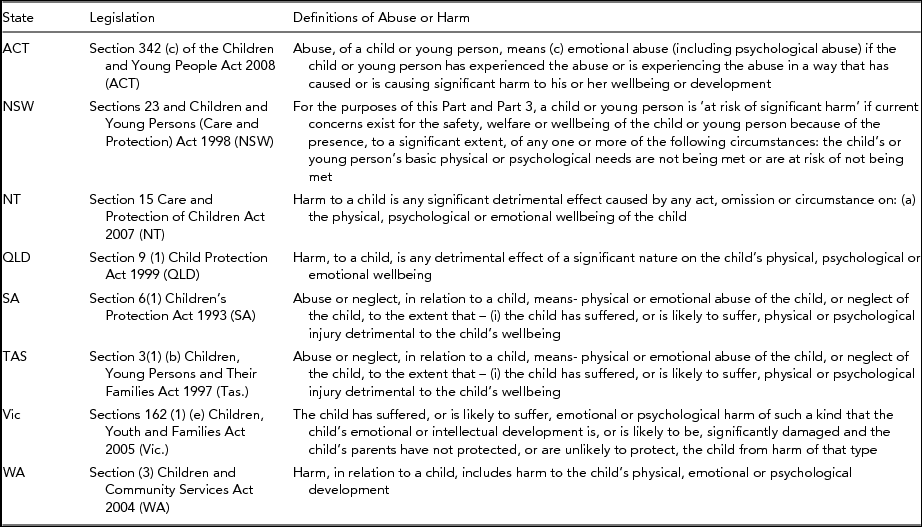
Since racism is a form of emotional abuse, it is important to identify how the current legislation in Australia defines emotional abuse as a category of harm to the child. Table 1 provides the relevant wording related to emotional abuse in each state and territory.
The Definitions of Abuse or Harm in State and Territory Legislations in Australia

The evidence from the legislation in Table 1 highlights that across Australia the legislation to the harm of children is related to either their emotional abuse, psychological abuse or wellbeing development in the home. Given the evidence of the emotional abuse of racism (Herbert, Reference Herbert2007), and the evidence that racism happens in schools (Buckskin, Reference Buckskin2009), there is a logical argument to extend the mandatory reporting of racism in the school environment. Carter (Reference Carter2007) argues there should be a link between the types of racism and the psychological and emotional impacts of these acts of racism on its targets. Mandatory reporting would raise the awareness of these links in the teaching profession.
Aboriginal and Torres Strait Islanders have been aware of the emotional abuse of racism and have called for the schools to be culturally safe. According to Bin-Sallik (Reference Bin-Sallik2003), cultural safety ‘encompasses a reflection on individual cultural identity and recognition of the impact of personal culture on professional practice’ (p. 21). Aboriginal and Torres Strait Islander parents are currently in a situation where the cultural safety they offer at home is not replicated by the school when their children are subject to racism. It appears counterproductive to the tenets of education that teachers are mandated to report evidence of emotional abuse in the home while similar forms of emotional abuse caused by racism in schools is not adequately challenged or in some cases not even identified.
There are at least two problems associated with mandated reporting of racism as emotional abuse. The first is how would this be operationalized in the classroom and staffroom? The actions teachers would need to take if racist acts were identified between students in a class would be difficult to manage. Students might feel more marginalized if singled out in front of their peers and the problem of denigrating ‘the other’ would not be resolved in the act of reporting the interactional racism. Likewise, in the staffroom, teachers would be put in a situation where they would need to report on each other if they encountered racist comments. This might not resolve the othering by the teacher who made the comment and could undermine staff cohesion in schools.
The second problem associated with mandated reporting of racism as emotional abuse is whether mandated reporting for cultural safety is a valid way to progress the social justice agenda of antiracism. Mandating the reporting of racism by teachers might overlook the need for acknowledging and listening to student voices (Donovan, Reference Donovan2015), developing deep and respectful partnerships with the community (Herbert, Reference Herbert2007) and negotiating the complex cultural interface between Indigenous knowledge systems and Western scientific knowledge in schools (Nakata, Reference Nakata2013). Good teachers engage in much more than antiracist practices to support the agency of Aboriginal and Torres Strait Islanders in schools. The mandated reporting of racism could focus but also limit the work of all teachers being compliant with a new legislation rather than the more nuanced work of becoming a teacher-ally, a term that Ritchie (Reference Ritchie2012) describes to encompass the teacher partnering with community agendas.
Antiracism as a Strategy of Successful Learning Programs
Tackling racism in schools was part of Sarra's (Reference Sarra2011) ‘stronger smarter’ strategy to provide a positive discourse about what it means to be Aboriginal. Success in stronger smarter schools is premised on challenging the racist beliefs that the learning capacity of Indigenous children is inferior to other students and therefore not worth investing time to improve their performance (Sarra, Reference Sarra2011). Mandatory reporting of racism would provide principals with an antiracist utility to tackle the interactions that are motivated by racist beliefs. Mandatory reporting, however, would not address the problem of how to change the racist beliefs of some teachers. Balint (Reference Balint2016) argues that simply not acting on racist beliefs is ‘a very unstable, potentially dangerous, and perhaps just plain wrong, situation’ (p. 17). One of the limitations of mandatory reporting of interactional racism is that the beliefs and attitudes of racially intolerant teachers would remain unchallenged through mandatory reporting. One cannot mandate for beliefs and attitudes but legislation can and does challenge the rights to act on these. The distinction between intolerant acts and intolerant attitudes and beliefs is useful in definitions of mandatory reporting of interactional racism but this distinction does not address the underlying motivation that perpetuates racism towards Aboriginal and Torres Strait Islanders in schools.
Sarra (Reference Sarra2011) had power to remove teachers from his school, but an initiative of mandatory reporting that involves all teachers in Australia to confront interactional racism could not be achieved by moving teachers. There would be no place for teachers demonstrating interactional racism to go. Principals and other teachers may find they focus on what constitutes interactional racism and how to deal with the process of mandatory reporting of racism, rather than improved transformation of learning opportunities for students in schools. While the evidence from the literature suggests transformation of learning for Aboriginal and Torres Strait Islanders cannot happen without addressing racism in schools, the resourcing for compliance with new legislation may take teachers away from their core work of quality teaching and learning.
The potential additional benefits of mandatory reporting of racism would go beyond existing mechanisms in place to address racism in schools. In every school in New South Wales, for example, the principal nominates an Anti-Racism Contact Officer (ARCO) from the teaching staff (NSW Department of Training, 2015). The ACRO receives training in developing an understanding of racism, procedures, policy and legislation, skills for resolving complaints and reflecting on case studies of racism. The school executive are responsible for resolving any complaints reported by the ARCO and the principals are responsible for reporting implementation and effectiveness of antiracism education strategies in their annual school report (NSW Department of Training, 2015). A brief scan of a sample of annual school reports in NSW reveals that principals are not obliged to report the number of incidents of racism in the annual school reports. Mandatory reporting of racism by teachers would distribute the role of the ARCO in schools so all teachers were bound to report racism so the reporting of racism would not be seen as the ‘job’ of the nominated teacher.
The Support for Bystander Antiracism by Teachers and Students
Bystander antiracism is the action taken by a person or persons (not directly involved as a target or perpetrator) to speak out about or to seek to engage others in responding (either directly or indirectly, immediately or at a later time) against interpersonal or systemic racism’ (Levine & Cassidy, Reference Levine, Cassidy, Sturmerm and Snyder2009, p. 265). Bystander antiracism aims to ‘stop the perpetration of racism, reduce its escalation, prevent the physical, psychological, and social harms that may result, and/or strengthen broader social norms that should reduce racism in the future’ (Levine & Cassidy, Reference Levine, Cassidy, Sturmerm and Snyder2009, p. 222). Antiracism projects in Australian schools such as ‘Racism - No Way’ (Conference of Education Cheif Executive Officers, 2000) and policies such as ‘Countering Racism Policy and Guidelines’ (Department of Education and Children's Services, 2007) are foregrounded on the effectiveness of by-stander antiracism as a way to challenge racism. Mandatory reporting of interactional racism would see teachers engaging in the identification and documentation of racism to bring an antiracism practice to the teaching profession. This would make by-stander antiracism a focal point for teachers in Australia. The narratives of racism experienced by Aboriginal and Torres Strait Islander teachers may motivate all teachers to disrupt interactional racism in their workplace. Levine and Cassidy (Reference Levine, Cassidy, Sturmerm and Snyder2009) argue that people are likely to help others when they are in-group members and the more inclusive the identity boundaries are, the greater the range of people will be helped. According to the logic from Levine and Cassidy (Reference Levine, Cassidy, Sturmerm and Snyder2009), where non-Indigenous Australian teachers identify that Aboriginal and Torres Strait Islander teachers are an integral part of the profession, they are more likely to support initiatives of by-stander antiracism.
There are some problems with by-stander antiracism being mandated in the teaching profession. Teachers might not be prepared for racism between minority students or minority teachers. Berman and Paradies (Reference Berman and Paradies2010) acknowledge that racist acts can be perpetuated between members of groups with relatively little social power so it is a mistake to think that racism only happens between the dominant group and its minorities. By-stander antiracism may play out as some teachers reporting on the racism of Aboriginal and Torres Strait Islander teachers. Teachers who are not sympathetic to an antiracism program might only look for opportunities to report racism between minorities.
Everyday Antiracism Aligns to Teaching Professional Standards
The Focus Area 1.4 (Strategies for teaching Aboriginal and Torres Strait Islander students) and Focus Area 2.4 (Understand and respect Aboriginal and Torres Strait Islander people to promote reconciliation between Indigenous and non-Indigenous Australians) from the Australian Institute of Teaching and School Leadership Standards (n.d.) have been cited by researchers as drivers of respectful changes in Aboriginal and Torres Strait Islander education (Andersen, Reference Andersen2012; Ma Rhea, Anderson, & Atkinson, Reference Ma Rhea, Anderson and Atkinson2012; Sarra, Reference Sarra, Lingard, Thomson and Wrigley2012). The impact of racism is a heavy burden on teachers that limits their effectiveness on their work in these foci areas. In relation to teaching, Moreton-Robinson, Singh, Kolopenuk, and Robinson (Reference Moreton-Robinson, Singh, Kolopenuk and Robinson2012) argue that ‘unless the relationship between racial privilege and racial disadvantage is understood the development of an effective Indigenous pedagogy remains beyond the scope of the national standards’ (p. 20). Buckskin (Reference Buckskin2013) argues that racism is an elephant in staffrooms in Australia and that while the racist practices of teachers is named, discussed and owned, it is not addressed.
Mandatory reporting of racism would give all teachers a legislative framework for reporting of racist practices that could challenge and change the racial dialogue when it emerges in staffrooms in Australia. An antiracist approach to education that engages in the normative and institutional power relations will lead to innovative pedagogies in the classroom (Moreton-Robinson et al., Reference Moreton-Robinson, Singh, Kolopenuk and Robinson2012). However, the links between mandatory reporting of racism and innovative classroom teaching to support the learning of Aboriginal and Torres Strait Islander students might be difficult for teachers to identify. Teachers are having trouble integrating the Focus Area 1.4 and Focus area 2.4 due to limited strategies in supporting teacher's work in Aboriginal and Torres Strait Islander education at the local level, the department level and the national level (Ma Rhea et al., Reference Ma Rhea, Anderson and Atkinson2012). The mandatory reporting of racism would not overcome the effects of these limited strategies on teacher's work in this area.
Professional Learning Associated With Mandatory Reporting
All teachers would need professional learning with responsibility of mandated reporting. One way of approaching this learning could be to explore the Herring's framework of cultural competency to address racism and trauma. This framework follows the steps of becoming informed taking a stance and reaching out so practitioners have strategies to reduce the impacts of racism across personal, practice and agency dimensions of their professional lives (Herring et al., Reference Herring, Lauw, McNamara and Spangaro2013). Partnerships with the local Aboriginal and Torres Strait Islander community will be essential to developing a coherent approach to teachers’ professional learning that will underpin a justification for the logic of mandatory reporting. An outcome of the professional learning would be that teachers know why they are reporting racism, when they are reporting it and to whom they report racial discrimination by students and fellow teachers.
School principals would also need supporting in leading the transition into mandatory reporting of racism in their school. Where the school principals are overseeing the reporting of incidences of racism by students and teachers, they would also need to follow a methodical process of investigating the contexts of the allegations of interactional racism. An important part of this process would be to remove as far as possible the biases that predominantly white principals bring to their leadership role. While exploring the context of racial discrimination in employment contexts, Krieger (Reference Krieger1995) suggests that employers bring a cognitive bias to their analysis of workplace relations that enact subtle favouring of dominant raced subjectivities. Principals would need support in identifying and managing their cognitive bias as they manage the reporting processes. The principal could manage overseeing the structures of warnings, counselling and removal of teachers from the classroom. The state or territory teaching authorities could manage the inclusion of mandatory reporting in the profession and the appropriate warnings and de-registration of teachers who do not comply with the legislation. Reporting the frequency of allegations and substantiations would give the school region, state and nation clear data on extent of the problem of racism for students in schools. Ultimately school principals should be motivated by an understanding that their leadership of mandatory reporting can disrupt the perpetuation of racial discrimination in their school that takes a toll on student learning and wellbeing.
State and Federal educational jurisdictions could team up with Local Educational Aboriginal Consultative Groups (LECGs) and the National Congress of Australia's First Peoples to devise the professional learning and reporting mechanism. Together they could explore the practice of modelling culturally appropriate student and professional behaviours as well as focusing on the reporting of racism in schools. The professional learning the teachers receive before the implementation of mandatory reporting of racism in schools could involve the modelling of culturally safe practices along with the justification and mechanism of mandatory reporting.
The design of the reporting would need to account for the children's stages of development of racial/cultural identity. Derman-Sparks (Reference Derman-Sparks2012) provides a developmental model of racial identity that is also influenced by the sociocultural context and racial background of the student. Children under 10 do not have good understandings of their actions and adolescents aged 10–14 may not fully understand the implications or impact of their actions (Derman-Sparks, Reference Derman-Sparks2012). With respect to the targets of racism, Brown and Bigler (Reference Brown and Bigler2005) assert that ‘assert that cognitive development, situational contexts, and individual differences affect children's perceptions of discrimination’ (p. 550). Teachers of young children would need to evaluate how the targets of racism respond to comments made by other children who may not be aware of their actions. The mandatory reporting of racism by teachers in the early years of school could be important to gather evidence to identify the targets of racism and explore strategies to put in place to disrupt this discrimination in schools. The developmental stages of children's awareness of racial and cultural identities would influence the way teachers enact the reporting and the program of reporting managed by the principals in their schools.
Conclusion
Giroux and Giroux (Reference Giroux and Giroux2007) suggest that racism is not a struggle to be waged through guilt but a struggle for the best democracy can offer. The argument for mandatory reporting of racism by teachers may be part of this offering. It is by no means the full answer to improving Aboriginal and Torres Strait Islander student engagement and participation in education. Mandatory reporting of racism would support the hundreds of programs in schools that extend the partnerships, voices, empowerment and participation of Aboriginal and Torres Strait Islanders in education in Australia. This diverse and complex work of all teachers in Australian schools is what Nakata (Reference Nakata2013) refers to as ‘complex middle ground’. Mandatory reporting of racism may provide a platform of human rights where this work can be sustained and developed to tackle some of the complex issues of power, identity and diversity in the learning environments of all students in Australia. There are risks that the mandatory reporting of racism would focus on the punitive nature of teachers’ work rather than the more generative work that is essential for relationship building, listening and empowerment that are essential if teachers are to support a socially just future for students and teachers. Many non-Indigenous teachers may approach the mandatory reporting of racism as an exercise in compliance, instead of building respectful relationships with the Aboriginal and Torres Strait Islander community to guide institutional change in schools.
The justification for the mandatory reporting of racism by teachers is particularly important for non-Aboriginal and Torres Strait Islander teachers to explore what Rose (Reference Rose and Price2012) identifies as professional blind spots. Rose (Reference Rose and Price2012) argues that schools are filled with half-truths and conceptual concoctions that distort and maim our national identity with respect to Aboriginal and Torres Strait Islander knowledge. The mandatory reporting of racism could provide a space to challenge the practices of all teachers so learning at school is not derailed by racism. One of the benefits of mandatory reporting of racism is that teachers would become professionally accountable to identifying and reducing racism in schools. Another benefit is that principals could report on the frequency and types of interactional racism in their school environment. As the data is aggregated, programs designed to reduce racism in schools can be more targeted to where the incidences of racism are most likely to occur. These antiracist programs could play an important part of a socially just reimaging of the teaching and learning opportunities in schools for Aboriginal and Torres Strait Islander students and teachers. Mandatory reporting of racism by teachers could be an important part of the best democracy can offer for all Australians.
Acknowledgements
I would like to thank Brian Martin and Jill Blackmore of Deakin University for their generative comments on an earlier draft of this paper.
About the Author
Glenn Auld lectures in the Education specialising in language and literacy. His teaching and research span the areas of literacy learning, new media, ethics and Aboriginal and Torres Strait Islander Education. He was the inaugural winner of the Betty Watts Award for research in Indigenous Education from the Australian Association of Researchers in Education.