Introduction
Cognitive impairment is a core feature of psychiatric disorders, including major depressive disorder (MDD), bipolar disorder (BD), and schizophrenia (SCZ),Reference Keefe and Fenton1- Reference Trotta, Murray and MacCabe5 although the diagnoses of MDD, BD, and SCZ are currently based on depressive, manic, or psychotic (positive and negative) symptoms and not cognitive impairment. Patients with MDD, BD, and SCZ present a wide range of cognitive disturbances, such as impairments in executive function, working memory, and attention, and display a decrease of approximately 0.5 to 2 standard deviations (SDs) in cognitive functions compared with healthy controls (HCs).Reference Keefe and Fenton1, Reference Schaefer, Giangrande and Weinberger2, Reference Solé, Jiménez and Torrent4, Reference Stordal, Lundervold and Egeland6, Reference Reichenberg, Harvey and Bowie7 Cognitive impairments are predictors of poor functional outcomes, such as social and occupational dysfunction.Reference Jaeger, Berns and Loftus8- Reference Green11 Cognitive impairments and depressive, manic, or psychotic symptoms are relatively independent dimensions.Reference Jaeger, Berns and Loftus8, Reference Badcock, Dragovic and Waters12 Even when full clinical remission is achieved, some patients do not obtain premorbid functioning, resulting in a reduced capacity to participate in ordinary working life.Reference Tohen, Zarate and Hennen13, Reference Caldiroli, Buoli and Serati14
Since the results of psychometric tests before the onset of illness are rarely available, an instrument for estimating the premorbid intelligence quotient (IQ) is required. Patients with psychiatric disorders exhibit relatively intact levels of crystallized intelligence assessed by the National Adult Reading Test (NART) and the Wechsler Test of Adult Reading compared with fluid intelligence assessed by full-scale IQ on the Wechsler Adult Intelligence Scale (WAIS).Reference Wells, Swaminathan and Sundram15- Reference Crawford, Besson and Parker20 Therefore, crystallized intelligence has been used to estimate premorbid IQ in a wide variety of clinical conditions, that is, in patients with MDD, BD, and SCZ. In contrast, various psychiatric disorders have been associated with impairments in fluid intelligence,Reference Marazziti, Consoli and Picchetti3, Reference Ohi, Shimada and Kataoka21, Reference Vaskinn, Haatveit and Melle22 and fluid intelligence has been used to assess the current intellectual capacity.
Lower childhood IQ has been associated with higher risks of developing any MDD or SCZ, whereas higher childhood IQ has been associated with a higher risk of developing BD.Reference Agnew-Blais, Buka and Fitzmaurice23, Reference Koenen, Moffitt and Roberts24 On the other hand, individuals with MDD and SCZ as well as BD show lower premorbid IQ than HCs.Reference Crawford, Besson and Parker20-Reference Vaskinn, Haatveit and Melle22 The discrepancy between higher childhood IQ and lower premorbid IQ in BD may be due to intelligence declines from childhood IQ level at premorbid and prodromal periods during adolescence and young adulthood. Similar to SCZ patients,Reference Weinberger25, Reference Sommer, Bearden and van Dellen26 impairments in premorbid IQ in patients with BD and MDD may be caused by early neurodevelopmental abnormalities. In addition to impairments in childhood IQ and premorbid IQ, patients with MDD, BD, and SCZ often show impairments in current IQ that are present beyond mood and psychotic episodes.Reference Marazziti, Consoli and Picchetti3, Reference Trotta, Murray and MacCabe5, Reference Ohi, Shimada and Kataoka21, Reference Vaskinn, Haatveit and Melle22 These findings suggest that patients with MDD, BD, and SCZ would have both lower premorbid IQ and present IQ compared with HCs.
Intelligence decline represents intraindividual differences in intelligence function at different time points. Intelligence decline in patients with psychiatric disorders is defined as a decrease in current IQ (after the onset of illness) from the premorbid level (before onset), and intelligence declines have been observed in patients with MDD, BD, and SCZ.Reference Trotta, Murray and MacCabe5, Reference Badcock, Dragovic and Waters12, Reference Ohi, Sumiyoshi and Fujino16, Reference Hashimoto, Ikeda and Ohi27, Reference Fujino, Sumiyoshi and Yasuda28 However, interindividual variability in the decline, such as preserved and deteriorated IQ groups, would also be present in patients with MDD, BD, and SCZ. As cognitive reserve (CR) provides resilience and adaptability against age- and disorder-related changes, CR has been proposed as important in the etiology of psychiatric disorders. Therefore, the understanding of intelligence decline across patients with MDD, BD, and SCZ and which factor contributes to the degree of intelligence decline in each psychiatric disorder may help to develop therapeutic drugs and cognitive remediation programs specifically tailored for the decline.
The main aim of this study was to compare the extent and severity of intelligence decline across groups of patients with MDD, BD, or SCZ, and HCs. We first investigated diagnostic differences in premorbid IQ, current IQ, and the decline across patients with MDD, BD, and SCZ, and HCs. We next examined whether clinical variables, such as years of education, symptoms, and medications, affected the intelligence decline in patients with each psychiatric disorder.
Methods
Subjects
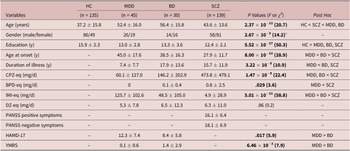
The subjects consisted of 45 patients with MDD (26 males/19 females; mean age ± SD: 52.4 ± 16.0 years), 30 patients with BD [14 bipolar I disorder (BD-I)/16 bipolar II disorder (BD-II); 14 males/16 females; 56.4 ± 15.8 years], 139 patients with SCZ (58 males/81 females; 43.6 ± 13.6 years), and 135 HCs (86 males/49 females; 37.2 ± 15.8 years). All subjects were of Japanese descent. The patients were recruited from both the outpatient and inpatient populations at Kanazawa Medical University Hospital, Kahoku, Japan. The patients with SCZ and HCs were recruited from the Schizophrenia Non-Affected Relative Project (SNARP).Reference Ohi, Shimada and Kataoka21, Reference Kataoka, Shimada and Koide29 Patients with MDD and BD were recruited to compare with the patients with SCZ and HCs as a part of the SNARP. All patients with SCZ (n = 125) and HCs (n = 107) who participated in a previous studyReference Ohi, Shimada and Kataoka21 were included in the current study. Each patient was diagnosed by at least two trained psychiatrists based on unstructured clinical interviews, medical records, and clinical conferences.Reference Ohi, Matsuda and Shimada30-Reference Ohi, Shimada and Kuwata34 The patients were diagnosed according to the criteria in the fifth edition of the Diagnostic and Statistical Manual of Mental Disorders (DSM-5). HCs were recruited through local advertisements and from among hospital staff at Kanazawa Medical University, and were also evaluated using the nonpatient version of the Structured Clinical Interview for DSM-IV (SCID) to exclude individuals who had current or past contact with psychiatric services, who had received psychiatric medication, or who had a family history of any neuropsychiatric diseases among second-degree relatives. Subjects were excluded from the analysis if they had neurological or medical conditions that could affect the central nervous system.Reference Ohi, Shimada and Kataoka21 Chlorpromazine equivalents of total antipsychotics (CPZ-eq), biperiden equivalents of total antiparkinsonian drugs (BPD-eq), imipramine equivalents of total antidepressants (IMI-eq), and diazepam equivalents (DZ-eq) were calculated based on a previous study.Reference Inada and Inagaki35 Current clinical symptoms were evaluated using the Positive and Negative Syndrome Scale (PANSS),Reference Kay, Fiszbein and Opler36 the 17-item Hamilton Rating Scale for Depression (HAMD-17),Reference Hamilton37 and the Young Mania Rating Scale (YMRS).Reference Young, Biggs and Ziegler38 The demographic variables among the four groups are summarized in Table 1. Written informed consent was obtained from all participants after the procedures had been thoroughly explained. This study was performed in accordance with the Declaration of Helsinki from the World Medical Association and was approved by the Research Ethical Committees of Gifu University and Kanazawa Medical University.
Demographic Variables Across Patients with MDD, BD, and SCZ, and HCs

Notes: P values of <.05 are shown in boldface, and post hoc indicates the post hoc comparisons that were performed. Means ± SD are shown.
Abbreviations: BD, bipolar disorder; BPD-eq, biperiden equivalents of total antiparkinsonian drugs; CPZ-eq, chlorpromazine equivalents of total antipsychotics; DZ-eq, diazepam equivalents; HAMD-17, 17-item Hamilton Rating Scale for Depression; HC, healthy control; IMI-eq, imipramine equivalents of total antidepressants; MDD, major depressive disorder; PANSS, Positive and Negative Syndrome Scale; SCZ, schizophrenia; YMRS, Young Mania Rating Scale.
a χ 2 test.
Premorbid IQ, present IQ, and intelligence decline
The NART, in which subjects have to read and pronounce 50 words, was developed to estimate premorbid IQ, because word reading ability is relatively intact in psychiatric disorders,Reference Crawford, Besson and Parker20, Reference Dalby and Williams39 and it has been validated in patients with MDD, BD, and SCZ.Reference Badcock, Dragovic and Waters12, Reference Crawford, Besson and Parker20, Reference Amminger, Edwards and Brewer40-Reference Schoeyen, Melle and Sundet42 The Japanese version of the NART (JART)Reference Matsuoka, Uno and Kasai43 has been widely used to estimate premorbid IQ in Japanese-speaking patients.Reference Ohi, Shimada and Kataoka21, Reference Ohi, Shimada and Kihara32, Reference Ohi, Shimada and Nitta44-Reference Ohi, Hashimoto and Ikeda49 Thus, JART was administered to measure premorbid IQ in our participants. In contrast, the full-scale IQ in the Japanese version of the WAIS-III was measured to measure present IQ.Reference Ohi, Sumiyoshi and Fujino16, Reference Ohi, Shimada and Kataoka21, Reference Fujino, Sumiyoshi and Yasuda28, Reference Wechsler50, Reference Sumiyoshi, Fujino and Sumiyoshi51 The participants were assessed by trained psychologists to obtain the full-scale IQ on the WAIS-III. The premorbid and present IQ were corrected for the covariates of age and gender by applying linear regression to the overall group and taking the unstandardized residuals of the IQ, although the present IQ score had already been corrected for age. For each participant, the unstandardized residual was added to the intercept + beta i × mean i , where i represents the different covariates. Thus, we used age- and gender-corrected premorbid and present IQ in the current study. Intelligence decline was estimated by subtracting the age- and gender-corrected estimated premorbid IQ from the age- and gender-corrected present IQ.Reference Badcock, Dragovic and Waters12, Reference Ohi, Sumiyoshi and Fujino16, Reference Ohi, Shimada and Kataoka21, Reference Hashimoto, Ikeda and Ohi27, Reference Fujino, Sumiyoshi and Yasuda28, Reference Sumiyoshi, Fujino and Sumiyoshi51
Statistical analyses
All statistical analyses were performed using IBM SPSS Statistics 24.0 software (IBM Japan, Tokyo, Japan). Differences in continuous variables, such as age and years of education, across diagnostic groups were analyzed using analysis of variance (ANOVA). Differences in categorical variables, such as gender, were analyzed using Pearson’s χ 2 test. The effects of diagnostic status on premorbid IQ, present IQ, or intelligence decline were analyzed using ANOVA with premorbid IQ, present IQ, or intelligence decline as a dependent variable, and diagnostic status (MDD, BD, SCZ, and HC) as an independent variable. Post hoc tests with Fisher’s least significant difference test were used to evaluate significant differences across groups. The intelligence decline between premorbid and present IQ in each diagnostic group was assessed using a paired t-test. Standardized effects were calculated using Cohen’s d method (https://lbecker.uccs.edu/). Correlations between intelligence declines and clinical characteristics were assessed using Pearson’s r coefficient. The significance level was set at a two-tailed P < .025 (α = 0.05/2; premorbid and present IQ) to control for type I error.
Results
Differences in premorbid IQ and present IQ across patients with MDD, BD, and SCZ, and HCs
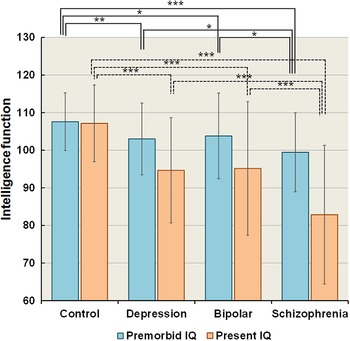
First, diagnostic differences in premorbid IQ and present IQ were investigated across patients with MDD, BD, and SCZ, and HCs. We found a significant difference in premorbid IQ across the four diagnostic groups (Figure 1; F3,345 = 17.0, P = 2.70 × 10⁻¹⁰). Post hoc analyses showed that patients with each psychiatric disorder had lower premorbid IQ than HCs (MDD: Cohen’s d = −0.53, P = 5.23 × 10⁻³; BD: d = −0.39, P = .048; SCZ: d = −0.89, P = 6.20 × 10⁻¹²). Furthermore, the patients with SCZ had lower premorbid IQ than the patients with MDD (d = −0.36, P = .029) and BD (d = −0.40, P = .023). We also found a significant difference in present IQ across the diagnostic groups (Figure 1; F3,345 = 59.0, P = 8.21 × 10⁻³¹). Post hoc analyses showed that patients with each psychiatric disorder had lower present IQ than HCs (MDD: d = −1.02, P = 2.36 × 10⁻⁶; BD: d = −0.83, P = 1.02 × 10⁻⁴; SCZ: d = −1.63, P = 6.96 × 10⁻³³). In addition, the patients with SCZ had lower present IQ than the patients with MDD (d = −0.72, P = 7.27 × 10⁻⁶) and BD (d = −0.68, P = 6.52 × 10⁻⁵). There were no significant differences in premorbid IQ or present IQ between the patients with MDD and the patients with BD (P > .05).
Estimated premorbid IQ and present IQ across patients with major depressive disorder, bipolar disorder, and schizophrenia, and healthy control subjects. Estimated premorbid IQ and present IQ scores were corrected by age and gender. Error bars represent the standard deviation. * Post hoc P < .05. ** P < .01. *** P < .001.

Differences in intelligence decline across patients with MDD, BD, and SCZ, and HCs
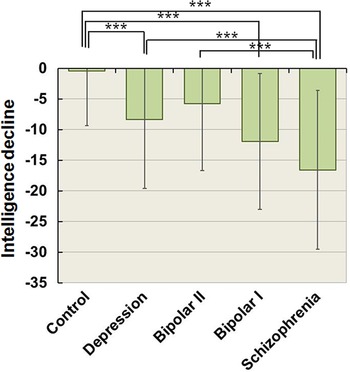
We found that patients with each psychiatric disorder showed a significant intelligence decline and a decrease in present IQ from the premorbid level (MDD: t = −5.0, P = 1.00 × 10⁻⁵; BD: t = −4.2, P = 2.28 × 10⁻⁴; SCZ: t = −15.1, P = 5.90 × 10⁻³¹). In contrast, there was no significant intelligence decline between premorbid and present IQ in HCs (P > .05). Next, diagnostic differences in the degree of intelligence decline were investigated across patients with MDD, BD, and SCZ, and HCs. We found a significant difference in intelligence decline across the four diagnostic groups (F3,345 = 47.6, P = 9.13 × 10⁻²⁶). Post hoc analyses showed that patients with each psychiatric disorder had significant intelligence decline compared with HCs (MDD: d = −0.78, P = 4.99 × 10⁻⁵; BD: d = −0.81, P = 3.22 × 10⁻⁴; SCZ: d = −1.45, P = 8.97 × 10⁻²⁸). Furthermore, the patients with SCZ had significant intelligence decline compared with the patients with MDD (d = −0.68, P = 2.27 × 10⁻⁵) and BD (d = −0.65, P = 4.73 × 10⁻⁴), while there was no difference in intelligence decline between the patients with MDD and the patients with BD (d = 0.03, P = .91).
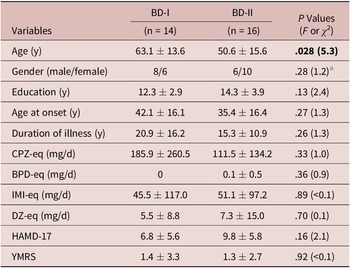
Although the sample size in patients with BD was relatively small, the patients were divided into patients with BD-I (n = 14) and BD-II (n = 16). There were no significant differences in clinical characteristics between the patients with BD-I and those with BD-II (P > .05), except for age (P = .028; Table 2). We investigated differences in intelligence decline across patients with MDD, BD-I, BD-II, and SCZ, and HCs. We also found a significant difference in intelligence decline across the five diagnostic groups (Figure 2; F4,344 = 36.4, P = 2.21 × 10⁻²¹). Compared with HCs, the patients with BD-I had a significant intelligence decline (d = −1.14, P = 2.78 × 10⁻⁴), and the patients with BD-II showed a marginal intelligence decline (d = −0.53, P = .07). Furthermore, the patients with SCZ had significant intelligence decline compared with the patients with BD-II (d = −0.90, P = 2.71 × 10⁻⁴), while there was no difference in intelligence decline between the patients with BD-I and those with SCZ (d = −0.38, P = .14). In addition, there was no difference in intelligence decline between the patients with MDD and those with BD-II (d = −0.23, P = .13).
Demographic Information for Patients with BD-I and BD-II

Notes: P values of <.05 are shown in boldface. Means ± SD are shown.
Abbreviations: BD-I, bipolar I disorder; BD-II, bipolar II disorder; BPD-eq, biperiden equivalents of total antiparkinsonian drugs; CPZ-eq, chlorpromazine equivalents of total antipsychotics; DZ-eq, diazepam equivalents; HAMD-17, 17-item Hamilton Rating Scale for Depression; IMI-eq, imipramine equivalents of total antidepressants; YMRS, Young Mania Rating Scale.
a χ 2 test.
Differences in intelligence decline across patients with major depressive disorder, bipolar II disorder, bipolar I disorder, and schizophrenia, and healthy control subjects. Error bars represent the standard deviation. *** Post hoc P < .001.

Correlations between intelligence decline and clinical variables in patients with MDD, BD, and SCZ
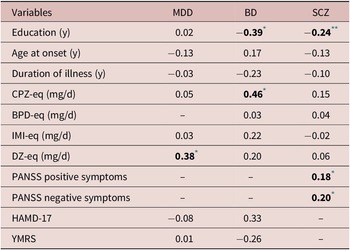
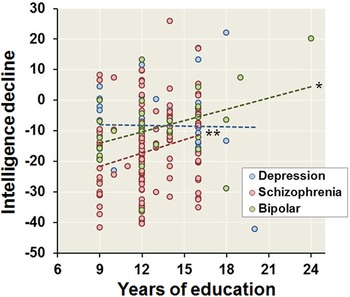
We investigated whether the intelligence declines were affected by clinical variables in patients with MDD, BD, and SCZ (Table 3). Fewer years of education were correlated with greater intelligence decline in the patients with BD (r = −0.39, P = .035) and those with SCZ (r = −0.24, P = 4.48 × 10⁻³), but not in patients with MDD (r = 0.02, P = .90; Figure 3). Patients with younger age at onset may drop out from schools and have shorter years of education. However, further partial correlation analysis showed that these correlations were still significant or marginally significant after adjusting for age at onset in patients with SCZ (adjusted r = −0.26, P = 2.41 × 10⁻³) and BD (adjusted r = −0.35, P = .060), respectively.
Correlations of Intelligence Decline with Clinical Variables in Patients with MDD, BD, or SCZ

Notes: Pearson’s r is shown. P values of <.05 are shown in boldface.
Abbreviations: BPD-eq, biperiden equivalents of total antiparkinsonian drugs; CPZ-eq, chlorpromazine equivalents of total antipsychotics; DZ-eq, diazepam equivalents; HAMD-17, 17-item Hamilton Rating Scale for Depression; IMI-eq, imipramine equivalents of total antidepressants; PANSS, Positive and Negative Syndrome Scale; YMRS, Young Mania Rating Scale.
* P < .05.
** P < .01.
Correlations between intelligence decline and years of education in patients with major depressive disorder, bipolar disorder, and schizophrenia. * P < .05. ** P < .01.

Of the other clinical variables, higher CPZ-eq levels (mg/d) were correlated with greater intelligence declines in the patients with BD (r = 0.46, P = .010) and higher DZ-eq levels (mg/d) were correlated with greater intelligence declines in the patients with MDD (r = 0.38, P = .011), while more severe psychiatric symptoms were correlated with greater intelligence declines in the patients with SCZ (positive symptoms: r = 0.18, P = .037; negative symptoms: r = 0.20, P = .021). There were no significant correlations between intelligence declines and other clinical variables in the patients with MDD, BD, or SCZ (Table 3; P > .05).
Discussion
Here, we expanded on a previous study that investigated intelligence decline among patients with SCZ, their first-degree relatives, and HCsReference Ohi, Shimada and Kataoka21 by including individuals with MDD and BD along with additional samples of individuals with SCZ and HCs, because studies of the intelligence decline associated with psychiatric disorders other than SCZ have been limited and inconclusive. Thus, this study is the first to investigate premorbid IQ, present IQ, and intelligence decline across patients with MDD, BD, and SCZ, and HCs, and to examine which clinical factors affect intelligence decline in each diagnostic group. Premorbid IQ and present IQ were lower and intelligence decline was greater in the patients with MDD, BD, and SCZ than in the HCs. The effect size for the differences in present IQ between HCs and each psychiatric disorder was approximately double compared with the effect size for the differences in premorbid IQ. Furthermore, premorbid IQ and present IQ were lower and intelligence decline was greater in the patients with SCZ than in the patients with MDD and BD. There were no significant differences in premorbid IQ, present IQ, or intelligence decline between the patients with MDD and those with BD. On the other hand, when the euthymic patients with BD were divided into BD-I and BD-II, the extent and severity of the intelligence declines were similar between MDD and BD-II and between BD-I and SCZ. Greater levels of intelligence decline were affected by fewer years of education in those with SCZ and BD, but not in those with MDD.
There is large degree of heterogeneity in cognitive function among psychiatric disorders. The proportion of individuals who do not actually show cognitive impairment in each psychiatric disorder is unclear. According to previous studies,Reference Ohi, Sumiyoshi and Fujino16, Reference Ohi, Shimada and Kataoka21 based on the degree of intelligence decline, our patients were classified into two groups: (i) preserved IQ with a less than 10-point difference between premorbid and present IQ and premorbid IQ score > 90, and (ii) deteriorated IQ with a ≥10-point decrease in present IQ relative to premorbid levels. Then, we compared the proportion of individuals in deteriorated and preserved IQ groups across psychiatric disorders. The number of patients with a deteriorated IQ in the MDD (54.5%) and BD (51.7%) groups was significantly lower than that in the SCZ (71.1%) group (χ 2 = 6.6, P = .037). Consistent with previous studies,Reference Solé, Jiménez and Torrent4, Reference Ohi, Sumiyoshi and Fujino16, Reference Ohi, Shimada and Kataoka21, Reference Pu, Noda and Setoyama52 approximately 50% of patients with MDD and BD and 30% of patients with SCZ belonged to the preserved IQ group, that is, cognitively intact. These distinct subtypes of intelligence decline in each psychiatric disorder may be reflected by different courses of neurodevelopmental abnormalities and may be associated with different prognoses. These findings suggest that although patients with MDD, BD, and SCZ display a significant intelligence decline, the severity of intelligence decline was different across psychiatric disorders. On the other hand, not all patients displayed a decline in intelligence in each psychiatric disorder.
Intelligence declines are stable over time after the onset of SCZ.Reference Ohi, Shimada and Kataoka21 Cognitive impairment in patients with SCZ appears earlier and tends to be more independent of clinical symptoms than in patients with MDD and BD.Reference Keefe and Fenton1 However, it is unclear whether intelligence decline is stable over time after the onset of MDD and BD. We indicated that the degree of intelligence decline was not correlated with the duration of illness or age at onset in any psychiatric disorder, suggesting that intelligence decline may be stable over time after the onset of SCZ as well as MDD and BD, although the decline was marginally correlated with some clinical symptoms and medications. Further studies with more frequent assessment of IQ through the premorbid, prodromal, early, and chronic phases of illnesses are required to identify the key period for the decline in each psychiatric disorder.
As shown in this study, intelligence function was impaired in patients with MDD. However, impaired IQ is not considered a primary disturbance but rather the result of impairments in memory, psychomotor skills, and/or attention.Reference Marazziti, Consoli and Picchetti3 We cannot verify this hypothesis, since we did not examine cognitive functions other than IQ. In contrast, present IQ and the intelligence decline were at least not affected by current symptoms or medications in our MDD patients (P > .05). Furthermore, cognitive impairments in patients with MDD were shown to be caused by shared genetic factors related to impaired IQ and the risk of MDD.Reference Ohi, Sumiyoshi and Fujino53-Reference Savage, Jansen and Stringer58 Genetic factors related to impaired IQ more strongly contribute to the risk of SCZ and less strongly contribute to the risk of BD compared to the relationship observed with MDD.Reference Ohi, Sumiyoshi and Fujino53-Reference Savage, Jansen and Stringer58 Considering that the degree of intelligence decline was similar between MDD and BD-II and between BD-I and SCZ, our findings support the evidence that BD-I is strongly and genetically correlated with SCZ, whereas BD-II is more strongly correlated with MDDReference Stahl, Breen and Forstner59 and suggest that the genetic factors related to impaired IQ would be strongly correlated with the risk of BD-I compared with the risk of BD-II.
Consistent with previous studies,Reference Solé, Jiménez and Torrent4, Reference Ohi, Shimada and Kataoka21, Reference Hinrichs, Easter and Angers60, Reference Bhalla, Butters and Zmuda61 a greater degree of intelligence decline was affected by fewer years of education in those with SCZ and BD, while the degree of intelligence decline was not affected by years of education in those with MDD. Higher educational attainment is one of predictors for symptomatic remission.Reference Conus, Cotton and Francey62 The reason why we did not detect the correlation between intelligence decline and educational attainment in the patients with MDD might be that higher educational attainment in those with BD and SCZ contributed to protection against intelligence decline as CR, while the effect of educational attainment on the decline was heterogeneous in MDD. Higher educational attainment in some MDD patients might have contributed to the decline via higher self-stigma and self-esteem, while higher educational attainment in other MDD patients might have contributed to resilience, for example, through lower self-stigma.Reference Brohan, Gauci and Sartorius63 Therefore, it appears that the moderating effect of education on intelligence decline may generalize to patients with BD and SCZ but not generalize to patients with MDD. As the degree of intelligence decline is expected on the basis of educational attainment, educational attainment could be a meaningful indicator for functional outcomes in patients with psychiatric disorders. We suggest that higher educational attainment may be protective in SCZ and BD patients and a portion of MDD patients, probably by increasing active CR.
There was no significant correlation between intelligence declines and BPD-eq in patients with SCZ. However, as previous studies have repeatedly showed the negative effects of antiparkinsonian drugs on cognitive functions,Reference Drimer, Shahal and Barak64 we explored the difference in intelligence declines between SCZ patients with antiparkinsonian drugs (n = 28, BPD-eq ± SD: 3.9 ± 4.2 mg/day, range: 0.5-23.0) and those without the drugs (n = 111, 0 mg/day). We did not find significant difference in our patients (P > .05). The reason why we did not detect the difference might be due to low dose and/or high SD of antiparkinsonian drugs.
There are some limitations to the interpretations of our findings. Compared with the sample sizes of the groups of patients with SCZ and HCs, those of the groups of patients with MDD and BD were relatively small, potentially resulting in false positive and negative findings. In particular, further study using larger BD-I and BD-II samples is required to confirm the difference in intelligence decline between BD-I and BD-II patients. As we mentioned in a previous study,Reference Ohi, Shimada and Kataoka21 the mean scores in premorbid IQ among HCs were above the standard mean score for IQ (100). The mean premorbid IQ scores among patients with psychiatric disorders were almost exactly 100. The higher IQ of the HCs may be reflective of the higher educational attainment among our hospital staff. Patients with higher educational attainment usually visit university hospitals to receive advanced medical treatments. Therefore, most of our participants might have had higher educational attainment than the general population.
These findings indicate that although all psychiatric disorders display intelligence decline, the severity of intelligence decline is different across psychiatric disorders (SCZ, BD-I > BD-II, MDD > HCs). Higher educational attainment in those with BD or SCZ contributed to protection against intelligence decline as CR, while the effect of educational attainment on the decline was heterogeneous in those with MDD. As current treatment strategies, including cognitive remediation and psychopharmacology, largely fail to ameliorate impaired IQ in patients with psychiatric disorders,Reference Keefe, Buchanan and Marder65 a better understanding of the pathogenesis underlying intelligence decline is required to develop more efficient prevention and treatment strategies for IQ impairments.
Acknowledgments
This work was supported by Grants-in-Aid for Scientific Research (C; 19K08081), Young Scientists (B; 16K19784), and Young Scientists (20K16624) from the Japan Society for the Promotion of Science (JSPS); a grant from the Uehara Memorial Foundation; a grant from the Takeda Science Foundation; a grant from the YOKOYAMA Foundation for Clinical Pharmacology (YRY-1807); a grant from the Smoking Research Foundation; and a grant from the SENSHIN Medical Research Foundation. We would like to thank all individuals who participated in this study.
Disclosures
Kazutaka Ohi, Kentaro Takai, Shunsuke Sugiyama, Hiromi Kitagawa, Yuzuru Kataoka, Midori Soda, Kiyoyuki Kitaichi, Yasuhiro Kawasaki, Munechika Ito, and Toshiki Shioiri declare that they have no competing interest.