Introduction
The relevance of intact cognition for everyday life functioning and well-being is crucial (e.g. Ihle et al., Reference Ihle, Schnitzspahn, Rendell, Luong and Kliegel2012; Reference Ihle2015b). Thus, one of the fundamental challenges for gerontological research is to identify and understand the predictors of how interindividual differences in cognitive resources and in vulnerability to cognitive decline emerge (Orrell and Sahakian, Reference Orrell and Sahakian1995; Hultsch et al., Reference Hultsch, Hertzog, Small and Dixon1999). To address this issue, the cognitive reserve concept (e.g. Stern, Reference Stern2002; Tucker and Stern, Reference Tucker and Stern2011) postulates that innate cognitive resources together with cognitive activity during brain maturation in childhood (e.g. via education) build up a buffer against cognitive decline in old age. Evidence for such an initial cognitive reserve effect comes from studies showing that higher educational attainment is associated with higher performance in multiple cognitive domains in old age (e.g. Gatz et al., Reference Gatz, Svedberg, Pedersen, Mortimer, Berg and Johansson2001; McDowell et al., Reference McDowell, Xi, Lindsay and Tierney2007). According to the disuse hypothesis (e.g. Orrell and Sahakian, Reference Orrell and Sahakian1995; Hultsch et al., Reference Hultsch, Hertzog, Small and Dixon1999), a cognitively engaged lifestyle during adulthood preserves and possibly even increases cognitive functioning while less use of personal intellectual resources would decrease the buffer against cognitive impairment. This hypothesis is supported by findings that across the adult lifespan, mental activities (e.g. taking courses, learning new languages), or cognitively stimulating leisure activities (e.g. go to the theater) are related to better cognitive functioning in later life (e.g. Hultsch et al., Reference Hultsch, Hammer and Small1993; Reference Hultsch, Hertzog, Small and Dixon1999; Schooler and Mulatu, Reference Schooler and Mulatu2001). Moreover, there is growing evidence to suggest that physical activity and social engagement may also be beneficial for cognitive performance in middle-aged and older adults (e.g. Karp et al., Reference Karp, Paillard-Borg, Wang, Silverstein, Winblad and Fratiglioni2006; Ihle et al., Reference Ihle, Oris, Fagot, Baeriswyl, Guichard and Kliegel2015a; see Hertzog et al., Reference Hertzog, Kramer, Wilson and Lindenberger2008, for a review on such enrichment effects in adulthood). Besides education and leisure activities, evidence has been reported that a high cognitive level of one's occupation leads to further enrichment effects and thereby makes a further contribution to cognitive reserve throughout a person's lifetime and is related to better cognitive functioning in old age (Stern et al., Reference Stern1995; Schooler et al., Reference Schooler, Mulatu and Oates1999).
In the context of these models, a recently raised appealing question concerns the interplay of such cognitively engaged lifestyle–cognition relations with other individual difference characteristics such as certain personality dimensions. The present paper will focus on the personality dimension openness to experience, which reflects (among others) the degree of intellectual curiosity, creativity, and preference for variety (McCrae and Costa, Reference McCrae, Costa, Pervin and John1999). Interestingly, engaging in stimulating leisure activities has for example been found to be greater in individuals with high openness to experience (e.g. Hultsch et al., Reference Hultsch, Hertzog, Small and Dixon1999; Soubelet and Salthouse, Reference Soubelet and Salthouse2010). Moreover, several studies provided evidence for the link of high openness to experience with better cognitive functioning (e.g. Wainwright et al., Reference Wainwright, Wright, Luciano, Geffen and Martin2008; Williams et al., Reference Williams, Suchy and Kraybill2013; DeYoung et al., Reference DeYoung, Quilty, Peterson and Gray2014). To explain those findings, it has been suggested that individuals with a high level of openness to experience more frequently and/or more intensively engage in stimulating activities that provide learning opportunities and that this engagement improves cognitive ability levels (e.g. Chamorro-Premuzic and Furnham, Reference Chamorro-Premuzic and Furnham2004). Soubelet and Salthouse (Reference Soubelet and Salthouse2010), as to our knowledge the only study so far, tested these predictions with cross-sectional data in a sample of 2,257 adults (ranging from 18 to 96 years of age). Yet, they could not provide evidence that greater engagement in cognitively stimulating activities mediates the relation of openness to experience with cognitive functioning. In addition, they observed only weak relations between activity engagement and cognitive performance. However, Soubelet and Salthouse (Reference Soubelet and Salthouse2010) concentrated only on current engagement in activities (i.e. referring to a “typical week”). Thus, it is possible that the time difference between the reported activity engagement and the assessed cognitive functioning may have been too short to allow the development of a link between the two through affecting cognitive reserve, at least with respect to interindividual differences. It would therefore be of particular interest to investigate the role of multiple markers of cognitive reserve such as education, occupation, and leisure activities with a focus on much earlier stages in individuals’ life courses, which will be explicitly targeted in the present work.
An alternative possibility is that the interplay of engaging in cognitively stimulating activities, cognitive functioning, and openness to experience constitutes a different mechanism. For example, it is possible that not the amount of time per se spent for the respective activity has an effect but instead that this is done with sufficient cognitive elaborateness to evoke the necessary cognitive stimulation. Assuming that particularly individuals with high openness to experience devote themselves to such cognitive elaborateness when engaging in stimulating activities, this may result in the pattern that the enrichment effects on cognitive functioning may only (or more strongly) become evident in this group (i.e. moderation effect).
Taken together, the pattern of the potential interplay of a cognitively engaged lifestyle with personality dimensions such as openness to experience in their relations to cognitive functioning remains unclear so far. Therefore, the present study aimed to extend the literature by investigating the interplay of engaging in cognitively stimulating activities (i.e. educational attainment, cognitive level of one's occupation, and leisure activities), openness to experience, and cognitive performance in a large sample of older adults in more detail. Specifically, our goal was to examine whether a greater engagement in cognitively stimulating activities throughout adulthood mediates the relation between openness to experience and cognitive functioning in old age. A further goal was to evaluate alternative mechanisms in terms of a moderation testing for interactive (i.e. dependent) effects of cognitive engagement and openness to experience. An explicit focus was to investigate the role of multiple markers of cognitive reserve that have been frequently used in the literature such as education, occupation, and leisure activities, with an emphasis on early and middle stages in individuals’ life courses.
Methods
Participants
Data come from the Vivre-Leben-Vivere (VLV) survey, an ongoing project on vulnerability started in Switzerland in 2011. The main sample of 3,080 participants who completed the research protocol was randomly selected in the cantonal and federal Swiss administrations’ records and stratified by age (65–69 years, 70–74 years, 75–79 years, 80–84 years, 85–89 years, and 90+ years), sex, and canton (Bale, Berne, Geneva, Ticino, and Valais). Of them, 2,812 cognitively healthy participants performed a test on verbal abilities (see below for further task descriptions) and served as sample for the present study. Two thousand and seventy three performed a psychometric test on processing speed (see Statistical analyses section for further details). Mean age of the analyzed sample was 77.9 years (SD = 8.2, range 65–101).
Materials
Cognitive performance
Verbal abilities
We administered the Mill Hill vocabulary scale (Deltour, Reference Deltour1993) measuring verbal abilities. For each item, participants had to underline the word (which was intermixed with five distractor words) that semantically matched the target word. After one practice item, participants had to complete ten items. The verbal abilities score was the proportion of correctly completed items.
Processing speed
We assessed the Trail Making Test part A (Reitan, Reference Reitan1958) measuring processing speed. After seven exercise trails, participants had to connect the numbers from 1 to 25 as fast as possible and without error in ascending order. The processing speed score was the time in seconds needed to connect the 25 numbers.
Educational attainment
Participants were asked to indicate their highest educational level attained by choosing one of the following six levels: (1) primary school level; (2) inferior secondary school level; (3) apprenticeship graduation; (4) superior secondary school level; (5) technical college or superior vocational college degree; or (6) university degree. For analyses, we distinguished the sample into three groups of low versus mid versus high educational attainment according to the categories of low education, leading mainly to unskilled work (i.e. levels 1 and 2) versus vocational education, leading mainly to manual work (i.e. level 3) versus higher (advanced) education, typically leading to intellectual work (i.e. levels 4, 5, and 6; see Gabriel et al., in press).
Cognitive level of job
Participants were asked to indicate the different professions they had practiced in adulthood, which we thereafter rated on a four-point scale adopted from Nucci et al. (Reference Nucci, Mapelli and Mondini2012), dealing with the degree of intellectual involvement and personal responsibility: (1) unskilled manual/non-manual work (e.g. farmer, car driver, call center operator); (2) skilled manual work (e.g. craftsman, clerk, hairdresser); (3) skilled non-manual or technical work (e.g. trader, kindergarten teacher, real estate agent); or (4) highly intellectual work (e.g. lawyer, physician, university professor, top manager). Cognitive level of job was recorded regarding the first profession practiced after education as well as regarding the last profession practiced before retirement.
Leisure activities
Participants were retrospectively interviewed regarding the following 18 leisure activities (that had been a priori selected with respect to different life domains such as mental activities, physical activities, or social activities comprising a large variety of leisure activities; see e.g. Karp et al., Reference Karp, Paillard-Borg, Wang, Silverstein, Winblad and Fratiglioni2006, for similar lists): (1) go for a walk; (2) gardening; (3) gymnastics or other physical exercises; (4) other sports; (5) go into a cafe, restaurant, etc.; (6) go to the cinema, theater, etc.; (7) excursions of 1 or 2 days; (8) journeys of at least 3 days; (9) play a musical instrument; (10) other artistic activities; (11) take courses, go to conferences, etc.; (12) party games (cards, scrabble, etc.); (13) crossword puzzles, Sudoku, etc.; (14) needlework (knit, dressmaking, etc.); (15) handicrafts, repair, carpentry, pottery, etc.; (16) participation in political or labor union activities; (17) participation in municipality or district activities; and (18) participation in sporting events (e.g. visit a football match, etc.). For each of these 18 activities, participants reported whether the respective activity had been carried out at age 45. Those activities were summed up for each individual to derive the overall number of leisure activities.
Openness to experience
As an indicator for the personality dimension openness to experience, we used the respective two items from a 10-item short version of the Big Five Inventory (Rammstedt and John, Reference Rammstedt and John2007). Regarding openness to experience, participants rated the statements “I see myself as someone who has few artistic interests” and “. . . has an active imagination” using a five-point Likert scale ranging from 1 (“strongly disagree”) to 5 (“strongly agree”). For analyses, the two item scores were averaged (item 1 was reversed before).
Procedure
A face-to-face questionnaire was administered using the CAPI (Computer-Assisted Personal Interview) method. This session contained (besides a larger set of other questionnaires) a socio-demographic survey, the items regarding occupation, leisure activities, and openness to experience as well as the paper–pencil assessment of the cognitive measures. Participants were individually tested. The experimenter always assured that the participant fully understood and followed the instructions.
Statistical analyses
The following analyses were run: First, we inspected relations between educational attainment, cognitive level of job, the number of leisure activities, openness to experience, and cognitive performance (by calculating Spearman's ρ for relations with educational attainment and Pearson's correlation coefficients r for relations between the other variables).
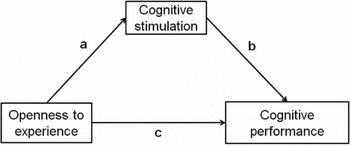
Second, we investigated whether the effect of openness to experience on cognitive performance was mediated via educational attainment/cognitive level of job/the number of leisure activities. For these mediation analyses, we used a path model approach, with an individual mediation model for each mediator. These models contained three paths (see Figure 1 for an illustration): path a, educational attainment/cognitive level of first/last job/the number of leisure activities regressed on openness to experience; path b, the respective cognitive performance measure regressed on educational attainment/cognitive level of first/last job/the number of leisure activities; and path c, the respective cognitive performance measure regressed on openness to experience. Importantly for evaluating mediation, the applied path model approach allowed simultaneously estimating the direct effect of openness to experience on the respective cognitive performance measure (i.e. the coefficient of path c) and the indirect (i.e. mediation) effect via the respective stimulating activity (i.e. the product of the coefficients for paths a and b), including their significance. The proportion of the size of the mediation effect and the total effect (i.e. the sum of the mediation and the direct effect) allowed quantifying the portion of the effect of openness to experience on cognitive functioning that is exerted indirectly via the respective mediator.
General structure of the path models applied to investigate whether the effect of openness to experience on cognitive performance in old age was mediated through engaging in cognitive stimulation in early and middle adulthood. These models allowed simultaneously estimating the direct effect of openness to experience on the respective cognitive performance measure (c) and the indirect (i.e. mediation) effect through educational attainment/cognitive level of first/last job/the number of leisure activities (a*b).

Third, we evaluated a set of alternative mechanisms. Thereby, we tested whether effects of educational attainment/cognitive level of job/the number of leisure activities on cognitive performance were mediated via openness to experience and whether effects of educational attainment/cognitive level of job/the number of leisure activities on openness to experience were mediated via cognitive performance.
In addition, using moderation analyses, we examined whether effects of educational attainment, cognitive level of job, and the number of leisure activities on cognitive performance interacted with openness to experience. For these latter moderation analyses, we applied an individual model for each stimulating activity/cognitive performance measure. Specifically, educational attainment/cognitive level of first/last job/the number of leisure activities as well as openness to experience were entered as predictors of the respective cognitive performance measure. In addition, an interaction term of the two predictors was specified to investigate whether the effect of one predictor varied as a function of the other one (i.e. indicating a moderation effect).
For all analyses, to achieve that higher values represented better performance across all variables (as common in correlative studies), the distribution of processing speed scores of all participants was reversed based on the sample mean so that interindividual differences remained identical. We calculated relations with processing speed based on 2,073 participants and all other relations based on 2,812 participants. Note that in the extensive survey procedure, we had administered the cognitive tests only if there was enough time left (allowing a proper administration of the verbal abilities test in 2,812 participants). Note that we had administered the processing speed test only if the participant had properly performed all seven exercise trails. Furthermore, we terminated the processing speed test (without any score) when the individual made any error in connecting the 25 numbers (allowing a proper administration of the processing speed test in 2,073 participants). Note that we applied these restrictive criteria to be able to directly compare reaction times (i.e. reaction times would be confounded when including participants that made errors and took additional time to correct them). Due to these restrictive criteria, the remaining sample was slightly younger, better educated, healthier, and contained a larger proportion of men, compared to the main sample (ps < 0.044). All analyses were performed with R (version 3.0.3; R Core Team, 2014).
Results
Descriptive statistics
Mean performance in verbal abilities was 59.4 percent correct (SD = 25.7). Mean performance in processing speed was 66.20 seconds (SD = 30.61). Mean rating regarding the cognitive level of job was 2.59 (SD = 0.94) for the first profession and 2.99 (SD = 0.99) for the last profession practiced. Mean number of leisure activities was 11.17 (SD = 2.96). Mean score in openness to experience was 3.55 (SD = 1.01).
Bivariate relations between measures
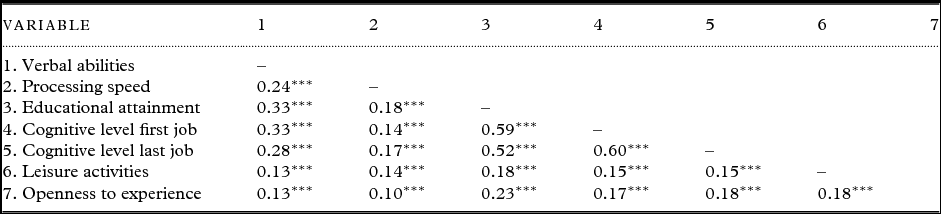
Higher educational attainment, higher cognitive level of job, higher number of leisure activities, and higher scores in openness to experience were significantly associated with better cognitive performance, in terms of verbal abilities and processing speed. Higher scores in openness to experience were significantly associated with higher educational attainment, higher cognitive level of job, and higher number of leisure activities (see Table 1 for the full correlation matrix).
Full correlation matrix of measures

***p < 0.001.
Mediation analyses
In the following step, to further elucidate the pattern of these relationships, we evaluated several mediational models. First, we applied a model in which the effect of openness to experience on cognitive performance was mediated via educational attainment. Results showed that 51.3% of the effect of openness to experience on verbal abilities was exerted indirectly via educational attainment (indirect effect size β = 0.07, p < 0.001). The same emerged for the effect on processing speed (35.0% exerted indirectly, β = 0.03, p < 0.001).
Second, we applied a model in which the effect of openness to experience on cognitive performance was mediated via cognitive level of both the first and the last job. Results showed that about one-third of the effect of openness to experience on verbal abilities was exerted indirectly via cognitive level of the first job (39.1% exerted indirectly, β = 0.05, p < 0.001). This was almost identical for the last job (36.3% exerted indirectly, β = 0.05, p < 0.001). Again, the same emerged for the effect on processing speed (first job: 20.8% exerted indirectly, β = 0.02, p < 0.001; last job: 26.9% exerted indirectly, β = 0.03, p < 0.001).
Third, we applied a model in which the effect of openness to experience on cognitive performance was mediated via the number of leisure activities. Results showed that a significant amount of the effect of openness to experience on verbal abilities was exerted indirectly via the number of leisure activities (15.0% exerted indirectly, β = 0.02, p < 0.001). Again, the same emerged for the effect on processing speed (22.0% exerted indirectly, β = 0.02, p < 0.001).
Evaluating alternative mechanisms
In the next step, to evaluate a set of alternative mechanisms, we analyzed whether effects of educational attainment/cognitive level of job/the number of leisure activities on cognitive performance were mediated via openness to experience and whether effects of educational attainment/cognitive level of job/the number of leisure activities on openness to experience were mediated via cognitive performance. Although those mediations were significant (all ps < 0.05), only 4% to 11% of the respective effect were exerted indirectly.
As a further set of alternative mechanisms, we analyzed whether effects of educational attainment, cognitive level of job, and the number of leisure activities on cognitive performance interacted with openness to experience (i.e. in terms of a moderation). Yet, there were no significant interactions of openness to experience neither with educational attainment (all ps > 0.185), nor with cognitive level of job (all ps > 0.300), nor with the number of leisure activities (all ps > 0.131).
Discussion
The present study set out to further explore the interplay of engaging in cognitively stimulating activities, openness to experience, and cognitive functioning in a large sample of older adults ranging from 65 to 101 years of age. In line with prior evidence (e.g. Schooler et al., Reference Schooler, Mulatu and Oates1999; Gatz et al., Reference Gatz, Svedberg, Pedersen, Mortimer, Berg and Johansson2001; Hertzog et al., Reference Hertzog, Kramer, Wilson and Lindenberger2008), we found that higher educational attainment, higher cognitive level of one's occupation, and greater engaging in a broad variety of leisure activities in middle adulthood were related to better cognitive functioning in old age. Consistent with the literature (e.g. Hultsch et al., Reference Hultsch, Hertzog, Small and Dixon1999; Soubelet and Salthouse, Reference Soubelet and Salthouse2010), we found that engaging in leisure activities was greater in individuals with high openness to experience. Those individuals also attained higher education and practiced jobs with higher cognitive demands. We also confirmed that individuals with higher openness to experience also showed better cognitive performance in old age (e.g. Williams et al., Reference Williams, Suchy and Kraybill2013; DeYoung et al., Reference DeYoung, Quilty, Peterson and Gray2014).
Extending this latter finding, we tested several possible models of the interplay across those variables and revealed that up to a half of the effect of openness to experience on cognitive functioning was mediated by educational attainment, cognitive level of job, and engaging in different leisure activities. To evaluate alternative mediational mechanisms, we analyzed whether effects of educational attainment/cognitive level of job/the number of leisure activities on cognitive performance were mediated via openness to experience and whether effects of educational attainment/cognitive level of job/the number of leisure activities on openness to experience were mediated via cognitive performance. Yet, such mediation effects were of rather small size and thus (compared to the larger proportion of the effect of openness to experience on cognitive functioning mediated via cognitively stimulating engagement discussed before) did not better explain the observed pattern of associations. Likewise, present data were not better explained by alternative moderation models testing for interactive (i.e. dependent) effects of openness to experience and cognitively stimulating engagement. Thus, in line with the investment view of Chamorro-Premuzic and Furnham (Reference Chamorro-Premuzic and Furnham2004), present results suggest that individuals with a high level of openness to experience may have been more frequently and/or with greater cognitive elaborateness engaged in stimulating activities. This possibly increased their cognitive reserve throughout early and middle adulthood and may finally enhance their cognitive ability level later in old age. This is also consistent with the perspective of Janzarik (Reference Janzarik2012) who emphasized that in the context of increasing cognitive reserve, central dispositions in individuals’ personality structure may determine the ability to successfully cope with challenges during the aging process such as cognitive decline. The present results suggest that the personality dimension openness to experience may play an important role in this framework. In this context, it has to be underlined that present data suggest that the contribution to cognitive functioning in old age may not be caused by openness to experience alone. Instead, the contribution of openness to experience to cognitive functioning in old age may (at least partly) become evident through an increased cognitively stimulating engagement during the life course.
In the context of the latter notions, we acknowledge that the present study is retrospective and limited by its cross-sectional design that does not allow for causal inferences. The directionality of observed relationships cannot be established with present cross-sectional data. Thus, we cannot clearly disentangle between individuals who decline because of reducing cognitive engagement and individuals who reduce cognitive engagement because of cognitive decline. Yet, for the observed associations of educational attainment in early life as well as working and leisure activities in middle adulthood with cognitive performance in old age, it is much less likely that they are driven by individuals who reduced cognitive engagement because of cognitive decline. More generally, analyses of the present study give only information about interindividual differences in cognitive status but do not allow drawing conclusions regarding cognitive decline (i.e. intraindividual changes over time), which needs to be evaluated with longitudinal data. This would be of particular importance to disentangle interindividual and intraindividual sources of variance to contribute to the ongoing debate of whether a longitudinal relation between engagement in activities and cognitive functioning is due to preserved differentiation (i.e. active individuals may have simply a higher initial cognitive ability level) or differential preservation (i.e. active individuals may show less cognitive decline over time; see e.g. Bielak et al., Reference Bielak, Cherbuin, Bunce and Anstey2014).
Another possible limitation could be related to the fact that we referred to the first and the last job of participants, for which we did not know whether they were those that had been practiced for the longest time in participant's life. Yet, the cognitive level of one's last job is seen as an appropriate marker of cognitive reserve (e.g. Nucci et al., Reference Nucci, Mapelli and Mondini2012). Given that (at least for the majority of workers and employees) cognitive level of one's occupation commonly increases during one's career, this may provide an indicator of one's highest cognitive level of job attained. This view is in line with present data as we observed a substantial increase in cognitive level from the first to the last job. Moreover, it should be noted that openness to experience had not been assessed with respect to the entire lifespan. Present conclusions are based on the assumption that individuals who currently have higher openness to experience may also have had so in adolescence and middle adulthood. This view is coherent with the five-factor model (McCrae and Costa, Reference McCrae, Costa, Pervin and John1999), which considers these dimensions as stable and enduring over time. Importantly for the present correlative study design, evidence indeed showed that (although there may be some change in mean level), interindividual differences in personality traits such as openness to experience remain largely stable across the lifespan, with highest stability across middle adulthood (e.g. Specht et al., Reference Specht, Egloff and Schmukle2011). Furthermore, one may argue that the measure for openness to experience used in the present study (that consisted of only two items) could not capture the entire construct and that results may be limited to creative facets. Although this may be true, it should be noted that, confirming the convergent validity of the used scale, the two items were substantially associated with openness to fantasy, openness to actions, openness to aesthetics, and openness to ideas (Rammstedt and John, Reference Rammstedt and John2007), i.e. facets for which particularly strong relations to cognitive abilities have been found (e.g. Wainwright et al., Reference Wainwright, Wright, Luciano, Geffen and Martin2008; Williams et al., Reference Williams, Suchy and Kraybill2013). Yet, it was not possible to disentangle the contribution of specific facets of openness to experience in the present study, which might be investigated with more detailed personality questionnaires in future work.
In the present study, we examined verbal abilities and processing speed. Thus, we acknowledge that present results hold (at least) for one specific test for these constructs (and notably show similar patterns for both cognitive measures, despite one being rather a marker for crystallized and one being rather a marker for fluid intelligence). This suggests that the observed effects may transfer to a larger number of cognitive abilities. To evaluate this in more detail, future studies might examine whether the present pattern of results holds also for a comprehensive set of cognitive abilities including episodic memory, working memory, and a broad range of executive functions. Moreover, we acknowledge that due to the restrictive criteria for the processing speed test (see Statistical analyses section for further details), there was a certain selection of the remaining sample. It may be possible that participants who properly did the test had better cognitive functioning than those who did an error. Thus, future research might investigate whether the present pattern of results holds also for individuals with cognitive impairments, which could give further insights into the link between openness to experience, cognitively stimulating engagement throughout adulthood, and mental health in old age.
Conflict of interest
None.
Description of authors’ roles
A. Ihle formulated the research question, analyzed the data, and wrote the manuscript. M. Oris and D. Fagot conceptualized the study, supervised the data collection, and participated in writing. C. Maggiori assisted with writing. M. Kliegel contributed to formulate the research question and was involved in writing the manuscript.
Acknowledgments
All the authors belong to the Swiss National Center of Competences in Research LIVES–Overcoming vulnerability: life course perspectives. This publication benefited from the support of the Swiss National Centre of Competences in Research LIVES – Overcoming vulnerability: life course perspectives, granted by the Swiss National Science Foundation. The authors are grateful to the Swiss National Science Foundation for its financial assistance.