INTRODUCTION
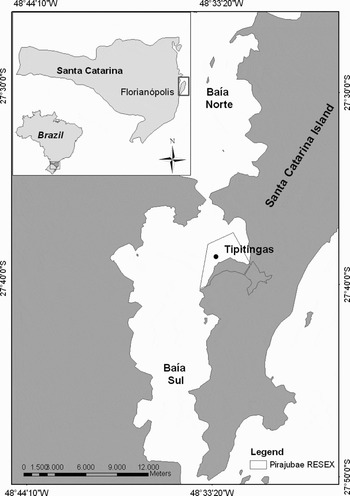
The venerid clam Anomalocardia brasiliana (Gmelin, 1791), popularly known as berbigão, has long been exploited by traditional communities throughout the Brazilian coast (Maltz & Faerman, Reference Maltz and Faerman1958; Peso, Reference Peso1980; Schaeffer-Noveli, 1980; Boehs, Reference Boehs2000; Araújo & Rocha-Barreira, Reference Araújo and Rocha-Barreira2004; Nishida et al., Reference Nishida, Nordi and Alves2006). In southern Brazil, one of its main fishing areas is the intertidal flat known as ‘Baixio das Tipitingas’, located at Florianópolis City, on the landward side of Santa Catarina Island (Pezzuto & Echternacht, Reference Pezzuto and Echternacht1999; Souza, Reference Souza2003) (Figure 1).
Map of the Pirajubaé RESEX area, including the study site on the tidal flat known as ‘Baixio das Tipitingas’, in Florianópolis, southern Brazil.

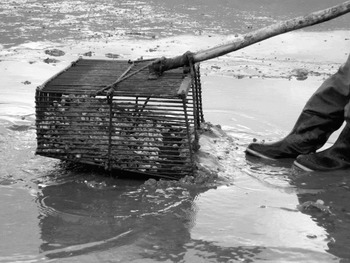
Clam harvesting in Florianópolis was traditionally conducted by hand for subsistence and small-scale commercial purposes. In 1987 a fishing company introduced a new gear in the region, starting the commercial fishery for A. brasiliana (Tremel, Reference Tremel2001). Known as gancho, this new device is a rudimentary hand dredge consisting of a metallic basket fixed to a wooden handle. The basket is made of welded iron bars armed with a row of teeth intended to dig out the animals from the sediment (Tremel, Reference Tremel2001) (Figure 2).
Hand dredge used in the fishery of the clam Anomalocardia brasiliana in the Pirajubaé RESEX, Florianópolis, southern Brazil (Photograph: Daniel Silva e Souza).

In 1992, part of the bay and mangrove areas where the Baixio das Tipitingas is included became the first Brazilian Marine Extractive Reserve (Pirajubaé RESEX), a special form of governance intended to promote communal exploitation of natural resources by assigning exclusive fishing rights to local traditional user groups (Von Behr, Reference Von Behr1995; Tremel, Reference Tremel2001; Diogo, Reference Diogo, Santos, Pimenta, Thiengo, Fernandez and Absalão2007). After several years of sustainable catches not exceeding 185 t.year−1 (Pezzuto & Echternacht, Reference Pezzuto and Echternacht1999; Souza, Reference Souza2007), uncontrolled fishing effort coupled with institutional shortcomings have increased the landings up to 500% in some years and led to significant reductions in individual shell size and weight (Souza, Reference Souza2007).
Recently, Souza (Reference Souza2007) conducted a high frequency in situ monitoring of fishing activity in the RESEX and provided a detailed description of the use of the hand dredge (hereafter referred simply as ‘dredge’) in the region. According to his observations the gear seems to be highly efficient, removing most of the individuals present in the gear's path. Knowing the efficiency of these dredges is, therefore, needed to implement effective effort controls.
Over the years, different minimum spacing values have been established for the metallic bars in the dredge's basket, with the aim of retaining only individuals larger than 20 mm (shell length), which are considered sexually mature (Araújo, Reference Araújo2001). Although minimum spacing regulations seemed to have been effective, as small individuals have been rarely found in commercial catches (Tremel, Reference Tremel2001; Pezzuto et al., Reference Pezzuto, Araújo and Magalhães2002; Souza, Reference Souza2007), there has been no experimental assessment of dredge selectivity under operational conditions, particularly during the recruitment seasons.
Attentive to the high effort levels currently applied in the A. brasiliana fishery and to signs of overexploitation, this study was conducted with the aim of evaluating the efficiency and selectivity of the dredge used in the RESEX, with the intention of providing scientific support to improve the management of the fishery.
MATERIALS AND METHODS
Sampling
The efficiency and selectivity of the dredge were evaluated through a field experiment conducted in October 2006 at the Pirajubaé RESEX (Figure 1). This period was specially selected for the analysis because most size-classes are represented in the area during the austral spring, including recruits of over 2 mm shell length (Pezzuto & Echternacht, Reference Pezzuto and Echternacht1999; Souza, Reference Souza2003; Nandi, Reference Nandi2005).
The sample design consisted of 15 plots, each of them 3 m long and 1 m wide (3 m2), organized in five strata (A, B, C, D and E). Three plots were randomly assigned to each of three treatments: control, 1 haul (1H) and 3 hauls (3H). Three sediment samples were taken with a corer (diameter = 15 cm, depth = 10 cm) within each treatment, before and after the experimental haul(s). The control treatment was not dredged, but three sediment samples were taken also both before and after the experiment, which lasted around 3 hours. The control was established in order to eliminate possible sources of variability related to clam behaviour in relation to environmental factors (e.g. tide level) and/or human interference during the experiment.
The experimental dredge was built by local fishermen and had the following dimensions: 40 cm mouth width, 27 cm depth of the basket, 17 l internal volume, 10.9 mm average spacing between metallic bars of the basket and teeth, 5 cm teeth length. Estimated mean depth of digging was 4.5 cm. A fisherman was hired to operate the dredge for mimicking normal conditions of the fishery. In each treatment (1H and 3H) the dredge passed over the 3 m2 area. In the case of the 1H treatment the plot was dredged just once, while in the 3H treatment the dredge was passed over the sediment three consecutive times, aiming to identify any acute effects of the concentration of effort on the fishing area.
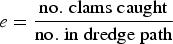
Following Caddy (Reference Caddy and Caddy1989), overall dredge efficiency (e) can be defined as:
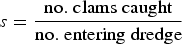
It can be divided in two components, efficiency of capture (E) and selectivity (s) as follow:

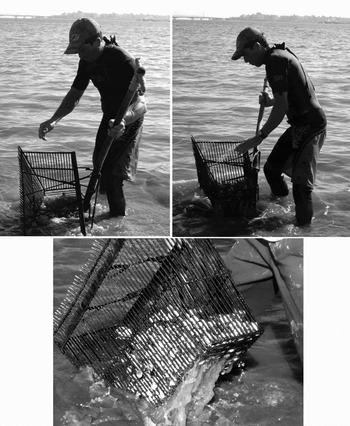
In order to calculate the efficiency of capture for different levels of effort (1H and 3H), the basket of the dredge was covered with a 1.3 m length net bag (cover). This cover measured nearly 5 times the basket's depth and was made of polyamide screen with a 1-mm square mesh, in order to impede the return of the clams to the sediment when the fisherman ‘washed’ the catch. During the ‘washing’ that normally follows the end of each haul the fisherman moves the dredge sideways in the water to eliminating sediments and small-sized individuals through the metallic bars of the basket (Figure 3). In the experiment, the cover was made deliberately longer and wider than the basket in order to keep the net and the sediment retained in its interior away from the dredge during the haul and in the washing. This prevented the clogging of the basket and possible interference with gear performance.
Process known as ‘washing’ the catch used by fishermen to eliminate sediment and small individuals caught by the dredge (Photographs: Daniel Silva e Souza).

In the 1H treatment the total volume of ‘washed’ material was recorded in the field by transferring sediment and clams retained in the cover to a 25-l graduated bucket. Three cores (15 cm diameter × 10 cm depth) were taken from inside the bucket to quantify and determine the size of the individuals that were selected during the washing process. The volume of material retained inside the dredge's basket (living clams plus biodetritic gravel) was recorded and an aliquot was taken using a 350 ml beaker. In the case of the 3H treatment the material retained in the cover was discarded outside the experimental plots. Due to operational limitations experienced in the field it was impossible to measure its volume accurately and to obtain unbiased samples from the several buckets that could be filled with the large amount of sediment retained in the cover.
Samples collected with the corer in the experimental areas and inside the bucket were sieved through a 0.5 mm mesh, labelled, placed in plastic bags and fixed in 4% formaldehyde. Samples taken from the dredge were labelled, placed in plastic bags and frozen. In the laboratory, animals from the corer samples were counted, weighted and measured (shell length) using sliding calipers (precision of 0.5 mm). After thawing, the biodetritic material (gravel) from the samples taken from the dredge was separated from the clams and its respective weights and volumes were determined.
The number of clams retained in the cover (N cover) in each experimental area i of the 1H treatment was estimated as follows:
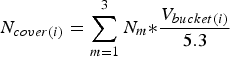
where N m refers to the number of clams recorded in the corer sample m, V bucket(i) is the volume of material (sediment + living clams) in the bucket i, and 5.3 represent the volume (in litres) of the 3 corers used for sampling the bucket.
The number of clams retained by the dredge in each experimental plot i (N catch) was estimated as follows:

where N beaker(i) is the number of clams in the beaker i, V total catch(i) is the volume of gravel and living clams retained inside the dredge after the haul i, and V beaker(i) is the total volume of the beaker sample i.
Data analysis
Efficiency of capture (E)
The efficiency of capture was defined as the proportion of individuals in the sediment, regardless of size, which entered the dredge during the haul. This proportion was calculated based on the difference between the mean density of individuals collected in the sediment before and after passing the gear over the experimental plots, taking into consideration that clams that entered the dredge did not return to the sediment, as they became retained in the basket or in the cover.
The efficiencies of capture (E) after one haul (1H) and 3 hauls (3H) were calculated, as follows:
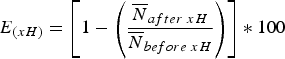
where x indicates effort level (1 or 3), and  and
 are the average density of individuals after and before dredging, respectively.
Average densities of clams in the sediment were calculated for each effort level i (control, 1H and 3H), time j (before and after hauls), and strata k (A, B, C, D and E). The averages were compared using nested ANOVA in hierarchical mode, where each of the five strata was considered a hierarchical replica of each of the treatments (=plots) and times. The factor time was considered orthogonal to the treatments. The statistical significance of the average density of the clams was obtained using the linear model:

where µ = total average; Ai = main effect of the treatments; Tj = main effect of time; A*Tij = orthogonal effect between the treatments and time; E(A*T)k(ij) = effect of the nesting of the strata in the treatments orthogonal to time; e l(ijk) = random error of the sample replication in strata, treatments and time.
Degrees of freedom, mean squares, F ratio and P values were calculated according to Underwood (Reference Underwood2001) with the software R 2.6.1 (R Development Core Team, 2007). The homoscedasticity of the variable density was tested with the Bartlett test and accepted for P > 0.05 (Underwood, Reference Underwood2001).
Overall gear efficiency (e)
Overall gear efficiency is defined as the proportion of individuals available in the gear's path that are retained (see Equation 1). Considering the knife-edge pattern of the selection ogive of the experimental dredge (see Results below), numbers kept on the gear's basket after each treatment were estimated by the difference observed in the density of clams larger than the selection size of the dredge (>LC50%, see below) inhabiting the sediment before and after the hauls. We estimated this efficiency considering two distinct scenarios:
a) overall efficiency for all size-classes (e t): number of clams retained (shell length > L50%) divided by the number of clams present in the sediment, irrespective of their sizes; and
b) overall efficiency for commercial-sized clams (e c): number of clams retained (shell length > LC50%) divided by the number of individuals available in the sediment in the same size interval.
Overall dredge efficiency for all size-classes (e t) under different fishing efforts (1H and 3H) was calculated through the following equation:

where x indicates effort level (1 or 3 hauls), the numerator indicates the average number of individuals larger than L50% that were retained by the dredge, and the denominator is the mean number of organisms (irrespective of their sizes) initially present in the sediment.
Overall dredge efficiency for commercial sized-clams (e c) under different fishing efforts (1H and 3H) was calculated through the equation:

where the numerator is the same from Equation 8 and the denominator represents the average density of clams larger than L50% available in the sediment before dredging the same areas.
Selectivity
Gear selectivity (s) (Caddy, Reference Caddy and Caddy1989) was evaluated only for the ‘1H’ treatment, as the covered cod-end experiment was carried out only for this treatment. Selectivity was calculated by using the following expression:
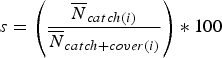
where the numerator indicates the average number of clams retained in the basket of the dredge in the 5 replicas of the 1H treatment, and the denominator indicates the average number of clams which entered the dredge and were retained either in the basket as in the cover.
Selectivity by size was studied according to Sparre & Venema (Reference Sparre and Venema1998). The size-structures of the clams retained inside the dredge's basket (catch) and in the cover of the 1H treatment were compared. The number of individuals retained was estimated following the procedures described in the ‘Sampling’ section.
The logistic model (Sparre & Venema, Reference Sparre and Venema1998),
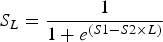
was used to describe the selectivity ogive, where L is the mid-point of the shell length interval (in mm) and S 1 and S 2 are constants. The model was fitted to size-specific observations of retention (number of clams retained/number of clams entering the dredge) using a non-linear minimum squares procedure. L 50% (shell length at which 50% of the individuals are retained by the gear) was estimated by

RESULTS
Dredge efficiency
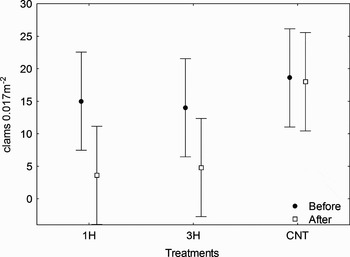
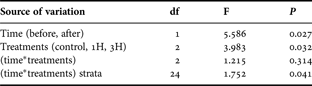
The ANOVA detected significant differences in mean densities of clams in the sediment, for both time (before and after the hauls) (F = 5.58, P = 0.02) and treatments (control, 1H and 3H) (F = 3.98, P = 0.03) (Table 1). Clam density was significantly reduced in treatments 1H and 3H after the hauls, as compared to the situation observed before and in any time of the control (Figure 4).
Average density (clams 0.017 m−2) (±CI 95%) of Anomalocardia brasiliana in the treatments before and after the haul(s). 1H, one haul; 3H, three hauls; CNT, control.

Results from the hierarchical ANOVA applied to densities of the clam Anomalocardia brasiliana.
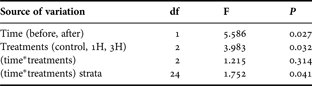
df, degrees of freedom.
No significant difference was detected in the interaction between the factors (F = 1.21, P = 0.3) (Table 1), confirming the similarity observed between treatments 1H and 3H after the passage of the dredge (Figure 4). However, a significant difference was detected in the interaction between the factors when the five strata were analysed separately (Table 1). This is associated with the variability in clam density among strata, indicating that the population was not distributed homogenously in the experimental site. The effects were more intense in the strata where density of clams was higher.
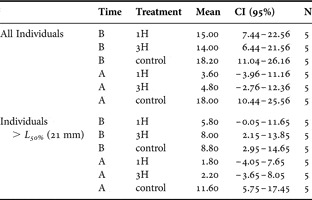
Dredge efficiency, as defined by Equations 6, 8 and 9, was estimated based on the average density of clams sampled in the sediment before and after the experimental hauls (Table 2). On average, the dredge showed an efficiency of capture (E) of 76% when a single haul was conducted over the experimental areas. This efficiency decreased to 66% when three hauls were carried out consecutively (Table 2). The overall efficiency for all size-classes (e t) was 27% and 41% for the 1H and 3H treatments, respectively, while the overall efficiency for commercial sized clams (e c) increased to 69% and 73% for the same effort units.
Average densities (clams.0.053 m−2) of Anomalocardia brasiliana in treatments 1H, 3H and control, considering all individuals present in the sediment and individuals larger than the L 50% estimated in the selectivity experiment. B, before; A, after; CI (95%), confidence interval; N, number of replicates.

Selectivity
Nearly 64% of the clams that entered the gear were retained in the basket, while the remaining 36% passed through the metallic bars and were retained in the cover.
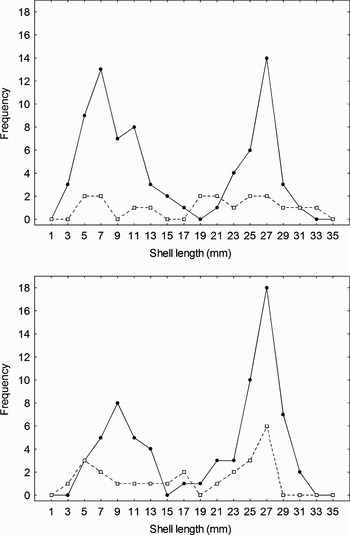
Figure 5 shows the size–frequency distributions of the organisms present in the sediment before and after dredging the 1H and 3H sites. Before the hauls the population was bi-modal in both experimental situations, the first mode (7–9 mm) corresponding to juveniles recruited in the previous austral autumn/winter and the second (27 mm) to the adults. Despite showing the same general size structure, the two treatments differed in the relative proportion of juveniles and adults before the hauls, juveniles being relatively more abundant in the 1H treatment (Figure 5). After dredging, clams in the experimental areas were not only significantly reduced in numbers, but showed a complete change in their size structure, resulting in a more homogeneous distribution of abundance among the several size classes. Comparing the two treatments, a more significant reduction was observed in the small size-classes, especially in the 1H treatment (Figure 5).
Size–frequency distributions for treatments 1H (upper) and 3H (lower), before (solid lines/closed circles) and after (dashed lines/opened squares) the haul(s).

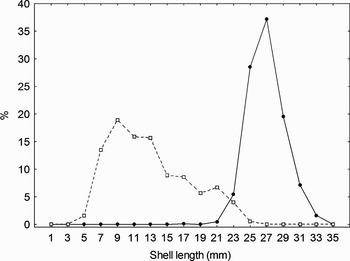
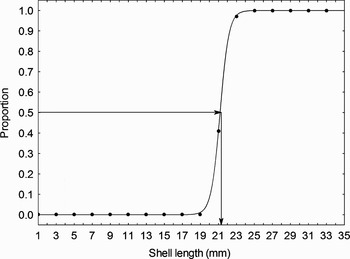
The size–frequency distributions of the clams retained in dredge's basket and in the cover were very dissimilar; only a minor overlapping occurred between the 21 and 25 mm size-classes (Figure 6). The resulting selection ogive followed a knife-edge pattern (Figure 7), as individuals smaller than 21 mm were not retained by the dredge. Parameters of the logistic model fitted to the data were highly significant (P < 0.0001; S1 = 43.050 ± 2.877; S2 = 2.032 ± 0.137 CI 95%) resulting in a L 50% estimate of 21.2 mm.
Size–frequency distribution of clams sampled in the dredge's basket (solid line/closed circles) and cover (dashed line/opened squares).

Logistic curve fitted to the observed data (points) in the selectivity experiment carried out with the hand dredge used in clam Anomalocardia brasiliana fishery. The arrows represent the shell length with a 50% chance of being retained by the dredge.

DISCUSSION
According to Fifas et al. (Reference Fifas, Vigneau and Lart2004) efficiency estimates of dredges can be obtained by absolute or relative methods. In the first approach abundance of the resource in the environment is sampled before and after the hauls, while in the latter the relative performance of the same gear or different gears is compared during standard hauls, for instance by means of covered cod-end experiments. Beukers-Stewart et al. (Reference Beukers-Stewart, Jenkins and Brand2001) recommend that whenever possible both methods should be combined.
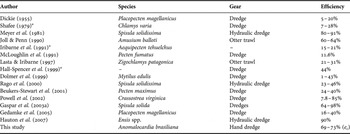
In this study the combined use of both approaches provided reliable information about the potential impact of the hand dredge on the Anomalocardia brasiliana population, as they were in accordance with recent estimates on stock abundance and removal rates practiced in the region. Based on intensive in situ monitoring of fishing activity conducted at the RESEX in 2005, Souza (Reference Souza2007) estimated the total fishing effort and respective clam catches for that year. Estimates were based on the average number of fishermen operating per day, fishing days per week, hauls per day, area swept per haul, and catches. The author concluded that nearly 88% of the tidal flat surface was swept at least once in 2005, while the annual landing of A. brasiliana (947 t) accounted for 92% of the exploitable biomass estimated at the beginning of the same year. Besides revealing an excessively high fishing mortality, the similarity between both proportions (swept area/tidal flat area and total landings/exploitable biomass) suggest that, in fact, the locally used dredges should be very efficient, removing most of the commercial-sized clams available in the dredge's path on a single haul. Our results, obtained from an entirely independent field experiment, confirmed this expectation, showing that the dredge is able to remove nearly 70% of the exploitable individuals present in the sediment. High efficiency, comparable to that found in this study, have been detected mainly in some very larger and heavier conventional or hydraulic dredges used in Spisula, Ensis and Crassostrea fisheries, while for other types of gear efficiency levels have been demonstrated to be generally smaller than 40% (Table 3).
Efficiencies estimated for several bivalve fishing gears. e c, overall efficiency for commercial-sized clams.

*, cited in Orensanz et al. (Reference Orensanz, Parma, Turk, Valero, Shumway and Parsons2006).
Gear efficiency can be influenced by several intrinsic and extrinsic factors including design, mesh size, spatial and temporal distribution of the fishing effort, velocity and direction of the haul, amount of catch retained in the cod-end, depth, weather conditions and characteristics of the sea floor, as well as characteristics of the target species and accompanying fauna (e.g. size/age structure, abundance, behavioural responses and recruitment levels) (Gulland, Reference Gulland1983; Rago et al., Reference Rago, Keith, Hendrickson and Murawski2000; Pezzuto & Borzone, Reference Pezzuto and Borzone2001; Beukers-Stewart et al., Reference Beukers-Stewart, Jenkins and Brand2001; Powell et al., Reference Powell, Ashton-Alcox, Dobarro, Cummings and Banta2002; Gaspar et al., Reference Gaspar, Leitão, Santos, Chícaro, Dias, Chícaro and Monteiro2003a; Leitão & Gaspar, Reference Leitão and Gaspar2007). The population structure of A. brasiliana and the physical and operational characteristics of the dredge influenced its efficiency and selectivity.
Samples taken in the experimental areas before the hauls were characterized by a bi-modal size-structure, the two modes corresponding to newly recruited individuals and adults. Small-sized clams were comparatively more abundant than adults in the 1H treatment, where they accounted for 65% of the sampled individuals (45% in the 3H treatment). Although no significant differences occurred between the efficiency of capture of the two treatments, a tendency towards a higher efficiency in the first case was observed (76% and 66%, respectively). This result is quite unexpected as one should assume that three consecutive hauls conducted exactly over the same area would dislodge more individuals from the sediment than a single one.
The higher proportion of juveniles in the 1H replicates and a distinct vertical distribution of juveniles and adults in the sediment may have influenced the efficiency of capture. As A. brasiliana is a suspension-feeder with short siphons (0.4 mm length for a 24.7 mm-long clam; Narchi, Reference Narchi1972), and its vertical distribution is largely concentrated in the first 5 cm, with a few individuals buried up to 10 cm (Schaeffer-Novelli, Reference Schaeffer-Novelli1980), juveniles are presumably distributed closer to the sediment surface than adults. Even considering that some selection might occur through the dredge's teeth, a more superficial distribution of smaller-sized individuals should make them more vulnerable to the gear, increasing the efficiency of capture estimated for the 1H treatment, where juveniles were comparatively more abundant. This demonstrates that population structure and behaviour may exert a strong influence on estimates of gear performance.
The comparison between the size–frequency distributions obtained before and after the hauls suggests also that the dredge used in the A. brasiliana fishery may alter its population structure to a large extent, given that not all size-classes will experience the same levels of retention by the gear and/or fishing mortality. In fact, under normal operational conditions (i.e. in the absence of the cover), juveniles entering the basket will return to the sediment during the washing process. Under the hypothesis that most of them could survive to the disturbance, population structure in the dredged areas should become progressively unimodal and dominated by these small-unselected individuals. On the other hand, if part of these juveniles does not survive burial and/or exposure to epibenthic predators, the effect of the fishery would become even more severe, with the population size-structure becoming progressively more homogeneous as found in the experimental areas after the hauls (Figure 5). While physical damage by the gear might also contribute significantly to the incidental mortality of the clams (Meyer et al., Reference Meyer, Cooper and Recci1981), this does not seem to be the case, as no individuals were found to exhibit signals of severe damage to their heavy shells (shell weight ~83% live weight; Pezzuto, personal observation). In this sense, the A. brasiliana fishery supports the findings of other studies which demonstrated that higher gear efficiency was associated with lower incidental mortality by damage, and vice versa (Caddy, Reference Caddy1973; Meyer et al., Reference Meyer, Cooper and Recci1981; McLoughlin et al., Reference McLoughlin, Young, Martin and Parslow1991; Gaspar et al., Reference Gaspar, Castro and Monteiro1998, Reference Gaspar, Leitão, Santos, Chícaro, Dias, Chícaro and Monteiro2003a). On the other hand, it should be remembered that the bottom characteristics may be strongly affected by dredging (Kaiser et al., Reference Kaiser, Collie, Hall, Jennings and Poiner2001; Schratzberger et al., Reference Schratzberger, Dinmore and Jennings2002) increasing the negative effects on the species, as already observed in other bottom fisheries (Piersma et al., Reference Piersma, Koolhaas, Dekinga, Beukema, Dekker and Essink2001).
Estimates of the efficiency of capture (E), overall gear efficiency for all size-classes (e t) and gear selectivity (s) are not expected to remain constant with time, but will vary according to fluctuations in the size-structure of the species. As the three parameters are heavily influenced by the ratios between the numbers of individuals larger and smaller than the selection size of the gear, E will increase and e t and s will decrease during seasons with high availability of juveniles, this pattern getting reversed as individuals grow, and when there is reduction in their abundance due to natural and fishing mortality. This is confirmed by other studies where a relationship between efficiency and abundance (Dolmer et al., Reference Dolmer, Kristensen and Hoffmann1999) or population structure has been found (Beukers-Stewart et al., Reference Beukers-Stewart, Jenkins and Brand2001; Powell et al., Reference Powell, Ashton-Alcox, Dobarro, Cummings and Banta2002). To the contrary, temporal changes in population structure will not affect overall gear efficiency for commercial-sized clams (e c); estimates should remain constant throughout the year, given that its calculation takes into consideration only organisms vulnerable to the gear (see Equation 9). Therefore, it can be concluded that this parameter in particular should be given priority in stock assessment analysis, avoiding the use of punctual estimates of e t or s, especially if such estimates are intended to be used to reflect the gear performance on an annual basis. In this case, estimates of both parameters could lead to severe under- or over-estimation of the average efficiency of the gear and corresponding fishing mortality rates over the year.
Traditionally, selectivity by trawl gear has been controlled through measures such as minimum cod-end mesh size (Maclennan, Reference Maclennan1992; Sparre & Venema, Reference Sparre and Venema1998). Additionally, a limit to teeth spacing in some commercial dredges has also been used as a management control to regulate selectivity. However, Gaspar et al. (Reference Gaspar, Leitão, Santos, Sobral, Chícaro, Chícaro and Monteiro2003b) and Kim et al. (Reference Kim, Mituhasi, Jo, Park and Tokai2005) found that variation in teeth spacing did not produce any difference in the size-structure of the individuals caught in two bivalve fisheries. According to Kim et al. (Reference Kim, Mituhasi, Jo, Park and Tokai2005) this occurs because the dredge's teeth are clogged with sediment during the haul, as can be easily observed during the operation of the A. brasiliana dredge (Figure 2). As pointed out by Gaspar et al. (Reference Gaspar, Castro and Monteiro1998, Reference Gaspar, Leitão, Santos, Sobral, Chícaro, Chícaro and Monteiro2003b) the main factor determining selectivity of dredges appears to be mesh size, while teeth length influences mainly dredge efficiency. Results presented in this paper corroborate these conclusions, indicating that mesh size limitations should be given priority for management purposes in this fishery.
Excessive and uncontrolled effort levels over the resource, coupled with the use of a highly efficient (although selective) fishing gear, have contributed to overfishing of the clam A. brasiliana, putting at risk the sustainability of this traditional fishery. As the potential impacts of the hand-dredge on the survival of recently-recruited individuals and in the benthic system as a whole are still unknown, a precautionary approach should be adopted in relation to the dissemination of this gear to other A. brasiliana fishing grounds along the Brazilian coast.
ACKNOWLEDGEMENTS
The authors are indebted to the oceanographers Daniel Silva e Souza, Luís Augusto Ebert and Maikon Di Domenico for their invaluable help in the field work and data analysis. Comments of the two anonymous referees which revised the first version of this manuscript are fully appreciated. This study was supported by DEINFRA/SC (Contract Number 078/2007—Programa de Monitoramento Ambiental na Região de Entorno do Aterro Hidráulico da Via Expressa Sul—Saco dos Limões, Baía Sul, Florianópolis/SC) and National Council for Scientific and Technological Development (CNPq), through a research grant awarded to the first author (Process 310820/2006-5). This work is part of the Bachelor's degree dissertation in oceanography of C.S.