Introduction
The soybean aphid (Aphis glycines Matsumura; Hemiptera: Aphididae) is native to eastern Asia and was first detected in North America in the year 2000 (Venette and Ragsdale, Reference Venette and Ragsdale2004). Over 4 years, its population expanded to the main soybean growing areas in the USA and Canada, and it became the most damaging pest of soybean in the north-central USA and eastern Canada (Ragsdale et al., Reference Ragsdale, Landis, Brodeur, Heimpel and Desneux2011; Koch et al., Reference Koch, Potter, Glogoza, Hodgson, Krupke, Tooker, DiFonzo, Michel, Tilmon, Prochaska, Knodel, Wright, Hunt, Jensen, Varenhorst, McCornack, Estes and Spencer2016). Control of soybean aphid is achieved primarily with foliar insecticides and neonicotinoid seed treatments (Ragsdale et al., Reference Ragsdale, Landis, Brodeur, Heimpel and Desneux2011; Douglas and Tooker, Reference Douglas and Tooker2015), but the widespread use of these insecticides is costly, risks inducing insecticide resistance, poses a danger to non-target organisms in fields and adjacent habitats, and produces substantial greenhouse-gas emissions (Heimpel et al., Reference Heimpel, Yang, Hill and Ragsdale2013; Stanley et al., Reference Stanley, Garratt, Wickens, Wickens, Potts and Raine2015; Hanson et al., Reference Hanson, Menger-Anderson, Silverstein, Potter, Macrae, Hodgson and Koch2017; Calvo-Agudo et al., Reference Calvo-Agudo, Dregni, González-Cabrera, Dicke, Heimpel and Tena2021). Finding alternatives to insecticides is a critically important component of developing sustainable soybean production.
Given that soybean aphid populations in eastern Asia support a suite of parasitic wasps and rarely reach economically damaging levels, the importation of Asian biological control agents to North America was considered as a potential solution (Heimpel et al., Reference Heimpel, Ragsdale, Venette, Hopper, O'Neil, Rutledge and Wu2004; Liu et al., Reference Liu, Wu, Hopper and Zhao2004; Wu et al., Reference Wu, Schenk-Hamlin, Zhan, Ragsdale and Heimpel2004). Several species of parasitic wasps were either imported from Asia or redistributed from within the continental USA during the first 10–15 years following the arrival of soybean aphid, yet none of these agents have contributed significantly to the suppression of soybean aphid populations for a number of hypothesized reasons (Chacón and Heimpel, Reference Chacón and Heimpel2010; Heimpel et al., Reference Heimpel, Frelich, Landis, Hopper, Hoelmer, Sezen, Asplen and Wu2010; Asplen et al., Reference Asplen, Wyckhuys and Heimpel2011; Ragsdale et al., Reference Ragsdale, Landis, Brodeur, Heimpel and Desneux2011; Ghising et al., Reference Ghising, Harmon, Beauzay, Prischmann-Voldseth, Helms, Ode and Knodel2012; Dieckhoff et al., Reference Dieckhoff, Theobald, Wäckers and Heimpel2014; Gariepy et al., Reference Gariepy, Boivin and Brodeur2015; Asplen et al., Reference Asplen, Chacón and Heimpel2016). The Asian parasitoid Aphelinus certus Yasnosh (Hymenoptera: Aphelinidae) was evaluated as a potential biological control agent of soybean aphid, but a petition for its release was not sought because it exhibited a relatively broad host range within aphids (Hopper et al., Reference Hopper, Lanier, Rhoades, Hoelmer, Meikle, Heimpel, O'Neil, Voegtlin and Woolley2017, Reference Hopper, Oppenheim, Kuhn, Lanier, Hoelmer, Heimpel, Meikle, O'Neil, Voegtlin, Wu, Woolley and Heraty2019) and included some native North American aphid species (Kaser, Reference Kaser2016; Monticelli et al., Reference Monticelli, Desneux and Heimpel2021). Despite the decision not to import this species, it arrived adventitiously in North America and was first detected in Connecticut in 2004 (Heimpel et al., Reference Heimpel, Frelich, Landis, Hopper, Hoelmer, Sezen, Asplen and Wu2010; Hopper et al., Reference Hopper, Oppenheim, Kuhn, Lanier, Hoelmer, Heimpel, Meikle, O'Neil, Voegtlin, Wu, Woolley and Heraty2019). Since then, A. certus has become geographically widespread and can be abundant in North American soybean fields (Frewin et al., Reference Frewin, Xue, Welsman, Broadbent, Schaafsma and Hallett2010; Hallett et al., Reference Hallett, Bahlai, Xue and Schaafsma2014; Kaser and Heimpel, Reference Kaser and Heimpel2018; Leblanc and Brodeur, Reference Leblanc and Brodeur2018; Miksanek and Heimpel, Reference Miksanek and Heimpel2020a, Reference Miksanek and Heimpel2020b). This parasitoid's ability to prevent economically damaging levels of soybean aphids seemed promising shortly after its detection in Minnesota in 2011 (Kaser and Heimpel, Reference Kaser and Heimpel2018). More recent work, however, indicates that although A. certus is limiting aphid population growth and likely preventing the application of insecticides in some cases, it has not controlled soybean aphid populations as well as initially expected (Leblanc and Brodeur, Reference Leblanc and Brodeur2018; Miksanek and Heimpel, Reference Miksanek and Heimpel2019, Reference Miksanek and Heimpel2020b). This lack of a strong impact was hypothesized by Leblanc and Brodeur (Reference Leblanc and Brodeur2018) to be caused by low rates of parasitism early in the growing season, and modeling work by Miksanek and Heimpel (Reference Miksanek and Heimpel2019) provides further support for this hypothesis.
The cause of these previously observed low rates of early-season parasitism of soybean aphid by A. certus is unknown. One potential explanation is that insufficient cold tolerance of A. certus during the winter in North American areas that support soybean aphid populations lead to high overwintering mortality for this parasitoid. However, neither the cold tolerance nor the effects of overwintering conditions on survival and timing of adult emergence of A. certus have been previously studied. Like other species of Aphelinus, individual A. certus overwinter as diapausing final-instar larvae inside of hardened and inflated remains of their hosts, called mummies (Yu, Reference Yu1992; Tatsumi and Takada, Reference Tatsumi and Takada2005, Reference Tatsumi and Takada2006; Su et al., Reference Su, Tan, Yang, Wan and Zhou2018). Viable diapausing A. certus have been found in October and November in Minnesota soybean fields both before and after harvest and on common buckthorn (Rhamnus cathartica) in Minnesota (C.S., unpublished). Common buckthorn is an invasive woody shrub native to Eurasia which serves as the most abundant overwintering host of soybean aphid in North America (Ragsdale et al., Reference Ragsdale, Voegtlin and O'Neil2004; Voegtlin et al., Reference Voegtlin, Halbert and Qiao2004, Reference Voegtlin, O'Neil, Graves, Lagos, Ho and Yoo2005). Viable A. certus mummies have also been found on common buckthorn in the spring in Pennsylvania (Hopper and Diers, Reference Hopper and Diers2014), suggesting that they can successfully overwinter on buckthorn.
The cold tolerance of insects that overwinter in temperate zones has been of interest to entomologists for many decades (Salt, Reference Salt1961; Somme, Reference Somme1999; Turnock and Fields, Reference Turnock and Fields2005; Lee, Reference Lee, Denlinger and Lee2010, Teets and Denlinger, Reference Teets and Denlinger2013; Overgaard and Macmillan, Reference Overgaard and Macmillan2017). The temperature at which an insect freezes is called the supercooling point (SCP). It has been useful to classify the cold-tolerance strategy of insect species as either freeze-tolerant, freeze-intolerant or chill-intolerant (in which case freeze intolerance is assumed). Although experiments involving brief exposures to very cold temperatures are essential for determining the cold-tolerance strategy and SCP, a full understanding of a species’ cold-tolerance profile also requires studying the effects of seasonal durations of low temperatures and variability of temperatures within the overwintering environment (Ramløv, Reference Ramløv2000; Renault et al., Reference Renault, Salin, Vannier and Vernon2002; Stockton et al., Reference Stockton, Wallingford, Rendon, Fanning, Green, Diepenbrock, Ballman, Walton, Isaacs, Leach, Sial, Drummond, Burrack and Loeb2019).
To determine whether insufficient overwintering cold tolerance might be limiting the efficacy of A. certus as a biological-control agent, we conducted laboratory studies to determine the SCP and lower lethal temperature and used these to hypothesize the cold-tolerance strategy. Based on this, we studied the effect of ecologically relevant simulated winter conditions on survival and timing of emergence. We also conducted field studies to determine the likelihood of survival across a 760 km latitudinal gradient and in multiple microhabitat types. Although the conditions governing diapause of some Aphelinus species have been studied (Trimble et al., Reference Trimble, Blommers and Helsen1990; Yu, Reference Yu1992; Tatsumi and Takada, Reference Tatsumi and Takada2005, Reference Tatsumi and Takada2006), Aphelinus mali, Aphelinus varipes, and Aphelinus near varipes are the only members of the genus whose cold tolerance has been investigated. Yu (Reference Yu1992) found that survival of diapausing A. varipes was unaffected by temperatures as low as −5°C but survival was reduced by exposure to −10°C beyond 8 weeks. Survival of diapausing Aphelinus near varipes was reduced by exposure to −5°C for 4 weeks or more and reduced to zero by exposure to −10°C beyond 10 weeks. Su et al. (Reference Su, Tan, Yang, Wan and Zhou2018) found the SCP of A. mali to be −26 and −28°C for two strains but did not determine this species’ survival with freezing or chilling. Based on these results, we predicted that A. certus would freeze between −25 and −30°C. Because most temperate insects can survive chilling but not internal ice formation, we expected A. certus to die upon freezing, or perhaps at temperatures slightly warmer than the SCP (Turnock and Fields, Reference Turnock and Fields2005). We also expected that longer exposures to moderately cold temperatures (0 and −17°C) would cause higher mortality and that some minimum duration of winter would be required to break diapause and produce synchronous emergence as adults. In our field studies, we expected that warmer and less variable climates would afford the highest overwintering survival, so survival would be higher at lower latitudes, as has been shown for other insects (Stockton et al., Reference Stockton, Wallingford, Rendon, Fanning, Green, Diepenbrock, Ballman, Walton, Isaacs, Leach, Sial, Drummond, Burrack and Loeb2019). Because the subnivean habitat (space where the ground meets the snowpack) has a more stable and often warmer microclimate than air temperatures (Pauli et al., Reference Pauli, Zuckerberg, Whiteman and Porter2013), we expected that mummies placed on the ground would have greater survival than those attached to vegetation above the snowpack. Finally, we expected that mummies placed on the ground in woodlots would have higher survival than mummies placed in soybean fields because the subnivean temperatures of forested areas are typically warmer and less variable with fewer extreme freezing events than open areas (Suggitt et al., Reference Suggitt, Gillingham, Hill, Huntley, Kunin, Roy and Thomas2011; Petty et al., Reference Petty, Zuckerberg and Pauli2015).
Materials and methods
Parasitoid acquisition and rearing
Aphelinus certus individuals used in the field studies and the supercooling laboratory assays came from a colony originating from parasitized A. glycines collected in Allentown, PA, USA in 2007 and reared on Glycine max at the US Department of Agriculture, Agricultural Research Service, Beneficial Insects Introduction Research Unit (BIIRU), Newark, Delaware. To induce diapause in A. certus, aphids were allowed to be stung by the parasitoids under laboratory conditions of 11L:13D (light:dark), 20°C, and 40% relative humidity. After 2 weeks under these conditions, diapausing parasitoid larvae inside of mummified aphid hosts were shipped to the University of Minnesota. Shipments were made in October 2016 and November 2017 for use in field experiments, and in April 2018 for thermocouple thermometry studies. Upon arrival in Minnesota, mummies were held in a refrigerator in total darkness at 7 ± 1°C for 7–35 days before being used for the field studies, and 1–17 days before being used for supercooling assays in the laboratory.
For the laboratory-based exposures to simulated winter conditions, we used a colony of A. certus that was initiated from field-collected mummies in August 2011 from the University of Minnesota's Rosemount Agricultural Experiment Station and the University of Minnesota St. Paul campus. This colony was continuously reared on A. glycines at the University of Minnesota, St. Paul. Rearing conditions similar to those in Newark were used to induce diapause. Four weeks after parasitoids were introduced into cages, individual mummies were moved from soybean plants into 1.5 ml microcentrifuge tubes and moved into the simulated winter conditions described below.
Supercooling points
SCPs were measured using contact-thermocouple thermometry following the methods of Hanson and Venette (Reference Hanson and Venette2013). Individual diapausing A. certus mummies that had been stored at 7°C for 1–5 days were placed within 1 mm of single 0.127 mm copper-constantan thermocouples, which were connected to a multichannel datalogger (USB-TC, Measurement Computing, Norton, MA, USA). Each paired insect and thermocouple were placed inside half of a gel capsule (Capsuline, size 4, Dania Beach, FL, USA), which was placed within a 1.5 ml microcentrifuge tube that was itself sealed with a milled plastic dowel. Each dowel was fitted with an O-ring, through which the wire was threaded. Each of these units were placed inside Pyrex test tubes (18 × 150 mm), and then into a programmable circulating cooling-bath of silicone 180 oil (A40; Thermo Fisher Scientific). This bath was then cooled at approximately −1.3°C/minute from 21°C to −40°C. Temperatures were recorded once per second using an analog data acquisition unit (USB-TC, Measurement Computing Core, Norton) and logged using Tracer-DAQ software (Measurement Computing, Norton). We identified each individual insect's SCP as the lowest temperature reached before the exotherm (heat release) produced by the phase change from liquid to solid using a set of functions to identify exotherms of at least 0.15°C that occurred between 0 and −40°C. All cooling curves and exotherms were visually verified. We recorded the SCPs of 35 A. certus individuals across three groups of 10–13 mummies during April 2018. SCPs did not vary significantly between groups, so all groups were pooled for the calculation of descriptive statistics.
Lower lethal temperature and cold-tolerance strategy
To test the survival of A. certus when exposed to acute, extreme, low temperatures, diapausing mummies were treated in the same manner as described in the previous section, except that they were removed from the cooling bath 0–10 s after reaching a predetermined treatment temperature, regardless of whether they had frozen. Based on the distribution of SCPs (see Results), we chose temperatures of −20, −22, −25, −28, and −30°C for this experiment and they were assigned using a randomized complete-block design. Controls were handled identically but remained at 7°C while test specimens were in the cooling bath. In total, 14 blocks including multiple replicates of each temperature treatment and three controls were tested, yielding data from 221 individuals. After each block was completed, all organisms were stored in darkness at 7°C. We recorded the presence and temperature of any SCPs that occurred during this study. We also recorded the actual removal temperature, which often differed by 0.05–0.5°C from the target removal temperature.
Survival after cold exposures was assessed in two ways. First, a random subset of A. certus mummies were dissected to determine survival 1 week after the onset of cold exposure from each block (n = 63). Healthy, diapausing final-instar larvae appeared greenish-yellow with clear external segmentation, bilateral symmetry, and compact dark gut contents (fig. 1). Dead larvae were identified by their irregular shape and lack of visible segmentation and often contained pockets of variously colored liquids, which were likely degraded tissues. We assessed larval survival 1 week following cold exposure because we found that mortality of larvae is difficult to determine 24 h following cold exposure. For the second measure of survival, the 159 remaining mummies were kept at the 7°C treatment for 95 days, after which they were moved to 20°C with a 16:8 h light dark cycle and monitored for emergence twice weekly until no parasitoids emerged for at least 1 week. At this point, all remaining mummies were dissected to determine their stage and survival, from which diapause status could be inferred. Healthy larvae appeared identical to those dissected 1 week after cold exposure, while dead larvae were typically dried and shriveled. Pupae were deemed dead if shriveled or misshapen. Adults were deemed alive only if they exhibited any movement (e.g., of appendages) upon dissection.
Photos of healthy (A) and dead (B) A. certus larvae dissected from mummified aphids 7 days after acute cold exposure.

Long-term cold tolerance
To determine the effect of the duration of exposure to severe but realistically cold air temperatures on A. certus, we overwintered diapausing mummies at −17°C for 0–60 days and then observed their emergence timing and success. We chose this temperature because −17 and −10°C bracket about 70% of the average daily temperatures during January and February in the soybean-growing areas of Minnesota (17% of average temperatures were below −17°C and 15% were above −10°C between 1895 and 2017, from https://arcgis.dnr.state.mn.us/ewr/climatetrends). Aphids were parasitized by A. certus females from the laboratory colony at the University of Minnesota at 10L:14D and 20°C to obtain a cohort of diapausing mummies that were placed individually into 0.6 ml microcentrifuge tubes. On day 21 post-parasitism, all mummies were checked for emergence (20/590 had emerged), and those that remained intact were assumed to be in diapause. All mummies were randomly assigned to treatment and kept in a polystyrene insulated box with a remote temperature logger (Onset Computer Corporation, Bourne, MA, USA) and 1 litre of water in a glass jar to provide thermal mass. After 7 days in a refrigerator at 0°C (day 28), experimental groups were moved to a freezer. Over the next 4 days, the temperature within the polystyrene box descended by about 3.9°C daily to −16°C and thereafter remained at a mean of −16.93°C, SD = 1.03. From the time that the temperature reached −16°C, mummies were exposed to these conditions for either 0, 1, 4, 7, 10, 13, 16, 30, or 60 days, and then returned to 0°C for 24 days. Controls were kept at 0°C for the duration of the experiment. At the end of this simulated winter, mummies were moved to a growth chamber with simulated growing season conditions of 16L:8D and 20 ± 1°C. HOBO Temperature loggers were included for the duration of exposure to monitor winter as well as growing season conditions. Parasitoid emergence was monitored daily for 49 days, after which time all remaining unemerged mummies were dissected to determine their stadium and survival.
Long-term exposure to 0°C
To determine the effect of the duration of exposure to temperatures hypothetically experienced under the snowpack on A. certus, we overwintered mummies at 0°C for 0–210 days, then observed their emergence timing and success. This approximates the temperature of the subnivean zone when there is at least 10 cm of snowpack (Thompson et al., Reference Thompson, Zuckerberg, Porter and Pauli2018). Our temperature measurements, averaged from 17 January to 4 March 2017, were −3°C on the ground and −7°C 1 m above the ground. Diapausing mummies were generated as described above and on day 24 post-parasitism, <1% of mummies had emerged. Of 80 mummies dissected at that time, 95% appeared to be healthy, final-instar (diapausing) A. certus larvae, while 5% contained dead larvae. All remaining mummies (n = 609) were randomly assigned to treatments and exposed to ~0°C in a polystyrene box with a 1 litre jar of water for thermal mass in a refrigerator for either 0, 5, 15, 30, 60, 101, 120, 150, 180, or 210 days (temperature mean ± SD = 0.50 ± 0.51°C). At the end of a given treatment's cold exposure, mummies were moved to a benchtop with simulated growing season conditions (16L:8D, 22 ± 2°C). The temperature was recorded hourly for the duration of exposure and parasitoid emergence was monitored daily for 40 days for those exposed to 0 or 5 days of cold. Because some parasitoids in these groups were still emerging near day 40, we implemented a conditional rule to decide when to stop checking emergence of the remaining groups. For all treatments exposed to 15 or more days of cold, we checked parasitoid emergence daily for at least 45 days, performing dissections only if no parasitoids within a treatment had emerged within the previous 5 days. All remaining mummies were dissected on the final day that emergence was checked for their treatment group to determine their stadia and survival status.
Field overwintering survival of Aphelinus mummies
We placed diapausing A. certus mummies into the field during the autumn and collected them in the spring to assess their capability to overwinter under various conditions. On 20 October 2016, soybean leaves laden with diapausing A. certus shipped from BIIRU Newark, Delaware, to the University of Minnesota and were held in growth chambers at 12 ± 2°C and 11L:13D until placed in the field 21–23 November 2016 (see below). Mummies were recovered from the field 4 months later, 20–22 March 2017. Control mummies remained on leaves and were maintained at 12 ± 2°C and 11L:13D in paper cups with mesh lids for the duration of the experiment. From the control group, 20 mummies were dissected on 5 December 2016, to verify diapause status and estimate pre-exposure mortality.
In the first experiment, mummies were placed at six sites along a ~760 km north–south transect from northern Minnesota to southern Iowa (table 1). Each site was a woodlot adjacent to a harvested soybean field. Mummies were put into 30 × 30 cm fine-mesh bags (approximately 1000 mummies/bag) to aid recovery, prevent escape of emerging wasps, and to prevent attack from predatory arthropods in the leaf litter. Bags were then placed inside rectangular boxes (33 × 26 × 3 cm) made of 0.5 cm wire mesh to prevent damage from small mammals. One pair of bags was placed at each of the six sites, 2–10 m into the wooded areas. One bag from each pair was affixed to the ground with lawn staples and covered with leaf litter at a density approximating the density of leaf litter in the area. This treatment simulated the microhabitat of mummies overwintering on leaves that had fallen to the forest floor. The second bag was affixed to the branches of saplings or small trees at 1–1.5 m above the ground. This treatment simulated the microhabitat of mummies overwintering attached to R. cathartica stems, buds, or foliage that did not fall to the ground.
Locations and dates of winter exposure for A. certus mummies overwintered in wooded areas near soy fields during the winter of 2016–2017

Mummies were recovered after 4 months in the field. Two hundred mummies were sampled haphazardly from each bag and allocated into ten groups of 20 mummies. Each group of 20 mummies was placed into a 0.6 ml microcentrifuge tube which was placed into a growth chamber at 20°C and 14L:10D. Parasitoid emergence was recorded periodically for 37–39 days after recovery from the field.
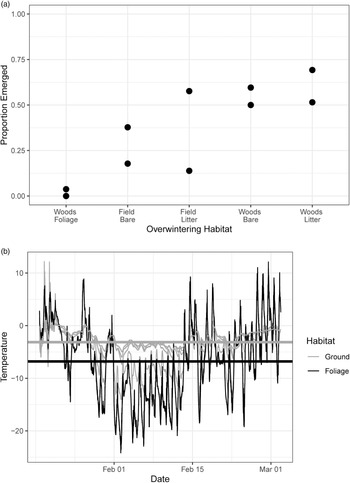
During the winter of 2017–2018, a second experiment was carried out at the St. Paul, MN site to further investigate the effect of habitat type on survival. Diapausing A. certus that arrived from BIIRU in Newark, Delaware, on 30 November 2017, were placed outside on 6 December 2017, and were retrieved on 9–11 April 2018. Groups of ~100–500 mummies were placed in fine mesh bags inside of wire mesh boxes, this time in microhabitats representing a range of possibly overwintering conditions. Two soybean fields (representing A. glycinis summer habitats) and two woodlots (representing typical soybean aphid overwintering habitats) on the University of Minnesota – St. Paul campus were chosen. All sites were within 0.5 km of one another. In each of the soybean-field sites, two mummy bags were placed on the ground: one covered in leaf litter and crop residue at a density approximating that of the surrounding field, and the other with no such cover. In each of the woodlot sites, three mummy bags were placed: two on the ground (one covered and one uncovered by leaf litter), and one attached to small trees at a height of 1 m off the ground. Thus, a total of five potential overwintering conditions were evaluated. Temperature loggers placed with one mummy bag in each condition recorded data every 10 min from 18 January through 2 March 2018. Control mummies were maintained in laboratory growth chambers at 12.5L:11.5D, 12°C in paper cups with mesh lids. Experimental and control mummies were recovered 9–11 April 2018. From each group, as many mummies as possible (range = 35–208, median = 96) were separated individually into 0.6 ml microcentrifuge tubes, placed in a growth chamber at 20°C and 16L:8D, and monitored daily for parasitoid emergence for 51 days.
Statistical analyses
All statistical analyses were done in R, version 3.6.1 (R Core Team, 2019). Unless otherwise specified, logistic regressions (GLMs) were implemented using the glm() function (R Core Team, 2019) while generalized linear mixed effects models (GLMMs) were implemented using the lme4 package (Bates et al., Reference Bates, Mächler, Bolker and Walker2015). Model assumptions were verified by plotting residuals and by testing for overdispersion against a χ2 distribution whenever residual deviance was greater than the residual degrees of freedom. To estimate the temperatures or durations required to kill 50 or 90% of individuals under specific conditions, we used the dose.p function within the MASS package (Venables & Ripley Reference Venables and Ripley2002).
To determine the lower lethal temperature, we used logistic regression to determine the effect of temperature, as well as the assessment method (dissection vs. emergence) on the survival of A. certus mummies. We excluded the controls (which were not exposed to subzero temperatures) to avoid non-equivalent prediction intervals between groups with different assessment methods (control insects are included in a separate analysis of insects that did not reach their SCP; see below). Inclusion of block in the model did not improve fit, so it was omitted for the final analysis. From the model output, we used the dose.p function within the MASS package (Venables & Ripley 2002) to determine the temperature expected to kill 50% of mummies.
To determine the cold-tolerance strategy, we applied Fisher exact tests to determine whether the likelihood of survival differed for mummies that were cooled but did not reach their SCP vs. those that did reach their SCP. Two Fisher exact tests were applied, one for those dissected 1 week following cold exposure and the other for those allowed to emerge after a simulated winter. We also used a binomial linear regression to test whether the survival of mummies that did not reach their SCP was affected by the removal temperature, survival assessment method, and their interaction. For this model, we included all insects, regardless of removal temperature, with controls to detect chill-induced mortality that might occur at 7°C. Again, inclusion of block in the model did not improve fit, so it was omitted for the final analysis.
To assess tolerance of long-term exposures to very cold conditions, we used logistic regression to evaluate the effect of duration of exposure to −17°C on the survival to emergence of individual mummies and used the dose.p function within the MASS package (Venables & Ripley 2002) to estimate the temperatures expected to cause 50 and 90% mortality. We initially included the cage of origin as a random effect but dropped this variable from the final model because it did not improve model fit. We used logistic regression with a negative-binomial error structure to estimate the number of days required to emerge as an adult following the onset of suitable growing conditions as predicted by the duration of cold exposure. Inclusion of a random effect for the cage in which each mummy formed did not improve either model, so was excluded from both.
To assess the effect long-term exposures to conditions expected under snowpack (0°C), we evaluated the effect of exposure duration by using a second-order polynomial logistic regression on parasitoid emergence within 40 days of the onset of suitable growing conditions. We used the second-order polynomial based on the prediction that emergence success might exhibit an intermediate winter duration.
We initially included the cage of origin as a random effect but dropped this variable from the final model because it did not improve model fit. To test the effect of the duration of exposure at 0°C on post-exposure emergence timing, we used a non-linear three-parameter asymptotic model (equation 1) using the nls() function in R (R Core Team, 2019). In this model, y = days to emerge, x = winter duration, a = the asymptote, b = the amount of change in y from intercept to asymptote, and c corresponds to the rate of change in y with respect to x. We excluded the two shortest duration exposures (0 and 5 days) because, unlike the other groups, we halted their emergence at 40 days after the onset of suitable growing conditions.

To assess overwintering survival of Aphelinus mummies in the field in the latitudinal transect experiment, we used a binomial generalized mixed effects model (GLMM) to determine the effect of latitude, microhabitat, and their interaction on survival, while accounting for potential random effects of emergence-tube batches. Survival of controls was low (21.5%), which we attribute to the control temperature of 12°C being too warm for the proper development of diapausing mummies, so we excluded them from this analysis.
To assess the effect of microhabitat on overwintering survival of Aphelinus mummies in the field, we used a binomial GLMM with a random effect of site (each of which contained two or three bags of mummies, depending on habitat type). We then used the glht() function within the multcomp package (Hothorn et al., Reference Hothorn, Bretz and Westfall2008) to generate Tukey-adjusted pairwise comparisons between all habitat types. Controls were excluded from analyses because 0% survived. We report descriptive statistics for the number of days to adult emergence as well as for the temperature above the snowpack and within the leaf litter microhabitat.
Results
Supercooling point
The SCPs of the 35 parasitoids tested ranged from −29.6 to −22.5°C, with a median of −27.9°C (fig. 2). Four individuals froze at temperatures warmer than −23°C, while the majority (27 individuals, 77.1%) froze at temperatures between −26 and −29.5°C.
Cumulative (right to left) proportion of A. certus larvae that reached their supercooling point at a given temperature. Vertical dashed line indicates the median supercooling point.

Lower lethal temperature and cold-tolerance strategy
The survival of A. certus depended strongly and significantly on the temperature of cold exposure (fig. 3; table 2). For the mummies dissected 1 week after exposure, parasitoid survival approached 100% at −20°C, an intermediate level of survival occurred at −28.0°C (SE = 0.65), and 90% mortality was observed at −31.3°C (SE = 1.2). For the individuals placed at 7°C for 95 days after exposure to the sub-zero temperature treatments, 44% emerged as adults (70/159) between 17 and 31 days after the onset of suitable growing conditions. All mummies from which parasitoids did not emerge contained dead parasitoids upon dissection at the end of the experiment; 75% of these were larvae, 12% were pupae, and 13% were adults. Logistic regression indicated that warmer removal temperatures were associated with greater likelihood of survival, that parasitoids assessed by allowing them to emerge as adults were less likely to survive than those that were dissected early were to appear alive, and that the positive effect of assessment by early dissection diminished for those exposed to colder temperatures (table 2). The temperature expected to kill 50% of parasitoids based on post-winter emergence is −22.8°C (SE = 0.65), while 90% mortality is expected to occur after exposure to −33.3°C (SE = 1.2).
Predicted survival of mummies assessed 1 week after cold exposure by dissection (black line) and mummies allowed to emerge after a simulated winter (grey line). Grey areas indicate 95% confidence intervals. Points represent individuals and have been made partially transparent and displaced (vertically only) to ease visualization.

The effects of removal temperature and assessment method (immediate dissection vs. post-winter adult emergence) on survival of diapausing A. certus mummy contents (binomial GLM).

The intercept represents hypothetical mummies removed at 0°C and allowed to emerge as adults after a simulated winter.
Bold p-values indicate p < 0.05.
Aphelinus certus could not tolerate freezing but did tolerate brief periods of chilling at temperatures nearly as cold as their SCP. Regardless of survival-assessment method, only parasitoids that did not reach their SCP survived. Of those dissected 1 week following cold exposure, 0/13 that reached their SCP survived, while 46/49 that did not reach their SCP survived (Fisher exact test, P < 0.0001). Of those allowed to emerge following a simulated winter, 0/30 that reached their SCP survived, while 70/129 that did not reach their SCP survived (Fisher exact test, P < 0.0001).
Long-term cold tolerance
The duration of exposure to −17°C had a significant negative effect on the survival of A. certus, despite being ~10°C warmer than the median SCP (fig. 4, table 3). An exposure duration of 0 days to these conditions led to 80.4% survival, with the odds of survival decreasing with additional cold exposure, such that an exposure for 9.04 days (SE = 0.95) killed 50% of overwintering parasitoids, while an exposure of 23.13 days (SE = 2.39) killed 90% of overwintering parasitoids (fig. 4). All of the 159 mummies that did not have adults emerge within 49 days of the onset of suitable growing conditions were found to contain dead parasitoids upon dissection (129 larvae, 11 pupae, 19 adults). The duration of exposure had no effect on the timing of adult emergence (GLM z = −1.043, P = 0.297, mean ± SD = 21.6 ± 6.48 days, minimum = 4, maximum = 43).
Likelihood of A. certus adult emergence after pupal diapause under simulated winter conditions (−17°C for 0–60 days). Adult emergence was recorded over a 40-day period of simulated summer conditions (20°C) following simulated winter. Point size corresponds to the number of individuals with a shared outcome.

The effect of duration of exposure to ~−17°C on survival to emergence (binomial GLM).

Exposure to ~−17°C occurred during a simulated winter with a baseline temperature of 0°C.
Bold p-values indicate p < 0.05.
Long-term exposure to 0°C
The duration of simulated winter at 0°C exhibited a dome-shaped relationship with adult emergence success such that the probability of emergence within 40 days of the onset of suitable growing conditions (16L:8D, 22 ± 2°C) was maximized at an exposure duration of approximately 83 days (fig. 5A; table 4). As winter duration increased, the days required to emerge decreased, reaching an estimated asymptote of 7.95 days (fig. 5B, table 5). The days to emerge also became more synchronous in the trials of longer winter durations, such that exposures of 100–200 days resulted in emergence times between 10 and 18 days. Mummies from which parasitoids had not emerged in groups exposed to 0 or 5 days of winter and dissected 40 days after the onset of suitable growing conditions contained live final-instar larvae, suggesting they had not yet broken diapause. Mummies from which parasitoids had not emerged in groups exposed to 60 or more days of winter were dissected 45 or more days after the onset of suitable growing conditions (see Methods). Within these groups, none of the unemerged parasitoids remained alive, suggesting that our methods allowed for the emergence of all wasps that would have emerged.
(A) Likelihood of adult emergence within 40 days of summer onset as a function of the duration of simulated winter at 0°C. (B) Number of days after the onset of suitable growing conditions (16L:8D, 22 ± 2°C) required for adult emergence based on the duration of simulated winter at 0°C. The fitted line represents a three-parameter asymptotic function. In both plots, point size corresponds to the number of individuals with a shared outcome.

The effect of duration of exposure to ~0°C as a second-order polynomial on survival to emergence within 40 days of the onset of suitable growing conditions (binomial GLM).

Bold p-values indicate p < 0.05.
The effect of duration of exposure to ~0°C on the number of days after the onset of suitable growing conditions required for adult emergence, fit by a three-parameter asymptotic function (y = a–b × e−cx).

In this model, y = days to emerge, x = winter duration, a = the asymptote, b = the amount of change in y from intercept to asymptote, and c corresponds to the rate of change in y with respect to x.
Bold p-values indicate p < 0.05.
Field overwintering survival of Aphelinus mummies
Survival of parasitoids that were placed on the ground and became snow-covered occurred at all six sites along the latitudinal gradient (survival = 32.5–70%, median = 53%, fig. 6). In contrast, survival of parasitoids elevated above the snowpack occurred at three of six sites, with the greatest survival at the two southernmost sites (survival = 0–55%, median = 14.25%, fig. 6). The binomial GLMM confirmed that parasitoids were significantly more likely to survive at lower latitudes (P < 0.001, table 6). While there was not a significant main effect of microhabitat, there was a significant habitat-by-latitude interaction such that the negative effect of latitude on survival was much more pronounced for the parasitoids elevated in the woody vegetation than parasitoids on the ground (P < 0.001, fig. 6, table 6). In dissections of 20 control mummies 14–16 days after experimental mummies were placed in the field, 75% of the parasitoids appeared to be in diapause (15 final instar larvae, 4 pupae, 1 adult; all appeared alive). Assuming this sample is representative of all mummies in our experiment and that mummies containing pupae or adults are non-diapausing and will not successfully overwinter, we would estimate a maximum of approximately 75% survival for any treatment in this experiment.
Proportion of A. certus emerged by latitude and habitat (bars) and the prediction proportion emerged based on results of the GLMM (lines).

The effects of latitude and habitat (exposed foliage vs. in leaf litter) on survival to emergence (binomial GLMM, random effect of emergence group).

The intercept includes mummies in the foliage at the most southerly site (40.95°N).
Bold p-values indicate p < 0.05.
In the experiment comparing survival of parasitoids in soybean fields or woodlots, parasitoids placed in the stems and foliage above the snowpack were significantly less likely to survive than parasitoids placed on the ground, regardless of whether they were covered with leaf litter or on bare ground, and regardless of whether they were placed in a field or wooded area (table 7, fig. 7A). For those on the ground, survival tended to be higher in the woods than in the field (mean = 58% vs. 32%, respectively). The number of days required to emerge as adults once moved to 20°C and 16L:8D was similar for those overwintered on bare ground and in the leaf litter (pooled mean ± SD = 18.94 ± 3.5; 383/918 emerged). The few parasitoids placed in the woody vegetation that survived to adulthood had relatively long mean durations to emergence (mean ± SD = 29.25 ± 4.65; 4/204 emerged).
The effects of various potential overwintering microhabitats on survival to emergence (binomial GLMM, random effect of plot).

The intercept represents mummies in a field on bare ground.
Bold p-values indicate p < 0.05.
(A) Survival of overwintering parasitoids in five microhabitats. Each dot represents the proportion surviving within a single plot. Tukey-adjusted pairwise comparisons show that woods foliage had significantly lower survival than all other microhabitats (all P < 0.01). Parasitoids placed in the leaf litter in woodlots had marginally greater survival than those on bare ground in fields (P = 0.074), but all other pairwise comparisons were not significant (P > 0.15). (B) Temperature logger data from foliage (two loggers) and on the ground (four loggers) from 18 January through 2 March 2018. Horizontal lines indicate mean temperatures for each habitat type during this period.

As expected, the temperature experienced by parasitoids under the snow was less variable and warmer, on average, than that experienced by those above the snowpack (mean ± SD = −3.1 ± 2.6°C vs. −6.8 ± 7.1°C, fig. 7B).
Discussion
Aphelinus certus is a widespread and abundant natural enemy of soybean aphid in much of North America, but low rates of early season parasitism seem to limit its role in biological control (Leblanc and Brodeur, Reference Leblanc and Brodeur2018; Miksanek and Heimpel, Reference Miksanek and Heimpel2019). We tested the hypothesis that A. certus might experience high overwintering mortality by measuring survival in laboratory and field settings. We found A. certus to be susceptible to typical prolonged winter air temperatures experienced in this region (−17°C), but generally well-adapted to the duration and temperature of winter in the subnivium (i.e., underneath snowpack; ~0°C). Like many temperate insects, diapausing A. certus can survive prolonged chilling events but cannot survive internal freezing, which occurs at approximately −28°C. This SCP is similar to that of A. mali and other freeze-intolerant insects in cold continental climatic zones (Turnock and Fields, Reference Turnock and Fields2005; Su et al., Reference Su, Tan, Yang, Wan and Zhou2018). Our experiments showed that A. certus diapause can be triggered by the presence of an autumn photoperiod of 11 h of light during oviposition and larval parasitoid development, and that diapause occurs primarily during the third-instar (final) larval stage. Once in diapause and held at 0°C, a chill period of 2–3 months is needed to break diapause, with chill periods less than 1 month leading to high mortality and extended development time of survivors. Together, our studies suggest that A. certus is well-adapted to overwintering under the snowpack in the north-central USA.
Our results thus suggest that barriers to overwintering survival of A. certus are mediated by snow cover, which can vary greatly across the landscape and is expected to diminish due to climate change (Zhu et al., Reference Zhu, Radeloff and Ives2017; Liess et al., Reference Liess, Twine, Snyder, Hutchison, Konar-Steenberg, Keeler and Brauman2022). The site of overwintering is therefore an important consideration for survival. The most likely sites for A. certus overwintering are buckthorn woodlots, soybean fields, or field edges. Woodlots tend to retain leaf litter and snow cover and are thus the most protected from cold. Since soybean aphid itself overwinters on buckthorn in the egg stage (Voegtlin et al., Reference Voegtlin, O'Neil, Graves, Lagos, Ho and Yoo2005), an early hypothesis was that its parasitoids may overwinter there as well. In this scenario, the parasitoids would either migrate to buckthorn as adults themselves and parasitize appropriate soybean aphid stages (gynoparae, males, or oviparae) or they would be transported to buckthorn as eggs within parasitized (but still active) gynoparous or male soybean aphids (Asplen et al., Reference Asplen, Wyckhuys and Heimpel2011). Once parasitoid mummies are formed under this scenario, they could either remain on buckthorn vegetation if they form on twigs, or they could drop to the forest floor if they form on buckthorn leaves. In the former case, they would be exposed to potentially lethal cold temperatures, and in the latter case, they would be protected under a layer of snow. The extent to which any these scenarios play out for A. certus is unclear, but very few A. certus mummies were encountered during extensive sampling in buckthorn during the fall in Minnesota (C.S., unpublished). We therefore suspect that buckthorn patches may not be a major overwintering site for A. certus. Finally, although we did not study the effect of temperature experience on cold-tolerance capability, it is well known that environmental cues can induce adaptations such as an increase in cryoprotective substances (Somme, Reference Somme1999). It is plausible that potential overwintering microhabitats vary in their conditions enough to result in differences in cold-hardiness and overwintering survival. Any such effects are difficult to predict and would likely depend on local weather but might play a role in this species overwintering ecology.
Soybean fields provide the most obvious site for A. certus overwintering, and our observations in Minnesota suggest that residual populations of soybean aphid are often present in soybean fields in the autumn when photoperiods would enable A. certus diapause (C.S. unpublished). Overwintering within soybean fields presents two main challenges for A. certus. First, after harvest the plant residues remaining in the field are sparse and can leave soybean fields exposed to cold air temperatures because snow cover is unpredictable and may be absent for weeks in an average winter (Demaria et al., Reference Demaria, Roundy, Wi and Palmer2016). Climate change is expected to further erode the depth and duration of winter snow cover in the north-central USA (Liess et al., Reference Liess, Twine, Snyder, Hutchison, Konar-Steenberg, Keeler and Brauman2022). Second, diapausing A. certus are prone to disruption from tillage. In a preliminary field study, we found that A. certus adults are not able to emerge from mummies that were placed under 4 cm of soil (J.D. & G.E.H., unpublished). Conservation tillage, which is the use of methods to disturb the soil less than conventional tillage, is practiced on the majority of US soybean acreage and warrants further study of its effect on parasitoid overwintering (Claassen et al., Reference Claassen, Bowman, Wallander, David and Steven2018).
Field edges are less exposed to cold than soybean fields, because of their relatively groundcover, and are likely to include known aphid hosts. Known hosts for A. certus include Aphis monardae on beebalm (Monardae spp.) and Aphis asclepiadis and Aphis nerii on milkweed (Asclepias spp.), as well as grain aphids found on grasses, including Sitobion avenae, Schizaphis graminum, Rhopalosiphum padi, and R. maidis (Kaser, Reference Kaser2016; Hopper et al., Reference Hopper, Lanier, Rhoades, Hoelmer, Meikle, Heimpel, O'Neil, Voegtlin and Woolley2017; Monticelli et al., Reference Monticelli, Desneux and Heimpel2021). These aphids have been shown to be hosts in no-choice laboratory tests but require more study to determine to what extent they are used as hosts by A. certus in the field.
Soybean aphids’ seasonal movement between habitats and crop rotation patterns typical of soy-growing regions of North America suggest that dispersal of A. certus is especially important for its ability to control soybean aphid populations. Soybean fields are often followed in annual rotation by corn and other non-legumes, and if A. certus overwinters in soybean fields it likely emerges in fields of corn or other crops. Upon emergence from winter diapause, the parasitoid may use grain aphids as hosts as well as nutritional resources from aphid honeydew and from host-feeding on the aphids (Miksanek and Heimpel, Reference Miksanek and Heimpel2020b). Whether emerging in woodlots, field edges, or last year's soybean field now planted in corn or other crops, soybean aphid parasitoids must travel at least a short distance to provide biological control of soybean aphid, and further study of its dispersal capacities could provide important insights (Heimpel and Asplen, Reference Heimpel and Asplen2011; Asplen et al., Reference Asplen, Chacón and Heimpel2016).
Clearly, the diapause status, movement, and host species utilization of A. certus individuals in the fall are important determinants of early-season population dynamics and deserve further research. An additional explanation worth investigating is the possibility that A. certus has low abundance of diapausing individuals in fall and at the onset of winter, which, in addition to cold-tolerance limitations, would also contribute to low rates of early season parasitism of soybean aphids.
Aphelinus certus has shown itself to be a hardy biological control agent that spread rapidly across the soybean-growing region of north-central North America despite tillage, foliar insecticides, and widespread use of neonicotinoid seed treatments. Improving the overwintering survival of diapausing A. certus may be possible through changes in field management, with special attention to studying mortality from tillage, dispersal capabilities of this parasitoid along with its use of other host aphids, and climate factors including snow cover and dates of first emergence in early summer. Further work is needed to determine A. certus overwintering strategies, although in all locales, this study indicates the importance of a stable subnivium in the overwintering survival of this parasitoid. On the other hand, the higher survival at lower latitudes, both on the ground and in foliage, suggests that a northward shift in warmer winters could increase A. certus overwintering survival in Minnesota. With greater understanding of the overwintering challenges faced by A. certus, we may be able to further suppress the soybean aphid and reduce costly and environmentally risky insecticide use.
Acknowledgements
We thank several undergraduate research assistants who contributed to this research, including Sarah Wood, Sierra Baum, Alex Dutchin, Linnea Fritz-Watson, and Allison Johnson. We also thank James Miksanek and Komala Kanagala for technical assistance with these experiments, and Ian MacRae, Gregg Johnson, Brian Lang, Matt O'Neal, and Nick Piekema for access and assistance with field research sites. We thank Kathryn Lanier for assistance with maintaining the colony of Aphelinus certus at BIIRU in Newark, Delaware. We thank Kathryn Lanier for assistance with maintaining the colony of Aphelinus certus at BIIRU in Newark, Delaware. Finally, we thank Pamela Rueda-Cediel, Mary Marek-Spartz, Eric Middleton, James Miksanek, and Kim Hoelmer for constructive comments on earlier versions of this manuscript. Funding for this project was provided by the Minnesota Invasive Terrestrial Plants and Pests Center through the Environment and Natural Resources Trust Fund as recommended by the Legislative-Citizen Commission on Minnesota Resources (LCCMR), The North Central Soybean Research Program, the Minnesota Soybean Research and Promotion Council, The University of Minnesota's Rapid Agricultural Response Fund, and the Minnesota Agricultural Experiment Station.
Competing interest
None.