Introduction
Head and neck paragangliomas are rare and account for around 3 per cent of all paragangliomas.Reference Sykes and Ossoff 1 Head and neck paragangliomas arise from neural crest derived cells found in the region of the parasympathetic paraganglia, and are frequently found in the vagal, tympanic and jugular paraganglia, as well as carotid bodies. Head and neck paragangliomas are usually slow-growing, benign, non-catecholamine secreting tumours, most frequently originating from the carotid body at the bifurcation of the common carotid. They can be locally aggressive and lead to lower cranial nerve palsies.
Around 3–5 per cent of paragangliomas will undergo malignant transformation.Reference Van den Berg 2 – Reference Boedeker, Neumann, Maier, Bausch, Schipper and Ridder 4 Factors such as genetic background, tumour size, anatomical location and high metadrenaline levels are associated with malignant disease. Malignant potential is uncommon and difficult to predict. A rapidly enlarging neck mass, pain and younger onset age can be associated with underlying malignancy.Reference Patetsios, Gable, Garrett, Lamont, Kuhn and Shutze 5 – Reference Samji, Crown, Buxton-Thomas, Aylwin, Schulte and Dizdarevic 7 Histopathological features cannot reliably distinguish benign from malignant tumours, and malignancy is confirmed with the presence of regional or distant metastasis to non-endocrine tissue.Reference Obholzer, Hornigold, Connor and Gleeson 8
In recent years, an active surveillance approach has emerged for those with head and neck paragangliomas, without malignant risk factors, who may be poor surgical candidates or have multifocal disease. Where possible, the traditional mainstay of treatment is surgical excision, which aims to prevent the local destruction of adjacent lower cranial nerves.Reference Netterville, Jackson, Miller, Wanamaker and Glasscock 9 Surgical excision can offer a cure, but is associated with significant morbidity due to cranial nerve involvement. Further options include stereotactic radiosurgery and external beam radiotherapy. Radiotherapy has been shown to achieve local control, with less morbidity and similar oncological outcomes to surgery; however, the symptomatic control of hearing loss and pulsatile tinnitus is less promising.Reference Jackson 10 , Reference Krych, Foote, Brown, Garces and Link 11
Readily available magnetic resonance imaging (MRI) is an accurate way of monitoring growth in head and neck paragangliomas without malignant risk factors. Currently, there is a paucity of evidence on the natural disease progression of head and neck paragangliomas; therefore, we report our experience on watch-and-surveillance scanning in head and neck paragangliomas.
Materials and methods
We retrospectively reviewed all head and neck paragangliomas managed with watch-and-surveillance scanning at two centres within the Thames Valley region, in the UK. Paragangliomas at all head and neck sites, including the carotid body, and jugulotympanic and vagal paragangliomas, were included. Patients were identified from the senior author's caseload using electronic medical records. All diagnoses were made using either MRI or computed tomography (CT).
Data obtained for each patient included demographics, anatomical site, presenting symptoms, development of symptoms such as cranial nerve palsy and hearing loss, rate of conversion to surgical or radiosurgical treatment, and paraganglioma growth rate between the date of the first presentation and the last follow up.
A literature search of the databases Medline, Embase, Cochrane Library and NHS Evidence, from inception to September 2015, was also performed to review the natural disease progression of head and neck paragangliomas.
Results
A total of 15 head and neck paragangliomas and 14 patients (10 females and 4 males) who underwent watch-and-surveillance scanning, with complete medical records, were identified for analysis. All patients presented from March 2003 to September 2015, with a range of 8 to 143 months’ follow up. Mean age at presentation was 61 years (range, 39–79 years). Four cases were found incidentally, six presented with a neck lump and two with pulsatile tinnitus. Two patients with jugulotympanic paragangliomas presented with associated sensorineural hearing loss, and one patient with a carotid body paraganglioma presented with bilateral sensorineural hearing loss and tinnitus unrelated to the tumour. Magnetic resonance imaging was used for diagnosis with serial examination in 13 patients, and CT was used for 1 patient.
Three patients had bilateral head and neck paragangliomas in this series. Two of these patients received surgical treatment for their first head and neck paragangliomas, as they presented over three decades ago when surgery was the mainstay of treatment. The surgically treated tumours are not included in this study. One patient sustained left vocal fold palsy following the surgical excision of a left jugulotympanic paraganglioma and declined surgery to the right vagal paraganglioma. The other patient had surgery to a carotid body paraganglioma; a carotid body tumour was an incidental finding on the other side at a later date, which was treated conservatively. One patient with bilateral jugulotympanic paragangliomas was managed conservatively and therefore both paragangliomas were included in the series.
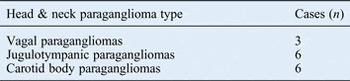
Table I shows the primary anatomical sites of the head and neck paragangliomas.
Primary anatomical site of head and neck paragangliomas

Only one patient presented initially with lower cranial nerve palsy. This was a case of a jugulotympanic paraganglioma, which had affected the hypoglossal and vagus nerves. Percutaneous endoscopic gastrostomy was eventually required to prevent aspiration. Interesting, the three patients with vagal paragangliomas did not have vocal fold palsies at presentation.
None of the patients in the case series developed a new lower cranial nerve palsy or progressive hearing loss during the follow-up period. Furthermore, none of the patients were converted to surgical or stereotactic radiosurgery. The largest increase in size was an incidental carotid body tumour, which increased in maximum linear dimension by 10 mm over a period of 119 months; this patient had undergone previous surgery on a contralateral carotid body tumour.
The median follow-up duration across all cases in the series was 49 months. At the time of diagnosis, the median maximum linear dimension on imaging was 20 mm (range, 5–50 mm), in comparison to 22 mm at the time of the last follow up. Ten head and neck paragangliomas (67.7 per cent) remained stable, whilst five (33.3 per cent) demonstrated growth between presentation and last follow up. The median increase in maximum linear dimension between presentation and last follow up on imaging was 4 mm over an average time frame of 57.4 months.
None of the patients in the study died of their disease, although one patient died of unrelated causes. Common indications for initial observation of patients in this case series included co-morbidities, the likelihood of surgical morbidity and patient choice.
A review of the literature from inception to September 2015 revealed five articles where head and neck paragangliomas had been managed with active surveillance.Reference Kunzel, de Tristan, Mantsopoulos, Koch, Baussmerth and Zenk 12 – Reference Jansen, van der Berg, Kuiper, van der Mey, Zwinderman and Cornelisse 16 The results are summarised in Table II.
Findings from other case series for conservative management of head and neck paragangliomas

*For breakdown, see Table I. CN = cranial nerve
Discussion
Aetiology and pathogenesis
Head and neck paragangliomas are rare, slow-growing tumours. They accounted for only 0.012 per cent of cases in a large oncological surgical series of paragangliomas.Reference Lack, Cubilla, Woodruff and Farr 17 Head and neck paragangliomas originate from neuroendocrine cells arising from the parasympathetic autonomic nervous system, in comparison to thorax or pelvis paragangliomas, which usually arise from the sympathetic autonomic nervous system. Physiologically, one of the main differences between parasympathetic and sympathetic paraganglia is that the parasympathetic ones, which are found in the head and neck, rarely secrete catecholamines.Reference Van Duinen, Steenvoorden, Kema, Jansen, Vriends and Bayley 18
Head and neck paragangliomas are associated with a genetic mutation of gene complexes that encode for succinate dehydrogenase, an enzyme complex bound to the inner membrane of mitochondria.Reference Boedeker, Neumann, Maier, Bausch, Schipper and Ridder 4 Up to 50 per cent of head and neck paragangliomas are familial,Reference Boedeker, Neumann, Maier, Bausch, Schipper and Ridder 4 , Reference Saldana, Salem and Travezan 19 , Reference van der Mey, Maaswinkel-Mooy, Cornelisse, Schmidt and van de Kamp 20 and genetic mutations have been found in 92 per cent of patients with a positive family history. Those with multiple paragangliomas, a young age at diagnosis, male gender and malignant disease have a higher chance of genetic mutation.Reference van der Mey, Maaswinkel-Mooy, Cornelisse, Schmidt and van de Kamp 20 , Reference Baysal 21 In those where an SDH mutation is identified, close monitoring and screening of first-degree relatives is advocated.Reference Boedeker, Neumann, Maier, Bausch, Schipper and Ridder 4
Incidence
Classically, head and neck paragangliomas present in the fourth and fifth decades of life, and affect more females than males.Reference Jackson 10 , Reference Burnichon, Abermil, Buffet, Favier and Gimenez-Roqueplo 22 In our series, the average age at presentation was 61 years and the tumours predominantly affected females. One explanation for this is the higher sensitivity of hypoxia in females as a result of the lower baseline haemoglobin level of 12–16 g/dl, in comparison to 14–18 g/dl in males. Hypoxia induces hyperplasia of the chemoreceptors, and paragangliomas are 10 times more prevalent at high altitude.Reference Jackson, McGrew, Forest, Netterville, Hampf and Glasscock 23 , Reference Heath 24 With this in mind, paragangliomas can be considered as more extensive hyperplasia rather than neoplasia.Reference Jackson, McGrew, Forest, Netterville, Hampf and Glasscock 23 Head and neck paragangliomas most frequently arise from the carotid body,Reference Boedeker, Neumann, Maier, Bausch, Schipper and Ridder 4 which is also evident in our series.
Investigation
Advances in imaging techniques have improved detection and surveillance of head and neck paragangliomas. Computed tomography and MRI are readily available cross-sectional imaging techniques. High-resolution contrast CT may have an advantage over MRI in delineating small jugulotympanic paragangliomas and extension of these tumours.Reference Van den Berg 2 However, for most other localisations, MRI provides superior diagnostic information to CT, identified by a salt and pepper appearance in T1- and T2-weighted images.Reference Van den Berg 2 Magnetic resonance imaging not only allows tumour detection, but also characterisation, and assessment of tumour extension and vessel encasement.Reference Van den Berg 2 Magnetic resonance imaging also avoids exposure to ionising radiation, an important consideration in the context of surveillance.Reference Corssmit and Romijn 25 A combination of unenhanced and contrast-enhanced three-dimensional time-of-flight magnetic resonance angiography can accurately detect small head and neck paragangliomas between 10 mm and 20 mm in size, which is particularly important in multicentric disease.Reference Taieb, Kaliski, Boedeker, Martucci, Fojo and Adler 26 , Reference van den Berg, Verbist, Mertens, van der Mey and van Buchem 27
Position emission tomography (PET) scanning techniques, including fluorodopa PET, somatostatin agonist PET-CT or fludeoxyglucose PET-CT, are highly sensitive in detecting head and neck paragangliomas. Obholzer et al. advocate PET scanning in all patients presenting with cervical paraganglioma, in order to identify multicentric disease.Reference Obholzer, Hornigold, Connor and Gleeson 8 Other authors have suggested PET scanning in those with a positive personal family history or succinate dehydrogenase genetic mutation, and in those with confirmed multifocality.Reference Taieb, Kaliski, Boedeker, Martucci, Fojo and Adler 26
Treatment and results
In 1989, van der Mey et al. compared the clinical outcomes of gross total resection with subtotal resection.Reference van der Mey, Maaswinkel-Mooy, Cornelisse, Schmidt and van de Kamp 20 They found no improvement in clinical outcome, but a higher incidence of cranial neuropathy was apparent with gross resection. In that study, head and neck paragangliomas showed slow progression, and this is the basis on which the conservative management of head and neck paragangliomas has been explored.Reference van der Mey, Maaswinkel-Mooy, Cornelisse, Schmidt and van de Kamp 20
High rates of morbidity are associated with the resection of certain types of head and neck paragangliomas, particularly jugulotympanic paragangliomas, and those requiring infratemporal or lateral skull base approaches.Reference Heath 24 , Reference Neskey, Hatoum, Modh, Civantos, Telischi and Angeli 28 Post-operative disease control is variable: overall recurrence rates following surgery have been reported to be 57 per cent, and 83 per cent in those tumours greater than 2 cm.Reference Netterville, Jackson, Miller, Wanamaker and Glasscock 9 , Reference Fish, Klein-Weigel, Biebl, Janecke, Tauscher and Fraedrich 29 A review of the literature by Cosetti et al., in 2008, showed post-operative control rates at between 80 and 95 per cent.Reference Cosetti, Linstrom, Alexiades, Tessema and Parisier 15 In many of these studies, those aged over 60 years old did not undergo surgical resection because of the significant morbidity and increased rehabilitative challenges in this age group.Reference Cosetti, Linstrom, Alexiades, Tessema and Parisier 15
Many series have reported that complete resection of vagal paragangliomas results in the loss of vagus nerve function in the majority of cases.Reference Carlson, Sweeney, Wanna, Netterville and Haynes 13 Obholzer et al. report that, in their experience, no dissection plane exists between the entrance and exit of the vagus nerve, and, although there are reports that vagal nerve function is preserved, there is inevitable reduction of function.Reference Obholzer, Hornigold, Connor and Gleeson 8
Regarding carotid body paraganglioma resection, an intra-operative mortality rate of 10 per cent has been reported.Reference Cosetti, Linstrom, Alexiades, Tessema and Parisier 15 Furthermore, post-operative mortality rates are as high as 4 per cent.Reference Havekes, Corssmit, Jansen, van der Mey, Vriends and Romijn 3 , Reference de Flines, Jansen, Elders, Siemers, Vriends and Hes 30 Other frequent functional deficits include Horner's syndrome, accessory nerve palsy, dysphagia, dysphonia and stroke. Pre-operative stenting of the internal carotid artery has been found to facilitate safe resection and avoid vascular injury.Reference Piazza, Di Lella, Bacciu, Di Trapani, Ait Mimoune and Sanna 31
Interestingly, in those with head and neck paragangliomas, survival has been shown to not statistically differ from that of the general population.Reference de Flines, Jansen, Elders, Siemers, Vriends and Hes 30 Cosetti et al. reviewed 12 patients; 7 had undergone previous subtotal surgical resection and 4 were treated with observation. One of the patients treated with observation demonstrated growth after six years.Reference Cosetti, Linstrom, Alexiades, Tessema and Parisier 15 Carlson et al. advocated ‘watch and wait surveillance scanning’ as a viable treatment option in older patients following a review of 16 ‘glomus jugulare tumours’.Reference Carlson, Sweeney, Wanna, Netterville and Haynes 13 They showed stable appearances in 7 patients on radiological follow up over an average of 57.6 months, and reported an average growth rate of 0.8 mm per year in the remaining 5 patients. Furthermore, less than a third of patients in that series had a new or worsening lower cranial nerve deficit.Reference Carlson, Sweeney, Wanna, Netterville and Haynes 13
Langerman et al. reviewed 47 cases of paragangliomas, including a combination of vagal and carotid body paragangliomas, and advocated surveillance scanning in those head and neck paraganglioma patients without worrisome symptoms, including those without lymphadenopathy, rapid growth or pain.Reference Langerman, Athavale, Rangarajan, Sinard and Netterville 14 Their results showed that only 38 per cent of paragangliomas grew, in comparison to our series where there was 33.3 per cent increase in size at an average rate of 0.84 mm per year.Reference Langerman, Athavale, Rangarajan, Sinard and Netterville 14 Reviewing existing studies, growth rate has been published at a rate of between 0.3 and 5 mm per year, with an average of 1 mm per year and a median doubling time of four years.Reference Langerman, Athavale, Rangarajan, Sinard and Netterville 14 , Reference Jansen, van der Berg, Kuiper, van der Mey, Zwinderman and Cornelisse 16
In 2000, Jansen et al. compared different tumour sites, and found that jugulotympanic paragangliomas were significantly less progressive compared to other head and neck paragangliomas.Reference Jansen, van der Berg, Kuiper, van der Mey, Zwinderman and Cornelisse 16 However, this may be related to the confined space within the petrous bone in which they are found. Sethi et al. found that vagal paragangliomas are more likely to demonstrate malignant features in the region of 19 per cent, compared to 6 per cent in carotid body tumours and 2–4 per cent in jugulotympanic paragangliomas.Reference Sethi, Sethi, Herr and Deschler 32
At present, it is almost impossible to differentiate between benign and malignant paragangliomas, as there are no reliable histological, cytological, molecular or immunohistochemical criteria for malignancy. Instead, malignancy is confirmed by the presence of metastasis in sites where paraganglia are not usually present, for example the liver and lymph nodes.Reference Chapman, Lippert, Geer, Edwards, Russell and Rees 6 , Reference Taieb, Kaliski, Boedeker, Martucci, Fojo and Adler 26 Historically, the behaviour of head and neck paragangliomas has been considered aggressive, but with recent studies and greater understanding they are now being increasingly recognised as more indolent, and the incidence of malignancy has been identified at between 3 and 19 per cent.Reference Jackson, McGrew, Forest, Netterville, Hampf and Glasscock 23 , Reference Sethi, Sethi, Herr and Deschler 32
Factors that should discourage against active surveillance include the presence of lymphadenopathy, rapid growth and pain. Evidence of familial predisposition to tumours as a result of a mutation in the succinate dehydrogenase gene, and younger age of onset, should prompt close monitoring, as there is an increased association with malignancy. Furthermore, in those undergoing active surveillance, the development of regional or distant metastasis, or a rapidly enlarging mass, should prompt intervention. The aforementioned study by Jansen et al., published in 2000, compared the clinical behaviour, and therefore the management, of head and neck paragangliomas with vestibular schwannomas.Reference Jansen, van der Berg, Kuiper, van der Mey, Zwinderman and Cornelisse 16 They showed that tumours with a smaller volume at presentation, of between 0 and 0.8 cm3, did not grow as much as those over 0.8 cm3, and they found that a large proportion of tumours were not progressive, which is comparable to our study. All these factors can only partially predict the biological behaviour of each individual head and neck paraganglioma, but the absence of growth in a large proportion of these tumours suggests there is a role for active surveillance.
Limitations of this study include the small cohort and its retrospective nature.
Conclusion
This case series lends further weight to a new trend in active surveillance scanning. Careful consideration still needs to be given, as locally aggressive disease and malignant potential, although rare, have been reported. Embarking on surgical resection is associated with debilitating morbidity and even mortality, which could be unnecessary given the natural progression of many head and neck paragangliomas.
With readily available modern cross-sectional imaging, head and neck paragangliomas can be accurately monitored for disease progression. The slow growth rate of many head and neck paragangliomas, as well as the low possibility of developing cranial nerve deficits and the potential for multifocal disease, justifies the consideration of an ‘active surveillance scanning’ approach. Awareness of all treatment options for head and neck paragangliomas is necessary to adequately counsel patients and to ensure that an appropriate management choice is selected.