The institutionalization of race in American policy has been well documented.Footnote 1 The scholarship on race and political development demonstrates that racial conceptions, values, and practices have long been embedded in public policy and political institutions as a result of political maneuverings, deliberate racism, racial social systems, or partisan ideology.Footnote 2 A central consequence of such institutional embedment is the persistence of racially disparate outcomes despite strides toward racial equality in the twenty-first century.Footnote 3
Less noticed in this literature is how family, as a deliberate political institution, is used to further racial goals and policy purposes. To be sure, much has been written on racial family policy frames such as “welfare queen” single mothers and “deadbeat” fathers, racially coded dog whistles that include pathologized black family practices, and the accommodation of racial family imagery in twentieth-century neoliberal political ideology.Footnote 4 Scholars of race have noted how black family disruption and repression of black family autonomy serve political functions, as mechanisms of group harm and racial oppression.Footnote 5 However, none of this work highlights and fits family as a critical, institutional piece to the puzzle of how race has served as an ongoing, organizing principle of political development.
This article hopes to do just that. It seeks to extend the burgeoning literature on family and state in political development to engage with race and slavery, tracing the foundations of the political welding of family and race to the slave South in the antebellum period from 1830 to 1860.Footnote 6 Family historians over the last three decades have deconstructed the myth of the nuclear, male-breadwinner family unit as the natural form of American family arrangements.Footnote 7 Recent scholarship by political scientists demonstrates how late twentieth-century “family values” conservatism and neoliberalism actively framed family as a timeless, prepolitical arrangement, existing prior to and separate from state.Footnote 8 As that work argues, viewing state action as merely legitimizing preexisting social formations obscures the work of the state in politically constructing family, whereby particularized, often racially specific, family forms, functions, and mechanics are institutionalized and linked to legal status at the expense of others.Footnote 9 I build on this insight to include the fact that nature, like family, is an evolving, historical, and politically contingent concept.Footnote 10 I argue that an important mechanism by which the state has exercised authority into the family is by constructing and institutionalizing certain family practices as natural and devised in historically specific and often racialized ways, to support broader, evolving, and political goals and commitments. A subtext of this argument is that family, as a political conceptual mechanism as well as a broad-based social experience, has historically been well-suited to upholding multiple state goals, including white supremacy and racial hegemony.
In particular, the article demonstrates how antebellum courts in South Carolina naturalized and constructed a standard of “domestic affection” to uphold the Southern state's commitment to white supremacy, white male political equality, and bourgeois market rationality.Footnote 11 By establishing affection as a natural norm practiced by white male slaveowners in their roles as fathers, husbands, and especially masters, Southern courts set a new standard by which to unify and make sense of messy family and social practices, and cohere diverse, complex lives into a policy whole. Utilizing rich testimonial evidence in court cases, I tell the story of how courts culled this affective standard from the everyday lives of southerners, and in the process liberalizing the rights of some subordinate groups, such as propertied white wives and some mixed-race children, while tightening the bonds of regulatory control over enslaved blacks.Footnote 12
Whereas scholars in political science have focused on marriage and sexuality as political constructs, none have considered or deconstructed affection in this way or tied it to an illiberal racial order. Instead, affection between intimate partners and between parents and children is often approached as a liberal project, a means to extend state recognition of family relations to previously excluded groups, as seen in the movement for marriage equality for same-sex couples.Footnote 13 However, as I show here, family affection—not unlike marriage or sexuality—can be, and has been, naturalized in historically specific ways and is capable of being deployed by the state to uphold racial hierarchies as well as to hold out a more liberal and egalitarian promise for excluded groups than is usually presumed.
The story of how the courts naturalized affection in the context of white slaveholding patriarchy has broader implications for how we view and understand antebellum Southern state authority, its exercise, and the distinctive role played by Southern courts in antebellum politics. By constructing and regulating domestic affection to uphold slavery amid the waves of multiple modernizing forces (democratization, advancing market economy, and household egalitarianism), Southern courts in the antebellum period presaged their postbellum role of reconstructing white supremacy in the wake of slavery's demise.Footnote 14 In both cases, the courts played a formative role in naturalizing family relations in racially specific ways, constructing affection and sexuality, respectively, to anchor the white family as the bulwark of white social and political hegemony.Footnote 15 In this way, this article seeks to contribute to the literatures on family and race in political development, demonstrating the codependence of family and race as evolving state standards and how conceiving family relations as merely sociological, natural, and thus apolitical can serve to instantiate and legitimize racial political ideologies and outcomes.
The narrative proceeds as follows. The first section is theoretical. It uses the theory of “standardization” posited by Desmond King and Marc Stears to frame and understand the Southern states’ commitment to the standard of patriarchal domestic affection in the light of their broader commitments to ascriptive Americanism, market liberalism, and liberal democracy. This section also assembles the Southern political understanding of nature in the context of these overlapping political traditions and highlights how nature-based family standards of patriarchal affection were tied to the defense slavery. The next three sections are empirical. Using 122 court family cases involving the law of slavery before the South Carolina law and Equity Courts, these sections demonstrate just how the courts constructed the legal (and political) ideal of masculine domestic affection from messy and fluid family lives and intimate practices, and how the affection standard naturalized the dominion of white slaveholding patriarchs over household dependents.Footnote 16 These sections also reveal the extent to which the natural affection standard associated with white patriarchal slave-owning families relied on, and was deeply intertwined with, a standard of natural black economic utility that commodified and denaturalized the family affective bonds of the enslaved. The conclusion discusses the implications of this study for how we understand Southern antebellum political developments and the contemporary political role of family in furthering policies with racially disparate outcomes.
1. State standard-setting theory and “natural” family affection in the antebellum South
Drawing upon the Foucauldian framework of “governmentality” to encompass hidden, submerged, and other non-Weberian forms of state authority, Desmond King and Marc Stears have identified “standard setting” as a central mechanism through which states exercise power, writing, “[if] a standard is established and citizens are enticed, encouraged, or persuaded to be guided by it … then power is exercised even without the threat or the use of coercive force.”Footnote 17 Instead of direct state coercion, or formal rules and bureaucratic instruments, state authority is also constituted more subtly and in an ongoing way, as “concerned not (merely) with the implantation of established norms but with the business of establishing norms in the first place.”Footnote 18
Since its founding, the state in the American context (national and subnational) has often relied on the idea of nature as a norm to set policy standards and to legitimize its actions.Footnote 19 The elevation of natural law as preceding and more enduring than positive law underscores the legal significance of nature and, in particular, the active role of courts and judges in discovering and constructing standards of natural in context of local practices and customs.Footnote 20
Nature and natural rights had distinctive meanings in the slave South. In the antebellum political struggle over slavery and the fate of the Union, southerners rejected the founding notion of natural rights and its standard of natural equality and instead presented social and political hierarchy as the natural state of human existence.Footnote 21 Slavery's most ardent defender, South Carolina Senator John C. Calhoun, like his compatriots, routinely challenged the Revolutionary principle that all men are born free and equal as “the most false and dangerous of all political errors.”Footnote 22 Instead, natural political and social inequality and hierarchy characterized Southern state efforts and the antebellum Southern worldview.Footnote 23
Naturalized hierarchies and dependencies based on family and race, between parents and children and between whites and blacks, respectively, underpinned the Southern antebellum defense of slavery as a necessary and positive good. In the words of Calhoun, “Men … while infants … are necessarily born subject to their parents, and remain so among all people, savage and civilized, until the development of their intellect and physical capacity enables them to take care of themselves.”Footnote 24 Likewise, invoking claims about natural racial differences, particularly notions of black intelligence as inferior, slavery was justified as a natural relation of dominance of a superior race over an inferior one.Footnote 25 Alexander Stephens, vice president of the Confederacy, rejected the “assumption behind the American Founding of the equality of races … [as] an error,” and asserted, “our new (Confederate) government is founded on exactly the opposite idea; its cornerstone rests upon the great truth that the negro is not the equal of the white man; that slavery—subordination to the superior race—is his natural and normal condition.”Footnote 26 Nowhere was nature, in particular natural inequality, as fundamental to the Southern worldview as in the case of family and race relations.
Much like other states, Southern slave states’ drive to set normative and juridical standards, to construct social and political experience in predictable ways, and to generate order was driven by what King and Stears refer to as overarching state “impulses” for standardization. These deep-seated state impulses, or “reasons to standardize,” are said to “impel a particular group of people or set of institutions to act as a result of some other deep commitment that they have.”Footnote 27 King and Stears identify two such impulses that have guided state standard setting in the American context: first, the impulse to a market order, that is, the need to generate predictable, enforceable market expectations and preconditions for capitalist exchange, and second, ideological impulses arising from commitments to the three American political traditions of ascriptivism, republicanism, and liberalism.Footnote 28The domestic affection standard used by Southern courts to assess and naturalize family relations in white families was also entrenched within these state impulses.
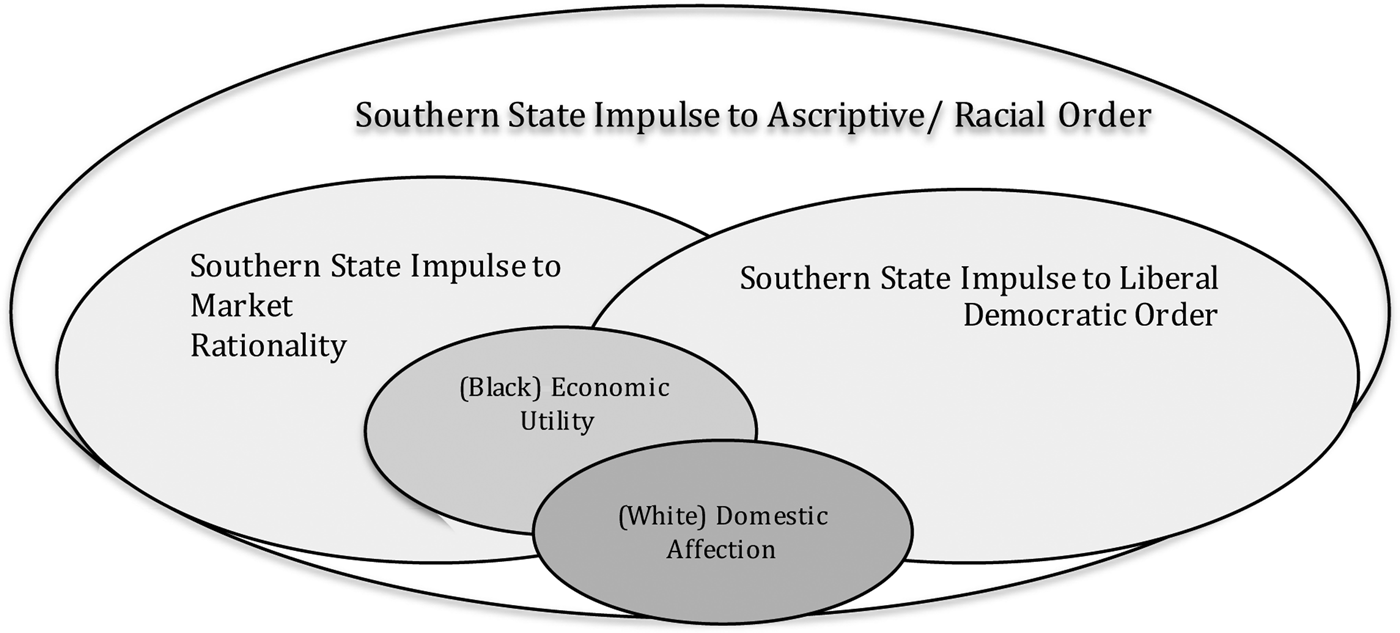
Southern states’ commitment to slavery above all else meant a commitment to white supremacy, ordering social and political experiences along ascriptive lines of racial difference, and “standardiz(ing) inequality, by fixing racial interactions in predictable and orderly ways.”Footnote 29 The commitment to white supremacist racial ordering infused all other Southern state commitments, including (as depicted in Figure 1) its increasing commitment to the liberal market and democratic order. Nature-based standards of family were central to both of these evolving traditions in the antebellum South.
Southern Slave State Impulses and “Natural Family Standards” of White Domestic Affection and Black Economic Utility.

Within market liberalism, it is well known that slavery was accommodated as part of an individual's natural right to liberty and property.Footnote 30 However, overlooked is the fact that the naturalness of an individual's right to property also rested on the idea of natural human desire to acquire, earn, accumulate, and alienate property for his family. For example, in his Speech on Slavery, South Carolina slaveholder Edmund Bellinger gave voice to the prevailing Southern view that “negro slavery … is our property, like other property, bequeathed by our parents, or earned by the sweat or our brow—by the hard efforts of honest industry … no authority on earth has the right, nor … the power, to strip us of that property or to crush the hope that we will be enabled to leave some small pittance to our children.”Footnote 31 As we shall see in the following court decisions, providing for one's children during one's lifetime and even after death was constructed as a natural paternal impulse warranting the highest consideration, and this acquisitive familial right underscored the need for stable expectations for continued mastery and liberal (contract-based) market conditions of ownership, exchange, and alienation of enslaved human property.
More fundamentally, white family property rights over enslaved blacks entailed a broader state commitment to a standard of inherent, black economic utility, that is, the commodification and economic utility of an enslaved black person—her body, life, and monetary worth. Commodification of human beings into quantifiable economic value or price, what historian Walter Johnson has seminally called the “chattel principle,” was “the being of slavery.”Footnote 32 The body and humanity of enslaved persons—and their complex lives as parents, children, adversaries, friends, and lovers—were at all times essentialized and held to a standard of economic value even if they themselves were only episodically priced, and “any slave's identity might be disrupted as easily as a price could be set and a piece of paper passed from one hand to another.”Footnote 33 Through a variety of state-supported commercial, accounting, and management techniques, such as using enslaved people as collateral for mortgages, as the basis of speculative futures or as means for credit, payment of debt, or in direct sales as consumer goods, quantification into market value rendered complex black lives and personhoods into units of exchange, into fungible human capital and personal property.Footnote 34 Within slave economies, state commitment to market order, to stable commercial expectations, and to norms of natural property rights rested on this standard of black economic utility. As legal historian Alfred Brophy has demonstrated, antebellum Southern jurisprudence was committed to fostering market competition and thus consistently favored protection of market conditions over the fate of enslaved human beings, assembling and privileging the hard standard of utility over abstract morality, humanity, and sentiment.Footnote 35
Although not the primary focus of the present article, note that the standard of black economic utility was also, in part, framed as a nature-based family standard, one that was largely centered on the body of the enslaved woman.Footnote 36 The reproductive capacity of enslaved women was attributed with distinctive utility as a “natural” form of property increase.Footnote 37 The common-law doctrine of partus sequitur ventrem, which held that the status of the offspring follows the condition of the mother, meant that enslaved childbearing served as an important mechanism of wealth generation for slaveholders, and the purchase of a “breeding” woman implied economic investment that could potentially amplify over time, in some cases more so than the labor of an enslaved man.Footnote 38 Reproduction and child bearing were seen as fundamental aspects of intimate family behavior constructed as inherently personal and familial in the context of white families. But by the third and fourth decades of the nineteenth century, reproduction and child bearing in the case of enslaved African American families were seen wholly in terms of economic utility, as part of profit and the regime of whites’ natural rights to property and ownership.Footnote 39 The primacy of black economic utility over considerations of humanity legitimized and accommodated the massive scale of black family disruptions through the sale and separations as well as forced “breeding” and enforced child-rearing practices, such as wet-nursing, to which primarily enslaved women but also some enslaved men and children were subjected to.Footnote 40
The nineteenth century also witnessed the tide of liberal democratic reform across the country, and Southern slave states too made increasing commitments to universalizing white male suffrage and upholding a more liberal political order based on the supremacy and political equality of white males.Footnote 41 At the core of white male political equality in the South was commonly assumed role of men as head of a (slave-owning) household. With the emergence of a market economy, republican theorists worried that wage labor could foster dangerous dependencies among citizens. Through the ideology of domesticity, family was elevated as a necessary counterweight to market imbalances.Footnote 42 A haven in a heartless commercial world, the domestic sphere was extolled as the site where republican virtues would be rekindled, preserving and restoring republican political values despite the onslaught of market competition and wage dependence.
For defenders of slavery, slavery was the “most perfect state” of harmony between republicanism and domesticity in contrast to wage markets.Footnote 43 They argued that slavery fused household and agricultural production within the plantation, enabling domestic republican values to organically permeate the sphere of production, preventing the tension between labor and capital in free-labor societies, and resulting in “true” political equality for all white males.Footnote 44 Widespread agreement over men's natural governing authority over household dependents including enslaved workers fueled the democratization of white male rights in the antebellum South.
By their daily control, command, and governance of household dependents, wives, children, and slaves, white men were seen to continually practice and earn their political liberties, demonstrating their eligibility to be equal citizens in the republic.Footnote 45 In this way, the slave South was commonly presented by Southern political thinkers as the last republic loyal to the principle of government by an exclusive citizen body of independent and equal white men, where male rights and liberties could be truly cultivated and earned, primarily within the domestic household.Footnote 46
For many political elites, certainly by the antebellum period, the tie between household governance and Southern republican rights and virtues was best exemplified and embodied by the planter-patriarch, an idealized master who served as the standard citizen that white men largely looked up to and sought to emulate.Footnote 47 Calhoun told the Senate in 1838, “Every plantation is a little community with the master at its head, who concentrates in himself the united interests of capital and labor, of which he is the common representative.” Presiding over the plantation as a “little community,” the planter was at once the master of wives and children, governor of slaves, and “common representative” of all household dependents, providing the economic, moral, and familial organization that held the little community together.Footnote 48 Rather than solely an economic or labor system, racial slavery was thus first and foremost a domestic, familial institution. And the white slaveholding planter family, or household, was the very site by which the system of slavery was made compatible with republicanism and liberalism, where public good and white male rights originated and were continually regenerated through a stream of daily acts of household mastery.Footnote 49
At the center of this political construct of family lay the naturalized standard of domestic affection that marked a “true” patriarch and slaveholding master. Domestic relations based on affection were increasingly valorized in nineteenth-century American society.Footnote 50 Presumed natural feelings of affection, altruism, and concern for others within the family were imagined to uniquely mark family and domestic relations in contrast to the market or public sphere. Calhoun, for instance, held that an “exception” to the “general and well understood law of our nature … that our individual [feelings] are stronger than our social feelings” were the “peculiar” and “extraordinary” relations “as that of a mother and her infant” in which social feelings for one's children overpower self-concern.Footnote 51 As legal scholars have acknowledged, by the early nineteenth century, “the web of affection and reciprocity” characterized the marriage and family bonds of most Americans as accommodated within the American legal system, much more than in England.Footnote 52
In New England and other wage societies, the elevated importance of domestic affection resulted in rights liberalization within the family and the incremental diminution of the rights of the patriarch. In contrast, the South was a region wedded to the institution of slavery and natural hierarchy, and thus the new focus on domestic affection served to further uphold the rights of the patriarch to control and govern household dependents.Footnote 53 Southern courts defended paternal authority strenuously and adopted domestic affection as an additional ground to extend (not limit) the power and the rights of the patriarch in new ways, in some instances even contradicting stated public policy.
In the antebellum period, paternalistic affection for slaves was the very justification for slavery. Mirroring the prevailing philosophy of paternalism that defended slavery as a positive, humane good, Southern courts constructed the bond of affection between master and enslaved as natural and organically arising from the many everyday domestic interactions between the two. The paternalistic affectionate master idea counteracted the abolitionist imagery of cruel and inhumane masters as a misrepresentation of the social practice of slavery. For instance, an 1835 report of an ad hoc antiabolition committee that convened in Calhoun's home district of Pendleton lamented, “the whole subject of Master and Slave … is one grossly misunderstood, and still more grossly misrepresented out of the States where the Institution prevails.” Instead, the committee declared that slavery “resembles … a happy patriarchal state in which the benevolence and kindness of the master, and the fidelity and affection of the slave” work in concert with one another and “in a harmonious manner.”Footnote 54 South Carolina Congressman James Henry Hammond (and later governor), who recorded his sexual abuse of several enslaved women and four of his own nieces, similarly stressed in a letter in 1845 that the South's “patriarchal scheme of domestic servitude is indeed well calculated to awaken the higher and finer feelings.”Footnote 55
The affective paternalist ideal became a deep-seated norm by which white southerners—slaveholders and non-slaveholders alike—came to benignly view themselves as well as the institution of slavery. This norm continued to hold sway even after the collapse of slavery. The abolitionist Henry Ward Beecher called on William Aiken Jr. at the end of the Civil War, in April 1865, to discuss the South's future. Aiken, the former governor of South Carolina who had owned close to a thousand enslaved people before the war and was a prominent Unionist, stressed his disagreement with Lincoln's Emancipation Proclamation. Instead, he reportedly talked at length about the misunderstood affectionate relationship he shared with his slaves. The governor's tales were typical of white southerners, and Beecher wrote, “there is liturgy on this subject … you may take a thousand Southerners at Saratoga and Newport, and they will all repeat the same story of their care and nurture of the slaves, and of the addiction of the slaves to them.”Footnote 56 Tellingly, of course, Beecher also reported that when he spoke to Aiken's former enslaved workers, they painted an entirely different picture.
Antebellum Southern courts’ construction of patriarchal domestic affection was thus a critical political exercise in state authority. The courts set the standards of natural family affection as defining patriarchal-male conduct, and thus exercised state authority to construct social norms and behavior to defend slavery and to align white intimate relations to the emerging liberal capitalist and democratic order of the slave South (see Table 1). The next section turns to an empirical investigation into just how the courts constructed and accommodated patriarchal domestic affection—toward slaves, children, wives, and mistresses—from the messy and fluid context of intimate family lives, naturalizing certain relations and practices, ignoring and trivializing some, while commodifying others.
Natural Family Standards Embedded within Liberal Market and Democratic Traditions

2. Domestic affection
Starting in the Revolutionary era and maturing in the nineteenth century, Americans in both the North and South increasingly acknowledged and associated romantic and parental love, affection, and a wide range of tender feelings to define and distinguish familial relations from other social and political interactions.Footnote 57 White antebellum litigants aggrieved by family members or claiming rights based on their family status increasingly referenced affection and affectionate practices to evidence their family ties in judicial cases.Footnote 58
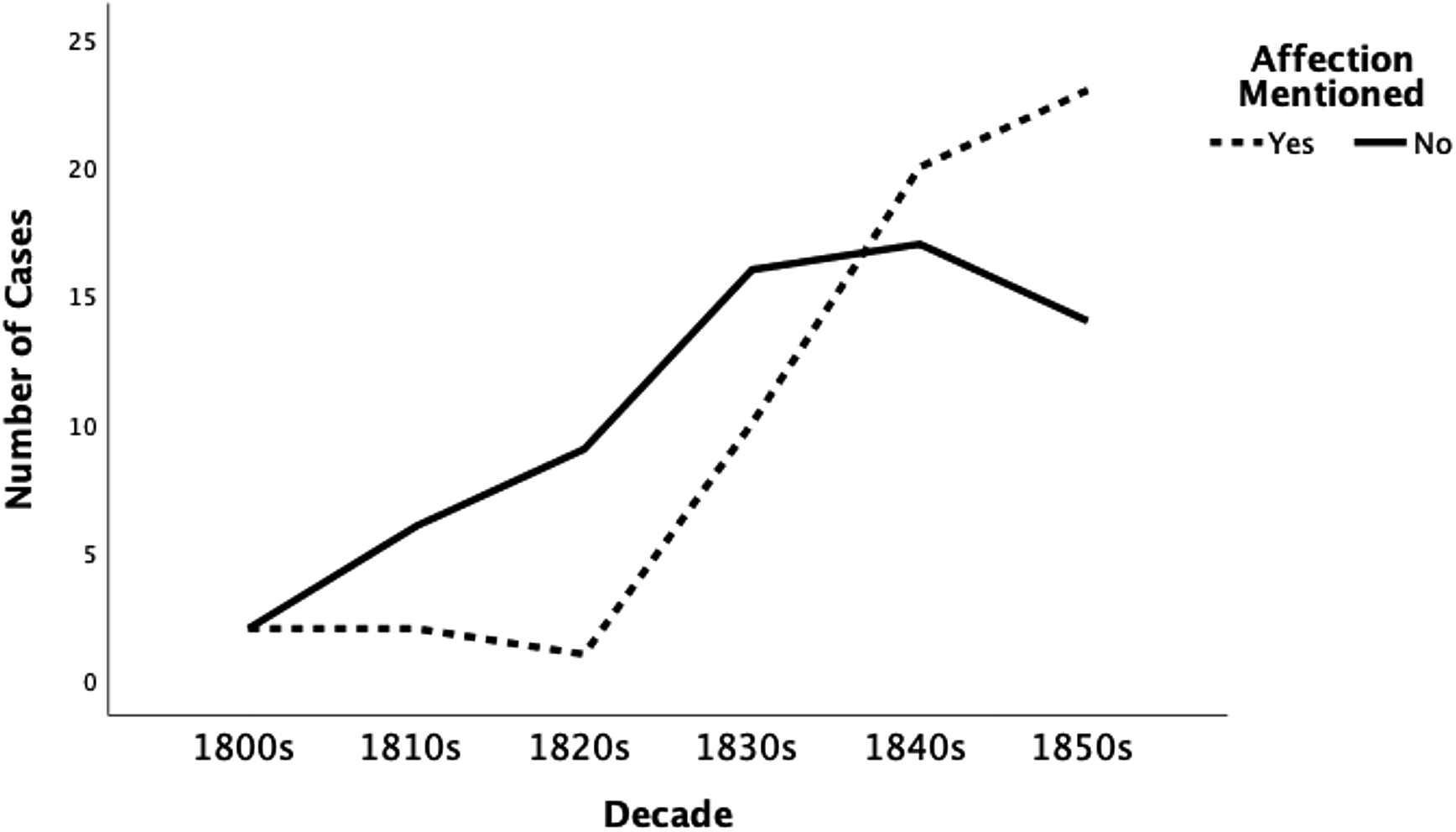
As seen in Figure 2, starting in the 1830s feelings of affection within the household were progressively invoked by parties in the cases before South Carolina courts. By the 1840s and 1850s a majority of the cases mentioned such affective ties. In suits involving the law of slavery, the recovery of enslaved property, inheritance, emancipation, personal injury, contracts, alimony, or even determination of race, judges and juries were presented with reams of testimonial evidence, documenting minute everyday household interactions, from which they selected some as appropriate demonstrations of domestic affection with legal consequences and eschewed others.
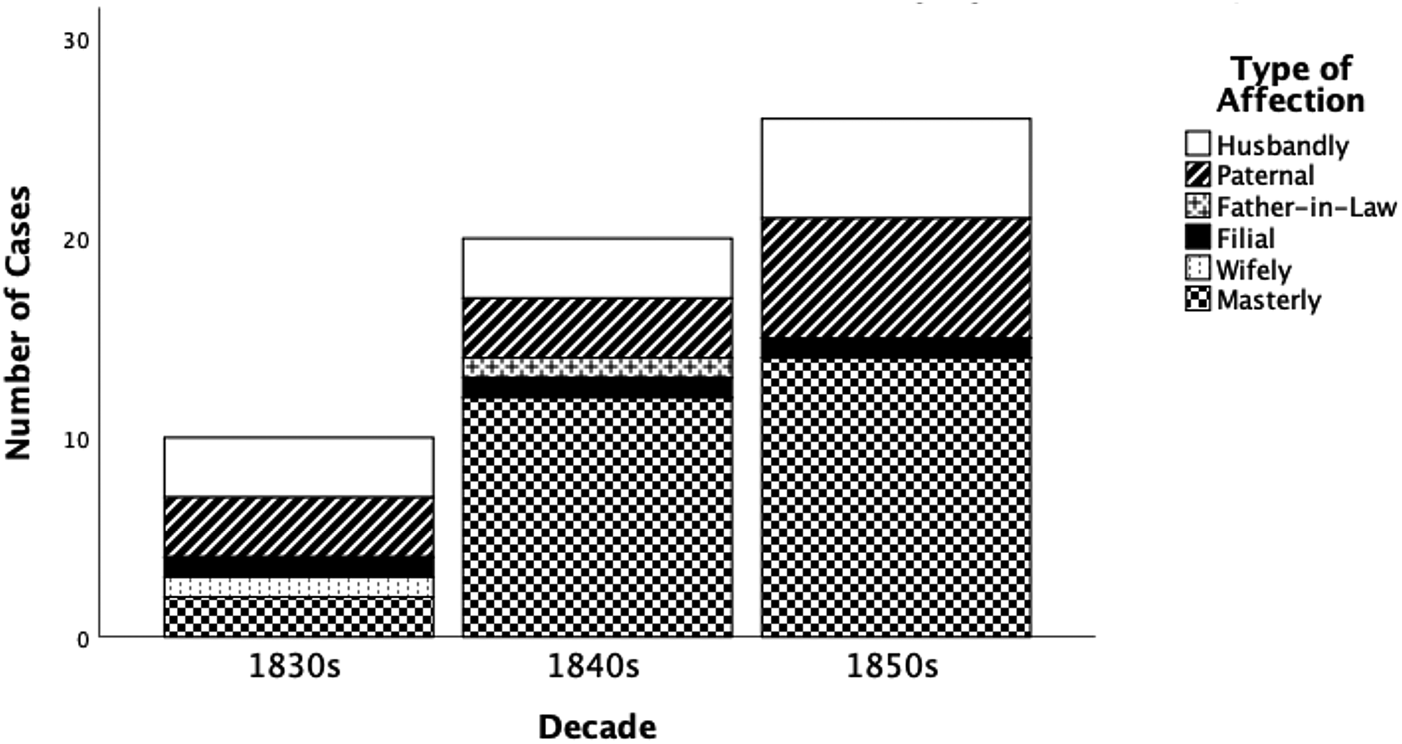
For both Southern judges and litigants, assumptions and express invocations of affectionate family practices largely revolved around the white man as father, husband, and master. The cases are writ large, with details regarding (white) fatherly love for children; fatherly sentiment toward sons-in-law; husbandly devotion to wives; masculine feelings toward neighbors, siblings, and friends; and white masterly feelings of kindness, benevolence, and sometimes passion toward enslaved blacks. Figure 3 illustrates the extent to which domestic affection referenced in the antebellum cases in South Carolina was unquestionably masculine and increasingly applied to the white master. Only one case in the 1830s referenced affection by a wife, and contrary to prevailing Northern conceptions of domesticity, none referred to maternal love or affection. Whereas the number of cases invoking affection by husbands remained somewhat constant across the three decades, there was a sharp increase in the number of cases where, either in testimony or in the decisions, feelings of affection by a master were described. References to fatherly affection to his children also increased substantially in the 1850s. As we shall see in the following narrative, judges in their decisions were most apt to recognize a white patriarch's expression of love, affection, and responsiveness toward his wife and children through his role as master and through the exercise of his control over enslaved blacks. By the 1850s, at the height of the paternalist defense of slavery, domestic affection was described in antebellum South Carolinian courts almost entirely as a standard of white patriarchal conduct, pivoting on the role of the white man as father and master, and only secondarily as husband.
Mention of Affection in South Carolina Law and Equity Family Cases, 1800–1860.
Notes. Data compiled by author. N = 122 cases. For case selection methodology, see footnote 16.

Kind of Affection Referenced in South Carolina Equity and Law Cases, 1830–1860.
Notes. Data compiled by author. N = 122 cases. For case selection methodology, see footnote 16.

The following sections parse the intricate ways by which the courts exercised authority in naturalizing and constructing white patriarchal affection. In so doing, judges in the antebellum years from 1830 to 1860 separated and elevated the white, patriarchal, slaveholding family as a unique bundle of hierarchical affective relations to be distinctively accommodated in the law, altering and, in some cases, making exceptions to prevailing legal doctrine. Progressively through the 1840s and 1850s, judges were evidently more self-conscious of their judicial role in upholding or excepting legislative public policy and were far more apt to reference “public policy,” particularly in regard to the policy of slavery and manumission. In 38 percent of the cases decided in the 1850s, judges referred to questions or concerns over “public policy,” compared to 33 percent of cases in the 1840s and only 23 percent of such cases in the 1830s. Through “natural affection” the courts played an active, self-conscious, role in antebellum politics, cohering the white propertied patriarchal family to the defense of slavery and to the emerging market liberalism of the South.
2.1. Fatherly affection—patriarchal provision and gifting the enslaved
The courts were apt to construct paternal affection as natural in cases involving white fathers’ purchase and gift of enslaved blacks to their children. When determining the question of lawful ownership over human property, that is, which family member legally owned a disputed enslaved servant, the courts navigated complex family arrangements, weaving through intermingled white family lives from childhood through adulthood, cradle to grave, constructing natural patriarchal affection through certain kinds of actions as opposed to others. By so doing, judges elevated the property interests of white fathers over other family members, notably sons-in-law and adult daughters.
Crafting of the domestic affection legal standard also involved the cold commodification of enslaved children and their families and a practiced blindness to the bonds of affective attachment among black families and kin. Whereas for white family members the gifting of slaves was an apparent demonstration of affection, care, and concern for one another, often celebrating a joyous occasion such as a marriage or birthday, for enslaved persons such milestones in the lives of their owners were potential calamities, portending the possible separation and permanent dissolution of their own family bonds.Footnote 59
Through posthumous bequests in wills and also during the course of their lives, slave-owning white fathers routinely gifted enslaved people—mothers, fathers, children, wives, and husbands themselves—to their children, in many instances to mark special life occasions such as baptisms, birthdays (especially twenty-first birthdays), holidays, marriages, childbirth, or widowhood. Justice Johnson for the South Carolina Court of Appeals pithily acknowledged the widespread practice of gifting enslaved people to daughters upon marriage as an outcome of natural parental sentiment: “where a parent is able, it is not only usual, but very natural to make some provision for their daughters on their marriage.”Footnote 60
Gifting of enslaved people often involved an intimate ritual in the presence of family and friends whereby the father placed the hand of the enslaved person into those of his child and recited words to indicate transfer of ownership.Footnote 61 Witness testimony in the case of Miller v. Anderson detailed how James Miller, on the morning after he buried his wife and in the presence of his mother and several family friends, apparently “called up three little negroes, Bob (about the size of Edmund, his son) Sue, (about the size of Mary, his daughter) and Elvira, (about the size of Emily, his youngest daughter) and putting Bob's hand into that of Edmund, Sue's into that of Mary, and Elvira's into that of Emily made the gift, saying the negroes were to be theirs (the children's) at his own death, and that what he did was done in compliance with his wife's death-bed request.”Footnote 62
Despite such ritualized public gifting, complex family lives rendered the legal fact of individual ownership difficult to untangle, which invited judicial innovation. In several cases, slaves were gifted in the form of parol gifts, that is, oral, unwritten transfers, whose evidence of delivery and intention to gift (the two components of a legal gift) were often unclear. Enslaved people thus often remained in the possession of the original master/father long after the children reached maturity and established independent marital households, complicating determinations of legal transfer of title. Evidence from cases also reveal that several enslaved people, out of feelings of attachment to kin and preference for one or the other master's households, often resisted transfer to new residences, further muddying the legal waters.
In the case of James Miller, Elvira, gifted to his youngest daughter Emily, remained at James Miller's household even after Emily was married and “settled off.” Miller's son, Edmund, moved upon his marriage to oversee a plantation of his father's on Horn's creek, where Bob, his childhood slave, worked as one of the hands, but when Edmund moved to another of his father's plantations, called Poverty Hill, Bob did not move with him and continued as before, “parcel of the Horn's creek gang.” Miller also retained possession of Sue, who was gifted to his second daughter, Mary, notwithstanding Mary's marriage and “settling off” ten years prior. A witness told the court that a short while after Mary's marriage, he rode up one morning to Miller's home and found him whipping Sue; by way of explanation, Miller stated that “Sue behaved badly; that when Mary went to herself, he had given Sue to her, but she was so mean that Mary would not have her, and he had been obliged to buy another to put in her place.” Sue received lashes for her lack of compliance in Mary's household, but by her resistance she was able to be moved back, successfully preventing her forced separation from her children who had remained at Miller's.Footnote 63 The judge and jury were left to untangle legal title to Elvira, Bob, and Sue, despite the fact that they remained with the father and were not in the possession of the (now adult) children.
The widespread practice of intrafamily gifting of enslaved workers, particularly children, to Southern white boys and girls early in their childhood was a deliberate act by which white slave-owning parents evidently planned the financial futures of their children and meant for the young owners to grow up alongside their slaves. In South Carolina the phrase “daily gift” was used to refer to the gift of enslaved people from a parent to a child, underscoring the everyday dominion expected from, and practiced by, young slaveowners over their slaves.Footnote 64 Jennie Fitts, for instance, recalled being gifted by her owner to his daughter, Annie, when she was still a girl, “Ise can membah whens de Marster takes me to Missy Annie and sez, “Ise gibin you to Missy, You jest do what she tells you to.” Jennie described the extent to which she was expected to practice daily servitude, by being with her “alls de time” to “tend to her.” “Ise wid her night and day,” she said, “Ise sleeps at de foot ob her bed. Ise keeps de flies off her wid de fan, gets her drink and sich, goes places fo’ to get things fo’ her. When she am ready to go to sleep, eber night, Ise rub her feet.”Footnote 65
In Moultrie v. Jennings, Ebenezer Hill was proved to be “much attached” to his stepson, Lewis Moultrie. Sometime after the untimely death of Moultrie, Moultrie's wife left their son Lewis Jr., 2 or 3 years old, with his grandmother and step-grandfather, Ebenezer, for a short while. When Lewis's mother came for him, Ebenezer asked her “if Lewis (Jr.) had told her that he had given him a negro? She said no. He said he had given one to her daughter, Sally who was named after his wife, and that he had also given Jinsey to Lewis, who was named after his father” and that he intended to make additional gifts to the other children of his deceased stepson, “equal to these two, by will.”Footnote 66 Despite the express gift to his step-grandchildren, Ebenezer Hill retained possession of the enslaved children, nevertheless consistently referring to them as Sally's or “Lewis's negro.” Witness testimony revealed that during their visits, Mr. Hill would update his stepdaughter-in law on the development of the enslaved children, the purported property of her children, saying, “Lewis's negro outgrew Sally's,” and “on some of those occasions he would make Lewis bring in the negro child, Jinsey, to show her to his mother.”Footnote 67
The prevailing legal principle was that permitting personal (enslaved) property to go into the possession of the child, usually the daughter, on her marriage and to remain there a considerable length of time was sufficient evidence of a gift. However, the courts acknowledged the presence of many “delicate” feelings that organically arose within family relations, particularly between fathers and sons-in-laws (the legal guardian of his wife's property), which, they said, often intervened to naturally alter the donee's expectations and willingness to enforce clear legal claims. “The very delicate relationship which subsists between the father-in-law and the son-in-law,” said Justice Johnson, “is a complete barrier to the latter's making any demand upon him as to the precise terms on which property is put into his possession. It is notorious that these things are usually negotiated through the mother, who ascertains the will of the father … but when this delicacy is gotten over, they never think of calling in witnesses to attest the gift, when each feels himself secure in the confidence and friendship of the other.”Footnote 68 Acknowledging and naturalizing family affective dynamics between father and son-in law and the intuitive nature of family relations as confounding clear and precise transfer of possession, the judge deemed the mere evidence of the ritual gifting (even without delivery) and the ongoing acceptance of the children's title by the father as “satisfactory,” upholding the verdict of the jury and the legality of the gift.Footnote 69
In a similar case, M'Ginney v. Wallace, Justice Evans of the Court of Appeals overturned the lower court's order and ordered a jury trial despite lack of delivery of enslaved Pat and her subsequent children to the plaintiff. Charles Hopkins had placed the hand of his enslaved servant, Pat, into the hand of his granddaughter, the plaintiff, saying to those present, “this is no longer my property, but this child's,” also adding, “but daughter, you must let her work for grandfather while she lives.” Despite the rule that all verbal gifts required to be perfected by delivery (which had not occurred), testimonial evidence involving shared family practices such as the fact that Hopkins always spoke of Pat as the “plaintiff's negro; and when the negro was sick, he had sent for the plaintiff's mother (his daughter) to nurse her; and she also paid the expenses of her confinement when her children were born” made the judge instead order a jury trial, holding that the facts were “not so clear as to take the case from the jury.”Footnote 70
Subsequent court decisions additionally looked for evidence regarding when a patriarch who often died intestate (i.e., without a formal will) intended the title to pass to the child. If it appeared that he intended to convey the title at the instant of making the gift, reserving the custody in himself but for their benefit, then it could be legally conveyed by parol, but if he was found to have intended to “pass a title to them in presenti, to take effect at his death, interposing in the meantime, a title in himself, for his own life, and for his own benefit,” then the gift could not occur by parol.Footnote 71 In making their determinations, judges considered evidence involving complex calculations on the part of fathers to provide for their married daughters and sons as offset against their own needs and ideas regarding enslavement. In the previously discussed case of Miller v. Anderson, a witness described a conversation he had had with James Miller on his piazza, who subsequently died intestate. Miller was “giving vent to his grief” upon the death of his children Edmund and Emily and “spoke of his endeavors to provide for them.” Miller recounted “how he had bought or furnished the means of buying, several negroes” for his daughter's husband, “and for Edmund, he had bought a family of negroes at Capt. Weaver's sale.” The witness then recalled that Miller “spoke of the reason of his not having given possession, which was, that he had no more negroes than he wanted, and that he disliked separating families of negroes and substituting others or strange negroes in their stead, for negroes were troublesome at best, and that it was time enough for them to have them at his death, when he was dead and gone.”Footnote 72 Paternal affection as underlying a white father's wish to provide for his children and to plan for their financial futures from childhood or upon their marriage or otherwise was thus presented to, and acknowledged, by the courts as a natural standard of domestic affection for white slaveholding patriarchs, such that the courts were apt to consider the legality of a father's gifts of slaves even when there was no clear delivery or transfer of possession.
Acknowledged as a universal habit, the Chancery Court came to declare that gifting enslaved people at marriage was part of the expected “moral obligation of a parent to provide suitably for his children, and the necessity for it is the more cogent upon their marriages, when they usually leave the parental roof and set out to provide for themselves.”Footnote 73 Courts played an additional role in constructing patriarchal gifts of enslaved property as absolute and not temporary, to discourage “the capricious and arbitrary will” of the parent, as Justice Nott explained in Brashears v. Blassingame, “if a gift of property to a son or daughter, on their marriage to be taken back at any indefinite period of time, at the capricious and arbitrary will of a parent, can in any case be viewed as a loan, I certainly think it a kind of loan not much to be encouraged.”Footnote 74
Gifting human beings was but one of several other paternal practices by which the courts endorsed and constructed patriarchal generosity: the ability and aptitude (and obligation) of the male head to determine and provide for the needs of his household dependents.Footnote 75 Through public legal acts of marriage settlements, trusts, and purchase of enslaved people with the express purpose of providing for wives or children, a slave-owning patriarch could, in effect, buy “life insurance—a legacy that would insulate his family from the effects of his own death.”Footnote 76The extent to which public purchase of slaves for family purposes was considered a distinctively masculine activity is evident in commercial slave trades, where such transactions were publicly recorded under the common heading of “patriarchal provision.” This included sales made to husbands or fathers who declared their intention to provide for wives and children, to do household work, to care for children—“to have a comfortable home.”Footnote 77
White male heads of households widely adopted the language of natural affection in transacting for slaves. Owen Smith, for instance, executed a postnuptial trust deed “for the consideration of the love and affection I bear towards my family, and my natural desire to provide for them,” by which he granted 100 acres of land and Hester, an enslaved woman “and her future increase” to his wife, Susannah Smith, and to “such child or children as she now has or may hereafter have by me.”Footnote 78 J. F. Smith similarly wrote to friends describing his intention “to purchase a girl of 18 or 20 years of age or a woman and children so that if I should be called away from my family they will at least have a comfortable home with servants sufficient without hiring and that will bring if sold double the original cost.”Footnote 79
Courts applauded the efforts of white patriarchs to provide for their families in life and after death, also recognizing these sentiments as the fundamental basis for private property accumulation, productivity, and capitalist enterprise. In adjudicating the estate of Daniel Huger, an illustrious South Carolinian planter and statesman of much repute, the Circuit Court in Huger v. Huger celebrated his vast property holdings, “a large portion [of which was] acquired by his enterprise and skill in agricultural operations,” as well as “his honorable name, distinguished for his eminent personal worth, by the high stations he had occupied, and by the services he had rendered his county.” Huger had left behind four sons, whom the court recognized as rightful heirs “to transmit his name and lineage to future times.” “Is it not natural,” asked the judge of the Circuit Court, “that he should desire, or at least have been willing, with his name to transmit his estate, or, at all events such portions of it as his sons should be entitled to?” Indeed, affirmed the court, such “sentiment” on the part of the deceased planter was “a natural feeling … one founded upon or accompanied by honorable ambition.”Footnote 80
As the next section demonstrates, in the case of white women, especially those from the upper ranks of South Carolina, the courts increasingly protected their ownership over slaves gifted or bequeathed from their fathers. The courts enhanced women's rights in marriage, sometimes even at the expense of their husbands, constructing a hierarchy of natural masculine domestic affection in which paternal affection for children often superseded husbandly interests.
2.2. Husbandly affection—marriage settlements and dominion over the enslaved
During the nineteenth century two distinct sets of legal principles, those of common law and equity law, governed the status of women in states such as South Carolina that were previously British colonies. Under the common-law doctrine of coverture, a wife's legal identity merged with that of her husband, with the husband solely representing the partnership.Footnote 81 A married woman (called feme covert) could not own property, either real or personal. All personal property that a woman brought to marriage became her husband's property absolutely and was subjected to his control, management, and debts. Married women, additionally, could not make independent contracts, initiate lawsuits, execute separate wills, administer an estate, or conduct sales.Footnote 82
However, unlike common law, equity law administered by the Courts of Chancery in South Carolina was more sympathetic to the financial precarity of wives. Chancery (equity) Courts departed from common-law strictures by recognizing a wife's separate estate in her property as a positive right.Footnote 83 In cases involving white married women's property rights over slaves, the courts were often involved in contests over whose intentions and wishes should prevail—her father's or her husband's? In so adjudicating, the courts not only naturalized a hierarchy of natural familial affection (father over husband) but also constructed when and how husbandly conduct would amount to legitimate expressions of domestic affection.
For Southern white women, owning enslaved people—the most valuable form of personal property—allowed them to mitigate some of the harshest elements of the common-law regime as it operated in their everyday life. As historian Stephanie Jones-Rogers has argued, for such white women “slavery was their freedom.”Footnote 84 Ownership of human beings, even a few but more likely scores, reaped great dividends for white women, greatly enhancing their prospects of marriage and their ability to control their own financial destiny and those of their children. For some, it held the possibility of class mobility, and for others, it cemented their upper-class status. On an everyday basis, slave ownership gave white women power, not only over the enslaved but also within their marriage. The term mistress denoted a woman's legal status as one who exercised “dominion, rule, or power” over bonded human beings, comparable to the authority of their husbands.Footnote 85 In practice, slaveholding white women were as likely to use various techniques of discipline, violence, control, and management of their bonded labor as did their husbands and fathers.Footnote 86
Equity Courts professed a self-described mission “of vigilance to protect” women from predatory suitors and husbands, acknowledging the necessity “to defeat the acts of those who creep into men's houses, leading silly captive women.”Footnote 87 Although marriage was a civil contract between two (nominally equal) parties and homes were designated unequivocally as “men's,” Equity Courts intervened on a case-by-case basis to protect the inherited property interest of women from the dominion of their husbands.
In the proceeding In Re Susan Huff, Susan Huff of Goose Creek parish in South Carolina was a 43-year-old woman, who owned some eight slaves, whom she had derived from her mother and grandfather. In April 1850 she was married to Thomas Blankton in a rushed ceremony, with only the groom's relatives present, and her own relatives having no knowledge of it. Upon gaining control of her property through marriage, Thomas sold all her slaves. The case involved the determination of whether Susan was of sound mind, capable or not of legally entering into a marriage contract. The decision turned on statements from witnesses who had known her from childhood who testified that “her father and mother both thought she had not good sense.” And that, “her mother used to watch her, not let her go about much,” and even though Susan wanted to get married, “her mother sent someone with her always; said she was afraid somebody would marry her, and take away her property.”Footnote 88 Upholding equity case law that “it falls to the Court to take care of those who can not take care of themselves,” Chancellor Dunkin maintained that to give this court jurisdiction, “it is not necessary to shew such a state that the party could … not know his father.” But instead, “the inquiry is, whether his capacity is of that kind that fits him for the government of himself, and the management of his affairs.”Footnote 89 In so doing, the court voided the marriage and the sale of Susan's slaves, curtailing the rights of her husband, Thomas, over her inherited property.
Time and time again, Equity Courts were willing to preserve a woman's natal family interest in enslaved property over her husband's, privileging the intimate knowledge, intentions, and opinions of parents, particularly fathers, over those of suitors. Equity Courts ascribed to wives the capacity to govern and manage their own affairs, separable from their husbands, particularly in the context of management of enslaved people who were received from their natal families. In interpreting marriage settlements liberally, in terms that favored women and not their husbands, Equity Courts upheld the intention of creators of separate estates, primarily fathers, but sometimes the women themselves, to vest management of derived property in the women rather than in trustees or husbands, shielding the family property from the husband's possible ineffectual business dealings and subsequent creditors.Footnote 90 In so doing, the courts not only elevated and naturalized affective interest of parents in providing a family fund for their daughter but also standardized slaveholding prospects, control, and daily dominion over enslaved people for white men and women, white boys and girls, within slaveholding families.
Apart from protecting slave and personal property of affluent wives through the instrument of marriage settlements, in most other aspects Southern courts and legislatures were far less likely to challenge the authority of husbands over wives.Footnote 91 Within a marriage, a husband's right to “govern when they could not agree” and “the duty of a wife to submit” were widely upheld by courts of law.Footnote 92 Southern courts were reluctant to give a woman custody over her children, without strong evidence of her husband's incompetence and her own suitability.Footnote 93 In South Carolina, divorce was not permitted under any circumstance, and alimony, payment to wife upon desertion, was granted only in the most extreme circumstances, when there was “bodily injury” or cruelty, proven desertion, or for “obscene and revolting indecencies practiced in the family circle.”Footnote 94 Unlike in most other states, adultery by the husband was not an adequate ground for alimony.Footnote 95
When husbands were tolerably kind and affectionate to their wives and could demonstrate an overarching family-focused economic rationality for their actions, then wives’ preferences, decisions, and individual claims were considered far secondary. In a suit for alimony against her husband Irvine, Rebecca Hair alleged that she had married him based on his solemn promise to her prior to their marriage, “never to remove her, without her consent, from the neighborhood of her mother, or to a place where she could not enjoy her mother's society, and that of her friends.” Contrary to that promise, he had deserted her and their infant daughter by renting the land on which the family resided, selling off most of their chattels and carrying away the family's slaves, Ann and her child Josephus, and attempting to take Hagar, who instead escaped and returned to Rebecca, to Louisiana in the dead of night.Footnote 96 Irvine admitted the desertion, but offered as an excuse that he had left some provisions for this wife and child and hoped his mother-in-law would take in his wife and daughter “for a time until his wife's interest and affection should induce her to follow him abroad, where prospects of success in agriculture were brighter.” He claimed to have left at night “to avoid a scene fearing the effects of his wife's affectionate persuasions to remain [t]here contrary to their interests … trusting that in a few months her fondness and isolation would constrain her to follow him.”Footnote 97
The evidence revealed that almost all of the property owned by the Hairs—their enslaved servants, their home, and their farm—was acquired from Rebecca through their marriage and that her mother continued to play a prominent role in their lives. Irvine, in fact, claimed the “malign influence” of his mother-in-law in his “domestic reign.” The couple had lived with Rebecca's mother for the first year of their marriage, when their daughter was born, and they subsequently moved to a small farm within half a mile of Rebecca's family home, which her mother had purchased for them. On the farm, Irvine said they “lived in general harmony, disturbed only by such casual miffs as are sometimes found among consorts in their sphere life.”Footnote 98 Although the evidence hints at “some immoralities on his part,” which had become known to Rebecca, these were not brought to issue, and instead Irvine highlighted the fact that his wife in her complaint “does not venture to charge him … with having been wanting to her in tenderness, respect and affection” and that he “renews the offer to take his wife and child with him to Louisiana and provide for them to the best of his ability.”Footnote 99
As was typical, the court failed to notice the affective family ties of the enslaved women, Ann and Hagar, and how their family affections no doubt greatly shaped their actions and consequently their fate. The evidence attests that Ann and Hagar were called to the field at midnight under the pretense of driving the hogs out, and they “made a great outcry” when Irvine attempted to seize them. Being unwilling to go, Hagar was able to escape and subsequently returned to the house, whereas Ann, who was claimed to have been “overpowered,” went with Irvine, who had possession of her young child, Josephus. Ann and her son Josephus thus stayed together and were removed to Louisiana, whereas unattached Hagar remained with Rebecca and continued to serve her.
In his opinion, the circuit judge, Chancellor Warlaw, seethed at the “unmanly conduct of this husband” and his “clandestine desertion,” and decried “his purpose to follow lucre, and leave his consort, and their helpless offspring without shelter or sustenance.”Footnote 100 He accordingly decreed that Irvine pay alimony to Rebecca. Reversing the lower court's decree, Chancellor Dargan of the Appellate Court instead opined that “some of the promises of a suiter [sic] to conciliate his mistress may not bind his conscience, as when they are made playfully, or would serve, if fulfilled to impair the obedience she owes to a husband, by law and religion.” The court more approvingly adjudged Irvine's speculations for wanting to move his family to Louisiana, citing that his current land was poor and that he wished “to better his condition, by moving to a country where lands were fertile and cheap” and where some of his own relatives had previously emigrated.Footnote 101 Noting that Irvine had “most earnestly solicited” Rebecca for years to accompany him, the court upheld his decision to move to Louisiana over his wife's “persistent” and “obstinate” refusal, emphatically stating that “the husband, by our laws, is lord of his own household and sole arbiter on the question as to where himself and family shall reside.”
It was in the very “nature of the conjugal relation,” according to Dargan, that “the wife obliges herself to follow the husband wherever he may judge fit to establish a permanent or temporary residence.” The emotional attachment of Rebecca to her mother and her relatives, or Irvine's promise to accommodate his wife's feelings in consideration of their marriage (and the property he devised from it) was of far less consequence than upholding Irvine's patriarchal authority to determine where and how his family's best economic interest lay. Satisfied by Irvine's “bona fide offer to take back the wife whom he has deserted, and to treat her with conjugal kindness and affection … due to her as his wife,” the court rescinded the lower court's decree of alimony and dismissed the case.Footnote 102 Husbandly kindness and affection toward his wife, although an increasingly expected standard of marital conduct, did not supersede his patriarchal authority or the expectation that he alone govern and make decisions, particularly economic ones, regarding the family interest. The fact that it was the wife's mother, and not father or stepfather, who played an intervening role most likely influenced the appellate court's determination in favor of the husband, underscoring the assumed masculinity of domestic control and highlighting the masculine right to act as master of the household in calculating and planning his family's future.
2.3. Masterly affection—“a thousand little incidents”: the affective family bonds of white enslaved ownership and black economic utility
The cotton boom transformed plantation life and greatly altered the role of white planter-masters as well as perceptions of enslaved blacks within South Carolinian society. Whereas for most of the eighteenth century, Lowcountry plantations approximated a West Indian model, with absentee planters and loose supervision of work routines, by the nineteenth century, the cotton boom spread many smaller and more closely supervised plantations throughout the region. White planters in the Lowcountry began to cultivate the image of being genteel “country gentleman,” paternalistic patriarchs deeply embedded in the day-to-day management, discipline, and production of their enslaved laborers.Footnote 103 No longer a monarch ruling over his plantation as a mini kingdom, a white master was reimagined more centrally as head of household, “surrounded by family, dependents, flocks and herds, with all around him looking to him for food, for comfort, for protection or instruction.” Enslaved blacks, in turn, came to be viewed more as children rather than subjects.Footnote 104
Whites ascribed childlike affection to their enslaved workers, manifesting a pervasive unease with conceiving of blacks in adult gender roles.Footnote 105 The narrative of the “faithful slave,” embodied in the emerging antebellum tropes of Mammy and Sambo, naturalized difference between the races by attributing a special endurance and cheerfulness to blacks who, unlike whites, were attributed with a unique natural capacity to flourish even in the harshest conditions of bonded servitude.Footnote 106 Justice William Johnson, an active member of Charleston's Circular Congregational Church reputed for work among slaves, called upon fellow planters to overcome their shortcomings and to “address ourselves more to their [slaves’] affections,” proclaiming, “is there one of us so unfortunate as never to have met with a faithful slave?” one with “that nature which could rise so superior to a state of slavery.” “Notwithstanding all the unavoidable incidents which daily occur in a family to excite irritation; and notwithstanding our too frequent readiness to yield ourselves up to passion in our treatment of them,” he said, “yet we commonly find them [slaves] watering the fresh grave of a master with the bitterest tears.”Footnote 107
Advocates of antebellum paternalism exhorted slaveowners to concern themselves with the humanity, sentiment, and feelings of enslaved people by touting such practices not merely as altruistic or Christian but also as maximally extractive. Aligning a planter's profit-seeking self-interest with masterly kindness and benevolence, paternalists’ interest in generating mutual bonds of attachment between master and slave were primarily aimed at fostering obedience, productivity, and fealty on the part of enslaved labor.Footnote 108 No doubt participation of enslaved people at every level was indispensable to the productivity, organization, and smooth operation of capitalist plantation agriculture. Compliance by the enslaved was most often extracted by extreme coercion and violence, and techniques of torture and coercive discipline were especially developed on plantations throughout the antebellum period.Footnote 109
In contrast, a perception of slavery as a truly paternalistic domestic system, rife with familial attachments and affect and embroiled in the everyday family life of the white household, is starkly evident in the judicial consideration of household slaves. Although household slaves made up at most only a quarter of all slaves, within that subgroup special legal exceptions were carved to accommodate affectionate ties between masters and favored enslaved servants, particularly those who were “reared” from birth in the slave-owning household.Footnote 110 In cases involving special performance of contracts for household slaves, the Equity Courts of South Carolina articulated most clearly the paternalist theory of family affection between masters and slaves, constructed as the inescapable, natural outcome of everyday family interactions.
In the 1835 circuit decision of Sarter v. Gordon,Footnote 111 Chancellor De Saussure pointed to the significance of family affection and attachment in excepting certain personal property from the general legal rule of monetary damages for failed contracts, “when the personal property is of a peculiar character and where a peculiar value is placed upon particular articles, such as pictures, vases, arms, amorial-bearings—from feelings of affection, family attachment, or other considerations of that kind.”Footnote 112 De Saussure applied that exception to contracts for slaves, “not perhaps, broadly and unqualifiedly, but to domestic servants brought up in a family.” William Harper for the Court of Appeals expanded De Saussure's decree, affirming “The tie of master and slave is one of the most intimate relations of society … in every instance where a slave has been reared in a family, there exists a mutual attachment between the members of it and himself.” Enslaved persons “brought up in his master's household” were considered to be “of more value to the master than he would be to stranger.”Footnote 113
Unlike other family emotional bonds, such as the love of a white father for his children that was naturalized as inherent and worthwhile in and of itself, the affection between master and family slave was always viewed instrumentally, as the means to enhance the economic utility of the enslaved black servant to his white master. Chancellor Harper maintained, “the owner better understands [his family slave's] qualities, and what he is capable of performing, and the slave will be more likely to serve with cheerfulness and fidelity. These considerations are greatly strengthened by that of humanity to the slave himself.”Footnote 114 In this case, the court upheld the claims of the plaintiffs, Sims family siblings, to the ownership of enslaved Abram and his family, whom they had inherited from their mother. Some of the disputed slaves had been purportedly “raised with” their mother, but all were sold in hard times by their father, Rueben Sims, to Edward Stevens. Stevens specifically promised to sell the Abram family back to the plaintiffs at a later date for the low price at which he himself had bought them at a sheriff's sale. Stevens had since died, and the administrator of his estate, Jesse Gordon, the defendant in the case, was seeking to sell the enslaved family in the open market for their market price and void the contract for specific performance entered into by Stevens and the Sims family, asserting that “there is nothing peculiar in the circumstances of this case … to induce the Court to exercise its extraordinary powers in compelling specific performance.”Footnote 115
Chancellor Harper of the Court of Appeals disagreed, detailing several instances that he said he had personally known where the ongoing, day-to-day, habitual service peculiar to the family and household circumstances of the owner rendered the special worth of certain enslaved people to their owners. Such household circumstances included “a slave accustomed to wait on a deaf and dumb person, and from long habit able to communicate ideas with him,” and “a slave [who] may have been the nurse of her master's children, or may have saved the life of one of his master's family.” The attachments that organically bloomed from these close, ongoing, everyday interactions “would add nothing to [the slave's] market value, though rendering him inestimable to his owner.” In such cases, said Harper, “what mockery would it be to tell the master that he might have full compensation by damages for the loss of the slave?… It would be great injustice if an individual cannot have this property without being liable to the estimate of people who have not his feelings upon it.”Footnote 116 It is telling that in all the pages (twenty) of the court's circuit and appellate decisions, the specific qualities of Abram and his family were never discussed, and neither was there any allusion to specific events demonstrating their closeness to the Sims family. Instead, thick affective ties binding the Abrams to the Sims were presumed to have arisen from the former's long association with Mrs. Sims in her natal and subsequent marital family, enhancing their economic utility and the scope of ownership of her children over them as family property.
Familial-based attachment, however, again presented the thorny issue of evidence. Being implicitly organic, personal, and to a large extent unconsciously generated, how could emotional attachment between masters and certain slaves be “seen” or proved as fact? In Young v. Burton (1841), Chancellor Johnson, writing a per curiam decision for the South Carolina Court of Errors, identified the problem. “A particular act of devotion, calculated to excite regard in the master, might be susceptible of proof, but it does not follow that the master would appreciate him the more on that account.” Instead, “more frequently,” wrote Johnson, “the attachment of the master to the slave, grows out of a thousand little incidents, of the influence of whom, he himself is hardly conscious; and if it arise out of some act of marked devotion, it may be known only to himself, and, therefore, incapable of proof.”Footnote 117 To address this evidentiary problem, the court broadened the principle established in Sarter v. Gordon, holding that the fact of the existence of affective attachment ties between master and certain slaves must therefore be presumed in all cases (not limited only to household slaves) where an owner requests specific delivery.Footnote 118
The court acknowledged the weighty implications of its broad holding, particularly insofar as it expanded the decretal authority of the Court of Chancery at the expense of a jury, the pillar of common-law fairness and justice. Even so, Chancellor Johnson stood firm in the decision to carve out this legal exception based on what he viewed to be a shared belief in the extraordinarily personal relation between master and enslaved, where affective ties, family emotion, and individual honor were deeply intermixed with economic extraction and utility. “Tell the people of this State,” he said, “that a stranger may enter upon you, and carry off your female slave, the mother of a dozen children otherwise the humblest of your gang; that he may select from them the most valuable and drive them all off en masse, and that at law your only remedy is damages (by jury), estimated at their marketable value, and I know nothing of their feeling and opinions, if they would not arm themselves, and prepare to oppose force by force.”Footnote 119
Enslaved housekeepers and stewards sometimes held enormous responsibilities, and a select few were prized for their role in running plantation operations, at times receiving preferential treatment in the wills of their masters. In their treatment of favored and skilled slaves, white owners made larger reputational claims to benevolence that were not only personal but also deeply embedded in family dynamics and family honor. Much like contests over family heirlooms, white heirs competed among themselves over the ownership of such prized household slaves, in part because of the economic value of their skills but also as a means to claim family honor and demonstrate familial connection and even affection for the deceased patriarch.
In Huger v. Huger, Jackey “the Key-keeper,” a “faithful and favorite slave” of Daniel Elliot Huger, played the central role in the adjudication of an inheritance dispute among his heirs. This case illustrates the extent to which personal economic and reputational goals within the family were deeply intertwined with ownership and possession of noteworthy slaves. Jackey was permitted by the executors of Huger's will to designate which of Huger's nine heirs should inherit him and his family. Huger's estate was extensive but not easily divisible, and the executors, who were family members themselves, put up for sale the plantation and its enslaved workers as a whole, while giving Jackey the option of going with the highest bidder or, in the event of him not so choosing, the executors devised that his value and that of his family would be deducted from the sale price. Jackey, as described by Chancellor Dargan in the opinion of the Court of Equity, was “a kind of steward, kept the keys, & c., and was eminently trustworthy,”Footnote 120 and the condition accommodating his choice apparently became the “source of much … excitement and intensity of feeling” within the family.Footnote 121
Undoubtedly, Jackey was critical to the successful operation of the plantation and was thus an essential component of it. However, Jackey's refusal to choose one son-in-law, Mr. Wilkinson, as his new owner was perceived by Wilkinson as much more than an economic setback; it was purportedly “so offensive” to him that he claimed that the executors’ accommodation of Jackey's choice was “aimed personally at him” and excluded him entirely from competing at the sale.Footnote 122 The court upheld the sale and the executors’ right to recognize Jackey's choice of owners, noting the role of family affect in such determinations: “it is perhaps a matter of regret, that the executors had not been more accommodating to the feelings of Mr. W, or exercised their undoubted privilege in a manner less offensive to him. But of this they were entitled to judge for themselves.”Footnote 123
Wilkinson's taking offense was much more than a personal quirk. White planters regularly established their social reputations within but also beyond the family through their mastery over enslaved blacks. Walter Johnson notes that enslaved people “embodied a public recognition—a type of honor.” Whether through slave breaking or through more paternalistic forms of slave management, the treatment of enslaved workers and their outward expressions of obedience, compliance, cheerfulness, or intransigence demonstrated what Johnson describes as the “fantasy of mastery” in the slave South “embodied in the public subjugation of another, of private omnipotence transmuted into public reputation.”Footnote 124 Undoubtedly indispensable to the economic efficiency and profitability of a capitalist plantation undertaking, the outward appearance of affection, attachment, and compliance of enslaved people to their owners also exemplified, as it did for Mr. Wilkinson, white masters’ claims to personal honor and family reputation.Footnote 125
Establishing the standard of natural domestic attachment (and affection) between master and enslaved as the basis for elevated legal consideration inevitably involved boundary setting. Courts also engaged in identifying, and thus constituting, when and how master-enslaved attachment was illegitimate, a form of deficient mastery. Several such instances involved succession cases, involving the will of deceased, white, slaveholding men that left property or granted freedom to certain enslaved blacks and the white heirs who claimed undue influence by the slaves, who sought to void such transfers.
In deciding such contests, the courts looked to the quality of the relationship between the master and the enslaved during the master's lifetime, posthumously constructing appropriate levels of masterly attachment and dominion.Footnote 126 On the one hand, judges constructed legitimate masters as those who were in control of their estates and could demonstrate bourgeois (market) qualities such money-mindedness, industriousness, and shrewdness and, in contrast, illegitimate masters as those who were physically frail, aged, or challenged in some way, dependent and altogether too “indulgent” of their slaves.Footnote 127 On the other hand, enslaved individuals, mostly men, who were demonstrably shrewd, clever, skilled, and well read (qualities that were reserved for white men) were seen as manipulative and potentially unsubservient, capable of subverting the master-slave hierarchy and exerting undue influence on their masters.
These posthumous determinations of masterly and enslaved interactions demonstrate the extent to which white masterly affection and attachment for enslaved persons, however humane, were forever inscribed in the Southern cultural and legal imagination within a market rationality, where economic utility and profit extraction from the enslaved by the master made up the irreplaceable foundation of all master-enslaved relationships despite any humane trappings. The domain of true intimacy was thus naturalized only between white family members, and affective attachment to slaves was vastly secondary. The authority and rights of masters who contravened these hierarchical boundaries of familial intimacy by privileging their relationships to their enslaved workers rather than to their kin were susceptible to legal challenge, although judges on the courts had varied responses, some accommodating and others more disdainful of such transgressions.Footnote 128
There were at least two kinds of alleged illegitimate masterly attachment to enslaved that recurred before the South Carolinian courts in the cases examined here. The first, more straightforward kind was based on dependency and involved the relationship between a master and his right-hand enslaved man, and the second kind, sexual in nature (when consanguineous ties extended across the color line), involved a master's relationship with an enslaved woman and/or his mixed-race enslaved children. In both sets of cases, claims of undue influence made by white kin impugned the authority of the master over his slaves, insofar as his everyday relationship with them during his lifetime appeared to deviate from the economic utility logic of slavery and seemed to veer dangerously close to approximating the intimacy and altruistic affection of white familial domestic affection.Footnote 129 In determining these cases, the courts again pored over detailed evidence of the lives of masters and the enslaved, grappling with the determination of whether feelings of love and affection could indeed only occur and be legally limited to white family members and the extent to which domestic affection could be legitimized only within the color line and within consanguineous relations.
In Tucker v Belcher, George was the enslaved cabinetmaker of Robert Tucker in the Upcountry district of Laurens in South Carolina. In 1854 Tucker executed two sets of documents in favor of W.W. Belcher, the defendant, who lived in the neighboring district of Abbeville, on the border with Georgia. One was a bill of sale for George to Belcher, for a consideration of $1,000, and the second was his will and an attendant bill of sale by which Tucker attempted to bequeath to Belcher all of his seven other slaves, among them a mother and her infant child, for the consideration of “love, good will, and affection towards his friend, Belcher” and of $50 received from him.Footnote 130 Tucker died soon thereafter. His will had been set aside and the administrator of Tucker's estate sought to sell the slaves in an open market, against which Belcher sought an injunction on the basis of the second bill of sale. George, however, via the first bill of sale, had passed into the possession of Belcher in Abbeville, got married to Rachel, who was enslaved at a neighboring plantation, and became “much attached to her.” George and Rachel escaped two years later as the owners of Rachel purportedly gave their tacit consent to her leaving the state and George went with her. At the time of trial in 1859, George and Rachel were said to be living in a free state, probably in Pennsylvania.
Tucker's heirs, most of whom lived out of state, filed against Belcher, contesting both deeds in his favor as executed through undue influence and in violation of the Act of 1841 that prohibited emancipation, also alleging that Belcher had contrived with Tucker and George to orchestrate George's escape. The circuit judge, Chancellor Wardlaw, noted that the deceased master Robert Tucker was, at the time of execution of the bills, “about eighty years, altogether unlettered, and of a mind, originally feeble, impaired by age and disease … [who] labored under the delusion of being bewitched.” When he interacted with his neighbors “in small matters of trade,” Tucker apparently did so usually “through the agency and under the supervision of some of his slaves.” Witness testimony claimed that he was “incapable of extended reasoning,” by pointing to his lack of market acumen in “asking high prices when he wished to sell and offer[ing] low prices when he wished to buy” and permitting George, his slave, to usually select all of the merchandise he purchased, including his burial clothes.
Tucker was unmarried and described as “excessively fond of his slaves and indulgent of them.” Chancellor Wardlaw commented that “indeed, they (the slaves) fared better than he did himself.” Although Tucker had an odd niece and nephew who “were treated affectionately by him,” he was described as estranged from the rest of his kin, “supposing that they envied his pecuniary condition, and waited greedily for his death.”Footnote 131 Despite his professed affection for Belcher, whom he designated as his friend, witnesses testified that Tucker apparently “knew nothing whatever of him by personal intercourse” except that which was relayed to him by George that Belcher “was a bachelor, a clever man, and the kind master of many slaves.” The legality of Tucker's beneficence to Belcher turned on two sets of relationships: first, the master-enslaved relationship between Tucker and George and, second, the nonfamilial relationship between Tucker and Belcher, who was described repeatedly as a “perfect stranger” to the deceased man.
In the first instance, Chancellor Wardlaw on circuit impugned both sets of relationships, adjudging the evidence as establishing imbecility on the part of Tucker “as to render him an easy subject of imposition and undue influence” and accepting that George in particular, but also the rest of his enslaved servants, had great influence over their master such that he “anxiously desired their emancipation at his death.”Footnote 132 Disagreeing with Belcher's claim that Tucker had voluntarily donated his slaves to him, Wardlaw instead highlighted the role of George as a go-between who was held to have contrived with Tucker, illegitimately influencing his actions, and that the donee (Belcher) “should not be allowed to take advantage from the fraud of another.” Instead, said Wardlaw, “one may naturally suspect fraud, or purpose to create a trust, when unreasonable and extravagant bounty is conferred on him by a stranger.”Footnote 133 Belcher was thus held accountable for the value of George to the benefit of Tucker's familial heirs, and the second deed transferring the other seven slaves to him was also voided.
On appeal, the Supreme Court of South Carolina reversed the first finding, upholding Belcher's explicit denial of any fiduciary relation between him and the escaped man and clearing him of any responsibility to Tucker's kin for the value of George. However, the court upheld as void the second deed transferring the other slaves to Belcher on the basis of what it presumed was a “secret confidence” reposed in Belcher by the deceased Tucker, “that there was a duty incumbent upon him which it would be sheer weakness to decline—that it would be equivalent to a betrayal of a trust.”Footnote 134 This “secret confidence” placed in Belcher that he would hold Tucker's slaves in nominal servitude and eventually emancipate them was held to be against the Act of 1841 proscribing emancipation and any trusts to that effect. The fact that Belcher was aware of such a confidence so placed on him by Tucker via George could be reasonably assumed, according to the court, from the strangeness of nonfamilial beneficence. As Chancellor Dargan wrote, “Can it be doubted that the defendant, hearing of this unexpected bounty on the part of a perfect stranger, was put on the inquiry, and that his inquiries were satisfied?”Footnote 135 Whereas it would have been completely unremarkable if Tucker had left his property to a distant blood relative, however much a stranger absent from his life, his bequest to Belcher was ultimately voided because they did not share consanguineous ties and thus necessarily implied illegal purpose.Footnote 136
The courts wrestled most with the boundaries of natural masterly domestic affection in cases where a white patriarch left property and sought to free an enslaved mistress and their mixed-race children through his will or other commercial transactions upon his death. In almost all such cases, the white slaveholder was either single or widowed, with no white wife or legitimate white child present, and his conduct and role as master with dominion over his enslaved servants even after death was melded with his roles as (illegitimate) lover and/or father of enslaved blacks.Footnote 137
Courts viewed masculine feelings of sexuality and sexual attraction that spilled across the color line as natural, even if deplorable, often mitigating the culpability of the white master.Footnote 138 The inability of a master to control such natural feelings, sometimes described as “sexual incontinence,” was nevertheless a common ground used by disaffected white heirs to impugn and delegitimize the conduct of the testator/master toward his enslaved mistress. Heirs provided testimony to paint enslaved women beneficiaries as powerful jezebels, exerting sexual influence over their white masters to the detriment of the masters’ own interests and that of their kin.Footnote 139
In Jouliffe v. Fanning, the siblings of Elijah Willis contested his last will, in which he directed his executors to take Amy (his enslaved partner), her seven children (three of whom were his), and her mother to Cincinnati and emancipate them there, also requiring that his considerable estate be liquidated and the proceeds be used to provide land, house, and furnishings for Amy and the children, who were also to receive the remainder of the money. A year from having written his will, Willis, Amy, her seven children, and her mother left for Ohio by train and then steamboat, where, upon arrival, between the steamboat landing and a hack he had hired to take them to their lodgings, Willis died, albeit with his last will upon his person, which was subsequently taken back to South Carolina to be probated.
The heirs contested the will, claiming insanity, fraud, and undue influence. They presented witnesses who testified that Willis was often “under gloomy depression of spirits—avoiding society on account of his connection with Amy; that he permitted her to act as the mistress of the house; to use saucy and improper language; that she was drunken and probably unfaithful to him.”Footnote 140 Unlike a slave and more like a white wife, Amy purportedly “exercised great influence over [Willis] in reference to his domestic affairs … taking slaves from his business, to make wheels for little wagons for his mulatto children, and inducing him to take off for sale the negro man who was her husband.”Footnote 141Whereas household management, affectionate nurturing of children as well as concern for one's husband was idealized feminine conduct within the prevailing ideology of domesticity, when exercised by enslaved Amy, these qualities were used to demonstrate her undue influence over Elijah.
Contrary to the views expressed by Justice John Belton O'Neall at circuit, the jury upheld the heirs’ claims and found against the will. However, the Court of Appeals reversed the jury finding and ordered a new trial. Highlighting the fact that Willis had made the will in the absence of Amy more than a year prior to his death and retained a copy during the whole time, the court dismissed any claim of undue influence. Instead, the court upheld Willis's deliberate agency, power, and control as master of Amy, “whom he allowed, though his slave, to occupy a level with himself, and to become the mother of his children.”Footnote 142 Justice Thomas J. Withers, writing the decision for the court, asserted that “the disgust which is properly felt at the course of conduct that supplied the motive” could not “blind us to the fact, that such motives … and such objects of bounty were perfectly consistent with the unconstrained pleasure and natural sentiments of such a man as Elijah Willis was.”Footnote 143 Ascribing the contents of the will to “reason and natural emotion,” the court also refused to impute insanity to the testator and upheld the “natural designs” of Willis, who had transported Amy and her children to Ohio “to find the aid he needed … however he may have detested Abolitionists.”Footnote 144 The court attributed Willis's purportedly reclusive behavior and “moody silence and reserve” not to insanity but to his remorse and gloom “when he contemplated the channel through which he must hand down his blood to posterity and the probable fortune of those who had sprung from him.”Footnote 145 In this way, despite their moral repugnance of interracial master-enslaved sexual activity and companionship, the judges turned to natural feelings of sexual attraction and affect for one's partner and natural concern for one's offspring to legitimize and uphold Willis's motives and his will as master of his property.
The white heirs initiated action two years later in a subsequent case, Willis v. Jouliffe, claiming that even if the will was valid, Amy and her family could not inherit because they were enslaved. The published report of the Court of Appeals decision on this case included the forty-four-page circuit decree of Chancellor Wardlaw as well as twenty pages of detailed testimony, depositions, and examinations. The testimony is rife with examples of family intimacy, Willis's affective ties, and conduct toward Amy and his children—in particular, his actions as an affectionate father. Amy and Willis had five mixed-race children; two died and three were raised by him. Several witnesses described seeing him “with one of the children in his lap,” and when dining with Willis, saw him give the children “the best victuals from the table,” “nurse them,” call them his, and in all ways evidently “treat them as his own.”Footnote 146 Testimony also evidenced that Amy rode in Elijah's carriage into Williston, the town, and traded “largely and freely as a white woman” at the store of James Willis, Elijah's nephew, who, according to one witness, had called her “Aunt Amy” and had said in an aside with a wink, ‘now I am going to make a big bill.’”Footnote 147 Amy was thus much “the reputed concubine” of Elijah Willis, and according to a close associate of the family, the couple “acted pretty much as man and wife,” with Amy exercising complete control over the domestic management of the household.Footnote 148
Elijah Willis, who was about 45 or 50 years old, was described as “a rather large man and fleshy,” “inclined to apoplexy,” and concerned that he “was liable at any moment to be called away.” Witnesses repeatedly described him as “money-minded,” “industrious,” and a “careful business man” whose “business appeared well conducted, his habits regular, and his ability fully sufficient for the management of his business.”Footnote 149 During their passage to Ohio, Willis openly referred to Amy and the children as “his colored family,” entering the cars with them and sitting with them in the car through the entire journey.Footnote 150 Justice O'Neall, now the chief justice writing the opinion of the court, held that rather than the free soil of Ohio, the deliberate act of Willis as master in transporting them to Ohio had the effect of conferring freedom, and that Amy and the children were free at his death and capable of receiving under his will. The court found that the array of testimony left no doubt that Willis “had long had the purpose in his mind” to free them so that they could have the benefit of his property.Footnote 151 Noting the concern of Chancellor Wardlaw at circuit, who went to elaborate lengths in his circuit opinion to argue that to allow Amy and family to be free and to permit them to take under the will could be “contrary to the policy of South Carolina,” Chief Justice O'Neall claimed the higher ground of law, saying, “I know no policy, except that which her laws declare.” Indeed, O'Neall said, “I should feel myself degraded if, like some in Ohio and other abolition States, I trampled on law and Constitution, in obedience to popular will.”Footnote 152
In the end, the court thus staked its decision “in this great case” on Elijah's deliberations and choices as master. Contrary to the heirs’ claim of his deficient mastery based on his illegitimate relationship with his enslaved family, the court in effect used his affection as father and partner to impute legal intention as master to free Amy and the children, despite widespread legislative and popular will to the contrary. This case is representative of several other cases across the antebellum South wherein mixed-race children of white slaveowners could reach a certain level of privilege and obtain freedom and property from Southern courts when their white fathers successfully demonstrated and embraced paternal affection, particularly when they transported the children across state lines.Footnote 153 In these select cases, the courts legitimized their natural affection as father by casting it as part of their natural authority as master.Footnote 154
Conclusion
It is hard to overstate the extent to which slavery, the ultimate purveyor of racial dominance, emerged as a domestic, household institution in the antebellum South. Facing a host of modernizing forces—democracy, individualism, industrialization, romanticism, and egalitarianism within the family—slavery was actively reconfigured as a part of Southern domestic relations, affirming masterly dominion over slaves as inseparable from patriarchal dominion over the household. Family and race, as evolving political institutions, were thus actively conjoined in this formative era.
The article has argued that in South Carolina the courts played a crucial role in the process of domesticizing racial slavery in the antebellum decades from 1830 to 1860, turning the family into a natural, everyday site by which to secure white supremacy and patriarchal dominion. In particular, through the assembly and construction of domestic affection, the courts welded together a planter-patriarch's various roles as father, husband, and master, fusing the intimate and economic lives of white slaveholding men to exemplify them as worthy citizens of the republic. The story of how the courts naturalized affection identifies natural feelings as the conceptual mechanism by which the Southern slave state operationalized paternalism and applied it to family life. Thus, this story highlights the significance of the courts in the historiography of slavery that presages their postbellum role in reconstructing white supremacy after slavery's collapse. By picking and choosing when and in what contexts to recognize domestic affection as an expected “natural” standard of white masculine conduct, and aligning it to the state's prevailing impulses toward market liberalism, democracy, and white racial hegemony, the courts demonstrated an enduring political tendency of depoliticizing the family while simultaneously harnessing the family to fundamental state ends.
Some family actors at the margins, such as white propertied wives and select mixed-race children, were able to utilize the standard of domestic affection for their own benefit and claim enhanced rights. In all other instances, the courts’ turning to domestic affection enhanced the manhood rights of Southern white men over the household. In the case of enslaved families who were subjected to violent separations, forced breeding, and a myriad of dehumanizing family indignities, affection between enslaved kin and family groups had no meaningful or legal value. Instead, the courts were steadfast in considering their economic utility above all else, and even affectionate ties that were presumed to exist between master and enslaved were first and foremost subsumed by the overarching focus on preserving masterly dominion. Natural patriarchal affection in the slave South thus served as a key mechanism to maintain racial slavery and naturalize race-based social and political hierarchy.
This article shows how the family as a political institution could enable the perpetuation of racial disparity across political time. I have demonstrated that an important mechanism by which the state has exercised authority into the family was by constructing certain family practices as natural, many of which (as in the case of patriarchal affection in the antebellum South) were devised historically in racialized ways to uphold state racial goals. Once so conceived, natural family policy standards could lead to racially disparate outcomes long after the original political (and racist) context had waned, precisely because their racial context and application had since become naturalized. From this telling, the family played a distinctive role in political development insofar as it obscured and invisibilized race within policy and political development, all while serving to perpetuate racial inequity.
Whereas naturalized ideas of racial difference and hierarchy are now roundly decried, ideas about natural family affection, mechanisms, and dynamics continue to be upheld in contemporary American politics. Marginalized families—such as those of the LGBTQ community—who can successfully demonstrate the naturalness, and hence legitimacy, of their affective family bonds—their love, caring, and nurturing for one another—are elevated in political and legal consideration. Yet for poor black and brown families, affection is a far more elusive claim. Instead, as we see in a myriad of welfare, prison, immigration, and other policies, state consideration of the affective bonds of poor and disproportionately black and brown families remains absent or is a distant afterthought to their regulation. Domestic affection in the long shadow of slavery has remained a de facto raced (and propertied) standard, even though white hegemony has since ceased to be a state goal. The rise of the South in national party politics since the late twentieth century has elevated the significance of family in American politics and heightened the need for a clearer understanding of family, as paradoxically natural and political, capable of perpetuating racial inequity while appearing race neutral.
Acknowledgements
I am thankful to James Morone and Eva Bertram for their insightful comments on this manuscript as well as to my colleagues at the Humanities Institute Seminar at Fairfield University. Research for this project was supported by a Research Grant and Sabbatical Research Leave provided by Fairfield University. Thanks also to the anonymous reviewers for their excellent feedback and to Richard Bensel, whose stimulating contribution to a previous project sparked my interest in the theoretical framing of slavery as pursued in this paper and in the larger book project of which it is part.