

Background
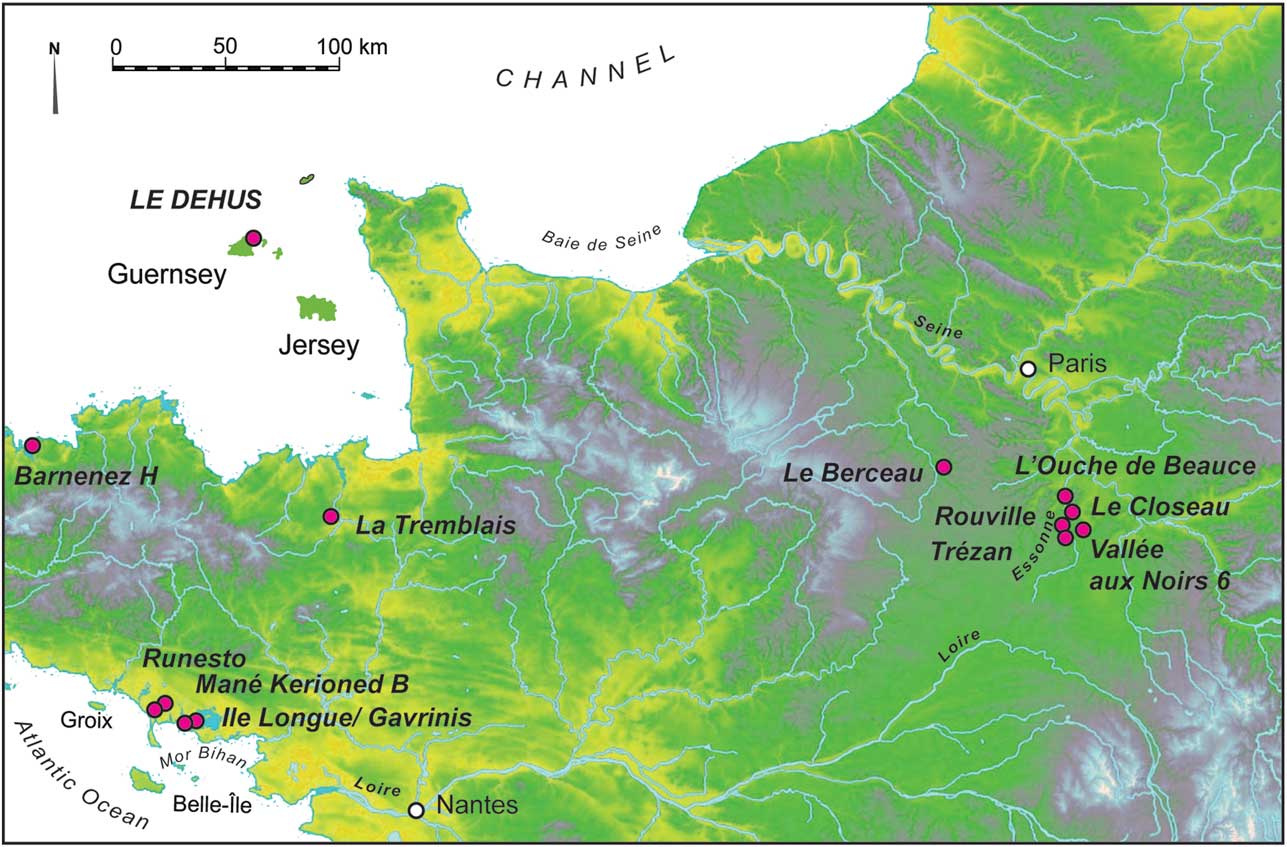
The discovery of an engraved bow motif on a Neolithic stele at Vale Maria do Meio (Evora, Portugal), similar to examples in western France, has enabled us to integrate the representation of this weapon into the iconography of the 5th millennium bc. Presented at the 2013 conference at the University of Evora (Cassen et al. Reference Cassen, Lescop, Grimaud, Alvim and de Jerseyforthcoming), the starting point for this comparative exercise is Brittany, where recent discoveries in megalithic tombs (Runesto, Plouharnel) and at unpublished sites (Mané Kerioned B, Carnac) can be added to other passage graves where the motif has been recognised for some time, such as Ile Longue (Larmor-Baden), Gavrinis (Larmor-Baden), and Barnenez H (Plouézoc’h). The engraved capstone which is present in a similar funerary context at Le Déhus, on Guernsey in the Channel Islands, can be incorporated into the same Armorican tradition, while an example from the Paris Basin (Le Berceau, Maintenon) seems to belong to another geographic and cultural group.
The process of recording at the Déhus, initiated in September 2012 for the 2013 Evora conference, could not be fully realised within the context of the comparative exercise described above, and consequently it is the principle subject of this paper. Although it is the bow and two arrows which have previously occupied most of our attention, the complete reconstruction of the engravings on the capstone has enabled us to recognise several different motifs, and to suggest an alternative reading of the stele, which departs from a strictly anthropomorphic interpretation.
The Site
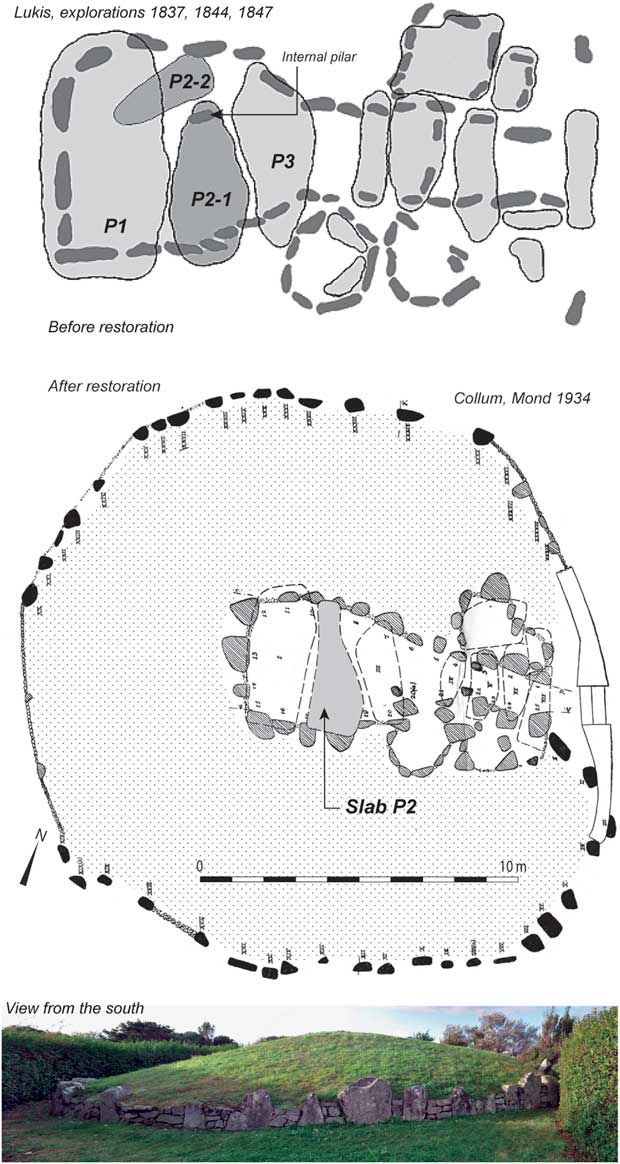
The passage grave of the Déhus is situated in the north-east of the island of Guernsey, in the parish of the Vale. The entrance is oriented to the east, overlooking the sea about 300 m distant. It is known to have been explored between 1837 and 1847 by the Lukis family, notably Frederick Corbin Lukis, who, although he kept relatively good records of his excavations, did not publish them (Sebire Reference Sebire2009). The restorations which took place in 1898 and 1932–3 (Collum Reference Collum1933) complicate the interpretation of the monument and in particular its side-chambers, some of which in their current form appear to be independent of the main chamber and its entrance passage (Fig. 1). The surrounding mound is also a reconstruction, although the vertical stones which delimit it were described by Lukis in 1837.
Top: plan surveyed by F.C. Lukis following the excavations of 1837, 1844, and 1847 (based on documents in Guernsey Museum). The capstone P2 is broken in two, on either side of the internal pillar; centre: plan following restoration (based on Collum Reference Collum1933); bottom: the enclosure of stones and the reconstructed cairn viewed from the south

The presence of large quantities of sea shell in the fill of the tomb ensured that human bone was relatively well-preserved. An important series of radiocarbon dates from these bones confirms that the monument belongs to the sequence of Armorican passage graves constructed at the end of the 5th and the beginning of the 4th millennium bc (4100–3900 bc: Schulting et al. Reference Schulting, Sebire and Robb2010). The material recovered is comparable to assemblages known from the continent for this period, from Brittany and Normandy, or from the Paris Basin, notably the coupe-à-socle or ‘vase support’ with incised, checked decoration (Kendrick Reference Kendrick1928, 90; Patton Reference Patton1995, 155). The presence of carinations enhanced with a double line of punchmarks, which is alien to the typical Chasséen tradition, suggests a clear link to the south Armorican Castellic, particularly in its late stage (4300–4000 bc) – but so as not to place this entirely within the tradition of the Morbihan, the contemporary Pinacle culture may be proposed as a heuristic hypothesis (Boujot & Cassen Reference Boujot and Cassen1992, 203; Cassen Reference Cassen2000, 308).
A small vessel with a cubical body and a narrow circular neck was found just outside the chamber, behind prop no. 8; the authors noted that the sediment in which it was found was the same as the old ground under the cairn (Collum Reference Collum1933, 59). This form is known from the Morbihan, although it is a rare morphology, present in a first generation passage grave (Moulin des Oies). It recalls cult contexts from central Europe, notably Lengyel (Cassen Reference Cassen2003). This singular type is also known through just a few examples in the Chasséen of the south of France, with parallels to the east (Italy, central Europe, and the Balkans; Sargiano et al. Reference Sargiano, Willigen, van, D’Anna, Renault, Hunger, Woerle-Soares and Gaday2009, 144).
The engravings on the second capstone of the chamber, in a local granite, were discovered at a relatively late date (de Guérin Reference Guérin1920). Although the anthropomorphic character of the engravings as a whole was not questioned (the term Gardien du Tombeau was coined at this time), the ‘bow’ was not recognised as such, de Guérin being content to describe it as ‘a crescent-shaped symbol’ (ibid., 214). E. Shee-Twohig is somewhat ambivalent in her description (Shee-Twohig Reference Shee-Twohig1981, 200) (‘a bow-shaped outline’), while F.C. Octobon makes specific mention of the throwing-stick in an anthropomorphic interpretation, in addition noting that the engravings on the capstone pre-date the construction of the monument (Octobon Reference Octobon1931, 509). The definitive interpretation thus far has been provided by Ian Kinnes and James Hibbs, who describe a male figure accompanied by two bows (Kinnes Reference Kinnes1980), or a bow and arrows (Kinnes & Hibbs Reference Kinnes and Hibbs1989, 162). On the basis of discoveries of steles reused in the monuments of Garvrinis and the Table des Marchands, in the Morbihan, these authors suggest of the Déhus capstone in its continental context that ‘the stelae, long mounds and grands tumulus are components of a pre-passage grave ritual landscape’ (Kinnes & Hibbs Reference Kinnes and Hibbs1989, 164; see also Kinnes Reference Kinnes1988, 40).
The reuse of this stele is sometimes considered to be the result of a voluntarily destructive act before its incorporation into the tomb (Scarre Reference Scarre2011, 99), following the model suggested by Jean L’Helgouac’h in the 1980s, although this has not been demonstrated so far (L’Helgouac’h Reference L’Helgouac’h1983). The reuse of older engraved slabs in Breton passage graves has, in contrast, been recognised for some time (Minot Reference Minot1964, 98). Fractures observed on the Breton monoliths are the result of breaks following their collapse (Gaumé Reference Gaumé1992; Bougis Reference Bougis1994), and steles in orthogneiss from south Morbihan were reused during the Middle and Late Neolithic, the Bronze Age (for cists), the Iron Age (for steles), and even for Gallo-Roman graves and buildings.
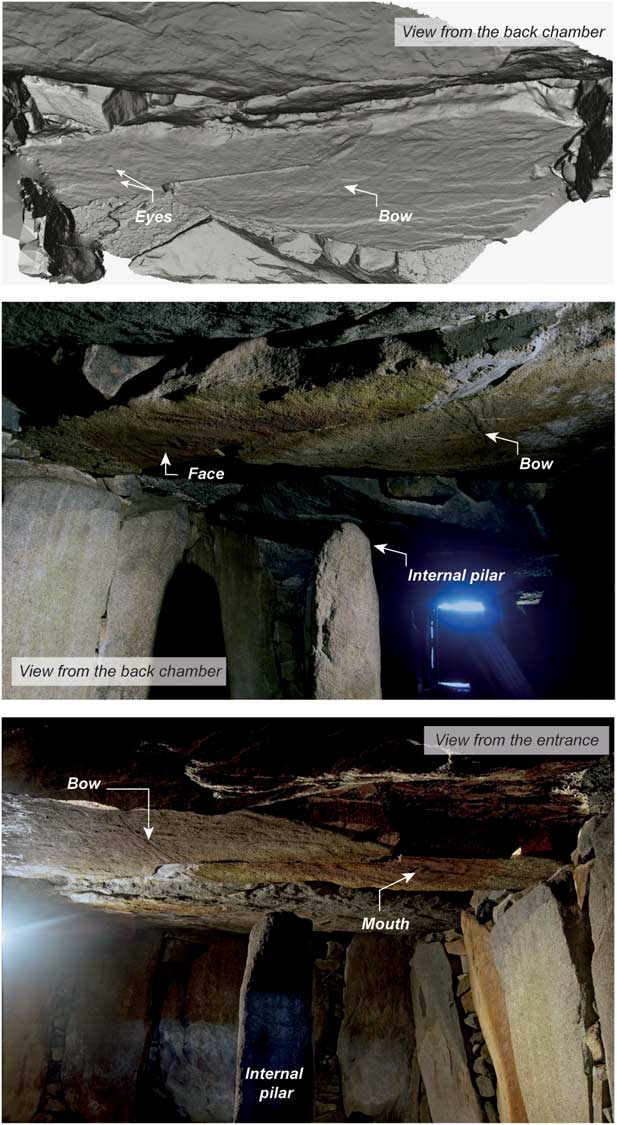
The engravings on the roof of the chamber are difficult to see, not least because of a pillar which partially obscures them (Fig. 2). The pillar appears to be in its original position, according to the plan drawn by F.C. Lukis before the restoration of the monument, which has led several writers to suppose that the engravings were created prior to the construction of the monument because their anthropomorphic aspect could only be observed by standing back from the upright slab. The isolated support pillar, encroaching on the useful space of the chamber, was in fact eminently functional because the engraved slab bore a severe structural fault which it was necessary to support, to avoid it breaking. The slab did break, in time; the two portions which fell into the chamber and were drawn by F.C. Lukis were reassembled and glued together in the restoration of 1898 (de Guérin Reference Guérin1920, 216). The extraordinary choice of such a fragile slab to serve as part of the roof of the tomb may have been motivated more by the presence of the engravings (Kinnes & Hibbs Reference Kinnes and Hibbs1989, 162) than their actual visibility. The various colours visible on both of the reassembled fragments testify to their respective post-depositional histories (differential red oxidation), as well as to manual contact (touching the surface of the rock), rubbing or moulages, which darkened the surface of the granite.
Top: oblique view of the roof of the chamber: the photogrammetric model reinstates the upper fragment of the stele, beyond the fracture line; centre & bottom: photographs of the capstone from two points of view

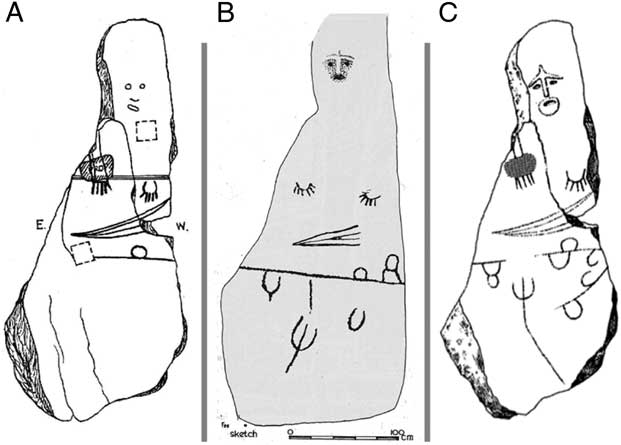
The ‘face’ has understandably attracted attention, particularly because of the care taken in working some of the surfaces, which seem to have been rubbed with sand and water, as plausibly suggested by Major Carey Curtis (de Guérin Reference Guérin1920, 216). The ‘nose’ was identified by de Guérin as a natural ridge in the rock, an interpretation shared by Kinnes. But for de Guérin the ‘hands’ consisted of five digits and a single ‘arm’ (the right), while Shee-Twohig saw six digits on each hand, but no arms (Fig. 3). Finally the outline of the ‘bow’ is complete for de Guérin, but incomplete for Shee-Twohig.
Three previous interpretations of the Déhus stele (after A: de Guérin Reference Guérin1920; B: Shee-Twohig Reference Shee-Twohig1981; C: Kinnes & Hibbs Reference Kinnes and Hibbs1989)

The Digital Survey
The acquisition of the data was based on a double process of recording: the compilation of digital photographs taken in various lighting conditions, which allows us to capture the detail of the engravings, supported by photogrammetry which enables us to calibrate the photographic survey and to restore the volumetry of the slab.
Procedure
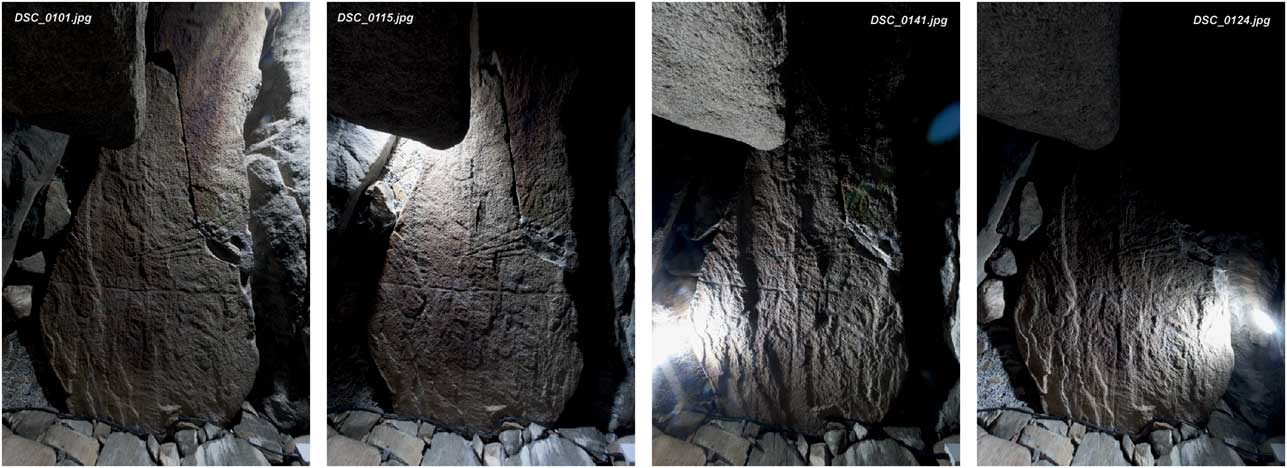
The principle of acquiring a series of images located on the same axis consists of taking a large number of digital photographs at a fixed focal length, under low-angle or raking light (Fig. 4), from a position as square-on as possible to the stone; multiplying the directions of lighting according to the state of the engraving; and then producing in the laboratory a vector drawing which identifies the greatest contrasts in relief.
An example of directed low-angle lighting on the central part of the stele (viewpoint 1)

The result is the amalgamation of gridded lines (signifying the inside or outside of depressions in the stone) which complement one another to give a more or less certain and acceptable contour survey, the observer weighing up and specifying their choice, and returning to the original photographic evidence if necessary.
A synthesis is thus proposed on the basis of these superimposed contours. The advantage of this method is that it allows other researchers to review the choices made and to use the same photographic corpus to repeat the exercise (Cassen & Vaquero Lastres Reference Cassen and Vaquero Lastres2003; Cassen & Robin Reference Cassen and Robin2010). The promising technique of Reflectance Transformation Imaging (RTI) could be used on these same principles, but there is an inherent difficulty in that the distance between the object and the light must be equal to the distance between the object and the camera; on site it would be difficult to satisfy this constraint other than by multiplying the points of observation in order to record the geometry of the carvings. Even so, it is impossible to apply it in an angle (such as between two orthostats or an orthostat and a cover slab).
The accessible part of the granite capstone measures 4.2 m in length, and about 1.5 m at its widest, at the point of contact with the southern orthostat. It varies in thickness between 0.3 m and 0.6 m. Its size and the relatively low ceiling height (averaging 1.7 m), together with the long span of the engravings, required that these features be recorded from three points aligned along the long axis of the stone, each overlapping with the next.
The photographic corpus consists of 176 images in NEF format, totalling 1.85 Gb:
Point 1 consists of 68 images on the same axis, under directional spot-lighting, of which 44 were used as 300 ppi JPGs (photos DSC_0094 to DSC_0156) to create 44 graphic files in Adobe Illustrator format;
Point 2 consists of 50 images, of which 41 (photos DSC_0158 to DSC_0207) were used to create 41 graphic files;
Point 3 consists of 58 images, of which 37 (photos DSC_0300 to DSC_0352) were used to create 37 vector data files.
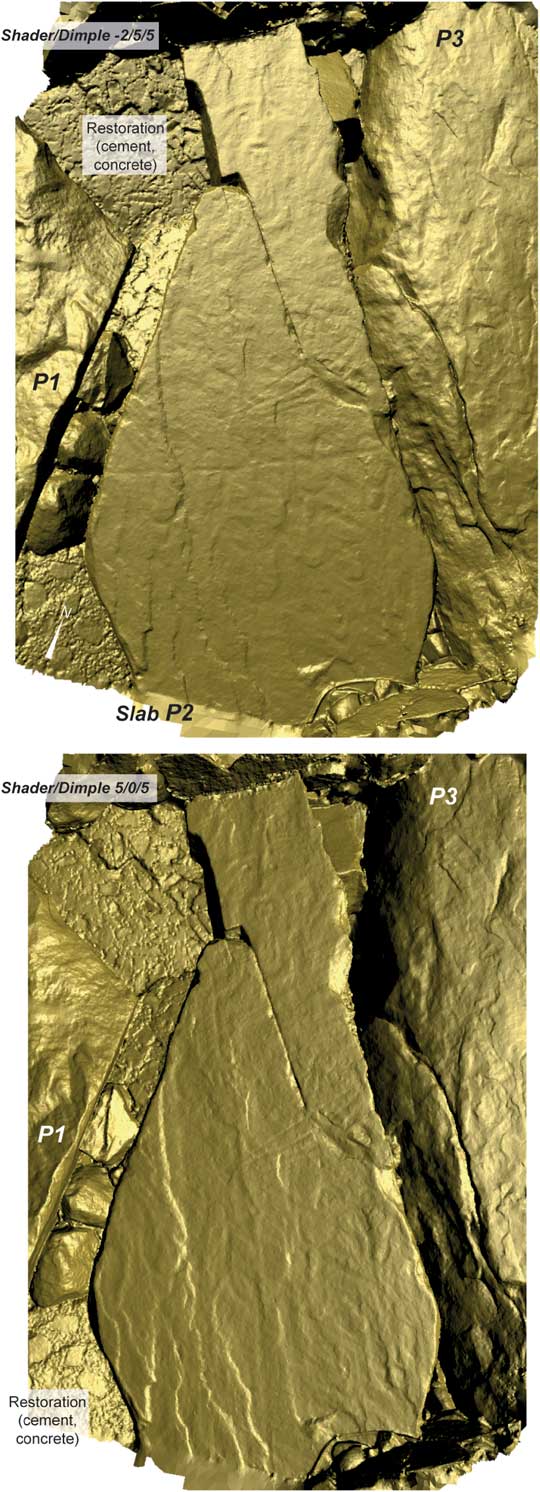
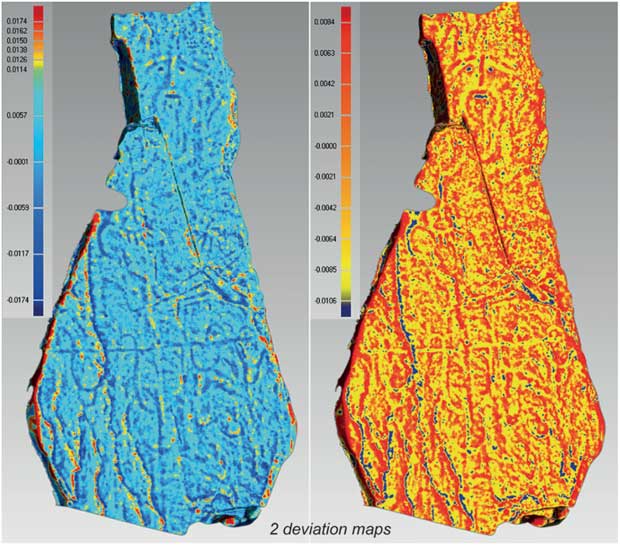
In addition to the digital images created under oblique lighting, we also compiled a photogrammetric survey based on 89 JPG images taken on a regular grid (totalling 416 Mb). The images were treated in Agisoft Photoscan, which renders a scatter of points of greater or lesser density. The correlation of these images restores the three-dimensional element of the prop (Fig. 5), and enables a geometrical correction of the synthesis of graphical elements deformed by the use of a 10.5 mm lens. The use of deviation maps capable of enhancing the engravings (and obtained by the contrast between low definition and high definition models, as Lescop et al. (Reference Lescop, Cassen and Grimaud2013)) did not provide any appreciable advantage because of the risk of confusing the engravings with natural fissures and fractures (Fig. 6). The 3-D model also permits the use of virtual lighting (in this case using the Meshlab program, with Shader/Lattice or Dimple tools), to identify some ambiguous natural features, complemented by observation on the ground (Fig. 7).
An example of virtual lighting on the engravings on a 3-D model, using the Shader/Dimple tool in Meshlab according to three values in space

Deviation maps calculated from the point cloud produced by photogrammetry; the depth of the engraving is more or less accentuated by the choice of colour: left (blue): deeper, right (red): superficial

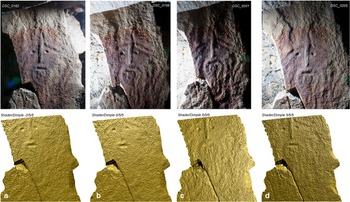
Complementary views of the anthropomorphic face produced from directional lighting on photographic images (viewpoint 2) and photogrammetry based on the same axis

These natural marks (creases, cracks, and joints) are all features of the original stone which could be better understood by a dedicated geological or geomorphological analysis. The identification of some ‘engravings’, or surfaces – are they anthropogenic or natural? – presents a serious problem working from the photographs alone, not least where an apparently symmetrical or logical arrangement automatically encourages the visual recognition of (imaginary) figures, particularly under ad hoc lighting conditions.
The results from the three photographic viewpoints will now be examined in detail, with the motifs which have been identified designated by capital letters, followed by numerals identifying the signs or symbols within each motif.
Viewpoint 1
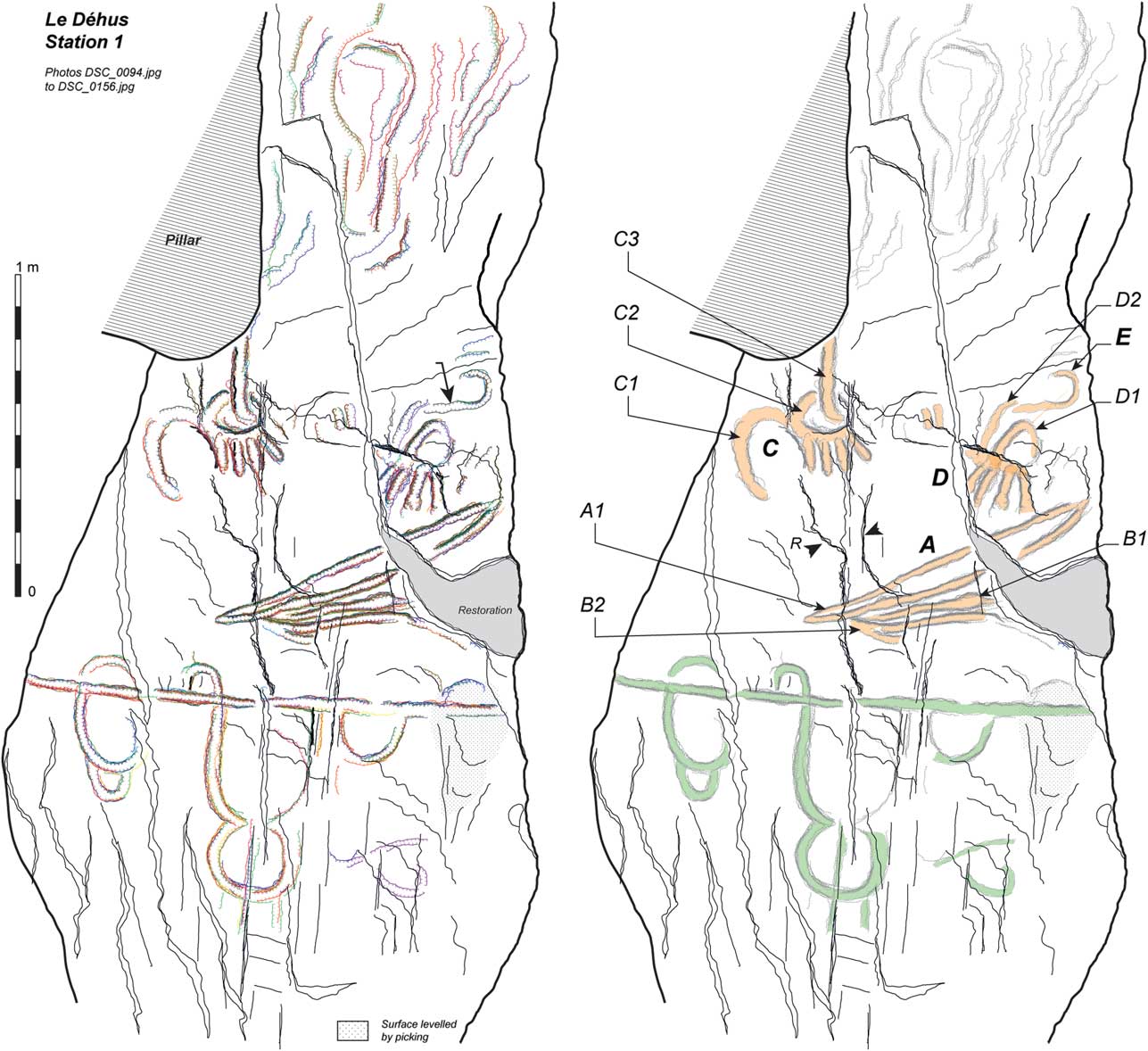
Viewpoint 1 recorded the central part of the capstone, taking the ‘bow’ as the principal motif, and the primary objective of our study of the Déhus.
This motif (A) is indeed comparable to a bow, but the engraving is not especially neat and one end is narrower than one would expect (A1, Fig. 8). This defect can probably be explained by the presence of two fissures in the rock (marked as R on Fig. 8), which deformed the deep pecking of the limbs of the bow and the string. The motif is in any case complete, interrupted only by a small fragment missing from the capstone which has been filled by cement (‘restoration’ on Fig. 8).
Viewpoint 1: graphical synthesis of the photographs. Contours of the engravings (on the left) and identification of motifs discussed in the text (on the right).

Beneath the bow (viewing the capstone with the narrow part to the top), there are two parallel engravings, the extremities of which are obscure. The upper part widens to the right (B1), and the lower segment seems to be prolonged towards the left, until it touches the limb of the bow (B2). It seems most likely that these two parallel lines, of equal length, should be interpreted as two arrows lying alongside one another. Their depth, 3–5 mm, is comparable to that of the bow.
Above the bow, the two ‘hands’ reveal their shortcomings: four more or less parallel strokes have been identified, but everything additional to these is natural.
-
∙ The motif to the left (C) consists of a slightly curved mark to which are attached four parallel strokes. It is extended by two curved segments, one of which (C1) is quite large and well-defined on the left, the other (C2) interrupted by another stroke (C3) extending upwards; this is probably a symmetrical extension to C1, although this cannot be proven because of the poor lighting caused by the top of the pillar stone.
-
∙ The motif to the right (D) is similar in appearance: the main part is cut by four more or less parallel marks, and there are two curvilinear traces this time extending from above the first mark, which is engraved to take advantage of a natural break in the surface of the stone. One of the two marks (D1) curves back down towards the ‘fingers’, while the other (D2) almost touches another part of the ensemble, a ‘crook’ motif (E).
The two groups of four marks (the ‘fingers’) are engraved to a depth equivalent to that of the bow.
Viewpoint 2
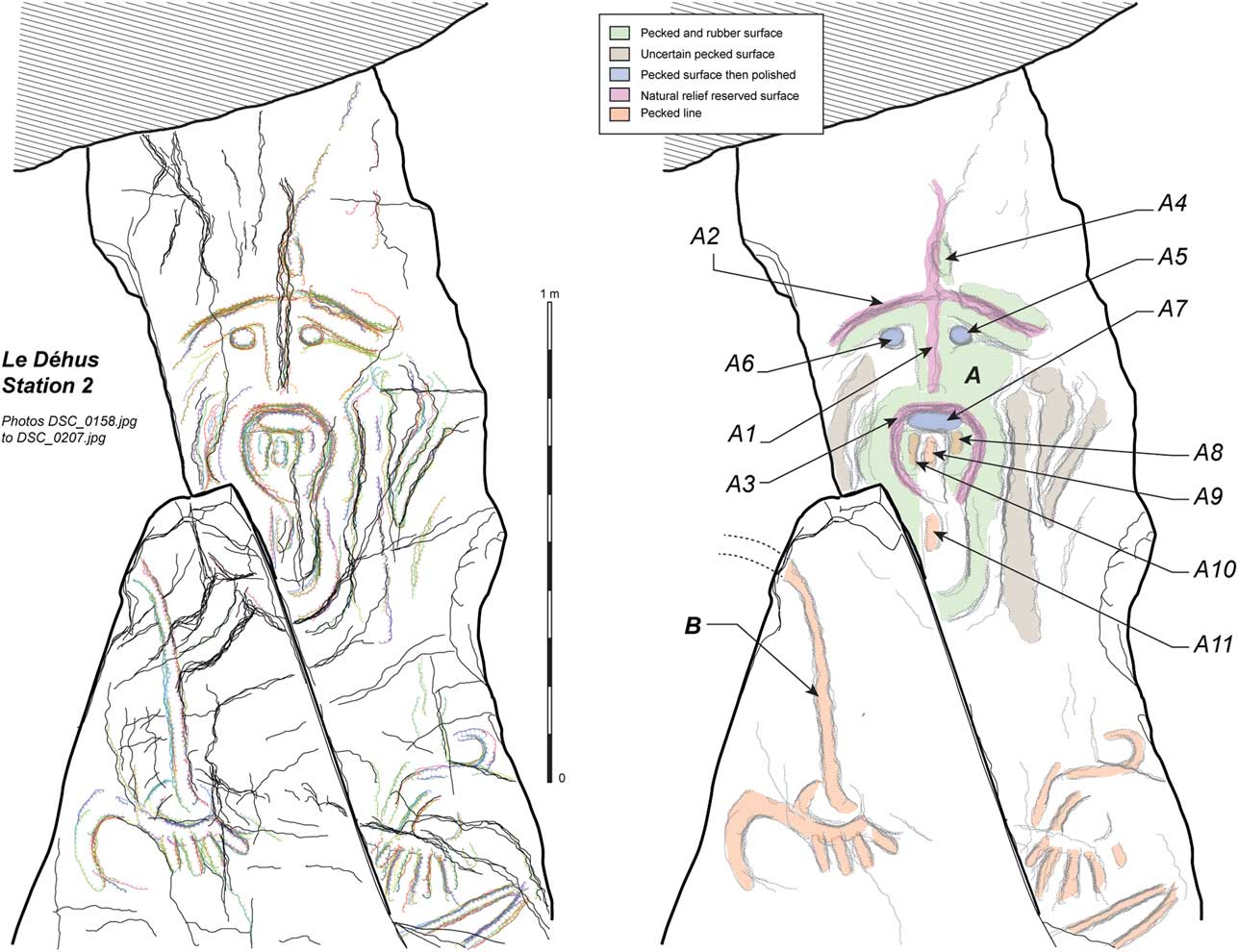
Viewpoint 2 was placed to examine the ‘face’ of the Gardien, and to clarify the status of the ‘arms’ of the so-called figure.
The principal difficulty here is to differentiate what may be the product of human action from natural features in the granite, particularly those repetitive or concentric features which, to our eyes, look unlikely to be of geological origin. These features were certainly appreciated and put to good use by the engraver, and our interpretation of the design is dependent upon disentangling the natural and the anthropogenic elements.
A first indication comes from the pecking and abrasion of the surfaces (Fig. 9, A, shaded area); this can be recognised by eye, and is readily perceptible in photographs where the surface appears to be regularly pecked, but needs to be validated by traceological analysis (Girya et al. Reference Girya, Drozdov, Devlet and Makulov2011; Devlet & Girya Reference Devlet and Girya2012).
Viewpoint 2: graphical synthesis of the photographs. Contours of the engravings (on the left) and identification of motifs discussed in the text (on the right)

This smoothing has the consequence of accentuating the natural ridges in the stone to suggest the shape of a ‘nose’ (A1), which as T.W. de Guérin appreciated, is a natural projection of the granite. The lower end of this ridge has been intentionally interrupted at the level where one would expect the nostrils, which shows up well on the 3-D image under virtual lighting (Fig. 7, a & b).
Crossing this raised line is a second, curved, line (A2), symmetrical on either side; it is difficult to judge to what extent this is the result of human action, except where pecking is evident on the edges (a subtle form of champlevé). A similar situation is present below, where a curvilinear line in relief (A3), slightly open at the base, is positioned in perfect symmetry with the vertical ridge (A1).
Alongside these modifications are several depressions in the stone, three of which have been fully polished. The first (A4) has been pecked out on the edge of the vertical segment (the ‘nose’ ridge). Two more depressions (A5 & A6) are located on either side of the vertical ridge: the base of each has been carefully polished smooth by rotational action. Another depression (A7) is comparable to A5 and A6, but the polish has been obtained by a ‘to and fro’ action. These three depressions were all made after the engraving on the surface of the stone (A6 recut the pecked line A2, for example).
In addition to these hollows, there are four short, vertical segments (A8–A11) which are identified with some reservations: perhaps natural, but too similar to the ‘beard’ of the figure at Buthiers in France (Cassen et al. Reference Cassen, Lescop, Grimaud and Caldwell2014a) to be ignored. The 3-D image obtained under virtual lighting also helps to distinguish these details (Fig. 7, c & d).
The ‘arm’ (B) can also be seen clearly from this viewpoint, interrupted by an old break in the rock.
Viewpoint 3
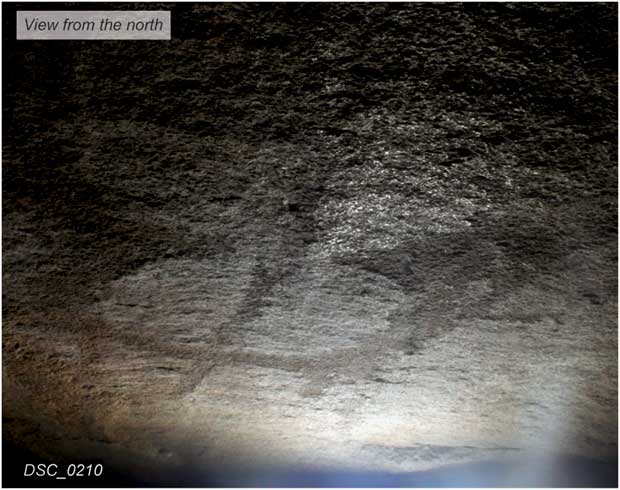
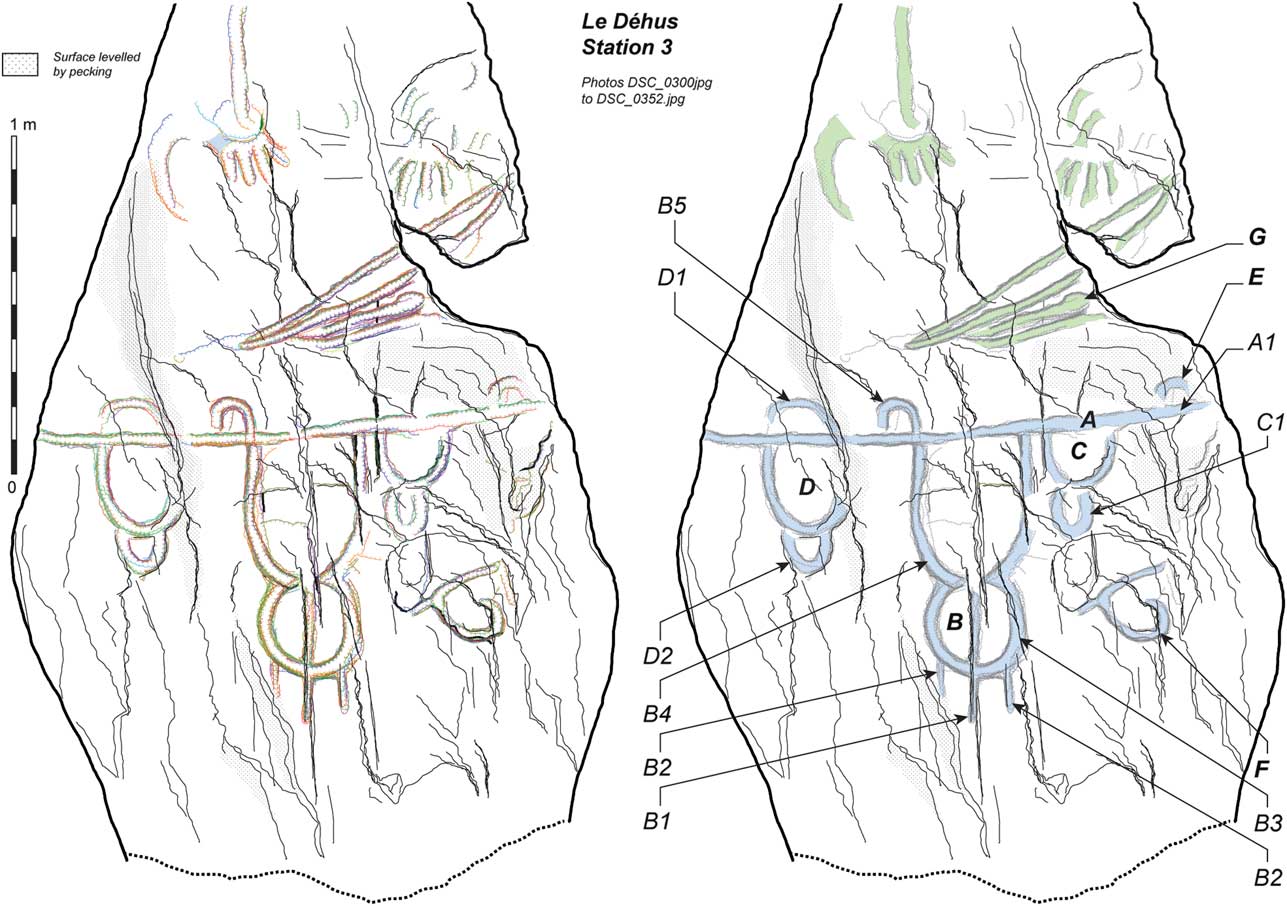
Viewpoint 3 was placed to examine the lower part of the stone, where a different pecking technique had been used to form the engravings; although fairly wide (20–30 mm) they are barely perceptible to the naked eye (Fig. 10). Their shallow depth (1 mm) means that they do not catch the light, and the natural roughness of the stone further conceals them without additional directional lighting.
Oblique photograph of a circular motif below the engraved ‘belt’. The flat and superficial pecking of the engraving stands out against the sparkling surface of the weathered granite

A straight line (Fig. 11, A) lies across the top of this group of motifs. Its depth, greater than that of the engravings beneath it, explains why every observer has noted its position in accordance with an anthropomorphic interpretation, ie, as a belt or girdle. This line cuts all the others in this area.
Viewpoint 3: graphical synthesis of the photographs. Contours of the engravings (on the left) and identification of motifs discussed in the text (on the right)

A central motif (B) is located on a natural ridge, continued on the same orientation by the mark B1. This engraving is accompanied by two parallel segments oriented downwards (B2). These segments are cut by a nearly circular motif (B3), itself surmounted by a curvilinear design (B4) almost symmetrically placed on the same longitudinal axis. The right hand branch of this motif (B4) stops at the horizontal line (A), while the left hand side finishes in a ‘crook’ above it (B5).
To the left and the right of this group of motifs are two similar designs (C & D), located as if hanging from the horizontal line, and their description to some extent follows the differences noted between the left and right branches of motif B. So for motif C, on the right, the longest curvilinear mark does not cross the horizontal line A, while for motif D, on the left, a curved line (D1) extends the two branches above line A. Both sides have a smaller, half or three-quarters circle motif hanging from them (C1 & D2).
A short mark (E) is not certainly an engraved motif. The surface in which it lies has been pecked and then smoothed, and it is difficult to judge its veracity. In contrast, F is anthropogenic, although it is difficult to trace its outline, confused as it is with the natural contours of the stone.
Finally, at G, the end of the first segment beneath the bow is clearly defined, and if it seems to be an arrowhead – which is plausible – it does not seem to have a transverse edge. But the absence of confirmation from the other mark means this typological and functional interpretation is not conclusive.
The pecking work, which has already been mentioned, was carried out on all the sharp edges of the stone: it is particularly noticeable on the left edge of the slab, where the surface has been reduced for a length of 1.5 m (shown in halftone on Fig. 11).
Discussion
Three techniques of engraving have been identified in the creation of these motifs:
-
∙ The first, focused on the anthropomorphic features of the upper part of the stone, is a form of champlevé, working with the natural creases in the rock, smoothing the bases of these folds with a polishing action which is also visible in the deeper hollows forming the eyes and the mouth.
-
∙ The second technique, found in the middle section of the stone, creates pecked motifs (bow, crook, quadrupeds), deep enough that they can be readily seen with directional lighting.
-
∙ The third technique, on the lower part of the stone, consists of very superficial pecking which, because of the shallowness of the engraving, can only be seen in the contrast of colours (lighter surfaces against the darker, natural, weathered background).
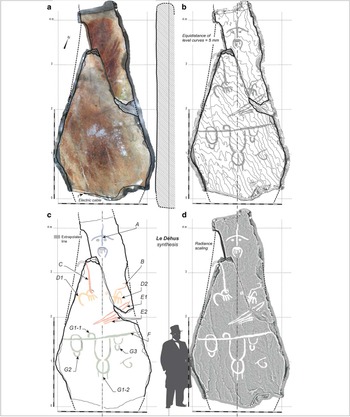
This spatial variation in the methods utilised is intriguing, and does not seem to support the argument for contemporaneity between the three areas of engraving. But a vertical line projected through the centre of the stone (Fig. 12) demonstrates that the nasal ridge of the face (A), and the large, lower motif (G1–2) are exactly placed on this axis, which surely cannot be simple coincidence. It is also worth noting that the two proximal ends of the arrows stop at this same axis, at a point which corresponds to the constriction of the bow, although this detail of the weapon seems to have been constrained by a natural fold in the granite. A more thorough discussion about the reasons for such a partition should be possible following the conclusion of the technical and chronological analysis on the engraved anthropomorphic motif in Buthiers (La Vallée aux Noirs 6), which is currently taking place.
Four representations of the stele of the Déhus: a: surface, actually photographed in true colour (see online version of this paper); b: microtopography (contours at intervals of 5 mm); c: synthesis of identified motifs; d: engravings on the three-dimensional model

The remainder of the motifs can now be inventoried. The fact that a number are partly obscured, or difficult to see, or difficult to examine in the current configuration of the tomb, makes it reasonable to consider that an older stone, previously in the open air, has been re-used here.
Seven distinct semiotic groups can be distinguished (Fig. 12, c):
The first (A) can be readily interpreted as anthropomorphic, but there is an interesting alternative.
-
∙ If we restrict ourselves to the lines in relief and the artificial hollows (as done for the stele when presented at the Evora conference), all the usual features are present for recognition as a human figure: the vertical body, arms outstretched and legs bowed, all in relief, and the head detached and hollowed out. To these can be added the anatomical or sexual characteristics: the two hollows at chest level, and an extended depression at the position of the genitals which does not confirm the sex of the figure either way.
-
∙ If the finely smoothed, almost polished ‘tracks’ are taken into consideration (Fig. 9), a face with a moustache can be recognised, the circular hollows and the rectilinear motif naturally forming the eyes and the mouth.
The second semiotic group is clearly a crook-shaped motif (B), although it is difficult to see at present with the naked eye.
Motif C might belong to the same tradition, but as its end is missing we cannot be sure; in any case its position is comparable to the preceding motif, supported on the horns of an animal.
At D we can see two similar motifs, both of which are horned animals, although on the basis of the horns alone it is impossible to decide whether that on the left (D1) is a bovine, and that on the right (D2) a caprine.
Further down, the bow (E1) – described in greater detail elsewhere (Cassen et al. forthcoming) – lies in an oblique position with respect to the longitudinal axis of the stone; it is accompanied by two short arrows (E2), the points of which are difficult to define, unlike those at (for example) Gavrinis.
Finally, below a line of separation (F) which intersects all the other motifs of the lower part of the stone, there are three enigmatic motifs (G1–G3) arranged around a vertical axis of symmetry, although there are no traces of engraving above the line F to the right hand side of the vertical axis (G1–2 and G3).
Leaving aside the motifs already discussed (the crook, the bow, and the horned animals), for which models are likely to be found among the steles of continental Armorica, there are no readily recognisable parallels in the same region for the face and the curvilinear motifs (on the lower part of the stone). Instead, we need to look towards the Paris Basin, and particularly the area of Buthiers-Malesherbes, south of Paris and on the western border of the forest of Fontainebleau. In this region there are a number of steles, cave walls and natural rocks with engravings which have only recently been recognised or published, and which shed new light on the composition of the Déhus engravings.
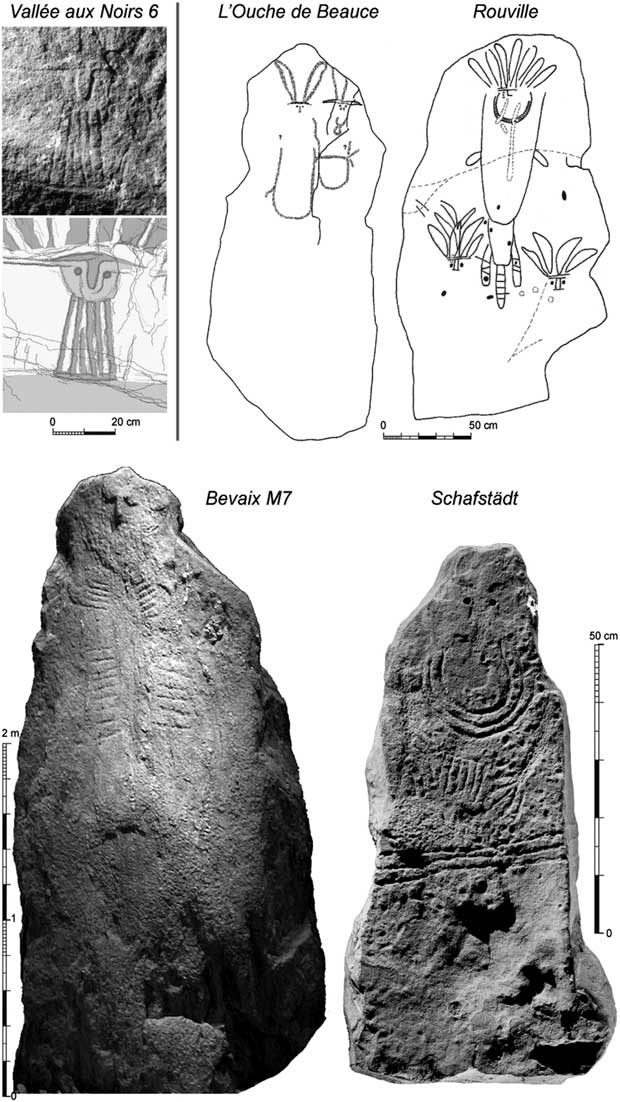
The shape of the face, playing on the continuity of relief between the bridge of the nose and the eyebrow ridges, is thus reminiscent of the vertical rocks at Closeau (Caldwell Reference Caldwell2013) and at the La Vallée aux Noirs 6 (Cassen et al. Reference Cassen, Grimaud, Lescop and Caldwell2014b). In both cases, the eyes are indicated in relief by champlevé (Fig. 13).
Anthropomorphic Neolithic engravings on rock and steles mentioned in the text: La Vallée aux Noirs 6 at Buthiers (photo by S. Cassen); L’Ouche de Beauce at Maisse (after Tarrête Reference Tarrête2001); Rouville at Malesherbes (after Bénard Reference Bénard2011); Bevaix M7, Switzerland (after Grau Bitterli & Fierz-Dayer Reference Grau Bitterli and Fierz-Dayer2011); and Schafstädt, Germany (Landesamt für Denkmalpflege und Archäologie Sachsen-Anhalt, photo by J. Lipták)

On the steles of Rouville (Devilliers Reference Devilliers2005) and L’Ouche de Beauce (Tarrête Reference Tarrête2001), the eyes are hollowed out as well as the eyebrow ridge (Fig. 13). Note that in all these representations there are ‘feathers’ above the head, which does not seem to be the case for the Déhus, although the end of the stone is not visible. The stone of La Vallée aux Noirs 6 has a motif beneath the face which might represent a beard, and is thus comparable to the Déhus. And the G3 motif in Déhus is quite similar to the so-called ‘horned’ sign on the smaller anthropomorph at L’Ouche de Beauce.
With regard to the two horned animals associated with two throwing sticks on the capstone in Guernsey, they can perhaps be paralleled by another horned animal in contact with a hafted axe on the stone of Trézan (Bénard Reference Bénard2011), a stone which may also display a second animal in contact with another hafted axe oriented on the same axis as the first; a more accurate survey should enable a better understanding of these Neolithic engravings. Pairs of horned animals are well-known in Brittany, on the famous stone of Gavrinis/Table des Marchands in Morbihan (Le Roux Reference Le Roux1984), and on La Tremblais (Giot & Morzadec Reference Giot and Morzadec1990), in the Côtes-d’Armor, the closest to the Déhus. It is worth noting that the relationship between the crook and the horn was emphasised at Gavrinis (Cassen Reference Cassen2007).
At a greater distance, there are two parallels – one in Switzerland and one in Germany – which are worth recording for the similarities they present with the Déhus in the opportunistic engraving in the rock, and the morphology of some of the motifs. The first is more compatible, chronologically speaking, consisting of steles erected at Bevaix, on the eastern shores of Lake Neuchâtel, between about 4400 and 4200 bc (Grau Bitterli & Fierz-Dayer Reference Grau Bitterli and Fierz-Dayer2011). A monolith 3.3 m in length has its summit marked out by pecking; a ‘face’ is visible in the natural form of the rock, suggesting a nose and the eyebrow ridge (with good lighting), as well as the ‘hands’, although the left has six digits; other parallel lines might represent the ribs (although non-symmetrical), or elements of clothing (Fig. 13).
The second parallel is another stele, poorly dated because it was found reused in a cist of the 3rd millennium (Schnurkeramik culture) at Schafstädt, Sachsen-Anhalt (Behrens Reference Behrens1973; Müller Reference Müller1997). Once again, the hands are shown at the sides, of which only one is well-restored; a collar and a belt suggest an anthropomorphic representation, while the face combines pecking and natural features in the rock (Fig. 13). In between the hands are repeated parallel strokes, which were at the level of the ribs on the stone from Bevaix, and at chin level in La Vallée aux Noirs 6. At both Bevaix and Schafstädt, however, there have been modifications to the original steles, which complicates the comparison to other stones.
Conclusions
Although our initial intention was simply to improve the analysis of the bow on the capstone in the Déhus, our research has led to a complete re-evaluation of the other motifs engraved on this piece of granite. This re-evaluation is based on photogrammetry of the surface of the rock (by correlating digital photographs) in order to obtain a three-dimensional model of the stone, in addition to the compilation of photographs arranged on the same axis and subject to oblique and directional lighting. The protocol of combining these two techniques ensures the production of controllable and reproducible results.
Three techniques of engraving have been noted, which can be refined in the light of recent experimentation in Brittany (Vourc’h et al. Reference Vourc’h, Chaigneau and Cassen2014), and intriguingly divided into the three semiotic groups identified on the stone:
-
∙ A percussive treatment (percussion posée) on the narrowest part of the stone (the top of the original stele) which emphasises the natural forms of the rock to suggest the anthropomorphic characteristics of a face, itself emphasised by the engraving of eyes and a mouth;
-
∙ A posed percussion with hammer on the central part of the stone, which created the deep traces of the bow and its two arrows, as well as the ‘hands’ thought to relate to the face above;
-
∙ Finally, on the widest part of the stone, and very probably created by means of percussion with a punch or chisel creating tiny impacts within broad strokes – too shallow to create a contrast by oblique lighting – there is an ensemble of curvilinear motifs displayed around the straight line joining the two edges of the stele.
To these groups of motifs can be added the partial preparation of the lower part of the stone, particularly through the reduction of the more prominent ridges by the use of a hard percussive tool. A complete technological analysis, however, still requires a rigorous application of traceology to reconstruct the chaine opératoire.
The three groups of motifs which correspond to these three different techniques are as follows:
-
1. The identification of a face at one end of the stone is not open to doubt, represented by the ridge of the nose, the eyebrow ridge, the eyes, and the mouth; the beard and moustache seem to lie around the mouth, but this identification is less certain, since these details are both recessed and raised up, and might represent some sort of adornment or ornamentation to the body.
-
2. The bow is accompanied by two arrows alongside the arm. It is engraved obliquely on the right part of the stele. The right ‘arm’ of the figure is truncated by the break in the edge of the stone and thus its interpretation remains difficult; its uniqueness, moreover, raises doubts about its anthropomorphic character. In contrast it is clear from the reinterpretation of the ‘hands’ that in place of four single fingers, we should understand these to be the legs of two animals, with horns divergent for one (bovine?) and radiating for the other (caprine?). And in so far as an additional motif in the form of a hooked throwing-stick appears at the end of one horn, it is postulated that the ‘branch’ leaning on another horn could be the shaft of a second throwing-stick, or a hafted axe.
-
3. There is a more deeply-engraved line, set at an angle to the longitudinal axis which passes through the centre of the face, which divides the capstone and touches most of the enigmatic motifs which are barely visible to the naked eye. The central motif is, however, symmetrically placed around this imaginary axis. In the perspective of an anthropomorphic representation, and taking this transverse line as a ‘belt’, this motif occupies the position of the genitals, or could indicate bodily accessories or clothing.
In this respect the research and identification of minor details on the large anthropomorphic representation of La Vallée aux Noirs 6, engraved on a rock wall near Paris (Fig. 14), may offer some new insight to our discussion here – not least because even if several motifs from the Déhus find good parallels in western France in the 5th millennium BC, it is beyond doubt that this reused stele also has a resonance with the iconographic traditions of the Paris Basin at the same time.
Location of sites mentioned in the text

Equipment
Note: the equipment used was as follows:
For oblique light: Nikon D5000 with Nikon 10.5 mm f/2.8G ED DX Fisheye-Nikkor lens, set at ISO 200, aperture 16, RAW format;
For photogrammetry: Nikon D40 with Nikon 27 mm f/3.5 lens, ISO 200.
Remote control: Kaiser (StarCluster) LED torch, daylight (5600°K, 500 lux);
A4 Wacom (Intuos) drawing tablet.