INTRODUCTION
This article investigates a case of real time language change involving the use of aller and être to express movement in the perfect and pluperfect past tenses in spoken Ontario French. The forms examined include the standard formal variant être allé, the ‘traditional’ non-standard variant avoir été, and the innovative non-standard avoir allé, all of which can be roughly translated as the English perfect ‘went’ or pluperfect ‘had gone’. Following Labovian variationist methodology, social and linguistic factors that condition these variants are considered and explained.
The analysis is based on the Mougeon, Nadasdi and Rehner corpus, which comprises interviews conducted in 2004–05 with adolescent speakers of Ontario French from four localities where francophones are either a strong majority of the local population (Hawkesbury), or a minority (Cornwall, North Bay, Pembroke). The results of this study are also compared to a previous analysis (Alexandre, Reference Alexandre2004) of the same variable from the Mougeon and Beniak corpus, collected among adolescent speakers of Ontario French in the same four communities in 1978. This permits us to examine changes in the use of these variants in the context of demographic change in these communities over close to three decades.
In Ontario in recent years, the pressure of English (the majority language) has manifested itself among speakers of French through social changes, among them increased bilingualism and a decreased number of domains in which French is regularly used. The results of this study show effects of these social changes as they are reflected in linguistic processes of devernacularization and regularization. The use of the vernacular variant avoir été has decreased in the speech of individuals from the francophone minority communities (devernacularization), and concomitantly the use of the innovative non-standard variant avoir allé has increased since 1978 (regularization). These results thus demonstrate how language change can be brought about as a result of decreased usage of French among adolescent speakers, as well as the increasingly important role of the French-medium schools in the linguistic production of the Franco-Ontarian community.
PREVIOUS RESEARCH
Previous research relevant to this study can be grouped into three main categories: (1) studies which have documented regularization and devernacularization as linguistic outcomes of restriction in the use of minority languages, (2) characteristics of language change in Ontario, and (3) previous research on the variable under study. These are summarized below.
Patterns of change in minority languages
When a minority language faces increased pressure from a dominant language, it recedes into a limited number of interactional domains and social contexts. Typically, the minority language becomes confined to the private domains of society (e.g., the home), where it may eventually become obsolescent. However, a reverse process has been documented in countries where the state has implemented linguistic policies meant to curb the erosion of minority languages (e.g., Wales, see Williams, Reference Williams1987). In such cases, as the minority language loses out to the dominant language in the private domains of society, it is allowed to enter into public or official institutions where its use was often banned before state intervention. Such institutions often include the school, which becomes the minority community's primary locus of linguistic reproduction.
Common linguistic outcomes in these two types of scenarios include processes such as regularization and other forms of structural simplification, as well as sociostylistic reduction. More specifically, due to insufficient use of the minority language in a broad range of contexts, its speakers are unable to fully learn its most complex forms or semantic distinctions. Consequently, they use more regular or simple alternatives (e.g., Dorian, 1988; Mougeon and Beniak, Reference Mougeon and Beniak1991: 4–5). While in many cases it makes sense to view these alternatives as internally-motivated innovations, there are instances where it is plausible to argue that they may also be reinforced by (or attributed to) transfer from the dominant language, another linguistic outcome of restricted minority language use (cf. Mougeon, Nadasdi and Rehner, Reference Mougeon, Nadasdi and Rehner2005). Sociostylistic reduction is the consequence of a decrease in the number of domains and social contexts in which speakers use the minority language. As a result, particular variants (be they phonological, lexical, or grammatical) associated with domains or contexts lost to the encroaching dominant language fall into disuse. Research on receding minority languages has documented two types of sociostylistic reduction. The first type involves a loss of formal variants, as the minority language is pushed out of the official or public domains by the dominant language, and an increase in the use of vernacular variants as the minority language becomes confined to the private domains. The second type entails a loss of informal or vernacular variants (devernacularization) as the minority language loses out to the dominant language in the private domains of society, and an increase in the use of formal variants if the minority language is ‘kept alive’ by the school and other official or public institutions.Footnote 1 This second type of sociostylistic reduction is relevant for the present study.
Language change in Ontario French
Several studies have focused on linguistic variation and change in the speech of Franco-Ontarian adolescents. These studies have demonstrated the effects of shift to English, the dominant language in Ontario, and concomitant restriction in the use of French, specifically devernacularization and simplification. Evidence of devernacularization has already been observed in regard to vernacular variants such as the use of à between two noun phrases to express possession, sur as an alternant for chez, ouvrage in the sense of ‘remunerated work,’ and rester in the sense of ‘to reside’ (Mougeon and Beniak, Reference Mougeon and Beniak1991; Nadasdi, Reference Nadasdi2005: 105). In each of these cases, the vernacular variants are either absent or very infrequent in the speech of restricted users of French. Because such speakers come from homes where French is, at best, used infrequently, they receive most of their input in French-medium schools, and hence exhibit the dual pattern of devernacularization and standardization. However, as argued by Mougeon (Reference Mougeon2005) and Mougeon and Beniak (Reference Mougeon and Beniak1991), not all vernacular variants undergo a decline in the speech of restricted users of French, since factors such as the sociostylistic salience and the systemic properties of the competing variants may neutralize the standardizing effect of the school. For example, restricted speakers do not make less use of the non-standard variant je vas (for je vais), since the former is frequent in discourse, morphologically regular, and socially unmarked (cf. Mougeon and Beniak, Reference Mougeon and Beniak1991).
Other studies have shown evidence of regularization in Ontario French. In particular, Mougeon and Beniak (Reference Mougeon and Beniak1991) found this effect in the use of irregular third person plural verb forms. Rather than employing the standard marked third person plural forms for irregular verbs, restricted speakers regularized by using the unmarked third person singular verb forms with third person plural subjects. Further evidence of this same tendency is found in Nadasdi's 2000 study of clitic pronouns. Restricted speakers show a tendency to postpose object clitics, thus following the more regular SVO order. This tendency is particularly strong with indirect object and locative clitics.
THE ÊTRE ALLÉ/AVOIR ÉTÉ/AVOIR ALLÉ VARIABLE
Corpus-based studies
The leveling of the auxiliary être by avoir in compound past tenses is a phenomenon that has received a great amount of treatment in the literature since the 1970s, primarily in Canadian varieties of French (see, e.g., Canale et al., Reference Canale, Mougeon and Bélanger1977; and Sankoff and Thibault, Reference Sankoff, Thibault and Sankoff1980; Knaus and Nadasdi, Reference Knaus and Nadasdi2001, inter alia). However, studies focusing specifically on the use of the verb aller (and its variants) in the past tenses are less common.
Canale et al. (Reference Canale, Mougeon and Beniak1978) is likely the first study documenting the vitality and stylistic markedness of the alternation of avoir été with être allé in Canadian French. These authors reported that in the spoken French of Franco-Ontarian students in Grades 9, 10, and 12, avoir été was used in 87% of all possible contexts. In these students’ written French, however, this variant was used only 66% of the time, suggesting that avoir été was somewhat less appropriate in formal contexts than in informal ones. D. Sankoff and Thibault (Reference Sankoff, Thibault, Johns and Strong1981) and G. Sankoff and Thibault (Reference Sankoff, Thibault and Sankoff1980) examined the distribution of être allé and avoir été in the 1971 Sankoff and Cedergren corpus of Montreal spoken French. Their research was limited to the use of these two forms in the compound past and when followed by a locative complement. G. Sankoff and Thibault found that être allé was used with a much lower level of frequency than avoir été. Further, both studies found that variant choice was socially stratified, with speakers occupying the lower levels of the linguistic marketplace index using avoir été considerably more frequently than speakers at the higher levels of this index. Finally, G. Sankoff and Thibault documented a third variant, avoir allé (Reference Sankoff, Thibault and Sankoff1980: 331). However, its use was quite marginal in their corpus, occurring in only 0.7% of all possible contexts, in contrast with much higher frequencies of avoir with verbs, such as passer, déménager, and tomber (331). The resistance of aller to the leveling process can be linked in part to the high discursive frequency of this verb and the fact that when être is used with allé, it almost always fulfills an auxiliary function, as opposed to a copula function (Sankoff and Thibault, Reference Sankoff, Thibault and Sankoff1980, 322).
Finally, Alexandre (Reference Alexandre2004) examined avoir été vs. être/avoir allé in the Mougeon and Beniak (Reference Mougeon and Beniak1978) corpus of adolescent Franco-Ontarian speech collected in three localities where francophones are in the minority and one locality where francophones are a strong majority. In the present study, we will use a corpus gathered among same-age speakers in 2005 in the same four francophone communities where Mougeon and Beniak collected their corpus. Thus, we will be able to examine linguistic change with real time data and identify the most important linguistic and social factors contributing to change.Footnote 2
We provide below only an overview of Alexandre's findings since they will be commented upon in detail in conjunction with the results of the present study. Alexandre found that language use restriction and locality of residence were the most significant predictors of variant choice. Unrestricted speakers and those from the majority francophone community of Hawkesbury strongly preferred the informal variant avoir été, while the more restricted speakers and especially those from the weak minority community of Pembroke were more likely to use être allé and the non-standard innovative variant avoir allé. In other words, in the case of avoir été vs. être allé, Alexandre found evidence of the dual processes of devernacularization and standardization, and in the case of avoir allé, she documented regularization as a result of imperfect learning. As for social class and sex, it was found that both working class and male adolescents favored avoir été, and middle class and female adolescents favored être allé.
Alexandre also measured the influence of linguistic factors. She focused on the type of complement following the verb (i.e., prepositional phrase containing geographic place name, prepositional phrase containing non-geographic noun phrase, and verb phrase). This factor was not found to have a statistically significant effect on any of the three variants examined.
Attestation of the variable in non-Canadian varieties of French
As we are reminded by Grevisse and Goose (Reference Grevisse and Goose1988: §803), use in the past tenses of être as a ‘synonym’ of aller and s’en aller is a long-standing feature of French. These authors provide numerous examples where être was used as a synonym of aller in the past tenses in literary French, dating back to the seventeenth century. They also point out in a historical note that such usage predates the classical period and was part of Old French which inherited it from Latin.
According to Grevisse and Goose, several grammarians or lexicographers have argued that use of être implies that motion to a given location was followed by a return to the point of departure, while use of aller implies that the mover has not yet returned and thus that the two forms cannot be interchanged (see also Dupré, Reference Dupré1972: 99–100 who provides an overview of the main authors who have defended this view). However, Grevisse and Goose provide several examples drawn from the works of ‘good authors’ which do not respect the +/- return distinction. They conclude that the two options are synonymous and that ‘the only difference is that avoir été is the predominant form in colloquial usage and aller the predominant one in careful usage’ [our translation]. This conclusion is echoed in Cohen (Reference Cohen1950: 64) and Frei (Reference Frei1971: 149). Further, these last two authors point out that in français populaire, être été may be used instead of avoir été (e.g., je suis été à Lausanne). Thus, in some varieties of French, the variable may be expressed via aller or être, with each of these two options being potentially realized, respectively, as être allé vs. avoir allé and avoir été vs. être été.Footnote 3
DATA AND METHOD
Corpus
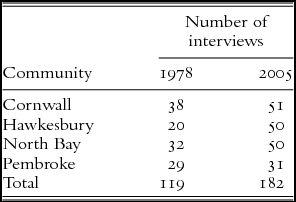
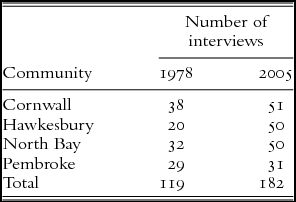
The data in this study were extracted from the Corpus of Ontario French (Mougeon, Nadasdi, and Rehner, Reference Mougeon, Nadasdi and Rehner2005). This corpus, collected in 2004–05, consists of semi-directed interviews with adolescents in four francophone communities in Ontario (Hawkesbury, North Bay, Cornwall and Pembroke). All interviews were conducted in French. The adolescent interviewees attended a French-language school, have at least one francophone parent, and were enroled in Grades 9 and 12 at the time of the interviews. Table 1 provides the total number of interviews from each community upon which both the 1978 and 2005 corpora are based.
Community distribution of speaker interviews
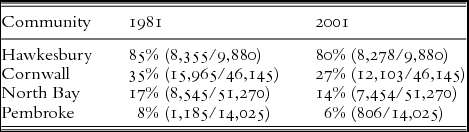
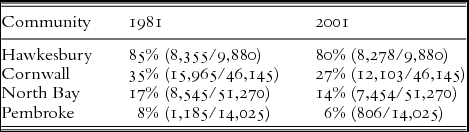
While more francophones reside in Ontario than in any other Canadian province apart from Québec, they are still in the minority when compared to the total population. According to the Canadian national census of 2001, 522,765 Ontarians claim French as their mother tongue. This constitutes 4.6% of the total Ontarian population (Nadasdi, Reference Nadasdi2005: 102). Furthermore, the degree of francophone concentration varies from community to community. Table 2 provides data from the Canadian census on the numbers and proportions of francophones in the four localities under study in 1981 and 2001, roughly the points in time when the corpora were collected. Hawkesbury stands out from the other three communities under study in that francophones constitute a strong majority. Cornwall has the second highest degree of francophone concentration, followed by North Bay and Pembroke. It is also noteworthy that from 1981 to 2001, the numbers and proportions of francophones declined in all four localities. These changes can be seen in Table 2.
Number of individuals with French as mother tongue (based on Mougeon et al. 2006: 21)
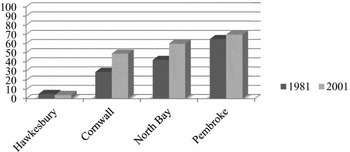
It is also informative to examine the Canadian census data on the proportion of French-mother tongue respondents who have shifted to English at home in the four communities. These data are illustrated in Figure 1. As can be seen, shift to English between 1981 and 2001 was marginal in Hawkesbury, but it was much more substantial in the three minority communities. Further, in Hawkesbury the rate of shift has remained unchanged, whereas in the minority communities it has increased. This suggests that in the three minority communities, the role of the home in intergenerational transmission of French has decreased. Consequently, French-medium schools play a greater role in ensuring the linguistic reproduction of francophones.
Rates of shift to English at home among French-mother tongue respondents (source: Canadian census)

Given the different levels of francophone concentration at the community level, opportunities to use French vary on both community and individual levels. In order to examine the linguistic ramifications of this, speakers have been grouped into three categories, based on their responses to a language usage questionnaire (cf. Mougeon & Beniak, Reference Mougeon and Beniak1991). Three broad categories can be established, namely:
• Unrestricted speakers: those who use French in almost every context of everyday life;
• Semi-restricted speakers: those who use French and English more or less with the same frequency;
• Restricted speakers: those who speak English much more often than French on a daily basis.
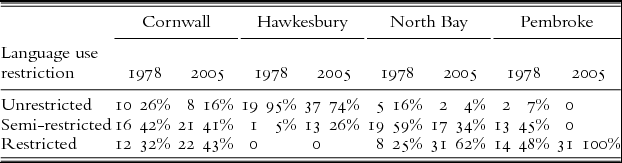
The distribution of speakers according to language use restriction is presented in Table 3.
Distribution of interviews according to restriction and locality of residence
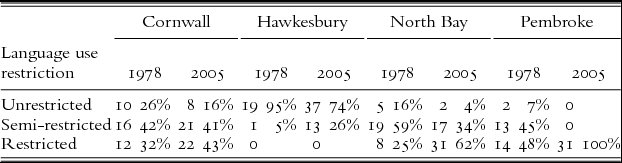
Table 3 shows that both the decrease in the demographic strength of francophones in all four communities and the increase in rates of shift to English at home in the three minority communities are reflected in the 1978 and 2005 speaker samples. As can be seen, there has been a clear increase in the proportion of restricted speakers in all three minority communities and a concomitant decrease in the proportions of unrestricted and semi-restricted speakers. In the majority community of Hawkesbury, change has been less extensive. However, we do note a decrease in unrestricted speakers and a rise in the semi-restricted cohort, which may be primarily the result of the drop in francophone concentration, since shift to English has remained marginal and stable from 1981 to 2001.
Linguistic factors
The corpus was scrutinized in order to extract all occurrences of aller and être used in the perfect and pluperfect past tenses and with either a locative complement or an infinitive, as illustrated by the examples drawn from the 2005 corpus of adolescent speech below:
Locative complement
(1) Oh oui ben cet été on a été à au Lac Saint-Jean
‘Oh yes, well that summer we went to Lac Saint-Jean’ (H2–30)
(2) J’ai allé chez ma mère.
‘I went to my mother's house’ (P2–19)
(3) Je suis /t/ allé à Jean XXIII jusqu’en première
‘I went to Jean XXIII until Grade 1’ (C2–40)Footnote 4
Infinitive complement
(4) On avait été faire du bénévolat . . .
‘We went to do some volunteer work’ (H2–38)
(5) Je suis allé voir un film.
‘I went to see a film’ (P2–02)
(6) J’ai allé parler au conducteur.
‘I went to speak to the conductor’ (P2–28)
In extracting the tokens of être and aller, we found a small number of instances of être été (N = 16), all but one occurring in the Hawkesbury corpus, where they represent 3.5 % of the total number of occurrences of the variable for Hawkesbury, e.g., oui je sais pas c’est où . . . j’suis déjà été là (H9–08) ‘yes I don't know where . . . I’ve already been there’. Due to their marginal frequency and near categorical absence in three of the four communities under study, these variants were not included in the statistical analysis of the data, but will be discussed further in our study.
As noted, Alexandre's analysis of the variable in the 1978 corpus did not identify any linguistic factors that significantly correlated with variation, though as mentioned above, the only linguistic factor examined was complement type. In the present study, we have nonetheless coded for several other basic linguistic factors to see if a correlation might obtain. We first considered the possibility of distinguishing uses of the variable where motion involves a return from those where the mover has not returned. However, due to the marginal number of tokens where we could ascertain that the mover had not returned, we were unable to verify whether this distinction is a constraint on variation. In addition to complement type following the verb, other linguistic factors included in the statistical analysis are a) number, b) person, c) tense, and d) polarity. Concerning complement type, we are particularly interested in determining whether or not locative complements are more common with the aller variants than with avoir été, given the inherent telic nature of aller.Footnote 5
Social factors
The following four social factors were considered in the study:
• Level of language use restriction (unrestricted, semi-restricted, restricted);
• Locality of residence (Hawkesbury, Pembroke, Cornwall, North Bay);
• Social class (working class, lower middle class, middle class);Footnote 6
• Sex (female, male)
It should be noted that Alexandre also included age as a social factor in the study of the 1978 corpus. However, in addition to the fact that the speakers are already very close in age (all from Grades 9 or 12), Alexandre found no relation between age and the use of the variants. For these reasons, age has not been included as a social factor in this study.
RESEARCH ISSUES
Based on the results of Alexandre (Reference Alexandre2004), Sankoff and Thibault (Reference Sankoff, Thibault and Sankoff1980), and previous research on the linguistic consequences of language use restriction on the spoken French of adolescent Franco-Ontarians, in addition to the demolinguistic changes documented above, the following research issues can be formulated:
Avoir allé
Given the sizeable increase in the number and proportions of restricted and semi-restricted speakers in each of the four communities, especially the minority ones, the frequency of the innovative non-standard variant avoir allé, which was quite low in 1978, is expected to rise substantially in 2005. That said, in 1978, avoir allé was confined to the speech of restricted and semi-restricted speakers and of the minority communities. It will be interesting to see if, along with the rise in frequency of avoir allé, this variant shows signs of spreading to the speech of unrestricted users of French and/or emerging in the majority community. Furthermore, in 1978, social class did not impact the frequency of avoir allé. Should the frequency of this variant rise substantially, it will be interesting to see if it has remained socially neutral.
Avoir été vs. être allé
We expect that the increase in the number and proportions of restricted and semi-restricted speakers will translate into a decrease in the frequency of the informal avoir été variant (and concomitant increase in that of the formal être allé variant) in each of the four communities under study, thus reflecting the related processes of devernacularization and standardization. As both Alexandre and Sankoff and Thibault found that the avoir été vs. être allé alternation was socially stratified, we expect to document a similar pattern in the 2005 corpus.
Être été
Although this variant was not included in Alexandre's study (Reference Alexandre2004), we looked for it in the 2005 corpus since it had been reported for European French. However, in the absence of previous sociolinguistic research on this form in spoken Canadian French, we have left open the question of its distribution according to extralinguistic factors.
RESULTS
The results will first include data on the frequency of the variants (assessed via numbers and percentages) in each of the four communities at the two points in time when the corpora were collected. We will then present and discuss the findings of two separate factor analyses performed with GoldVarb seeking to identify the internal and external constraints of variation and to measure the strength of their respective influence.
The first analysis compares the use of être allé and avoir été. With this binary contrast we focus on standardization and devernacularization. In the second analysis we pit avoir allé against the other two variants, in order to assess the extent to which the innovative variant is gaining ground on its two traditional competitors.
Frequency of the variants
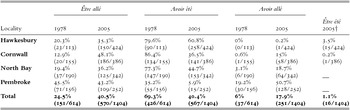
Overall, a total of 1404 tokens of the variable were found in the 2005 corpus. There were 570 total occurrences of the variant être allé, 567 occurrences of the variant avoir été, 251 occurrences of the variant avoir allé, and 16 occurrences of être été. In Table 4, we can see the total frequencies of each variant in the four communities under examination in both the 1978 and the 2005 corpora. In addition to these variants, there were a total of 71 occurrences of the past tense used with the verb aller found in the corpus without either avoir or être as an auxiliary. These forms were discarded due to absence of the auxiliary.
Frequency of past tense variants expressing motion in 1978 and 2005

† Alexandre (2004) did not search for this variant in the 1978 corpus.
As shown by the totals in Table 4, the use of the standard variant être allé has risen from 20.5% in 1978 to 40.5% in 2005. The use of the non-standard variant avoir été, on the other hand, has greatly decreased, from 69.3% in 1978 to 40.8% in 2005. Use of the non-standard innovative variant avoir allé has tripled from only 6% in 1978 to 17.8% in 2005, which is surprisingly high. As for être été, we cannot track the evolution of this variant from 1978 to 2005 due to the absence of data on its frequency in the 1978 corpus.
While the overall evolution of the frequency of être allé, avoir été, and avoir allé from 1978 to 2005 is in line with our expectations regarding the impact of the rise in the number of semi-restricted speakers on linguistic change, it hides differences in the trajectory of the variants across the communities under study. As shown by Table 4, the frequencies found in each of the four communities reveal three patterns of change.
First, there has been a decrease in the frequency of avoir été (79.6% 60.8%) in the speech of adolescents from the majority community of Hawkesbury, accompanied by a rise in the frequency of être allé (20.3% vs. 35.3%). Meanwhile, the frequency of avoir allé has remained virtually identical (i.e., from nil to close to nil). These results reflect the interrelated processes of both devernacularization and standardization in this community.
Second, at the other end of the scale of local francophone concentration, in the speech of the adolescents from Pembroke (the weakest of the three minorities), the frequency of être allé has remained almost the same, suggesting that standardization has reached a peak at around 44%. With a rate of 5.9% in 2005, the frequency of avoir été has declined substantially, suggesting that devernacularization is reaching completion. Finally, there has been a 31% increase in the frequency of avoir allé (the regularized variant), propelling this form to first rank in the frequency hierarchy (50.7% in 2005).
Third, in the two minority communities of Cornwall and North Bay, adolescent speech exhibits all three processes of standardization, devernacularization, and regularization. However, judging from the size of the differences between the 1978 and 2005 frequency rates, the intensity of this latter process appears to be weaker than that of the other two processes. This finding sets these two minority communities apart from Pembroke, where regularization is by far the main internal mechanism driving linguistic change.
As for the variant être été, Table 4 shows that its frequency is not only quite low in the 2005 corpus, but also that it is almost entirely confined to the speech of Hawkesbury adolescents. Two possible interpretations for this latter finding can be offered. As a feature of vernacular French, être été is more likely to be preserved in a majority francophone community like Hawkesbury, where the local Francophone population includes a strong working class component, than in the other three communities, where working class speakers are in the minority (see Mougeon, Rehner, and Alexandre, Reference Mougeon, Nadasdi and Rehner2005). The other possible interpretation is that être été is a form of hypercorrection, reflecting the fact that Standard French prescribes the use of auxiliary être with the so-called verbs of motion (including aller the most frequent of these verbs). In line with this interpretation, it can be pointed out that as a strong majority francophone community, Hawkesbury is a setting where French is used extensively in all the economic sectors and hence where mastery of Standard French has real instrumental value (see Mougeon, Reference Mougeon2005). Thus, it is plausible that in such a setting some speakers will hypercorrect.
In sum, looking at the distribution and evolution of variants in each of the communities under study provides answers to the research questions we have left open, as well as sharper qualitative and quantitative insight for the verification of our hypotheses on the impact of restriction in the use of French on change. Specifically, the inter-community comparison revealed that être été is almost entirely confined to Hawkesbury, and that in this community regularization has remained absent. Such comparison also revealed that there is a progression in the effect of restriction on the processes of change, from i) a modest effect on standardization and devernacularization (Hawkesbury), to ii) an effect on all three processes, with the effect on regularization being weaker than on the other two processes (Cornwall and North Bay), to iii) a major impact on devernacularization and regularization (Pembroke). In fact, the Hawkesbury findings lead us to wonder if restriction plays a role in the modest increase of être allé and decrease of avoir été, and if similar fluctuations would also be observable in other majority Ontario or Quebec francophone communities. We will return to this issue in the discussion.
Analysis 1: avoir été versus être allé
The first analysis is comprised of the two main variants, avoir été and être allé. In this section, the frequencies of these two variants according to the five linguistic factors (complement type, person, number, tense, and polarity), as well as the four social factors (socioeconomic status, locality of residence, restriction of language use, and sex) will be presented.
Linguistic distribution
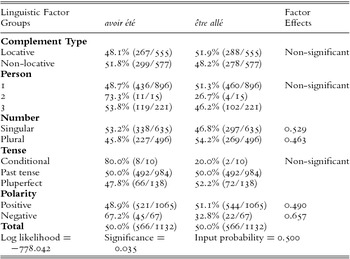
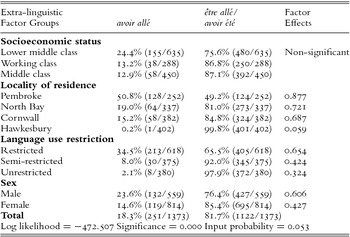
Two of the five linguistic factors tested were found to have a significant effect on the use of avoir été. These factors were polarity and number. Complement type, person, and tense were found to have no significant effect. In terms of polarity, negative clauses are favorable to the avoir été variant (0.657), while positive clauses are only marginally unfavorable to this variant (0.490, only one point below the 0.50 neutral factor weight value). As for number, we found that the singular slightly favors avoir été over the plural (0.529, 0.463 respectively). That being said, since the two factor weights are both close to 0.50, we can infer that the effect exerted by number is not pronounced. These results are presented in Table 5.
Effects of linguistic factors on the use of avoir été versus être allé

The fact that complement type exerts no significant effect on variant choice is in line with Alexandre (Reference Alexandre2004), who arrived at the same finding in the 1978 corpus. In previous stages of the history of French, there may have been a tendency to use aller more frequently with locative complements, reflecting the telic nature of this verb. If this is the case, the findings mentioned above suggest that it is no longer productive in Ontario French.
Social distribution
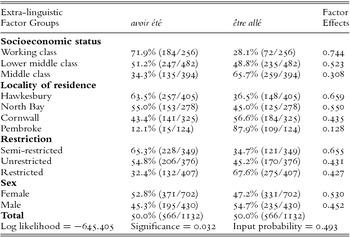
As seen in Table 6, all four of the social factors examined were found to exercise a significant effect on variation.
Effects of social factors on the use of avoir été versus être allé

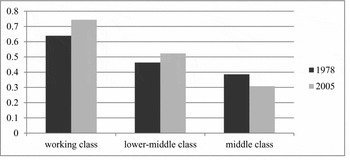
The relationship between socioeconomic status and the use of avoir été is a linear one. Speakers belonging to the working class strongly favor the use of avoir été (0.744), followed by the lower middle class (0.523). The middle class is the least likely to use this variant (0.308). A similar association was found in Alexandre's study of the 1978 data. However, the pattern has become even stronger over time, with middle-class speakers showing a clear decline in their use of the non-standard variant and a concomitant rise in their use of standard être allé, as revealed in Figure 2.
Use of avoir été over time – socioeconomic status

Locality of residence is also a relevant factor. Speakers from the strongest majority francophone community, Hawkesbury, show a strong positive effect for the use of avoir été (0.659). North Bay has a somewhat positive effect (0.550), and Cornwall a somewhat negative effect (0.435). While the difference between these two effect values is not substantial, it is unexpected, since Cornwall has a stronger francophone concentration than does North Bay. An explanation for this unexpected pattern seems to lie in the evolution of the social makeup of the French language school population in Cornwall. In this community, the proportion of working class students has decreased markedly over the 28-year period under study. This pattern is most evident among the unrestricted working class speakers who have become vanishingly rare in Cornwall's total school population. This is in fact reflected in our 2005 speaker sample, which includes only one unrestricted working class speaker for the community of Cornwall and in the entire Gr. 9 and 12 student population, which includes only two such speakers.Footnote 7
As for the factor effect found for Pembroke, it is strongly negative (0.128). This finding is in keeping with the fact that Pembroke is the weakest of the three minority communities under study. It can also be pointed out that in the 2005 corpus, all of the students in the Pembroke sample were restricted speakers, whereas in the 1978 corpus, over half of the students in the sample were unrestricted or semi-restricted speakers (see Table 3). The difference between the two samples reflects broader demo-linguistic changes in the French-language school population in Pembroke from 1978 to 2005 (see Mougeon, Rehner, and Alexandre, Reference Mougeon, Nadasdi and Rehner2005).
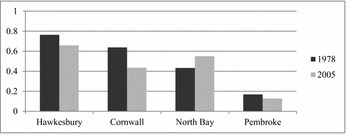
Alexandre also found that Hawkesbury showed the strongest positive effect for the use of avoir été (0.764). However, Cornwall came in second with a factor effect of 0.638, while North Bay was third (0.433). As in the present study, Pembroke also showed the weakest effect (0.169) (Alexandre, Reference Alexandre2004: 97). Figure 3 shows a general decrease in the use of avoir été during the 27-year period in question. This is particularly true for Pembroke, where use of the non-standard variant has dropped off sharply. This figure also reveals a modest rise in the frequency of être allé in Hawkesbury. This runs counter to what has been found for other variables, e.g., the standard variants donc and je vais, which have decreased in frequency over the last three decades (cf. Mougeon, Nadasdi, Rehner, Reference Mougeon, Nadasdi, Rehner, Baronian and Martineau2009a, Reference Mougeon, Nadasdi, Rehner, Martineau, Mougeon, Nadasdi and Tremblay2009b).
Use of avoir été over time – locality of residence

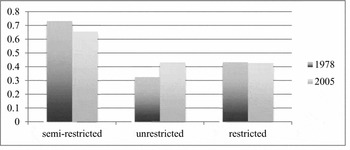
Restriction in language use continues to be an important predictor for the use of avoir été in the 2005 corpus. Both semi-restricted and unrestricted speakers use avoir été in a majority of occurrences (65% and 55% respectively). Restricted speakers, on the other hand, strongly prefer the standard variant, être allé, which constitutes 68% of occurrences. While the general pattern was the same in 1978 (with semi-restricted speakers making greatest use of avoir été), usage of avoir été has decreased among all speaker groups in terms of level of restriction. The results for this factor group differ from those of Alexandre (see Figure 4).
Use of avoir été over time – language use restriction

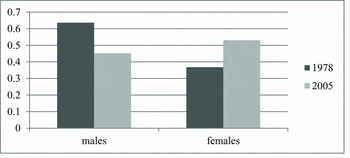
With regard to sex, females appear to slightly favor avoir été over their male counterparts (0.530, 0.452 respectively). However, this difference is relatively modest. In the 1978 corpus, Alexandre found that males favored avoir été over females (0.636, 0.368 respectively). That the effect of speaker sex is in flux and seems to have weakened in 2005 suggests that the avoir été variant may not be overly stigmatized. These results are shown in Figure 5.
Use of avoir été over time – sex

Analysis 2: avoir allé versus avoir été and être allé
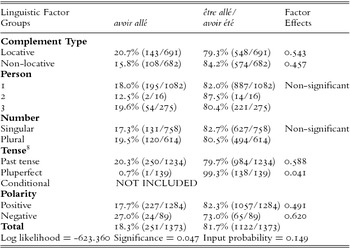
The second analysis in this study was a comparison of the use of avoir allé with regard to the two variants already seen, être allé and avoir été. The linguistic factors examined here are identical to those in the first analysis and are presented in Table 7.
Effects of linguistic factors on the use of avoir allé versus être allé / avoir été

Linguistic distribution
In this analysis, three of the five linguistic factors tested were found to have a significant effect on the use of avoir allé. The significant factors are complement type, tense, and polarity. Person and number were found to have no significant effect. Locative complements were found to have a somewhat positive effect on the use of avoir allé (0.543), while non-locative complements have a somewhat negative effect (0.457). Alexandre, on the other hand, found that complement type was not a significant predictor for this analysis in the 1978 corpus (Reference Alexandre2004: 107). Our results suggest that those speakers who use this innovative variant tend to associate this usage with locative complements.
In terms of tense, the perfect tense was found to be most favorable to avoir allé, at 0.588, while the pluperfect was found to disfavor it most strongly (0.041). There are no instances of avoir allé in the conditional, and thus it was excluded from this analysis. The pluperfect occurs only once with avoir allé. Besides this one occurrence, all instances of avoir allé occur in the perfect tense. As pointed out above, avoir allé is the outcome of regularization, since avoir is the auxiliary that is used to form the perfect tense with the majority of verbs. Therefore, it is logical that speakers who are simplifying by using avoir with allé would use it almost exclusively in the perfect tense, since it is the least difficult of the tenses to form.
Polarity was also found to be significant. There is a positive effect with the negative (0.620), while the positive shows a near neutral effect of 0.491. Here too, regularization may be playing a role. The added structural complexity involved in producing negative sentences may promote the use of the more regular and more frequent auxiliary avoir.
Social distribution
The relative effects of social factors on avoir allé vs. avoir été and être allé are presented in Table 8.
Effects of social factors on the use of avoir allé versus être allé / avoir été

In this analysis, three of the four social factors were found to exercise a significant effect on variation. Socioeconomic status is the only factor found to be non-significant. This factor was also found to be non-significant in Alexandre's study of the 1978 corpus. Given that avoir allé is the outcome of regularization and that its rise seems to be relatively recent, a classic SES effect would not necessarily be expected, as was the case in Mougeon and Beniak's (Reference Mougeon and Beniak1995) study of third person plural leveling in Ontario French. These authors found that such leveling occurred primarily in restricted and semi-restricted speech and was not correlated with speaker SES.
Use of avoir allé over time – locality of residence

Use of avoir allé over time – language use restriction

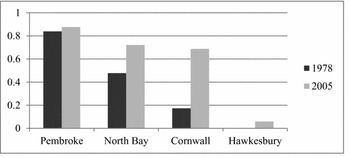
Regarding locality of residence, Table 8 shows that there is non-negligible use of avoir allé in all communities except Hawkesbury. The relationship is linear, based on degree of francophone concentration. We find the strongest association in Pembroke, the area with the lowest francophone concentration. In this community, the innovative avoir allé variant is in fact the one used in the majority of occurrences. North Bay and Cornwall follow, with factor weights of 0.721 and 0.687, respectively. This variant occurs only once in the strong francophone minority community of Hawkesbury. These results are very similar to those found in Alexandre's study, which also found that locality of residence was the best predictor of avoir allé usage among the four social factors tested.
In 1978, there was a very strong positive association between avoir allé and Pembroke (0.839), negative associations between this variant and North Bay and Cornwall (0.478 and 0.174, respectively), and zero occurrences of this variant from Hawkesbury in the 1978 corpus (Alexandre, Reference Alexandre2004: 108). Alexandre states, ‘The fact that no instances of avoir allé were uncovered in localities where Francophones far outnumber Anglophones provides further support to the fact that this innovative use is largely due to extensive contact with English and/or extensive French language use restriction’ (Reference Alexandre2004: 110). Figure 5 lends credence to this interpretation since, with the exception of Hawkesbury, it appears that in 2005 the use of this variant has risen substantially in all of the minority communities since 1978, reflecting an increase in the number of semi-restricted and restricted speakers, i.e., individuals who have been found to exhibit patterns of morphosyntactic regularization in previous studies.
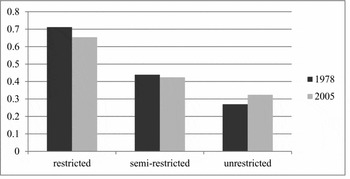
The analysis in Table 8 also reveals a linear correlation between language use restriction and the use of this variant. Restricted speakers show the strongest positive effect for the use of avoir allé (0.654). Semi-restricted speakers are next, with a factor weight of 0.424, and unrestricted speakers are shown to strongly disfavor this variant, with a factor weight of 0.324. The results from Alexandre's study were quite similar. The strongest relationship was with restricted speakers (0.712), followed by semi-restricted speakers (0.439), and finally unrestricted speakers (0.270) (Alexandre, Reference Alexandre2004: 108).
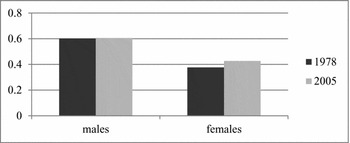
Finally, males were found to slightly favor avoir allé. Males show a positive effect of 0.606, while females show a negative effect of 0.427. Similar results were found in Alexandre's study. In the 1978 corpus, males were found to favor avoir allé with a factor effect of 0.602, while females showed a factor effect of only 0.377. Alexandre claims that this may be due to female awareness and monitoring of speech: ‘This particular finding may be indicative of the fact that the female students monitor their speech more than the male students and evidence a greater capacity to overcome the tendency to use avoir with aller’ (Reference Alexandre2004: 110). In this analysis, the factor effect values found for both males and females are close to the neutral threshold, which may be another indication that avoir allé no longer patterns as a classic vernacular variant, as seen above with socioeconomic status.
Use of avoir allé over time – sex

DISCUSSION
The following general trends have been documented in the 2005 data:
avoir été versus être allé:
Avoir été is favored by unrestricted and semi-restricted speakers. Restricted speakers favor the variant être allé. The fact that restricted speakers disfavor the vernacular variant and that they do so to an even greater extent than in 1978 is evidence of further devernacularization. Mougeon, Nadasdi, and Rehner (Reference Mougeon, Nadasdi, Rehner, Baronian and Martineau2009a; Reference Mougeon, Nadasdi, Rehner, Martineau, Mougeon, Nadasdi and Tremblay2009b) also documented intensified devernacularization in their studies of other variables in the 2005 corpus. That said, from 1978 to 2005, the correlation with restriction has remained non-linear since the semi-restricted speakers continue to make greatest use of the vernacular variant. Along with Mougeon, Nadasdi, and Rehner (Reference Mougeon, Nadasdi, Rehner, Baronian and Martineau2009a), who also documented greatest use of vernacular variant m’as in the speech of semi-restricted speakers in 2005 in Hawkesbury, it may be hypothesized that semi-restricted speakers are not cut off from vernacular Ontario French, even though they are also active users of English and thus may be less inclined to master standard French than speakers who remain dominant in French.
Furthermore, as was shown in Mougeon (Reference Mougeon2005), the systemic and sociostylistic properties of the vernacular variants have an impact on the probability that they will decline in the speech of restricted users of French. With certain vernacular variants, devernacularization can be marginal or blocked and with others it can be dramatic. The fact that in the present study devernacularization of avoir été is not blocked reflects certain properties of avoir été: (1) it does not have an English equivalent (the semantics of have been is much more restricted than that of avoir été, assuming that restricted speakers link the two forms); (2) it is likely not a form that L2 learners will produce developmentally; and (3) it is also used markedly less frequently than être allé by the students’ teachers in the classroom.Footnote 9
Avoir été occurs most frequently among speakers from Hawkesbury, a strong francophone majority community, and least frequently among speakers from Pembroke, where francophones represented only 8% of the population in 2005 and where most adolescents in the French language school population are restricted speakers. In such a setting, avoir été has come close to disappearing from adolescent speech. In contrast, in Hawkesbury avoir été was still strong in 2005, although it had evidenced a relative decline in favor of être allé. To gain some insight into the factors which may have caused this decline, we ran a separate GoldVarb analysis focused on avoir été vs. être allé in the Hawkesbury 2005 sub-corpus. It revealed that only social class had an effect on variation and that restriction in the use of French had no effect on variation. Thus, it is possible that the modest standardization trend found in Hawkesbury reflects a ‘normal’ progression in the frequency of être allé rather than a rise reflecting the influx of semi-restricted speakers among the French language school population.
With regard to socioeconomic status, the vernacular variant avoir été is favored the most by the working class and the least by the middle class. The opposite is true for the standard variant être allé. This pattern of social stratification has remained constant from 1978 to 2005.
Avoir allé versus avoir été and être allé:
In the 2005 corpus, avoir allé is used most often by restricted speakers, though it is occasionally used by semi-restricted speakers, and seldom used by unrestricted speakers. In keeping with the linear correlation of avoir allé with level of restriction, we also found a linear and sharp correlation with community of residence. Only one occurrence of this variant was found in the strong francophone majority community of Hawkesbury, while at the opposite end of the local francophone density scale, in Pembroke, avoir allé is used over 50% of the time. Finally, the frequency of avoir allé has increased significantly between 1978 and 2005 in each of the three minority communities, a rise which reflects the numerical and proportional increase of restricted and semi-restricted speakers in the student population of the French language schools in such communities.
Être été
Several linguists have documented this variant in hexagonal French, where it is described as a feature of lower class speech. To our knowledge, our study is the first to have documented this form in varieties of Canadian French and to have provided data on its frequency. The fact that être été is infrequent and almost entirely confined to Hawkesbury has led us to hypothesize that it may be the outcome of hyper-corrective analogy reflecting the use of auxiliary être with a subset of motion verbs in Standard French. Hopefully, this variant will be documented again in future research on the avoir été vs. être allé vs. avoir allé variable and one will gain additional insight into the factors associated with its use.
CONCLUSION
In conclusion, this study reveals several important factors in the use of variants of the verb aller in the past tense. These include language use restriction, locality of residence, and social class. We also find evidence of devernacularization in that the non-standard variant avoir été is used increasingly less, based on the speaker's level of language use restriction. The rise of avoir allé is likely due to a process of regularization, since avoir is the auxiliary used with most verbs. These speakers are unlikely to have received this input from teachers or course materials, but instead would have been exposed to the other two variants. The regularization of ‘to be’ verbs with ‘to have’ verbs has been found in other Romance languages as well. This phenomenon has been fully incorporated into Modern Spanish, and has begun to develop in Italian (Knaus and Nadasdi, Reference Knaus and Nadasdi2001: 290). It is therefore not surprising that French would also evolve in this way. That said, our research arrives at the same finding as that of both Alexandre (Reference Alexandre2004), which is based on two benchmark corpora of majority spoken French (i.e., the Hawesbury sub-corpus and Mougeon's 1978 corpus of Quebec City adolescent speech), and that of Sankoff and Thibault (Reference Sankoff, Thibault and Sankoff1980), which is based on the 1971 corpus of Montreal spoken French. The verb aller is close to completely impervious to analogical leveling in these three genetically related varieties of Canadian French. This suggests that the necessary external condition to trigger replacement of être with avoir when aller is used in the past is pronounced restriction in the use of French. However, if, as documented by Mougeon, Rehner, and Alexandre (Reference Mougeon, Nadasdi and Rehner2005), the number of restricted speakers continues to increase not only among the younger Franco-Ontarian generations but among the younger generations in the other francophone communities of anglophone Canada, it is not unlikely that the variant avoir été may eventually disappear in favor of the standard être allé, and that the latter variant will undergo gradual replacement with avoir allé.