

Introduction
Apera spica-venti L. (silky bent grass) is one of the most common herbicide resistant weed species in Europe (Massa and Gerhards, Reference Massa and Gerhards2011). A reliable and fast approach to identify the herbicide resistant population will improve the herbicide efficacy and reduce the yield loss. Several approaches have been introduced in the weed research community for screening the herbicide resistance, like whole plant bioassay in greenhouses, enzyme assay or PCR gene sequencing in the laboratory (Beffa, Reference Beffa, Figge, Lorentz, Hess, Laber and Ruiz-Santaella2012). However, these methods are labor, time and cost intensive. Moreover, these methods usually cannot be used in the same season for applying a different herbicide. Chlorophyll fluorescence can sensitively indicate the plants physiological status (Maxwell and Johnson, Reference Maxwell and Johnson2000; Baker, Reference Baker2008). It has been used to investigate the effect of PS II inhibitors on weeds (van Oorschot and van Leeuwen, Reference Van Oorschot and van Leeuwen1992; Norsworthy et al., Reference Norsworthy, Talbert and Hoagland1998; Klem, Reference Klem, Špundová, Hrabalova, Nauš, Váňová, Masojidek and Tomek2002). In greenhouse experiments, Kaiser et al. (Reference Kaiser, Menegat and Gerhards2013), and Zhang et al. (Reference Zhang, Lim, Kim, Nah, Fischer and Kim2016), applied chlorophyll fluorescence for identifying the resistance of Alopecurus mysuroides Huds. and Echinochloa species to ALS and ACCase inhibitors. Wang et al. (Reference Wang, Li and Gerhards2016a and Reference Wang, Peteinatos, Li and Gerhards2016b) have used the aforementioned system in the field for identifying resistant A. mysuroides populations in winter wheat fields. However, this method has never been applied to the detection of herbicide resistant A. spica-venti populations. Thus, the objective of this research was to clarify if the herbicide sensitive and resistant A. spica-venti populations can also be discriminated using chlorophyll fluorescence measurements.
Materials and methods
WEED-PAM® sensor
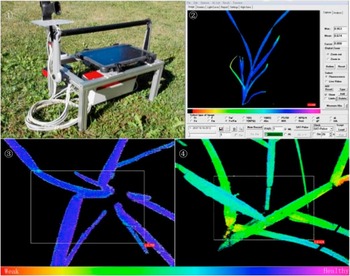
The WEED-PAM® sensor (Figure 1) is a mobile fluorescence imaging sensor (IMAGING-PAM MINI, Heinz Walz GmbH, Germany). It can emission light at 460 nm to induce chlorophyll fluorescence (Wang et al., Reference Wang, Peteinatos, Li and Gerhards2016b). Imaging is realized by a CCD-sensor with 640×480 resolution. The calculated parameter maximal PS II quantum yield (Fv/Fm) was selected to exam the PS II efficacy of the A. spica-venti plants. The parameter can be obtained using the following equation:
 $$Fv/Fm\,{\equals}\,{{Fm{\minus}Fo} \over {Fm}}$$
where, Fo is the basic fluorescence emission of plants after dark adaption, Fm is the maximum fluorescence yield of dark adapted plants after a saturation pulse and Fv is the difference Fm−Fo. Measurements were done five days after treatment. Prior to measuring Fv/Fm, the plants were covered for about 20 min for dark adaptation. The dark adaption was conducted by covering the plant with a cover box on the ground. A window on top of the cover box can be opened when the camera is mounted, permitting the measurement, while still excluding external light interference.
The WEED-PAM® chlorophyll fluorescence imaging sensor, ① A picture of the sensor. It consists of the camera control unit and the computer software. ② The software’s graphical interface. ③ A resistant plant to pinoxaden (ACCase inhibitor) measured 3 DAT. The blue shift responds to higher Fv/Fm and higher vitality. ④ A sensitive plant to pinoxaden (ACCase inhibitor) measured 3 DAT. The red shift responds to lower Fv/Fm and stress.

Experimental design
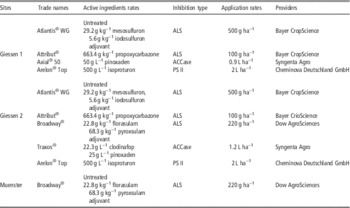
Three field experiments were conducted in central Germany in 2015 (Table 1). Winter barley fields with a high population of A. spica-venti were chosen. The first and second experiment, labeled Giessen 1, and Giessen 2 were conducted near the location Giessen (50.534 N, 8.605E; 50.545 N, 8.619E). The third experiment was conducted near Muenster (52.031 N, 7.612E). The three A. spica-venti populations were recorded, in the previous years, to exhibit resistance against either ALS- or ACCase- inhibitors. More information about the current resistant levels for each field can be found in Table 2. In the fields, weed infestation was measured to be between 200–700 plants m−2. The experimental setup was a completely randomized block design with three repetitions, and a plot size of 2×5 m. The chemical application was carried out, on each site, with the herbicides listed in Table 1 when A. spica-venti had generated the second or third tiller. An untreated control was always included. Herbicides were sprayed, at a spraying volume of 200 L ha−1, with a plot sprayer equipped with Lechler IDK 120–02 nozzles. In all experiments, herbicides were sprayed at temperatures above 10 °C. No rainfall was recorded within 24 hours after treatment.
Location and herbicide treatment details of the experiments

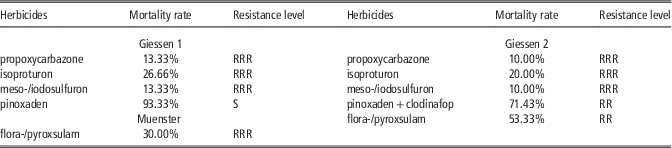
Herbicide resistance classification of Apera spica-venti populations at each site. ‘S’=sensitive, 100–81% mortality; ‘R?’=slightly resistant, 80–73% mortality; ‘RR’, resistant, 72–37% mortality; ‘RRR’, strongly resistant, 36–0% mortality

Measurement and data analysis
In all experiments, the Fv/Fm value of 30 A. spica-venti plants, per treatment were measured. During the measurements, each measured plant was marked. Visual assessment of the herbicide efficacy for each marked plant was made 21 days after treatment. The plants were then classified as ‘dead’ (sensitive) or ‘survived’ (resistant). The herbicide resistance level was determined by the ratio of dead plants in each treatment, as proposed by Moss et al. (Reference Moss, Clarke, Blair and Culley1999, Reference Moss, Perryman and Tatnell2007): ‘S’=sensitive, 100–81% mortality; ‘R?’=slightly resistant, 80–73% mortality; ‘RR’, resistant, 72–37% mortality; ‘RRR’, strongly resistant, 36–0% mortality.
Data were analyzed using R Studio (R Development Core Team, 2013), in order to determine if the herbicide treatments significantly affected Fv/Fm. It was also examined if the Fv/Fm value of sensitive and resistant plants can be differentiated under herbicide stress conditions. All the datasets were proved to be normally distributed by the Shapiro-Wilk test (p>0.05). Homogeneity of variances was analyzed using Levene’s test (p>0.05).
Results and discussion
Herbicide effect on PSII efficacy of Apera spica-venti
Table 2 shows the mortality rates and the resistance classification of all different treatments per site. Except from the A. spica-venti biotype at the site Giessen 1, which was sensitive to the ACCase inhibitor pinoxaden, all three biotypes were resistant to the herbicides involved.
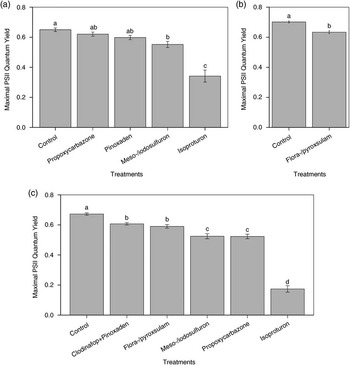
Figure 2 shows the average Fv/Fm values of the weeds after herbicide application at all three sites. Herbicide treated weeds present lower Fv/Fm values than their untreated counterparts. In Giessen 1 apart from pinoxaden also propoxycarbazone could not be differentiated from the untreated control. In the tested A. spica-venti biotypes, the reaction of their PS II system was different from what has been recorded for A. myosuroides. Resistant A. myosuroides populations could conduct photosynthesis after the herbicide treatment in similar levels as untreated plants. On the other hand, Fv/Fm values of sensitive A. myosuroides biotypes would significantly decrease their photosynthetic activity after the herbicide treatment (Kaiser et al., Reference Kaiser, Menegat and Gerhards2013; Wang et al., Reference Wang, Li and Gerhards2016a and Reference Wang, Peteinatos, Li and Gerhards2016b). However, in this study, the Fv/Fm values of resistant A. spica-venti weeds reduced, showing a similar reaction to the sensitive population. This agrees with the findings by Zhang et al. (Reference Zhang, Lim, Kim, Nah, Fischer and Kim2016) producing similar results on Echinochloa species. In that study, the Fv/Fm values of resistant Echinochloa spp., measured at 8 days after treatement, decreased significantly after treating them with ALS and ACCase inhibitors. Thus, the resistant or sensitive Apera spica-venti biotypes could not be identified with the current method.
Herbicide stress of Apera spica-venti five days after treatment. (a) Giessen 1, (b) Muenster, (c) Giessen 2; significant differences of Fv/Fm values between each treatment are indicated by different letters (Tukey’s test, p<0.05).

Resistance differentiation of Apera spica-venti using WEED-PAM®
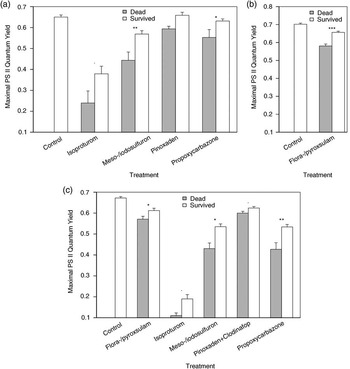
In order to further investigate the different herbicide effects on the ‘sensitive’ (Dead) and ‘resistant’ (Survived) A. spica-venti weeds, the plants were grouped based on the results of the visual assessment, performed on 21 DAT. The results are shown in Figure 3. Resistant plants to ALS inhibitors and PS II inhibitors displayed higher Fv/Fm values than the plants that eventually died. The same could not be stated for the ACCase resistant and sensitive weeds.
Herbicide stress of sensitive (Dead) and resistant (Survived) Apera spica-venti plants five days after treatment. (a) Giessen 1, (b) Muenster, (c) Giessen 2. Significant difference codes due to the p values of Tukey’s test: 0 ‘***’ 0.001 ‘**’ 0.01 ‘*’ 0.05 ‘.’ 0.1 ‘ ’ 1

When the A. spica-venti weeds were affected by ALS inhibitors, less valine, leucine and isoleucine were produced (Whitcomb, Reference Whitcomb1999; Oettmeier, Reference Oettmeier1999), resulting in lower synthesis rate of the protein in sensitive plants (Xiong et al., Reference Xiong, Subramaniam and Govindjee1996). Thus, there would be a slower electron transfer rate in the sensitive plants. This is observed as lower PS II efficacy, and a lower Fv/Fm value. PS II inhibitors induce a more intensive effect on the PS II efficacy for both sensitive and resistant plants than the ALS inhibitors. As expected a different Fv/Fm value was recorded (p<0.1). However, as previous researches showed (Pfister, Reference Pfister and Arntzen1979 and Reference Pfister, Steinback, Gardner and Arntzen1981), isoproturon cannot bind in the target site of target site resistant populations. Hence, there is a suspicion that non-target site resistant populations might be involved in the current research. The applied isoproturon rate might exceed the available rate that can be metabolized by the A. spica-venti populations. The metabolism resistance of PS II inhibitors has been found in Lolium rigidum and A. myosuroides, which could detoxify the ureas with enhanced N-demethylation and ring alkyl-oxidation (Moss, Reference Moss1990; Burnet et al., Reference Burnet, Hildebrand, Holtum and Powles1991). Therefore, the sensitive and resistant populations can be separated, as the PS II efficiency was affected due to the different intoxication level.
Wang et al. (Reference Wang, Peteinatos, Li and Gerhards2016b) reported significant Fv/Fm reduction of sensitive A. myosuroides with pinoxaden 5 DAT. On the other hand, different plant species need a different time period to manifest a measurable result in the photosynthetic system. A longer time period might be essential when applying this system to the measurement of A. spica-venti. Further studies are required for optimizing the measurement time for identifying resistant A. spica-venti plants, using the WEED-PAM® sensor.
Conclusion
The WEED-PAM sensor is capable of differentiating herbicide sensitive and resistant A. spica-venti weeds five days after treatment with ALS and PS II inhibitors. This potentially could enable farmers to take precautionary measures in the same growing season. However, the resistance to ACCase inhibitors cannot be identified. Further studies need to be carried out, in order to optimize the resistance detection time.
Acknowledgements
The authors would like to thank Dr. Dominik Dicke, Dr. Alexander Menegat, and Dr. Markus Soekefeld for their valuable advice and technical support. This project was funded by the Federal Ministry of Food and Agriculture in Germany (‘BLE-HerbiResistenz’ - FKZ 2814705011) and the Chinese Scholarship Council (CSC, China, No. 201306350053).