Introduction
Light pollution is an important but often overlooked consequence of human development on ecosystems (Gaston et al. Reference Gaston, Bennie, Davies and Hopkins2013). Artificial lighting can drastically alter the night-time landscape around areas of human influence, shifting community composition of nocturnal organisms (Longcore & Rich Reference Longcore and Rich2004). Community assembly around human-disturbed areas is theoretically determined by environmental, biotic and anthropogenic filters, which ultimately are governed by life history and functional traits (Aronson et al. Reference Aronson, Nilon, Lepczyk, Parker, Warren, Cilliers, Goddard, Hahs, Herzog, Katti and La Sorte2016). Elucidating the traits that characterize species response to artificial lights enables understanding of how anthropogenic lighting filters species at local scales (Aronson et al. Reference Aronson, Nilon, Lepczyk, Parker, Warren, Cilliers, Goddard, Hahs, Herzog, Katti and La Sorte2016).
Bats are likely to be heavily impacted by the expansion of artificial lighting due to their nocturnal habits (Stone et al. Reference Stone, Harris and Jones2015a). In temperate zones, many species of aerial insectivores – bats that forage by catching prey on the wing – are attracted to insects that congregate around artificial lights (Rydell Reference Rydell1992), while other species avoid lights (Kuijper et al. Reference Kuijper, Schut, Van Dullemen, Toorman, Goossens, Ouwehand and Limpens2008, Polak et al. Reference Polak, Korine, Yair and Holderied2011, Stone et al. Reference Stone, Jones and Harris2009). Hence, the proliferation of light pollution has the potential to alter community structure by selectively benefitting certain species of aerial insectivores while restricting the range of other bats (Rowse et al. Reference Rowse, Lewanzik, Stone, Harris, Jones, Voight and Kingston2016, Stone et al. Reference Stone, Harris and Jones2015a).
The traits that separate aerial insectivorous bat species that forage around lights from those that do not are poorly known. Aerial insectivores may be subdivided into functional guilds based on whether they forage in open areas or in edge spaces near environmental clutter (Denzinger et al. Reference Denzinger, Tschapka and Schnitzler2018). Studies in temperate zones suggest that fast-flying open-air foragers are attracted to streetlights, whereas slow-flying bats that forage in cluttered environments avoid them (Stone et al. Reference Stone, Harris and Jones2015a). Hence, functional guild (open vs. edge) and flying speed (fast vs. slow) may be important traits determining tolerance of aerial insectivores to artificial lights, a hypothesis that requires specific surveys in tropical areas, where bats are most functionally and taxonomically diverse (LaVal & Rodríguez-H Reference Laval and Rodríguez-H2002).
To our knowledge, only one prior study has evaluated the effect of anthropogenic lights on bat community composition in the tropics. Jung & Kalko (Reference Jung and Kalko2010) used acoustic monitoring to examine the microhabitat utilization of aerial insectivores in a forest–town interface in the Panamanian lowlands. They found that foraging activity was higher around streetlights than in nearby forest. However, both fast and slow-flying species regularly foraged around streetlights (Jung & Kalko Reference Jung and Kalko2010), not supporting the hypothesis that flight speed is the main trait dictating response to artificial light.
To focus directly on bat responses to artificial light, rather than the general differences between urban and forest environments investigated by Jung & Kalko (Reference Jung and Kalko2010), we compared foraging activity and diversity at multiple pairs of lit and adjacent unlit sites in the cloud forest of Monteverde, Costa Rica. We expected most aerial insectivore species to be attracted to lights (Jung & Kalko Reference Jung and Kalko2010). If the evaluated hypothesis is true, fast-flying species that usually forage in open areas above the canopy should be common near lights, whereas slow-moving species that usually forage in forest or edge conditions below canopy level should avoid lights. Our analysis accounted for covariation with the potentially confounding factors found to be important by Jung & Kalko (Reference Jung and Kalko2010) for explaining bat activity: distance to forest edge, artificial light type, lunar phase and time since sunset.
Study site
Acoustic monitoring was conducted in Monteverde, Costa Rica (10°19′N, 84°49′W) during 20 nights over the course of two separate periods, both at the end of Monteverde’s rainy season: the first from 22 October to 17 November 2015; the second from 18 October to 14 November 2017. Located on the western side of Costa Rica’s Atlantic slope, Monteverde is surrounded by large amounts of intact premontane and lower montane wet forest. However, the region has experienced a rapid increase in development over the past 50 y (Nadkarni & Wheelwright Reference Nadkarni, Wheelwright and Nadkarni2000), making it an ideal area to observe how encroaching light pollution may impact the ecology of a largely intact tropical forest. Monteverde is particularly well suited for a tropical bat-focused study, as its bat community has been documented for several decades (LaVal & Fitch Reference LaVal and Fitch1977) and the calls of at least 25 different species of insectivorous bat have been recorded in the area (LaVal Reference LaVal2004).
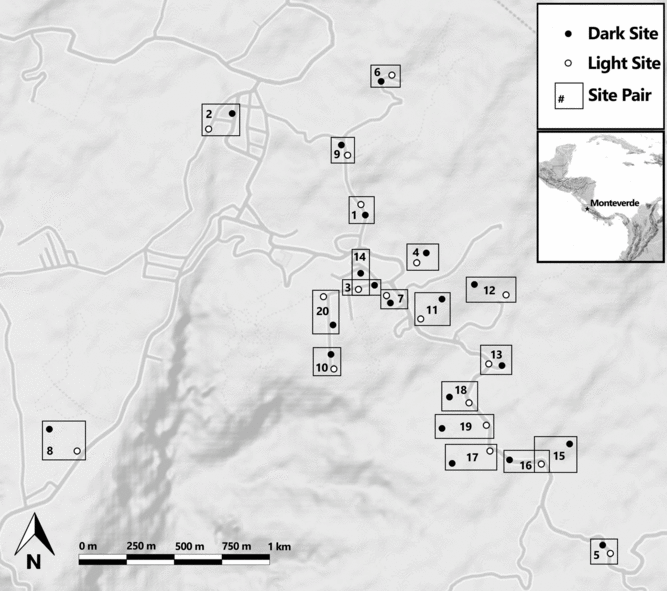
There were 20 pairs of recording sites, each consisting of one site centred at a streetlamp or fixed artificial light and one site nearby with no artificial lights (Figure 1). Sites were chosen that lacked canopy cover overhead, but were near forest edge, to: (1) avoid affecting the microphone’s range with surrounding vegetation; (2) maximize the likelihood of both open-air and edge foragers utilizing the sites; and (3) take advantage of the fact that the highest bat activity generally is observed near forest edge (Azam et al. Reference Azam, Le Viol, Bas, Zissis, Vernet, Julien and Kerbiriou2018, Lewanzik Reference Lewanzik2017).
Shaded relief map of Monteverde region in Costa Rica depicting the 20 study sites used to record bats. Each pair of light and dark sites is numbered and outlined in a rectangle. Note that pair 15 overlaps with pair 16, and pair 3 similarly overlaps with pair 14 – in both these cases, the same light site was used for the overlapping pairs. The inset map shows the location of Monteverde within Central America and surrounding regions. Created with the R package ‘ggmap’ (Kahle & Wickham Reference Kahle and Wickham2013).

Recording sites ranged from 1269 m to 1476 m asl. Within each pair, sites differed from each other in elevation by no more than 30 m, with a mean difference of 9.6 m. Paired light and dark sites ranged from 35 to 260 m apart in ground distance, with a mean distance of 125 m between paired sites (Appendix 1). Attraction to streetlights in temperate bats has been observed to diminish beyond a 10-m radius for temperate aerial insectivores, while streetlight avoidance has been detected at up to 50 m for some species (Azam et al. Reference Azam, Le Viol, Bas, Zissis, Vernet, Julien and Kerbiriou2018), so we expect any potential bias in the results to be towards under-measuring activity of light-avoiding species at dark sites. Two light sites were used twice, the Monteverde Cheese Factory (Nights 15 and 16) and a street lamp near the local bullring (Nights 3 and 14), for a total of 18 independent pairs (Appendix 1). To account for lack of independence in these cases, we included site identity as a random effect in our statistical models.
Methods
Each pair of sites was recorded in a single night. By recording both sites in a pair during one night, we minimized the influence of environmental variables that change significantly from night to night, such as weather and available moonlight. To control for the disrupting variable of bat activity fluctuating through the course of the night (LaVal Reference LaVal1970), each night’s recording was divided into four 30-min intervals alternating between the light and dark site of the pair. Thus, each site was covered twice in a night: 2 h were recorded per pair, with two 30-min periods devoted to each dark and light site. The order of recording sites in the pair was altered every night so that 10 of the nights began with the light site and 10 began with the dark site. We additionally accounted for the effect of fluctuating foraging activity by including in our analysis the time since sunset of each recording session. Because insectivorous bats usually do not forage in severe rain (LaVal & Fitch Reference LaVal and Fitch1977), we did not record on nights when precipitation exceeded a drizzle. On nights when it began to rain during recording, the session was cut short, or, if either site was recorded for less than 30 min before the onset of rain, the night was not included in the study. For nights cut short by rain during the third recording session, we only analysed data from the complete first two sessions. For nights cut short during the final recording session, we manually cropped the third session to match the time recorded in the fourth so that, in all cases, recording time at each site in a pair was equal. Five out of the 20 total nights had fewer than the full 2 h of recording (the minimum was 1 h). As most bat species display peak activity shortly following sunset (Brown Reference Brown1968, LaVal Reference LaVal1970), we began recording around 18 h each night (around 45 min after sunset).
To record bat calls, we used Wildlife Acoustics Corp.’s Echo Meter Touch (EMT) connected to an iPad Mini 2. The EMT can detect input from 8 kHz to 125 kHz, but was manually restricted to recording from 15 to 100 kHz to minimize extraneous sound input, as virtually all known aerial insectivorous bats from Monteverde fall into this range (R. LaVal, pers. obs.). The microphone was placed or held horizontally at chest level, 2-6 m from the point directly below the light source during recordings for each site, depending on the space that was available. The EMT’s microphone records calls omnidirectionally, and though detection range varies considerably with environmental variables and call frequency, a 50 kHz bat call can, on average, be detected around 15 m away (https://www.wildlifeacoustics.com/images/pdfs/UltrasonicMicrophones.pdf). The EMT was set to retain all recordings as .wav files, including those identified by the EMT application software as noise, to be sorted through manually.
After recording, the. wav files from the EMT were converted to zero-crossing files using Kaleidoscope software (Wildlife Acoustics Inc., USA) and examined in AnaLook software (Titley Scientific, Australia) to be counted and manually classified by species. The calls were quantified as passes, with each pass representing an instance of a continuous series of similar calls, presumably originating from a single individual flying past the microphone. The EMT microphone automatically begins recording when it detects sounds above a certain amplitude (the trigger sensitivity was kept on medium for the study) within the specified frequency range. The EMT continues recording for an additional 3 s after the detected noise drops below the trigger intensity, to avoid prematurely dividing a pass into multiple fragments. A single pass typically consisted of two to several dozen calls, and passes frequently lasted more than 10 s. Some recording files contained multiple concurrent passes; we manually identified these cases based on the presence of multiple species’ calls in a single spectrogram, or simultaneous calls that overlapped and could not have been produced by a single individual. Species assignments were based on frequency-time structure and morphology in spectrograms. We used a digital library containing recordings of Monteverde’s known bats as a reference in classification.
Potential confounding variables were recorded at each site. Distance to forest edge was measured from the point of recording using transect tape. Lunar phase and sunset times were obtained from publicly available online tables. Light type was assessed visually and, when unclear, was confirmed by contacting the owners of the lighting fixture. Most of the artificial light sources (16 of 20) were Monteverde’s public street lights, which, based on their yellow glow, appeared to be sodium vapour lamps. Given the fact that insects were observed circling these lights, they probably were high-pressure sodium vapour lamps, as low-pressure sodium illumination tends to attract few, if any, nocturnal insects (Rydell Reference Rydell1992). Four sites were lit by white lamps: one mercury vapour, two blue-white fluorescent and one blue-white LED. The bias towards sodium vapour lamps in our sample reflects the strong bias that currently exists in Monteverde towards this light type. We included all existing white lamp sites in the study area in our sample. We did not measure wind velocity, another potentially important factor (Santos-Moreno et al. Reference Santos-Moreno, Ruiz and Martínez2010), because the study was conducted during the wet season, when wind varies little in Monteverde (Clark et al. Reference Clark, Lawton, Butler, Wheelwright and Nadkarni2000).
We assigned species to functional guilds (open vs. edge forager) following Denzinger et al. (Reference Denzinger, Tschapka and Schnitzler2018), and as fast or slow flier following Jung & Kalko (Reference Jung and Kalko2010), given the absence of similar studies for Costa Rica. At these study sites, both located in Panama, all congeneric species shared the same guild and flying mode (Denzinger et al. Reference Denzinger, Tschapka and Schnitzler2018, Jung & Kalko Reference Jung and Kalko2010). For that reason, we assigned the same guild and flying mode to all congeneric species in our study when a species recorded in Monteverde was not listed by Denzinger et al. (Reference Denzinger, Tschapka and Schnitzler2018) or Jung & Kalko (Reference Jung and Kalko2010). Eptesicus fuscus, which is not reported in Jung & Kalko (Reference Jung and Kalko2010), was classified as a fast flier based on speed values (Hayward & Davis Reference Hayward and Davis1964) comparable to Neotropical mormoopid bats, which are considered fast fliers (Hopkins et al. Reference Hopkins, Sánchez-Hernández, Romero-Almaraz, Gilley, Schnell and Kennedy2003).
Statistical analyses
We fitted linear mixed models to evaluate the effect of treatment (dark, light) and the effect of potential confounding variables on the number of passes, on the number of species recorded and on the ratio of number of species to number of passes. The last of those metrics was included to assess the potential effect of the distribution of observations among species (i.e. evenness), as it was expected that raw species count would positively correlate with activity. All continuous data were log-transformed to meet the assumptions of linearity, homogeneity of residuals and normal distribution of residuals. We fitted one model for each one of these three response variables. All explanatory variables and two-level interactions were included as fixed effects in the models. Site was included as a random effect to account for the pairwise nature of the experimental design (light and dark treatments within each site) and to account for the use of light sites more than once. The order in which the treatments were sampled within each site was also included as a random effect nested within site. P values were calculated using Type II sums of squares with the Anova function of the R package ‘car’. Models were simplified to the minimum adequate model by removing non-significant terms on the base of changes in deviance, starting with the highest-order interactions (Crawley Reference Crawley2007). We show this analysis of deviance in our results. Post hoc comparisons were used to test for differences between dark and light sites across moon phases in minimum adequate models using the function ‘lsmeans’ (Tukey adjustment). A priori planned independent contrasts were used to compare the effect of light type between light sites in minimum adequate models, using ‘lsmeans’. All analyses in this study were conducted in R 3.4.2.
We also fitted a linear mixed model for each species recorded at more than five sites to evaluate the effect of lights on the activity of at least some individual species (log transformed). The models only included treatment as a fixed effect and site as a random effect due to sample size limitations. These limited models allowed us to evaluate whether some species were detected more frequently in light or dark areas. We excluded two of the most commonly recorded species, Eptesicus brasiliensis and Dasypterus ega, as their calls are near the same frequency and have similar morphologies in spectrograms, making it difficult to differentiate them with a high degree of accuracy. For these analyses, we excluded nights in which the species was not recorded at both the dark and light site in that particular pair. This was because the absence of a species at both sites in a given night did not suggest a lack of preference between light and dark treatment, but simply that the species in question was not present in the general area. Including nights with zero records at both dark and light sites would have biased the analysis against detecting preference towards light or dark in rarer species that did not appear on most nights. In the analysis for Eumops auripendulus, we chose to exclude one night (Night 13) in which the dark site was located near an abandoned building that was a known roosting site for that species, so as not to bias the results.
Results
Bat activity
A total of 2773 bat passes were recorded across the 20 nights of recording. An average night had 138.65 passes across both sites in the site pair, but nightly counts varied greatly between a minimum of four passes and a maximum of 461 passes. The mean nightly activity for light sites was 95.1 passes, with a maximum of 317 passes and a minimum of zero passes in one night. At dark sites, the nightly mean was 55.95 passes, with a maximum of 144 and a minimum of three passes in a single night.
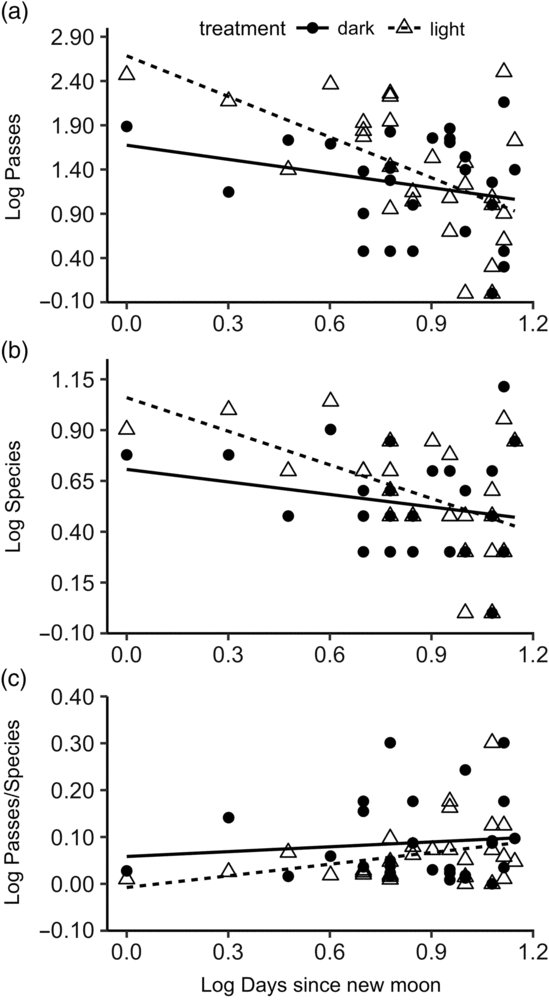
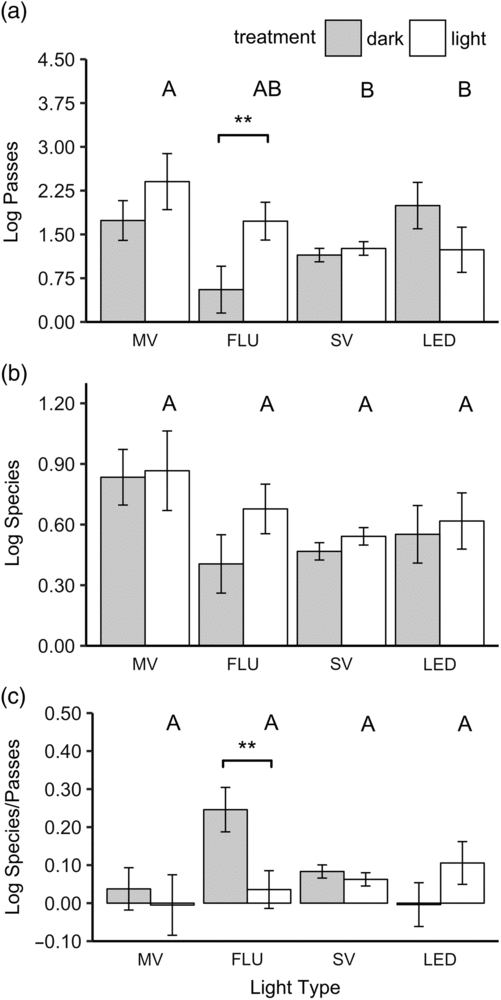
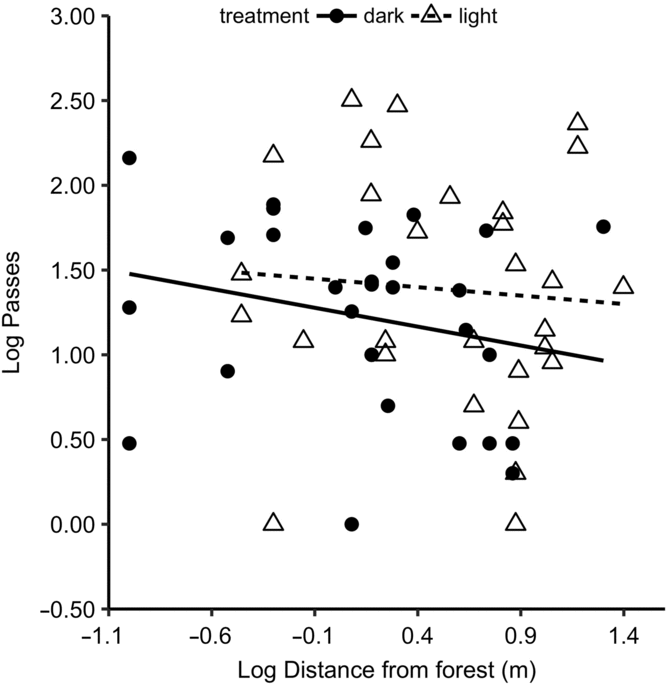
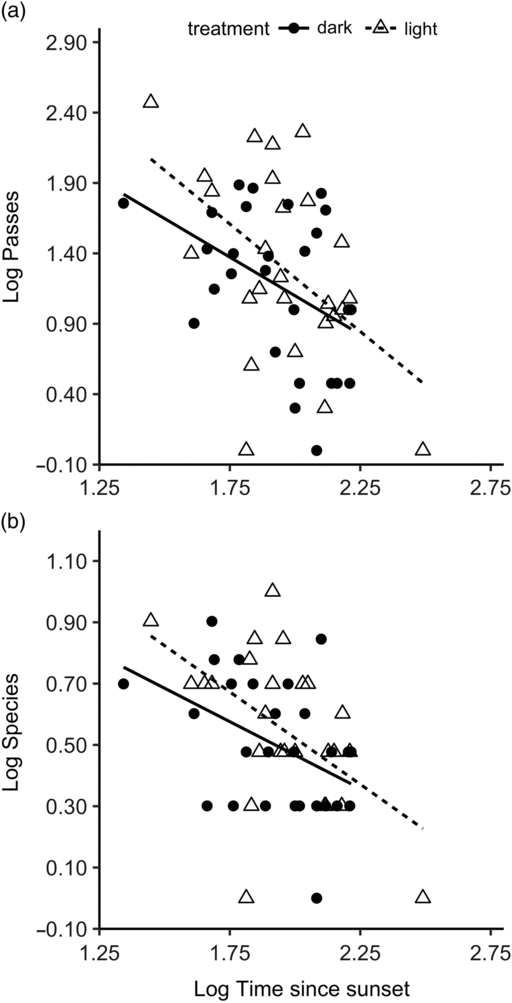
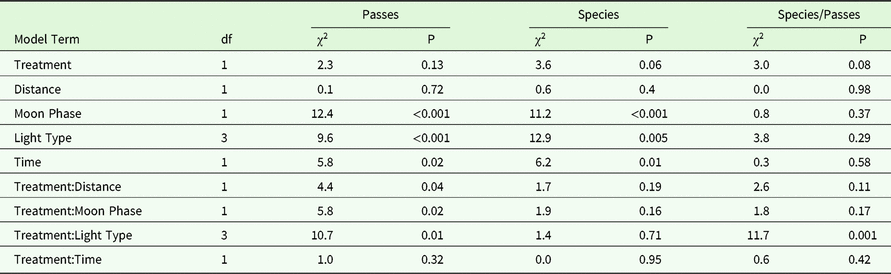
While the numbers seem to suggest overall higher activity at light sites, the difference between dark and light sites was not statistically significant (P = 0.13, Table 1). However, moon phase, light type and distance from forest edge affected bat activity differently between dark and light sites (Table 1). Hence, differences in activity between dark and light sites have to be interpreted taking the effect of these variables into account. In the case of moon phase, there were significantly more passes at light than dark sites during the new-moon phase, but the difference decreased progressively with increasing days since the new moon (as the amount of moonlight increased) until the difference disappeared around the full moon (Figure 2a). In the case of light type, we detected, on average, more bats around mercury vapour and fluorescent lights than adjacent dark areas, but the difference between dark and light sites was only statistically significant for fluorescent lights (Figure 3a). We did not find significant differences between dark and light sites around sodium vapour lights. For LEDs, on average we detected more bats at dark sites than around the lights, although this apparent difference was not significant (Figure 3a). Planned independent contrast between light sites showed that activity was significantly higher at mercury vapour lights compared with sodium vapour and LED lamps (Figure 3a). Fluorescent lights were intermediate in activity between mercury vapour and the other two types, but these apparent differences with other light types were not statistically significant (Figure 3a). With respect to distance from forest edge, there were, in general, more passes in light areas at all distances (Figure 4). The number of passes decreased with increasing distance from forest edge, but the decline was slightly more pronounced in dark areas (Figure 4). Finally, the number of passes declined with increasing time since sunset, but the decline was similar for dark and light sites (Table 1, Figure 5a).
Bat activity (a), number of species (b) and the ratio of number of species to activity (c) in relation to the number of days since the new-moon phase when sound recordings were conducted. Twenty pairs of light and dark sites were recorded twice in the premontane and lower montane forest of Monteverde, Costa Rica.

Bat activity (a), number of species (b) and the ratio of number of species to activity (c) in relation to light type. Bat activity and richness were sampled from sound recordings conducted twice of 20 pairs of light and dark sites in the premontane and lower montane forest of Monteverde, Costa Rica. MV = mercury vapour, FLU = fluorescent, SV = sodium vapour, LED = light-emitting diode. Least square means are presented with one standard error. Significant post hoc comparisons (Tukey, P < 0.05) between light and dark sites for a light type are shown with asterisks. Different letters above the means for light sites indicate significant differences based on planned independent contrasts.

The location where data points were collected in relation to forest edge affected the number of bat passes recorded. The decrease in activity with increased distance is slightly more drastic for dark sites resulting in a significant interaction between treatment and this variable. Sound recordings were collected twice on 20 pairs of light and dark sites in the premontane and lower montane forest of Monteverde, Costa Rica.

Time when data points were collected in relation to sunset affected the number of bat passes (a) and species (b) recorded. The decrease in bat activity with increased time since sunset is similar between dark and light sites. Sound recordings were collected twice on 20 pairs of light and dark sites in the premontane and lower montane forest of Monteverde, Costa Rica.

Results of linear mixed model analysis on bat activity measured as the number of passes, number of species and the ratio between these variables at light versus dark sites in Monteverde, Costa Rica. Variables in the model: Treatment (dark, light), Distance from forest edge, Time since sunset, Moon Phase measured as the number of days from the closest new moon and Light Type, and respective two-way interactions. Bat calls were recorded twice at 20 pairs of light and dark sites. P values correspond to type II sums of squares (analysis of deviance)

Species richness
We identified 19 distinct species in the dataset (Appendix 2). One species of bat was recorded with a distinctive call in the 70–90 kHz range – above the range of any known aerial insectivore from the area, but consistent with recordings of Natalus lanatus, a bat believed to be a gleaner (Denzinger et al. Reference Denzinger, Tschapka and Schnitzler2018, Rodríguez-Herrera et al. Reference Rodríguez-Herrera, Sánchez and Pineda2011). An average night had 7.8 species between both sites with a maximum of 13 and a minimum of three. Light sites saw a mean of 4.70 species in a night (with a maximum of 10 and a minimum of zero), whereas dark sites saw a mean of 4.05 species per night (with a maximum of 12 and a minimum of one).
As with general bat activity, more species were recorded around light sites but the difference between dark and light sites was marginally not significant (P = 0.06, Table 1). The number of species declined with number of days following a new moon and time since sunset, but in similar ways between dark and light sites (Table 1, Figure 5b). The patterns detected between treatment and moon phase and treatment and light type for activity are similar in the case of species count (Figures 2b and 3b), but in this case the patterns are not significant – likely due to smaller sample size.
Species to passes ratio
We calculated a higher ratio of species number to passes in dark areas (mean ± SE: 0.25 ± 0.05 species/passes compared with 0.17 ± 0.4 species/passes per night at the light sites). Hence, evenness was apparently higher in dark areas compared with lit areas, but the difference was marginally not significant (P = 0.08, Table 1). The only variable that significantly affected the evenness between light and dark areas was light type (Table 1). In general, species evenness was low around both dark and corresponding light sites except at fluorescent light sites, where evenness was much higher in dark sites compared with corresponding light sites (Figure 3c).
Individual species activity
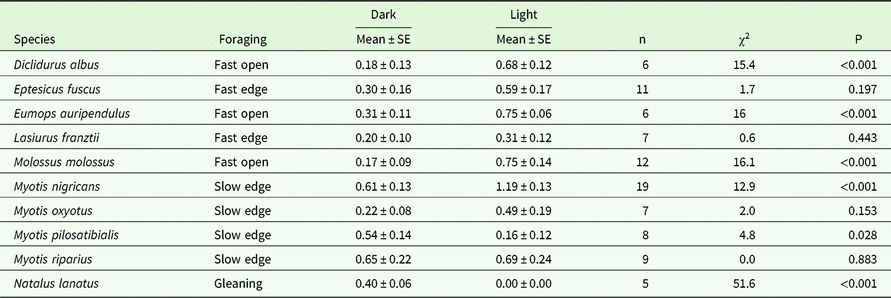
Most of the analysed species (seven out of 10) were recorded more often at light sites, although only four of these species showed a significant difference in activity between treatments (Table 2). The low sample size for most individual species is likely responsible for the general lack of significant differences. For the species that showed significant preference towards light sites, mean activity per 30-min recording session ranged between 95% and 341% higher around lights than at dark sites (Table 2).
Results of linear mixed model analysis on bat activity at light versus dark sites for 10 insectivorous bat species recorded in at least five pairs of dark and light sites (n). Activity was measured as the number of identified passes of each species from recordings at 20 pairs of light and dark sites in premontane and lower montane forest of Monteverde, Costa Rica. Mean activity represents number of passes per 30-min recording session. Nights in which a given species was not found at either pair of sites were excluded from the analysis of that species. The data for E. auripendulus excluded one night in which the dark site was located at a known roost for that species. Species were classified into functional guilds as either open-air foragers or edge foragers based on Denzinger et al. (Reference Denzinger, Tschapka and Schnitzler2018), and as fast or slow fliers based on Jung & Kalko (Reference Jung and Kalko2010) and Hayward & Davies (Reference Hayward and Davis1964)

Two species – Myotis pilosatibialis and Natalus lanatus – were recorded significantly more frequently at dark sites. Mean activity per 30-min recording session was 317% higher at dark sites than at light sites for M. pilosatibialis, and N. lanatus was only recorded at dark sites (Table 2). There was not a clear association between the foraging mode of a species and its response to artificial lights (Table 2). The three species known to be fast fliers foraging in open areas were, as predicted, more active at light sites, but one slow-flying species that forages around forest edges was also more active at light sites. Of the four species known to forage on edges using slow flying, one was more active at dark sites, two were more active near lights (only one significantly), and one showed very similar activity at dark and light sites. The species that were not significantly more active in dark or light areas were also a mixture of fast and slow edge-foragers (Table 2).
Discussion
As predicted on the basis of Jung & Kalko (Reference Jung and Kalko2010), foraging activity of aerial insectivorous bats was greater around streetlights compared with unlit sites, although the difference between treatments was only apparent in the presence of certain moon phases and light types. The fact that the activity difference between light and dark sites disappeared around the full moon indicates that moonlight can mitigate the impact of artificial sources of light on insectivorous bats. Our explanation for this result is that artificial light sources attract fewer insects during bright moon phases, a phenomenon that previously has been observed (Eisenbeis Reference Eisenbeis, Rich and Longcore2006). This explanation is further supported in our results by the fact that light sites show a sharper decrease in bat activity as the moon waxes than dark sites.
Of the light types in our sample, mercury vapour and fluorescent lights were associated with the highest bat activity. These results are consistent with the increased bat activity at bluish-white lights found by Jung & Kalko (Reference Jung and Kalko2010) and support the idea that bats are attracted to insects drawn to lights based on the amount of UV light they emit – mercury vapour and cool-white fluorescent lights tend to produce more UV radiation than high-pressure sodium vapour lamps (Stone et al. Reference Stone, Wakefield, Harris and Jones2015b), and LEDs in many cases produce little or no UV light (Lewanzik & Voigt Reference Lewanzik and Voigt2017, Wakefield et al. Reference Wakefield, Broyles, Stone, Harris and Jones2017). Lights that do not attract significant insect activity provide less benefit for light-tolerant bats, and thus low-UV lights likely attract these bats relatively less (Lewanzik & Voigt Reference Lewanzik and Voigt2017, Rowse et al. Reference Rowse, Lewanzik, Stone, Harris, Jones, Voight and Kingston2016).
As expected, activity declined with distance from forest edge. The slightly less sharp decline observed for light sites potentially can be explained if light-attracted aerial insectivore species also tend to be adapted to forage in more open areas, an idea that has previous support in the literature (Rowse et al. Reference Rowse, Lewanzik, Stone, Harris, Jones, Voight and Kingston2016).
Overall, bat species richness followed the same patterns in our results as bat activity. This suggests that, like aerial insectivorous bats studied in the temperate zone (Rydell Reference Rydell1992) and in Panama (Jung & Kalko Reference Jung and Kalko2010), many aerial insectivore species in Monteverde forage around artificial light sources. This was supported by the fact that, in the species analyses, more species showed a preference for light sites than dark sites (and of species that did not show a significant difference, most were observed more commonly at light sites). Unlike species count, we found that species evenness (as measured by a species/passes ratio) tended to follow the inverse of patterns observed for activity. Fluorescent lights, the light type that attracted the most bat activity, hosted a significantly lower evenness ratio than corresponding dark sites. These data suggest that, while artificial lights attract many species from the local community, at high levels of activity, foraging is dominated by a few of the species present. This might signify that among species attracted to artificial lights, some are selectively advantaged. Alternatively, the low evenness at light sites could reflect a general tendency for species evenness to decrease with increasing activity that is not particular to artificial lights.
Most species of aerial insectivore in the individual analyses were found to be more active around lights, including taxa that were not fast-flying, open-air foragers. Three of the four species significantly more active near lights (Molossus molossus, Eumops auripendulus and Diclidurus albus) are fast fliers that forage in the open, as expected, but the fourth (Myotis nigricans) is a slow flier that forages near forest edge (Denzinger et al. Reference Denzinger, Tschapka and Schnitzler2018, Hayward & Davis Reference Hayward and Davis1964, Jung & Kalko Reference Jung and Kalko2010). This result is consistent with the findings of Jung & Kalko (Reference Jung and Kalko2010) that both fast- and slow-flying aerial insectivores are attracted to artificial lights. The species found around lights by Jung & Kalko (Reference Jung and Kalko2010) are also a mixture of open and edge foragers based on Denzinger et al. (Reference Denzinger, Tschapka and Schnitzler2018). In general, the results of the comparison between dark and light sites in our study were consistent with the findings of Jung & Kalko (Reference Jung and Kalko2010) when the same species or genera were found. However, Jung & Kalko (Reference Jung and Kalko2010) found that Eumops spp. and M. molossus were more active at dark sites, whereas in our study the two species were more active at light sites. This difference between studies may represent regional variation in the behaviour of these taxa, perhaps mediated by the other aerial insectivore species present in the local community, or differences in predator and prey species between a cloud forest and tropical lowland ecosystem. Bat predators found in the Costa Rican lowlands, like the black-and-white owl and great potoo, are absent in Monteverde (bat falcons occur very rarely, Garrigues & Dean Reference Garrigues and Dean2014), so bats in the highlands may perceive relatively less risk of predation and be more prone to foraging in well-lit areas.
The species that we found to be more common in dark areas – M. pilosatibialis and N. lanatus – consist of a slow flier that forages near foliage and a gleaner, supporting results found in temperate zones. It should be noted that our study did not account for differences in vehicular traffic between sites, which may have impacted the results if these two species were avoiding only traffic (which presumably was higher on average at light sites) and not artificial lights. However, we believe the results cannot be explained by differences in traffic alone, as the majority of the site pairs where these two species were recorded had either both light and dark sites located along roads, or neither. We thus interpret the data for M. pilosatibialis and N. lanatus as indicating an avoidance of artificial light. It might be that M. pilosatibialis, with its low flight pattern (Denzinger et al. Reference Denzinger, Tschapka and Schnitzler2018, R. LaVal, pers. obs. based on mist net captures), exposes its eyes to a greater intensity of artificial light than do species flying mostly above streetlamp level, forcing M. pilosatibialis to alter its behaviour. It is also possible that the lower-flying prey of M. pilosatibialis is less concentrated around lights, given that low-flying insects tend to be smaller (Taylor Reference Taylor1974) and smaller insects tend to be less attracted to lamps (van Langevelde et al. Reference Van Langevelde, Ettema, Donners, Wallisdevries and Groenendijk2011). That the echolocation calls ascribed to N. lanatus, a gleaner presumably flying close enough to the microphone to record, were only encountered at dark sites is consistent with the idea that bats other than aerial insectivores should avoid lights (Stone et al. Reference Stone, Jones and Harris2009).
The results from our study and from Jung & Kalko (Reference Jung and Kalko2010) suggest that aerial insectivorous bats have a high potential to adapt to anthropogenic light pollution in the tropics, but that the tolerance level to disturbance is species-specific. In general, foraging guild (open vs. edge) and flying speed (fast vs. slow) do not provide a categorical separation between aerial insectivorous species that are attracted to lights from those that avoid them in the tropics. While fast-flying and open-space foraging are traits that in our results do seem to predict attraction or tolerance to artificial lights, slow-flying, edge-foraging, and even the combination of the two traits are not necessarily indicative of a light-avoidant species. It is likely that flight speed and foraging mode play a role in determining the response of aerial insectivorous bats to light pollution, but are not the only relevant traits. The species that avoided lights completely in Panama do not seem to share life history or functional traits, and their absence in lighted areas may be a consequence of their high sensitivity to forest disturbance (Jung & Kalko Reference Jung and Kalko2010). We suggest that specific studies on foraging behaviour of aerial insectivore species near and away from artificial lights should be conducted to elucidate the functional traits or combinations of traits that govern species filtering and ultimately community assembly (Aronson et al. Reference Aronson, Nilon, Lepczyk, Parker, Warren, Cilliers, Goddard, Hahs, Herzog, Katti and La Sorte2016) in tropical urban areas.
Regardless of the exact reasons why these species avoid lights, variation in species responses to artificial light implies that light pollution selectively benefits the tropical bat community just as it does temperate-zone bat populations (Stone et al. Reference Stone, Harris and Jones2015a). Species that do not take advantage of lights, or cannot take advantage of them as effectively as other species, may be threatened as the use of artificial lighting continues to expand throughout the tropics.
Acknowledgements
We thank the Costa Rican National Conservation System for permitting us the opportunity to conduct research in Costa Rica (RESOLUCION SINAC-SE- GASP-PI- R-046- 2015). We thank the Monteverde Butterfly Garden, the Monteverde Cheese Factory (Alimentos Sigma), Hotel Fonda Vela, the Monteverde Cloud Forest Lodge, Cabañas Los Pinos and the Monteverde Inn for allowing us to record at their property and for providing information about their night lighting. Alan Masters, José Carlos (Moncho) Calderón and Raquel Bone, through their insights, made valuable contributions to the experimental design of this study. Brandon Hedrick, Peter Dodson, Jodi Danzig and two anonymous reviewers provided constructive feedback in the writing of this manuscript.
Financial support
None.
Appendix 1
Site-specific information for recording bat echolocation in Monteverde, Costa Rica. Distance between paired sites was calculated in Google Earth. Distance to forest edge was measured with a transect tape. MV = mercury vapour, FLU = fluorescent, SV = sodium vapour, LED = light-emitting diode

Appendix 2
List of species identified from recorded echolocation calls in Monteverde, Costa Rica. Nomenclature follows Baird et al. (Reference Baird, Braun, Mares, Morales, Patton, Tran and Bickham2015) for Dasypterus and Lasiurus, Mantilla-Meluk & Muñoz-Garay (Reference Mantilla-Meluk and Muñoz-Garay2014) for Myotis pilosatibialis, Rodríguez-Herrera et al. (Reference Rodríguez-Herrera, Sánchez and Pineda2011) for Natalus, and LaVal & Rodríguez-H (Reference Laval and Rodríguez-H2002) for all other taxa:
Dasypterus ega
Dasypterus intermedius
Diclidurus albus
Eptesicus brasiliensis
Eptesicus fuscus
Eumops auripendulus
Lasiurus franztii
Molossus molossus
Molossus sinaloae
Molossus rufus
Myotis nigricans
Myotis oxyotus
Myotis pilosatibialis
Myotis riparius
Natalus lanatus
Peropteryx kappleri
Peropteryx macrotis
Pteronotus gymnonotus
Tadarida brasiliensis