Introduction
Between the middle of the eighteenth and the middle of the nineteenth century, the North Sea area witnessed a rapid increase in the number of operating weekly markets. New weekly markets were established in England and Wales, as well as in Ireland and France (Chartres, 1990a; Chartres, Reference Chartres and Desplat1996; Margairaz, Reference Margairaz1988; O'Flanagan, 1983; O'Flanagan, 1985). Flanders was no exception to this trend but the stimulus for the multiplication of such local markets remains unclear. As Margairaz (Reference Margairaz1986: 1227–33) shows, new markets could be intended for diverse purposes, and could either support or hinder the interests of different groups: producers, consumers as well as tradesmen. On the one hand, markets could be needed as an outlet for agricultural or industrial produce. On the other hand, markets could also be required as a source of supplies, either of raw materials or food, for a growing rural proletariat involved in cottage industries, for instance.
It is tempting to see the multiplication of markets as the response of agricultural producers to growing external demand, thereby supporting market integration. For example, Margairaz (Reference Margairaz and Cavaciocchi2001: 205–7, 210–11) argues that in France the need to commercialise grain surpluses that would otherwise have been wasted was frequently cited as a reason to establish new markets. At the same time, rural producers were anxious to escape the ‘tyranny’ of grain merchants, to whom they could only sell at low prices, by creating an alternative outlet. Authorities permitted these requests, believing a densification of the network of markets would stabilise both supplies and prices. In a rare historical study of the commercial infrastructure in Belgium, Michielsen ([1938]: 31–2) puts forward a similar view. He writes that the number of ‘collecting markets’ grew quickly from the end of the eighteenth century and this process continued in the nineteenth century. He suggests that these markets did not serve local needs, but rather those of growing towns. Local weekly markets would have solved the problem that on the one hand farmers wanted to supply remote towns but on the other hand were reluctant to travel long distances. In local markets, however, farmers could sell to middlemen, who in turn supplied towns. Therefore, in the view of both Margairaz and Michielsen, many new local markets served to connect agricultural producers with distant consumers, thereby integrating relatively isolated areas within ‘the’ market.
Market integration or, at least, price integration did improve in Belgium in the eighteenth and nineteenth centuries (Bateman, Reference Bateman2011; Jacks, Reference Jacks2005; Unger, Reference Unger and Van Winter1983). According to Dejongh et al., between 1700 and 1850 Belgian agriculture came ‘in the grip of the market’. Farmers responded to the growing demand for food and the corresponding rise in prices by orienting their production more towards the market. After the middle of the nineteenth century, an ‘homogeneous national market’ formed in Belgium (Dejongh, Reference Dejongh1999: 235–314; Dejongh, Van Campenhout and Ceusters, 2000), but it is unclear whether the multiplication of markets contributed to that process. Margairaz (Reference Margairaz and Cavaciocchi2001: 211–19) did not find that the densification of the network of markets had an effect on grain price dispersion.
When linking the establishment of new markets to market integration, this development is primarily seen as a response of rural producers to external factors, namely rising demand and prices. As a result, changes within rural society tend to get neglected. O'Flanagan (Reference O'Flanagan1985: 364, 367–8) has indicated the need to take the internal dynamics of rural societies into account in his study of markets in Ireland, where he argues that the market infrastructure developed ‘as a result of new external and internal pressures’. Although markets in Ireland became involved in long distance trade oriented towards export, they ‘may have been conceived initially as mechanisms to generate local exchange’.
Likewise in large parts of Flanders, the establishment of new markets was not primarily a response of rural producers to growing external demand for food and corresponding rising prices. Rather, this article will show that new markets were established in an attempt to permit households to intensify their activities in order to cope with increasing economic difficulties between the late eighteenth century and first half of the nineteenth century. Developments within rural society, such as rising population pressure, the need to produce and sell more, and deteriorating informal exchange networks among countrymen, coupled to a decline in demand for rural industrial products, were the main drive behind the multiplication of markets.
The focus in this study is on the province of East Flanders, which together with West Flanders made up most of the former county of Flanders, located in the north-west of present day Belgium (see Figure 1). In the first section, the main developments in Flemish rural society in the eighteenth and first half of the nineteenth centuries will be discussed. The following section then presents a reconstruction of the total number of operating weekly markets in East Flanders between 1750 and 1900, which will show a considerable increase between the late eighteenth and the middle of the nineteenth century. The focus here is on ‘real’, periodic markets, the officially recognised weekly gatherings of buyers and sellers. The people and products for which these markets were intended are addressed in the third section, coupled to a regional analysis, suggesting that in most of the province the establishment of the markets followed a specific pattern. The final section then focuses on these markets, and shows how they were a response to the absence of market access experienced by many households.
East and West Flanders, mid nineteenth century

The Flemish ‘commercial survival economy’ under pressure
The rural economy of inland Flanders in the modern period has recently been described as a ‘commercial survival economy’, where the majority of households could only cope by combining subsistence production with market activities (Thoen, Reference Thoen, Hoppenbrouwers and van Zanden2001). By the middle of the nineteenth century, most holdings in inland Flanders were no more than five hectares and the majority were not even one or two hectares (Vanhaute, Reference Vanhaute2001; 2004). Yet even these smallholdings were used for both arable farming and livestock rearing. Arable land was mainly, although not exclusively, used for basic food production, while cows, which appeared on almost all holdings larger than half a hectare, provided milk and butter, as well as draught power (Thoen and Vanhaute, Reference Thoen, Vanhaute, Thoen and van Bavel1999). As these smallholdings were insufficient to support a household, additional sources of incomes were needed. Performing labour on large farms was one option, yet more and more households turned to spinning and weaving flax (Mendels, Reference Mendels1972; 1975; Sabbe, Reference Sabbe1975). Rising sales figures of cloth in the markets of Ghent and Aalst reveal that activity in the linen industry rose impressively in the course of the eighteenth century (Vandenbroeke, Reference Vandenbroeke1979: 158–69).
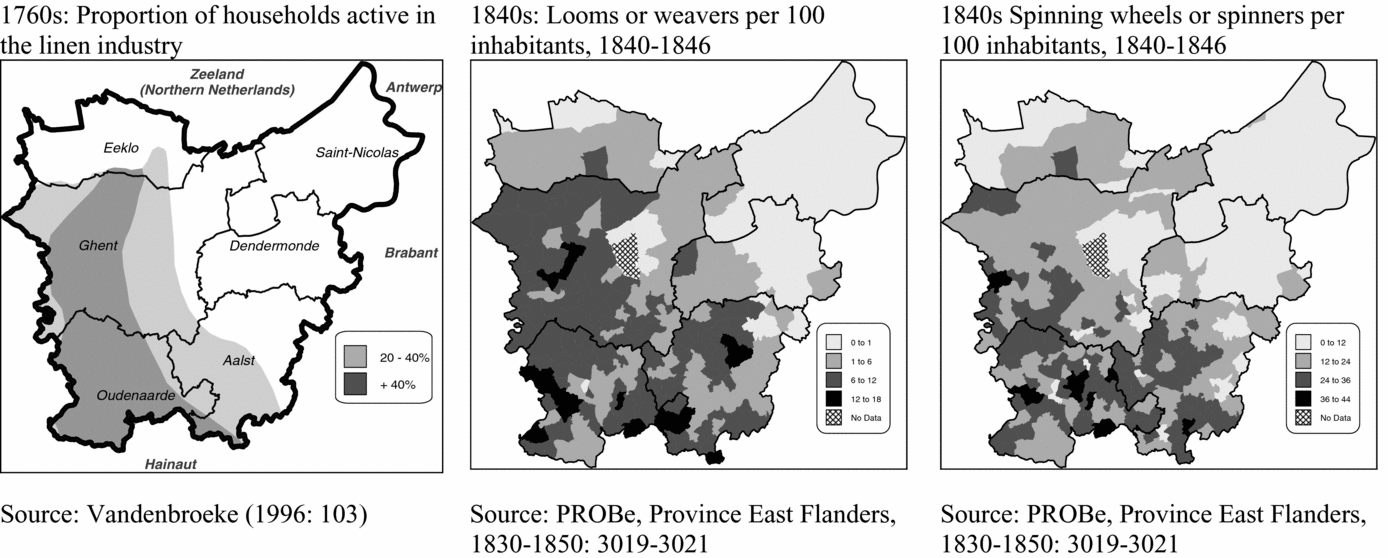
The linen industry was not spread all over Flanders but rather was concentrated in central and southern Flanders. Within the East Flanders province (see Figure 2), it was virtually absent in the north east, the districts of Dendermonde and Sint-Niklaas, but widespread in the south and west, the districts of Ghent, Oudenaarde and Aalst. Around 1840, roughly between twenty-five and thirty-five per cent of the entire rural population in these three districts were active in the linen industry, or between forty and sixty per cent of the active population (Jacquemyns, Reference Jacquemyns1929: 54). Subsistence farming, in combination with the small scale sale of agricultural products such as industrial crops or dairy produce, with agricultural labour on the larger farms and/or spinning and weaving, provided the basis for the economic and demographic expansion of the Flemish countryside in the second and third quarter of the eighteenth century (Vandenbroeke, Reference Vandenbroeke1982; 1985; 1996). High yields as a result of labour intensive cultivation and low grain prices around the middle of the eighteenth century, in addition to the introduction of the potato, made it possible to feed a growing population on a small area. The combination of industrial activities with subsistence agriculture permitted spinners and weavers to accept low rates of profit, which gave Flemish producers their competitive edge.
The linen industry in East Flanders, 1760s-1840s
From the last quarter of the eighteenth century, however, the Flemish commercial survival economy increasingly came under pressure. The elements that made the expansion around the middle of the eighteenth century possible also led to rising population densities, accelerated the fragmentation of holdings and drove up lease prices, with leasehold in the long run becoming more and more widespread. As the linen industry faced increasing competition from mechanised cotton production abroad, particularly in the second quarter of the nineteenth century, Flemish artisanal producers had no other recourse than to accept further reductions in their profit rates. Starting around 1780, dropping prices of cloth and rising prices of grain pushed incomes downwards in real terms. This happened slowly at first, but accelerated after 1830. Spinners and weavers needed to produce ever more to be able to cope, leading to a further rise in total output until the 1830s (Vandenbroeke, Reference Vandenbroeke1979: 144–8, 172–4; 1982: 137–41; 1985: 321–2; 1996: 107–8; Vanhaute, Reference Vanhaute, Ó Gráda, Paping and Vanhaute2007: 133). According to Vanhaute (Reference Vanhaute, Ó Gráda, Paping and Vanhaute2007: 123–30), this model of the rural society had reached its limits by the middle of the nineteenth century. When this looming structural and industrial crisis met with a harvest crisis in the mid 1840s, the core area of the linen industry, including the regions of Ghent, Oudenaarde and Aalst, was among those hardest hit (Vanhaute, Reference Vanhaute, Ó Gráda, Paping and Vanhaute2007; Vanhaute and Lambrecht, Reference Vanhaute and Lambrecht2011; Vanneste, Reference Vanneste1997).
The need to work harder and produce more for the market from the last decades of the eighteenth century also implied the need to sell more. Yet access to periodic markets was problematic. Several recent studies on Flemish rural society in the late modern period have stressed that, to a large extent, smallholders had access to the market through local large farmers who acted as intermediaries (Lambrecht, Reference Lambrecht2002; 2003; 2009; Vermoesen, Reference Vermoesen2008; 2010; 2011). The mass of smallholders in the countryside did not depend on an anonymous market, but rather on a significant minority of ‘peasant-supporting’ large farmers (Thoen, Reference Thoen, Hoppenbrouwers and van Zanden2001: 111–12; 2002: 171–2; 2004: 58). Both groups developed reciprocal exchange relations. While smallholders and day labourers mainly supplied the large farmers with labour, the latter could in return provide services such as carrying goods to market with their carts and horses, or selling grain, leasing plots and lending implements and horses to the smallholders and day labourers. As such, the large farmers ‘mediated’ the market dependence of smallholders. They were simultaneously a means of access to the market and a buffer against market forces.
However, there were limits to the extent of these networks. Some products, such as butter and eggs, hardly circulated within the informal exchange networks, in contrast to grain or linen cloth for example (Vermoesen, Reference Vermoesen2011: 155–61, 179–91). That also meant that large farmers had little interest in carrying butter or eggs to market. The same probably applied to small surpluses of flax and yarn produced by smallholders or spinners. Furthermore, it is unclear whether the expansion of the linen industry helped to support or dissolve these relationships. According to Vermoesen (Reference Vermoesen2008; 2010; 2011), spinners and weavers were still included in the informal exchange networks. Large farmers supplied raw materials or accepted linen cloth in return for the goods and services they provided, and may even in some cases have acted as putting-out merchants. That view goes against the earlier claim by Thoen (Reference Thoen, Hoppenbrouwers and van Zanden2001: 114) that ‘the growing importance of rural industry tended to loosen the ties between smallholders and large farms in inland Flanders’. According to Thoen's view, the growth of the linen industry also meant, for a significant part of the rural population, an increasing independence from the existing informal exchange networks in the countryside, together with a growing dependence on more formal exchange mechanisms for purchasing raw materials and selling output.
This is more consistent with the arguments of Vanhaute and Lambrecht (Reference Vanhaute and Lambrecht2011), who explain the shift to more formal exchange mechanisms as a response to the increasing insufficiency of the existing, informal exchange networks. Not only were there limits to these networks with regard to the products that circulated within them, but Vanhaute and Lambrecht suggest that there was also a growing part of the population that could no longer be included. The informal, reciprocal exchange relationships mainly rested on the labour absorbing capacity of large farms. However, as there were limits to that capacity, and as population levels grew and the fragmentation of smallholdings proceeded, an increasing proportion of rural households could not or only incompletely be included in these exchange relationships. As a result, ‘households faced with insufficient food supplies had to turn to formal markets or depend on other, more formal networks of distribution to ensure their survival’ (Vanhaute and Lambrecht, Reference Vanhaute and Lambrecht2011: 177). Vanhaute and Lambrecht argue that this was the background behind the increasing reliance on formal institutions for poor relief that appears from a comparison of the way local administrations dealt with the subsistence crises of the 1740s and 1840s.
Ties between villagers were further disturbed in the 1830s as a result of the introduction of mechanical yarn. In the course of the 1830s, the production of mechanically spun flaxen yarn made great progress. Soon, imports of English mechanical yarn rose exponentially, reaching a temporary maximum in 1838 (Jacquemyns, Reference Jacquemyns1929: 145, 418–19). For Flemish spinners, this had a double effect. Firstly, it caused the price of manual yarn to drop. Secondly, weavers increasingly switched to the cheaper mechanical yarn, no longer as independent producers but within a putting-out system, with the mechanical yarn supplied to them by merchant-entrepreneurs. As a result, the spinners who needed to sell more to compensate for declining prices were confronted with increasing difficulties in supplying their yarn to family members or fellow villagers, within the existing informal exchange networks (Haagen, Reference Haagen1983: 226–42; Jacquemyns, Reference Jacquemyns1929: 67–202; Sabbe, Reference Sabbe1975: 345–82, 500–15).
Like the increasing reliance on formal institutions for poor relief, the multiplication of markets in the Flemish countryside was symptomatic of the shift towards more formal exchange mechanisms. When conditions deteriorated from the 1780s, households responded by an intensification of their coping mechanisms, which also entailed a higher volume and frequency of sales. However, these households were soon confronted with a lack of market access. In response, village administrations, in which large farmers were probably well represented, sought to establish local markets for the sale of small amounts of flax, yarn, butter and eggs, to enable their populations to manage more on their own. The result was a proliferation of markets in the Flemish countryside between the last decades of the eighteenth century and the middle of the nineteenth century. For many, this also meant more unmediated market-dependence, increasing their independence from the existing informal exchange relations.
New weekly market places in East Flanders, 1750–1900
There are a number of problems in the process of reconstructing trends in the establishment of new market places and ascertaining the total number of operating markets through time (Chartres, 1990a: 3–4, 160; Chartres, Reference Chartres and Desplat1996: 159–60; O'Flanagan, 1985: 364–66). In addition, the specific administrative practices of the successive Austrian (1713–1795), French (1795–1815), Dutch (1815–1830) and Belgian (1830-) regimes in the Southern Netherlands have contributed to the complexity of the matter. While official figures by province on the number of weekly markets in Belgium were published, these cannot be used as they do not specify what is counted: the geographical, temporal or qualitative component of weekly markets.Footnote 1 For example, one municipality may have a market, yet it can also state that it has a Monday and Friday market, or both a grain and cattle market. That would be one market place, but could be counted as two or more markets. Presumably different administrations used different criteria to count markets when compiling the figures. Moreover, the official figures after 1870 are manifestly wrong.
From the French period, official lists of markets were regularly drawn up providing not only numbers but the names of all the places where markets could be held, and sometimes indicating the products that were sold or the dates they were instated.Footnote 2 The problem with these lists is that they often represent the legal situation, rather than the real situation. Some markets that were on the lists had only an official existence, but were in reality attended by no one, while in other places that were not listed, weekly markets were held for years without official sanction. Unlike the lists that were drawn up for England, Wales and Ireland in the nineteenth century, these lists are too incomplete to retrace the history of markets.
Finally, there are the files treating the requests from local authorities to be granted permission to hold a market.Footnote 3 Until 1870, weekly markets in the southern Netherlands could only be held with official permission from central powers.Footnote 4 However, not all requests for markets are preserved. In addition, some places probably never submitted a formal request, and only managed to get recognition for an illicit market when official lists were drawn up.Footnote 5 Conversely, some places submitted a request for a weekly market, even when they already possessed an older legal title for a market which had ceased to exist. The latter case raises questions of the conditions under which a market is really ‘new’.
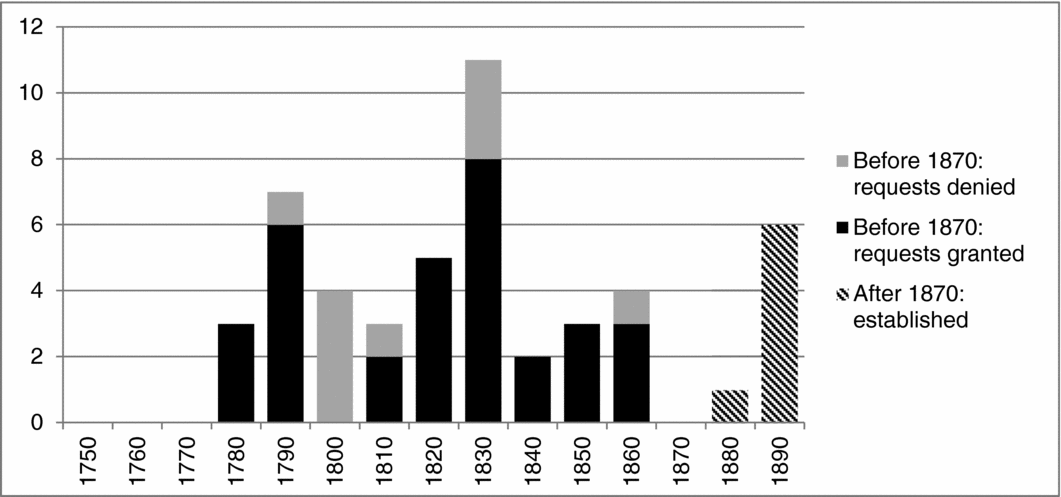
Only by combining these and other sources could an overview be compiled containing, as far as records permit, all places where weekly markets were officially held in East Flanders between 1750 and 1900.Footnote 6 This overview counts places, that is, the geographical location of markets, irrespective of their temporal and qualitative component. Figure 3 shows this information, indicating the establishment of ‘relatively new’ market places in East Flanders between 1750 and 1900. These ‘relatively new’ market places include municipalities where an existing market had ceased for a considerable lapse of time, but exclude municipalities where a market that had collapsed recently, for example as a result of exceptional circumstances such as the French occupation, was merely reinstated. It also does not include municipalities that already held a general market and developed a new market for a specific product, or established an additional monthly or annual market. Finally, it should be emphasised that this graph shows nothing but official weekly markets, and says nothing of illicit markets.
Newly established market places in East Flanders, 1750–1900 Source: Overview of markets in East Flanders, 1750–1900 (Ronsijn, Reference Ronsijn2012)
It is possible Figure 3 underestimates the number of markets established in the early French (the 1790s) and Dutch (1815–1830) period. However, although further refinements to the graph are possible, it is unlikely these will alter the pattern which clearly emerges from it. Three waves stand out: the 1780s to 1790s; the 1820s to 1830s; and the 1890s. Between 1750 and 1900, new weekly markets were officially established or recognised in no less than thirty-eight different villages in East Flanders.Footnote 7 These were all located in the countryside, as all towns in the province already possessed markets.
Whether new markets could be established evidently depended on the willingness of central authorities to grant requests. After 1780, that did not appear to have been a problem.Footnote 8Figure 3 shows that it was rather uncommon for requests to be rejected, except in the Napoleonic period. However, the willingness of authorities to grant requests was by itself not a decisive factor in the multiplication of market places. Several of the markets that were officially instated had been held illicitly for years, showing that the need for these markets was a more determining factor than the ability to establish them.Footnote 9 Moreover, when official permission was no longer required after 1870, there was no sudden surge in the introduction of markets. Obviously, the capacity to set up legal markets was an essential requirement, yet does not of itself explain why new markets were in fact established.
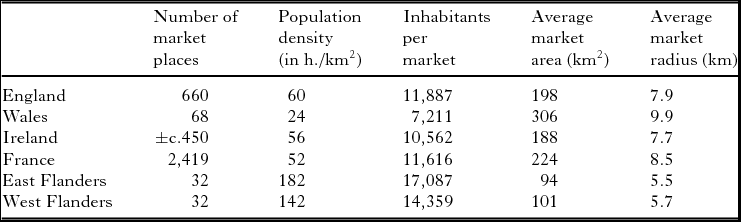
The impact of the creation of new market places can only be measured by its effect on the total number of operating weekly markets in the province. Table 1 indicates the total number of effectively operative market places in East Flanders between 1750 and 1900 that have been revealed by the sources. It does so in thirty year intervals, in absolute as well as relative terms. In relative terms, the average market area has been calculated, expressed both as surface area and radius. Table 1 shows that the first two waves of market establishments had a significant impact on the number of operative markets in the province. In the ninety years between 1780 and 1870, the number of operating markets almost doubled. The average market radius was still 5.7 kilometres in 1780, but dropped within less than a century to about four kilometres around the middle of the nineteenth century. After 1870, the total number of operating markets dropped. It is possible the decline began earlier as the number of operating markets in 1870 might be overestimated. This suggests that market density may have reached a peak around the middle of the nineteenth century. New markets were established in the 1890s, but this appears to have been part of a different dynamic. At that time, there was no further densification of the market infrastructure, new markets rather being part of a geographical reorientation of that infrastructure.
Operative market places in East Flanders, 1750–1900

Source: overview of markets in East Flanders, 1750–1900 (Ronsijn, Reference Ronsijn2012). Compared to population data for 1806, 1846, 1866 and 1900 (HISSTAT-LOKSTAT database, Ghent University).
Developments in East Flanders are probably representative for neighbouring West Flanders as well. In the latter province, a number of new markets were established in the 1780s (Baert, Reference Baert1986; Martyn, Reference Martyn2002; Wante, Reference Wante1978; Wante and Vandermaelen, Reference Wante and Vandermaelen1979; Wante and Vandermaelen, Reference Wante and Vandermaelen1984). In the nineteenth century, the total number of markets in West Flanders rose from thirty-two around 1800 to over forty-one in 1819 and up to fifty-five by 1868.Footnote 10 Moreover, Flanders was not the only place where a considerable number of new market places were established in the eighteenth and nineteenth centuries. In England, Wales and Ireland, the total number of markets increased considerably in the second half of the eighteenth century, after their numbers had stagnated or declined for about a century (Chartres, Reference Chartres and Chartres1990b: 160–3; 1996: 160, 169; O'Flanagan, 1983; 1985). It is not known how the number of markets developed in England and Wales in the nineteenth century, but in Ireland the erection of new markets almost came to a standstill in the first half of the century. Developments in France probably resemble those in Flanders more closely. Not only were many new markets established in the last decades of the Ancien Regime, but this development continued in France until at least the middle of the nineteenth century (Margairaz, Reference Margairaz1988: 22–3, 40–7, 81–2, 90–3; Margairaz, Reference Margairaz and Cavaciocchi2001: 208–9).
At the end of the eighteenth century, the average number of people theoretically served by each market place was very similar in all parts of the North Sea area (see Table 2). In England, Ireland and France, there was on average one market for about 11,000 inhabitants. On a county or department level in England and France, the figure was usually between 5,000 and 20,000 inhabitants. In Wales, the average figure was somewhat lower, and in Flanders somewhat higher, in accordance with the differences in population density. In East Flanders, the establishment of new markets since the late eighteenth century at first reduced the number of people served by each market, but the proportion remained remarkably constant afterwards at about one market for 15,000 inhabitants until 1870 (see Table 1).
Market places in the North Sea area, c. 1790
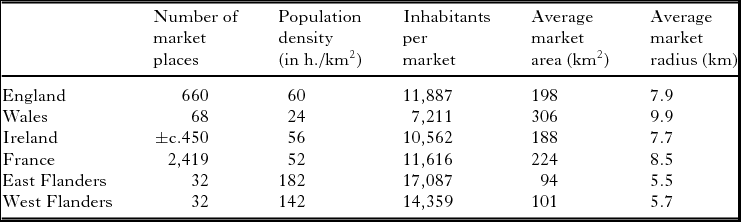
All data for c. 1790, except West Flanders for c. 1800. Data for France do not include Corsica.
Sources: Population data: England (1791): Wrigley (Reference Wrigley2007: 54–55); Wales: estimated as 6.25 per cent of the English population (proportion in Capper, Reference Capper1801: 80); France (1791): Dupâquier (1988: 82–3) (corrected figures); East and West Flanders: 1800 population data (HISSTAT-LOKSTAT database, Ghent University), for East Flanders adjusted with the indexes by Jaspers and Stevens (1985: 18) to obtain data for 1792.
Markets: England and Wales (1792): Chartres (Reference Chartres1990b: 161–162); France (c. 1790): Margairaz (Reference Margairaz1988: 48–49); Ireland: O'Flannagan (1983: 150); West Flanders (c. 1800): Michielsen ([1938]: 32); East Flanders (1790): Overview of markets in East Flanders, 1750–1900 (Ronsijn, Reference Ronsijn2012)
Since the proportion between the number of people and the number of market places in Flanders at the end of the eighteenth century was not far behind the average for the North Sea area, whereas population densities were far higher, market densities were higher as well. In Flanders, the average market area was close to one hundred square kilometres, or about half that in England, Ireland and France. Furthermore, the average market area considerably declined in the first half of the nineteenth century. In East Flanders, the average market area declined from somewhat more than one hundred square kilometres in 1750 to between fifty and sixty square kilometres around the middle of the nineteenth century. In West Flanders, the average market area declined from about one hundred square kilometres around 1800 to fifty-nine square kilometres in 1868. This made Flanders one of the most market dense regions in the North Sea area although other countries had sub regions with similar market densities (Chartres, Reference Chartres and Desplat1996: 159–60; Everitt, Reference Everitt and Chartres1990: 45–7; Margairaz, Reference Margairaz1988: 48–9, 246; O'Flanagan, 1985: 373–4).
Markets for the sale of small amounts of flax, yarn, butter and eggs
East Flanders was already a relatively market dense region in the middle of the eighteenth century and that density increased considerably from the late eighteenth until the middle of the nineteenth century. For the period up to 1870, the files treating the requests for new markets can be used to reconstruct the motivation for new markets. After 1870, permission from the central government was no longer needed, and such files were no longer compiled. But while these sources can provide some insights, they can also create problems. One major difficulty is that some markets were established without much discussion, especially in the early French and the Dutch periods, leaving the motives for their establishment unclear. Indeed, several requests from these times have not been found, if they were ever submitted. Another problem is that this approach assumes there were no incentives beyond those explicitly mentioned, disregarding the possibility that the official discussion of new markets was merely a discourse behind which other reasons were at play. Moreover, analysis of the discussion of new markets says nothing about the function that these markets performed once established. Finally, even in those cases where the purposes for which a market was requested are clear, common patterns are often entwined with local particularities, rendering it difficult to make generalisations.
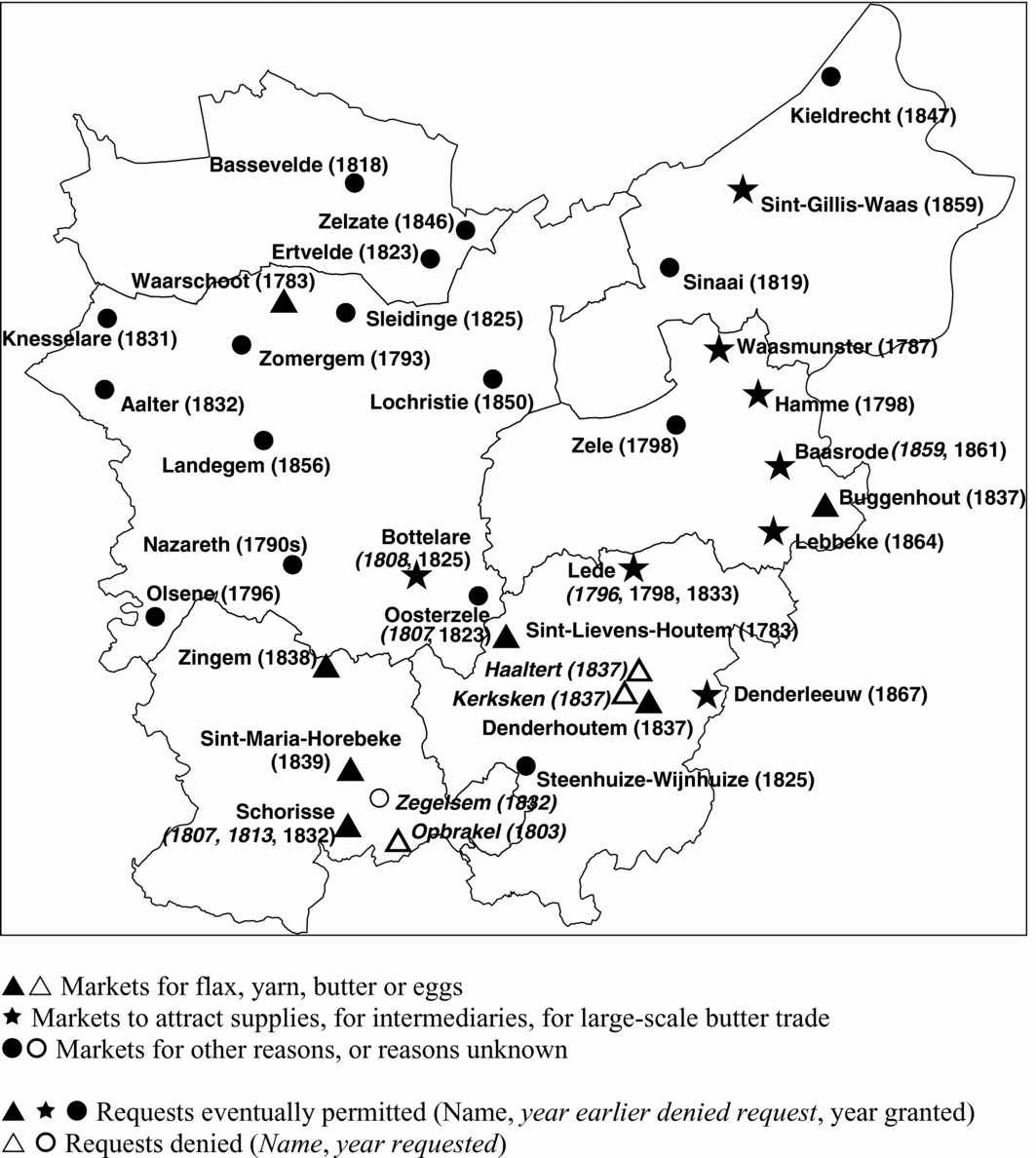
Nonetheless, two groups can be distinguished from the accounts of the motivation behind the establishment of new markets in East Flanders between 1780 and 1870. Firstly, the largest group of cases (twelve files from ten villages) concerns markets intended for the small-scale sale of flax, yarn, butter and eggs. Most of these requests were formulated in the 1780s and 1830s. Secondly, a number of markets (eleven files from eight villages) were meant to attract supplies, for intermediaries, manufacturers or tradesmen, or for the sale of butter on a larger scale. In this group, the temporal pattern is less clear. Apart from those two groups, there remain many cases (nineteen files from eighteen villages)Footnote 11 where motivations are unclear, or where markets were requested not for the direct benefits of being able to buy or sell in the market, but rather for the side-effects of having a market.
Displaying these groups on the map of East Flanders, shown in Figure 4, reveals a clear pattern. Markets about which little is known were spread over more or less the entire province. Of those markets for which the motivation for a request was clear, it appears that those markets meant to attract supplies, for intermediaries or for the sale of butter on a larger scale were all situated roughly in the northeast, while those markets intended for the small-scale sale of flax, yarn, butter and eggs were all situated roughly in the south and west of East Flanders. Consequently, in the core area of the linen industry in inland Flanders, new markets were particularly established in the 1780s and 1830s, to support the livelihoods of smallholders, spinners and weavers, by facilitating the sale of small amounts of livestock produce such as butter and eggs, and industrial products such as flax or yarn. In the request of Sint-Lievens-Houtem, for example, several surrounding villages explicitly identify two sorts of people for whom the market would be useful: on the one hand those involved in the linen industry, who would be able to buy and sell flax, tow or yarn and on the other hand those who kept cattle or small animals, who would be able to sell their butter, eggs, or poultry.Footnote 12 A similar observation was made in the request of Zingem about fifty years later: a market would be particularly useful not just for flax spinners, but also for small cottagers selling butter and eggs.Footnote 13 Outside East Flanders, local case studies have already revealed that at least the markets established in Avelgem (1784), Meulebeke (1784) and Waregem (1784) in West Flanders, and Opwijk (1838) in Brabant, to some extent fit this pattern (Baert, Reference Baert1986; Martyn, Reference Martyn2002; Wante, Reference Wante1978; Wante and Vandermaelen, Reference Wante and Vandermaelen1979; Wante and Vandermaelen, Reference Wante and Vandermaelen1984; Willcox, Reference Willcox1996).
Location of markets requested or established in East Flanders between 1780 and 1870 Source: Overview of markets in East Flanders, 1750–1900 (Ronsijn, Reference Ronsijn2012)
The impoverishment of the Flemish countryside, accelerating in the 1780s and 1830s, was the main drive behind the multiplication of markets in the core area of the linen industry. Many files from villages in this area support their requests by citing the large number of inhabitants occupied in the linen industry, and the poor state in which they lived. In Waarschoot in 1783, two-thirds of the inhabitants allegedly lived from spinning and weaving, and many of them were dependent on these activities to such an extent that ‘they only inhabit a small house consisting of a kitchen and some just one more room and a weaving room, without any fields to cultivate, the majority of them having only a small garden for their vegetables.’Footnote 14 On the request of Schorisse of 1807, the sub prefect claimed that most inhabitants in the municipality were spinners and weavers, and no other municipality in his district, which at that time encompassed most of south East Flanders, counted that many poor.Footnote 15 Denderhoutem wanted a market in 1837 ‘to facilitate the sale of the objects offered for sale by a numerous class, namely that which has to live from the sale of flax, and notably yarn, and other small objects’. They claimed this class made up at least half of the population of each village.Footnote 16 Poverty also rose outside the core area of the linen industry. For instance, not only Waarschoot but also Waasmunster claimed in the 1780s that the number of poor in their villages had grown to such an extent that the armendissen, the local institutions for poor relief, no longer had sufficient means to support them.Footnote 17
A ‘scarcity of markets’
Most of the markets established in the south and west of East Flanders therefore fitted within the existing coping mechanisms of the majority of rural households: the sale of small amounts of butter, eggs, flax and yarn, in addition to subsistence agriculture, linen cloth production and labour on larger farms. The requests for new markets show that a lack of market access was one of the main reasons preventing households from a further intensification of these activities. Since many had only small quantities to sell, they could hardly sell their output profitably if the markets were far away and the condition of roads poor. New markets were meant to overcome these problems. In many requests, the small quantities in which goods were to be sold is striking. The villages commented in the request of Sint-Lievens-Houtem that these people usually only carried between two and four pounds of butter or one or two dozen eggs to the market. In the case of flax and yarn, only about one, two or three pounds were brought to the market.Footnote 18 Similarly, Zingem claimed that their poor people often carried no more than half or even a quarter kilogram of yarn to the market.Footnote 19
While the quantities marketed on each occasion were often small, the costs of carrying them to the markets were high. In Zingem in 1838, the small fee required to cross the Scheldt river to reach the market of neighbouring Gavere gave rise to bitter complaints, especially since the price of yarn had dropped following the import of English yarns.Footnote 20 Elsewhere, the poor state of roads was a hindrance. Spinning and weaving was mostly performed in wintertime, when weather conditions could make roads almost useless. Probably exaggerating considerably, Sint-Lievens-Houtem and Schorisse both claimed that roads were almost unusable for eight or nine months per year.Footnote 21 People involved in the linen industry therefore suffered particularly from the poor condition of roads, although it could also be argued that for small objects the condition of roads mattered less than that of footways. Denderhoutem for instance confronted the argument that their requested market would be unreachable by claiming that the objects to be brought to the market did not require carts or carriages because they could be carried by pedestrians and the footways were always in a good state.Footnote 22
Whatever the state of roads, the distance to existing markets could make the sale of small amounts of flax, yarn, butter or eggs time consuming, and therefore less profitable. The district commissar of Oudenaarde claimed in 1807 that the main reason spinners and weavers in the village of Schorisse were so poor was because it was so difficult and time consuming selling the fruits of their labour.Footnote 23 Time spent on the road to market was time they could not spend behind their spinning wheels or their looms. Kerksken claimed in 1837 that the ‘needy class of weavers and spinners’ travelled by night along unusable roads to reach the nearest markets on time.Footnote 24 In the request for a market of Sint-Maria-Horebeke, neighbouring Sint-Kornelis-Horebeke commented:
How depressing it is when one sees the poor folk of our village as well as those of Sint-Maria-Horebeke and Mater in wintertime from four o'clock in the morning go past our houses through hail, snow, rain, stained, knee-deep in mud, with clogs on their feet and scarcely any clothes on their bodies, to sell their yarn on one or another market and at the same time acquire new materials and some foodstuffs.Footnote 25
That the costs of marketing almost negated the profit from the sale of goods is a clear indication that margins were very small, and that profits could only be increased by working harder and longer and producing and selling more. That is also indicated by the fact that countrymen increased the sale of mere surpluses of butter and eggs. The butter and eggs that were to be sold in the market of Sint-Lievens-Houtem reportedly used to be either consumed or wasted in the countryside because they were of too little value to be carried to any nearby market.Footnote 26 Flax and yarn could also be simply surpluses, if households mainly sold that part which was not spun or woven by their own members.
The quantities traded were also small because it was apparently difficult to store not only perishable products such as butter or eggs but also flax and yarn in order to carry larger quantities to the markets. Spinners, weavers and smallholders needed to sell more frequently, not less. Near Denderhoutem, those working with flax, especially the spinners, were ‘obliged to sell in the morning what they made the day before’. They needed to live from the product of the day, and were often unable to wait until the next market day. Rural producers in the area suffered from a ‘scarcity of markets’,Footnote 27 and this was one of the main motivations to establish new weekly markets in the countryside. The existing network of markets, or the access to these markets provided by large farmers, was insufficient for them to attain a higher volume and frequency of sales. By the eighteenth century, products like butter, eggs, flax and yarn which were marketed only in small volumes were already less likely to circulate within the informal exchange networks. However, large farmers may have continued to act as go-betweens for the sale of linen cloth. The sale of cloth was hardly ever mentioned in the requests for markets in East Flanders. One piece of cloth took more than a week to produce and despite dropping prices remained comparatively valuable, which meant that transaction costs mattered less. This is in contrast to the markets established in the 1780s in West Flanders, where cloth was sold.Footnote 28
In the south and west of East Flanders, markets were mainly established to facilitate exchange among villagers, rather than for the sale of cloth, which was mostly sold in urban markets to tradesmen for export. In 1832, the mayor of Schorisse stated that it should hardly be surprising to find that the inhabitants of a large village, at a great distance from the existing markets, found it in their interest ‘to hold a market among themselves’.Footnote 29 These markets facilitated the sale of raw materials since some households contained spinners but no weavers, while other households contained weavers but no spinners.Footnote 30 For spinners with yarn to sell or in need of raw flax, or weavers in need of yarn, a market in their own or a neighbouring village reduced the cost not only of transportation but also of searching for buyers and sellers. Spinners became even more dependent on these markets following the introduction of mechanical yarn, which led to further reductions in prices, as mentioned in the request of Zingem, and the emergence of tradesmen who increasingly supplied this yarn to the weavers. But these markets were also used for the exchange of foodstuffs. It was remarked how convenient it was that the inhabitants of Maarke-Kerkem could sell yarn at the nearby market in Schorisse and at the same time buy new flax and grain, while losing only two hours of their timeFootnote 31 and Sint-Kornelis-Horebeke made a similar comment, quoted above, about the market to be established in Sint-Maria-Horebeke.Footnote 32 Still, it is possible that on some markets yarn was also sold to tradesmen.Footnote 33
As these markets were mainly established to facilitate an intensification of existing rural livelihoods, they disappeared when those coping mechanisms were transformed. According to an overview of markets of 1853, those of Sint-Lievens-Houtem, Denderhoutem and Sint-Maria-Horebeke had recently ceased to exist. The market of Schorisse no longer existed in 1873, while those of Waarschoot and Zingem collapsed some years later. Activity in the linen industry greatly declined after the middle of the nineteenth century and the weavers that remained active mostly did so for putting-out merchants rather than as independent producers. In the case of Sint-Maria-Horebeke, the link between the decaying linen industry and the decaying market was explicitly made. New coping mechanisms emerged as subsistence agriculture was combined with new rural industries, particularly lacework by a putting-out system; migrant labour, initially in the form of seasonal agricultural labour, particularly in Northern France, and then later weekly industrial labour, notably in Wallonia; and subsequently employment in modern factories established in the countryside (Vanhaute, Reference Vanhaute1994; Verhaegen, Reference Verhaegen1961: 209–318). There was little need for small village markets for these activities.
Conclusion
Between the late eighteenth and the middle of the nineteenth century, there was a considerable densification in the network of weekly markets in Flanders, as in other regions of the North Sea area. In East Flanders, this process started around 1780, slowed down in the Napoleonic era but resumed afterwards. As a result, the number of effectively operating markets in that province almost doubled between 1780 and 1870. After that, new markets continued to be established but the total number of effectively operating markets declined. Throughout this period, Flanders was among the most market dense regions of the North Sea area. New markets in East Flanders were established for a range of purposes, often associated with local particularities and sometimes not even for the sake of the market itself, but for the side-effects of having a market. Nonetheless, it is clear that few markets were established with a view to supplying distant consumers. In the north-eastern part of the province, a number of markets were established to attract supplies, in several cases for the needs of intermediaries, rather than ordinary consumers, or for the sale of butter on a larger scale. In the remainder of the province, the southern and western parts, many markets were established for the small scale sale of flax, yarn, butter and eggs. Probably the majority of markets established between the late eighteenth and the middle of the nineteenth century in East and West Flanders were of that type.
In the south and west of East Flanders, a growing proportion of rural households, in need of income in addition to that from their smallholdings, turned to spinning and weaving, complemented with the sale of small amounts of dairy products and industrial crops, as local large farms could not provide sufficient employment. From the 1780s onwards, and accelerating further in the 1830s, these households increasingly needed to sell more, and more frequently, because prices of linen products dropped while prices of food and land rents rose. However, attaining that goal was difficult as these households clearly suffered from a lack of market access. Long distances and poor roads meant that attending existing markets was difficult and time consuming. Large farmers did not provide sufficient access in their role as go-betweens, because the number of households and the frequency at which they needed to buy and sell was too high, while the profit margins on their small amounts of butter, eggs, flax and yarn were low. Existing informal exchange networks were also disturbed by the introduction of mechanical yarn in the 1830s, which stimulated the shift to a putting-out system. Market access was provided by establishing new markets nearby. At the same time, these local markets can be seen as a means by which rural producers could maintain their independence, rather than becoming labourers for putting-out merchants.
The multiplication of markets in the south and west of East Flanders between the late eighteenth and middle of the nineteenth century was therefore symptomatic of the need for households to intensify their coping mechanisms. In addition, the multiplication of markets also shows that these households increasingly relied on formal, rather than informal, exchange mechanisms. These markets were to a large extent meant for exchange among countrymen, rather than to supply distant consumers, and as such they are a sign of a formalisation of exchange relations in the countryside. Paradoxically, they arose not as a result of rising external demand, as the traditional view on these markets holds, but partly as a result of declining external demand, visible in the declining prices of linen products. But this process did not take place everywhere in East Flanders. In the north-eastern part of the province, where the linen industry was of little significance, markets were clearly established for different reasons. How the rise of these markets responded to internal or external developments, still remains to be investigated.
This article has shown that markets could be established for diverse reasons beyond being a response to growing external demand. Taking the internal dynamics of rural societies and their regional differences into account is crucial to understanding this process. It is necessary to see how periodic markets fitted with the goals and strategies of the country dwellers themselves, not only those of distant consumers. Market integration studies, many of which have implicitly tended to see countrymen as an undifferentiated mass of producers merely waiting for better access to markets to seize the opportunities provided by external demand, cannot but benefit from such a broader perspective. On the other hand, developments in external demand should not be ignored either, although their effects are not straightforward. Both a growing and dropping external demand can lead to a multiplication of markets in the countryside.