Introduction
Parkinson's disease (PD) has traditionally been viewed as a movement disorder characterized by resting tremor, rigidity, bradykinesia, and postural instability, but non-motor symptoms of the disease are also experienced by the majority of patients (∼83%; Shulman, Taback, Bean, & Weiner, Reference Shulman, Taback, Bean and Weiner2001) including disorders of sensation and perception, mood, sleep, and cognition (for recent reviews, see Chaudhuri & Schapira, Reference Chaudhuri and Schapira2009; Cronin-Golomb, Reference Cronin-Golomb2010; Pandya, Kubu, & Giroux, Reference Pandya, Kubu and Giroux2008; Poewe, Reference Poewe2008). These non-motor symptoms are as debilitating as the motor symptoms and may actually be better predictors of quality of life (Witjas et al., Reference Witjas, Kaphan, Azulay, Blin, Ceccaldi, Pouget and Chériff2002). Patients with worse non-motor symptoms report more impairments in overall daily functioning (Hariz & Forsgren, Reference Hariz and Forsgren2011). Objective measures of non-motor symptoms, such as visual testing, have been found to relate to performance on certain activities of daily living (ADL), such as driving a car (Amick, Grace, & Ott, Reference Amick, Grace and Ott2007; Uc, Rizzo, Johnson, et al., Reference Uc, Rizzo, Johnson, Dastrup, Anderson and Dawson2009). Visual perceptual deficits are of particular relevance to vision-based ADLs.
Patients with PD exhibit an array of visual perceptual deficits, ranging from problems with basic abilities such as detecting color (Buttner et al., Reference Buttner, Kuhn, Klotz, Steinber, Voss, Bulgaru and Przuntek1993; Diederich, Raman, Leurgans, & Goetz, Reference Diederich, Raman, Leurgans and Goetz2002; Lee & Harris, Reference Lee and Harris1999; Price, Feldman, Adelberg, & Kayne, Reference Price, Feldman, Adelberg and Kayne1992) and perception of planar motion and optic flow (Davidsdottir, Wagenaar, Young, & Cronin-Golomb, Reference Davidsdottir, Wagenaar, Young and Cronin-Golomb2008) to higher-order abilities such as facial emotion recognition (Clark, Neargarder, & Cronin-Golomb, Reference Clark, Neargarder and Cronin-Golomb2008) and facial scanning (Clark, Neargarder, & Cronin-Golomb, Reference Clark, Neargarder and Cronin-Golomb2010). Numerous studies indicate that patients with PD experience deficits in contrast sensitivity. In an early report, Bodis-Wollner and Yahr (Reference Bodis-Wollner and Yahr1978) found that patients with PD displayed greater latencies to visual evoked potentials than did a control group in response to sinusoidal contrast gratings, providing initial evidence for visual perceptual deficits. Reduced contrast sensitivity in PD has since been reported using low-contrast letter reading charts (e.g., Regan & Neima, Reference Regan and Neima1984; Regan & Maxner, Reference Regan and Maxner1987) and computer-based measures (e.g., Amick, Cronin-Golomb, & Gilmore, Reference Amick, Cronin-Golomb and Gilmore2003; Davidsdottir et al., Reference Davidsdottir, Wagenaar, Young and Cronin-Golomb2008). These changes in contrast sensitivity are not benign as they have been related to quality of life in PD. For example, poor contrast sensitivity is associated with worse driving performance (Amick et al., Reference Amick, Grace and Ott2007; Devos et al., Reference Devos, Vandenberghe, Nieuwboer, Tant, Baten and De Weerdt2007; Uc, Rizzo, Anderson, et al., Reference Uc, Rizzo, Anderson, Dastrup, Sparks and Dawson2009; Worringham, Wood, Kerr, & Silburn, Reference Worringham, Wood, Kerr and Silburn2006) and with motor freezing and hallucinations (Davidsdottir, Cronin-Golomb, & Lee, Reference Davidsdottir, Cronin-Golomb and Lee2005).
In addition to deficits in basic visual functioning, patients with PD experience problems with higher-level visuospatial functioning, which may affect performance on ADLs. Visuospatial functioning includes perceiving the spatial relations among visual stimuli, a skill necessary to performing everyday tasks such as preparing meals, driving a car, and selecting medications. Experimental studies have shown that several aspects of visuospatial functioning are impaired in PD, including spatial navigation, mental rotation, hierarchical pattern perception, facial emotion recognition, spatial working memory and spatial planning (Altgassen, Phillips, Kopp, & Kliegel, Reference Altgassen, Phillips, Kopp and Kliegel2007; Amick, Schendan, Ganis, & Cronin-Golomb, Reference Amick, Schendan, Ganis and Cronin-Golomb2006; Clark et al., Reference Clark, Neargarder and Cronin-Golomb2008; Cronin-Golomb, Reference Cronin-Golomb2010; Davidsdottir et al., Reference Davidsdottir, Wagenaar, Young and Cronin-Golomb2008; Kemps, Szmalec, Vandierendonck, & Crevits, Reference Kemps, Szmalec, Vandierendonck and Crevits2005; Lee, Harris, & Calvert, 1998; Montse, Pere, Carme, Francesc, & Eduardo, Reference Montse, Pere, Carme, Francesc and Eduardo2001; Possin, Filoteo, Song, & Salmon, Reference Possin, Filoteo, Song and Salmon2008; Schendan, Amick, & Cronin-Golomb, Reference Schendan, Amick and Cronin-Golomb2009; Siegert, Weatherall, Taylor, & Abernethy, Reference Siegert, Weatherall, Taylor and Abernethy2008). These findings are in line with studies using self-report measures, through which PD patients report problems judging distances (Davidsdottir et al., Reference Davidsdottir, Cronin-Golomb and Lee2005; Lee & Harris, Reference Lee and Harris1999; McDowell & Harris, 1997a). The relation between these visuospatial changes and performance on a variety of everyday tasks is less clear. Klepac, Trkulja, Relja, and Babić (Reference Klepac, Trkulja, Relja and Babić2008) reported that better performance on neuropsychological tests of visuospatial and executive functioning were related to better health-related quality of life as indicated by self report (Parkinson's Disease Questionnaire; PDQ-39). Studies using more naturalistic designs have reached similar conclusions. For example, Uc and colleagues (Reference Uc, Rizzo, Anderson, Sparks, Rodnitzky and Dawson2007) examined the relation between driving and neuropsychological performance. They found that performance on visuospatial and executive functioning tasks but not on tasks of motor function predicted driving performance, suggesting that the non-motor symptoms of PD are at least as detrimental to everyday functioning as the motor symptoms.
PD is described as a heterogeneous disorder in many respects, including in terms of perceptual abilities, and this heterogeneity may be related to daily function. Attention is being turned increasingly to the type of initial symptom of PD (Lewis et al., Reference Lewis, Foltynie, Blackwell, Robbins, Owen and Barker2005) as a major source of heterogeneity, with differences emerging between patients presenting with resting tremor versus non-tremor symptoms. The non-tremor subtype is also referred to as akinetic-rigid or postural instability-gait difficulty (PIGD; Zaidel, Arkadir, Israel, & Bergman, Reference Zaidel, Arkadir, Israel and Bergman2009). Multiple single-photon emission studies have demonstrated negative correlations between striatal uptake of dopamine and non-tremor symptoms (i.e., rigidity, bradykinesia, gait, balance, and posture) but not tremor symptoms, indicating that these two types of motor symptoms likely arise from disturbances of different neural systems (Benamer et al., Reference Benamer, Patterson, Wyper, Hadley, Macphee and Grosset2000; Brücke et al. Reference Brücke, Asenbaum, Pirker, Djamshidian, Wenger, Wober and Podreka1997; Seibyl et al., Reference Seibyl, Marek, Quinlan, Sheff, Zoghbi, Zea-Ponce and van Dyck1995; Shinotoh, Uchida, Ito, & Harrori, Reference Shinotoh, Uchida, Ito and Harrori2000; Spiegel et al., Reference Spiegel, Hellwig, Samnick, Jost, Möllers, Fassbender and Dillmann2007). These findings have been further supported by post-mortem studies indicating more diffusely located cortical Lewy bodies (Selikhova, Williams, Kempster, Holton, & Lees, Reference Selikhova, Williams, Kempster, Holton and Lees2009) and greater dopamine loss within the ventral rostral region of the globus pallidus in cases with non-tremor onset relative to tremor-onset (Rajput et al., Reference Rajput, Sitte, Rajput, Fenton, Pifl and Hornykiewicz2008). In regard to clinical presentation, non-tremor onset patients experience faster disease progression and more frequent dyskinesias, gait disorders and falls (Rudzinska et al., Reference Rudzinska, Marona, Bukowczan, Banaszkiewicz, Mirek and Szczudlik2007). They appear to be more susceptible to non-motor symptoms than the tremor-onset subtype (Reijnders, Ehrt, Lousberg, Aarsland, & Leentjens, Reference Reijnders, Ehrt, Lousberg, Aarsland and Leentjens2009), including slower psychomotor speed and decreased cognitive flexibility (Lyros, Messinis, & Papathanasopoulos, Reference Lyros, Messinis and Papathanasopoulos2008), procedural learning (Vakil & Herichanu-Naaman, Reference Vakil and Herishanu-Naaman1998), attentional decline (Taylor et al., Reference Taylor, Rowan, Lett, O'Brien, McKeith and Burn2008), more frequent dementia (Alves, Larson, Emre, Wentzel-Larson, & Aarsland, Reference Alves, Larson, Emre, Wentzel-Larson and Aarsland2006; Burn et al., Reference Burn, Rowan, Allan, Molloy, O'Brien and McKeith2006; Burn et al., Reference Burn, Rowan, Minett, Sanders, Myint, Richardson and McKeith2003; Rajput, Voll, Rajput, Robinson, & Rajput, Reference Rajput, Voll, Rajput, Robinson and Rajput2009), and more frequent depression (Burn et al., Reference Burn, Rowan, Minett, Sanders, Myint, Richardson and McKeith2003; Lewis et al., Reference Lewis, Foltynie, Blackwell, Robbins, Owen and Barker2005). Additionally, non-tremor onset patients have reported poorer ADLs than tremor onset patients (Hariz et al., 2011). Visual-based ADLs (everyday activities performed for self-care that rely on visual functioning) have not yet been examined for these subtypes of PD.
Previous reports linking visual deficits to impaired functional performance in PD have primarily focused on contrast sensitivity and on driving competence in PD without reference to subtypes. The present study expands the scope of investigation by using visual assessments together with a validated self-report measure (Visual Activities Questionnaire; VAQ) to identify the extent to which visual ADLs are compromised by PD and to determine which specific visual domains are most affected in the tremor and non-tremor PD subtypes. We hypothesized that the non-tremor onset subtype would report more problems with visual ADLs, consistent with recent evidence suggesting that this subtype experiences a wide range of non-motor symptoms, including difficulties with ADLs in general. A better understanding of visual deficits and the visual ADL domains affected may point to specific interventions to improve ADLs and quality of life in PD.
Method
Participants
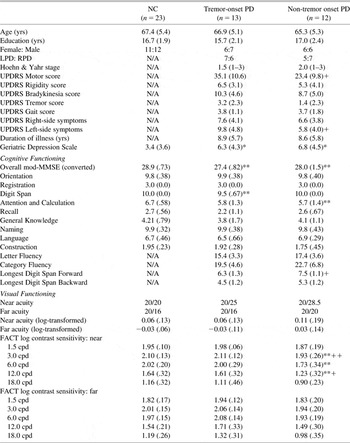
Participants included 25 individuals with PD (12 women, 13 men) and 23 age and education-matched normal control participants (NC; 11 women, 12 men). The PD participants were grouped by type of initial motor symptom: tremor dominant onset (TD; 6 women, 7 men) or non-tremor dominant onset (NTD; 6 women, 6 men). Five of the NTD subtype participants had initial symptoms starting on the left side of the body and seven had symptoms starting on the right side of the body. In the TD subtype, seven participants’ initial symptoms were on the left side and six on the right side. Demographic characteristics were similar between participants with respect to side of initial symptom. Characteristics of the TD and NTD subtypes are listed in Table 1. All participants provided informed consent for the protocol approved by the Boston University Charles River Campus Institutional Review Board.
Participant characteristics
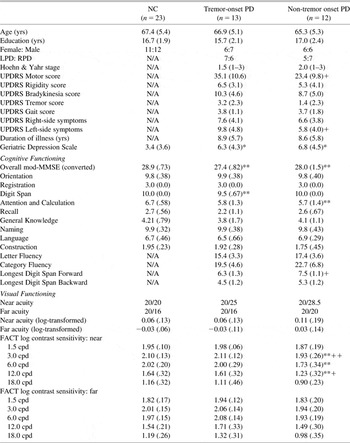
Note. Values represent means and standard deviations except near and far acuity, which are reported as medians, and Hoehn & Yahr scores, which are reported in median and range. Hoehn and Yahr stage is an index of motor severity in PD. LPD, RPD: left- and right-onset Parkinson's disease. FACT = Functional Acuity Contrast Test. UPDRS = Unified Parkinson's Disease Rating Scale. cpd = cycles per degree.
*indicates PD group differed from NC (p < .05); **indicates PD group differed from NC (p < .017).
+indicates PD groups differed from each other (p < .05); ++ indicates PD groups differed from each other (p < .017).
PD patients were recruited from the Parkinson's Disease Clinic of Boston Medical Center. NC participants were recruited from the general community. Exclusion criteria included co-existing serious chronic medical illnesses (including psychiatric or neurological), use of psychoactive medications besides antidepressants and anxiolytics in the PD group, use of any psychoactive medications in the NC group, history of intracranial surgery, traumatic brain injury, alcoholism or other drug abuse, or eye disease or abnormalities as noted on an eye examination. Seventeen of the 23 NC and 17 of the 25 PD participants received a detailed neuro-ophthalmological examination to rule out visual disorders arising from dysfunction of anterior pathways, including cataracts, glaucoma, and macular degeneration. There were no differences between those who completed the neuro-ophthalmological examination and those who did not on any of the visual measures or the VAQ. Participants used their own refractive correction for all testing.
The groups were matched for age, education, and male:female ratio. No participants were demented, with all obtaining scores of 27 or above on the standard Mini-Mental State Examination (four NC) or 25 or above on the Modified Mini-Mental State Examination (all other participants; overall scores converted to the standard MMSE scale). Because the Modified MMSE includes items that are sensitive to PD-based cognitive problems in the absence of dementia, we used a cut-off score of 25 rather than the standard MMSE cut-off of 27. Mean scores for both the tremor onset subtype (27.4; SD = .82) and non-tremor onset subtype (28.0; SD = 1.5) were worse than for the NC group (28.9, SD = .73).
Analyses of the Modified MMSE subscales were conducted to examine potential cognitive differences between groups and post hoc comparisons were corrected to .017 for the number of groups (.05/3). All groups performed similarly on orientation (p = .99), registration (all groups performed without error), recall (p = .12), general knowledge (p = .46), confrontation naming (p = .67), language (p = .09), and construction (p = .23) (performance near ceiling in all cases). The TD group had lower scores on digit span than the NC group (p < .017); NTD and NC participants received the maximum subscale score (10 of 10). The digit span subscale of the Modified MMSE differs from traditional digit span scores as up to only 10 points can be awarded (up to 6 for digits forward and up to 4 for digits backward). NTD patients performed more poorly than NC on attention and concentration (i.e., serial sevens and adding change; p < .017), and there was a trend for TD patients to perform more poorly than NC (p = .03). There was no difference between the two PD groups (p = .82).
In addition to MMSE, verbal fluency (category-animals and letter “F”) and traditional (longest) digit span forward and backward were also assessed for the PD participants. The TD and NTD groups performed similarly on both measures of verbal fluency and on longest digit span backward, but the TD group performed more poorly than the NTD group on longest digit span forward (p < .05).
PD patients endorsed more depressive symptoms on the Geriatric Depression Scale (GDS; Yesavage et al., 1983) than the NC (t (46) = 2.7; p < .01). Patients with the tremor onset and non-tremor onset subtypes indicated similar levels of depression (t(23) = 0.3; p = .77). PD participants had mild to moderate motor symptoms as indicated by a median stage II Hoehn and Yahr score (Hoehn & Yahr, Reference Hoehn and Yahr1967) with a stage range of I to III. Motor scores on the Unified Parkinson's Disease Rating Scale (UPDRS) ranged from 9 to 48 with a mean of 35.1 (SD = 10.6) for the TD group and 25.7 (SD = 10.4) for the NTD group (t(23) = 2.2, p < .04), indicating that the TD group had worse overall motor scores. Motor symptom scores for the rigidity, bradykinesia, gait, and tremor subscales were similar for the PD subgroups. The mean duration of illness was similar for NTD (8.6 years) and TD (8.9 years). Overall, the TD group had more severe motor symptoms (as indicated by UPDRS total motor score) than the NTD group, despite the groups being similar in cognitive performance. All participants were tested while they were in the “on” stage of medication effectiveness. For PD, levodopa equivalent dosages (LED) were calculated based on previous reports with LED: (regular levodopa dose × 1) + (levodopa controlled-release does × .75) + (pramipexole dose × 67.0) + ropinirole dose × 16.67) + (rotigotine × 16.67) + (pergolide dose and cabergoline dose × 67.0) + (bromocriptine dose × 10) + ([regular levodopa dose + levodopa controlled-release dose × .75] × .25) if taking tolcapone or entacapone. Mean LED was 545.4 mg (standard deviation = 329.6). Of 21 PD patients who provided details of their medications, 17 (81%) were on a combination of carbidopa and levodopa and 17 patients (81%) were also taking a DA agonist including three of the four who were not on a combination carbidopa/levodopa medication. Overall, 20 of the 21 participants (95%) were on one or both of these medications. PD symptoms in the remaining participant were being treated with an MAO inhibitor (selegiline). Five patients were on a COMT inhibitor (mean = 575 mg; standard deviation = 419.3 mg).
Measures and Procedures
Participants were administered the VAQ and several measures of basic visual functioning. Visual functioning was assessed at both near and far distances because deficits may occur at one distance and not the other, and these differences may relate to different types of visual ADLs. For example, deficits at closer distances may affect reading, whereas deficits at farther distances may affect driving.
Acuity Snellen eye charts (Lighthouse, Long Island City, New York) were used to measure binocular visual acuity at 10 feet for far acuity and 16 inches to the corner of the eye for near acuity. Participants read a series of progressively smaller letters starting at the top row (largest) and move down until they can no longer identify one half of the letters on that row. Standard Snellen scores (minimal angle of resolution) were log-transformed to perform group comparisons.
Contrast Sensitivity was assessed binocularly with near (16 inches) and far (10 ft) Functional Acuity Contrast Test Charts (FACT: Stereo Optical, Chicago, IL). The FACT assesses the degree of contrast at which an individual can correctly detect the orientation of sinusoidal gratings at various spatial frequencies. The stimuli are presented in nine rows of circles that decrease in contrast from left to right. Moving down each column, the gratings increase in spatial frequency, from 1.5, 3, 6, 12, to 18 cycles per degree (cpd). In each circle, the gratings are oriented either vertically, to the left, or to the right and the participant indicates the orientation, either verbally or by hand gesture. A contrast level is determined for each spatial frequency by finding the minimal perceptible contrast level required to correctly identify the orientation of the grating for a given row. Higher scores indicate better contrast sensitivity. Participants who could not recognize the highest contrast level for each spatial frequency were excluded from analysis.
The Visual Activities Questionnaire (Sloane, Ball, Owsley, Bruni, & Roenker, Reference Sloane, Ball, Owsley, Bruni and Roenker1992) is a 33-item self-report measure of the effect of vision on performing everyday tasks. Participants are provided the following instructions printed on the top of the questionnaire: “On the next few pages you'll read some statements about problems you may encounter during activities which involve vision. Read each statement carefully. Then indicate how frequently you have the problem, by choosing the word beneath the statement that best applies to you and your situation. Please answer all the questions as if you were wearing your glasses or contact lenses (if any).” For each statement, participants place a mark to indicate the frequency at which problems occur on a five-point scale: never, rarely, sometimes, often, or always. On the five items that ask about driving a car, participants can also mark “do not drive” and these scores are removed from subscale calculations. Higher scores indicate worse visual functioning. Items load onto one of eight subscales: color discrimination (three items), glare disability (three items), light/dark adaptation (four items), acuity/spatial vision (four items), depth perception (three items), peripheral vision (five items), visual search (five items), and visual processing speed (six items). Participants were provided as much time as required to complete the questionnaire.
Results
Visual Functioning by Group
Acuity scores were similar among the three groups at both near (F(2,45) = 0.9; p = .42) and far (F(2,45) = 1.6; p = .21) distances.
Near FACT
The FACT contrast sensitivity test provides data at specific cycles per degree (cpd). For near FACT, four PD participants (three non-tremor onset) could not see even the highest contrast level at the highest spatial frequency, 18 cpd. Accordingly, data were analyzed for the first four spatial frequencies (1.5, 3.0, 6.0, and 12.0 cpd) using a mixed design ANOVA and at the highest spatial frequency (18.0 cpd) using an independent groups t test. By analyzing the data separately we avoided the elimination of the four participants’ data in the frequencies below 18.0 cpd. A one-tailed mixed design analysis of variance (ANOVA) with group serving as the between group factor (NC, TD, and NTD) and frequency (1.5, 3.0, 6.0, 12.0 cpd) serving as the within group factor indicated a significant main effect of spatial frequency (F(2.2, 95.7) = 94.8; p < .001), a significant main effect of group ( F(2,44) = 6.7; p < .002), and a significant interaction between group and spatial frequency (F(4.4, 95.7 = 3.0; p < .01). Post hoc analyses for the interaction indicated that the NTD group had reduced contrast sensitivity relative to NC at 3.0 cpd (p < .02), 6.0 cpd (p < .01), and 12.0 cpd (p < .002), and relative to the TD group at 3.0 cpd (p < .02) and 12.0 cpd (p < .04). NC and the TD group performed similarly to each other across spatial frequencies. For the 18.0 cpd condition, there were no significant differences between groups (F(2,41) = 1.9; p = .08).
Far FACT
For the far FACT, one NTD and two NC participants could not see the highest contrast level at 18.0 cpd, and data were, therefore, analyzed separately as described above. This is typical of normal aging (reviewed in Owsley, Reference Owsley2010). For the first four spatial frequencies, we observed a significant main effect of spatial frequency (F(2.7, 121.4) = 73.8; p < .001), and a significant main effect of group (F(2,42) = 2.8; p < .04), but no interaction between group and spatial frequency (F(5.4, 121.4) = .60; p = .38). After correcting for multiple comparisons, post hoc analyses were not significant for any comparison. For the 18.0 cpd condition, there was a significant difference between groups (F(2, 42) = 2.6; p < .04), however, corrected post hoc analyses did not reveal any notable differences between the three groups.
Statistical analyses of the VAQ
Non-parametric statistics were used to perform all analyses. Effects of group (TD, NTD, NC) were examined by the Kruskall-Wallis test and when indicated (alpha ≤.05), post hoc analyses were performed (Mann-Whitney U test). Post hoc analyses were adjusted for multiple comparisons using Bonferroni's correction (.05/3 = .017). Spearman rank correlation coefficients were used to determine dependence between variables. Although individuals with PD endorsed more depressive symptoms on the Geriatric Depression Scale than did NC, results were not correlated with performance on any of the VAQ subscales for either group, indicating that depression differences were not responsible for the significant group findings.
Scores on the VAQ by group
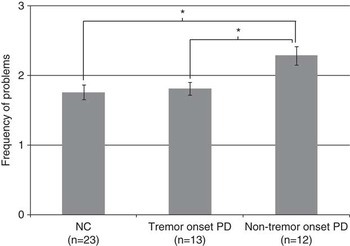
The Kruskall-Wallis test revealed significant differences by group (NC, TD, NTD) on the overall composite score (H(2) = 8.9; p < .05). Post hoc analyses were adjusted for multiple comparisons using Bonferroni's correction and indicated that the NTD group endorsed more problems than either the NC group (U = 62.0; p < .017) or the TD group (U = 30.0; p < .017). There was no difference in scores between NC and the TD group (U = 130; p = .54). Medium to large effect sizes were observed for the NTD group compared to NC (r = −.45) and the NTD group compared to TD group (r = −.52) (Figure 1).
Mean total score on the VAQ for NC, Tremor onset PD and Non-tremor onset PD. Error bars represent standard errors of the mean. The Non-tremor onset PD patients indicated worse functioning than the NC (p < .017) and Tremor onset PD groups (p < .017).

Analyses of the eight subscales by group
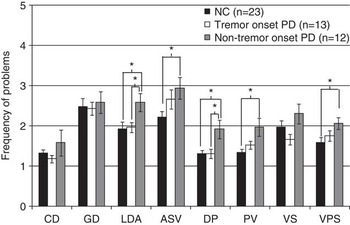
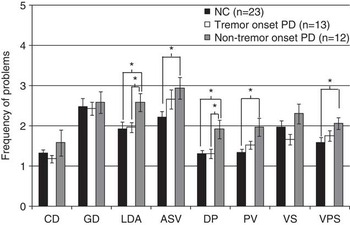
Kruskall-Wallis tests were performed at each subscale to examine potential group differences. Significant group differences were observed on the subscales for light/dark adaptation (H(2) = 8.4; p < .05), acuity/spatial vision (H(2) = 6.1; p < .05), depth perception (H(2) = 9.3; p < .01), peripheral vision (H(2) = 9.7; p < .01), and visual processing speed (H(2) = 7.7; p < .05). Post hoc analyses were performed and were adjusted for multiple comparisons using Bonferroni's correction. There were no significant differences in scores between the NC and TD group. The NTD group endorsed more problems than the NC group on light/dark adaptation (U = 65.5; p < .017), acuity/spatial vision (U = 69.5; p < .017) depth perception (U = 62.0; p < .017), peripheral vision (U = 56.5; p < .017) and visual processing speed (U = 66.5; p < .017). When compared to the TD group, the NTD group endorsed more problems on light/dark adaptation (U = 31.0; p < .017) and depth perception (U = 33.0; p < .017). Effect size analyses were performed when appropriate using Pearson's correlation coefficient. Medium to large effect sizes were observed for the NTD group compared to the NC on light/dark adaptation (r = −.43), acuity/spatial vision (r = −.40), depth perception (r = −.47), peripheral vision (r = −.49), and visual processing speed (r = −.42). Large effect sizes were observed for the NTD group compared the TD group on light/dark adaptation (r = −.52) and depth perception (r = −.51). See Figure 2.
Mean score for each of the eight scales of the VAQ for NC, Tremor onset PD and Non-tremor onset PD. Error bars represent standard errors of the mean. The Non-tremor PD patients indicated worse functioning on the light/dark adaptation, acuity/spatial vision, depth perception, peripheral vision and visual processing speed subscales than the NC group (p < .017). Non-tremor PD patients also indicated worse functioning on the light/dark adaptation and depth subscales (p < .017) than the tremor onset group. VAQ subscales: CD = color discrimination; GD = glare disability; LDA = light/dark adaptation; ASV = acuity/spatial Vision; DP = depth perception; PV = peripheral vision; VS = visual search; VPS = visual processing speed.
Correlations between VAQ scores and vision results
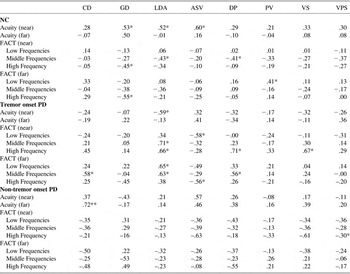
Correlations between vision scores and the VAQ were determined by Spearman rank correlation coefficients for NC and for the two PD subgroups. All significant correlations are shown in Table 2. For analyses, FACT levels were grouped according to whether they were low (1.5, 3.0 cpd), middle (6.0, 12.0 cpd), or high spatial frequencies (18.0 cpd). Lower scores on the FACT indicate worse contrast sensitivity and higher scores on the VAQ indicate more problems with visual ADLs; hence, negative correlations indicate more problems with visual ADLs with poorer contrast sensitivity. All correlations for the NC group were negative, as expected. No correlations were significant for the NT group. For the tremor-onset group, correlations with the acuity/spatial vision subscale were negative; correlations with other subscales were positive. In light of the number of correlations and the resulting limitation of statistical power, these comparisons should be considered exploratory in nature.
Significant correlations between visual assessments and scores on the VAQ
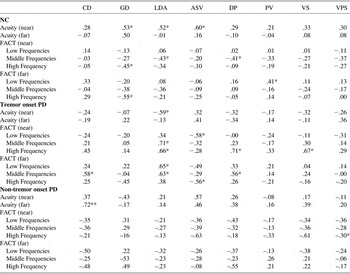
Note. For all correlations (Spearman), p < .05. CD = Color Discrimination; GD = Glare Disability; LDA = Light/Dark Adaptation; ASV = Acuity/Spatial Vision; DP = Depth Perception; PV = Peripheral Vision; VS = Visual Search; VPS = Visual Processing Speed.
Discussion
We found that PD patients without tremor as the initial symptom experienced more problems with visual ADLs than did either PD patients with tremor as the initial symptom or healthy control adults. This finding is consistent with recent evidence suggesting that non-tremor onset PD is associated with a wide range of non-motor symptoms and problems with ADLs in general. Group differences were observed between the non-tremor onset patients and the NC group in five of the eight visual domains tested by the VAQ, including light/dark adaptation, acuity/spatial vision, depth perception, peripheral vision, and visual processing speed. PD subtype differences were also observed, with the non-tremor patients reporting more problems with light/dark adaptation and depth perception than the tremor subtype. By contrast, PD participants with tremor as the initial symptom indicated levels of functioning similar to the NC group in all visual ADL domains. This finding accords with reports indicating that the tremor subtype experiences fewer and less severe non-motor symptoms of PD than does the non-tremor subtype (Allcock, Kenny, & Burn, Reference Allcock, Kenny and Burn2006; Burn et al., Reference Burn, Rowan, Minett, Sanders, Myint, Richardson and McKeith2003; Hariz et al., 2011) and indicates that, in mild to moderate PD, visual ADLs are preserved in the tremor subtype.
We also observed that the non-tremor subtype had worse near contrast sensitivity when compared to either tremor onset PD or healthy control adults. Contrast sensitivity deficits in PD have been reported consistently (Amick et al., Reference Amick, Cronin-Golomb and Gilmore2003; Bodis-Wollner et al., Reference Bodis-Wollner, Marx, Mitra, Bobak, Mylin and Yahr1987; Davidsdottir et al., Reference Davidsdottir, Wagenaar, Young and Cronin-Golomb2008; Diederich et al., Reference Diederich, Raman, Leurgans and Goetz2002; Kupersmith, Shakin, Siegel, & Liberman, Reference Kupersmith, Shakin, Siegel and Lieberman1982; Pieri, Diederich, Raman, & Goetz, Reference Pieri, Diederich, Raman and Goetz2000; Regan and Neima, Reference Regan and Neima1984; Regan and Maxner, Reference Regan and Maxner1987), but this is the first study to our knowledge indicating that these deficits are especially pronounced in the non-tremor subtype. Further studies are needed to assess why the contrast sensitivity deficit emerged at the near distance only. As with normal aging and other age-related neurological disorders, the reduced signal strength stemming from deficits in visual perception may impact cognition (Clay et al., Reference Clay, Edwards, Ross, Okonkwo, Wadley, Roth and Ball2009; Cronin-Golomb, Corkin, & Growdon, 1995; Cronin-Golomb, Gilmore, Neargarder, Morrison, & Laudate, 2007; Gilmore, Spinks, & Thomas, 2006), thereby resulting in worse functional outcomes. In PD there is some evidence that increasing contrast improves cognition and everyday functioning (Amick et al., Reference Amick, Cronin-Golomb and Gilmore2003; Uc, Rizzo, Anderson, et al., Reference Uc, Rizzo, Anderson, Dastrup, Sparks and Dawson2009). The results of the present study suggest that further investigation of the effect of sensory deficits, particularly contrast sensitivity, on cognition and everyday function by PD subtype is warranted.
Single photon emission computed tomography studies routinely demonstrate negative correlations between striatal uptake of dopamine and the non-tremor symptoms of PD (i.e., rigidity, bradykinesia, gait, balance, and posture), but not tremor, suggesting that the non-tremor symptoms (but not tremor) stem from deficits in the nigrostriatal dopaminergic system. These findings are also observed when striatal dopamine levels are analyzed by group (i.e., non-tremor PD vs. tremor PD; Spiegel et al., Reference Spiegel, Hellwig, Samnick, Jost, Möllers, Fassbender and Dillmann2007). Some of the visual perceptual deficits seen in PD, particularly contrast sensitivity, may be associated with dopamine changes in the retina (for reviews, see Bodis-Wollner, Reference Bodis-Wollner1990, Reference Bodis-Wollner2009; Witkovsky, Reference Witkovsky2004). Consistent with these two lines of investigation, we observed contrast sensitivity deficits in the PD subtype associated with greater striatal dopamine loss (non-tremor subtype) relative to the PD subtype with the least striatal dopamine loss (tremor subtype). This finding suggests that the non-tremor subtype may be associated with more significant dopamine deficits in the retina than the tremor subtype, likely stemming from deficits in the nigrostriatal system. Dopamine also plays a role in visual processing in posterior cortical regions and it has been proposed that visual processing relies on a dopamine-dependent circuit between the basal ganglia and the striate cortex (Silkis, Reference Silkis2007a; Silkas, Reference Silkis2007b). Accordingly, contrast sensitivity deficits, especially in non-tremor onset PD, may also stem from dopamine loss in posterior regions.
Light/Dark Adaptation
The light/dark adaption subscale of the VAQ reflects problems performing visual ADLs that require adjusting to lighting conditions, such as going from a dark movie theater into daylight. We found that non-tremor onset PD is associated with more problems adjusting to these settings than both a well-matched control group and tremor-onset PD. This finding is consistent with experimental studies indicating that patients with PD have deficits in pupil reactivity, an autonomic function, in response to light adaptation (Micieli et al., 1991; Verbaan et al., 2007), but suggest that this type of autonomic dysfunction may be more pronounced in the non-tremor subtype. Autonomic dysfunction as indicated by orthostatic hypotension has been previously shown to be worse in the non-tremor subtype (Allcock et al., 2006). Further studies exploring the extent of autonomic dysfunction by PD subtype may be warranted. It is unclear why the tremor onset group, unlike the other two groups, showed a negative correlation between light–dark adaptation and acuity/contrast sensitivity. Follow-up studies are planned to examine this finding.
Acuity and Spatial Vision
The acuity/spatial vision subscale of the VAQ reflects problems performing visual ADLs that require seeing fine detail, such as reading small print seen in phone books or newspapers. Three of the four items are specific to reading text that is either small in size or of low contrast and may, therefore, reflect difficulties with acuity and concentration. Davidsdottir and colleagues (Reference Davidsdottir, Cronin-Golomb and Lee2005) found that over 40% of their sample of 81 PD patients reported not being able to read as well as they used to, and they attributed these difficulties to problems with vision and concentration. Consistent with this self-report, in the present study we found that the scores of tremor-onset PD patients on the acuity/spatial vision subscale correlated with performance on contrast sensitivity (FACT). In fact, the correlation between performance on the acuity/spatial subscale and contrast sensitivity was in the expected direction, with poorer acuity/spatial behavior associated with poorer contrast sensitivity, whereas for the other subscales the correlation was of better acuity/spatial behavior associated with poorer contrast sensitivity. These findings may reflect the known individual variability of the relation between visual input and spatial navigation in PD, with investigators attributing inconsistencies in the effectiveness of visual cues to compensate for gait and postural abnormalities in PD to individual differences at the perceptual level (e.g., Azulay et al., Reference Azulay, van den Brand, Mestre, Blin, Sangla, Pouget and Serratrice1996, Reference Azulay, Mesure, Amblard, Blin, Sangla and Pouget1999); to date, no studies have investigated this relation by PD subtype. In our sample, the non-tremor subtype, but not the tremor subtype, had significantly worse near contrast sensitivity (3.0, 6.0, and 12.0 cpd) than the NC group. Likewise we found group differences on the acuity/spatial subscale of the VAQ between the non-tremor subtype and NC. Taken together, these findings suggest that the worse contrast sensitivity in the non-tremor subtype likely contributed to difficulties performing visual ADLs involving acuity/spatial vision, particularly reading.
Depth Perception
The depth perception subscale of the VAQ reflects problems performing visual ADLs that require appreciating the spatial relations between objects, such as judging the level of liquid in a cup when pouring a cup of coffee. We found that non-tremor onset PD was associated with more problems performing depth perception related ADLs than both the NC subtype and tremor-onset PD patients. Visuospatial deficits in PD are well documented and have been previously linked to side of motor symptom onset in PD (reviewed in Cronin-Golomb, Reference Cronin-Golomb2010), but there is only limited evidence relating type of motor symptom to visuospatial performance. Maeshima and colleagues (1997) reported that PD patients with visuospatial deficits (as indicated by cube copying) had more bradykinesia (as indicated by alternating hand movements) than PD patients without visuospatial deficits. Our findings are consistent with those of these investigators in that PD patients with non-tremor onset, including those presenting with bradykinesia, indicated more problems with visual ADLs involving depth perception.
Peripheral Vision
The peripheral vision subscale of the VAQ reflects problems performing visual ADLs that require detecting and orienting to stimuli in the periphery, such as changing lanes in traffic due to problems seeing cars in the next lane. Difficulties with peripheral vision-related ADLs in the non-tremor subtype may stem from the more extensive akinesia, rigidity, and bradykinesia in this group, which affect initiation and speed of voluntary movements. Deficits in attentional systems may also contribute to problems with peripheral vision-related ADLs. In a series of experiments, McDowell and Harris (Reference McDowell and Harris1997b) examined reaction time in response to a centered visual cue displayed on a computer monitor with and without additional stimuli in the periphery. Time to initiate movement (i.e., latency from start signal to release of finger from a touch pad) in PD was similar to that of control participants when the peripheral field was blank (e.g., a solid color). When the peripheral field contained additional stimuli including stationary and moving objects, however, PD participants were slower to initiate movement than the control group. Follow-up experiments indicated that this delay in motor action was particularly pronounced when appearance (or disappearance) of peripheral stimuli occurred near the onset of the visual cue that signaled that a motor response was required. These findings are particularly relevant to certain visual ADLs, such as driving, in which stimuli in the peripheral vision are constantly changing and require speeded motor responses. The results of the present study indicate that non-tremor onset patients experience more deficits with these types of visual ADLs than do healthy adults.
Visual Processing Speed
The visual processing speed scale of the VAQ assesses problems performing visual ADLs that require quickly processing visual information, such as noticing when a car directly in front is speeding up or slowing down. Although several studies have indicated that PD patients with an initial symptom other than tremor experience worse overall cognition than do those presenting with tremor onset (Oh, Kim, Choi, Sohn, & Lee, 2009; Taylor et al., Reference Taylor, Rowan, Lett, O'Brien, McKeith and Burn2008; Verbaan et al., 2007; Williams et al., 2007; Williams-Gray, Foltynie, Brayne, Robbins, & Barker, 2007; Zetusky & Jankovic, 1985), ours is the first study demonstrating a deficit in visual processing speed that is specific to non-tremor patients.
The present study focused on the relation between visual functioning and self-reported problems with visual ADLs in PD subtypes, finding that the PD subtype with worse visual functioning (non-tremor symptom onset) also endorsed more problems performing visual ADLs. This study was not designed to examine the relation between visual ADLs and cognitive functioning. In this high-functioning sample, subgroups were generally similar on neuropsychological performance. Further studies using a more comprehensive cognitive assessment with a larger sample appear warranted to determine whether subtle cognitive deficits are related to deficits in visual ADLs.
In summary, our results indicated that PD patients with non-tremor symptoms at disease onset, but not PD participants with tremor at onset, had impairments in visual ADLs, particularly those involving light/dark adaptation, acuity/spatial vision, depth perception, peripheral vision and visual processing speed. These findings are in accord with a growing body of evidence that non-tremor onset PD, relative to the tremor-onset type, is associated with more extensive cortical and subcortical pathology as well as worse non-motor symptoms. This is the first study to our knowledge demonstrating that the non-tremor subtype of PD exhibits greater functional impairment when performing visual ADLs. Environmental enhancements, such as increasing room lighting and reducing visual clutter, may help to ameliorate ADL impairments seen in individuals with PD, particularly those with the non-tremor onset subtype.
Acknowledgments
We thank all of the individuals who participated in this study. Our recruitment efforts were supported, with our gratitude, by Marie Saint-Hilaire, MD, and Cathi Thomas RN, MSN, of Boston Medical Center Neurology Associates, and by Boston area Parkinson Disease support groups. Karen Sullivan, PhD, collaborated on test development. Tom Laudate, MA, Chelsea Toner, MA, Bruce Reese, MA, and Samantha Ekka-Duffy, BA provided expert technical support. Funding for this study was provided by the National Institute of Neurological Disorders and Stroke (R01 NS050446 and R01 NS052914 to ACG). There were no financial or other relationships that could be interpreted as a conflict of interest affecting this article.