Beginning in the 1980s, interest in the Shi‘as increased primarily due to the events of the Iranian Revolution, the rise of Hizbollāh, and the Iran-Iraq War. This interest has increased particularly as a result of the collapse of Saddam Hussein's regime in Iraq and the subsequent historical emergence of the first ever Shi‘a governed Arab state, the rise in power and influence of Iran as a possible regional hegemon, and the debatable success of Hizbollāh in holding off the better equipped Israeli military in the summer of 2006. Additionally, the Shi‘a-Sunni division has been the focal point of many academic, theoretical, and media discussions in the first decade of the 21st century (Fuad Reference Fuad2006; Abd al-Jabbar Reference Abd al-Jabbar2003; Louër Reference Louër2008; Fuller and Francke Reference Fuller and Francke2000; Nakash Reference Nakash2006; Nasr Reference Nasr2006a; Reference Nasr2006b). Although the discussion is fresh and new for the western world, the division between Shi‘a and Sunni Muslims is centuries old. It did not begin with Saddam's reign, nor will it end if or when hostilities come to a close in Iraq.
This research discusses the Shi‘a-Sunni division in a totally different context, one in which both Shi'a and Sunnis are minorities looking in from the outside. This article is quantitative in nature, and will utilize the survey conducted by Barreto and Dana (Reference Barreto and Dana2008) and other members of the Muslim-American Political Opinion Survey (MAPOS) research team. The MAPOS data will be utilized to compare Shi‘a and Sunni responses in a few areas of interest: religious identity, views of being a Muslim in the United States, and political participation. The question that will be answered is as follows:
Does belonging to either the Shi‘a or Sunni schools of Islam have an effect on Muslim religious identity, perceptions of being Muslim in the United States, and political participation in the United States?
The expectation is to find a significant difference between Shi‘a and Sunni respondents given the different perceptions of political participation, historical legacies, as well as other factors (both domestic and foreign). As will be discussed in the literature review, the quietist tradition of Shi‘a political theory and the relatively young age of their Islamic centers has been suggested as explanations for the lack of political and social involvement outside the community. Additionally, Sunnis have established the majority of Muslim advocacy groups, and only recently have the Shi‘as begun to form such groups and associations. Based on these points, I hypothesize that there will be an association between Islamic sect and Muslim religious identity, perceptions of being Muslim in the United States, and political participation in the United States. The study will illustrate that on two key variables.
The study of Muslim-Americans and Muslims in America is a new and burgeoning field. Just as with the rejuvenated fascination with the Muslim world, scholars are also examining the religious, social, and political lives of Muslims in the West. Most of the literature that involves Shi‘as in the United States has predominantly been focused in religious studies and sociological studies, and these works will be discussed in the literature review. This article is the beginning of a larger project that aims to take an in-depth look at Shi‘a Muslims’ political dispositions in the United States, and will be the first of its kind in the field of political science. This current piece of work commences the discussion of Shi‘a political participation in the American body politic, and calls for a more in-depth analysis of how the narratives of Shi‘ism contributes to the construction of identities, and how those identities manifest themselves in the United States.
STATE OF RESEARCH ON SHI‘ISM AND SHI‘A IN THE AMERICAN CONTEXT
As mentioned, Shi‘as in the United States have not been thoroughly studied; however, it is important to clarify that they have not been studied extensively as Shi‘as. Studies exist that examine Iranian-Americans (Ansari Reference Ansari1988) and Arab-Americans (Suleiman Reference Suleiman1999), who of course include Shi‘as. However, there actually exists very little work on the Shi‘as qua Shi‘as.
Walbridge's (Reference Walbridge1993; Reference Walbridge, Haddad and Smith1994; Reference Walbridge1997; Reference Walbridge and Suleiman1999) anthropological work focuses on the Dearborn, Michigan area, and provides a rich and in-depth analysis of this community. Hers is a historical account of the process of the formation of the early Shi‘a community in Dearborn, which melded with America and its culture to the detriment of its Shi‘a identity, to the transformation that occurred with the influx of immigrants from a “different” Middle East, one that had been changed by the failures of Arabism, the emergence of Islamism, the Iranian Revolution, and the Lebanese Civil War (Walbridge Reference Walbridge1997).
Takim's (Reference Takim2000) look at the exterior influences on American-Shi‘a also discusses the institution of marja‘īyah, how the marājī‘ have become increasingly interested in fostering closer ties with their flocks in the West.Footnote 1 Additionally, Takim finds that some communities accentuate their Shi‘a identity more than others. Shi‘as in the United States are more likely to identify with the greater Muslim community in areas where they are a significant minority.
Takim (Reference Takim and Haddad2002) is one of the only scholars to take a look at the political dispositions of Shi‘as in the American context, although his is primarily a list of how Shi‘as have participated. The fact of the matter is that the list is rather short. However, what is offered is instructive in trying to understand how Shi‘as view their situation in the United States. As Takim argues, Shi‘as do not view American citizenship as something incompatible with being Shi‘a. In fact, most apply for citizenship as soon as possible. The MAPOS data show that 83% of the Shi‘a respondents were United States citizens. When discussing political participation, Takim (Reference Takim and Haddad2002) makes some very astute observations claiming that the quietist tradition of Shi‘a political theory and the relatively young age of their Islamic centers have contributed to the lack of political and social involvement outside of the community.Footnote 2
DATA AND METHODS
The comparison of the responses of Shi‘a and Sunni respondents in the MAPOS data set is necessary to discern if there are fundamental differences in the way these two groups see themselves in the American political and social system. MAPOS is a unique public opinion survey of Muslim-Americans that was conducted in an effort to better understand the political implications of this religious and ethnic community in the United States, and also provides comparative data for Muslim-Americans on many traditional measures of political behavior and participation that are currently lacking. The data were collected in Seattle, Washington; Dearborn, Michigan; San Diego, California; Riverside, California; Irvine, California; Los Angeles, California; Raleigh-Durham, North Carolina; Washington, D.C.; Houston, Texas; Dallas, Texas; Oklahoma City, Oklahoma; and Chicago, Illinois. An “exit-poll” method was utilized, in which Muslim-American research assistants (usually recruited by campus Muslim Student Associations) would randomly recruit prospective participants by means of a traditional skip pattern. If prospective respondents agreed to participate, a clipboard with survey (in either English or Arabic, depending on the respondent's preference) was supplied, and the respondents would complete it on their own.
Twenty-one locations were included in total from December 30, 2006 to December 8, 2008, and yielded 1,410 total respondents. The bulk of the data were collected on two occasions on the Islamic calendar, Eid al-Fiṭr and Eid al-Aḍha, for the two year period. Therefore, the data were collected on three commemorations for Eid al-Aḍha from 2006 to 2008, and two commemorations of Eid al-Fiṭr from 2007 to 2008. Eid gatherings at mosques, Islamic centers, or large community centers work well for creating the possibility of obtaining a random sample as well as increasing the sample size. These occasions also allow for a variation in the type of Muslims who could participate in the survey. Eid prayers will attract the most devout Muslims, the most secular Muslims, and anyone who falls in between. Additionally, a significant number of surveys were collected on occasions other than Eid al-Fiṭr and Eid al-Aḍha (Barreto and Bozonelos Reference Barreto and Bozonelos2009).
Comparison of means and t-tests are utilized in order to compare the differences between Shi‘a and Sunni respondents.Footnote 3 Out of the 1,410 total MAPOS respondents, 960 identified as Sunni and 96 as Shi‘a. This analysis will only take into account the responses from these respondents. Three broad categories were selected to distinguish if fundamental differences exist between the Shi‘a and Sunni respondents. These areas are as follows:
1. Religious Identity: Is one's “Muslim-ness” affected by whether he or she self-identifies as Shi‘a or Sunni? “Muslim-ness” refers to activities and knowledge that creates or builds-onto a “Muslim identity.” These include variables that take into account how much the respondent has in common with other Muslims; how closely he or she follows the Qur’ān and Ḥadīth in their daily life; how active s/he is in the mosque outside of the daily prayers and the Friday congregational prayer; if s/he ever attended an activity at the mosque excluding the prayers in 2006/2008; and if s/he gave ṣadaqāh (voluntary charity) to a Muslim individual/organization in 2006/2008.
2. Muslims in American Society: Are one's views of being Muslim in the United States affected by whether s/he self-identifies as Shi‘a or Sunni? This includes variables that take into account how important it is for Muslims to change in order that they blend into the larger society, and if they believe that the teachings of Islam are compatible with participation in the American political system.
3. Political Participation in the American context: Is participation in the American political context affected by whether they self-identify as Shi‘a or Sunni? This category establishes how closely respondents followed news about the candidates and initiatives in the 2006/2008 elections, and if they participated in a community meeting, rally or protest, letter writing campaign, donated to a political candidate/campaign, and voted in the November 2006/2008 election.
ANALYSIS
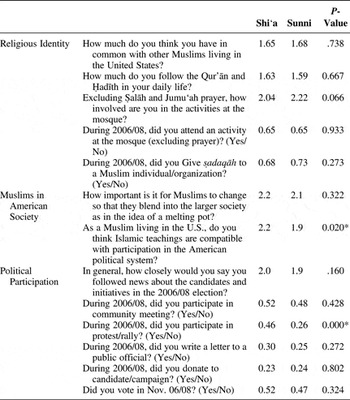
Table 1 lists the mean responses for the questions that pertained to each broad category. The following is the explanation of the analysis.
Religious Identity, Muslims in American Society, and Political Participation (Mean Responses)

Religious Identity
The purpose of determining the “Muslim-ness” of the respondents is to observe if there was any significant difference between the Shi‘as and Sunnis in forming a Muslim identity. The MAPOS dataset contained five questions that were useful in understanding how much a respondent's identity was closely related to his or her own perceptions of what it meant to be Muslim, and if s/he participated in activities that might be seen as common practices of Muslims.
The section of Table 1 entitled “Religious Identity” indicates that all five variables displayed no significant difference between Shi‘as and Sunnis respondents. The first three questions allowed respondents to answer on a scale from 1 to 4, with 1 being the highest and 4 being the least. Therefore, this signifies that on average, both Shi‘as and Sunnis found a great deal to a fair amount in common with other Muslims living in the United States, with the average Shi‘a respondent having more in common with other Muslims.
The results reveal that Shi‘as and Sunnis claim to follow the Qur’ān and Ḥadīth of the Prophet Muḥammad, and that these two bases of Islam play a rather substantial role in their daily lives, although the average Sunni respondent claimed to follow these sources more strictly. This is an important variable to consider given the Prophet Muḥammad's injunction during the Farewell Pilgrimage to hold tight to the Qur'ān and his Ahl al-Bayt/Sunnāh.Footnote 4 Given the importance of the Qur’ān as well as the actions and words of the Prophet, it is necessary to see how closely respondents adhere (or think they adhere) to these important articles of faith. Based on the results in Table 1 it can be claimed that being Shi‘a or Sunni has no significant effect on how closely one follows the Qur’ān and Ḥadīth of the Prophet Muḥammad.
Another important factor was determining how participatory respondents were in activities in the mosque outside of the five obligatory prayers and the Friday congregational prayer. Although it is recommended to pray as many of the obligatory prayers as possible inside the mosque, it is sometimes difficult to do so because of responsibilities dealing with work, school, raising children, etc. However, for the Sunnis, the Friday congregational prayer is a wājib (obligatory) act that should not be missed. The Shi‘a on the other hand, view the Friday prayer as wājib only if a ma‘ṣūm (one of the Infallible Imams) is present to lead the prayer. Although Shi‘as throughout the world hold Friday prayers, it is not incumbent upon believers to attend.Footnote 5 Another important distinction to mention is that many Muslims may not keep up with their obligatory prayers, but will attend Friday prayer regularly for the feeling of communal togetherness. The expectation is that the more involved an individual is in mosque activities, the more “Muslim” he or she might be.
The results demonstrate that both Shi‘as and Sunnis were either very or somewhat involved in activities in the mosque excluding the obligatory prayers and the Friday congregational prayer. Shi‘a respondents exhibited a slightly higher degree of involvement; however, there was no significant difference. The slightly higher average response of Shi‘a respondents about being involved in mosque activities may be due to the very common practice of Shi‘as congregating on Thursday nights (Friday eve) for the recitation of Du’ā Kumayl, which is a supplication written by the Prophet Khiḍr and then suggested for recital every Thursday night by the first Imam of Shi‘ism, ‘Alī ibn Abī Ṭālib. Though not a wājib act, it is seen as a defining characteristic of the Shi‘a faith that does not exist in the Sunni world. In addition to this supplication, which is recited in Arabic by one or more of the congregants, there is usually a sermon/lecture that is given by one of the leading members of the congregation or the resident imam. Moreover, it is important to take into consideration that there are numerous occasions that the Shi‘as commemorate inside the mosque that do not occur in the Sunni world. Some of these events include the birthdates and deaths of all of the 14 Infallibles, as well as other ‘Eids such as ‘Eid al-Ghadīr, ‘Eid al-Mubāhalāh, and ‘Eid al-Zahrā’. Probably the most recognized of these commemorations are the 10 to13 nights that coincide with the martyrdom of Imam Ḥusayn and his family and companions at Karbalā' in 61 AH/680 CE known as ‘Āshūrā’.
The last two variables regarding the issue of religious identity involved yes/no questions. Consequently, being Shi‘a or Sunni has no significant bearing on whether respondents attended an activity at a mosque outside of the prayer in 2006/2008. Moreover, approximately 73% of the Sunni respondents answered in the affirmative as compared to approximately 68% of the Shi‘as. Again, there was no significant difference. Therefore, it cannot be claimed that difference in Islamic sect has a significant effect on whether a respondent gives ṣadaqāh to a Muslim individual and/or organization.
Being Muslim in American Society
Determining how Muslims themselves view the compatibility of Islam with the Western world is incredibly important in order to understand the complexities that Muslims face in a society where in many cases they are not fully accepted. In a post-September 11, 2001 world, many Muslims living in the West are often scrutinized and falsely accused either of being sympathetic to or even of being terrorists, of being a “fifth column” for shady foreign organizations or states, and of being intolerant of Western values, democracy, and ways of life. The MAPOS dataset contained two questions that were useful in understanding how respondents perceived the mix of Islam and American society. Both questions allowed respondents to answer on a scale from 1 to 4, with 1 being the highest and 4 being the least.
The section of Table 1 entitled “Muslims in American Society” illustrates that Shi‘a respondents were slightly less inclined to think it was as important for Muslims to change and blend into the larger American society; however, the difference was negligible. Therefore, it can be claimed that difference in Islamic sect does not have a significant effect on a respondent's opinion of how important it is for Muslims to blend into the larger society.
The results do, however, offer a significant difference between Shi‘a and Sunni respondents in regards to their perceptions of whether the teachings of Islam are compatible with political participation in the United States. It is appropriate to state that there is evidence of an association between a respondent's Islamic sect and his or her opinion of how compatible Islamic teachings are with participation in the American political system.
Political Participation in the American Context
Often it is argued that Islam and democracy do not mix … that there is something about Islam that breeds authoritarianism and the lack of political participation (Fish Reference Fish2002; Donno and Russett Reference Donno and Russett2004). One major goal of this research is to determine if Muslims in general, and Shi‘as specifically, are participating politically given a situation in the United States where political participation is guaranteed along with a host of rights and protections. Additionally, if they are participating, in what ways are they doing so?
The third section of Table 1 (“Political Participation”) explains that on average the Shi‘a respondents followed the news about candidates and initiatives slightly less so than the Sunnis. Again, there was a negligible difference. Hence, it can be claimed that difference in Islamic sect does not have a significant effect on how closely a respondent followed the news about the candidates and initiatives in the 2006/2008 elections.
The MAPOS survey also asked if respondents participated in (1) a community meeting, (2) rally or protest, (3) writing a letter to a public official, (4) donating to a political candidate/campaign, and (5) the November 2006/2008 elections. On all of these measures, excluding “donating to a political candidate/campaign,” the Shi‘a respondents participated in higher percentages (four to five percentage points higher than Sunni respondents). Out of these five measures of political participation, only the variable pertaining to participation in a rally or protest was statistically significant. Therefore, it can be claimed that difference in Islamic sect does have a significant effect on a whether a respondent participated in a rally or protest in 2006/2008, but not on whether a respondent participated in a community meeting, wrote a letter to a public official, donated to a political candidate/campaign, or voted in November 2006/2008.
DEARBORN EFFECT
Out of the 13 variables considered, the t-test yielded two of the variables to be statistically significant. Being whether a person was Shi‘a or Sunni had a significant effect on whether the respondent believed that Islamic teachings were compatible with participation in American politics and whether or not the respondent had participated in a protest or rally in 2006/2008.
The variable involving participation in a rally or protest had such a glaring difference between the Shi‘a and Sunni respondents that it called for further analysis. Taking into account that in the United States during the summer of 2006 there were many protests of the Israeli invasion of Lebanon, it was necessary to test if there was a particular location at which a large number of Shi‘as protested. This led to the discovery that the MAPOS dataset only contained two locations in which there were majority Shi‘a populations. One location was in the Los Angeles area, and was quickly determined to be an Iranian-Muslim community center, not an official mosque or Islamic center per se. The other location was a Shi‘a mosque in the Dearborn area. Taking into account the large number of Shi‘as and Lebanese in the Dearborn area, the comparison of means and t-tests were once again used excluding the members of this particular mosque.
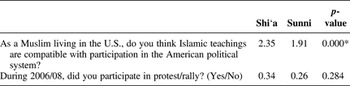
Table 2 illustrates that, when excluding the members of the Dearborn Shi‘a mosque, whether a respondent was Shi‘a or Sunni had a significant effect on whether the respondent believed that the teachings of Islam were compatible with political participation in the United States. However, it can no longer be claimed that difference in Islamic sect has a significant effect on whether a respondent participated in a rally or protest in 2006/2008. Allaying concerns of a possible “Lebanese effect,” it was established that no association existed between ethnicity (i.e., Lebanese, Iraqi, or other) and participation in a rally or protest within this Dearborn Shi‘a mosque.
Dearborn Effect (Excluding Dearborn Shi‘a Mosque)

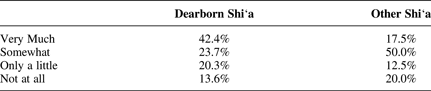
Table 3 compares responses from within this particular mosque and the other Shi‘a respondents in the MAPOS dataset in regards to their views on the compatibility of Islamic teachings with political participation in the United States. Table 4 compares the responses of the respondents from within this specific Shi‘a mosque, other Shi‘a respondents, and all Sunni respondents. Again, the location played a significant role in how the Shi‘as viewed compatibility of Islamic teachings with political participation and with participation in a rally or protest.
Comparison of Shi‘a Respondents in Regards to the Compatibility of Islamic Teachings with Participation in the American Political System
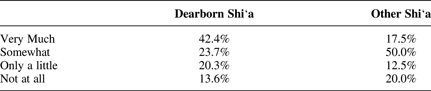
Comparison of Dearborn Shi‘a, Non-Dearborn Shi‘a, and All Sunni Respondents in Regards to Participation in a Rally/Protest

IMPLICATIONS AND FURTHER RESEARCH
For the most part, whether a respondent was Shi‘a or Sunni had no significant effect on that respondents' answers. The only two variables that were statistically significant illustrate that Sunnis felt more strongly that the teachings of Islam were compatible with political participation in the United States, and that a statistically significantly higher percentage of Shi‘a respondents participated in a rally or protest.
It is conceivable that congregants inside Shi‘a mosques view Islamic teachings as being more compatible with participation in American politics; however, the results of this analysis alone cannot allow us to make such claims, but it can open the door for some theorizing. Perhaps there is something occurring within various Shi‘a mosques that influences people to be more politically active. One concrete example is evident (and it ironically involves the example of attending a rally/protest), the holding of Yaūm al-Quds (Jerusalem Day) that occurs on the last Friday of every Ramaḍān. This commemoration is characterized by peaceful protests and demonstrations at government buildings in support of the Palestinian cause, and was initiated by Imam Khūmaynī in the 1980s. This event is planned and carried out by Shi‘as around the globe, and is typified by equating the struggle of the Palestinians with the difficulties and suffering the Ahl al-Bayt endured, most notably the massacre of Imam Ḥusayn at Karbalā’. Those who gather for this event often do so for the cause of justice as exemplified by the struggle between Imam Ḥusayn and the army of Yazīd. Ironically, those whom they support are Palestinian and Sunni, for whom the Shi‘as narrative of ‘Āshūrā’ has little emotional salience. Yet, for the Shi‘as that show up in the many cities of the United States on the last day of Ramaḍān, it is an obligation to “enjoin what is good and forbid what is evil,” as the Qur’ān commands.
The implications for such findings may lead the study of Muslims in the United States into a new direction, not one that abandons the study of Muslims in general or Sunnis specifically, but one that may open the door for a more in-depth study of Shi‘a Muslims in the American political and social context. Although the MAPOS dataset has been of great benefit, it was inadvertently biased more toward Sunni respondents just by the simple fact that the overwhelming majority of locations included were Sunni-majority centers. Moreover, a large number of Shi‘as responded differently from the Dearborn Shi‘a mosque respondents on a few key questions. Those Shi‘as who responded to surveys after participating in a Sunni ‘Eid gathering did so either because being Shi‘a or Sunni does not make much of a difference or because there was no other alternative (e.g., the absence of a Shi‘a mosque or gathering). Therefore, this begs the question, “How Shi‘a were those Shi‘as?” I assert that more Shi‘a centers need to be included to get a more accurate measure of Shi‘a respondents. However, this does not solve the problem entirely. We can ascertain the opinions of respondents using survey data, but it is almost impossible to understand how they arrived at those opinions. What was it that caused those Shi‘as at the Dearborn location to be much more open to participation in American politics? I argue that the narratives that drive Shi‘ism are also empowering many Shi‘as to act politically for the benefit of society as a whole, not just for Shi‘as’ or Muslims' gains. This article only leads to speculations about Shi‘a political behavior in the United States; however, a richer study drawing on surveys, interviews and ethnography would go a long way to explain how Shi‘as frame their political experience in a country in which they can definitely be labeled as a “minority within a minority” (Sachedina Reference Sachedina, Haddad and Smith1994).