1 Introduction
Tobacco use remains a serious health concern to policymakers. In the parlance of the Centers for Disease Control and Prevention (CDC), cigarette smoking – the most commonly used tobacco product among US adults – is responsible for most of the preventable diseases and deaths in the United States (US Department of Health and Human Services, 2014). The victims, encompassing more than 480,000 deaths, largely comprise adults in the age range of 18–64 years (Jamal et al, Reference Jamal, King, Neff, Whitmill, Babb and Graffunder2016). In particular, college students are a group of interest because smoking habits blossom during late adolescence. Despite the declining trend in cigarette smoking over the years, the prevalence rate among college students is equivalent to the rate of death caused by tobacco use and significantly is higher than the national average (CDC, 2016; Johnston et al., Reference Johnston, O’Malley, Miech, Bachman and Schulenberg2016). Furthermore, in spite of the increased knowledge college students receive about the consequences of tobacco use, as well as the availability of health education and promotion services and/or cessation resources on college campuses, more than two-thirds are infrequent or intermittent smokers (Sutfin et al., Reference Sutfin, McCoy, Berg, Champion, Helme, O’Brien and Wolfson2012).
The health implications of smoking and tobacco use have been well documented (He et al., Reference He, Vupputuri, Allen, Prerost, Hughes and Whelton1999; Glantz and Parmley, Reference Glantz and Parmley2001; Barnoya and Glantz, Reference Barnoya and Glantz2005; Institute of Medicine, 2009; US Department of Health and Human Services, 2010, 2014; International Tobacco Control Project, World Health Organization, and World Heart Federation, 2012; CDC, 2016), including the examination of health risks among college students (Prokhorov et al., Reference Prokhorov, Warneke, de Moor C, Emmons, Mullin Jones, Rosenblum, Hudmon and Gritz2003; Dierker et al., Reference Dierker, Lloyd-Richardson, Stolar, Flay, Tiffany, Collins, Bailey, Nichter, Nichter and Clayton2006; Kenney and Holahan, Reference Kenney and Holahan2008; An et al., Reference An, Berg, Klatt, Perry, Thomas, Luo, Ehlinger and Ahluwalia2009; Halperin et al., Reference Halperin, Smith, Heiligenstein, Brown and Fleming2010). Smoking has also been found to have an impact on academic performance. Poor grades and low academic intentions were found to be significant risk factors for regular smoking during middle adolescence and young adulthood, and poor grades were a marginally significant risk factor in late adolescence (Tucker et al., Reference Tucker, Ellickson and Klein2003). Furthermore, in the Harvard College Alcohol Study, Rigotti et al. (Reference Rigotti, Lee and Wechsler2000) found that college student smokers were more likely to have lower grade point averages (GPA) than non-smokers.
In response to health and associated concerns related to smoking and second-hand smoke exposure, including among college students, policies restricting or prohibiting smoking have been established in public places (e.g. schools, colleges, restaurants, workplaces and bars) in some states and municipalities as a means of limiting non-smoker exposure to second-hand smoke and discouraging smoking while encouraging smokers to decrease or even quit smoking (Shetty et al., Reference Shetty, DeLeire, White and Bhattacharya2011; Chaaya et al., Reference Chaaya, Alameddine, Nakkash, Afifi, Khalil and Nahhas2013). To reduce smoking rates on college campuses, several national organisations [i.e. The American College Health Association (ACHA), the US Department of Health and Human Services, the US National Center on Addiction and Substance Abuse and the American Cancer Society] recommend that colleges and universities implement stricter tobacco restriction and prevention policies, including best practices in tobacco prevention, cessation and control, as well as the adoption, implementation and enforcement of policies requiring smoke-free and tobacco-free campuses. Although an increasing number of college campuses have incorporated a policy related to tobacco-free policy adoption over the past few years, the majority have not yet adopted a smoke-free and/or tobacco-free campus policy. As of 1 October 2016, there were approximately 1713 100% smoke-free college campuses (limits or eliminates tobacco that produces smoke and has the primary concern of non-smokers inhaling second-hand smoke), of which 1427 were also 100% tobacco-free (limits or eliminates all forms of tobacco, including cigarettes, e-cigarettes, cigars, pipes, bidis, spit tobacco, snuff, smokeless products and hookahs), an increase from the 586 smoke-free campuses in October 2011 (American Nonsmokers’ Rights Foundation, 2016). For health implications, it is important to understand the effects of a smoking and/or tobacco policy on a college campus to identify if such policies are effective in reducing smoking and tobacco use.
Being able to identify and study the mechanism responsible for the association between the policy and smoking outcomes is necessary for any appropriate policy response. More recently, there is a blossoming health economics literature on the direct impact on health arising from the implementation of various smoking policies (Evans et al., Reference Evans, Farrelly and Montgomery1999; Chaloupka, Reference Chaloupka2004; Adda and Cornaglia, Reference Adda and Cornaglia2010; Callison and Kaestner, Reference Callison and Kaestner2014). Establishing credible estimates of the causal effect of a smoking policy on related health behaviours is an empirical challenge. An association between the smoking policy and related health may arise because of the existence of other policies or programmes (such as the dissemination of health information) related to smoking. To control for this possibility, we created an index of health knowledge, which is the percentage of answers affirming the receipt of health information on a range of topics.Footnote 1 It is also possible that the observed association between the policy and smoking is at least due to unobserved characteristics occurring at the same time as the programme implementation. A placebo test was undertaken by creating a ‘false treatment’ policy variable with the assumption that the policy has taken place in a period before it became effective.
We exploit variations in health behaviours and academic performance that were plausibly generated by a school policy reform implemented in February 2015. The policy limits tobacco (but not other tobacco products or electronic cigarettes) use to a specified number of designated areas of the campus. We employ data from the American College Health Association-National College Health Assessment (ACHA-NCHA) survey administered in 2012, 2014 and 2016, to investigate whether a campus smoking policy has an impact on smoking behaviour, health and academic outcomes among a representative sample of college students. The identification strategy seeks to exploit differences in outcomes between two groups of individuals: those who were exposed to the smoking ban (i.e. the 2016 sample) and those individuals in the 2012 and 2014 sample who at the time were not exposed to the ban. We employ propensity score matching (PSM) estimators to control for endogeneity due to the possible influence of unobservable characteristics. Our findings indicate that the smoking policy reduces smoking participation and demand among college students. Although the policy has no significant impact on student health, we find an improvement in academic performance since its introduction.
The remainder of the paper proceeds as follows: Section 2 reviews the literature on campus smoking bans and the relation between these policies on smoking, health and academic outcomes. Section 3 introduces the data set used in the analysis and the rich set of covariates. Section 4 discusses the econometric methodology, while Section 5 reports the results, including a sensitivity analysis. Section 6 concludes the paper.
2 Literature review
A number of studies have focussed on the role of smoking policies on college campuses and the impact of such policies on students. For the most part, the results have been mixed regarding the effectiveness of smoking policies. Borders et al. (Reference Borders, Xu, Bacchi, Cohen and SoRelle-Miner2005) surveyed approximately 13,000 undergraduate students at 12 universities or colleges with smoking policies in the state of Texas, and based on their findings suggested that policies such as restrictive smoking areas within 20 ft from entrances and prohibition of smoking in residence halls are ineffective in influencing college students’ smoking behaviours. Cho and DeVaney (Reference Cho and DeVaney2010), using phenomenological inquiry that observed and interviewed both smoking and non-smoking students, similarly found that the smoking policy (not smoking within 30 ft of buildings) was weak and often ignored. Moreover, a study by Lochbihler et al. (Reference Lochbihler, Miller and Etcheverry2014) found that the designated smoking areas on campus presented unintended consequences of students finding smoking on campus more rewarding than those who smoked alone due to the interaction in the smoking areas and they looked forward to smoking and visiting their preferred smoking area more often, thus not decreasing smoking behaviour. The implication of this finding is that further questions may be raised as to the usefulness of a partial ban, which may find greater support by tobacco industries compared with a complete ban.Footnote 2
On the contrary, Seo et al. (Reference Seo, Macy, Torabi and Middlestadt2011) suggested that a smoking policy may reduce tobacco use among college students in their study that used both cross-sectional and longitudinal data to test the effect of a campus-wide smoke-free air policy on college students’ smoking behaviours and attitudes at two large matched public universities in Indiana before and after one of the campuses went smoke-free. They concluded that students exposed to a smoke-free campus policy demonstrated significant favourable changes in smoking behaviour, perceptions of peer tobacco use and smoking norms, as well as significant favourable changes in attitudes towards regulation of tobacco. Similarly, 1223 student smokers were surveyed about their smoking habits in a case study conducted at the University of Köln, Germany, which indicated that the smoking policy, limiting smoking to designated areas around campus buildings, resulted in a decrease in the number of cigarettes smoked (Apel et al., Reference Apel, Klein, McDermott and Westhoff1997). Additionally, Fallin et al. (Reference Fallin, Roditis and Glantz2015) surveyed students on eight California 4-year college and university campuses with a range of policies and reported that students on the tobacco-free campuses reported the lowest intention to smoke on campus in the next 6 months.
3 Data
This paper utilises data from the spring semesters of 2012, 2014 and 2016 waves of the ACHA-NCHA survey for a mid-sized public university located in a southern state in the United States that does not have a state-wide smoke-free law, but it is located in a city that has a smoke-free business ordinance passed in 2011 [herein referred to as Western Kentucky University (WKU)]. The university is the only public institution of higher education in the state that is not tobacco free and located in a state that has one of the highest smoking rates in the nation. The established limited smoking policy, launched in 2015 to potentially reduce the negative externalities associated with smoking, includes smokers being allowed to smoke in designated areas at least 30 ft from signage that is adjacent to university buildings at 12 sites on campus. In addition, smokers are required to utilise smoking waste receptacles, and all residence halls are smoke-free. The policy does not limit the use of other tobacco products or e-cigarettes.
The WKU ACHA-NCHA is a broader programme of college student health surveys conducted at many higher education institutions across the country. Our ACHA-NCHA sample is cross-sectional in nature and was first launched in fall 2002 and administered biannually every fall through 2006.Footnote 3 Thereafter, the survey was switched to spring 2010, with the most recent survey conducted in 2016.
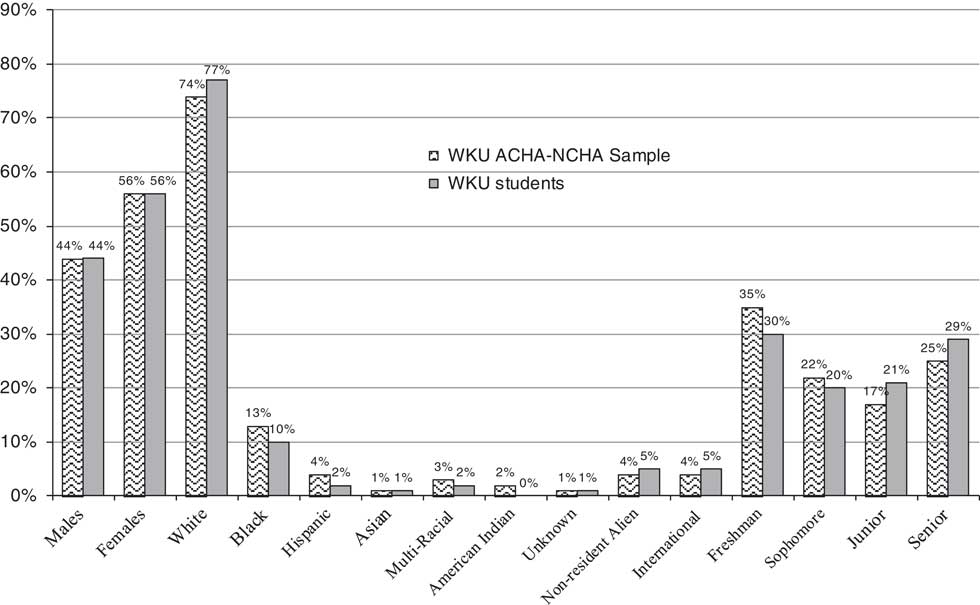
The classroom-administered paper-based survey uses a stratified random sampling of all required upper-division undergraduate-level courses of each major discipline. It is also representative of the student population (Figure 1). The primary purpose of the survey is to collect data on students’ health habits, behaviours and perceptions for the purpose of health promotion in higher education and ultimately student success. Each survey contains questions that gauge smoking habits with respect to cigarettes, cigars, hookah or water pipe, marijuana, as well as other tobacco products such as smokeless tobacco. Information is also collected on academic performance and indicators of general health.
Undergraduate student demographics (2013/2014) – American College Health Association-National College Health Assessment (ACHA-NCHA) sample vs Western Kentucky University (WKU). Source: Adapted from Institutional Research, WKU; ACHA-NCHA.

3.1 Smoking and other outcome variables
In each of the survey periods, students were asked about past smoking and other drugs’ behaviour. Specifically, respondents were asked ‘within the last 30 days, on how many days did you use cigarettes, cigars, etc?’. Possible responses were ‘never used’, ‘have used, but not in the last 30 days’, ‘1–2 days’, ‘3–5 days’, ‘6–9 days’, ‘10–19 days’, 20–29 days’ and ‘used daily’. For each category of cigarette, cigar and other drugs, two dichotomous indicators were created as measures of participation: one for ever participated and another for participated only in the past 30 days. For example, if a student has ever smoked cigarette, then the variable takes the value of 1 if he or she indicates ‘have used [cigarettes], but not in the last 30 days’ or if such a person has used cigarettes at least 1 day in the past 30 days. On the other hand, if the student has smoked in the past 30 days, the dummy variable is given the value of 1 for the use of cigarettes at least 1 day in the past 30 days; otherwise, the value of this variable is 0. Following DeCicca et al. (Reference DeCicca, Kenkel, Mathios, Shin and Lim2008), a measure of unconditional demand is also constructed by using the mid-point of each of the above ranges of days during which the student used the substance as follows: a value of 0 indicates that the student did not smoke on a day in the past 30 days or never used cigarettes, while 1.5, 4, 7.5, 14.5, 24.5 and 30.5 represent the average number of days smoked in the past 30 days.Footnote 4
The list of outcome variables also includes perception of students’ participation in and demand for smoking. Our measure of the perception of students’ participation in smoking is based on the following question: ‘Within the last 30 days, what percent of students at your school used [cigarettes or cigars as the case may be]: State your best estimate’. We assess the perception of students’ demand for smoking from the question, which asked ‘Within the last 30 days, how often do you think the typical student at your school used [cigarettes, cigars]: (State your best estimate…)’. In a fashion similar to DeCicca et al. (Reference DeCicca, Kenkel, Mathios, Shin and Lim2008), we create a variable to take the value of 0 if the respondent thinks a typical student may have smoked, but not in the last 30 days; the mid-point value for each of the following estimated range of the number of days a typical student may have used cigarettes/cigars: 1–2 days, 3–5 days, 6–9 days, 10–19 days, 20–29 days; and a value of 30.5 for those students who are perceived to have smoked daily.
This measure is important for outcomes such as cigarette smoking where it is well known that survey respondents are more likely to under-report the true extent of their smoking (Hatziandreu et al., Reference Hatziandreu, Pierce, Fiore, Grise, Novotny and Davis1989; Wasserman et al., Reference Wasserman, Manning, Newhouse and Winkler1991). In addition to information on smoking and tobacco products, the survey contains other important outcomes such as academic performance (cumulative and term GPA) and being ‘healthy’, which takes the value of 1 if the student’s self-assessed health is excellent, very good or good, and 0 if otherwise. Data on e-cigarettes are excluded in the cigarette smoking outcomes, since this information was first collected in spring 2016 and the resolution supporting smoking in designated areas on campus does not apply to e-cigarettes.
3.2 Control variables
The WKU ACHA-NCHA provides standard individual-level socio-economic and demographic characteristics to create independent variables that are important correlates of youth smoking behaviour. Our included covariates are designed to be strictly exogenous since any variable that is highly correlated with the policy and smoking may induce bias in the estimates. These variables include age, age squared, dichotomous variables for gender (female), race (Black, Asian, Native American, Bi-racial, other race), ethnicity (Hispanic of any race), on campus residence, membership in a Greek-letter organisation, employed, student classification (freshman, sophomore, junior), health knowledge and self-described overweight, and continuous variables for depression index and the number of drinks consumed when partying or socialising.Footnote 5
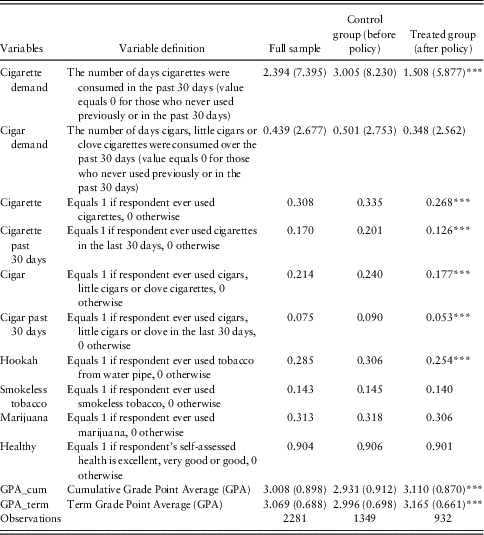
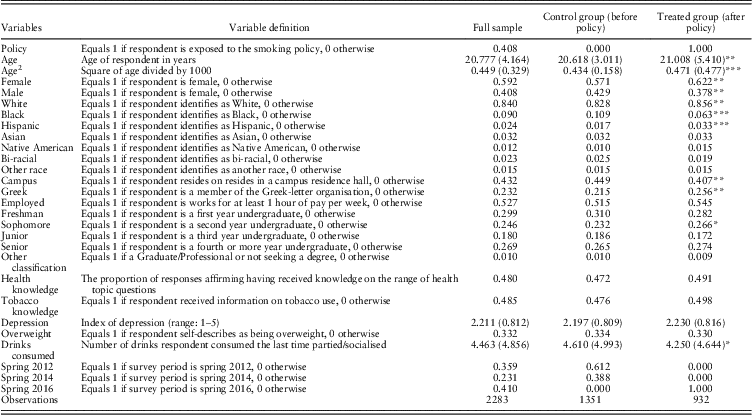
After excluding data with missing cases, the sample is reduced to approximately 2283 students, with 932 of them being exposed to the smoking policy. The sample is defined and summarised for all students, as well as for students pre- and post-policy according to outcome variables (Table 1) and covariates (Table 2). If the means are statistically different before and after policy, at least one asterisk (*) is placed next to it. With respect to the outcome variables, students spend fewer days on average consuming cigarettes after the policy was introduced. Additionally, students are less likely to participate in smoking cigarette, cigars and hookah. They are also likely to have higher term and cumulative GPAs since the policy began. In terms of the explanatory variables, students who are exposed to the policy are older on average and more likely to be females, white and non-Hispanic. Since the policy began, students are less likely to live on campus but more likely to be part of Greek-letter organisations and sophomores. Students’ consumption of alcohol since the policy began also significantly declined.
Means of dependent variables on smoking, health and academic outcomes before and after smoking policy

Note: Standard deviations in parentheses.
Significance level *** indicates statistically significant difference from the mean value in the pre-policy period at p<0.1, p<0.05 and p<0.01, respectively.
Means of control variables before and after smoking policy

Note: Standard deviations in parentheses.
Significance levels *, ** and *** indicate statistically significant difference from the mean value in the pre-policy period at p<0.1, p<0.05 and p<0.01, respectively.
3.3 Empirical strategy
In assessing the effects of a university smoking policy on smoking behaviour, health and academic outcomes, we estimate variants of the equation:
 $$Y_{{it}} \;{\equals}\;\beta _{0} {\plus}\beta _{1} \,Policy_{t} {\plus}{\bf{X}} _{{it}} \Omega {\plus}{\mib {\varepsilon}} _{{it,}} $$
where subscripts denote individual i in time period t. The variable Y it denotes one of several smoking behaviours, as well as health and academic outcomes, as described above. Policy t , our key variable of interest, is a dichotomous variable that equals 1 if a smoking policy is in place in survey period t, and 0 otherwise. Since the resolution to support a limited smoking campus was passed in 2015, Policy t takes the value of 1 for spring 2016 and 0 for previous periods (namely, 2012 and 2014) in the sample. We consider those who are surveyed in 2016 as the treatment group. Since the policy was implemented in 2015, those who are surveyed in 2012 and 2014 comprise the control group as they were never exposed to the programme at the time. From the full sample of approximately 2281 respondents, about 60%, or a total of 1349, came from the control group while the remaining 932 constitute the treatment group.
For the outcome variables, the coefficient β 1 measures the impact of the policy on smoking (e.g. cigarette and cigars) participation, as well as the average change in the amount of cigarettes and cigars smoked in the past 30 days. The coefficient also captures the impact on self-assessed health and student academic outcomes since the introduction of the policy. The vector of controls (X it ) comprises observable individual and socio-economic characteristics that are associated with a penchant for smoking as described above.
There are a number of empirical challenges in estimating the impact of a smoking policy on smoking behaviour, as well as health and academic outcomes. For instance, an important identifying assumption of equation (1) is that minus the limited smoking policy, there should be no differences in smoking behaviour and other outcomes for those exposed to the policy and the other students (i.e. β 1=0). It further assumes the absence of other policies being implemented around the same time and which may have had a similar impact on the outcomes of interest. Also, as part of our robustness exercise, results of a placebo test are presented, in which the policy is switched to a period where it never occurred. Another econometric concern is the potential for the policy to be highly correlated with other variables in the model, resulting in spurious results. Results from the variance inflation factor show no evidence of strong collinearity in the observable measures in the model. This result suggests that multicollinearity is not a problem in the model estimation.
Other identification issues may be encountered in investigating a causal effect of the policy on smoking and other outcomes related to smoking behaviour. Given the quasi-experimental design of our difference-in-difference strategy, an important concern is the possibility of biased results arising from omitted variables and unobserved heterogeneity. We attempt to control for omitted variable bias by directly controlling for factors, such as whether an individual has received health knowledge of any form from the university, and show that our results are robust after excluding those students who have received some form of health information. Even then, failure to properly account for important characteristics related the outcome and the policy can result in biased estimates in ordinary least squares (OLS) regression. An alternative estimation procedure that can address endogeneity due to unobserved characteristics is instrumental variables method, which requires finding at least one instrument that is highly correlated with the smoking policy but does not have a direct effect on students’ smoking behaviour, health and academic outcomes. An effective instrumental variable strategy often requires finding a range of policy-related variables with significant variation. Given the cross-sectional nature of the data, this is empirically challenging. One useful alternative strategy that may not suffer from these limitations is PSM, which is described below.
3.4 PSM
PSM methods, attributable to the seminal work of Rosenbaum and Rubin (Reference Rosenbaum and Rubin1983), are designed to create subsets or blocks of similar individuals based on a set of pre-treatment characteristics. Within each block, there are two groups comprising the treatment (those students who were exposed to the smoking policy) and a control (students who were not exposed to the policy). In traditional PSM techniques, each observation in the treatment unit is matched with at least one observation in the untreated or control group. The differences in outcomes between both groups are calculated for each block and then averaged to obtain an overall effect attributable to the treatment (smoking policy). This average is called the Average Treatment Effect on the Treated (ATT). There are two key advantages to using PSM over standard regression techniques. First, PSM is non-parametric in nature and therefore requires no specific functional form of the model; second, PSM relaxes the assumption of homogeneity in treatment across the two groups (Dehejia and Wahba, Reference Dehejia and Wahba1999; Zhao, Reference Zhao2005).
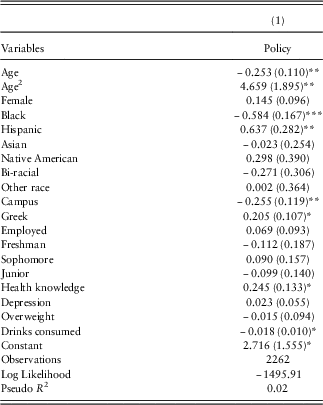
To obtain the ATT, we first obtain propensity scores defined as the probability of receiving treatment conditional on a set of pre-treatment covariates. That is, p(X)≡Pr(Policy=1 | X), where p(X) is the propensity score and Policy and X are as defined in equation (1). The propensity scores, which are obtained from a logit regression on a fairly large number of covariates, can be used to calculate the ATT as follows:
 $$\eqalignno{ & E\left\{ {Y_{i} {\equals}0, \,Y_{i} {\equals}1\,\mid\,Policy{\equals}1} \right\} \cr & {\equals}E\,[E\{ Y_{i} {\equals}0, \,Y_{i} {\equals}1\,\mid\,Policy{\equals}1,\,p\left( {\rm X} \right)\} {\rm }] \cr & {\equals}E[E\{ Y_{i} {\equals}1\,\mid\,Policy{\equals}1,p\left( {\rm X} \right)\} {\minus}E\{ Y_{i} {\equals}0\,\mid\,Policy{\equals}0,\,p\left( {\rm X} \right)\} \,\mid\,Policy{\equals}1], $$
where Y i is outcome already defined earlier and E is expectation. Both the PSM and the ATT rely on two main assumptions: (1) the assumptions of unconfoundedness (conditional independence), where the assignment to treatment is independent of the outcomes, given the covariates (i.e. Y i=0, Y i=1 ⊥ Policy=1, X), and (2) balancing, where observations with same propensity score follow the same distribution of observable and unobservable covariates independent of treatment status [i.e. Policy ⊥ X | p(X)]. To ensure that each treatment unit is matched to at least one corresponding control, there must be a common support that implies that the probability of assignment is bounded between 0 and 1, 0< Pr(Policy=1 | X) <1.
We employ several methods that can be used to evaluate the ATT through the matching process. Each of these matching algorithms possesses unique advantages (Mocan and Tekin, Reference Mocan and Tekin2006). Further, within finite samples there is a trade-off between quality (the efficiency of the estimates) and quantity (the extent of biasness in the estimates). In order to properly evaluate the robustness of the matching estimates, consideration is given to several matching algorithms. The following commonly employed matching algorithms were used: variants of the nearest neighbour matching method, caliper matching and radius matching with a caliper and local linear regression and kernel matching, the latter two being non-parametric in nature. Dehejia and Wahba (Reference Dehejia and Wahba2002) and Mocan and Tekin (Reference Mocan and Tekin2006) provide excellent discussions on the various methods.
4 Results
4.1 Estimates of the smoking policy effect on smoking participation
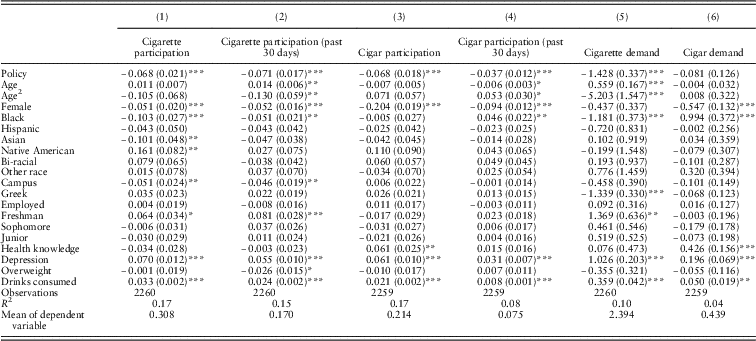
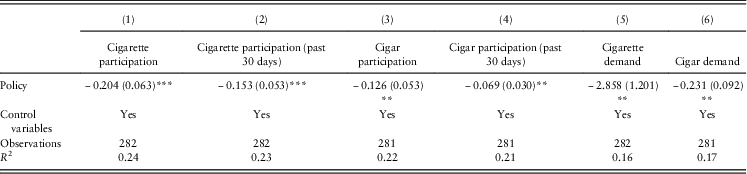
We assess the impact of the smoking policy on smoking (cigarette and cigars) participation. Estimates of linear probability models are reported for ease of interpretation. Two specifications are shown for each type of smoking participation: whether the student has ever smoked (cigarette and cigars) and whether they have smoked in the past 30 days. Table 3 (columns 1–4) presents the results from models of smoking participation as a function of the policy without covariates, while Table 4 includes all control variables. Based on these results, the policy is associated with a statistically significant decline in smoking participation (separately for cigarettes and cigars) in both specifications. Focussing on the results in Table 4, OLS analyses indicate that the smoking participation declined by between 22% (0.068 percentage points) and 42% (0.071 percentage points) for cigarettes and decreased in the range of 32% (0.068 percentage points) to 49% (0.037 percentage points) for cigars.Footnote 6
The impact of policy on smoking variables (ordinary least squares results) (no control variables)

Notes: Robust standard errors in parentheses.
Statistical level of significance is as follows: *** indicates p<0.01.
The impact of policy on smoking variables (ordinary least squares results)

Notes: Regressions include dummy variables for each survey period. Constant term not reported.
Robust standard errors in parentheses.
Statistical levels of significance are as follows: * indicates p<0.1, ** indicates p<0.05 and *** indicates p<0.01.
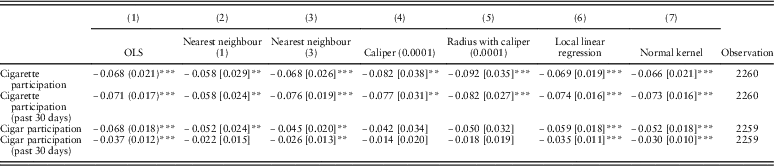
Table 5 presents the PSM estimates that control for possible endogeneity due to selection on unobservables. Columns 2–7 present the estimates of the ATT that emerge from the various matching methods described earlier. Columns 2 and 3 depict the estimates obtained from the nearest neighbour matching using 1 and 3 nearest neighbour, respectively. Column 4 displays the estimates from caliper matching with a caliper of 0.0001; column 5 presents radius matching with a caliper of 0.0001; and columns 6 and 7 give estimates from the non-parametric techniques associated with local linear regression and kernel matching. The regressions include the number of observations on the common support for the PSM estimates. Column 1 of Table 5 shows the OLS results for the purposes of comparison.
The impact of policy on smoking variables (propensity score matching results)

Notes: Ordinary least squares (OLS) results with standard errors in (parentheses) are shown for comparison. Bootstrapped standard errors with 500 replications are shown in [brackets].
Each column reports the matching estimator with a different algorithm as follows: column (2) nearest neighbour matching using one nearest neighbour, column (3) nearest neighbour matching using three nearest neighbours, column (4) caliper matching with a caliper of 0.0001, column (5) radius matching with a caliper of 0.0001, column (6) Local Linear Regression and column (7) kernel matching using normal density.
Statistical levels of significance are as follows: **indicates p<0.05 and ***indicates p<0.01.
With respect to both specifications of cigarette participation, the PSM results confirm the effect of the policy on smoking participation. The decline in cigarette smoking participation attributable to the policy is as large as 30% (0.092 percentage points). In terms of the cigar participation outcomes, the effect of the policy is negative throughout and significant for most of the matching algorithms. Further, the policy has reduced the propensity to use cigars by as much as 28% (0.059 percentage points).
The finding that the policy decreases the propensity to smoke is not without precedence. A study by Wasserman et al. (Reference Wasserman, Manning, Newhouse and Winkler1991), examining the effects of some of the most comprehensive smoking restrictions, showed that overall cigarette consumption by teenagers declined by over 40% – almost twice our most conservative estimate.
4.2 Estimates of the smoking policy effect on smoking demand
Columns 5 and 6 (Tables 3 and 4) present results of estimates of unconditional demand for cigarettes and cigars.Footnote 7 As in the models of smoking participation, the policy impact is negative, although only significant in the case of cigarettes. In the model specification with covariates, students are smoking about 1 day fewer in the past 30 days since the introduction of the policy.
4.3 Estimates of the smoking policy effect on health and academic outcomes
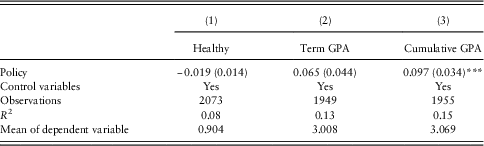
Table 6 presents results of the effect of the policy on self-assessed health and academic outcomes. Our measure of health is a dichotomous variable indicating whether the student self-assessed health is excellent, very good or good, while the cumulative/term GPAs represent the two measures of academic performance. In general, the OLS results indicate that there is no impact of the policy on the student’s state of feeling healthy. This result is consistent with the lack of relationship between smoking bans and general well-being (Odermatt and Stutzer, Reference Odermatt and Stutzer2015). On the other hand, the introduction of the smoking policy is associated with a 3.2% improvement in students overall academic outcomes as measured by cumulative GPA. This is suggestive of the effect of the policy in combatting the adverse cognitive impact of smoking (Marie and Zölitz, Reference Marie and Zölitz2015).
The impact of policy on health and academic outcomes (ordinary least squares results)

Notes: GPA=grade point averages.
Robust standard errors in parentheses.
Regressions include control variables as used in Table 3, as well as dummy variables for each survey period. Constant terms are not reported.
Statistical level of significance is as follows: ***indicates p<0.01.
4.4 Sensitivity analysis
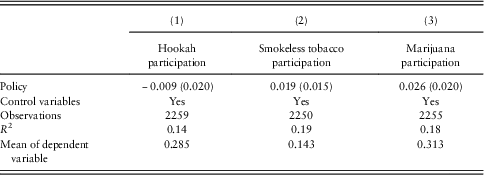
The following robustness exercises are intended to provide additional support to the identification strategy. In Table 7, the effect of the policy on other tobacco and smoking outcomes, namely participation in hookah, smokeless tobacco and marijuana, is shown. As the limited policy includes the smoking of tobacco products only, in general, it is expected to have no impact on these other outcomes. In our results, we find this to be the case.
The impact of policy on other smoking outcomes (ordinary least squares results)

Notes: Robust standard errors in parentheses.
Regressions include control variables as used in Table 3, as well as dummy variables for each survey period. Constant terms are not reported.
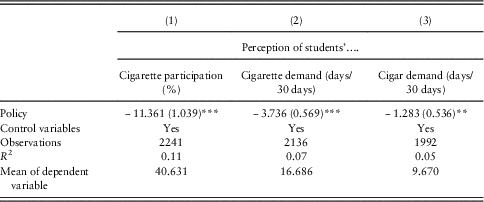
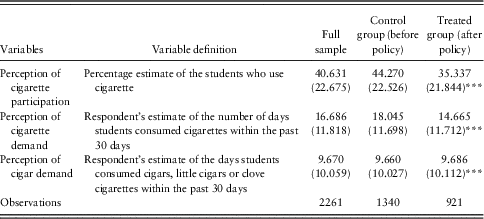
Next, the relationship between the policy and students’ perceptions of smoking participation (in the case of cigarette) and demand is examined. Students’ perception of smoking has been closely linked to actual smoking behaviour (Seo et al., Reference Seo, Macy, Torabi and Middlestadt2011). Therefore, if the policy has led to a decrease in students’ perception of smoking participation and demand, it can be inferred that it also reduced actual smoking behaviour. Table 8 confirms that the policy has had a negative influence on students’ perceptions of peer smoking activities.
The impact of policy on perception of cigarette and cigar smoking (ordinary least squares results)

Notes: Robust standard errors in parentheses.
Regressions include control variables as used in Table 3, as well as dummy variables for each survey period. Constant terms are not reported.
Statistical levels of significance are as follows: **indicates p<0.05 and ***indicates p<0.01.
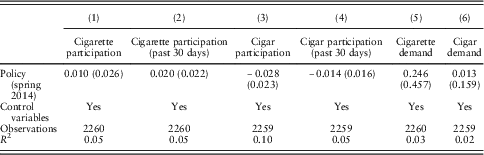
Despite the consistent finding that the smoking policy is decreasing smoking behaviour, it is possible for the estimates to be sensitive to policies or programmes related to smoking, as well as other non-policy impacts. In Table 9, results are presented from a falsification exercise, which tests for a possible non-policy-related impact on student smoking behaviour by using the time period prior to the policy intervention. Specifically, we created a ‘false treatment’ policy variable equalling 1 for spring 2014 and 0 otherwise. The coefficients on this placebo variable are small and statistically insignificant in all of the outcomes. This provides support that we are unlikely to be picking up some period-specific effect unrelated to the policy.
Placebo test – impact of a ‘false’ policy on smoking variables (ordinary least squares results)

Notes: Robust standard errors in parentheses.
Regressions include control variables comprising age, gender, race and ethnicity, residence on campus, membership in a Greek organisation, as well as dummy variables for each survey period. Constant terms are not reported.
Finally, we consider the possibility that some other programme unrelated to the policy may have occurred around the same time. For instance, if the policy variable is a proxy for an increase in anti-smoking information dissemination, then a causal interpretation is invalid. We include a health knowledge index, which measures the percentage of responses indicating having received information from the university on any of a range of topics. Any student receiving any form of health information is excluded from the sample entirely. According to Table 10, the results are robust to this exclusion, so it does not appear that any anti-smoking campaign was the driving force.
Impact of policy on smoking variables after excluding those with any health knowledge (ordinary least squares results)

Notes: Robust standard errors in parentheses.
Regressions include control variables as used in Table 3, as well as dummy variables for each survey period. Constant terms are not reported.
Statistical levels of significance are as follows: ** indicates p<0.05 and *** indicates p<0.01.
5 Conclusion
The harmful effects of smoking are well documented in the literature, and smoking among students on college campuses can have negative consequences for smokers and non-smokers as a whole. Although student smoking behaviour on campus can be modified by information dissemination and moral suasion, other tools such as smoking bans have taken on greater importance.
Using a rich representative data set, this paper analyses the impact of a smoking policy on smoking behaviour, health and academic outcomes of students at a mid-sized public university in the southern United States. OLS and PSM were used to control for endogeneity that may be associated with unobservable factors correlated with the policy and the outcomes of interest. The results indicate significant declines in student smoking behaviour (participation and demand) due to the introduction of a smoking policy on campus. Our most conservative estimates show a 22% (30%) decline in smoking participation attributable to the use of cigarettes (cigars). There were also significant declines in smoking demand. Although self-assessed health remains unaffected, we find that the policy increases academic outcomes among students. We also undertake a variety of sensitivity analyses to buttress our identification strategy.
We are unclear of the mechanisms through which the policy alters an individual’s smoking behaviour. The impact may be due to a number of factors such as the barrier or inconvenience caused by significantly reducing the number of designated smoking areas. Additionally, the information flow and the initial lack of clarity regarding the extent of the policy (whether it was smoke-free or tobacco-free) may have influenced students’ smoking behaviour. There is no evidence that other similar policies were being enacted around the same time as the limited smoking on campus policy.
One notable limitation to the analysis is that our results are restricted to the short term. In part, this is due to the cross-sectional nature of the data, but more importantly to the infancy of smoking laws in higher education, the state and more broadly in the United States. It is possible for there to be differential impacts of such a policy in the short term compared to the long term. The impact of smoking laws on university campuses may be large in the long run if a longer adjustment period is required in response to these policies. On the other hand, the short-term effects may be larger if individuals are able to make certain long-run adjustments designed to minimise or even negate the impact of the smoking ban. Such adjustments may include increasing smoking intensity in designated smoking areas and off-campus or resorting (substituting away from cigarettes) to greater use of products such as marijuana and hookah. In the end, the long-term implication of smoking laws on health behaviour on university campuses is an empirical question that deserves future research.
Taken together, these findings have important policy implications for schools, which are considering moving forward in instituting comprehensive smoking bans on college campuses. The estimated effects and the changes in smoking behaviour along with the inferred impact on student achievement ought to be seriously taken into consideration amidst the contentious debates on the (de)merits of such policies.
Acknowledgements
The authors thank participants at the London School of Economics Health & Social Care inaugural International Health Policy Conference, the editor and an anonymous referee for numerous useful comments and suggestions. There is no conflict of interest to disclose and all views expressed, errors and omissions are the authors’ own.