Is women's chronic minority status worldwide explained by a lack of women wishing to stand for political office or by party selectors’ disinterest in selecting women candidates? This debate continues among gender politics scholars; however, an increasing number of studies highlight the need to further investigate how the demands of party selectors might shape the supply of women candidates, especially in strong parliamentary democracies where political parties are the key gatekeepers (Kenny Reference Kenny2013; Murray Reference Murray2010). This concern was already present in Norris and Lovenduski's (Reference Norris and Lovenduski1995) original model, which called for a deeper examination of the “interaction effects” between “supply” and “demand.” In engaging with this call, I argue that the constraining effects of supply are reinforced not only by the demands of party selectors, but also by the everyday (gendered) functioning of political parties, which helps us understand the differential chances of women and men eventually becoming candidates.
POLITICAL PARTIES IN THE SPOTLIGHT
In strong parliamentary democracies, party service is usually an eligibility criterion to become a candidate for elective office, as generous public funding of electoral campaigns renders personal financial resources rather irrelevant. Not only are independent candidacies rare, but aspirants cannot just seek party endorsement for their candidacy. All aspirants must navigate through the internal party selection process, which may be more or less centralized and more or less exclusive (Hazan and Rahat Reference Hazan and Rahat2010). The bulk of candidates are party members, although nonpartisan candidates may be directly recruited by the party leadership. Therefore, at the earliest stage of the ladder of political recruitment, “supply” generally starts with eligible candidates becoming (or already being) party members. From the point of application onward, “demand” is considered to predominate (Lovenduski Reference Lovenduski2005, 64). The gendered formal and informal criteria underlying the preferences and expectations of party selectors around the qualities candidates should have, including party service, often result in direct or indirect discrimination against women and other groups of candidates.
Building on my previous research on gender and political parties (Verge Reference Verge2009; Verge and de la Fuente Reference Verge and de la Fuente2014) and drawing on examples from other studies, I argue that demand is already in motion through the ways in which everyday party politics is structured. When studying political recruitment, we often come across a broad array of examples of gendered norms and practices beyond the recruitment process, but we rarely discuss how this may push women out of party politics and deter them from applying for either party or public office. Given that participation in political parties is entrenched in a web of gendered structures and institutions (Lovenduski and Norris Reference Lovenduski and Norris1993), gender differences in aspirations to compete for public office might well be shaped by gendered patterns of participation in the party organization. Masculinity dominates personnel, procedures, and policies, making political parties “institutionally sexist” organizations (Lovenduski Reference Lovenduski2005, 52). Some studies have exposed that the party organization produces gender-related behavior and roles among activists (Fowlkes, Perkins, and Tolleson Rinehart Reference Fowlkes, Perkins and Rinehart1979; Jennings and Farah Reference Jennings and Farah1981), while others have unveiled how intraparty institutionalized masculinity empowers men and disempowers women (Verge and de la Fuente Reference Verge and de la Fuente2014).
FEEDBACK EFFECTS AND DOUBLE BINDS
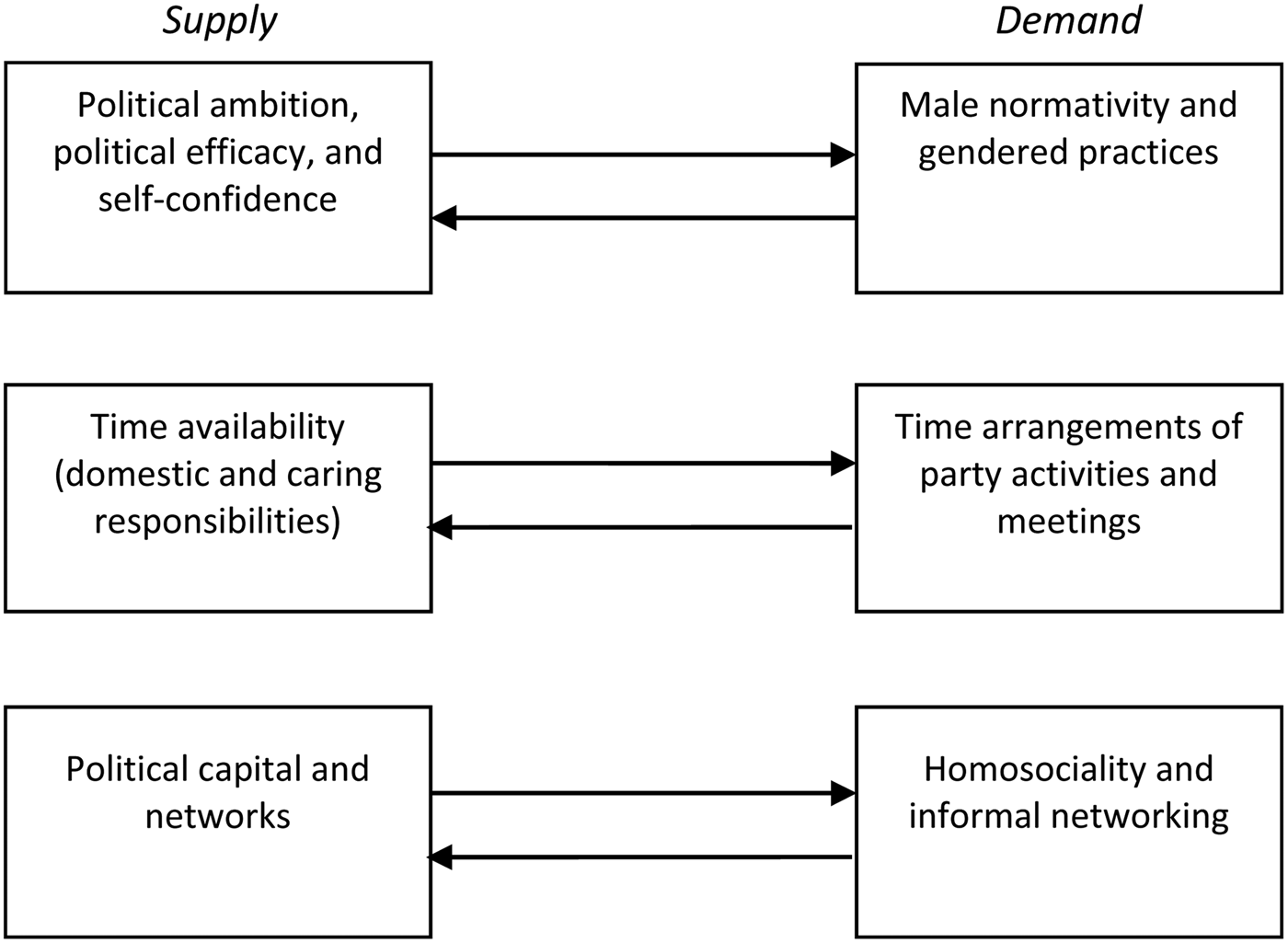
Women's underrepresentation begins to occur at the first stage of the ladder of political recruitment, namely the transition from party members to (eligible) aspirants, due to the numerous interactions between supply and demand factors found in the everyday operation of political parties. A broad array of gendered norms and practices sustain parties’ gender regimes by accommodating and reinforcing existing social ideologies of gender and arrangements between the sexes. This yields several double binds for female party members—that is, women often face a restricted set of options, all of which yield undesirable effects for their chances of career advancement in politics. Figure 1 clusters the most relevant feedback effects into three groups, which are discussed in detail below.
Feedback effects in political party participation.
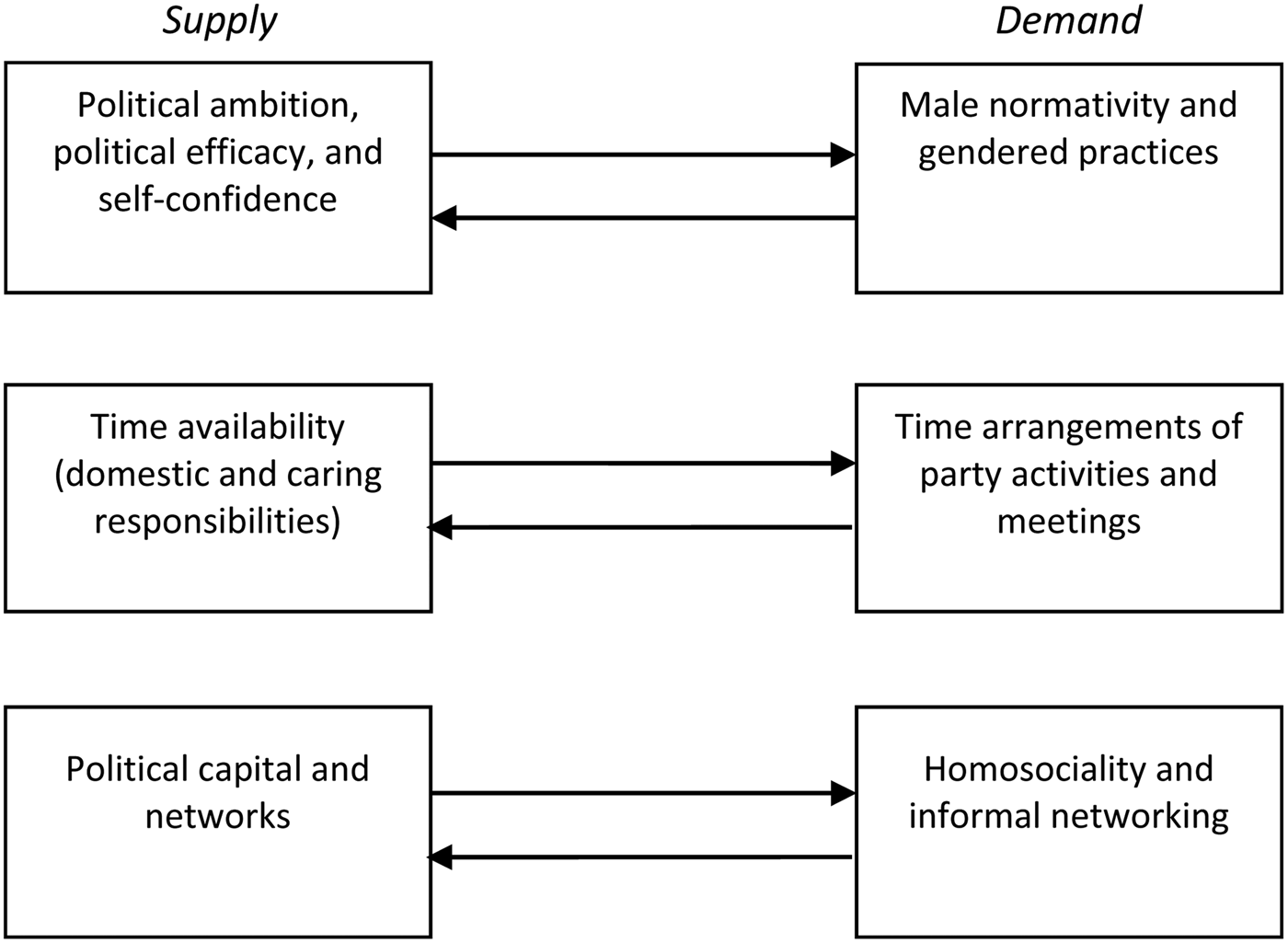
Firstly, gendered social ideologies view speaking assertively, displaying authoritative leadership styles, or showing overt ambition as inappropriate for women (Norris and Lovenduski Reference Norris and Lovenduski1995), but the behavior and skills most valued to qualify for party or elective office are those commonly displayed by men, such as forceful assertiveness, competitiveness, ambition, and adversarial styles of debate (Lovenduski Reference Lovenduski2005, 53). This double bind means women cannot simultaneously fit into social and party norms. Indeed, gendered informal sanctions may be imposed on women displaying such traits, as the latter are generally seen as positive when found in men but not in women (Kenny Reference Kenny2013). Likewise, women's performance in party office carries the burden of doubt and is often subject to “super-surveillance,” as found in parliamentary arenas (Puwar Reference Puwar2004). Therefore, while women's levels of political efficacy, ambition, and self-confidence tend to be lower than men's (Lawless and Fox Reference Lawless and Fox2005), not “meeting” the male norm(s) further plummets their confidence since alternative leadership styles are not recognized as valuable (Verge and de la Fuente Reference Verge2014, 71).
Positional power in party executive bodies can also pave the way for a political career in public office. The gendered division of labor in the distribution of party offices (Jennings and Farah Reference Jennings and Farah1981), though, yields an asymmetric disposition of resources and of visibility and influence. Both high-level offices such as the top positions in the party leadership (vertical segregation) and the most valued portfolios within party executive bodies (horizontal segregation) are still largely occupied by men, such as organizational matters, political strategies, and campaigning (Verge Reference Verge2009). Hence, focusing on women's and social issues in party work—thus substantively representing women—deprives women from recognition and provides them with fewer opportunities to develop successful political careers, a double bind similarly observed in parliamentary settings (Franceschet, Krook, and Piscopo Reference Franceschet, Krook, Piscopo, Franceschet, Krook and Piscopo2012, 238).
The functioning of party meetings is also founded on exclusionary practices that reflect an entrenched institutional masculinity in party service. For example, women's participation is discouraged by several gendered rituals, including glossing over women's contributions or repetitive interventions by male participants who reference each other, even when building on points initially raised by a woman. Besides making the meetings unnecessarily much longer, these performative rituals ensure that men are conversationally dominant even in gender-balanced party executive bodies (Verge and de la Fuente Reference Verge and de la Fuente2014, 72). While women often perform labor intensive roles or routine functions (Fowlkes, Perkins and Tolleson-Rinehart Reference Fowlkes, Perkins and Rinehart1979, 777), such as taking the minutes and monitoring the implementation of decisions in between meetings, the work carried out by women in “feminine” portfolios usually receives scarce attention in party meetings. Consequently, many women feel that both their work and contributions are irrelevant (or, in any case, less relevant than men's), which may negatively affect their sense of political efficacy and self-confidence and may induce them to resign from party office.
Second, political parties organize their activities with little regard for women's specific needs. Lower time availability—due to the unequal distribution of housework and caring responsibilities—is coupled with an androcentric use of time within political parties that constrains women's engagement. The prevailing intensive dedication norm with regard to party service (i.e., actively contributing to party activities such as campaigning and canvassing, holding party office, or organizing and attending multiple party events and meetings), especially when candidacy is sought, and the tendency to hold meetings in the late evenings may provoke in women a feeling of guilt for spending hours on party politics at the expense of family time, an experience with no parallel for most men. Many women might thus avoid assuming party positions or give up on demanding more resources for the positions they hold, thereby renouncing the desire to possess influence and to eventually qualify as aspirants to elective office (Verge and de la Fuente Reference Verge and de la Fuente2014, 71). Hence women party members confront another double bind: if they put long hours into party work, social gender norms regarding care responsibilities are violated; if they do not, their party service may not be visible enough to qualify as candidates.
Third, informal practices of party decision making usually take place after the already late formal meetings are over and thus contribute to sustaining male dominance. Following up discussions on political decisions and strategies at nightly hours in bars or restaurants reflects “male schedules and wifely or maternal supports” (Franceschet Reference Franceschet2005, 90). This informal networking is carried out basically by men and, as such, builds on as well as produces “homosocial capital” (Bjarnegård Reference Bjarnegård2013, 24; Bjarnegård and Kenny in this volume). This form of men's complicity is never put into question nor considered political, although it has a prominent role in parties’ decision making and in the building of support when aspirants decide to run for office (Verge and de la Fuente Reference Verge2014, 76). Thus, lack of family-friendly arrangements in the ways parties organize their schedules for party meetings and activities and informal (male) networking strongly demotivate women's political engagement and depress their political capital.
CONCLUSION
The gendered micropolitics of political participation within parties shape the broader institutional dynamics of political recruitment. Specifically, the interactions between supply and demand extend well before the point of application by would-be aspirants, and their feedback effects mutually reinforce men's advantage and women's disadvantage in the very same ways parties organize. The nontrivial ways in which women's choices and their capacity to act are constrained in party politics, either intentionally or routinely, suggest that women are still conceived of as “space invaders” (Puwar Reference Puwar2004). The individual fulfilling the “ideal” party member traits, behavior, and participation repertoires that provide more credentials in the recruitment process is by definition a man—the man. We can conclude then that parties’ gender regime molds candidate recruitment; that is, demand makes its own supply of aspirants among party members. Therefore, the feminization of politics must urgently start with the regendering of the everyday functioning of political parties.