Introduction
Bone- and joint-related illnesses (e.g. arthritis, joint and back pain) are growing public health problems (Mili, Helmick and Zack Reference Mili, Helmick and Zack2002). The prevalence of these conditions rises with age (Oliver and Hill Reference Oliver and Hill2005), with people from both high-income and low-income countries being affected (Center for Diseases Control and Prevention (CDC) 2000). In Bangladesh, bone- and joint-related illnesses are commonly reported health problems in old age (Rana et al. Reference Rana, Lundborg, Wahlin, Ahmed and Kabir2008; Kabir et al. Reference Kabir, Tishelman, Agüero-Torres, Chowdhury, Winblad and Höjer2003; Mostafa and Streatfield Reference Mostafa, Streatfield and Kabir2003). In the United States (US), well over one-half of elderly people report chronic joint symptoms (Leveille Reference Leveille2004). Although bone and joint diseases seldom cause death, they have a significant impact on health and health-related quality of life (CDC 2000; Kosinski et al. Reference Kosinski, Kujawaski, Martin, Wanke, Buatti, Ware and Perfetto2002), impair functional ability, limit mobility and cause disability (Mili, Helmick and Zack Reference Mili, Helmick and Zack2002). These conditions place a significant burden on health-care and social-care systems (Woolf and Pfleger Reference Woolf and Pfleger2003); in Australia, treating musculoskeletal disorders ranks third among disease groups as the reason for health-services expenditure (Brooks and Hart Reference Brooks and Hart2000). The World Health Organisation (WHO) has endorsed these medical conditions as a public health problem and declared 2000–10 as the ‘Bone and Joint Decade’, with the aims of raising awareness, promoting prevention, empowering people in the management of bone and joint diseases through education campaigns, and stimulating research into better health care and ways of reducing the burden of bone and joint diseases (Hazes and Woolf Reference Hazes and Woolf2000).
Quality of life is a subjective and complex concept which is experienced differently by individuals. WHO defines ‘quality of life as an individual's perception of his/her position in life, in the context of the culture and value systems in which he/she lives and in relation to goals, expectations, standards and concerns’ (WHOQOL Group 1998). Further, health-related quality of life (HRQoL) is defined to comprise those aspects of quality of life that are affected by health, both physical and mental (Rapley Reference Rapley2003). HRQoL is a holistic approach for assessing individual wellbeing and has multiple domains, including physical, psychological, social, spiritual, economic, environmental and other dimensions. Over the last few decades, the assessment of HRQoL has been widely adopted as an outcome measure in health-care research and various assessment instruments are available (Hickey et al. Reference Hickey, Barker, McGee and O'Boyle2005). Research has suggested that the measure usefully contributes to the assessment of both the health of individuals and their health-care needs (Nordenfelt Reference Nordenfelt1991).
The fact that more and more people entering old age have chronic conditions underscores the point that assessing quality of life makes an important contribution to understanding the impact of health problems (Hickey et al. Reference Hickey, Barker, McGee and O'Boyle2005). Beyond the impact of ill health, it is of interest to examine the relationships between self-reported health and HRQoL. Self-reported health is not only related to verified health outcomes including specific diseases (Kempen et al. Reference Kempen, Ormel, Brilman and Relyveld1997), but ratings are also known to reflect other aspects of human ageing, such as attitudes and beliefs about health, social roles, activities and emotional wellbeing (Benyamini et al. Reference Benyamini, Idler, Leventhal and Leventhal2000; Idler, Hudson and Leventhal Reference Idler, Hudson and Leventhal1999). Thus, there is reason to believe that although HRQoL is associated with diagnosed conditions, it is more generally associated with self-reported health and other dimensions of HRQoL. Besides, it is of interest to examine whether the association of bone and joint diseases with HRQoL differs for men and women.
Although some research in high income countries has examined the association of chronic conditions with HRQoL (Alonso et al. Reference Alonso, Ferrer, Gandek, Ware, Aaronson, Mosconi, Rasmussen, Bullinger, Fukuhara, Kaasa and Leplège2004), such evidence is not available for low-income countries. To our knowledge, this is the first population-based study to examine the association of bone and joint diseases with HRQoL among older people in Bangladesh. Bangladesh is a low-income country where 36 per cent of the population lives on less than one US dollar per day (World Bank 2006). The country has a total population of 144 million (Population Reference Bureau 2005) living in 147,570 square kilometres (Bangladesh Bureau of Statistics 2004), resulting in one of the highest population densities in the world (976 persons/km2). The population aged 60 or more years is currently nearly 8.5 million. A high prevalence of different illnesses and co-morbidity are common features in the age group (Kabir et al. Reference Kabir, Tishelman, Agüero-Torres, Chowdhury, Winblad and Höjer2003; Ahmed et al. Reference Ahmed, Tomson, Petzold and Kabir2005), yet provision of formal health care is sub-optimal (HelpAge International 2000). The co-residence of older people with adult children is common in both rural and urban areas, irrespective of the economic status of the household (Kabir, Szebehely and Tishelman Reference Kabir, Szebehely and Tishelman2002). However, inadequate economic security and formal health-care services result in many older people being vulnerable (HelpAge International 2000).
This study examined whether self-reported and doctor-diagnosed bone and joint diseases are associated with HRQoL and its various dimensions among older people in rural Bangladesh. It also investigated disparities in the associations between doctor-diagnosed and self-reported conditions as well as differences by gender. To achieve these aims, we used data collected by the Poverty and Health in Ageing (PHA) project, a population-based study of elderly people in rural Bangladesh (Kabir et al. Reference Kabir, Ferdous, Cederholm, Khanam, Streatfield and Wahlin2006).
Materials and methods
Study design
A cross-sectional study was conducted from July 2003 to March 2004 in the rural area of Matlab, a sub-district 55 kilometres southeast of Dhaka, the capital of Bangladesh. In Matlab, an international research organisation, Knowledge for Lifesaving Solutions, formerly known as the International Centre for Diarrhoeal Disease Research or ICDDR-B, has been running a Demographic Surveillance System (DSS) since 1966. DSS collects information on vital events such as birth, death and migration, as well as certain health-related information, such as illness episodes and contraception use (Young et al. Reference Young, Menken, Williams, Khan and Kuhn2006). For administrative purposes, all the villages in the DSS area were divided into seven blocks. ICDDR-B provides maternal and child health-care services in four of the seven blocks, and the government provides services in the other three blocks. For the PHA study, from the four blocks where ICDDR-B provides the above-mentioned health services, the two with the easiest access for the participants to the health centre (for the clinical examinations) were selected.
Sampling and data collection
The study participants were selected through simple random sampling in the two research blocks. The sample comprised 850 people aged 60 or more years. Of these, 625 were interviewed in their homes, so the non-response rate was 25 per cent. The reasons for non-response included: 93 (11.1%) were unavailable, 63 (7.5%) died between sample selection and data collection, 38 (4.5%) refused to take part, 18 (2.1%) individuals were duplicated in the surveillance database, 11 (1.3%) had migrated to another area, and two (0.2%) people were found to be less than 60 years old. The non-response rate in the clinical examination was 24 per cent. The participants were invited to attend for a clinical examination at a nearby health centre, and 473 attended. The results reported in the present paper are based on a sample of 471 for whom complete information was available. Verbal informed consent was obtained before the data collection. The survey used structured questionnaires that collected data on socio-demographic attributes, aspects of nutrition, morbidity, health-care management and functional ability. Experienced interviewers were recruited and trained before the data collection. Clinical examinations were conducted at two local ICDDR-B health centres by specially trained physicians.
The HRQoL assessment instrument for older people
HRQoL was assessed using a multi-dimensional generic instrument that includes 24 items covering six dimensions, i.e. physical, psychological, social, spiritual, economic and environmental. The instrument was developed because an appropriate instrument for assessing the HRQoL of older people, particularly in low-income countries, is not available. Building from a review of existing generic instruments and relevant qualitative studies in Bangladesh, a new instrument was proposed (Nilsson, Parker and Kabir Reference Nilsson, Parker and Kabir2004). A qualitative study confirmed that the dimensions of HRQoL suggested for assessing older people were appropriate (Nilsson et al. Reference Nilsson, Grafström, Zaman and Kabir2005; Nilsson Reference Nilsson2005). The instrument was constructed under the auspices of Primary Health-Care in Later Life: Improving Services in Bangladesh and Vietnam (PHILL) project, and tested in Bangladesh and Vietnam (Ahmed, Rana and Kabir 2003). Cronbach's alpha score of 0.81 indicated that the instrument has high reliability.
Standardisation of scores
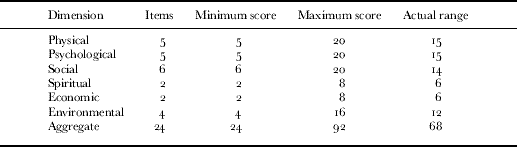
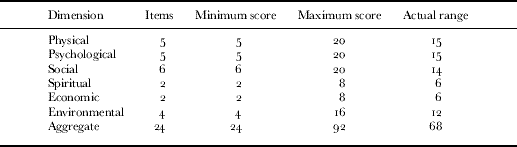
The raw scores used four-point scales (except for two items) from ‘1’ to ‘4’, where lower scores indicated poorer quality-of-life status. The number of items in the dimensions ranged between two and six, giving unequal maximum possible scores for different dimensions (for details, see Table 1). To enable meaningful comparisons of the various dimensions, the aggregate score x for each dimension was standardised to a range from ‘0’ to ‘100’ (Ware et al. Reference Ware, Snow, Kosinki and Gandek1993). Lower scores indicate poorer status. The transformation formula is:

Scoring the six dimensions of the Health-related Quality of Life (HRQoL) measure
The measures
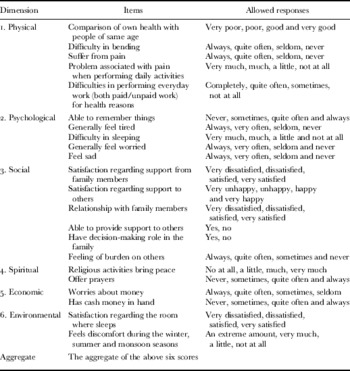
Seven outcome variables for the physical, psychological, social, spiritual, economic and environmental dimensions and the aggregate HRQoL score are examined in this study, as detailed in Table 2. Three independent or predictor variables were designated: doctor-diagnosed arthritis, doctor-diagnosed joint and back pain, and self-reported joint and back pain. Two questions were considered during the clinical examination: Do you have any back pain? and Where is it exactly? To diagnose arthritis, two or three questions were asked: Have you been diagnosed as having arthritis? Do you have painful or stiff joints? and Are your joints ever swollen? The three illnesses were scored as dichotomies, i.e. present or absent.
The seven outcome variables.

The associations between HRQoL and the following socio-demographic indicators were examined: sex (man, woman), age (continuous), educational status (no formal education versus some formal education), marital status (single, currently married), and household size (number of persons in the household); and the associations with the following socio-economic predictors were analysed: self-reported individual income (continuous), per capita household expenditure on food during the day before the interview (continuous); and present occupation (paid work, unpaid work). ‘Single’ marital status included divorced, widow, widower and never-married persons.
The analyses
Bivariate analyses, independent t-tests, and chi-squared tests were used to test for differences between sub-groups. Hierarchical linear regression analyses were run to examine the influence of arthritis, joint and back pain controlling for the socio-demographic and socio-economic indicators. These analyses were performed for each dimension of HRQoL and the overall score. Two hierarchical linear regression analyses were run. In Model 1, doctor-diagnosed medical conditions were first entered followed by the self-reported conditions. In Model 2, self-reported conditions were first entered followed by doctor-diagnosed conditions. The other first order and interaction predictors (the socio-demographic and socio-economic variables, sex by self-reported bone and joint diseases, sex by doctor-diagnosed bone and joint disease, and age by sex) were entered in the same order in both models. The interaction terms between sex and bone and joint diseases were entered because the prevalence of bone- and joint-related conditions is significantly higher among women. The cross-product interaction terms of sex by self-reported bone and joint disease, sex by doctor-diagnosed bone and joint disease, and age by sex, were entered after accounting for the main effects.
Results
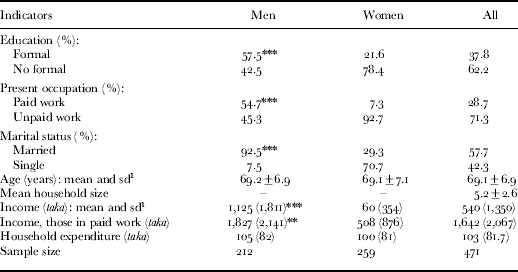
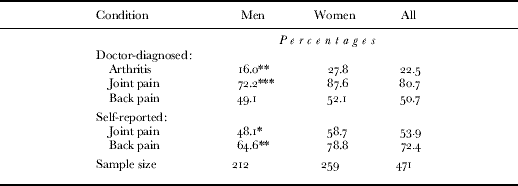
Table 3 shows the socio-demographic and socio-economic attributes of the analysis sample. No significant age differences between men and women were detected, but the shares of men with formal education and in paid work were significantly greater. Moreover, a significantly higher percentage of men were married, and men had significantly higher incomes than women, both overall and when comparing only those in paid work (p<0.01). Table 4 displays the prevalence of bone and joint diseases by sex. According to the doctors' diagnoses, about 23 per cent of the participants suffered from arthritis, and the prevalence of both doctor-diagnosed and self-reported joint and back pain was over 50 per cent. Significantly more women suffered from arthritis, joint pain (both doctor diagnosed and self reported) and self-reported back pain compared to men. No sex differences were detected for doctor-diagnosed back pain.
Socio-demographic characteristics of the study participants
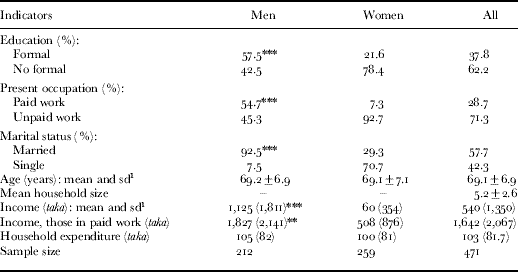
Note: US$1=60 Bangladesh taka in 2003. 1. Mean and standard deviation (sd).
Significance levels: ** p<0.01, *** p<0.001.
Prevalence of arthritis, joint and back pain (doctor-diagnosed), and joint and back pain (self-reported)
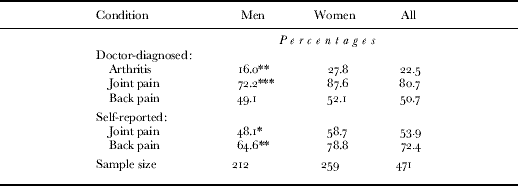
Significance levels:* p<0.05, ** p<0.01, *** p<0.001.
Variations in HRQoL
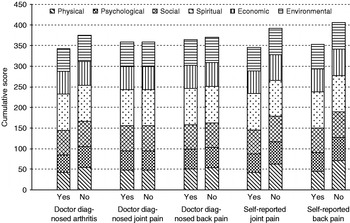
Figure 1 shows that people who suffered from doctor-diagnosed arthritis has significantly lower HRQoL scores than those who did not, particularly in the physical, psychological and environmental dimensions, although no significant differences were noted in the social, economic and spiritual dimensions. Those who suffered from doctor-diagnosed joint pain had significantly lower scores in overall HRQoL, and in all but one of its dimensions (the spiritual). Similar variations were noted for self-reported back and joint pain. Comparisons of mean scores for the different dimensions showed that those who suffered from bone and joint diseases had significantly lower scores in the physical and psychological dimensions of HRQoL.
Health-related quality of life dimension scores among older people by long-term condition, Matlab, Bangladesh, 2003–04.

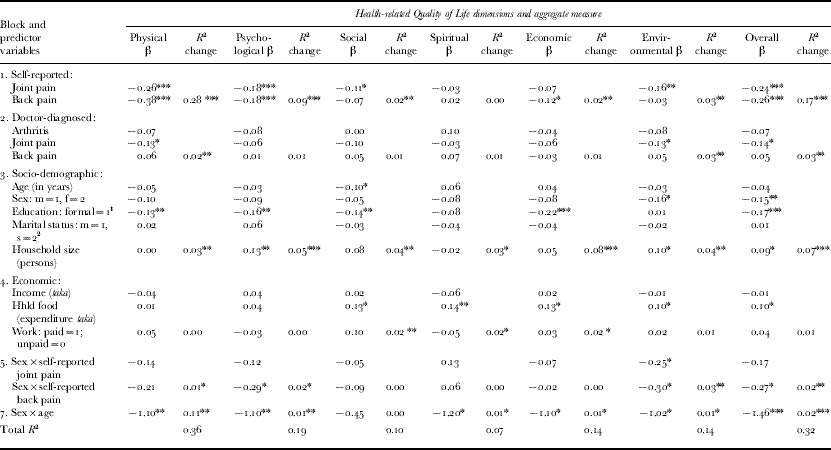
The results of the hierarchical regression analyses can be found in Table 5. The first two blocks of self-reported and doctor-diagnosed pain and arthritis variables accounted for almost 20 per cent of the variation in the overall HRQoL scores. In follow-up analyses, the entry order of blocks 1 and 2 were reversed. When the self-reported indicators were entered first, joint pain was a significant predictor of lower scores across the physical, psychological, social, environmental and overall dimensions, as was self-reported back pain for the physical, psychological, economic and overall scores. When, instead, these predictors were entered at the second step, the results were largely similar. Except for joint pain, the doctor-diagnosed arthritis and pain variables were unrelated to the HRQoL measures after accounting for the self-reported measures. Reversing the entry order, however, resulted in several significant negative associations. When entered first, arthritis predicted lower scores in the physical, psychological, and overall dimensions, back pain predicted the environmental score, and joint pain predicted the physical, psychological, economic, environmental dimensions and overall HRQoL scores.
Results of hierarchical linear regressions examining predictors of health-related quality of life
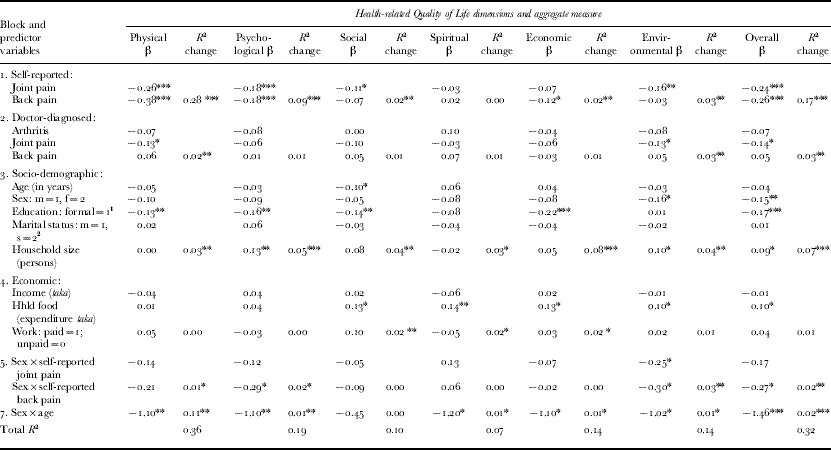
Notes: Interactions for sex by doctor-diagnosed conditions are not shown in the table as entering these (sixth block) showed no significant association with any HRQOL dimension. Hhld: household. 1. none=2. 2. married=1, single=2.
Significance levels:* p<0.05, ** p<0.01, *** p<0.001.
When the third block of socio-demographic variables was entered, higher age predicted significantly lower scores in the social dimension of HRQoL, and being female predicted lower scores in the environmental dimension and overall scores. Lack of education was associated with lower scores in the physical, psychological, social and economic dimensions and the overall scores. Finally, larger households predicted higher psychological, environmental and overall scores. When the fourth block of socio-economic variables were entered, higher expenditure on food associated with higher scores in the social, spiritual, economic and environmental dimensions and the overall HRQoL scores.
At the fifth step, the sex by self-reported joint and back pain interaction terms were entered. A significant effect was that women with joint pain scored lower on the environmental dimension, and women with self-reported back pain scored lower on the psychological and environmental dimensions and on the aggregate HRQoL score. At the sixth step, entering the sex by doctor-diagnosed arthritis, joint and back pain interaction terms did not find significant effects (coefficients not shown). At the seventh and final step, the age by sex interaction term was entered. It was found that women of older age had lower scores in the physical, psychological, spiritual, economic and environmental dimensions and for the aggregate HRQoL scores. The total variation accounted for by the predictors varied by dimension from seven to 36 per cent.
Discussion
By using population-based cross-sectional data collected in a rural area of Bangladesh, this study has examined the association of bone and joint diseases, both doctor-diagnosed and self-reported, with health-related quality of life (HRQoL). The three examined diseases were arthritis, back pain and joint pain. This study also examined the relative association with HRQoL of doctor-diagnosed and self-reported conditions. The findings have revealed that the presence of joint pain, whether doctor-diagnosed or self-reported, and of self-reported back pain is significantly associated with different dimensions of HRQoL as well as the aggregate scores. The findings replicate research in the United States, which showed that arthritic conditions were significantly associated with health-related quality of life in the adult population (CDC 2000).
An important feature of the presented findings is that, rather than arthritis, doctor-diagnosed or self-reported joint pain and self-reported back pain had a pronounced association with HRQoL (considering the number of dimensions with significant effects). It is possible that a diagnosis of arthritis leads to treatment that alleviates its impact on HRQoL, whereas those with other symptoms lingered in seeking health care. It was also observed that, compared to doctor-diagnosed conditions, each of the self-reported conditions emerged as significant predictors of lower HRQoL scores irrespective of block order entry. The patterns of association of self-reported and doctor-diagnosed medical conditions with HRQoL might arise from overlapping prevalence or the fact that self-reports reflect subjective complaints beyond what is captured by clinical diagnosis. Doctor-diagnosed bone and joint diseases did not explain much additional variation in HRQoL beyond that accounted for by the self-reports.
Another important finding was that among all the dimensions of HRQoL, the physical and psychological components were the most affected by bone and joint diseases – and were the dimensions that produced the lowest HRQoL scores. Research has demonstrated that physical health, mental health and sleep problems are common among people with bone and joint diseases (Dominick et al. Reference Dominick, Ahern, Gold and Heller2004), and that psychological distress is commonplace and has a significant negative association with physical wellbeing (Hill et al. Reference Hill, Gill, Tylor, Daly, Grande and Adams2006). Other research has shown that the majority of those who are in paid work at the onset of their bone and joint diseases discontinue their work approximately seven years after the diagnosis (Rkain et al. Reference Rkain, Allali, Jroundi and Hajjaj-Hassouni2006).
Several medical conditions are highly prevalent in old age (Kabir et al. Reference Kabir, Tishelman, Agüero-Torres, Chowdhury, Winblad and Höjer2003; World Bank 2006; Mostafa and Streatfield Reference Mostafa, Streatfield and Kabir2003). This study presents a similar picture, most of the participants had self-reported and clinically-diagnosed bone and joint conditions, and the prevalence was higher among women. Other research also demonstrates that bone- and joint- related conditions are generally more frequent among women than men (Kvien et al. Reference Kvien, Uhlig, Odegard and Heiberg2006). The sex-by-disease interaction terms revealed that self-reported joint pain resulted in lower scores in the environmental dimension, and that sex by self-reported back pain predicted lower scores in the psychological and environmental dimensions and for the aggregate scores. Furthermore, examination of the sex-by-age interaction effects revealed that being a woman of older age was significantly associated with lower scores in all but the social dimension of HRQoL, over and above the main effects of age and sex, while higher age irrespective of sex predicted lower scores in the social dimension.
The combined effect of age and sex has been shown by previous research on, for example, socio-economic differences in rheumatoid arthritis (Groessl, Ganiats and Sarkin Reference Groessl, Ganiats and Sarkin2006). It has also been shown that various factors moderate sex differences; for example, use of health-care services by people who are sick occurs less often among older women than older men (Young et al. Reference Young, Menken, Williams, Khan and Kuhn2006; Ahmed et al. Reference Ahmed, Adams, Chowdhury and Bhuiya2000). The associations with other factors such as women's lower literacy rate and lower participation in the labour force should not be overlooked. Research in Bangladesh has indicated that women's economic empowerment increases mobility and autonomy within the household, which improves their access to and control over resources, and hence potentially enables treatment for their health problems (Nanda Reference Nanda1999). Among the presented findings, educational status emerged as a significant predictor of higher scores in most of the dimensions and the aggregate HRQoL scores. Other research has noted that less-educated persons with rheumatoid arthritis have lower HRQoL scores (Groessl, Ganiats and Sarkin Reference Groessl, Ganiats and Sarkin2006), as have those with osteoarthritis (Woo et al. Reference Woo, Lau, Lee, Kwok, Lau, Chan, Chiu, Li, Sham and Lam2004).
We found that living in large households had a positive association with HRQoL, as reflected in higher scores in the psychological and environmental dimensions and the aggregate of HRQoL. Other research has shown that social networks have beneficial effects on health outcomes (Fratiglioni et al. Reference Fratiglioni, Wang, Ericsson, Maytan and Winblad2000) and that social ties have beneficial effects on perceived health in old age (Seeman Reference Seeman1996). It is noteworthy that the level of per capita daily household food expenditure was a significant predictor of most of the dimensions of HRQoL, whereas personal income was not associated significantly with any of the outcome variables. This may be because the family plays an important role in financially supporting its older members, with the result that per capita household food expenditure is more closely associated with HRQoL than an older person's own income. This scenario is also reflected in the income and expenditure data, for a significant sex difference was noted for individual income, but no significant sex differences were noted for food expenditure.
There were no significant associations between the presence of bone and joint diseases and the spiritual dimension of HRQoL. The reason may be that in Bangladesh, older people devote much time to spiritual activities irrespective of their medical conditions. The scores on the spiritual dimension were significantly higher than for all other dimensions. Previous research has also shown that religion significantly influences the expression of certain aspects of HRQoL (Juarez, Ferrell and Borneman Reference Juarez, Ferrell and Borneman1998), and that the presence or absence of medical conditions is not a strong determinant of spiritual wellbeing (Jelsma and Ferguson Reference Jelsma and Ferguson2004). Qualitative research on HRQoL among older people in Bangladesh has indicated that being active in religious activities correlates with better social functioning and psychological wellbeing (Nilsson et al. Reference Nilsson, Grafström, Zaman and Kabir2005).
Limitations of the analyses
Some methodological issues should be noted. The data for this study were collected in two steps: the participants were first interviewed in their homes and then invited to a clinical examination at a nearby health centre. The fact that the clinical examinations were not done at the older persons' homes may have resulted in the exclusion of those unable to attend for reasons of severe illness or disability, thus influencing the results. To maximise participation in the clinical examination, however, transport was provided for all the participants. A broader concern is that the lack of information on severity of illness may reduce the generalisability of the results. On the other hand, among the strengths of the study was that after the clinical examination, two doctors independently checked the documented medical conditions for accuracy of the diagnoses. Where there were differences, a consensual diagnosis was agreed. To avoid recall bias in the self-reports of illness, only the current status of back pain and joint pain was considered. Finally, the instrument used for assessing HRQoL was specifically designed for older people living in Bangladesh.
Conclusions
It is concluded that the presence of bone and joint diseases such as joint pain, whether doctor-diagnosed or self-reported, and of self-reported back pain are significant predictors of low health-related quality of life in old age. The burden and significant association of bone and joint diseases with HRQoL underscores the importance of considering these illnesses as public-health problems in the national health agenda. Furthermore, the findings imply that if the burdens of bone and joint diseases are reduced, the health-related quality of life/of elderly persons will be enhanced. To reduce the burden of these illnesses, a possible intervention is to introduce health education. Importantly, research has indicated that adherence to health education messages about bone and joint diseases has the potential to improve self-care and to reduce the burdens of discomfort and disability (Barlow, Turner and Wright Reference Barlow, Turner and Wright2000; Lorig, Mazonson and Holman Reference Lorig, Mazonson and Holman1993; Rana et al. Reference Rana, Lundborg, Wahlin, Ahmed and Kabir2008).
Acknowledgements
This study was financially supported by the UK Department for International Development, by the International Centre for Diarrhoeal Disease Research (ICDDR-B), by the Centre for Population and Health Research, and by grants from the Swedish Medical Research Council and Sida to ICDDR-B and Karolinska Institutet through the Swedish Research Links Programme. The Swedish Institute and the Bangladesh Rural Advancement Committee (BRAC) supported the first author. We are grateful to the staff and participants of the Poverty and Health in Ageing project in Bangladesh.