China's rapid economic growth has brought with it various social problems and discontent for which some people blame the government. Indeed, some social conflicts are directly related to governmental policies and their misuse. Land expropriation is a representative case. The land rights system in China endows county and higher levels of governments with the authority to expropriate farmland from rural peasants to boost urbanization. Although governments are mandated to pay compensation to peasants, in some circumstances the limited amount of compensation offered is insufficient to provide them with the same standard of living they enjoyed before land expropriation. As a result, some peasants struggle to survive after losing their farmland, a situation which then leads to discontent and social protest. Since 2005, land loss has become the leading cause of social protest in rural China.Footnote 1 How to properly resolve land expropriation conflicts has become a big challenge for the Chinese government.
Unpacking peasants’ resistance behaviour is crucial to understanding the resistance of land-lost farmers and finding feasible solutions to avoid potential protests. The existing literature has paid some attention to the causes of social conflicts that occur in land expropriation, including institutional flaws such as the absence of clear definitions of land ownership and use rightsFootnote 2 and, specifically, inadequate land expropriation policies with poor definitions of the public interest and substandard land compensation systems.Footnote 3 Land expropriation without the agreement of farmers, violations of the proper legal procedures and the corruption of government officials have also led to considerable land conflicts all around the country.Footnote 4 Among all the causes, however, inadequate compensation is a prime trigger.Footnote 5 Compensation for land expropriation in China has been criticized for being unfairly low, particularly when compared to the appreciation in land value, and for being insufficient to maintain the living standards of land-lost farmers.Footnote 6 According to data released by the Ministry of Natural Resources, in the first half of 2002 around 40 per cent of petitions related to land expropriation were a result of inadequate compensation for land and unfair resettlement subsidies.Footnote 7
This begs the question, what is “adequate” compensation? Existing studies have proposed two principles for “adequate” compensation: complete compensation and equivalent compensation. Complete compensation offers full compensation for the loss of land, including direct losses such as land value and attachments value and indirect losses such as residual land value and spiritual loss.Footnote 8 Equivalent compensation ensures that the amount of compensation should not downgrade peasants’ living standards.Footnote 9 Putting the theoretical and moral discussions aside, it is also important to explore what is appropriate compensation from the standpoint of peasants. An intuitive association must be that the higher the compensation, the more satisfied the peasants. Drawing on our experience of field surveys in some provinces, however, we believe that this association needs further consideration. In some coastal cities like Wenzhou 温州市, we find that although the city governments provide peasants with generous compensation for their land, there continues to exist strong resentment. In contrast, peasants offered paltry sums for their land by governments of less-developed cities seem to be quite satisfied with the meagre compensation. Perhaps the answer to such a puzzle can be found in social psychology. Social psychologists believe that people's satisfaction is highly related to the comparisons they make. Individuals sometimes judge themselves to be disadvantaged when compared to a relevant referent and thus harbour feelings of anger or resentment.Footnote 10 Such a judgement is described as “relative deprivation,” a concept that is widely used to account for the formation of social movements, resistance and protest.Footnote 11
Following this line, this paper attempts to test the effect of relative deprivation on peasants’ resistance behaviour during land expropriation. We combine evidence from a case study with quantitative research. The case study illustrates the causal process, from relative deprivation to peasants’ resistance, and the quantitative research is designed to test the external validity.Footnote 12 There are two main challenges for the quantitative research here. The first is how to measure the degree of relative deprivation. We suppose that peasants will make a comparison between the compensation for land expropriation and the revenues generated by land leasing. As land expropriation compensation is formulated according to the original land use (i.e. agricultural), the compensation is far less than the market value of the land.Footnote 13 Peasants may develop a sense of relative deprivation when they lose their property rights but discover that the compensation offered is far less than revenue generated by leasing the land on the market. Therefore, we define the relative deprivation as the gap between compensation for land expropriation and the market value of the land: the bigger the gap, the stronger the relative deprivation felt by peasants.
The second challenge is how to identify peasants’ resistance behaviour. In China, people express their grievances in many ways, for example by petitioning the government (xinfang 信访) or, more radically, mobilizing a mass event (jitixing shijian 集体性事件).Footnote 14 However, partly owing to social stability considerations, governments do not publicize statistical data on petitions.Footnote 15 Thus, we turn our focus to a specific type of resistance, resistance through administration litigation. China promulgated the Administrative Litigation Law (ALL) at the end of the 1980s. This law provides people with the legal tools to challenge public power and to sue the state for a resolution. Drawing on judicial documents (we provide a more detailed introduction of the data below), we calculate the number of legal cases related to land expropriation that occurred in a city for a given year to precisely depict the degree of resistance.
The quantitative results show a significantly positive effect of relative deprivation on peasants’ resistance through administrative litigation. The stronger the relative deprivation felt by peasants in a prefecture, the greater the number of administrative litigations in that prefecture. Specifically, a 10 per cent increase in relative deprivation will lead to a 22.12 per cent increase in administrative litigation cases. We also test the effect of the absolute value of compensation, but the results are not statistically significant. Our findings that relative deprivation is a more critical inducement of resistance than the absolute value of compensation challenge the conventional wisdom. Additionally, we find the positive effect of relative deprivation on administrative litigation has become more sizable over time, implying peasants’ growing awareness of resistance through legal weapons.
Our paper intersects with several branches of the literature, with the first relating to studies on land expropriation conflicts. As mentioned above, the existing literature has widely discussed the causes of land expropriation-related conflicts, including the vague definition of public interest, unfair distribution of compensation and discontinuity of compensation policies.Footnote 16 Following a different tack to these studies which emphasize the importance of macro policies, we start from the psychology of peasants and explore how relative deprivation might be the more profound reason leading to peasants’ resistance. By validating the effect of relative deprivation, this paper sheds new light on the causes of land-related resistance in rural China. Further, by uncovering the importance of relative deprivation, our work highlights new policy implications for the ongoing reform of land expropriation in China.
Second, this paper also contributes to the well-established literature on relative deprivation by extending the application of relative deprivation. The term “relative deprivation” was coined by Samuel Stouffer and his wartime colleagues to explain the stratified satisfaction of military police and soldiers.Footnote 17 Since then, this concept has been well developed and widely used across the globe.Footnote 18 In the context of China, studies mainly focus on how relative deprivation generated in the process of horizontal comparison contributes to people's falling psychological health, life satisfaction and happiness.Footnote 19 For example, Shuwei Zhang and colleagues find individuals habitually compare their economic status and social position with their occupational counterparts.Footnote 20 Relative deprivation is formed from such comparisons and significantly impairs people's life satisfaction. Eiji Mangyo and Albert Park together find that urban residents use relatives and classmates as reference groups, while rural residents usually take their neighbours as referents.Footnote 21 Whatever reference groups are used, relative deprivation will significantly damage residents’ physical and psychosocial health. Different from the previous literature, this paper points out that relative deprivation generated in the process of vertical comparisons also has a significant impact on people's behaviour. Additionally, we extend the application field of relative deprivation. To the best of our knowledge, this is the first study that applies the concept of relative deprivation to understand peasants’ resistance behaviour in the context of land expropriation in China.
The paper is organized as follows. Next, we introduce the institutional background of the ALL and land expropriation in China. The meaning and operation of relative deprivation is also discussed and formally defined in this section. Then, we present a case study to elaborate the causal process from relative deprivation to peasants’ legal resistance. The section following that highlights the data and methods we use in quantitative research. Quantitative results are then presented and discussed. We conclude the paper with a discussion of the implications of the findings.
Institutional Background and Conceptual Definition
Administrative litigation in China
Enacted in 1989, the ALL is a part of the Chinese government's pursuit of a comprehensive administrative law regime. Before its promulgation, the only way for aggrieved Chinese citizens to challenge the abuse of state power by governments and officials was to petition or write appeal letters to higher-level governments. Some people even travelled to Beijing in the hope that the central government would redress their grievances.Footnote 22 After the ALL came into effect, Chinese people, for the first time in their history, were equipped with the legal tools to combat abuses of official power and sue the state for a remedy.Footnote 23 At the beginning of the implementation of the ALL, there were some embedded flaws. For example, the law paid more attention to legality than to the propriety of administrative decisions, making it difficult for Chinese citizens to challenge substantive government policies.Footnote 24 However, during the last decades, Chinese courts have made evident progress, which can be seen in the improving quality of judicial staff, the broader scope of jurisdiction and the growing number of cases being processed and resolved.Footnote 25
However, the take up of administrative litigation to convey discontent seems to be less prevalent in rural China for several reasons. First, rural villages are close-knit communities where peasants interact in a “multiplex” context, providing different conditions that offer other channels through which to solve disputes and punish illegal behaviour.Footnote 26 Second, peasants in China are generally less educated and less informed. Such a fact not only blocks the entry to judicial proceedings for peasants but also invokes a distrust of courts. Peasants believe that the likelihood of winning a lawsuit is very low because courts and governments must shield one another.Footnote 27 Nevertheless, one should never discount the value of administrative litigation for peasants. Kevin O'Brien and Lianjiang Li provide one of the few studies that concentrates on administrative litigation in rural areas.Footnote 28 Their research shows that it is impossible for local governments to always dictate verdicts, particularly when the evidence is strong and it is widely known which party is in the right. Further, suing the state may attract the attention of the people's congress, higher-level governments and media, which could improve the plaintiff's odds of winning the lawsuit.Footnote 29 That means, even for peasants, administrative litigation can offer a vital instrument with which to defend themselves when confronting state power.
Land expropriation in rural China
Land expropriation is a public power used widely in many countries and regions to provide land for public use, correct economic inefficiency and achieve more significant social equity and justice.Footnote 30 In China, however, other motivations have emerged for land expropriation beyond the claims for “public interest.” Since the launch of the reform and opening-up policy led by Deng Xiaoping 邓小平 in 1978, Chinese local governments have devoted themselves to attracting foreign capital by taking advantage of their abundant land and labour resources. The Land Management Law (LML) was introduced in 1986 to revitalize land resources that had been frozen in the planned economy for 30 years. In line with that change of course, the PRC Constitution was also revised in 1988. Since then, land ownership in China has been organized under a dual system, where urban land is owned by the state, and rural land is owned by rural collectives.Footnote 31 The use rights for state-owned land can be separated and transferred to commercial users; however, collective-owned land must be converted to state-owned status before a transfer of land-use right can be effected.Footnote 32 The conversion of land ownership is achieved by land expropriation led by local governments. According to work by Lian Hongping and colleagues, around three-quarters of the land for construction is acquired by local governments through expropriation orders.Footnote 33 In this process, governments expropriate land from peasants and then sell it to developers at market value.Footnote 34 The land-centred development model, called “land expropriation-land selling,” has been a major contributor to the rapid urbanization and industrialization of China.Footnote 35
Farmland is not expropriated without compensation. The Constitution and LML stipulate that the government must pay peasants compensation for the stripping away of their property rights. In general, three elements are taken into consideration in determining the amount of compensation: compensation for the land according to its original use; compensation for lost (unharvested) crops; and a resettlement allowance for displaced peasants.Footnote 36 This seemingly complete compensation, however, has at least two significant flaws. First, owing to the lack of definite guidelines on compensation, farmers’ compensation for land expropriated tends to be arbitrary.Footnote 37 This places peasants in an inferior political position with little ability to negotiate with land- and profit-hungry local governments.Footnote 38 Second, compensation is calculated according to the original use of the land, meaning that the value added by land-use conversion is not shared with peasants. To sum up, many of the land-lost peasants are insufficiently compensated and financially worse-off than they were before land expropriation.Footnote 39 Governments, however, reap a bonanza from land expropriation. According to one estimate, the revenue generated by land conveyance fees alone bring the local government 10 to 20 times more than the compensation offered for land expropriation.Footnote 40
Definition of relative deprivation and its application
Since Stouffer first proposed the relative deprivation theory,Footnote 41 this social-psychological conception has been widely accepted and developed throughout the social sciences.Footnote 42 Different from absolute deprivation, relative deprivation links with the interpersonal and intergroup levels of analysis.Footnote 43 Formally, Heather Smith and Thomas Pettigrew define relative deprivation as “a judgment that one or one's ingroup is disadvantaged compared to a relevant referent, and that this judgment invokes feelings of anger, resentment, and entitlement.”Footnote 44 By such a definition, a complete connotation of relative deprivation should include the following. First, individuals must make comparisons – this is to determine that the deprivation is relative rather than absolute. Second, individuals must make cognitive appraisals that lead them to perceive they or their group are disadvantaged. Third, the perceived disadvantages must be viewed as unfair. The individual holds the view that he/she deserves better. Finally, individuals must resent these unfair and underserved disadvantages.Footnote 45 A concept of relative deprivation can only operate if these four criteria are met.Footnote 46
At first glance, relative deprivation should be measured by subject indexes since it is a concept of psychology. However, as Ted Gurr and Raymond Duvall point out, relative deprivation, as a psychological concept, cannot be adequately measured at national level.Footnote 47 Gurr and Duvall dealt with this issue by indexing relative deprivation based on social conditions and patterns of change. In fact, dozens of studies have tried to measure relative deprivation with an objective index. Aggregated economic indexes such as GNP growth rates, crop failures, unemployment or other economic conditions are the most popular.Footnote 48 In addition, objective indexes on an individual level, such as the ratio of individuals’ self-reported income to the income of referents (referents from similar regions, age groups and with similar education levels, etc.), are also widely used.Footnote 49
Drawing lessons from research that applies an objective measure of relative deprivation and taking into account the huge gap between land compensation and the market value of land, this paper proposes that peasants feel relative deprivation according to the gap between compensation for land expropriation and the market value of land. Such a definition is consistent with the basic components of relative deprivation. First, both the information on compensation and the market value of land is public, so individuals can easily make a comparison between them. Second, once peasants discover the discrepancy between the compensation they receive and the land revenues generated in land transfer, which implies that they are excluded from a share of the value added to the land, they must feel disadvantaged and unfairly treated. Third, such unfair treatment inevitably invokes resent among the peasants. According to Julia Chuang, meagre compensation for land expropriation significantly contributes to peasants’ discontent.Footnote 50
How Relative Deprivation Leads to Administrative Litigation: A Case Study
To illustrate the detailed causal process from relative deprivation to peasants’ legal resistance, we introduce a typical case encountered during our field work. This case study depicts more detailed causal links between relative deprivation and peasants’ legal resistance. The induction from this concise case study is also supposed to guide the following quantitative research.
This case is about land expropriation and demolition in Wujiang county in 2016.Footnote 51 Wujiang is a county located in the south-east of China. Although Wujiang is a relatively underdeveloped county for coastal areas, its economic level is still more advanced than most inland counties. In August 2016, owing to the construction of development zones initiated by the county governments, part of Hushan Street was expropriated and eight households lost their land. Claiming that it was using a benchmark price for the land, the county government set the compensation amount at 150,000 yuan/mu.Footnote 52 Without any consultation or negotiation with the eight households, the “Decision on land expropriation” and “Decision on land compensation” were delivered to these peasants. The eight households were required to sign the “Decisions,” vacate their houses and surrender their land-use rights within 60 days.
The arbitrariness of the compensation rate aroused great ire among the eight households and they decided to work together to resist the land expropriation and demolition of the houses. Despite several rounds of complaints being lodged with the bureau of natural resources, bureau of housing and construction and bureau of complaints and proposals, their grievance was still not resolved and so they chose to sue the bureau of housing and construction, the bureau responsible for the construction of development zone, at the Wujiang court. The plaintiffs' main argument was that the compensation was unreasonable and too low, as was evident in the huge gap between the compensation rate offered and the land transfer price. Specifically, they argued that the transfer prices of land near the expropriated land had reached more than 1,200,000 yuan/mu, but the compensation they received was less than one-eighth of the land market price. Thus, they had been unfairly excluded from a share of the true value of the land.
About two months after the litigation application was submitted, the court rejected the plaintiffs' claim. The court stated that according to the ALL and “Regulations on expropriation and compensation of houses on state-owned land,” the bureau of housing and construction had the statutory authority to make decisions on expropriation and compensation. Further, it stated that there was no legal basis for demanding compensation based on the market price of the land. Although the plaintiffs did not win the lawsuit and did not receive compensation equivalent to the market value of the land, the government did make a concession following other demonstrations of resistance by peasants. Eight households finally received compensation at a rate of 180,000 yuan/mu and withdrew their appeal to higher courts. When talking about this land expropriation and litigation, one peasant conceded to us:
All in all, everything is about money. If the government can compensate us according to the market value of the land, who will choose to resist? … We just couldn't tolerate the government making money by transferring our land. This is completely depriving us. The income from land sales should have belonged to us … Why not appeal to a higher court? We know it's impossible for the government to compensate us at market prices, otherwise how can the government make revenues by land sales? Successfully striving for a reduced level of deprivation is already the best result for us.Footnote 53
This simple case is a good illustration of how peasants judge the sufficiency of land compensation. They believe they deserve a share of the land appreciation, gained through its change of use, but, in reality, the largest proportion of the land value is captured by local governments. When they compare compensation rates and the land market value, peasants feel deprived. The larger the gap, the greater the sense of relative deprivation, and the greater the motivation to resist land expropriation through legal actions. Even when administrative litigation fails to generate the result they want, peasants will still try.Footnote 54 An administrative lawsuit is a relatively less risky path for peasants compared with other means of resistance such as petitioning or gathering on the street. Further, as noted by Li and O'Brien, failure in the courts may still attract the attention of society and media to their plight and thus force the government to allocate more of the benefits of land expropriation to the peasants.Footnote 55 To sum up, this case could be viewed as preliminary evidence of how relative deprivation leads to peasants’ legal actions.
Quantitative Examination Design: Data and Method
Although the case offers a vivid story of how relative deprivation leads to peasants’ legal resistance, an inference from a single case lacks external validity.Footnote 56 Therefore, we designed a quantitative study to examine whether the link between relative deprivation and legal resistance still holds when facing big-sample data.
Data collection
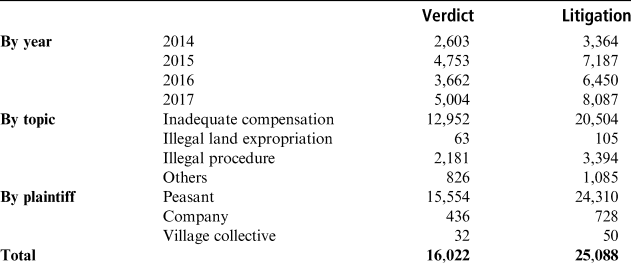
To conduct the quantitative examination, we first built a unique dataset. This dataset mainly comprises two types of data: the amount of administrative litigation and the index of relative deprivation. To measure administrative litigation, we collected all the documents from judicial trials posted on China Judgments Online.Footnote 57 This website was established by the Supreme People's Court and publicizes judgment documents delivered by courts at all levels. Following the implementation of the “Provisions of the Supreme People's Court on the publication of judgment documents on the internet” on 1 January 2014, it is mandatory to publish all judgment documents other than for special cases on this platform.Footnote 58 We used keyword searches for all documents published on the portal since 1 January 2014. By using the term “land expropriation” and its synonyms as keywords and then limiting the results to the scope of administrative litigation, we retrieved 25,088 documents. Of these, 16,022 are verdict documents (panjue shu 判决书) and others are adjudication documents (caiding shu 裁定书).Footnote 59 We then identified the defendant in each case and distinguished which prefecture the defendant belonged to. Finally, we counted the administrative litigation cases that occurred in a prefecture in a single year.
It is worth noting that administrative litigation may not be a perfect choice to represent peasants’ resistance behaviour. Given the political regime in China, there exist some inherent defects. For example, courts come under the leadership of the Party committee at the same level and depend on the local government for finances. Courts may not dare to accept (shouli 受理) cases implicating a powerful local authority.Footnote 60 Consequently, some litigations may be submitted to court but then fail to go to trial. Further, cases deemed to be politically sensitive may not be posted online.Footnote 61 Therefore, some lawsuits have been judged but are missing from the judgment documents database. Despite the above problems, we argue that using the documents from China Judgments Online works for our examination for two reasons. First, the factors behind the incompleteness of the record of judgments are rooted in the political ecology of a city. For example, cities with a more powerful Party committee are more likely to intervene in the legal procedure, which might result in more missing documents. This city-determined incompleteness can be addressed by controlling city fixed effects in the regression model. Second, as the issue concerns missing documents, the bias of the regression (if there are still any after controlling for fixed effects) would be downward rather than upward. If an underestimated coefficient is significant, the real effect can only be more significant. Such a bias (if any) is acceptable for empirical researchers. Therefore, we can confidently use the documents from China Judgments Online for the quantitative study.
We then investigated what the land expropriation litigation cases were about. For example, were these cases lodged because of insufficient compensation or something else? Do peasants fight for higher compensation or have other appeals? Only by establishing links between relative deprivation and the cases complaining about inadequate compensation and appealing for higher compensation can the hypothesis be more precisely examined. Therefore, we conducted an in-depth content analysis of the documents to uncover the topics of each litigation. Following Junyan Jiang, Tianguang Meng and Qing Zhang,Footnote 62 we used a Latent Dirichlet Allocation (LDA) model to uncover topics in the documents and estimate the proportions of each topic. An LDA algorithm clusters words strictly according to their occurrence patterns, which could effectively avoid the errors in hand coding and improve efficiency. We estimated a 10-topic model as a baseline and a 20-topic model as a robustness check. After merging similar classification results, we uncovered four types of causes of administrative litigation: inadequate compensation, illegal land expropriation, illegal procedures used in land expropriation, and others. The online Appendix introduces the methodology and estimation procedure of the LDA algorithm, the topic clustering results and the reclassification process in more detail.
To measure relative deprivation, we constructed a relative deprivation index by calculating the gap between compensation for expropriated land and the market value of the land. The data on compensation were manually collected from compensation rates drafted by each provincial government.Footnote 63 The compensation standards formulate different bottom lines of compensation for various counties in a province. We averaged the compensation rates for all counties in a prefecture to derive the prefecture-level compensation standards. We also gathered data on the area of land transferred by local governments in the primary land market and the total revenues generated by land transfer from the China Land and Resources Statistical Yearbook. Then, we calculated the average price of leased land as the market value of land. Finally, we defined the relative deprivation index as 1 minus (compensation for land expropriation/market value of land). This index depicts the percentage of the increase in land value that is captured by governments in the process of land expropriation. Obviously, the higher the index, the greater degree of relative deprivation felt by peasants.
Description of data and preliminary evidence
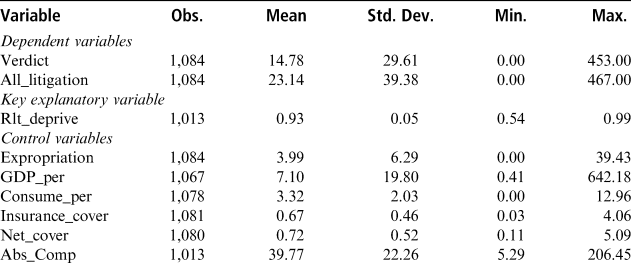
Before conducting rigorous regression analysis, this section provides an overview of the distribution of administrative litigation cases and relative deprivation. Table 1 presents the number of verdicts and all litigation cases according to year, topics and types of plaintiffs. Partly because 2014 is the first year of the mandatory disclosure of judicial documents, the number of verdicts and litigations is particularly small. Table 1 also shows that compensation accounts for the largest proportion of topics and, in most cases, peasants (including a single peasant and several peasants together) are the plaintiffs. Table 2 presents the descriptive statistics of all variables. On average, each city has around 23.14 administrative litigations related to land expropriation each year (among which 14.78 are verdicts). As for relative deprivation, we find that peasants are almost always completely excluded from a share of the appreciation in land value during land expropriation. The average value of relative deprivation is 0.93, implying that 93 per cent of profits generated through land expropriation and land leasing are kept by governments, with peasants only receiving the remaining 7 per cent. These data are similar to the estimation made by Chengri Ding, who points out that the revenues generated by land leasing are generally 10 to 20 times more than the compensation offered in land expropriation.Footnote 64
Distribution of Administrative Litigation Cases

Source: Compiled by author from documents on China Judgment Online.
Descriptive Statistics

Source: Judicial trial data are from China Judgments Online; data on relative deprivation are taken from China Land and Resources Statistical Yearbooks and compensation standards for land expropriation issued by provincial governments; data for control variables are from China Regional Statistical Yearbooks.
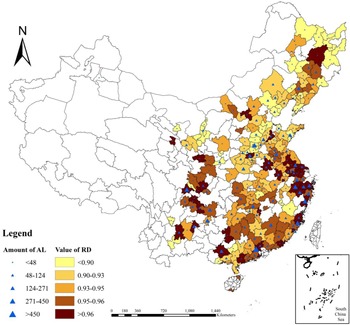
To derive preliminary evidence, we overlay the number of administrative litigations and the value of relative deprivation on a map of China in Figure 1. The triangles represent the total number of administrative litigations in a city in 2014–2017, where larger triangles imply more litigation cases. The colour of prefecture indicates the value of relative deprivation. The darker the colour, the stronger the relative deprivation felt by peasants. Intuitively, the larger number of administrative litigations is accompanied by stronger relative deprivation, which concurs with our hypothesis. However, this preliminary graph overlooks some issues like missing variables, so we ran more rigorous regression tests.
The Spatial Distribution of Administrative Litigation (AL) and Relative Deprivation (RD)

Method
Since the number of administrative litigations is a non-negative integer, we use the Poisson regression model to analyse the count data. Now that we view the dependent variable following a Poisson distribution with the parameter μ it, the regression model can be expressed as follows:
 $${\rm E}[ {AL_{it}{\rm \vert }RD_{it}, \;X_{it}, \;\epsilon_i, \;\theta_t} ] = \exp ( {\alpha_1RD_{it} + \alpha_2X_{it} + \epsilon_i + \theta_t} ) = \mu _{it}$$
In the equation, i and t represent the observation in city i in year t. AL and RD represent the number of administrative litigations and the index of relative deprivation, respectively. X it includes a series of control variables that have a potential impact on administrative litigations. Specifically, four dimensions of control variables are considered. The first is the area of land being expropriated. It goes without saying that a broader range of land expropriation will lead to a higher probability of resistance. The second is the economic level of a prefecture. We suppose that peasants living in more developed prefectures may have a stronger rights consciousness so that they are more likely to resist when they believe their rights are violated. The third consideration is the level of social security provided by the prefecture. If peasants are from a prefecture with poor social security, they are more likely to resort to acts of resistance because their lives will be more severely impacted by land expropriation. Finally, we also control the accessibility of information. It is supposed that more accessible information will contribute to a growing consciousness of rights.Footnote 65 The descriptive statistics of all variables are shown in Table 2. To exclude the effect of unobservable factors, we also add the city fixed effect ε i and year fixed effect θ t to the model.
Results
Baseline results
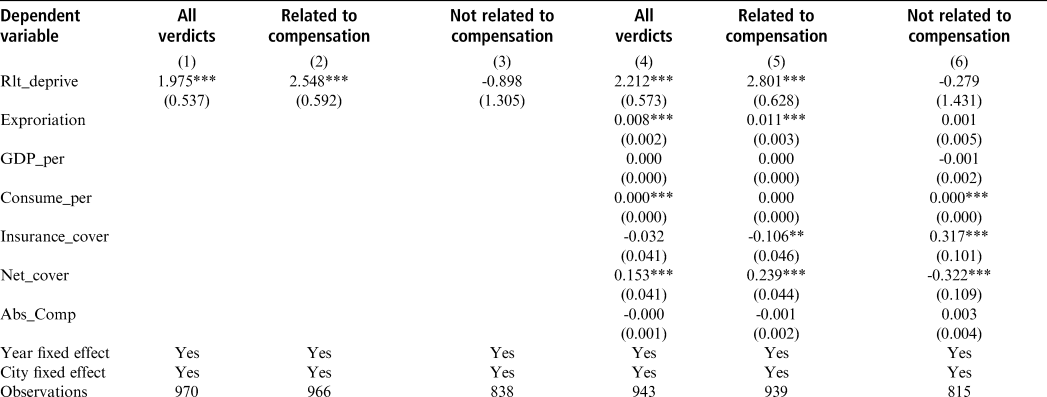
Table 3 presents the effect of relative deprivation on the number of administrative litigations. The first three columns only include city and year fixed effects, while the last three columns control for all covariates. To compare like with like, we divide the documents into those related to land compensation and those not related to compensation, based on the content analysis. Before controlling covariates, the positive effect of relative deprivation on the numbers of total verdicts and verdicts related to land compensation is statistically significant. After the introduction of control variables, the coefficients increase further. Except for statistical significance, the coefficients also reveal the sizable effect of relative deprivation. Take the fourth column as an example. The coefficient of 2.212 implies that a 10 per cent increase in relative deprivation will lead to a 22.12 per cent increase in land expropriation verdicts in a city. The regression with verdicts not related to compensation (columns 3 and 6) could be viewed as a placebo test. That is, there might be some unobservable factors such as culture and tradition that lead to more administrative litigation. Meanwhile, these factors are also correlated with the key explanatory variable, i.e. relative deprivation. In this case, there will be endogenous problems caused by the missing variables. If this were the case, we would still arrive at similar results if we regressed the verdicts not related to compensation on relative deprivation. However, as shown by columns 3 and 6, the results are not significant. That means relative deprivation directly contributes to the increase in number of verdicts related to land compensation, which accords with our hypothesis that peasants are more likely to sue the government when they feel a higher degree of relative deprivation.
The Effect of Relative Deprivation on Administrative Litigation

Note: Standard errors in parentheses; *** p<0.01, ** p<0.05, * p<0.1.
The results of the control variables also accord with our supposition. For example, more land being expropriated by the state will trigger more administration litigation. With access to better education and information accessibility, peasants living in more developed and well-informed cities are more likely to resist. Improvements in social security, which is measured by the coverage of insurance, might be an effective way to mitigate land-related grievances and decrease the possibility of resistance. It is worth noting that the coefficient of the absolute value of compensation, which could be viewed as a proxy of absolute deprivation, is not significant, suggesting that relative deprivation is a more critical inducement of resistance.
Robustness checks
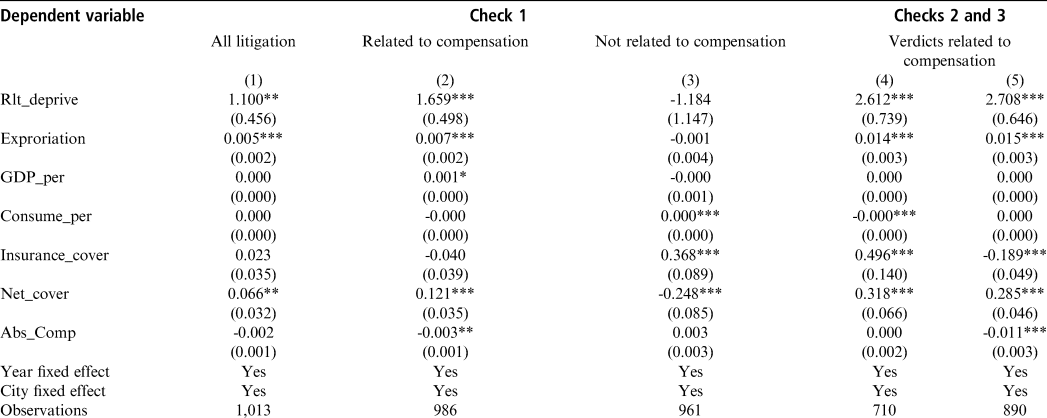
To test the baseline results, we conducted the following robustness checks. First, we used the number of litigation documents (i.e. verdict and adjudication documents) as the dependent variable. The primary difference between verdict and adjudication is that the former deals with substantive disputes (such as disputes over rights and obligations) while the latter focuses on disputes regarding the litigation process (for example, the plaintiff may submit his indictment to the wrong court). Therefore, we suppose that the grievances caused by land expropriation might spill over to adjudication because more verdicts are likely to mean more adjudications. The results are shown in the first three columns in Table 4. Obviously, although smaller than those in Table 3, the coefficients of all litigations and those related to land compensation are statistically significant at the 1 per cent level, while this is not the case for litigations not related to compensation.
Robustness Checks

Note: Standard errors in parentheses; *** p<0.01, ** p<0.05, * p<0.1; column (4) excludes the samples from 2014; and column (5) excludes the samples from vice-provincial prefectures.
Second, as shown in Table 1, the number of administrative litigations in 2014 is notably smaller than the number in the following years. Combining the fact that the mandatory disclosure requirement has only been in place since January 2014, there is a possibility that the records for 2014 might not be complete. Therefore, we exclude the 2014 sample and re-run the regression. The results are shown in column 4. We find that the coefficient is only slightly changed and still statistically significant.
The third robustness test derives from the fact that there are some vice-provincial prefectures in China. According to the Legislation Law, vice-provincial cities are endowed with the authority to legislate local regulations, which could be used as a reference in administrative litigations. Therefore, we take into consideration that peasants in these prefectures may have more litigation channels, lowering the threshold for peasants to sue the state. Consequently, we exclude the samples of vice-provincial prefectures in the regression of column 5. Once again, the significant effect of relative deprivation on the amount of administrative litigation still holds. The three checks confirm the robustness of the baseline results.
Dynamic effect of relative deprivation
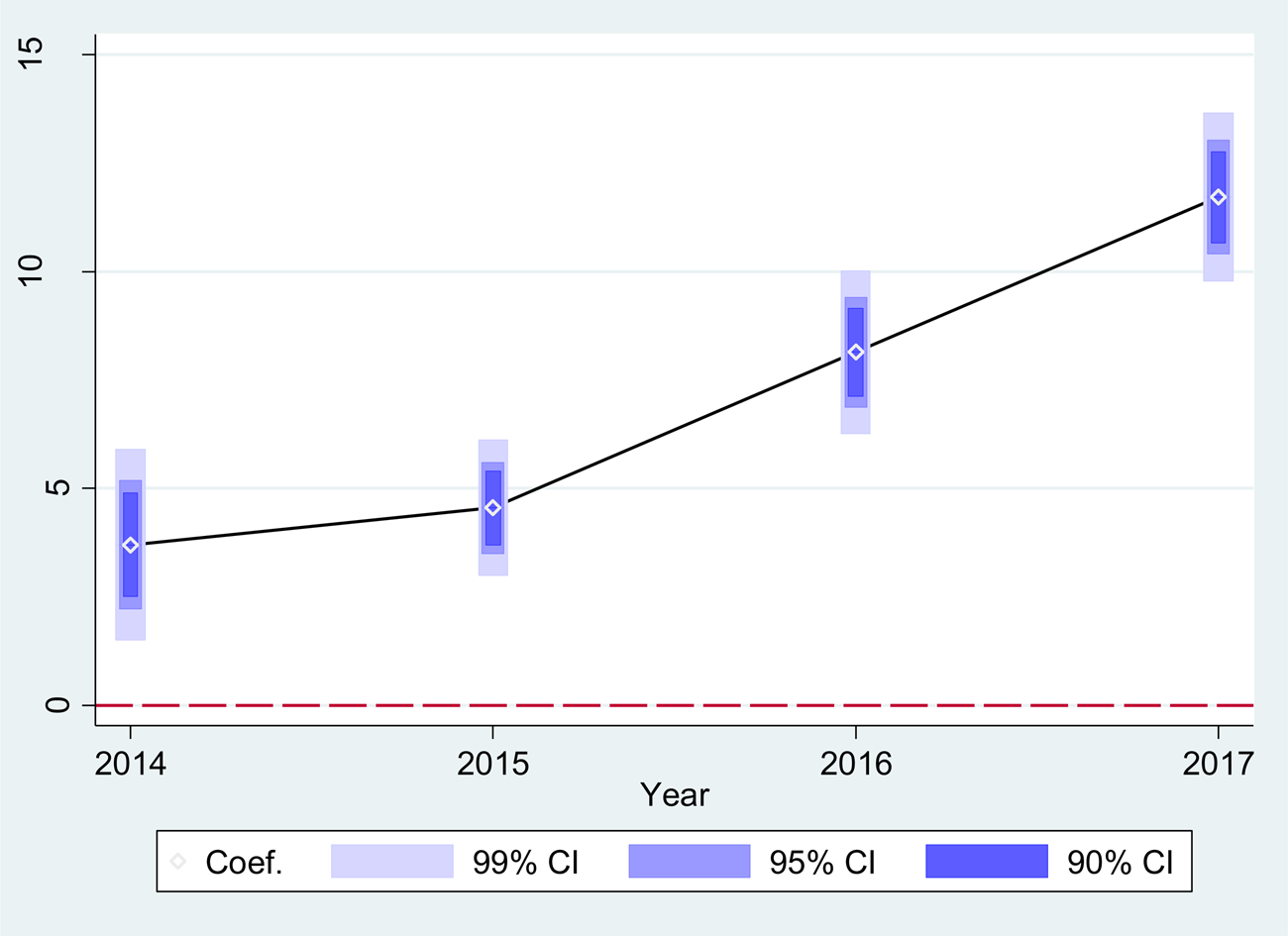
Kevin O'Brien suggests that resistance by Chinese peasants could be viewed as a growing rights consciousness and a more contractual approach to political life.Footnote 66 In this section, we turn to explore the dynamic effect of relative deprivation on administrative litigation. To do this, we run the Poisson model by leveraging separate data for each year. We then plot the coefficient of relative deprivation and its confidence interval in Figure 2. As time goes by, the positive effect of relative deprivation becomes more and more significant. In 2014, the estimated coefficient of relative deprivation is only around 3.7. The coefficient then grows steadily to 11.71 in 2017. That means peasants are increasingly likely to sue the state when they feel deprived during land expropriation. Consistent with the conclusion drawn by O'Brien, we view the growing impact of relative deprivation as evidence of peasants’ growing awareness of resistance through legal channels.
Dynamic of the Effect of Relative Deprivation

Discussion and Conclusion
In recent decades, land expropriation has given rise to antagonism between peasants and local governments in rural China. According to the social psychology literature, people's grievances and dissension are highly related to their relative deprivation, which is generated when people make comparisons between what they have gained and what they think they should have gained. In the context of land expropriation, peasants receive compensation but are almost completely excluded from a share of the appreciation in the land value gained through the conversion of its use. The gap between compensation offered for land expropriation and the market value of land is at the root of an important source of relative deprivation. With such a hypothesis in mind, this paper aims to uncover the relationship between relative deprivation and peasants’ resistance behaviour. Taking advantage of the openness of judicial documents, we focus on a specific pattern of resistance – administrative litigation. We created a unique database of the number of administrative litigation cases and the index of relative deprivation for each prefecture in each year. The regression results show that relative deprivation significantly contributes to the increase in land expropriation-related administrative litigation cases, implying that peasants are more likely to sue the state when they feel deprived. The dynamic analysis reveals a gradually increasing effect of relative deprivation, which could be viewed as peasants’ growing right consciousness.
Our findings have profound policy implications. In recent years, the Chinese government has realized that unfair compensation has been a major reason for social protest. It has also paid increasing attention to improving the level of compensation offered to land-lost farmers to ensure that they can maintain their living standards. However, there is still no standard on what is considered to be appropriate compensation. According to our findings, appropriate compensation should be based on the market value of land following conversion of use rather than on the value according to its original use. Allowing peasants to share in the appreciation of land value during the process of urbanization is an essential step towards eliminating potential land-related conflicts. To achieve this goal, some measures could be considered by governments. First, given that the market value of construction land is determined locally, it is essential to decentralize the decision authority for setting compensation to prefecture- or county-level governments. Only with complete information can policymakers formulate an appropriate standard of compensation. Second, peasants should be empowered with the right to negotiate when compensation is determined. When grassroots voices are heard and taken into consideration during the policymaking process, there will be fewer grounds for discontent and social protest.
Acknowledgements
The authors would like to thank the China Social Science Major Foundation (15ZDA024) for its sponsorship, and Joanne Phillips for her superb editing. The authors contributions are as follows: Shenghua Lu: conceptualization, methodology, data collection, formal analysis, investigation, writing the original draft; Xiang Zhou: conceptualization, data collection; Yuting Yao: investigation, reviewing and editing the paper; Hui Wang: conceptualization, funding acquisition, project administration, reviewing and editing the paper.
Supplementary material
Supplementary material is available online at https://doi.org/10.1017/S0305741022000832.
Conflicts of interest
None.
Biographical notes
Shenghua LU is a PhD candidate at the department of land and resource management, School of Public Affairs, Zhejiang University, China. He specializes in the politics of land and urban development in China.
Xiang ZHOU is an associate research fellow at the Guanghua Law School, Zhejiang University, China. His areas of specialization include digital justice and the judicial system in China.
Yuting YAO is a PhD candidate at the department of land and resource management, School of Public Affairs, Zhejiang University, China. Her current field of specialization is land expropriation in China.
Hui WANG is a professor at the department of land and resource management, School of Public Affairs, Zhejiang University, China. His research focuses on land-use policy, the urban economy and real estate economy.