Introduction
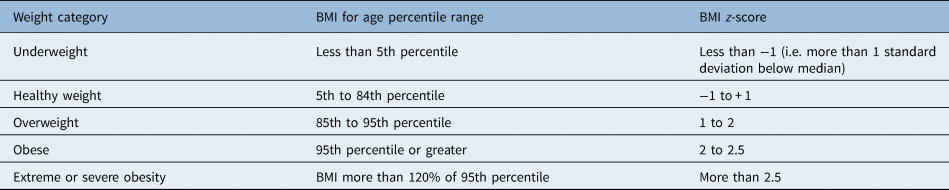
Obstructive sleep apnoea (OSA) is an increasingly common condition in the paediatric population, compounded by rising rates of obesity in young patients.Reference Bentham, Di Cesare, Bilano, Bixby, Zhou and Stevens1,Reference Arens and Muzumdar2 Within the paediatric population, obesity is diagnosed when a child's body mass index (BMI) for age is greater than the 95th percentile. Weight categories for children and adolescents are shown in Table 1.
Weight categories based on BMI for age and BMI z-score for children and adolescentsReference Bentham, Di Cesare, Bilano, Bixby, Zhou and Stevens1,Reference Barlow17,Reference de Onis, Onyango, Borghi, Siyam, Nishida and Siekmann43

BMI = body mass index
In particular, extreme or severe paediatric obesity is noted to be the fastest growing category of obesity in youth and is associated with an increased risk for developing cardiovascular disease and type 2 diabetes.Reference Kelly, Barlow, Rao, Inge, Hayman and Steinberger3 Used interchangeably, extreme or severe obesity is defined as a BMI greater than 120 per cent of the 95th BMI percentile.Reference Flegal, Wei, Ogden, Freedman, Johnson and Curtin4,Reference Koebnick, Smith, Coleman, Getahun, Reynolds and Quinn5 Alternate definitions of extreme obesity include a BMI for age greater than the 99th percentileReference Barlow6 or BMI z-score greater than 2.5.Reference Koebnick, Smith, Coleman, Getahun, Reynolds and Quinn5 Obesity has been demonstrated as an important risk factor for obstructive sleep-disordered breathing,Reference Shine, Coates and Lannigan7 the most severe form of which is OSA. Although the most common cause of upper airway obstruction is adenotonsillar hypertrophy, fat deposition in the pharyngeal muscles and extra-pharyngeal compression from excess subcutaneous fat is also seen in obese children.Reference Shelton, Woodson, Gay and Suratt8 This results in decreased pharyngeal patency and therefore airway obstruction.
Complications of OSA include behavioural problems (depression and hyperactivity), cardiovascular morbidity (hypertension and altered left ventricular geometry) and endocrine morbidity (insulin resistance and metabolic syndrome).Reference Arens and Muzumdar2,Reference Mitchell and Kelly9,Reference Capdevila, Kheirandish-Gozal, Dayyat and Gozal10 These complications may manifest in adult life, resulting in a decrease in quality of life. There is evidence in the literature showing improvement in hypopnoea-apnoea indexReference Martinot, Le-Dong, Denison, Guénard, Borel and Silkoff11,Reference Costa and Mitchell12 and behaviourReference Mitchell and Kelly9,Reference Costa and Mitchell12 in non-obese paediatric patients following adenotonsillectomy. The argument for performing adenotonsillectomy has been further strengthened by a recent Cochrane reviewReference Venekamp, Hearne, Chandrasekharan, Blackshaw, Lim and Schilder13 and a recent publication by Lee et al. (2018) demonstrating improvement in blood pressure measurements post-operatively.Reference Lee, Kang, Chiu, Chang, Weng and Lee14 However, the same results are not seen in obese paediatric patients, and the perceived efficacy of adenotonsillectomy in managing OSA in this subpopulation is waning.Reference Costa and Mitchell12 A recent meta-analysis by Scheffler et al. (2019)Reference Scheffler, Wolter, Narang, Amin, Holler and Ishman15 concluded that the rate of persistent OSA following adenotonsillectomy in obese children ranged from 51 per cent to 66 per cent. Moreover, Lennon et al. (2017)Reference Lennon, Wang, Wallace and Chinnadurai16 demonstrated that for patients with a BMI z-value of over three (two patients within their larger obese cohort), adenotonsillectomy for OSA did not result in any post-operative improvement in polysomnography. This led the authors and others to specify the need for additional assessment of extreme obesity as a distinct group in need of separate evaluation.Reference Barlow17
Within our centre we have therefore specifically reviewed outcomes of paediatric patients with extreme obesity undergoing adenotonsillectomy for the intended treatment of OSA. The aim is to better inform surgeons, parents and patients as to the efficacy of adenotonsillectomy in the context of extreme obesity.
Materials and methods
At our tertiary paediatric centre, an obesity clinic is run by a multidisciplinary team that includes paediatricians, paediatric respiratory physicians, paediatric endocrinologists and dieticians. A database of patients attending this clinic was retrospectively reviewed to identify patients who underwent adenotonsillectomy for treatment of OSA over a 24-month period between January 2015 and January 2017.
Criteria for referral to the obesity clinic were patients with a BMI z-score equal to or more than 3 (corresponding to the 99.87th percentile for BMI) and in need of regular multidisciplinary specialist input. Inclusion criteria for our study were patients with extreme obesity who had adenotonsillectomy performed for OSA. Exclusion criteria were patients aged over 16 years or those with craniofacial or neuromuscular disorders. Paediatric respiratory polygraphy consisted of nocturnal pulse oximetry, audio and video recording along with carbon dioxide monitoring with waking capillary blood gas.
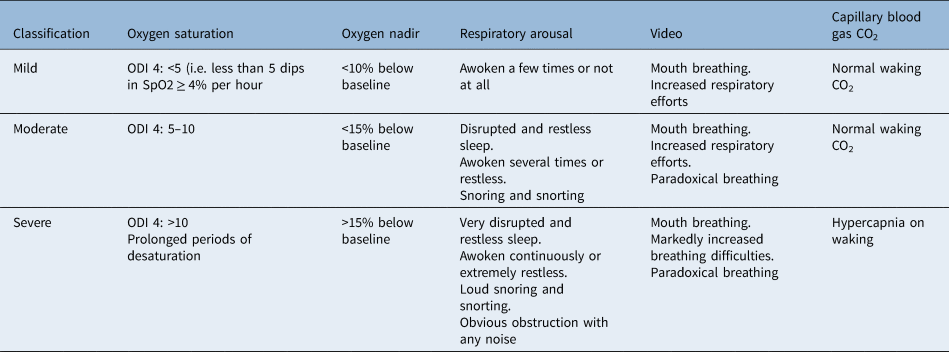
OSA was graded as described in Table 2, based on oxygen saturation on pulse oximetry, partial pressure of carbon dioxide on capillary blood gas, respiratory arousal and audio-visual analysis. An oxygen desaturation index of 4 per cent (number of dips in oxygen saturation equal to or more than 4 per cent per hour) has been demonstrated to have a good positive predictive value for identifying children with OSA.Reference Tsai, Kang, Su, Lin, Huang and Chen18–Reference Brouillette, Morielli, Leimanis, Waters, Luciano and Ducharme21 Partial pressure of carbon dioxide measurements on waking were used to assess adequacy of ventilation in order to ensure the identification of partial airway obstruction and obstructive hypoventilation without apnoeas.Reference Rosen, D'andrea and Haddad22,Reference Nixon and Brouillette23
Criteria for classification of obstructive sleep apnoea on polysomnography

CO2 = carbon dioxide; ODI = oxygen desaturation index; SpO2 = oxygen saturation
Decision for provision of nocturnal non-invasive ventilation was taken through the paediatric obesity clinic based on clinical history, examination and polygraphy results in accordance with European Respiratory Society guidelines,24,Reference Dehlink and Tan25 and this was managed by the paediatric respiratory team. Post-operative follow up and repeat polygraphy was analysed at a minimum of three months post-surgery.
Results
Demographics
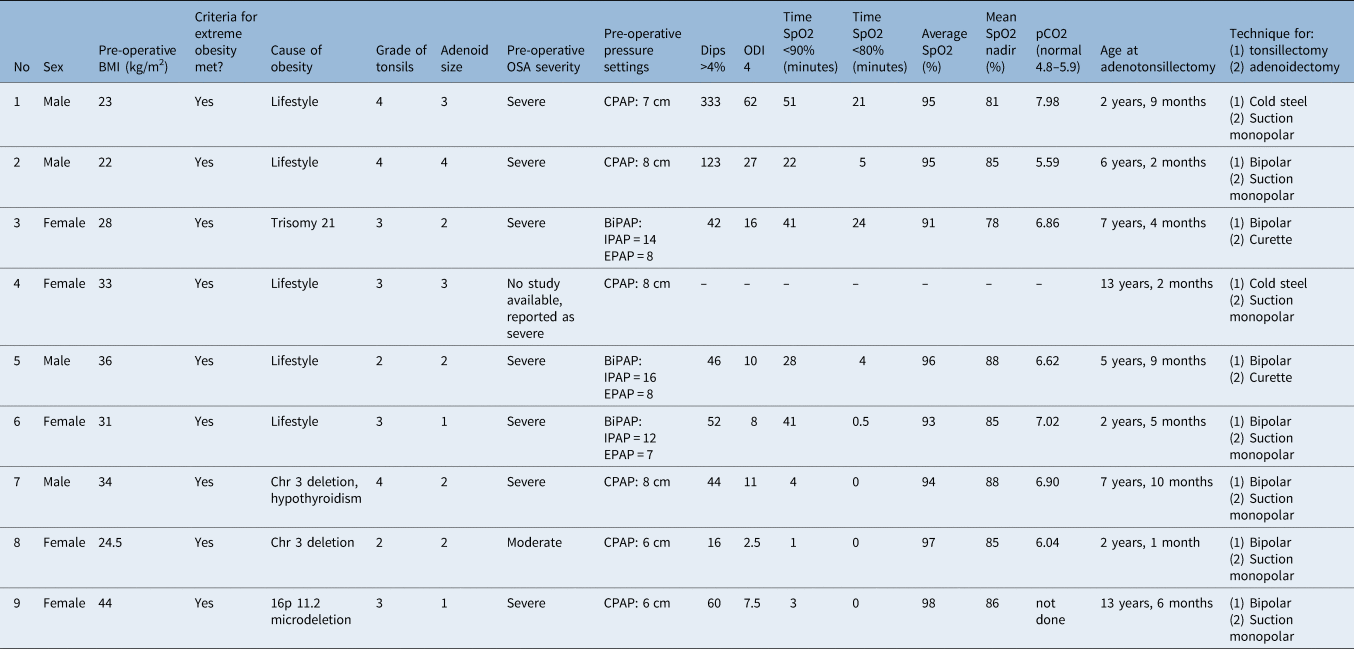
Nine patients with a BMI meeting the criteria for extreme obesity were identified. Four of the patients were male (44.4 per cent) and five were female (55.6 per cent). The mean age at referral to the obesity clinic was 6.9 years (14 months to 13 years, 4 months). All children were 13 years old or below at the time of adenotonsillectomy. Four patients had an underlying known medical cause for obesity (Table 3), whereas for the remainder no medical cause was identified. Two patients had chromosome 3 deletions, one had trisomy 21 and a further had 16p11.2 microdeletion. None of the patients studied had an underlying craniofacial or neuromuscular disorder.
Patients with extreme obesity who had adenotonsillectomy, including pre-operative sleep study results and non-invasive ventilation requirements

All studies were performed with the non-invasive ventilation settings stated. No = number; BMI = body mass index; OSA = obstructive sleep apnoea; ODI = oxygen desaturation index; SpO2 = oxygen saturation; pCO2 = partial pressure of carbon dioxide; CPAP = continuous positive airway pressure; BiPAP = bi-level positive airway pressure; IPAP = inspiratory positive airway pressure; EPAP = expiratory positive airway pressure
Pre-operative assessment
All identified patients had been commenced on nocturnal non-invasive ventilation (six on continuous positive airway pressure (CPAP) and three on bi-level positive airway pressure) prior to adenotonsillectomy by the paediatric respiratory team. Pre-operative non-invasive ventilation pressure settings for each patient are included in Table 3. Seven children (77.8 per cent) had severe OSA, and one child (11.1 per cent) had moderate OSA (further sleep study parameters are included in Table 3). One child did not have a pre-operative polygraphy performed at our centre, but prior to referral was graded as having severe OSA. The mean oxygen nadir of this cohort was 84.5 per cent oxygen saturation. Partial pressure of carbon dioxide values on capillary blood gas were raised in 6 patients (66.6 per cent), were normal in 1 patient (11.1 per cent) and were not taken in 2 patients (22.2 per cent). Mean partial pressure of carbon dioxide for the cohort pre-operatively was raised at 6.7.
Operative findings
All patients received adenotonsillectomy under general anaesthesia. At the time of procedure, three patients (33.3 per cent) had grade 4 tonsils, four patients (44.4 per cent) had grade 3 tonsils and two patients (22.2 per cent) had grade 2 tonsils. One patient (11.1 per cent) had grade 4 adenoids, two patients (22.2 per cent) had grade 3 adenoids, four patients (44.4 per cent) had grade 2 adenoids and two patients (22.2 per cent) had grade 1 adenoids.
In terms of procedure type, the majority of tonsillectomy procedures were performed using bipolar dissection (7 cases; 77.8 per cent), with the remaining 2 cases performed via cold steel dissection. Similarly, with adenoidectomy there was a propensity for suction monopolar, which was used in 7 cases (77.8 per cent), with the remaining 2 cases performed using curette.
Post-operative assessment
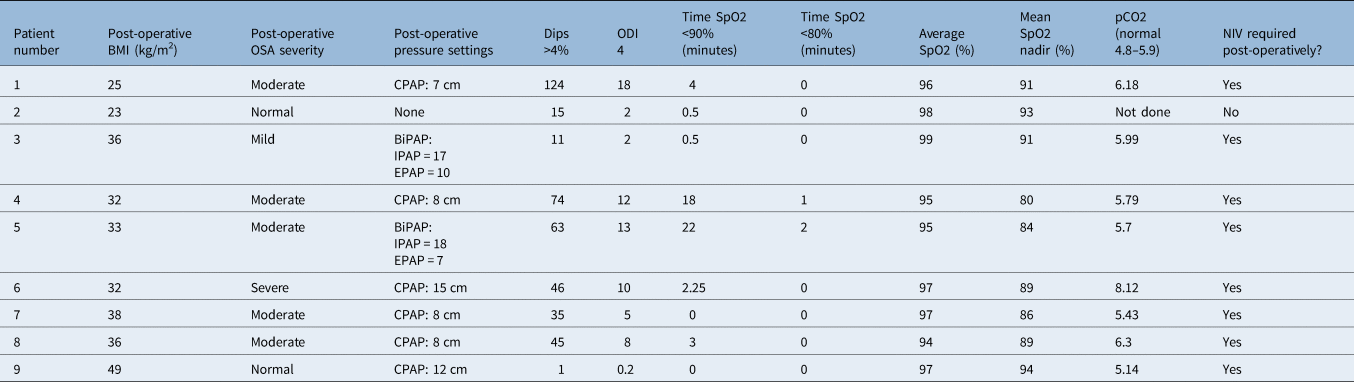
Overall severity of OSA improved on post-operative polygraphy in 7 patients (77.8 per cent) and was unchanged in 2 patients (22 per cent; Table 4). Paired t-test analysis demonstrated a statistically significant increase in mean oxygen nadir (p = 0.04) and reduced time with oxygen saturations less than 90 per cent (p = 0.02) following adenotonsillectomy.
Post-operative BMI, sleep study results and non-invasive ventilation requirements

All studies were performed with the non-invasive ventilation settings stated. BMI = body mass index; OSA = obstructive sleep apnoea; ODI = oxygen desaturation index; SpO2 = oxygen saturation; pCO2 = partial pressure of carbon dioxide; NIV = non-invasive ventilation; CPAP = continuous positive airway pressure; BiPAP = bi-level positive airway pressure; IPAP = inspiratory positive airway pressure; EPAP = expiratory positive airway pressure
Despite this, repeat sleep study and assessment demonstrated persistent OSA in 8 patients (89 per cent) requiring on-going use of non-invasive ventilation (6 on CPAP and 2 on bi-level positive airway pressure). The non-invasive ventilation pressure settings overall were increased in 4 patients (44.4 per cent) and unchanged in 3 patients (33.3 per cent); 1 patient (11.1 per cent) was changed from bi-level positive airway pressure to CPAP. Partial pressure of carbon dioxide on capillary blood gas taken during the polygraphy continued to be raised in 4 patients (44.4 per cent), was normal in 4 patients (44.4 per cent) and was not taken in 1 patient (11.1 per cent). Post-operative BMI reduced in 2 patients (22.2 per cent) but increased in the remaining 7 patients (77.8 per cent), and all patients continued to meet the criteria for extreme obesity post-operatively.
Discussion
Our study represents the largest review of patients exclusively with extreme paediatric obesity (BMI z-score more than three) receiving adenotonsillectomy for OSA. The results demonstrated that despite adenotonsillectomy, 89 per cent of our cases required ongoing use of non-invasive ventilation for OSA, with a surgical cure rate of just 11 per cent. This directly mirrors the experience of Lennon et al.,Reference Lennon, Wang, Wallace and Chinnadurai16 who concluded that a lack of post-operative improvement in two patients with BMI z-score of over three in their cohort required further specific review. With rising rates of obesity in the paediatric population, including those in the extreme obesity category, a cure rate for OSA of just 11 per cent is insufficient given the known sequelae of OSA.
A 2009 meta-analysis of 4 studies by Costa and MitchellReference Costa and Mitchell12 reported that 88 per cent of obese children had ongoing evidence of OSA. Included in this meta-analysis was a study of 30 obese children by Mitchell and KellyReference Mitchell and Kelly26 (2004). Their cohort had a mean BMI z-score of 2.43 (less than 2.5, the threshold for extreme obesity), an average pre-operative BMI of 28.6 (range, 19.2 to 47.1, lower than the average pre-operative BMI of 30.6 in our cohort) and a lower average post-operative BMI 27.9 (compared with 33.8 seen in our cohort). They found a cure rate following adenotonsillectomy of 46 per cent. Given that our study comprised patients with extreme obesity, the lower cure rate is important to acknowledge.
Of the four studies in the meta-analysis, only one included patients treated with non-invasive ventilation. Shine et al. (2006)Reference Shine, Lannigan, Coates and Wilson27 found that 37 per cent were cured with adenotonsillectomy, and 53 per cent had residual OSA sufficient to require CPAP. Unlike our cohort, none of the patients were treated pre-operatively for OSA with non-invasive ventilation, and our study therefore uniquely allows comparison of non-invasive ventilation requirement pre- and post-operatively.
Within the eight patients from our cohort who required ongoing use of non-invasive ventilation post-operatively, half required increased pressure settings and three required the same settings, which suggests that adenotonsillectomy provided no improvement in non-invasive ventilation requirements in 7 out of 9 patients (77.8 per cent). Four patients (44.4 per cent) were hypercapnic on capillary blood gas performed post-operatively, demonstrating ongoing ventilatory failure post-adenotonsillectomy.
Our results provide further evidence that adenotonsillectomy in the extreme obese paediatric population has a far lower cure rate than in the non-obese population, in which a cure rate of greater than 80 per cent was demonstrated in a meta-analysis in 2006.Reference Brietzke and Gallagher28 Furthermore, as our study population consists solely of patients with extreme obesity both pre- and post-operatively, we suggest that the rates of cure following adenotonsillectomy are lower still compared with a ‘non-extreme’ cohort of obese paediatric patients.
By comparison, in a study published in 2019, weight loss therapy demonstrated a cure rate based on the apnoea-hypopnoea index of 38 per cent after approximately 6 months and 44 per cent after 12 months.Reference Andersen, Holm and Homøe29 Similarly, Verhulst et al.Reference Verhulst, Franckx, Van Gaal, De Backer and Desager30 reported resolution of sleep-disordered breathing in 62 per cent of obese paediatric patients after a median of 5.2 months from commencement of weight loss therapy. Although adenotonsillectomy is one of the most commonly performed surgical procedures in the paediatric population, it is not without risk, and obese patients are more likely to develop post-operative respiratory complications.Reference Nafiu, Green, Walton, Morris, Reddy and Tremper31 In a review of patients admitted to paediatric intensive care unit following adenotonsillectomy at a tertiary paediatric centre, a BMI more than the 95th percentile was seen in 35.4 per cent of high-risk patients.Reference Lavin, Smith, Harris and Thompson32 Non-surgical management, especially weight-loss therapy should be considered the first line treatment. If weight loss is successful, but there is ongoing OSA, adenotonsillectomy can be considered in the context of a patient who has reduced their surgical risk through pre-operative weight loss.
Drug-induced sleep endoscopy can be used to assess the anatomy and patency of the upper airway during sedation, mimicking conditions during sleep.Reference Croft and Pringle33 It allows the dynamic assessment of the upper airway and therefore identification of the level of obstruction in OSA. Use of drug-induced sleep endoscopy in the paediatric OSA population has been demonstrated to alter surgical decision making; for example, based on findings during drug-induced sleep endoscopy, a decision can be made to not perform adenoidectomy or tonsillectomy if predicted to be ineffectual.Reference Boudewyns, Verhulst, Maris, Saldien and Van de Heyning34–Reference Gazzaz, Isaac, Anderson, Alsufyani, Alrajhi and El-Hakim36 A 2021 study by Van de Perck et al.Reference Van de Perck, Van Hoorenbeeck, Verhulst, Saldien, Vanderveken and Boudewyns37 demonstrated an association between increased body weight and circumferential upper airway collapse during drug-induced sleep endoscopy, further supporting the idea that the cause of upper airway collapse differs between obese and non-obese children with OSA.
OSA is a condition that carries potential long-term complications if left untreated. Although there is strong evidence that adenotonsillectomy can be curative for OSA in up to 80 per cent of non-obese children, the same results are not demonstrated in obese children and are worse still in the extreme obese population. Management of obesity has been demonstrated to improve OSA and should be actively sought by otolaryngologists before consideration of surgery, particularly in cases of extreme obesity. In this manner, its management more closely reflects surgical trends in adult management of OSA.Reference Kotecha and Hall38
Although the apnoea-hypopnoea index via polysomnography can be utilised to assist stratification of OSA severity, recent work has supported the use of oxygen desaturation index 4 per cent during pulse oximetry in the paediatric population particularly for patients with severe OSA, showing good sensitivity and specificity in this context.Reference Kaditis, Kheirandish-Gozal and Gozal19,Reference Rashid, Zaghi, Scapuccin, Camacho, Certal and Capasso39–Reference Dos Santos, Samuels, Laverty and Raywood41 In addition, other validated parameters such as mean oxygen saturation nadir, respiratory arousal and video feedback were used in combination. Further research has also supported this approach in the follow up of paediatric adenotonsillectomy patients.Reference Liu, Tsai, Su, Lin, Lin and Lee42
• Incidence of paediatric obesity is increasing, with the fastest growth in the extreme obesity category
• Adenotonsillectomy results are worse in obese patients compared with non-obese counterparts
• In this study, patients with extreme obesity had a cure rate for obstructive sleep apnoea of just 11 per cent following adenotonsillectomy
• Eighty-nine per cent of patients required ongoing use of non-invasive ventilation post-operatively
• There was no improvement in non-invasive ventilation pressure settings to suggest any benefit from adenotonsillectomy
Although the cohort of patients studied is small, in the current literature, this is the largest collection of paediatric OSA patients with a BMI z-score more than three who are undergoing adenotonsillectomy. Future engagement in the form of multi-centre collaboration may allow further conclusions to be drawn, yet we believe our work highlights the need to adequately consider the degree of paediatric obesity in discussions on surgical outcomes. The potential summative impact of long-term post-operative weight loss in combination with adenotonsillectomy would be an avenue for further research.
Conclusion
Although adenotonsillectomy is effective in the management of OSA in the non-obese paediatric population, cure rates for OSA in the obese paediatric population are far lower. This study demonstrates a poor success rate for adenotonsillectomy in children with extreme obesity, adding further evidence that this method of treatment is of limited use in isolation and instead should be used in conjunction with weight loss and further strategies. The management of OSA in the obese paediatric population and especially the extreme obese subpopulation therefore requires a shift in the priority given to surgical treatment, with focus on weight loss with non-invasive ventilation where required to prevent other sequelae. As such, patient and parental counselling should be tailored to ensure the awareness that adenotonsillar surgery is unlikely to alter non-invasive ventilation usage or pressure settings when assessed after three months post-operatively.
Competing interests
None declared