1 Introduction
1.1 What are light verb constructions?
Agreed-upon definitions of light verb constructions (LVCs) both crosslinguistically and within a language remain elusive (see Jespersen Reference Jespersen1942, Grimshaw & Mester Reference Grimshaw and Mester1988, Rosen Reference Rosen1989 and Butt Reference Butt1995 for some varieties of definitions). Putting aside definitional differences, this research focuses on constructions consisting of a semantically general, highly polysemous verb (e.g. make) and a noun (e.g. offer) that denotes an event or a state. These two elements together create a complex predicate (e.g. make an offer): while the noun provides the majority of the event semantics, the verb both syntactically licenses this and modulates the meaning of the expression in a variety of manners and extents depending upon the exact LVC (Butt Reference Butt, Amberber, Baker and Harvey2010). The verbs allowed in these constructions have relatively low ‘cue validity’ in the sense expressed by Goldberg (Reference Goldberg2006: 109), meaning that the verb alone is not a very reliable predictor of overall sentence meaning. Nonetheless, the contribution of the verb in the overall meaning of the complex predicate is easily seen when we compare two LVCs with the same noun but a different verb; for example:

Here, the choice of light verb can alter the valency of the complex predicate, allowing for the addition of an agent argument in (1a). Despite individual differences in LVCs, in all cases, it is the noun that provides most of the information about the event or state (i.e. expresses the predication of the utterance).
These constructions are distinct from ‘heavy’ usages of the same verb. A heavy usage is one in which the verb sense is a canonical, literal sense. For example, a heavy sense of make is ‘create’, take is ‘cause motion/get into one’s possession’, have is ‘possession’, and give is ‘transfer possession’ (e.g. make a cake, take a book off the shelf, have a television, give a present). The heavy usages can generally be interpreted compositionally: each component word contributes its lexical semantics to the sentence meaning.
LVCs, such as have a drink and take a walk, are neither purely idiomatic nor purely compositional in their meaning. They are somewhat idiomatic because their interpretation relies upon recognizing that the semantics of these phrases, including the roles of participants in the events, stem largely from the nominal complement rather than the verb. For example, the aforementioned phrases, have a drink and take a walk do not generally express events of possession or transfer of possession in context, as one may expect when considering the verbs have and take, respectively. Rather, these phrases express events of drinking and walking. Thus, despite the fact that these phrases are syntactically indistinguishable from phrases like have a toy or take a toy, these particular combinations of words carry special meaning. In this way, LVCs are similar to idioms like trip the light fantastic ‘dance’. However, LVCs clearly differ from fixed, non-compositional idioms like kick the bucket, in which the meaning of the phrase, ‘die’, has no clear relationship to the component words of the phrase. The meaning of the nominal complement within an LVC is quite transparent; it is the combined meaning of the verb and noun that is idiomatic, and arguably changeable depending upon the verb and noun combined. Thus, LVCs are neither fully idiomatic nor fully compositional, and can best be thought of as semi-compositional.
1.2 What is the function of English light verb constructions?
English LVCs in particular pose interesting theoretical questions because crosslinguistically they are somewhat unusual. It is generally possible to define LVCs syntactically according to language-dependent criteria (Grimshaw & Mester Reference Grimshaw and Mester1988; Butt Reference Butt1995, Reference Butt, Aygen, Bowern and Quinn2003, Reference Butt, Amberber, Baker and Harvey2010), and it is common for LVCs to exist in complementary distribution with lexical verbs, such that LVCs are exploited where a lexical verb counterpart for the concept does not exist (Zarco Reference Zarco and Saint-Dizier1999). For example, drawing on the work of Schultze-Berndt (Reference Schultze-Berndt2000, Reference Schultze-Berndt2002), Butt (Reference Butt, Aygen, Bowern and Quinn2003) points out that light verbs in the Australian language Jaminjung can be recognized based on their distribution. Jaminjung has a class of coverbs, which do not inflect and seem to share characteristics with both verbs and adverbs. Additionally, the language has a closed class of inflecting verbs that can be used as a main verbs, but when combined with a coverb, their predicational power is light (below, ‘go’ is the inflecting verb with light semantics, while ‘race’ is the coverb):

Thus, the light verb usages can be recognized by their patterning with coverbs.
Northern Australian languages like Wagiman (Wilson Reference Wilson1999), Bardi (Bowern Reference Bowern2002), and Jaminjung bring to light an important feature of LVCs crosslinguistically. These languages make extensive use of LVCs, and this seems to be related to the fact that there is a relatively small, closed class of inflecting predicates. Thus, LVCs fill a void in the language’s resources, extending the array of meanings that can be expressed with a closed set of inflecting predicates.
In contrast, English LVCs are not syntactically distinguishable from other verb + noun constructions (Butt & Geuder Reference Butt, Geuder, Corver and van Riemsdijk2001). Furthermore, LVCs in English and Romance languages tend to have semantically similar synthetic verb counterparts (Zarco Reference Zarco and Saint-Dizier1999). For example, from the Corpus of Contemporary American English (COCA; Davies Reference Davies2008):

This runs contrary to assumptions in linguistic theories that two competing forms are rarely maintained in a language unless they serve distinct purposes (e.g. Grice Reference Grice, Cole and Morgan1975). This research aims to explore what distinct purposes these two forms serve.
The importance of addressing this question goes beyond theoretical interest, impacting how LVCs are defined and represented in Natural Language Processing (NLP) annotated data resources and therefore how they are modeled in the applications trained on that data. Existing NLP corpora of LVC annotations largely make the limiting assumption that all English LVCs are interchangeable, or rephrasable, with their counterpart lexical verbs (e.g. Tu & Roth Reference Tu, Roth, Kordoni, Ramisch and Villavicencio2011, Banarescu et al. Reference Banarescu, Bonial, Cai, Georgescu, Griffitt, Hermjakob, Knight, Koehn, Palmer and Schneider2013). Interchangeability is the most common heuristic for identifying LVCs; therefore, only LVCs that have a related counterpart have been included in annotated corpora, while those that lack an interchangeable counterpart tend to be ignored. Since only LVCs with counterparts are included in most data, the assumption that LVCs can be interpreted, translated, and generated interchangeably with their verb counterparts is propagated. If LVCs do carry a specialized function in English in comparison to their synthetic verb counterparts, as most linguistic theories would posit, then this function is getting lost in many language models. This may be especially problematic for crosslinguistic applicability, given that LVCs in many languages do not have interchangeable synthetic counterparts. To facilitate more accurate models with greater crosslinguistic validity, it is critical to provide corpus-based evidence outlining what the general function of LVCs might be.
1.3 Research overview
Two relatively prominent hypotheses concerning LVC function are explored in a corpus study: (i) an aspectual function – LVCs are telic whereas synthetic verb counterparts are atelic, and (ii) a modification function – LVCs can express a wider range of descriptions of the same event given the array of nominal modification possible. Related work summarized here provides insights into the potential validity of both of these hypotheses. However, an empirical, corpus-based analysis has previously been precluded given the challenges of creating resources that would facilitate such an analysis. Addressing this gap in resources, the present research describes the development and refinement of guidelines for the annotation of LVCs in the English PropBank (Palmer et al. Reference Palmer, Gildea and Kingsbury2005, Bonial & Palmer Reference Bonial, Palmer, Calzolari, Choukri, Declerck, Goggi, Grobelnik, Maegaard, Mariani, Mazo, Moreno, Odijk and Piperidis2015). The focus of this article is the subsequent analysis of these annotations, aimed at uncovering corpus evidence of what contexts call for the use of an LVC over a synthetic verb.
2 Related work on LVC function
There has been research attempting to pinpoint how individual LVCs differ from their synthetic verb counterparts (Wierzbicka Reference Wierzbicka1982, Lakoff Reference Lakoff1987, Norvig & Lakoff Reference Norvig, Lakoff, Aske, Beery, Michaelis and Filip1987), and these differences range from volitionality to aimlessness. While enumerating such individual differences is valuable, pinpointing them on the scale that would be required for NLP may be intractable. Generalizing a bit further, Wittenberg & Snedeker (Reference Wittenberg and Snedeker2014) and Wittenberg, Khan & Snedeker (Reference Wittenberg, Khan and Snedeker2017) experimentally study differences in the conceptualization of thematic argument structure in give LVCs and their transitive, synthetic verb counterparts. In contrast to these approaches, the present research turns to empirical facts about the usages of LVCs and counterpart lexical verbs to demonstrate a more general function of LVCs across various light verb and noun combinations. Related work, which elucidates two dominant hypotheses pertinent to general LVC function, is discussed in the sections to follow.
2.1 Related work: Aspectual function of light verb constructions
One of the most widely proposed semantic differences between lexical verbs and LVC counterparts are aspectual differences: most commonly, the LVC counterpart is thought to lend a sense of boundedness, or telicity to the event denoted. Butt (Reference Butt, Aygen, Bowern and Quinn2003) points out that LVCs crosslinguistically tend to affect the Aktionsart of the joint predication by rendering the event bounded. Similarly, according to Wierzbicka (Reference Wierzbicka1982: 757), the clear difference between the lexical verbs and the periphrastic have a V construction is that the latter presents the action or process as limited in time. Several authors postulate this difference as the key motivation for LVCs as a distinct mode of expression: ‘the characteristic [of LVCs], which is most consistent and which perhaps makes for its widespread use, is aspectual connotation’ (Live Reference Live1973: 34). Brinton & Akimoto (Reference Brinton and Akimoto1999a) cite LVCs in English as an important means of making situations telic, specifically by converting activities into accomplishments or achievements, without the necessity of stating an explicit goal. As well as adding telicity, perfectivity is also occasionally associated with LVCs in contrast to their counterpart lexical verbs (Prince Reference Prince and Plötz1972, Stein Reference Stein1991).
The presence or absence of articles accompanying the noun seems to play a role in the interpretation of telicity. Indeed, the outward evidence of the difference in telicity that is often pointed to is the presence of articles modifying the eventive/stative noun, which is taken to indicate the countable, bounded nature of the situation expressed (Wierzbicka Reference Wierzbicka1982, Brinton & Akimoto Reference Brinton and Akimoto1999a, Butt & Geuder Reference Butt, Geuder, Corver and van Riemsdijk2001). For example, although the event is arguably the same, give a groan lends telicity, while groan is atelic. However, note that if articles play an important role in the telic nature of LVCs, then one may expect article use within LVCs to be fairly consistent; this will be explored further in Section 3.3.
In an experimental study in which participants are asked to estimate the duration of the same event expressed as a give–a LVC (e.g. give a kiss) or a synthetic verb (e.g. kiss), Wittenberg & Levy (Reference Wittenberg and Levy2017) find that participants reliably estimate the duration of LVCs to be shorter than synthetic verb counterparts. Notably, the authors also find that give LVCs with mass nouns (e.g. give advice) are perceived as shorter in duration than synthetic verb counterparts (e.g. advise). The authors conclude that the trend toward shorter duration estimates indicates that the LVCs are perceived as bounded in their event semantics. Although relevant, Wittenberg & Levy’s findings may not be directly comparable to the current research since they make distinctions based upon punctive and durative events that are not made here; thus, boundedness/telicity is defined somewhat differently (see Section 3.2.4 for linguistic tests used to determine telicity here). Additionally, the current research explores a variety of LVCs whereas Wittenberg & Levy’s findings stem from a study of give LVCs only.
2.2 Related work: Modification function of light verb constructions
Akimoto & Brinton (Reference Akimoto and Brinton1999) cite the importance that modification seems to play in the preference for LVCs. The authors note that most LVCs are characterized by adjectival modification of the noun, relativization, or conjoined nouns. Given this fact, they consider ease of modification and facilitation of conjunction the primary motivation for use of LVCs in Old English (OE) (Akimoto & Brinton Reference Akimoto and Brinton1999: 51–52).
Compared with the 114 LVC types observed by Akimoto & Brinton (Reference Akimoto and Brinton1999) in OE, Matsumoto (Reference Matsumoto1999) finds that there are 990 LVC types observed in the texts of ME, with many stemming from the works of Chaucer and Malory. Matsumoto observes that LVCs seem to be a preferred expression in the works of Chaucer and Malory, and believes that LVCs are used as a poetic, stylistic device (1999: 61). This seems fitting given certain metrical considerations involved in such literary works. In ME as in OE, there are lexical verb equivalents to LVCs, and Matsumoto specifically compares LVCs with adjectival modifiers to equivalent lexical verbs with adverbial modification, and concludes as follows:

In fact, constructions with lexical verbs along with adverbs were extremely rare in Chaucer and Malory. However, Matsumoto theorizes that for LVCs that seemed more idiomaticized through frequent use, the status of the LVC becomes more similar to that of a single, unified verb. The tighter connection of light verb + noun increases the likelihood that the LVC will take adverbial modifiers, as opposed to adjectival modifiers of the noun. Consider the following case of the frequently used LVC make vow, which includes adverbial modification devoutly:

Thus, Matsumoto demonstrates that while adjectival modification seems to be an important factor in the preference for LVCs, the presence or absence of adjectival modification and adverbial modification may be affected by how frequent and fixed, or idiomaticized, the expression is.
Similarly, Kyto (Reference Kyto1999), examining early Modern English, sees the major reason for LVCs’ popularity as the flexibility and modifiability of the structure in comparison to the more rigid lexical verb. Kyto (Reference Kyto1999) is one of the few to indicate an actual percentage of modified LVCs in Early Modern English. Kyto finds that overall, approximately 70% of LVC instances include modification, and when the nouns in LVCs are plural, modification is found in 90% of the cases observed (ibid.: 182–183). Although debatable, Kyto (Reference Kyto1999), like Matsumoto (Reference Matsumoto1999), finds evidence that older, more frequent LVCs are more likely to appear without modification of the noun, indicating that these LVCs may have increased in syntactic fixity over time.
Finally, Nickel (Reference Nickel1978: 77), who focuses on reanalyzing complex verbal structures within the framework of generative transformational grammar, also concludes that ‘the main motivation ... is the fact that the nouns used in complex structures can be modified in various ways to give expression to infinite shades of meaning’. This leads to the question of whether ease of modification may be the primary factor for selecting an LVC over a lexical verb counterpart in today’s English.
2.3 Hypotheses from related work
The survey of related work exploring the function of LVCs suggests that there are two dominant possibilities as to the function or motivations for use of an LVC over a counterpart lexical verb:

Note that these hypotheses are not mutually exclusive, as modification within the noun phrase that modulates aspect is plausible: She gave me a single, quickkiss. Each of these hypotheses are evaluated in the corpus study described next.
3 Corpus study on LVC function
To our knowledge, there are no corpus-based, published studies comparing the modification and aspectual properties of present-day English LVCs to counterpart synthetic verbs. This may stem from the fact that such a study would rely upon consistent identification of LVCs in corpora. Within NLP, there have been a variety of efforts to create such corpora (e.g. the TectoGrammatical Treebank (TTree; Cinková et al. Reference Cinková, Hajič, Mikulová, Mladová, Nedolužko, Pajas, Panevová, Semecký, Šindlerová, Toman, Urešová and Žabokrtský2004) and the British National Corpus data set of Tu & Roth Reference Tu, Roth, Kordoni, Ramisch and Villavicencio2011), motivated by the fact that distinguishing LVCs and subsequently interpreting them distinctly from heavy usages is crucial for application areas such as natural language understanding and machine translation.
Each of these corpora differs in their definition of LVCs; therefore, what is included and excluded can vary widely. Furthermore, existing LVC annotation efforts make simplifying assumptions of what constitutes an LVC, and rely primarily upon a ‘rephrasing test’ for determining LVC-hood: can the potential LVC be rephrased as a synthetic verb without a significant loss or change in meaning? Although intuitively appealing, reliance on this heuristic provides an overly narrow view of LVCs, since there are two kinds of LVCs that are difficult to test using rephrasing. First, some LVCs in English have no etymologically related verbal counterpart (e.g. commit suicide). Secondly, some LVC counterparts of verbs affect valency in a manner similar to the passive voice (e.g. make a call vs. get a call); if these are rephrased with a synthetic verb in the active voice, the meaning is distinct. Given that they are problematic for the rephrasing test, these two relatively common kinds of LVCs have been largely left out of existing annotated corpora, despite the fact that most linguistic theories would include them as LVCs. What’s more, identifying the first kind (with no etymological verb counterpart) is of crucial importance to the question of LVC function, as will be seen in Section 3.2.2.
In order to address the gap in resources that would enable robust linguistic research on LVCs and facilitate more comprehensive and consistent annotations supporting automatic identification of LVCs, a necessary first step in the present research was creating a large-scale, theoretically-grounded corpus of LVC annotations. Thus, the benchmark NLP corpus, PropBank, was extended to include LVC annotations.
3.1 Development of the PropBank LVC annotation schema
The goal of PropBank is to supply consistent, general-purpose labeling of semantic roles across different syntactic realizations. With over two million words from diverse genres, the annotated corpus supports the training of automatic semantic role labelers, which in turn support other NLP areas, such as question-answering. PropBank annotation consists of two tasks: sense and role annotation. The PropBank lexicon provides a listing of the coarse-grained senses of a verb, noun, or adjective relation, and the roles associated with each sense (known as a ‘roleset’). The roles are listed as argument numbers corresponding to verb-specific roles. For example:

Previous versions of PropBank maintained separate rolesets for distinct parts of speech (e.g. the verb offer, and the related nouns offer/offering) but, as part of this body of research, these have been combined to provide parallel annotations of related usages (Bonial et al. Reference Bonial, Bonn, Conger, Hwang and Palmer2014, Reference Bonial, Conger, Hwang, Mansouri, Aseri, Bonn, O’Gorman, Palmer, Pustejovsky and Ide2017). For example:

Prior to this research (see also Hwang et al. Reference Hwang, Bhatia, Bonial, Mansouri, Vaidya, Xue, Palmer, Xue and Poesio2010), PropBank 1.0 had no special guidelines for LVCs. Therefore, example (5b) above would have been annotated according to the semantic roles found in the verb roleset, make-01 meaning ‘create’, which is, at best, metaphorically related to the LVC usage. Thus, this practice conflated LVC usages like make an offer with heavy usages of the same verb, like make a cake, in which make is used in its heavy, ‘creation’ sense.
Clearly, LVCs require a unique annotation procedure that represents the event semantics of the construction stemming from the noun, as opposed to the verb. First, however, we must recognize LVCs consistently. This has been problematic, given that definitions of LVCs crosslinguistically and within a language remain nebulous. Nonetheless, LVCs in English are largely thought to consist of a semantically general, highly polysemous verb and a noun denoting an event or state (e.g. Butt Reference Butt, Aygen, Bowern and Quinn2003). More detailed aspects of LVCs remain debatable.
The following basic criteria, established through a survey of linguistic research on LVCs, are the starting point of the annotation guidelines for LVCs:

This basic definition does not allow for consistent manual, much less automatic, detection of LVCs since surface-identical forms can be LVCs or heavy usages of the same verbs:

Such usages are syntactically indistinguishable (Butt & Geuder Reference Butt, Geuder, Corver and van Riemsdijk2001); thus, neither annotators nor automatic systems can rely on syntactic criteria to identify LVCs and must use semantic criteria instead.
Current PropBank guidelines therefore focus on the semantic nature of arguments.Footnote [4] This helped to ground the guidelines in theoretical research on English LVCs, which generally assumes that the semantic content of the construction stems from the noun, while the verb provides the syntactic scaffolding for the noun to act as the main predicate (Grimshaw & Mester Reference Grimshaw and Mester1988, Butt Reference Butt, Aygen, Bowern and Quinn2003). Accordingly, the arguments, including the syntactic subject of the verb, will carry the semantic roles of the noun. Thus, the annotators are instructed to compare the fit of the semantic roles listed for the verb’s roleset to that of the noun’s roleset.
To briefly give a sense of these guidelines in use, consider the earlier sentence from example (5), involving make_offer. Annotators would examine the potentially relevant rolesets to decide which is more fitting. Given the roleset for the heavy sense of make:

The following annotation would be assigned:

On the other hand, the roleset for offer,

facilitates the following annotation:

The verb-centric annotation in (7) does not capture the semantics of the ‘offer’ event, instead focusing on make as if it were a heavy verb. Thus, an argument (to acquire PS) lacks an appropriate tag in the roleset. The noun roleset offer-01 provides the appropriate roles to label each argument. Furthermore, the span of annotation for the complex predicate includes the domain of locality of the noun, allowing for the Arg2 price to be captured in (8). Given these considerations, the semantic roles appear to be assigned by the noun relation, guiding the annotator to conclude that the usage should be annotated as an LVC.
The success of these guidelines has been demonstrated in the high agreement rates between annotators.Footnote [5] On a task composed solely of the most likely LVs (give, have, take, make, do), the agreement rate between annotators was 93.8%.Footnote [6] As proof of the quality of PropBank’s annotations, an automatic LVC detection system has been trained on the OntoNotes 4.99 corpus (Weischedel et al. Reference Weischedel, Hovy, Palmer, Marcus, Belvin, Pradhan, Ramshaw, Xue, Olive, Christianson and McCary2011), of which PropBank is one layer. This system achieves a state-of-the-art F-score of 89% (Chen, Bonial & Palmer Reference Chen, Bonial, Palmer, Rossi and Ahmed2015) when tested on the same data used by Tu & Roth (Reference Tu, Roth, Kordoni, Ramisch and Villavicencio2011) to establish the previous state-of-the-art system with an F-score of 86.3%.Footnote [7]
3.2 Corpus study on LVC function: Materials and methods
3.2.1 Additional modifier tags
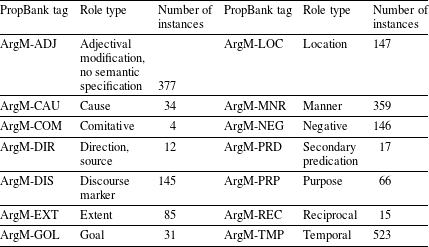
The PropBank corpus includes annotations identifying English LVCs and providing semantic role tags for each of the arguments of the complex predicates, including both syntactic arguments of the light verb and syntactic arguments of the nominal predicate. In the PropBank corpus, frequent or more core arguments are assigned numbered arguments while adjuncts or modifier arguments are assigned an ArgM (Modifier) label. Table 1 gives the possible ArgM labels that can be used with noun relations, as well as the number of instances of each tag found in the PropBank sample of 1,820 LVC annotations. Definitions are drawn from the PropBank annotation guidelines.Footnote [8]
Noun relation ArgM types, with number of instances found in LVC annotations.

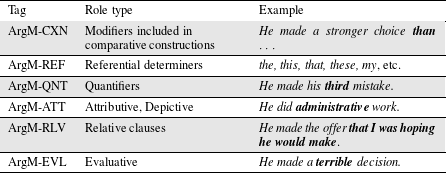
Unfortunately for this research, these labels do not include tags for a variety of modifier types that may be of interest for the study of LVC function: modifiers that are unique to nouns and can generally only be expressed periphrastically with verbs – precisely the type of modifiers that, if needed for conveying the intended meaning, would require expression of the event as a noun within an LVC. (For example, quantifiers, as in He gave her a secondkiss that day, and relative clauses, as in He gave her the kiss that changed everything, are only compatible with nominal expressions of events.) Without a more specific tag, such arguments are assigned the general ArgM-ADJ tag, which can include any type of modifier or argument of a noun relation that does not fit one of the other categories, or they are assigned no tag at all in the case of most determiner types. In order to further study modification within LVCs, all LVC PropBank instances were annotated with additional modifier tags by two PropBank adjudicators, including one of the present authors. The tags were only assigned within the domain of locality of the noun. The additional tags are given in Table 2.
Modifier tags developed for the LVC function corpus study, which reflect modifier types that are often used with nouns, but are either incompatible with verbs or can only be used periphrastically with verbs.

3.2.2 Categories of LVCs in relation to lexical verbs
A pilot study in the COCA corpus distinguished three categories of LVCs with potentially differing functions in contrast to synthetic verbs. The three categories differ in the character of the noun denoting an event or state: (i) morphologically related to a lexical verb, or a zero-derived nominal that is identical to a lexical verb (e.g. make a decision, make an offer); (ii) etymologically related to a lexical verb (e.g. have a thought, give a speech); or (iii) not clearly related to a verb from a synchronic perspective (e.g. give an overview, make an effort).
LVCs of category (iii) are perhaps the simplest to explain in terms of semantic differences from lexical verbs as they mirror a crosslinguistically common situation: because there is no exact lexical verb alternative in the language that can be used to express the concept, speakers will use an existing eventive noun within an LVC to express the concept instead. LVCs of category (ii), while similar to category (iii), are slightly more problematic for an explanation of how LVCs differ from lexical verbs because nearly equivalent lexical verbs exist, which can be used to express the same event. Finally, LVCs of category (i) are especially perplexing: why should an LVC exist to express a concept that can clearly be expressed (more economically) by a lexical verb alone? For example, I made a decision to buy the house versus I decided to buy the house.
The pilot study showed that LVCs of category (i) and (ii) do tend to have higher levels of modification than LVCs of category (iii), motivating the following, refined version of the Modification Function Hypothesis:

According to this hypothesis, we might expect to see higher levels of modification across category (i) and (ii) LVCs, and lower levels of modification across category (iii) LVCs. Furthermore, we might expect to see higher levels of modification in LVCs of categories (i) and (ii) in comparison to their counterpart lexical verbs. To test the Modification Function Hypothesis on a larger scale, each of the PropBank LVC annotations was annotated with the LVC category, in addition to the more refined argM labels.
3.2.3 Corpus summary
Within the adjudicated, gold-standard LVC annotations, the top 19 most frequent LVCs of categories (i) and (ii) were determined (LVCs with six or more occurences). For these LVCs, all of the PropBank annotations of counterpart verbs were also extracted. For comparison to nouns outside of LVCs, 18,734 annotations of noun relations not included in LVCs were also extracted (see end notes for results of this comparison). The result was a corpus of 1,820 detailed LVC annotations with the additional noun modifier tags and LVC category ((i)/(ii)/(iii)), a corpus of 10,432 annotated counterpart verb tokens, and a corpus of 18,734 annotated noun relations found outside LVCs. Finally, searches in COCA for attested LVCs extracted from PropBank provided supplementary data and example usages for qualitative exploration of the function of LVCs.
3.2.4 Aspectual distinctions
In this research, whether or not an LVC or counterpart lexical verb was telic, with an inherent endpoint, was considered through the lens of research on Aktionsart from Van Valin & LaPolla (Reference Van Valin and LaPolla1997). To determine whether or not a given usage of a predicate was telic, tests for determining Aktionsart type were employed (ibid.: 94). Both achievements and accomplishments are [ $+$telic], a feature indicating that the predicate depicts a state of affairs with an inherent terminal point (ibid.: 93). VanValin & LaPolla point to two specific tests that distinguish telic from non-telic predicates:

These tests isolate the properties of duration in time and whether or not an event has terminal endpoints. Van Valin & LaPolla (Reference Van Valin and LaPolla1997) indicate that while states and activities readily take the for-phrase duration, telic activities and accomplishments are generally only compatible with the in-phrase duration, and sometimes only very short durations (e.g. in the blink of an eye). Thus, if an LVC or counterpart verb usage was compatible with the for-phrase test, but not compatible with the second in-phrase test, it was determined to be [–telic], and, conversely, if it was not compatible with for but compatible with in-phrase durations, it was determined to be [+telic] (e.g. I thought about aspect for an hour is [–telic]; vs. ?I had a thought about aspect for an hour, which is [+telic]).Footnote [9]
There is a certain amount of aspectual indeterminacy involved in some LVCs. For example, it does not seem incorrect to say either I took a shower for twenty minutes or I took a shower in twenty minutes. For this reason, this research does not attempt a full empirical analysis of the aspectual properties of LVCs, instead focusing on broader descriptions providing evidence for and against the possibility of an aspectual function of LVCs.
3.3 Aspectual function of LVCs: Results and discussion
Aspectual differences are clearly found in certain LVCs of English. Consider the following examples of the activity verb, think, and its counterpart LVC have a thought:

While (9a) gives the impression of an event that may have continued for an undetermined time, (9b) gives the impression of an endpoint of the moment when the ‘thought’ arises. However, if we consider the very same LVC (have + thought), we can see other examples where the construction does not seem to lend telicity:

In the above cases, where ‘thought’ is plural and lacks a determiner, the LVC doesn’t necessarily give an impression of a bounded, telic event, nor does it necessarily carry the meaning of iterative, bounded periods of thinking. In the final example above, the light verb is in the progressive, indicating that the event is durative rather than punctual (Van Valin & LaPolla Reference Van Valin and LaPolla1997).
If LVCs exist as a resource in the English language separate from lexical verbs because LVCs lend telicity to the event, then it follows that we would see a consistent distinction in telicity between a lexical verb [–telic] and LVC counterpart [+telic]. As demonstrated above, this does not seem to be true for all realizations of a single LVC, and it certainly does not seem to be true of all LVCs. Clear counter-evidence comes from LVCs characterized by nouns that denote states (understanding – see example (11) below) or events that are already inherently telic (decision, appearance – see examples (12) and (13)):

Thus, it seems as though the facts of English do not point to a consistent transformation from an atelic lexical verb to a telic LVC counterpart.
As opposed to LVCs conveying telicity, the character of the noun (whether it is a mass or count noun, singular or plural) often conveys the telicity of the LVC. This can be evident from the article, or lack thereof, accompanying the noun (e.g. have a thought is telic, have thoughts is atelic). Again, if the primary function of LVCs was to lend boundedness to the event or state described, then one might expect the construction to consistently require the form of light verb + a + noun. This is not the case, however. Some LVCs almost always occur with articles, some optionally occur with articles, and others never appear with articles:

Even in cases where the noun involved is an unbounded mass noun (and therefore, potentially particularly ‘ripe’ for transformation into a bounded event within an LVC), the LVC encompassing this noun is not necessarily telic, again indicating that there is no consistent relationship between the aspectual quality of the event or state denoted by the noun and the resulting aspect of the LVC. For example:

Thus, the telicity of the event expressed by an LVC seems to be more closely associated with the nature of the noun and the interplay of the noun with the tense of the light verb, as opposed to the construction.
3.4 Modification function of LVCs: Results and discussion
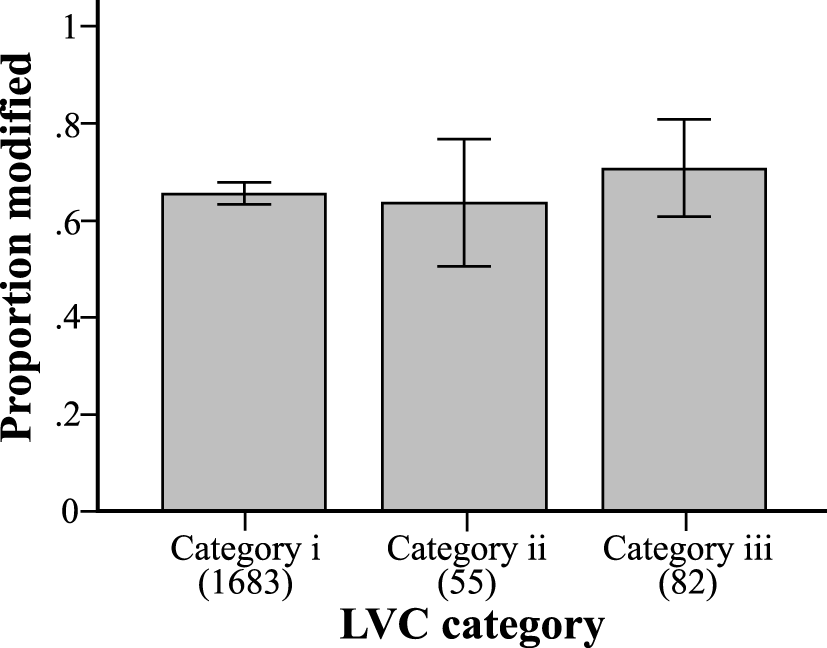
The refined version of the Modification Function Hypothesis is compatible with the expectation that levels of modification may be higher across LVCs of categories (i) (derivationally related to a verb or a zero-derived nominal) and (ii) (etymologically related to a verb) than category (iii) (no clear synchronic relationship to a synthetic verb), as seen in the pilot study. This finding was not replicated in the full corpus study. A chi-square test was performed to examine the relationship between LVC category ((i)/(ii)/(iii)) and modification. There was no significant difference in modification across LVC categories  $(\unicode[STIX]{x1D712}^{2}(2,N=1820)=1.05,p=.59)$.
 $N$
 $=$ total number of cases across all categories. Modification of categories (i) and (ii) LVCs considered together also did not significantly differ from that of category (iii) LVCs (
 $\unicode[STIX]{x1D712}^{2}$(1,
 $N=1820$)
 $=$ 0.96,
 $p=.33$). These results are summarized in Figure 1, which also lists in parentheses the number of cases in each LVC category ((i)/(ii)/(iii)) found in the corpus. Error bars indicate 95% confidence intervals (CIs).
Proportion modified (±95% CI) for each category of LVC. The number of cases in each category is shown in parentheses.

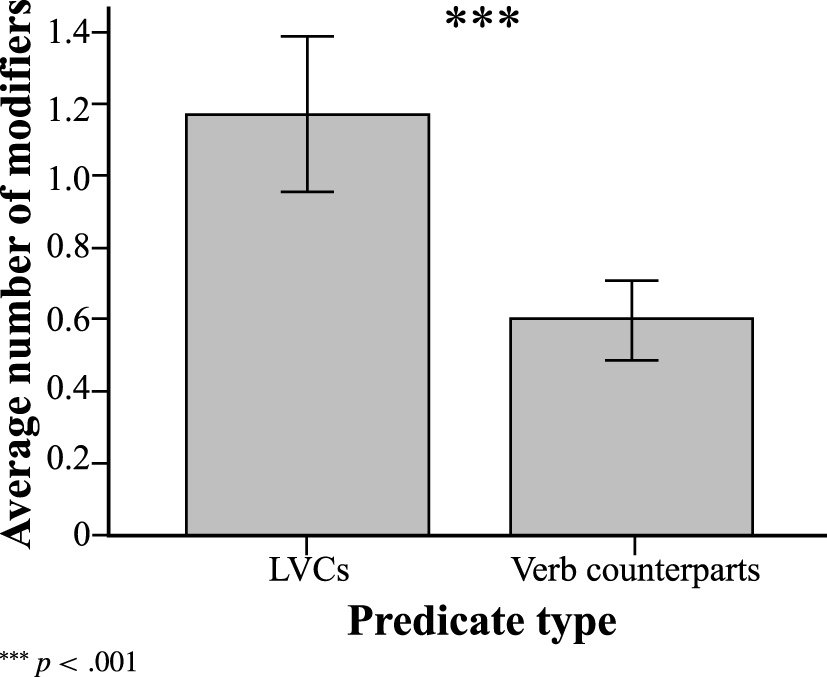
Number of modifiers (mean ±95% CI) associated with LVCs and verb counterparts.

The portion of the Modification Function Hypothesis predicting that levels of modification will be higher across LVCs than their counterpart lexical verbs was clearly supported. LVCs were associated with significantly more modifiers ( $M=1.17$, SD
 $=$ 0.45) than were verb counterparts (
 $M=$ 0.60, SD
 $=$ 0.23;
 $t$(36)
 $=$ 4.93,
 $p$ < .001). Data were checked for normality and homogeneity of variance, and met the required statistical assumptions. Due to the diverse and often idiomatic usage of these words, they were deemed to be independent, rather than paired, samples. However, using a paired-samples comparison yielded the same results, with LVCs having significantly more modifiers than their specific verb counterparts (
 $t$(18)
 $=$ 5.60,
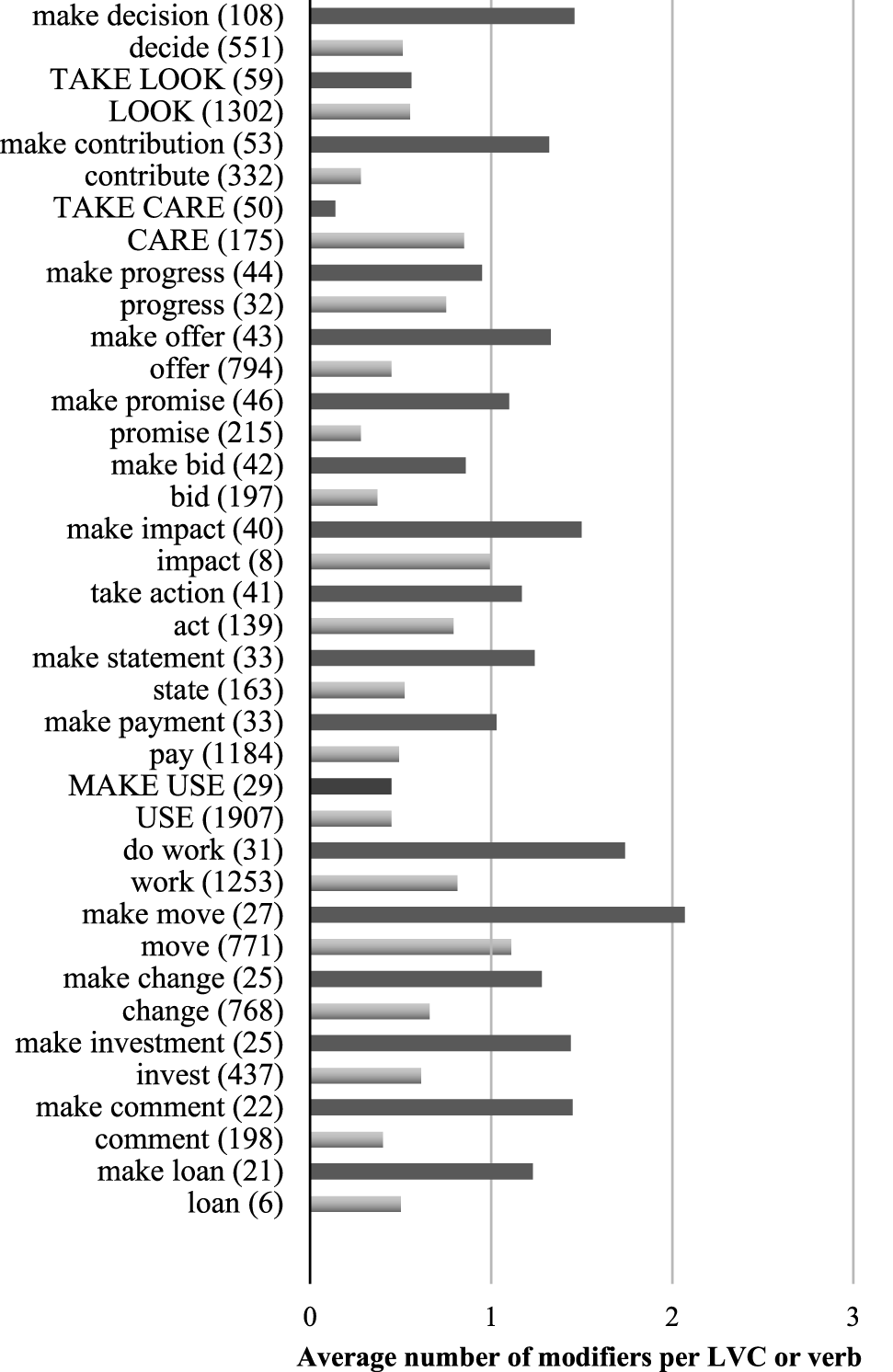
 $p$ < .001). Figure 2 shows the average number of modifiers across the two predicate types.Footnote [10] Error bars indicate 95% confidence intervals. Figure 3 gives the average number of modifiers per LVC predicate and counterpart lexical verb; additionally, the number of each LVC and counterpart lexical verb examined in the corpus is given in parentheses.
The average number of modifiers, comparing individual LVCs and lexical verb counterparts. Exceptional cases discussed below are shown in caps and the number of each predicate found in the data is shown in parentheses.

The three exceptions wherein the lexical verb was modified approximately as often, or more often than the LVC were: look (average of 0.55 modifiers/token) and take_look (average of 0.56 modifiers/token), care (average of 0.85 modifiers/token) and take_care (average of 0.14 modifiers/token), use (average of 0.45 modifiers/token) and make_use (average of 0.45 modifiers/token). These exceptions have reasonable explanations when the data is explored. First, take_care and make_use are somewhat exceptional LVCs because they generally do not take any article, and for this reason they have likely developed a stronger cohesion over time, discouraging intervening modifiers, as suggested in related work described in Section 2.3. Take_look and take_care are often used imperatively within commands or requests: Take care! Thus, speakers generally do not need to convey rich event descriptions, since the event is hypothetical or future.Footnote [11]
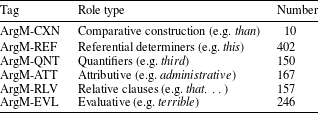
Modification is not simply more frequent in the case of LVCs than lexical verbs, it is also qualitatively different. In English, nouns can be modified not only by adjectives, but also by other nouns, in the case of noun-noun compounds, and by relative clauses. Additionally, nouns are compatible with various types of determiners, quantifiers and articles (such as possessive pronouns and cardinal numbers) that can add shades of meaning, including those of an aspectual nature, or can contribute to reference tracking. Table 1 presented in Section 3.2.1 summarizes the number of each of the original PropBank modifier tags found within LVCs in the sample. Table 3 summarizes the number of each of the nominal modifier tags annotated specifically for this research, defined in Table 2.
Number of nominal modifiers developed for LVC corpus study.

Although there is some overlap in what can be expressed by nominal modification and what can be expressed by verbal modification (e.g. the manner of the event, deliberate vs. deliberately), much of the modification within LVCs has no counterpart in verbal modification, and could only be expressed periphrastically. This can be observed in the following usage examples of LVCs with evaluative or attributive modification, followed by an invented example that attempts a reformulation of the LVC using the corresponding verb:

Example (17b) shows a typical alternation in meaning: the transformation of an evaluative nominal modifier into an adverbial modifier changes the meaning of the modifier into what is most likely to be interpreted as a somewhat awkward and ambiguous manner modifier. At best, we could rephrase this as We laughed really hard and then things happened, but even this changes the meaning of the phrase. Other nominal modifiers, seemingly primarily those that are evaluative, simply do not have an adverbial equivalent that is both grammatical and semantically very similar:

The qualitative differences seen in the types of modifiers of LVCs and the types of modifiers of the corresponding verbs provides further evidence for the reason that LVCs of category (i), which have morphologically equivalent lexical verbs, exist alongside these verbs: LVCs provide a resource of the language, or coding means, exploited by speakers to express an event as a noun, and therefore also express descriptions of the event using nominal modification, which is more flexible than verbal modification and allows for the grammatical and economical expression of rich descriptions.
4 Conclusions and impacts on NLP
The two views on the function of LVCs explored here, emphasizing either the importance of modification or aspectual qualities, are not at odds. Articles lending telicity are merely one of the many elements compatible with nouns that can be used within LVCs to express subtle meanings. Given that LVCs have been used for their modificational potential throughout the history of English, it is not surprising that speakers would use LVCs in combination with articles and pluralization in order to convey certain aspectual nuances once these resources had become fully developed in the English language. However, a full examination of these views demonstrates that LVCs are used with many types of modificational elements, of which those that lend aspectual distinctions are only a subset.
There are several implications of this research for NLP. First, this study reveals a characteristic of LVCs important for their automatic detection: they generally include some modification of the noun. This characteristic is consistently overlooked in NLP, as many LVC detection systems operate under the assumption that only a determiner will occur between the verb and noun (e.g. Stevenson, Fazly & North Reference Stevenson, Fazly, North, Tanaka, Villavicencio, Bond and Korhonen2004). Second, this research demonstrates that automatic systems cannot necessarily equate LVCs with verbal counterparts – LVCs are needed to give natural expression of events that require elements of nominal modification for conveying the intended meaning. The simplifying assumption that all LVCs are interchangeable with a synthetic verb is made in resources, such as the Abstract Meaning Representation (AMR) project (Banarescu et al. Reference Banarescu, Bonial, Cai, Georgescu, Griffitt, Hermjakob, Knight, Koehn, Palmer and Schneider2013), designed to support natural language generation, natural language understanding and machine translation. In order for our NLP systems to detect, interpret, translate, and generate natural language appropriately, these systems must model LVCs according to their usage. LVCs are constructions that do not fit an expected pattern with only an intervening determiner. Additionally, LVCs go far beyond mere ‘flowery’ language, serving as a necessary coding means in the English inventory for the detailed expression of event semantics. These findings will inform ongoing efforts expanding NLP resources, such as PropBank and AMR, to capture the meaning of constructions.