Well-fed people can enhance their dignity, their health and their learning capacity. Putting resources into social programs is not expenditure. It is investment.
This chapter analyzes the transformation of social policies in Latin America. The poor were traditionally excluded from public welfare. Social insurance policies – old age pensions, health insurance, housing support and disability, and maternity benefits – disproportionately benefited the middle classes, leaving the poor unprotected. In theory, funded by contributions, Latin America’s “truncated welfare states”ended up paid by general taxation, which meant that the poor effectively transferred income to the rich, reinforcing and widening income inequality (Lindert et al., Reference Lindert, Skoufias and Shapiro2006).
The biggest social policy challenge during the democratic era has been to extend welfare benefits to those traditionally excluded from social insurance programs, which in most Latin American countries were set up by authoritarian regimes (Mares and Carnes, Reference Mares and Carnes2009). Democratization in Latin America was not accompanied by immediate improvements in social expenditures for poverty relief. Countries in the region transited to democracy during an era of economic crises and structural adjustment, which made fiscal contraction necessary (Haggard and Kaufman, Reference Haggard and Kaufman1995). As Latin American countries were able to regain economic growth – in part spurred by recent booms in commodity prices – diverse social programs involving food support, conditional cash transfers, financial support of education, noncontributory old-age pensions, and health insurance for the poor had begun to mushroom throughout the region.
This chapter documents the expansion of social protection in the region, distinguishing four paths of welfare system development:
Clientelistic social protection in which most poverty relief programs are discretionary and administered through partisan or personal networks. Examples are Mexico’s PRI prior to 1997, Fujimori in Peru, Hugo Chávez in Venezuela, Rafael Correa in Ecuador, and the Peronists in Argentina. Clientelism in social protection fosters corruption and rent-seeking and is not effective at alleviating poverty.
Entitled social protection whereby expanded benefits to the poor are targeted according to means-testing criteria, which are also better insulated from political manipulation. This outcome characterizes Brazil after the Partido dos Trabalhadores won the presidential election in 2002, when Bolsa Familia was expanded to become the largest CCT program in the world, and Mexico after 1997 when Progresa/Oportunidades was launched. Colombia, Chile, Uruguay, and Costa Rica also fit this characterization. Although an array of clientelistic programs and practices persist in these countries, these coexist with CCTs and other means-tested poverty alleviation programs.
Universalistic social protection in which poverty alleviation programs, including CCTs, are universalistic rather than targeted. Bolivia during the presidency of Evo Morales exemplifies this pattern. Universalism discourages clientelistic manipulation and entails lower administrative costs, but makes poverty alleviation much more expensive.
Failed social protection is the last of the four trajectories. Guatemala is a stark case to consider, in which expansion of social assistance programs for the poor was frail and short-lived.
This chapter proceeds as follows. Section 1.1 maps Latin American social protection policies on our conceptual map that highlights the governance dimensions of antipoverty programs: universalism versus targeting and nondiscretionary versus discretionary. Section 1.2 argues that democratization and pressures from below propelled Latin American countries to expand truncated welfare states by creating an array of social programs directed at the poor. Section 1.3 discusses how real poverty relief requires moving away from clientelism toward nondiscretionary programs that target beneficiaries according to income rather than political criteria. Whether countries will endorse nondiscretionary social assistance depends on the existence of institutional constraints that effectively deter political manipulation of antipoverty programs. Section 1.4 maps Latin American countries along the four paths of welfare system development.
1.1 Varieties of Social Policies
Throughout most of the twentieth century, the main redistributive efforts in the region went into starting the construction of welfare states. Unlike their European counterparts, these Latin American welfare regimes were limited because, whatever their nominal degree of universality, they only covered persons with formal employment (Lindert et al., Reference Lindert, Skoufias and Shapiro2006). This restriction of social insurance to the formal sector has led to the characterization of the region’s various social protection systems as “truncated welfare states” (De Ferranti et al., Reference De Ferranti, Perry, Ferreira and Walton2004; Fiszbein, Reference Fiszbein2004; Rawlings et al., Reference Rawlings, Sherburne-Benz and Van Domelen2004). Moreover, despite formal membership contributions, social insurance plans have run considerable deficits that must be financed through tax revenues.
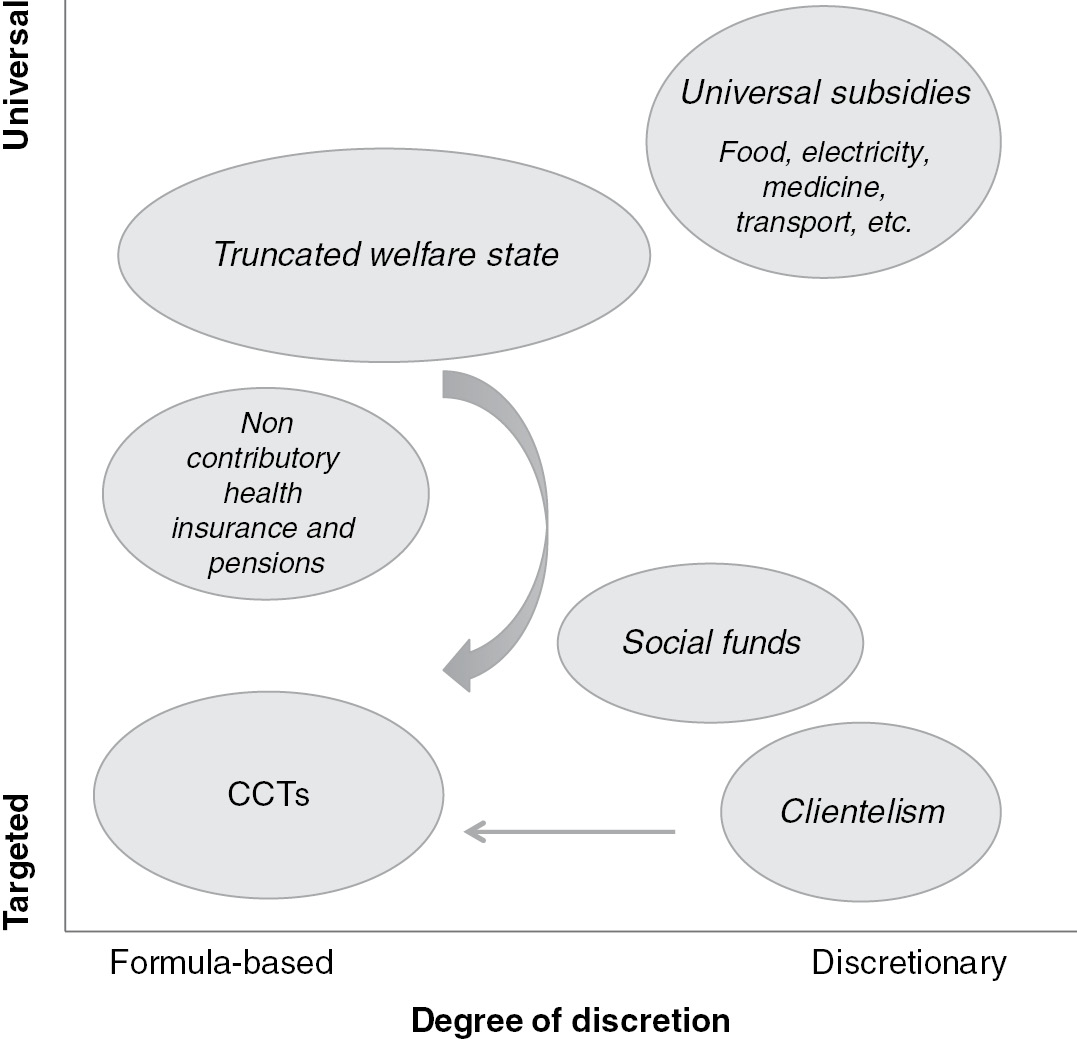
Along these governance dimensions of poverty relief, Latin America’s historical welfare regimes can be located in the upper left region of Figure 1.1, which maps social policies by degree of government discretion and the extent to which they are targeted or universal. Welfare polices benefited formal workers and state employees, who could not be withdrawn from the welfare regime on the basis of partisanship. Hence, according to our categorization, these traits make these social insurance programs nondiscretionary.
Social protection in Latin America.

Latin American social insurance programs – maternity and family benefits, health insurance, old-age pensions, and disability benefits – typically began as emoluments meant for relatively small groups such as state employees, armed-forces personnel, and those working in certain favored industries (Mesa-Lago and Bertrabou, Reference Mesa-Lago and Bertranou1998). The welfare state’s coverage gradually expanded throughout the twentieth century until most formal workers came under its umbrella (though formal employees in agriculture were rarely incorporated).
Nominally financed by contributions, most of these programs are in fact financed by general revenues. Because “the regressivity in social insurance schemes has not been helped by any significant progressivity in tax financing,” these schemes foster a “reverse Robin Hood effect,” in which the poor are made to pay for the benefit of the rich (Lindert et al., Reference Lindert, Skoufias and Shapiro2006). Latin American social policy, in other words, has mostly historically worked backward, making preexisting economic and social inequalities wider rather than narrower.
Another form of social policy commonly used in Latin America during the period of Import Substitution Industrialization (ISI) were price controls and universal subsidies – for food, gasoline, electricity, medicines, transport, among others. In Figure 1.1 these policies are mapped in the upper-right region. Many of these poorly targeted subsidies ended up benefiting in a disproportionate manner the middle and upper classes in the cities (Bates, Reference Bates1981). Like social insurance benefits, these price controls and subsidies are poorly targeted, but they are also discretionary, since politicians can often start, stop, or modify them by decree. It is not uncommon, for example, to observe food, medical, and transport subsidies rise during electoral years and plummet once the election is over.
To expand benefits to the poor, especially once electoral democracy took root in the region in the early 1990s, Latin American countries began to introduce a series of social funds intended to improve social infrastructure and provision of public goods in poor communities (Rawlings et al., Reference Rawlings, Sherburne-Benz and Van Domelen2004). With its regressive urban bias, the era of ISI produced massive migration from the countryside to city slums on the outskirts of most major cities in Latin America. It also left thousands of towns and rural communities with no basic public services.
Two of the most well known of these social funds were Peru’s Fondo de Cooperación para el Desarrollo Social (FONCODES) and Mexico’s Programa Nacional de Solidaridad (Pronasol). We map those social funds in Figure 1.1 as reflecting discretionary policies that deliver public goods to communities. Empirical evaluations of these social funds show mixed results. In principle, most of them assigned benefits in decentralized fashion in response to petitions from community organizations, while in practice politicians and bureaucrats at the center enjoyed wide discretion to choose beneficiaries.
Discretionary poverty alleviation programs such as FONCODES and Pronasol are particularly vulnerable to political interference, and as later chapters reveal, they do not alleviate poverty. Over the past decade Latin America has gradually begun to introduce nondiscretionary social protection programs to target the poor. Many social protection programs focus largely on helping raise the consumption levels of the destitute poor (Lindert et al., Reference Lindert, Skoufias and Shapiro2006). The best-known contemporary social assistance schemes are conditional cash transfers (CCTs). These programs are progressive in relative terms in that the average transfer represents a higher proportion of income (consumption) for those at the poorer end of the spectrum.
Between 1997 and 2011, most Latin American countries introduced cash transfers granted to women conditional to their children’s school attendance and health clinic visits. These programs may also require attending basic courses on preventive health care and hygiene and offer nutritional supplements. CCTs are meant to benefit the extreme poor.
Brazil implemented the first federal program in 2001 (after similar programs at the state level) and the first Lula da Silva administration (2003–2006) expanded Bolsa Familia to the entire country. Mexico implemented the first nationwide CCT program in 1997, Honduras in 1998, Nicaragua in 2000, Colombia and Jamaica in 2001, Chile in 2002, Ecuador in 2003, El Salvador and Dominican Republic in 2005, Guatemala in 2008 (Diaz-Cayeros and Magaloni, Reference Diaz-Cayeros and Magaloni2009; De la O, 2013). “By 2008 every Latin American country except Cuba, Haiti, and Venezuela had enacted a CCT program covering from 12 (El Salvador’s Red Solidaria) to 100 percent (Ecuador’s Bono de Desarrollo Humano) of its poor population” (McGuire, 2013: 3).
The largest CCT program is Brazil’s Bolsa Familia followed by Mexico’s Oportunidades. Both of these programs have been credited with reducing inequality (Soares et al., Reference Soares, Ribas and Osório2010). In general, evaluations reveal highly positive results from CCTs. Mexico’s Progresa, which is arguably the most researched of all these programs, was found to be associated with increased food consumption, declines in school dropout rates, and increases in children’s average height and weight, among other indicators (Levy, Reference Levy2006; Gertler, Reference Gertler2004). Colombia‘s Familias en Acción boosted school enrollments and healthcare access, although it failed to show any effect on nutritional levels (Attanasio et al., Reference Attanasio, Battistin, Fitzimons, Mesnard and Vera-Hernández2005).
The process of diffusion of this policy innovation across Latin America is evident. But politics has played an important role in shaping the timing of adoption (Diaz-Cayeros and Magaloni, Reference Diaz-Cayeros and Magaloni2009) as well as the program’s institutional details, including not only how beneficiaries are identified and selected, but also whether the program is properly insulated from political manipulation (De la O, 2012).
Democracy has generated a cycle of redistribution in the region, but whether this cycle ends up benefiting the poor over the long run depends on a country’s institutions and on the design that social protection takes. CCTs vary significantly in their governance structures and implementation. Although in Figure 1.1 we have mapped these on the lower-left corner indicating nondiscretionary governance, there is variation across Latin America. De la O’s (2015) evidence shows that in countries where the executive power’s electoral strength was dominant, measured as undivided government, CCT program design is less strict. Hence, majority parties that rule unconstrained are more likely to attempt to direct CCTs for political gain. Further, CCTs are likely to be less effective in countries with limited state capacity in the provision of health services and education to the impoverished.
Mexico’s Oportunidades and Brazil’s Bolsa Familia are among the most professional and better insulated, and so is Colombia‘s Familias en Acción. But other countries have failed to enact CCTs that are free of political manipulation. Guatemala’s Mi Familia Progresa (MIFAPRO) is perhaps one of the clearest examples of failure, driven by limited state capacity and defective design. As we further discuss, the program was terminated because of accusations of political manipulation by the former president, Alvaro Colom, and his electioneering wife, Sandra Torres.
Figure 1.1 shows a movement in social policy in Latin America from universalism to improved targeting. This movement is consistent with the current approach to poverty relief around the world, which has shifted away from universalism (Coady et al., Reference Coady, Grosh and Hoddinott2004). How governments select or target the poor involves decisions about governance. To target the poor, governments can employ objective income criteria or they can resort to self-reporting; the latter can be done even through self-assessments of one’s status or through community-based assessments (Alatas et al., Reference Alatas, Banerjee, Hanna, Olken and Tobiass2012).
In Figure 1.1 effective poverty relief requires movements toward the lower-left region occupied by CCTs, or what we call entitled policies of social protection. These redistributive policies targeted to the poor are administered through professional bureaucracies. But expansion of social benefits to the poor can also take the form of clientelistic social protection, which we map on the lower-right region of Figure 1.1. Clientelism targets benefits to the poor through political criteria. In the section that follows, we discuss what propelled Latin American countries to expand welfare benefits to cover the poor and describe the particular form this expansion took place in various countries.
1.2 The Expansion of Social Benefits to the Poor
Despite important variations across Latin America, countries in the region have witnessed similar transformations in their welfare regimes. What drove the expansion of Latin American’s welfare regimes? Why are poverty relief programs discretionary or nondiscretionary? The first question involves addressing movements along the vertical axis of Figure 1.1 from universal to targeted programs, and the second along the horizontal one from discretionary to nondiscretionary programs. In the pages that follow, we discuss each of these processes.
Moving beyond Truncated Welfare States
Changes in the mechanics of redistribution often result from pressures from below. Acemoglu and Robinson (Reference Acemoglu and Robinson2006) and Boix (Reference Boix2003) have made this claim for nineteenth-century Europe and the world in general. In their view, democracy and dictatorship are different equilibria of a game of redistribution between the rich and the poor. The elite can voluntarily extend democracy in order to prevent a violent revolution that ends by seizing their assets by force. Democracies are expected to arise in more egalitarian societies and, consistent with the Meltzer and Richard’s (Reference Meltzer and Richard1981) model, to lead to redistribution because electoral competition generates incentives to enact policies and a tax rate consistent with the median voter’s preferences. If the median voter, rather than the elite, sets too high a tax rate, the elite can mount a coup against democracy, and a military regime will come to thwart demands for redistribution.
One of the challenges this view faces for the case of Latin America is that the creation of welfare states often took place under authoritarianism (Mares and Carnes, Reference Mares and Carnes2009). Dictators tended to privilege powerful interests such as labor and state employees over the mass of poor citizens. The poor were occasionally targeted with government transfers, yet it was often with highly discretionary policies, which were meant to control them. Land reform was a common form of social policy that was targeted to the poor to prevent revolt (Albertus, Reference Albertus2015).
Another lesser challenge to Meltzer and Richard’s (Reference Meltzer and Richard1981) model predicting that democracy should lead to redistribution comes from the fact that in Latin America it took more than a decade for democracy to produce some meaningful redistribution. This is due to the fact that the shift to democracy in the 1980s and 1990s was accompanied by fiscal and state retrenchment as well as serious contractions of international financial flows, including public debt (Haggard and Kaufman, Reference Haggard and Kaufman1995). In many countries this period also witnessed episodes of hyperinflation and repeated but failed attempts at macroeconomic stabilization. In this context of hard times, governments on left and right converged on a set of policy initiatives (the so-called Washington Consensus) to confront these challenges. Hence, demands for redistribution by the mass of poor voters could not be promptly met with significant expansions of welfare benefits.
Although democracy did not have an immediate impact on redistribution, it did create an institutional space that gave more power to the poor. Kaufman and Segura-Ubiergo (Reference Kaufman and Segura-Ubiergo2001) demonstrate that trade integration and openness to capital markets after the 1990s had a consistently negative effect on aggregate social spending. The authors then disaggregate spending into social security transfers and expenditures on health and education. They find that a shift to democracy led to increases in health and education spending. Similarly, Brown and Hunter (Reference Brown and Hunter1999) investigate the effects of political regimes on social spending in Latin America, and they find that during times of economic crises, democracies, relative to autocracies, increased resources to social programs.
These studies do not contemplate other forms of social spending, including the enactment of social protection programs. Diaz-Cayeros and Magaloni (Reference Diaz-Cayeros and Magaloni2009) employ a survival model to explain the timing of implementation of CCTs across the region. Their econometric findings suggest that democracy generated incentives to reach out to the poor with social benefits. The more years since the democratic transition, the larger the probability of adoption of a CCT. Their results also suggest that CCT adoption is not correlated with ideology: governments from the left and the right have sought to accommodate the poor with an expansion of social protection. The authors also show that inequality and poverty generate more pressures for the expansion of benefits to the poor. Finally, state capacity also seems to matter: CCTs are adopted more rapidly where public institutions are able to reach out to the poor, as measured by higher immunization levels that presupposed functioning clinics and health services.
From Clientelism to Entitlements
This chapter traces the evolution of Latin America’s social policy in recent years, identifying two types of welfare regimes – clientelistic and entitled social protection – and argues that only the latter works to reduce poverty. Clientelism denies poverty relief to qualifying citizens on the basis of partisanship. That is why these policies often fail to improve the well-being of the poor. Entitled social protection programs instead target beneficiaries according to income, often through means-testing. Nondiscretionary programs are also harder to manipulate because politicians cannot deselect beneficiaries on the basis of political intent.
To account for movements along the axis of discretion, our approach emphasizes the political incentives to delegate the implementation of social protection to a professional bureaucracy. As argued by Geddes (Reference Geddes1994), “bureaucratic inefficiency, patronage-induced overstaffing, and outright corruption retard economic development and reduce public well-being in developing countries” (p. 371). Proper bureaucratic insulation is necessary to restrain clientelism. Nevertheless, these types of administrative reforms often face severe obstacles to their enactment because politicians profit from manipulating social programs to better serve their prospects for remaining in power.
In her study of Latin American civil service reform, Geddes (Reference Geddes1994) provides an insightful account of why and when politicians in developing countries are expected to adopt reforms that insulate bureaucracies from political manipulation. “No politician in competition with others engaged in trading jobs and favors for votes can afford unilaterally to eschew reliance on patronage. Some, however, might be willing to give up this resource if others did” (p. 375). Her game theoretic approach emphasizes the following factors as driving politicians’ decisions to delegate power to independent bureaucratic agencies: (1) political parties are more likely to pass reform when patronage is evenly distributed among the strongest parties; (2) reforms are more likely to pass when the electoral weight of the top two parties remains relatively even and stable; (3) even when one party dominates, reforms are more likely to pass when the majority anticipates losing and seeks to tie the hands of its successors and prevent them from conquering the bureaucracy to serve their own patronage ends.
We extend this argument to understand the establishment of entitled social protection, which we claim is influenced by the balance of forces between political parties and their expectation to lose power in future elections. When a majority party dominates and there is no balance of power between competing parties, this party will seek to conquer the bureaucracy to administer social programs according to partisan goals.
An important implication of our theoretical approach is that effective poverty alleviation might paradoxically presuppose the presence of strong center-right parties that are necessary to restrain majoritarian left-wing coalitions in their attempt to conquer the state to serve their own partisan ends. A strong center-right political force is present in countries where we find entitled social protection regimes: Mexico, Brazil, Chile, Uruguay, Costa Rica, and Colombia. When center-right parties are weak, unable to build roots in society (often because of their ideological extremism as in Bolivia), or have a woeful record in power (as the Union Cívica Radical in Argentina or the AD and Christian Democratic parties in Venezuela), left-leaning parties or candidates will be better able to amass large electoral majorities and undermine the system of checks and balances to operate social programs and poverty reduction through clientelistic networks.
1.3 Mapping Social Protection in Latin America
Democratization in Latin America has contributed to the creation of new public programs aimed at poverty relief. Below we differentiate Latin American countries according to how they expanded welfare programs for the poor.
Clientelistic Social Protection
Clientelistic redistribution targets benefits to a party’s support base. Poverty relief is given according to partisanship, and it is administered through clientelistic networks rather than professional bureaucratic agencies. Clientelistic redistribution hence presupposes that an incumbent party captures the bureaucracy to distribute jobs, government programs and transfers, and other benefits to its supporters.
We distinguish two different forms of clientelistic redistribution in Latin America, a “personalistic” and a “partisan” one. In the first, neopopulist leaders from outside the established party system use clientelistic redistribution to solidify their grip on power. In many of these cases, neopopulist leaders have also undermined democratic political institutions. Where established party systems failed to accommodate the poor with more expansive social policies, they became more vulnerable to the emergence of neopopulist leaders (Weyland et al., Reference Weyland, Madrid and Hunter2010; Cleary, Reference Cleary2006). Alberto Fujimori in Peru, Hugo Chávez in Venezuela, and Rafael Correa in Ecuador are notable examples.
Clientelistic redistribution can also be administered by established dominant parties, like Mexico’s PRI and the PJ in Argentina. In both the cases, populist parties were able to amass electoral support by administering social programs and patronage through their partisan networks (Levitsky, Reference Levitsky2003; Calvo and Murillo, Reference Calvo and Murillo2004; Magaloni, Reference Magaloni2006; Molinar and Weldon, Reference Molinar, Weldon, Cornelius, Craig and Fox1994). Partisan biases in fiscal and electoral institutions reinforced these parties’ incumbency advantage. In line with Geddes’ (Reference Geddes1994) theory, these dominant parties possessed no incentives to delegate the administration of social programs to an independent bureaucracy.
Clientelism traps the poor in a perverse relationship: either you are with the government or you will not get government transfers. The problem is that poor voters under this type of “punishment regime” cannot sanction government corruption because individual defection is costly. Exiting the system requires the capacity of a voter to absorb the costs of not having access to the spoils system. These costs are formidable for the poor, who often depend on the machine’s favors for basic survival.Footnote 1 In the following sections, we briefly discuss examples of personalism and partisan clientelism in social protection.
Peru
Peru witnessed one of the first episodes of neopopulism during the 1990s. An outsider and practically unknown candidate, Alberto Fujimori was elected in 1990 on a populist platform defeating rightist Mario Vargas Llosa. Upon assuming office, Alberto Fujimori switched his campaign promises and instituted wide-ranging neoliberal reforms, the so-called Fujishock (Stokes, Reference Stokes2001). Fujimori succeeded in stabilizing the economy and pacifying the country with the defeat of Sendero Luminoso. The fear of mounting social tension led him to enact a major expansion of poverty relief through the FONCODES.
The program provided public goods – clean water, roads, electricity, schools, clinics, and hospitals – as well as particularistic transfers, including nutritional supplements and food. Schady (Reference Schady2000) demonstrates that FONCODES funds were not assigned to reach the poor but to orchestrate Fujimori’s reelection for a second term. Between 1991 and 1993, FONCODES expenditures favored his supporters. After a disappointing result in a national referendum held in 1993, however, Fujimori administration redirected resources in an attempt to “buy back the vote in turncoat provinces” (Schady, Reference Schady2000: 291). FONCODES allowed Fujimori to bolster his popularity and political capital, enabling him to win the constitutional referendum to permit his reelection. He was also able to win the 1995 presidential election.
Fujimori resorted to increasingly authoritarian measures. In response to political deadlock, Fujimori decided to close Congress, suspended the constitution, and purged the judiciary with the support of the military – also known as the autogolpe (auto-coup). Fujimori ran for a third term, even though the constitution forbade this. His opponent Alejandro Toledo campaigned forcefully to have the election annulled. At this point, a corruption scandal involving Vladimiro Montesinos broke out (McMillan and Zoido, Reference McMillan and Zoido2004). A cable television station broadcasted the footage of Montesinos bribing opposition congressman Alberto Kouri for his defection to Fujimori‘s Perú 2000 party. Fujimori’s support virtually collapsed. He left Peru in 2001 and eventually served jail time for using Montesinos to bribe and tap the phones of journalists, businessmen, and opposition politicians.
Since Fujimori left office, governments in Peru have not expanded social benefits to the poor in a substantial manner. Peru should hence be characterized today as a case of limited expansion of social protection; it spends less than most other Latin American countries in social policies. Only Guatemala and Ecuador spend less (Yamada and Castro, Reference Yamada and Castro2012).
Venezuela
Venezuela experienced a colossal challenge to its party system by a neopopulist outsider. The emergence of Hugo Chávez and the Movimiento Bolivariano can be traced to the collapse of Venezuela’s two-party system, stable since the Punto Fijo Pact in 1958. Failed structural adjustment and neoliberal reform implemented by the administration of Carlos Andrés Pérez led to massive protests and looting. The president ordered the violent repression of the protests known as Caracazo, which left many people dead. The 1989 riots were the worst in Venezuelan history. The president decelerated a state of emergency. The crisis of government and economic collapse led to the impeachment of the president in 1993 (Weyland, Reference Weyland2004; Pérez–Liñal, Reference Pérez-Liñal2007; Lupu, Reference Lupu2013).
Hugo Chávez began preparing for a military coup, and although he failed to grab power by force, he later won the presidential elections in 1998. The mass of poor voters supporting Chávez revolted against the domination of politics by Venezuelan oligarchy since 1958 and its two-party system, the Christian Democratic Party (Political Electoral Independent Organization [COPEI]) and Democratic Action Party (AD). Chávez was able to expand and solidify his power to a large extent because the Venezuelan oligarchy and the preexisting party system had failed to accommodate the poor, improve living standards for the vast majority, and curb corruption. In addition, ideological convergence between AD and COPEI led to a failure of representation (Seawright, Reference Seawright2012; Morgan, Reference Morgan2011).
He was able to amass power because he used money from the oil boom to expand social benefits. During his government, Chávez successfully mobilized support from the poor through a large expansion of programs such as Las Misiones Bolivarianas, which have entailed a massive expansion of antipoverty initiatives, including educational campaigns, construction of thousands of homes, enactment of food and housing subsidies, construction of clinics, expansion of medical protection, the granting of land titles, among others.
These programs are largely administered through clientelistic practices. In their seminal study, Hsieh et al. (Reference Hsieh, Miguel, Ortega and Rodriguez2011) employ the well-known Maisanta list of several million voters who in 2003 signed a petition to remove Chávez from office and match it with household survey in order to measure the economic effects of being identified as Chávez political opponent. They find that voters who were identified as Chávez‘s opponents experienced a 5 percent drop in earnings and a 1.3 point drop in employment rates after the president released the list throughout the government bureaucracy. Hawkins et al. (Reference Hawkins, Rosas and Johnson2011) present a fascinating analysis of Las Misiones, showing that Chavez’s control of the programs is strong and that the programs have been plagued with political manipulation and corruption. Stokes et al. (Reference Stokes, Dunning, Nazareno and Brusco2013) also find that benefits in the Misiones social programs went to Chavez’ supporters.
Similar to Fujimori, Chávez undermined democratic political institutions (Mainwaring, Reference Mainwaring2012; Levitsky and Way, Reference Levitsky and Way2010). When he was elected in February 1999, the legislative and judicial branches of the national government were controlled by opposition forces. Chávez diluted these checks and balances by rewriting the Venezuelan constitution and packing the new Supreme Court with judges he could control. After having been reelected trice, he died with large popular support in March 2013.
Argentina
The case of Argentina cannot be understood without taking into account the resilience of the Peronista Party (the Partido Justicialista or PJ) in both the provincial governments and the federal level since the return to democracy in 1983. The Peronista machines have traditionally mobilized voters in the city of Buenos Aires, its hinterland, and the other provinces by distributing food, medicines, or employment (Levitsky, Reference Burgess and Levitsky2003; Auyero, Reference Auyero2007; Szwarcberg, Reference Szwarcberg2012; Giraudy, Reference Giraudy2007; Weitz-Shapiro, Reference Weitz-Shapiro2012 and Reference Trejo2014).
After the transition to democracy in 1983, political power alternated between the Radical Civic Union (UCR) and the PJ. Argentina experienced a profound economic crisis and hyperinflation during the 1980s. President Menem campaigned as a populist but upon assuming office adopted a neoliberal agenda of economic reform (Stokes, Reference Stokes2001). The successful turnaround of the economy contributed to president Menem’s popularity. After a political agreement with the UCR, he was able to modify the constitution to run for reelection in 1995. Menem’s second term became tainted with accusations of corruption, and as a result his party suffered a massive defeat in the 1997 mid-term elections. He attempted to run for reelection a third time in 1999 but his attempt was ruled unconstitutional. UCR candidate Fernando de la Rua defeated Eduardo Duhalde of the PJ in those elections.
The pegging of the peso and mounting fiscal deficient made economic policies unsustainable. De la Rua enacted austerity measures and budget cuts. The financial crisis and the wave of capital flight led de la Rua to impose a freeze on cash withdrawals, which triggered popular protests and rioting. He was forced out of office with the cry “¡Que se vayan todos!” (Away with them all!) The riots toppled two presidents in the span of ten days. By the following legislative elections of 2005, his party virtually disappeared from the political scene (Lupu, Reference Lupu2013).
Little-known Peronist governor, Nestor Kirchner, won the presidential elections of 2003 after Menem withdrew from the run-off election. The country was bankrupt, with a depleted middle class and rising poverty. He was able to restructure Argentine debt first by announcing the cancelation of its foreign debt to the IMF and then offering a single payment. Upon assuming office, he declared social problems his first priority and expanded social programs. Nestor Kirchner “left office as the most popular outgoing president in modern Argentine history. After taking office in the aftermath of Argentina‘s worst-ever-recession, Kirchner presided over four years of export-led growth, rooted in a comparative exchange rate and soaring commodity prices…. Kirchner also pushed through a social security reform that extended access to unemployed and informal sector workers, thereby bringing more than a million new people into the system. Investment in public works increased more than a fivefold under Krichner, producing major expansion in housing and infrastructure” (Levitsky and Murillo, 2008: 17). Living standards improved and unemployment and poverty fell. Succeeding her husband, Cristina Kirschner won the 2007 election by a landslide and the PJ has been able to increasingly consolidate its dominance in power profiting from opposition weakness after the UCE collapse. The PJ remains virtually unchallenged in many peripheral provinces, although the major metropolitan areas are highly competitive.
Defying the trends throughout Latin America, Argentine leaders did not create a true CCT program, even though they had a large number of transfer programs in place, particularly related to unemployment, worker retraining and other labor issues. The character of the cash transfer programs in Argentina is consistent with the overall architecture of distributive politics in the country. Calvo and Murillo (Reference Calvo and Murillo2004) have provided strong evidence regarding the primacy of a partisan logic in the allocation of fiscal transfers and public employment opportunities in Argentina.Footnote 2 In the same vein, Giraudy (Reference Giraudy2007) shows that in the specific case of workfare programs (such as the Plan Jefes y Jefas de Hogares Desocupados created in 2002, following the Plan Trabajar launched in 1996 by President Menem) partisanship overrides criteria related to need or poverty. Within the framework of the social security system, Argentina has also created a universal child allowance program for uninsured workers in the informal sector. The program’s targeting the poor is probably better than what was observed in Trabajar or Jefes y Jefas, and its coverage has been growing.
Networks of voters controlled or intermediated by political brokers (punteros) seem to play a key role in the way all these programs are designed and operated in Argentina. As noted by Stokes et al. (Reference Stokes, Dunning, Nazareno and Brusco2013), those brokers may be at odds with the party leadership, but they are also necessary for voter mobilization on election day (Nichter, Reference Nichter2008). Political networks that mobilize support are not exclusive to the PJ, but are also present in other parties like the Union Civica Radical (UCR) (Calvo and Murillo, Reference Calvo and Murillo2013).
A critical challenge Argentine social policies face today is rooted in politics and the absolute dominance of the PJ. After the collapse of the UCR, no new stable non-Peronist alternatives have emerged. “With the collapse of the UCR, the non-Peronist half of the party system has become a fragmented collection of personalistc vehicles, local patronage-based machines, and short-lived programmatic parties” (Levitsky and Murillo, 2008: 23). Without a strong opposition, the system of checks and balances is weak and the PJ has ample leeway to manipulate social policies and administer them through its clientelistic networks.
Entitled Social Protection
The establishment of entitled welfare regimes in Latin America has taken place in countries where systems of checks and balances operate more effectively to counterbalance majoritarian tendencies. Mexico and Brazil stand out for their capacity to reduce poverty and inequality through the implementation of effective social protection policies. Both counties have established welfare regimes based on entitlements rather than discretionary handouts. In 2010 the largest CCT programs in Latin America were Brazil’s Bolsa Família, which served about 52 million people (compared to 53.3 million living on less than $4 per day), and Mexico’s Oportunidades, which served about 24 million people (compared to 27.8 million living on less than US$4 per day) (McGuire, Reference McGuire2013). In both cases incumbent parties were constrained to administer social policies, and particularly CCTs. This does not mean no political returns accrued to their entitlement programs, but that they could not use partisan and governmental networks to skew program grants.
The Brazilian Social Democracy (PSDB), which has moved to the center-right after Fernando Cardoso forged an alliance with the Liberal Front Party and was elected president, played a fundamental role in creating the predecessor of Bolsa Familia. President Luiz Inacio Lula da Silva of the Workers Party must be credited for the dramatic reduction of income inequality taking place in Brazil during his administration because he massively expanded social benefits to the poor. But the presence of the PSDB and of Brazil’s federal system of government have served as critical counterbalancing forces to restrain the Workers Party from administering Bolsa Familia and other social programs through clientelistic practices.Footnote 3
Bolsa Familia had been originally pioneered in Brasilia and other municipalities and states had adopted it before Cardoso, and later adopted the program at the federal level. Upon assuming office, Lula chose moderation in economic policy and discourse (Campello, Reference Campello2013). But he put social programs at the top of his agenda. In 2003 Lula formed Bolsa Familia by combining Bolsa Escola with other programs such as Bolsa Alimentação, Cartai Alimentação and Auxilio Gas. He also created a new Ministry of Social Development and War against Hunger and massively expanded the program to cover the poor all over Brazil. During Bolsa Família‘s first six years of operation (2003–2009) per capita public health care spending rose 70 percent.
As a redistributive program, Bolsa Familia depends on central local collaboration. Municipal governments act as the main agents of the federal government in the implementation of the program, although local authorities cannot claim credit or cut out beneficiaries. Hence, Bolsa Familia is embedded in a federal system of government that is strongly antimajoritarian. The program was mounted on Cardosso’s successful fiscal reform that gave municipalities incentives to collaborate with the central government in fiscal stabilization.
The relative stability of Brazilian institutions and its party system created strong moderating incentives for president Lula’s PT government (Hunter, Reference Hunter2010 and Reference Hunter2007). The president confronted multiple veto players and faced institutional constraints that would not have allowed him to design a discretionary welfare regime for the poor. Brazil has a strong federal system, and governors and municipal presidents are very powerful. State governors are able to constraint the central government. Subnational interests effectively get articulated within the Brazilian National Congress (Samuels, 2006).
The consolidation of the Brazilian party system was gradual, but it is with Lula’s presidency (2003–2011) that the PT grew into a national party with widespread electoral appeal, to a large extent because of the expansion of social benefits and social policies to the poor, including through Bolsa Familia. Brazil’s political parties were proscribed during the first part of the military dictatorship, but then they were allowed to compete from 1966 to 1979 into a legally enforced two-party political system: the National Renewal Alliance Party (ARENA) and the official opposition Brazilian Democratic Movement (MDB). When Brazil returned to democracy, a large amount of parties emerged and the system became very fragmented and inefficient (Mainwaring, Reference Mainwaring1999). The system has gradually consolidated into five stronger parties: the Workers party (PT), the Brazilian Social Democracy Party (PSBD), the Brazilian Democratic Movement (PMDB), and the Democrats (DEM). The PSBD is the strongest opposition to the PT. Although in its origins center-left in orientation, the party shifted to the right when Henrique Cardoso forged an alliance with the right-wing Liberal Front to run for the presidency. The PSBD was born as part of the democratic opposition to the military regime and has a strong base of support.
Hunter and Sugiyama’s (Reference Hunter and Sugiyama2009) study of clientelism and Bolsa Família in Brazil in 2009 found that the method of transfer (a debit card that cuts out the middleman) and provisions for voicing complains such as a toll-free number prevented Bolsa Familia from becoming a program easily manipulated by local officials for political gain. In his cross-sectional study of Brazil’s 5,565 municipalities in 2008, Fried (Reference Fried2012) found no evidence of preferential targeting of Bolsa Família either to core government supporters or to swing voters. No doubt that Lula’s government expanded eligibility for Bolsa Família with the aim of winning votes in the 2006 presidential election. “That might be interpreted as the politicization of a CCT program, but it is also a case of electoral incentives encouraging a policy that helps the poor” (McGuire, Reference McGuire2013: 10).
Universalistic Social Protection
Bolivia has embarked on a distinctive path in the expansion of its social programs. Universalism is the cornerstone of Bolivian social protection policies, including the recently instituted CCT programs, which constitutes a departure from the movement toward increased targeting taking place in most other Latin American countries.
Prior to the arrival of Evo Morales to the presidency in 2005, democracy in Bolivia had brought very little for the poor. During the 1980s, Bolivia experienced one of the deepest economic recessions in the region, with rampant inflation, massive job losses and a severe currency crisis. Austerity measures succeeded in curbing inflation but also widened the huge wealth gap between the white elite and the impoverished Indian population and generated social unrest (Madrid, Reference Madrid2012).
Bolivia introduced Latin America’s first social investment fund, the Fondo Social de Emergencia, in 1986. The fund was demand-driven and gave cash transfers to successful proposals by community leaders. The funds were geared toward building or improving public facilities like health clinics, water and sewer lines, and roads. The most impoverished communities did not receive these funds because they did not have the capacity to submit successful proposals to the government (McGuire, Reference McGuire2013). The Movimiento Nacional Revolucionario (MNR) government of Gonzalo Sánchez de Lozada passed a decentralization law in 1994 that gave a much greater role to municipalities in designing and administering social services. Faguet (Reference Faguet2004) demonstrates that these funds had a positive impact on improving investments in basic infrastructure for impoverished communities.
Sánchez de Lozada was forced to resign during his second term in office, after massive street protests related to the Bolivian gas conflict. Political instability continued after his resignation and in 2005 the new president, Carlos Mesa, also had to resign as a result of growing discontent and popular unrest. Massive protests and roadblocks made Congress to move the 2007 elections to 2005.
Evo Morales won with 53.7 percent of the vote. He became the country’s first democratically elected president to win an absolute majority in the first round. His election represented a radical shift for his country. His victory was made possible by the systematic failure of the established political parties to enact policies to alleviate poverty and aid the country’s indigenous majority. Until Evo Morales‘ victory, Bolivia had remained a country divided into two separate countries in which the indigenous majority was for the most part excluded (Madrid, Reference Madrid2012).
Social policies began to marginally expand under President Gonzalo Sánchez de Lozada. He introduced a universalistic Bono de Solidaridad (Bonosol) retirement pension, which gave every Bolivian age sixty-five or older an annual pension of about US $230. However, the triumph of Evo Morales brought a more fundamental transformation of the social protection regime.
During his first term, he increased state intervention in the economy by nationalizing oil, mines, gas, and communications. Thanks to revenue from the energy sector, he has been able to expand social programs, including through the introduction of a CCT program and the expansion of the noncontributory old-age pensions, renamed Renta Dignidad. A new state-owned committee was also established to distribute food at subsidized prices. Not only the Bono Juancito Pinto and the Bono Juana Azurduy, but also the noncontributory pension, Renta Dignidad, are funded by dividends from renationalized state corporations and by taxes on natural gas and mineral extraction (McGuire, Reference McGuire2013).
These social programs afforded Evo Morales huge electoral support. He was able to employ his popularity among the poor to win a referendum to enact a constitutional reform in 2009. After modifying the constitution, he was able to reelect himself for a second five-year term by a landslide victory of 64 percent of the vote in the 2009 presidential elections. Candidates from his party (Movement toward Socialism) have claimed large majorities in both Chambers of the National Congress and have won the majority of Bolivia’s nine departments.
Extreme poverty and inequality remain pervasive in Bolivia. The government has emphasized the need to develop and expand social programs. Two CCTs have been enacted in Bolivia Bono Juancito Pinto (for schoolchildren) and Bono Juana Azurduy (for expectant and new mothers). According to McGuire (Reference McGuire2013) careful analysis, they have not demonstrably reduced poverty and improved health. “One thing that distinguishes these programs is their universality. Bolivia has Latin America’s only CCTs that are not targeted either to people below a certain income level, or to people living in particular impoverished regions” (p. 1). According to McGuire (Reference McGuire2013), the lack of demonstrable program impact has to do more with problems in the public provision of health and education services, and low state capacity, than to the universality of these programs.
Indigenous peoples are clearly better off after Evo Morales came to power because now there are social programs aimed at assisting them. Moreover, his presidency has brought an important agenda of institutional reform that grants constitutional statue to indigenous traditions and governance. A dilemma Bolivia faces is that super-majoritarianism might work to undermine democracy. A related challenge is that without institutional constraints, the Movimiento al Socialismo has been able to conquer the state.
Aborted Expansion of Social Protection
Guatemala has traditionally excluded and oppressed the poor, mostly indigenous Mayans. Social and economic injustice and racial discrimination contributed to a long Civil War (1960–1996). The peace accords of 1996 ending the thirty-six-years violent conflict led to the establishment of electoral democracy. Guatemala experienced the first important expansion of social benefits to the poor during the presidency of Alvaro Colom, who was elected in 2007. He expanded social programs and access to health and education to the poor. Many of these programs, including the CCT MIFAPRO, were discredited because of alleged political manipulation. The incoming administration of Otto Perez Molina, of the right-wing Partido Patriota elected in 2012, reversed many of these social policies.
MIFAPRO constituted one of the first social protection schemes ever targeted to the poor in Guatemala. The program was created from a presidential initiative within the executive secretariat of the presidency. It was ascribed to the Ministry of Education. In addition, and most controversially, the execution and monitoring of the program was assigned to the Consejo de Cohesión Social (Council of Social Cohesion) and the Oficina de la Primera Dama de la Nación (Office of the First Lady). Hence Sandra Torres was in charge of orienting social investment and combating poverty during her husband’s presidency. The program was ultimately discredited when there were rumors that Sandra Torres would divorce the president to overcome a constitutional impediment that forbade her to run for the presidential election of 2011. She wanted to run as the candidate of her party, the Unidad Nacional de la Esperaza (UNE). The Supreme Court ruled against her candidacy for the presidency on the grounds of a “serious intent to subvert the law” via divorce.
The accusations of political manipulation gave arguments to the right-wing Patriotic Party and the upper classes to reverse the expansion of social policies in Guatemala. MIFAPRO was one of the first social assistance schemes ever instituted in the country with the explicit aim to alleviate extreme poverty. According to the report by UNDP on MIFAPRO (UNDP, 2011), the Guatemalan CCT could have served as the foundation for a more ambitious social assistance regime in a country afflicted with extreme poverty. The report remarks that “even if the program is properly designed to insulate it from clientelistic practices and political manipulation, it is true that a better institutionalization would insulated it more effectively” (UNDP, 2011: 50).
Interviews collected by one of the authors in the summers of 2011 and 2012 with a large number of women in various rural communities in the region of Lake Atitlán made evident the difference the program was making for indigenous families to cope with child malnutrition and mortality from preventable illnesses. In several interviews it became clear how the cash given through MIFAPRO made the difference between life and death for the children of the impoverished communities. One woman reported using the cash to take her baby girl to a private doctor when she had a terrible attack of diarrhea that otherwise would have killed her. The little girl was now around three years old, and was playing with two of her brothers. The mother was clearly thankful to MIFAPRO for saving her only daughter’s life. Other women reported using the cash to pay for transportation to reach the nearest hospital in an emergency. All of these women reported using the money to feed their children better – occasionally they could buy some meat, even if in small quantity. One woman was using the CCT cash to buy formula that allowed her to feed her baby after her breast milk dried out due to a postpartum infection. The alternative would have been feeding the baby “water and sugar”, and most likely death due to extreme malnutrition.
In our interviews we learned about how frightened women were to talk about politics and about revealing their partisanship. Women hardly talked openly about the coming presidential elections, although we were able to gain insight from a few who were more outspoken. We learned about how terrified women were of the Patriotic Party and its candidate because they believed that if this party won MIFAPRO would be terminated. It was hence unsurprising that women did not want to talk about their partisanship openly for fear of being identified with the opposition in the event the candidate of the “Mano Dura” (strong hand) had won.
The critical importance of state capacity for proper implementation was evident in our interviews. In the communities we visited the last cash transfer scheduled to arrive in the spring never did. State officials had not returned since 2008 to collect new income information to be able to incorporate new deserving beneficiaries. More than political manipulation, many of the problems on the ground were clearly about implementation and lack of state capacity.
The program was terminated after the elections Otto Perez Molina won the presidential elections. When we returned the following summer to interview with families in the same communities, we encountered a sad panorama. The benefits from MIFAMPRO had been removed from the entire region, which was clearly supportive of the UNE in the presidential elections. As we were interviewing one woman who had recently delivered her sixth baby, we learned that she had been feeding the baby water with diluted corn maize because her breast milk had dried out after a postpartum infection. She had no cash to buy formula and the baby was literally dying in her desperate hands.Footnote 4 The optimism the CCT program had brought among the women had been replaced by stoic faces confronting, once again, the adversities of having to live in extreme poverty without a safety net.
1.4 Conclusion
This chapter has documented the expansion of social protection in the region, distinguishing four paths of welfare system development. Democratization and pressures from below propelled Latin American countries to expand truncated welfare states by creating an array of social programs to benefit the poor. We argued that effective poverty relief requires moving away from clientelism and establishing nondiscretionary programs that target beneficiaries according to income rather than partisanship or other political criteria. Democratic politicians will inevitably be tempted to manipulate social programs and poverty relief for electoral objectives. Hence nondiscretionary social assistance can come about only when there are effective institutional constraints to prevent incumbents from politicizing antipoverty programs.