In 1831, Begum Samru, the ruler of Sardhana, a small principality near Delhi, communicated with Pope Gregory XVI, expressing her wish to donate a generous sum of 150,000 rupees to the Church of Rome.Footnote 1 She also pledged an annual sum of 50,000 rupees to charities in England, the distribution being entrusted to the archbishop of Canterbury.Footnote 2 Born as Farzana in mid eighteenth-century Shahjahanabad (present-day Old Delhi), Samru rose to fame as a high-ranked courtesan, married an Austro-German mercenary, converted to Catholicism, and inherited the substantial state of Sardhana. A jagirdar, diplomat, military commander, and patron of the arts and architecture, the enigmatic, cross-cultural career of Begum Joanna Nobilis Samru figures prominently in Persian and English sources and has been studied as a form of ‘strategic cosmopolitanism’.Footnote 3
While Begum Samru stands out as possibly the best-documented courtesan-turned-ruler of her period, her life trajectory also raises some pertinent questions regarding the complex interplay between gender, class, and social structures in early modern North India. Who constituted the social group of women performers? How did they enter this profession, and what place did they occupy in the socio-economic sphere? In what ways did they interact with the state? This article seeks to answer these questions by turning the gaze away from the Mughal court and focusing on a set of local documents that offers insights into the socio-economic status of courtesans in the long eighteenth century. It locates them within the economic networks of the time and traces one of the potential ways through which they were initiated into the courtesan tradition. Based on a collection of slave deeds issued in the region of Allahabad, the article draws upon the scholarship of Katherine Schofield, Ramya Sreenivasan, Shweta Sachdeva Jha, and Shadab Bano to expand our understanding of social relations of dependencies and gendered asymmetries.Footnote 4 It locates courtesans within the monetary and non-monetary transactions of the slave trade and studies how this trade acted as a form of generating social capital for these non-royal women. Since the possession of slaves was a mark of distinction and affluence, the article argues that a section of courtesans, by being slave owners, managed to move upwards in the socio-economic hierarchy. In this context, the article shows that courtesans can be considered as liminal actors who belonged to mobile communities that moved both geographically and socially. Furthermore, the article looks at the overlaps within the social hierarchisation of female performers, concubines, and slaves, and the interlinkages between gender, enslavement, and the state in early modern India.
The article offers two main interventions—first, it uses a rare set of legal documents to understand questions of gender and enslavement in the early modern period. Second, it posits courtesans as historical actors and agentive individuals—with their agency differentiated by factors like social location and age—who gained social mobility through their participation in these transactions. This article thus contributes to the growing body of scholarship on non-royal women, both free and enslaved, in eighteenth-century North India.Footnote 5 In doing so, it reveals the significance of (1) patronage of and by courtesans, (2) courtesans’ movement, mobility, and privileged access, and (3) the differential agency enjoyed by a variety of dancing and musical performing communities.
In attempting to reconstruct the life trajectories of courtesans, one comes across a number of methodological challenges, given the fragmentary nature of the record. There is, first of all, the question of origins. Where did they come from? More importantly, what were the personal, social, or economic exigencies that brought them into the fold of public performance, concubinage, and/or servitude? This article reveals the economic exigencies in the eighteenth century that may have precipitated the initiation of at least some women as public performers. Secondly, closely related to the question of their origin(s) is the matter of their selection and training, which played a pivotal role in shaping their future life trajectories and social capital.
As for the origins of these courtesans, there are only incidental references in Persian chronicles and European travelogues of the time. For instance, Francisco Pelsaert, a traveller who sailed for Surat from Antwerp in 1618 as part of the Dutch East India Company’s commercial service, documented the different groups of skilled dancers who were called for the guests’ entertainment, noting that many of them came to India from Persia:
There are many classes of dancers, among them lolonis,Footnote 6 who are descended from courtesans who have come from Persia to India, and sing only in Persian; and a second class, domnis, who sing in Hindustani, and whose songs are considered more beautiful, more amorous, and more profound, than those of the Persians … Other classes are named horckenis [hurkini] and hentsinis, who have various styles of singing and dancing, but who are all alike accommodating people.Footnote 7
As noted above by Pelsaert, there were many categories of female performers in seventeenth-century India. Scholars differ over the interchangeability of the two most common terms used for such female performers—‘courtesan’ and tawa’if. In Persian, courtly singers and dancers in the Mughal period were generally referred to as ahl-i-ţarab and ahl-i-sāz in official accounts. Schofield highlights various categories of dancers, singers, and musicians in the Mughal court, objecting to the usage of ‘courtesan’ as a blanket term. Schofield thus uses the term tawa’if specifically for highly ranked courtesans, while arguing that the term was not prevalent before the 1800s.Footnote 8 However, the documents studied in this article reveal that the term tawa’if was employed to designate socially and economically powerful non-royal performer women as early as at least the 1720s. Therefore, in this article, I will employ the term tawa’if, or ‘courtesan’ as its English translation, unless specified otherwise.
Beyond highly ranked courtesans, there were itinerant groups of performers, often identified by their place of origin, who moved both socially as well as geographically.Footnote 9 For example, Chandar Bhan Brahman, a seventeenth-century munshi who served as emperor Shah Jahan’s (r. 1628–1658) wāqi’ah navīs (private diarist) noted the presence of many musicians and dancers in various court festivals. Providing a glimpse of the cosmopolitan Mughal court during Shah Jahan’s reign, Chandar Bhan’s Chahār Chaman (Four gardens) gives an account of the emperor’s daily routine, which included performances by ijtima’-i arbāb-i lab-o raqqāşāñ wa bāzīgarān-i har diyār (a variety of master players, dancers, and jugglers from every region).Footnote 10 While Chandar Bhan does not explore the nature of the relationship between patrons and performers, or the latter’s social backgrounds, Rajeev Kinra argues that the focus of Chahār Chaman on highlighting the courtly culture and dance forms was a means to expand the audience beyond South Asia and impress the wider transregional Persianate world. Some of these peripatetic communities of hereditary performers had a mix of female dancers, male singers, and musicians. They served as a constant aural and visual accompaniment to Shah Jahan’s official appearances. Many of these performers moved from one city to another as per the movement of the imperial court, and the entire camp, wrote Chandar Bhan, created ‘a commotion that, when added to the general bustle of people and animals, could be heard for miles around’.Footnote 11 Along with local hereditary communities, several references in literary sources also point towards the Circassian origin of some women performers.Footnote 12
Furthermore, it is quite evident that some performing groups came to the Mughal court via Isfahan and its neighbouring areas, as noted by Pelsaert. The influences of global trade networks and migrations, combined with imperial ideas of sovereignty, created a fertile environment for a multicultural pluralistic arena in the early modern world.Footnote 13 Such movements, therefore, were due to ties of shared kinship, facilitated by Indo-Iranian elite patronage and transregional trade networks that fostered a distinctive cultural space with a blend of Indian and Persian elements. Although many of them belonged to the hereditary communities of performers, in some cases, when the courtesanal households did not have enough performing women, young girls were indentured or adopted, as discussed further in this article. It would perhaps be incorrect to assume that the majority of them joined the profession willingly. Impoverishment, enslavement, domestic abuse, abandonment by family, and reversal of family fortune could have been possible reasons for women to take up this profession.Footnote 14 However, once they were initiated into courtesanship, many of these women were able to transform their identities and gain social mobility.Footnote 15
Shifting identities, social mobility, and patronage: a brief background
Slaves and women performers in the Mughal court were often given new names by their masters, which effectively erased their past affiliations. Niccolao Manucci produced a remarkable list of names of the superintendents of the dancers and singers in the Mughal court, perhaps one of the first of its kind. He listed 33 women and did not differentiate between female musicians and dancers. Some of the prominent ones were Suñdar Bā’ī (Beauty), Mrig Nain (Gazelle-eyed), Hīra Bā’ī (Diamond), Jāliya Bā’ī (The net), Manasa Bā’ī (Pearl), Nainjot Bā’ī (Light of the eyes), Gul-rū Ba’ī (Rose-visaged), Chañchal Bā’ī (The bold), Gyān Bā’ī (The inventive), Murād Bā’ī (The desired), Kastūrī Bā’ī (Musk-perfumed), and Kesar Bā’ī (Saffron).Footnote 16 Most of the names mentioned in the list are those of flowers, colours, food items, or what are thought of as conventional feminine traits, thus signalling a rupture from their previous identities and marking their assimilation. Elaborating on these performers, Manucci makes an interesting remark, stating that despite the Hindu-sounding names, these women were ‘Mahomedans’.Footnote 17
Strategies of acculturation and adaptation, rather than escape or resistance, were thus followed.Footnote 18 There were multiple hierarchies within the service, depending upon the performer’s art, status, and role(s) in the imperial court and household. Patronage patterns were also a major cause for the creation of asymmetric dependencies within the group. In some cases, patronage by the imperial family, nobility, and other wealthy groups provided them not only material prosperity but improved their social standing as well. Thus, their realities and scope of mobility depended directly upon the kind of interaction they had with the elite.
Women performers in the early modern period performed in various spaces—the imperial court, the harem, private residences of nobles, public squares, and at their own place of residence. Manucci noted that some dancing girls were employed in the caravanserais that were built along major highways and in cities. These roadside inns were open to travellers, scholars, merchants, and pilgrims. On the other hand, skilled performers like the kanchanis were obligated to perform at the court twice a week. They performed in the imperial court and in some selected open places in the city. In Muraqqa’-i Dehli (The album of Delhi, 1741), Dargah Quli Khan describes the Mughal court during the reign of emperor Muhammad Shah ‘Rangeela’ (r. 1719–1748), which patronised many high-ranking courtesans like Nur Bai, Ad Begum, Chamani, Chak Mak Dahni, Kamal Bai, and Panna, who performed in the Red Fort on several occasions. Khan’s description of the arbab-i tarab—the dancers, mimics, musicians, instrumentalists and accompanists—shows that these performances were ‘a popular and pervasive form of entertainment’.Footnote 19
The Muraqqa’ underscores that performances in Shahjahanabad were ‘a popular and pervasive form of entertainment’.Footnote 20 Along with glamour and intrigue, Khan showcased the withering away of binaries like high/low or elite/popular cultures.Footnote 21 The percolation of courtly culture and elevation of popular elements produced a synthesis of new and refined performance traditions. A close reading of the Muraqqa’ shows that while imperial patronage continued to be a big source of legitimacy as well as a sustainer of musical mehfils (social gatherings centered on poetry and performance), it was no longer the sole means through which artists received social or monetary support. Mehfils were organised by nobles, businessmen, or sometimes the artists themselves, who had by now started living independently, away from the imperial court. Sunil Sharma notes that compared to the sixteenth century, in the eighteenth century, non-courtly settings flourished with a much more socially diverse, new audience of townsmen and bourgeois gentlemen in attendance.Footnote 22 This change was accompanied by a change in the social environment and patronage patterns.
From itinerant dancers who provided entertainment to the common man in bazaars and serais to highly accomplished dancers who catered to the aristocracy, the figure of a female public performer therefore appears to have been ambiguous in nature—a woman whose presence was auspicious yet one who was seductive and respectable at the same time. Apart from being property owners and taxpayers, courtesans organised funds, paid people, and also arranged for travel. Typically, the areas where their households were located became a hub of activity. An important means of increasing the strength of their institution was by buying young girls who could be trained and polished by senior courtesans for their affluent audience. In cities like Delhi, Lucknow, and Faizabad, these spaces were located in market areas and business centres of those times, where men spent their days and nights. Their performances, which incorporated diverse local and transregional styles and traditions, created a space for social interaction and cultural exchange that challenged prevalent spatial divisions.Footnote 23 From performing on celebratory occasions at the imperial court, holding private and semi-private gatherings for patrons at their establishments, to travelling all over the region as part of marriage processions and other celebrations (such as the spring festival in Delhi), women performers continuously negotiated the boundaries between elite and non-elite and fostered new social patterns, habits, and aspirations. As far as power and agency were concerned, courtesans held a position that was simultaneously powerful and marginal. While they socialised with powerful men, it did not always translate into social and cultural capital for them. However, as the documents from eighteenth-century Allahabad show, there were several instances when they utilised their cultural capital to negotiate the sale and purchase of the enslaved, thereby further strengthening their social and economic status.
Courtesans, slavery, and local power relations: the case of suba Allahabad
While Persian court chronicles of the period seem usually inattentive in describing the lives of courtesans in detail, dalliances with them have been recorded by many, since such incidents were seen as ruffling the normative codes of masculinity, particularly in the sixteenth and seventeenth centuries.Footnote 24 One of the ways in which courtesans figure more substantively in official records is through their involvement in the slave trade in subah Allahabad.Footnote 25 The location of Allahabad signals that these courtesans operated their own establishments and networks that were not directly reliant upon the imperial Mughal court at Delhi, or any of its successor courts such as Awadh. By sheer historical chance, a rather exceptional archival corpus of 60 legal documents has survived into the present. Produced between 1720 and 1784, these Persian documents present courtesans as buyers and owners of young girls.Footnote 26 They record the trade of female slaves, concubines, and children who were sold by their masters or parents to courtesans.Footnote 27 Currently housed at the National Archives of India, these documents can be classified into various contracts such as farūkht nāmā/farokht nāmā (sale deed), raẕā-nāmā/rāẕīnāmā (agreement), ladāwā (written receipt attesting the settlement of a fine or debt), bai’ nāmā (bill of sale), mu’āfī nāmā (letter of exemption), dastāvīz (title deed or bond), bakhshīsh nāmā (deed of gift), muchalkā (bond, agreement, recognizance, or engagement), and chiṭṭhā-i bardā-faroshī (receipt of the sale of a slave).Footnote 28
Such distinct categories of legal contracts underscore both the complexity as well as the institutionalised nature of the slave trade in the region. Further, formularies such as Inshā-yi Harkaran (translated as ‘The Forms of Herkern’ in 1781) demonstrate that the legalese surrounding enslavement remained largely unchanged into the eighteenth century.Footnote 29 This continuity points to the persistence of institutionalised slavery as well as the endurance of juridical frameworks and bureaucratic procedures that normalised and sustained the practice over time.
Their importance is manifold: first, they are perhaps one of the few surviving documents of the period that inform us of the nature of enslavement that took place outside the bounds of the imperial palace and seraglio. Second, along with throwing light on the manner of slave acquisition, they help us in understanding the role of a courtesan in both monetary and non-monetary transactions, an aspect that forms the central focus of the present article. Further, the presence of texts like Inshā-yi Harkaran in the seventeenth century would suggest that these eighteenth-century documents are not entirely unique, since slavery was legal (albeit regulated) within normative legal practice during the previous century. However, until a similar trove of sale deeds is unearthed for the sixteenth and seventeenth centuries, this rare collection of documents offers an unparalleled view of courtesans as uniquely agentive individuals involved in the sale and purchase of slaves.
In order to make sense of these contracts, it is necessary to first locate them within the broader political and economic contexts of the time. Constituting a category of forced labour, slavery in early modern South Asia included many subcategories within itself, depending upon the nature of the master, the purpose of slave-owning, and the mode of purchase.Footnote 30 Many enslaved women served as domestic servants (kanīz), gift-slaves, debt-slaves, or marriage-slaves.Footnote 31 Scholars who have worked extensively on early modern slavery argue that warfare and impoverishment were the two most common reasons behind the enslavement of men, women, and children.Footnote 32 Across time and space, war captives were usually put under servitude by the victorious faction, be it during the rule of the Delhi sultans, the Rajput kings, the Deccani kingdoms, or the Chola empire.Footnote 33 Sreenivasan’s research on pre-colonial Rajasthan substantiates that women were more vulnerable to enslavement and endured varying forms of servitude.Footnote 34 Similarly, Shadab Bano’s work, based on the early Sultanate chronicles, shows that dance and music performances were forced upon the captive and enslaved women in order to further humiliate the conquered enemy and increase the victor’s social capital.Footnote 35 This continued in the Mughal period as well, which had ‘anywhere between thirty and four hundred slaves attached to the harems of elite households alone’.Footnote 36 Even though Mughal emperor Akbar (r. 1556–1605) had prohibited imperial soldiers from enslaving women, children, and relatives of the enemy, private transactions of sale and purchase continued in the region. Bano argues that despite the imperial ban on slavery, an ‘attitude of indifference probably crept into state policy’, which changed both the nature as well as the scope of the slave trade in medieval India.Footnote 37
Apart from involuntary enslavement, slavery also took voluntary forms. During famines, open sales at public places were allowed. In the second half of the seventeenth century, we find references of ‘distressed peasants offering either themselves or their children for sale to pay the increased taxes’.Footnote 38 While the Allahabad documents do not state the reason(s) behind the sale, one could speculate that the tumultuous socio-political conditions in eighteenth-century North India might have played a role in it. The political authority of the Mughals outside the imperial capital territory was experiencing a gradual weakening post emperor Aurangzeb’s death (r. 1658–1707). Persian ruler Nadir Shah’s invasion of Shahjahanabad in 1739 and frequent raids by Afghan leader Ahmad Shah Abdali between 1748 and 1761 further exacerbated the conditions in the heartland.Footnote 39 A decade-long civil war (1751–1761) between rival Mughal ministers ‘Imad-ul-Mulk and Safdar Jung, and concurrent attacks by Jats and Marathas, also contributed to the political instability.Footnote 40 The province of Allahabad remained a point of struggle for local governors in a period of turmoil, which ended with the Battle of Baksar in 1764. This transition from Mughal to the English East India Company (EIC) rule was accompanied by immense socio-political and cultural transformations. It seems plausible that in this transitional phase, selling off children and their enslavement was a means to deal with repeated incursions and plunder.Footnote 41
While the above politico-economic factors help us understand the motives behind the practice of enslaving women and children, the concurrent rise of the highly ranked courtesans (tawa’ifs) also needs to be examined in order to study the sale deeds. According to Farhat Hasan, the eighteenth century witnessed ‘a reconfiguration of the Mughal system of power, not its collapse; the state was now shifting towards more locally rooted centres of power and authority’.Footnote 42 Furthermore, Urvashi Dalal argues that ‘incipient femininity’ and ‘inversion of masculinity’ were the markers of this period.Footnote 43 Looking at the rise of courtesans like Lal Kunwar, Begum Samru, and Qudsia Begum, Dalal suggests that this period allowed women of popular origins to participate in the spheres of state politics and administration. Foreign travellers like Francois Bernier also mention that attending a dance performance was regarded as an important form of public entertainment, and the eighteenth century saw tremendous patronage and legitimacy bestowed upon tawa’ifs—their households grew more affluent and became an integral part of the cultural as well as economic set-up.Footnote 44
The strength of a tawa’if’s household could be increased by buying young girls who were to be trained and polished by senior courtesans for their affluent audience. Enslavement of young girls, therefore, would have been done for a variety of reasons, depending upon the status of their employer. They were employed not only for performing household chores and menial work but also for company, pleasure, sexual access, and reproduction. Reading the sale deeds from Allahabad against this backdrop hence provides some helpful insights into the dimensions of service, servitude, asymmetrical power networks, and mobility.
First of all, the sale deeds employ a variety of terms to refer to the slave children—kanīz, kanīzak, dah, asāmī-kanīzak, ghulām, and chhokrī—roughly translating to servant, slave girl, or domestic maid. In particular, the term dah carries a dual implication—it can be used for both a slave girl as well as a woman fit for concubinage. The slave-buyers, on the other hand, are referred to as bā’i, ţawā’if, and harkanī (or hurkinī), indicating that the buyer belonged to a community of hereditary public performers.Footnote 45 These sale deeds confirm that the purchase of young girls by senior courtesans was not an informal or clandestine operation at all. In fact, the social and economic regulation of the act as recorded in the documents carries imprints of local power relations. In this way, these legal documents acted as a site for legitimation of power.Footnote 46 Moreover, a formal settlement of claims and resolution of any future dispute(s) was also clearly spelled out.Footnote 47 For instance, a chiṭṭhā-i-bardā-faroshī, written in 1740, records:
A slave girl of ten years has been purchased by Madan and Jadi tawa’if from Nawāzi, a sheikhzāda and resident of Jāis, sarkar Mānikpur for a sum of 20 rupees in ‘ālamgīrī coins; the maḩsūl [tax] has been deposited in the chabūtra of kotwālī [chief police station] of Allahabad city and as such no one is to trouble them on any pretext whatsoever.Footnote 48
Similarly, an exemption letter (chiṭṭhā mu’āfi) issued in 1725, states:
The orders of Muhammad Ja’far, kotwāl [chief police officer] of Allahabad city, must be known to all the police officials of Allahabad that with respect to the exemption from maḩsūl on the purchase of young chhokrī [maidservant] by Chanda, mother of Moti tawa’if, as the latter has been serving under Salim Beg Khan. It directs them to see that no one harasses her on any ground.Footnote 49
It is interesting to note that the kotwāls not only provided legitimacy to these transactions but also exempted tawa’ifs from payment of taxes on some purchases as well.Footnote 50 With courtesans acquiring socio-political clout at routine festivities of the elite during the eighteenth century, it would not be entirely inaccurate to attribute these tax exemptions to their growing connections with the elite of the region.Footnote 51 The above exemption letter mentions that Chanda, the buyer, had been exempted from paying the tax because her mother—courtesan Moti—was in the service of Salim Beg Khan, presumably a man of repute and power. Their proximity to the state’s elite thus meant that some women performers went beyond the arts and into the world of politics, a remarkable feat for a woman at the time. It is also important to note that these were probably the only female slave owners who were not from the royal family. Moreover, it can also be suggested that courtesans could have been intermediaries in the slave trade as well.
A female figure named Mulayam Bai figures multiple times in these sale deeds. A resident of the royal camp, she made multiple purchases of young girls, who were most likely to be employed either in the domestic service or in the tawa’if household. She received various tax exemptions and was also presented with several slave girls as gifts, which indicates that she held a position of considerable social significance. Given the uniqueness of the Allahabad corpus, it is unclear whether similarly powerful courtesans existed prior to the eighteenth century. Certainly, for the eighteenth century, her repeated presence in these sale deeds can be interpreted as an important indicator of the extent of the courtesans’ influence in the region in the eighteenth century.
A thirteen-year-old slave girl or concubine named Raushan Afza was reported to have been given to Mulayam by one Jawahar Darbari as a gift.Footnote 52 Similarly, a bakhshīsh nāmā executed by Najabat Ali Rezavi in 1762 establishes that he gifted a kanīzak (slave girl) named Gulbahar to Mulayam free of cost on his accord.Footnote 53 A dastak (writ) issued in favour of rāhdārsFootnote 54 and chowkidars (guards) posted at the chowkis from Allahabad to qasbā [a small town] Chail ordered them ‘not to realise any mahsūl [tax] on five chhakṛās [bullock carts] of Mulayam Bai passing through their jurisdiction’.Footnote 55 Another document states that a kanīzak was sold for 23 rupees by an elite woman named Sanjida Bano to Mulayam Bai.Footnote 56 Apart from Mulayam, the sale deeds show that tawa’ifs like Madan, Jadi, Shobha, Chanda, and Moti were also involved in the sale and purchase of young girls. A sanad (deed), issued under Salim Beg Khan’s name in 1757, confirms that he gifted one chhokri named Durdana to Moti tawa’if free of charge.Footnote 57 Similarly, a sale deed from 1724 notes that a five-year-old asāmī-kanīzak was given to Panna hurkini by Salhu Khan for ‘free’.Footnote 58
How does one interpret these non-monetary transactions where young girls were gifted to courtesans ‘free’ of charge? According to Marcel Mauss, ‘the gift is a perfect example of a total social phenomenon, as it involves legal, economic, moral, religious, aesthetic, and other dimensions’.Footnote 59 Mauss argued that gifts are never truly free, as they entail a reciprocal exchange. Indrani Chatterjee has also called gift-giving an important socio-political transaction in South Asia; ‘gifts’ were often presented in order to extract some concession or favours from the donee.Footnote 60 Furthermore, the value of the gift indicated the relative standing of the personages involved.Footnote 61 Several Persian as well as vernacular sources, particularly Abul Fazl’s Ā’īn-i-Akbarī and Jahangir’s Tuzk-i-Jahāngīrī, confirm that the practice of giving eunuchs and dancing girls as gifts was not uncommon in medieval and early modern India.Footnote 62
According to Sreenivasan, the ‘voluntary transfer of such performers signified a relationship of vassalage to an overlord; in contrast, their forced surrender signified subjugation and the loss of sovereignty’.Footnote 63 Such transactions created a bond between the seller and the buyer; at the same time the slave who was being gifted had no choice in the matter. In her work on the ḵẖẉāja-sarā (eunuch) children, Jessica Hinchy suggests that presenting children as ‘gifts’ by families in exchange for some favours or goodwill could possibly have been a strategy to distance themselves from the ‘shame and dishonour of monetary transactions involved in the enslavement of children’.Footnote 64 In this context, it can be argued that the gifting of slave girls indicates that some tawa’ifs had a higher social status than the seller and were in a position to bestow certain favours on the latter if and when needed. As opposed to the sixteenth and seventeenth centuries, when liaisons with low-born female public entertainers outside the performing arena were mostly seen as a transgression of the norms of morality, by the eighteenth century, associating with the highly ranked tawa’ifs came to be considered a marker of prestige and power. Gifts and tax exemptions, therefore, can be seen as indicators of their social status and perhaps a form of social respectability as well. Furthermore, even though some girls were presented to them as ‘free gifts’, the written documentation of it points towards the formalisation of the gift economy.
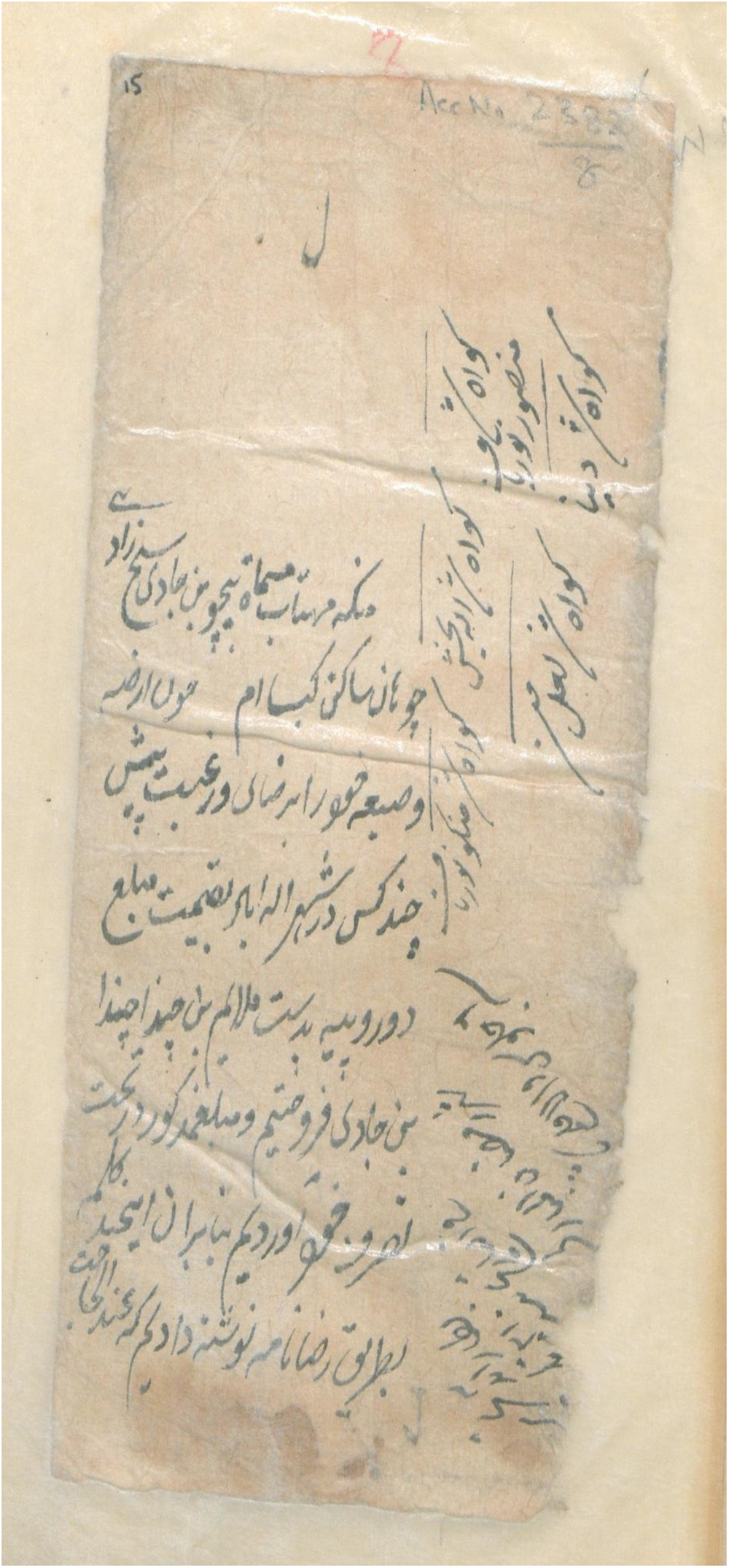
The girls mentioned in the documents can be categorised into two main groups—free-borns and slaves (who were resold to courtesans). Terms such as kanīz or kanīzak (slave girl or concubine),Footnote 65 asāmī (servant), chhokrī (maidservant), and dah (concubine) denote that those who were being sold or gifted to these courtesans had previously been in the service of their sellers. For instance, a document recorded that Khunnu Shaukhzadi sold one of her own house kanīz to Chanda tawa’if for seven rupees.Footnote 66 On the other hand, certain deeds refer to them as the seller’s ‘own daughter’ or ‘foster daughter’, indicating that the girl was still a free-born at the time of the transaction. In a rāẕīnāmā, Mahtab, wife of Pechu, sold her ‘foster daughter’ out of free will to Mulayam for the sum of two rupees (see Figure 1).Footnote 67
Rāẕīnāmā for the sale of a ‘foster daughter’. Source: National Archives of India, Acc No. 2382/8.

Figure 1 Long description
The document features handwritten text in a script, arranged in multiple lines. The text appears to be written on aged paper, with visible creases and wear. There are annotations and markings at the top, including 'Acc No. 2382/8'. The script is neatly organized, with some lines indented or aligned differently, suggesting a structured format or list. The paper shows signs of aging, such as discoloration and frayed edges.
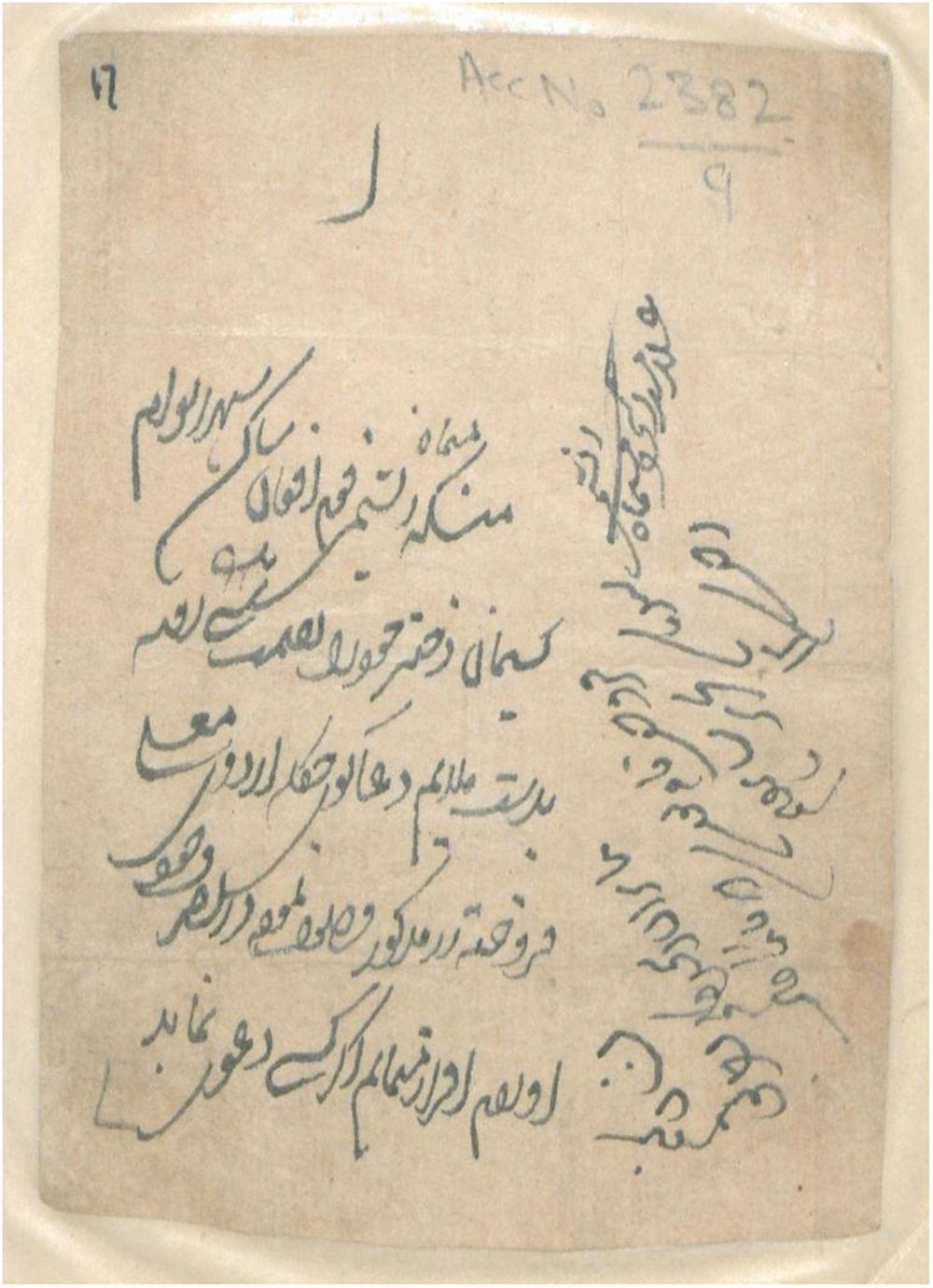
Another document, a farokhtnāmā (sale deed) written in 1731, states:
I am lady (musammāt) Reshma, of the Afghan community. I have sold my daughter, Kasiman, to Mulayam, of the royal camp for 30 rupees. I have received the aforementioned sum and affirm that if anybody has a claim over the girl, it will be declared null and void.Footnote 68 (See Figure 2.)
Sale deed for a seller’s daughter. Source: National Archives of India, Acc No. 2382/9.

Figure 2 Long description
The document contains handwritten text in a flowing script, arranged in multiple lines across the page. The text includes several annotations and appears to be written in a formal style. At the top, there is a reference number 'Acc No. 2382/9'. The script is dense and covers most of the page, with some lines written at an angle. The paper has a textured appearance, suggesting it is aged or historical.
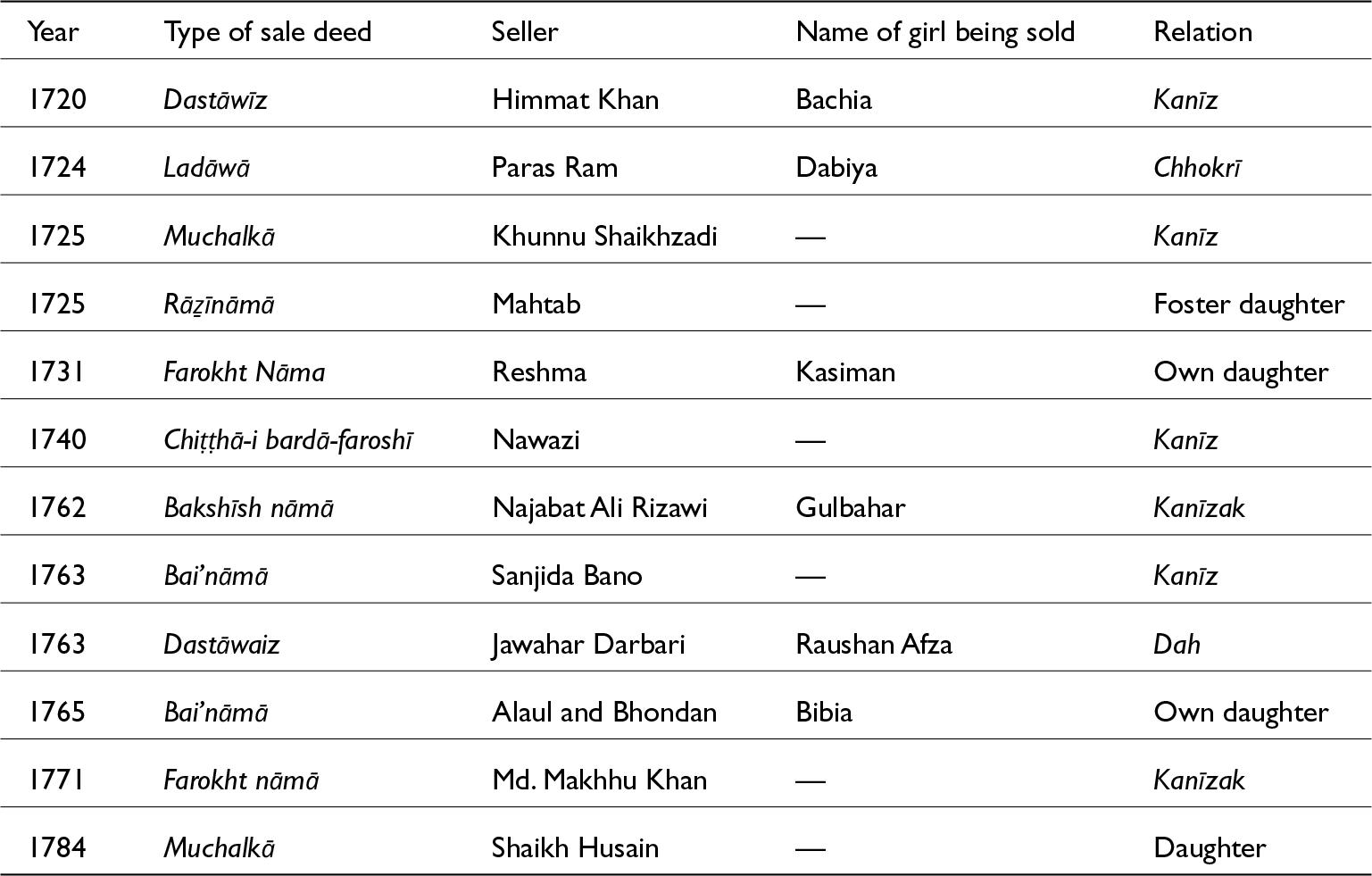
The nature of the relationship shared by the seller and the enslaved girls is full of complexities (as shown in Table 1). There is little evidence to check the veracity of claims that the seller and the girl being sold actually shared a familial relationship. Indrani Chatterjee has argued that slave owners often tried to legitimise slavery by treating it as a kinship institution and disguised it by using kinship terms like ‘son’ and ‘daughter’.Footnote 69 Furthermore, as Hinchy’s research has shown, the formation of interpersonal or affective relationships was a key aspect of North Indian enslavement, as it was ‘a significant way in which children lessened the emotional impacts of enslavement, the severing of familial ties and estrangement from their origins’.Footnote 70 Hence the relationship between the seller, their ‘daughter’, and the courtesan remains ambiguous in this case.
Nature of the relationship between the seller and the girl being sold

Table 1 Long description
The table records the nature of relationships between sellers and girls being sold from 1720 to 1784, highlighting different types of sale deeds. Most girls were sold as 'Kanīz', indicating servitude, while some were sold as daughters, suggesting familial transactions. Notably, in 1731 and 1765, girls were sold by their own parents, Reshma and Alaul with Bhondan, respectively. The data shows a trend of using various sale deed types, such as 'Dastāwīz', 'Muchalkā', and 'Farokht Nāma', with sellers including individuals like Himmat Khan and Md. Makhhu Khan. The absence of names for some girls suggests incomplete records or anonymity. This table provides insight into historical practices of selling girls, reflecting societal norms and legal frameworks of the time.
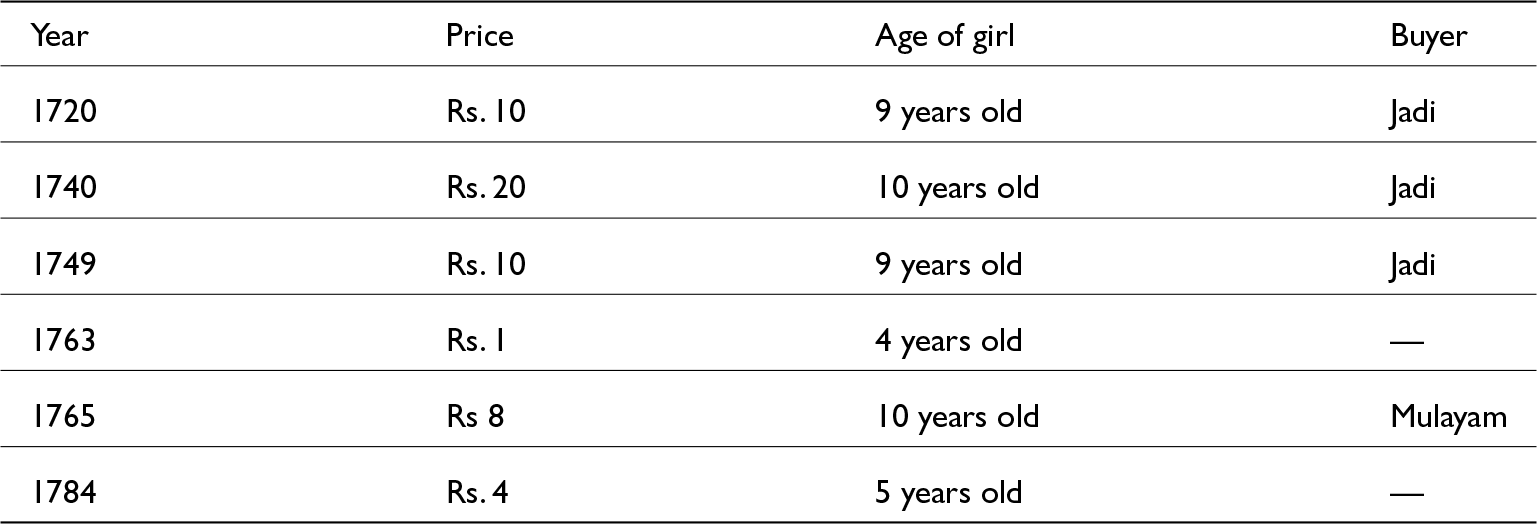
Another aspect that demands our attention is the correlation between the age of the girl and the price at which she was sold. The sexual aspect of the slave trade needs to be taken into consideration here. If looked at closely, one finds that girls nearing the age of puberty (i.e. aged 9–11) were sold at a higher price than those who were younger than them. Priced at 1–30 rupees (as evidenced in Table 2), these slave girls were sold to courtesans who would have employed them for different purposes, including, most likely, as courtesan-trainees. While there is no detailed evidence of courtesan households from the eighteenth century, evidence from the nineteenth century and later, especially as first argued by Veena Talwar Oldenburg, reveals that running a tawa’if household involved complex financial arrangements and fiercely competitive displays of wealth.Footnote 71 Senior courtesans invested their time, labour, skills, and resources to train the young recruits. As they grew up, they would be attached to some rich patron. It should be noted that skilled performers were sought after as they were a status symbol for those who employed them. By recruiting and training near-adolescent girls, the courtesans could reap commercial profits in a shorter amount of time. Compared to the older girls, the younger ones (aged 1–8) would have required more investment in terms of both time as well as money. Read within this social context, the documents show that around 13 girls were sold at five rupees or less, and most of them were aged eight or younger.
Price and age of the girls being sold

Table 2 Long description
The table records the price and age of girls sold between 1720 and 1784, along with the buyers' names. Prices varied from Rs. 1 to Rs. 20, with ages ranging from 4 to 10 years. Jadi purchased girls in 1720, 1740, and 1749, while Mulayam bought one in 1765. Notably, in 1763 and 1784, there were no buyers listed. The data shows a fluctuation in prices over the years, with the lowest price being Rs. 1 for a 4-year-old in 1763 and the highest being Rs. 20 for a 10-year-old in 1740. The absence of buyers in some years suggests possible gaps or changes in the market or record-keeping.
The works of Shireen Moosvi and Shadab Bano show that the sexual aspect of the slave trade had been an important factor in determining the rate of slaves in the preceding centuries as well. For instance, the prices of slaves during the reign of sultan Alauddin Khilji (r. 1296–1316) varied from 5 to 40 coins (in silver tankas). While a maid/slave was priced between 5 and 12 tankas, a female bought for the purpose of concubinage was sold at as high a price as 40 tankas. Similarly, untrained boys were priced at 7–8 tankas and experienced male slaves between 10 and 15, but a ‘handsome boy slave’ could fetch up to 20 or 30 tankas.Footnote 72 Apart from the buyer’s occupation, prevailing socio-economic conditions were also a major factor in determining the rate list. Comparing the slave trade in Allahabad to that of Bengal in the early eighteenth century, one finds that the price of domestic slaves where sales were accentuated by poverty and indebtedness had to be lower.Footnote 73 In the famine-stricken region of Bengal, two girls (aged 6 and 11) were sold for only three rupees. On the other hand, girls in Allahabad were sold for as high a price as 30 rupees. Since they were purchased by influential tawa’ifs connected to the ruling power, it is likely that they were to be used for delivering performances for the elite, or for being in their service for other activities. If the patrons were impressed, it would have translated into more business and riches for the courtesan household.
Hence, the reproductive potential, physical attributes, mannerisms, adaptability of girls, as well as socio-economic circumstances of the seller would have played a crucial role in determining the price of the slave girls. Once they were initiated into the courtesan tradition (whether voluntarily or involuntarily), there were possibilities to move up the ladder in due course. The process of enslavement, as Indrani Chatterjee, Richard Eaton, and others have shown, was not static in nature. The asymmetrical relationship(s) between the enslaved and the master, therefore, could change with time.Footnote 74 The spatial, social, and occupational mobility, coupled with their skills and the position of their patrons, thus provided many of them with varied degrees of autonomy.
While the Allahabad documents provide details about different buyers, they also reflect a certain sense of subjection and a loss of agency concerning the young girls who were sold. Their gender and class location often informed their marginalised social reality. Sumit Guha argues that ‘slavery’ and ‘freedom’ were no absolutes in early modern India and thus various degrees of dependency can be observed. Moving away from a reductive and strict binary, scholars have suggested that such strong asymmetrical dependencies or variations of servitude need to be understood as a ‘spectrum of statuses’ or ‘intermediate categories’.Footnote 75 Enslavement often came with the possibilities of training, education, promotion, and also occasional beatings and resale. Firstly, the status of the buyer and the purpose of purchase shaped the captive girls’ chances for upward social mobility. Cultural practices also provided further mobility to some enterprising female slaves. While elite women often kept talented slave girls for their own ‘prestige, entertainment, companionship, patronage, profit, and power’, a few of them, despite their vulnerabilities, used their ‘wits, charm, talent, and beauty’ to achieve social mobility.Footnote 76 Yet many others were not so successful.
Conclusion
An integral part of the social life of the imperial courts, public performers occupy a peripheral presence in contemporary Persian chronicles. Given that the performers, and particularly female performers, have left us almost no trace of themselves in their own words, reconstructing their history requires piecing together fragmentary references found in other textual sources, travelogues, and paintings. Moreover, the evidence of non-royal women engaging in economic transactions are few and far between. Thus, their presence in this unique tranche of sale deeds uncovered from suba Allahabad has provided us with important insights into the courtesan tradition and more broadly the socio-economic and cultural aspects of eighteenth-century North India.
This article sought to examine the lives of female performers, concubines, and enslaved people to shed light on the social hierarchies in early modern North India. It focused on one of the ways through which young girls were initiated into the tradition and the role played by senior courtesans in the process. It revealed the potential social status and political connections of elite eighteenth-century tawa’ifs, as evidenced in their interaction with public officials during the sale and purchase of slaves, locating senior courtesans within the context of a cash nexus, a commercial market, and a monetised economy.
The sale deeds show that the lines between servile and enslaved groups in the early modern period are often hard to delineate. The sale of young girls to courtesans had some sort of social acceptability as the transactions usually took place in public places in the presence of two or more witnesses, including a police officer. It could also be argued that rather than a widespread acceptance of the practice, perhaps society had become indifferent to the buying and selling of slaves. Or perhaps that slaves, including female slaves, were an active part of the economy in this period and that the state may have taxed the slave trade. Since the possession of slaves was a mark of distinction and affluence, this article also showed that courtesans in this period were part of an influential class of slave owners. This finding underscores their financial independence and ascendancy in society. Finally, the Allahabad documents also record the lives of the enslaved children at pivotal moments, pointing to eighteenth-century practices around enslavement, or more simply, the transfer of human property.
While it would be ahistorical to assume a homogeneous character for these women, some of these groups were successful indeed in building social and political networks and crafting a route to respectability for themselves. At the same time, such evidence also reveals the lost stories of exploitation and commodification of labour, especially of young girls from disadvantaged backgrounds, whose lives were shaped by prevailing power structures, gender norms, and the socio-economic status of their families.
The effort here, therefore, was not to glorify the courtesan tradition but to understand the complex nature of the relationship between a ‘slave’ and their buyer/owner, who was also a public performer. Moving away from a static and homogenised narrative, a de-romanticised view of these female public performers and their multifaceted lives thus offers a fresh lens to study the complex socio-political landscape and paves the way for future investigations into the intersections of legal history and gender history in early modern South Asia.
Acknowledgements
I am deeply grateful to the anonymous reviewers for their incisive comments, and to the editors for their constant support. I would also like to thank Professor Joy Pachuau, Amrita Chattopadhyay, Pratichi Priyambada, and Nitika Sharma for their feedback and help.
Conflicts of interest
None.