




No CrossRef data available.
Article contents
Couple power dynamics, systemic family functioning, and child adjustment: A test of a mediational model in a multiethnic sample
Published online by Cambridge University Press: 01 September 2004
Abstract
Power dynamics in the marital dyad and systemic elements of whole-family functioning (cohesion, subsystem boundary formations) were examined in relation to each other and also in relation to child adjustment in a multiethnic sample of families. Support was found for a mediational model, such that family functioning was found to mediate the relationship between marital power dynamics and children's internalizing and externalizing behavior. Some support also was found for ethnicity as a moderator of the association between systemic family processes and children's adjustment. Disturbances in family cohesion and subsystem boundaries were more strongly related to internalizing symptomatology for children in European American families compared to children in Hispanic American families.This research was funded by National Institute of Mental Health Grant R03 MH54631. We thank Jean–Philippe Laurenceau for his feedback on drafts of this manuscript and for statistical consultation. We also are very grateful to the participating families for the generous donation of their time and effort.
Information
- Type
- Research Article
- Information
- Copyright
- © 2004 Cambridge University Press
The field of developmental psychopathology seeks to understand not only the processes that are linked with children's adjustment difficulties but also those experiences that are linked, in the face of developmental risk, with the process of children's resilience (Cummings, Davies, & Campbell, 2000). Foundational theories of child and family development, including the transactional model of child development (Sameroff & Chandler, 1975), family systems theory (Minuchin, 1974, 1985), and ecological theory (Bronfenbrenner, 1979) clearly indicate that to understand children's adjustment, an examination of the dynamics linking the child and his or her context is critical. Context is important because multiple levels of experience are part of a mutual, transactional process that shapes the trajectory of children's development. A growing literature acknowledges the importance of the whole-family system and larger social networks to child development (Cox & Paley, 1997; Lynch & Cicchetti, 1998; Sameroff & MacKenzie, 2003). The current study is an effort to extend those literatures by examining child functioning in the context of triadic family functioning, interrelations among family subsystems, and family ethnicity.
Bronfenbrenner (1979), and later Lynch and Cicchetti (1998), described children's ontogenic level of functioning as nested or embedded within multiple levels of experience. Child functioning is nested within the microsystem, which is the family environment and communication and relational patterns among family members. Family systems theorists would also argue that embedded within this microsystem are multiple subsystems (e.g., marital and parent–child), and that functioning across these subsystems is a transactional process (Belsky, 1981; Minuchin, 1974, 1985; Nichols & Schwartz, 2004). At the exosystem level, the neighborhood and community may shape, affect, and be affected by that which happens in families and children's lives. All of these levels of experience are further nested within the macrosystem, which is a larger system of society and culture that carries messages, traditions, and practices that can be translated into the cultural, racial, or ethnic identifications (Cox & Paley, 1997). The values and norms that come from the macrosystem level of experience are then expressed within family relationships. To study transactionally based theories of development, it is important to empirically operationalize the varying systems that make up nested levels of children's experiences. This study examined power dynamics in the marriage as they related to whole-family functioning (at the microsystem level) and child adjustment (ontogenic level) in a multiethnic sample (taking into account macrosystemic factors).
Marital functioning and child adjustment
First-generation research
A large body of research documents consistent, moderate effects of marital conflict on parenting behaviors and child adjustment (see Grych & Fincham, 2001; Zimet & Jacob, 2001, for comprehensive reviews). A substantial line of research by Mark Cummings and colleagues examining children's reactions to adult anger and marital conflict indicates that across developmental stages from infancy through the teen years, children may become distressed, fearful, and angry when exposed to interparental conflict (see Cummings et al., 2000). Research also has shown children to have significant psychophysiologocal reactions and dysregulation in response to interparental conflict, as well as peer relationship problems and externalizing difficulties. These difficulties may, in part, arise from affect regulation compromises both through emotional insecurity and heightened stress (El-Sheikh & Cummings, 1995; El-Sheikh, Cummings, & Reiter, 1996; Katz, 2001).
Second-generation research
First-generation research provided evidence that interparental functioning is related to child functioning. Second-generation research has sought to understand the mechanisms through which dysfunction in the marital dyad affects children. The parent–child subsystem has been a frequent target of this work, generally operating on the hypothesis that parenting behaviors carry the negative valence of the marital relationship into interactions with children. This phenomenon has been described as “spillover” from the marriage into the parent–child dyad (Engfer, 1988). Two meta-analyses have been conducted in this area to date, indicating effect sizes of between .46 and .62 linking conflict in the marriage to negative parenting behaviors (Erel & Burman, 1995; Krishnakumar & Buehler, 2000).
Relatively few empirical investigations, however, have actually examined the unique, additive, or interactive effects of interparental conflict and parenting behavior on children (Buehler & Gerard, 2002). In fact, Buehler and Gerard noted that only 12 empirical articles were found documenting links among marital, parenting, and child functioning. Based on a national survey of over 2,500 ethnically diverse families with children of all ages, Buehler and Gerard found more punitive parenting and less parental involvement partially mediated the relation between marital conflict and an overall index of child adjustment.
Triadic family functioning and child adjustment
Among the most recent developments in the area of interparental conflict and child adjustment is the focus on triadic family functioning as a mediator or moderator of the relation between couple level dynamics and child adjustment. Understanding the whole family as a unit is important to development, in that it is the medium through which a variety of developmental functions unfold (Cummings et al., 2000; Minuchin, 1985). Functioning at the family level can be related to both resilience and risk for child development. Based largely on clinical experiences and family systems theory, Salvador Minuchin (1974) described several types of boundary or structural disturbances in triadic family relationships, arising from perturbations in the interparental relationship, that may lead to child adjustment difficulties. First, parents may “detour” their conflict onto the child to preserve the marital relationship, such that they work to strengthen the bond between them by diverting conflict from within to focusing negativity on a child. Second, parents may engage in triangulation, or attempts by one parent to gain a child's support and loyalty, which meets that parent's needs for a close relationship within the family but creates crossgenerational boundaries and excludes the other parent. Third, family relationships may become strained and distant, indicating a weak family structure and disengaged family relationships. Although methodologically challenging to conduct, there is a growing body of research examining these structural and affective processes in families and the links between subsystem, whole system, and child functioning (Gordis, Margolin, & John, 1997, 2001; Katz & Gottman, 1996; Kerig, 1995; Lindahl & Malik, 1999b; McHale & Fivas–Depeursinge, 1999; Westerman, 1987).
Parenting behavior in triadic context
Several studies of the whole-family context and child adjustment focused on parenting behaviors as they occurred in a triadic setting (Buhrmester, Camparo, Christensen, Gonzalez, & Hinshaw, 1992; Florsheim, Tolan, & Gorman–Smith, 1996; Gordis et al., 1997, 2001; Katz & Gottman, 1996; McHale & Cowan, 1996; Vuchinich, Wood, & Vuchinich, 1994; Westerman & Massoff, 2001). These initial studies included small to medium sample sizes (between 50& and 100 families) and focused primarily on boys. Most included families who were mostly white, non-Hispanic, European American (with Florsheim et al., 1996, as a notable exception). One of the landmark studies was that of Katz and Gottman (1996), who found that observations of hostility in marital interactions had an indirect effect on boys' peer aggression, through observed paternal rejecting behaviors in the family triadic interaction. Also examining parenting behavior in the triad, Gordis et al. (1997, 2001) found several interactive effects between marital aggression and hostility and triadic parenting hostility on boys' observed withdrawal, distraction, and anxiety in triadic interaction, as well as on boys' internalizing and externalizing behaviors. Although focusing on parent behavior in particular rather than overall quality of the triadic interaction, the data obtained by Gordis et al. (1997, 2001), along with the findings of Katz and Gottman (1996), pioneered work in the area of empirically testing spillover through systems theory driven, multiple method designs.
The initial research in on family processes revealed important methodological issues in the study of microsystem influences on child development. First, most research in this area focuses on global indices of marital functioning, such as conflict or satisfaction, and there is a need to specify which elements of the marital relationship are most linked to family functioning and child adjustment (Fincham, 1998). Second, given the complexity of the questions asked, whole-family processes rather than just individual or dyadic factors must be studied. Third, most studies are not ethnically diverse, limiting their generalizability. A growing literature exists attempting to respond to some of these methodological issues.
Specifying marital functioning
One of the specific marital dynamics to examine is how power and control are distributed in relationships. Researchers and theorists have suggested the importance of power in family relationships, and the marital dyad in particular, for a number of years (e.g., Blood & Wolfe, 1960; Gottman & Notarius, 2002; Huston, 1983; Olson & Cromwell, 1975). These researchers have suggested that understanding the structure of relationships, including the symmetry or asymmetry of influence, decision making, and authority within couple and family relationships, provides insight into communication patterns, relationship stability, and relationship quality. As such, this systemic process in couple relationships has become a focus of our efforts to understand marital and family functioning across ethnic groups (Malik & Lindahl, 1998). Some evidence for the unique role of marital power dynamics in family functioning came from an investigation we did with 113 Hispanic American and European American families with a school aged child. Marital functioning was assessed observationally with measures of marital power dynamics and conflict management style (Lindahl & Malik, 1999a). Specifically, we examined the observed balance of power between members of the couple, operationalized as how authority, power, and decision making are distributed across partners. Conflict management style categorizes couples into harmonious, disengaged, and destructive conflict types, based in part on Gottman's (1993) typology of couple interaction styles.
Similar to the results of Katz and Gottman (1996), Lindahl and Malik (1999a) found that links between couple conflict and triadic parenting behavior were stronger for fathers than for mothers, and that less harmonious conflict management styles in the marital interaction were related to less support, more coerciveness, more rejection, and more withdrawal from their child in triadic interaction. In addition to conflict, marital balance of power also was uniquely related to triadic observations, with imbalanced power dynamics related to less optimal parent and child behaviors. Some ethnic differences were found with both balance of power and conflict in the marriage, such that disturbances in the marriage were more often related to negative parenting behavior for European American than Hispanic American couples.
Triadic family processes
Few studies have been published that focus specifically on whole or triadic family processes. Patricia Kerig's work is a notable exception. Studying family processes explicitly derived from systems theory, Kerig (1995) found important links among family subsystems and children's functioning. Based on self-report data, triadic family relationships were categorized as “cohesive” (all three family members are close), “separate” (all are distant), “triangulated” (crossgenerational boundaries exist), or “detouring” (a strong parental subsystem excludes the child and deflects attention away from marital issues toward the child). Families with crossgenerational boundary formations reported poorer marital quality and more negative parent–child relationships. Detouring was associated with a higher quality of marital relations but was also associated with higher levels of child self-blame and internalizing and externalizing symptoms. Children from families classified as separate had the highest level of externalizing problems (Kerig, 1995).
Building on the work of Kerig (1995) and others, studies from our lab have attempted to operationalize specific whole-family processes and to investigate their relations with child adjustment with both clinical and nonclinical groups. Utilizing a triadic coding system, Lindahl (1998) examined whether a variety of family systems factors would differentiate among four groups of school aged boys: those without behavior problems, and those with behaviors consistent with attention-deficit/hyperactivity disorder (ADHD), oppositional defiant disorder (ODD), or both ADHD and ODD behaviors. Triadic family interactions were coded both for overall family interaction patterns and for parenting behaviors in the triad. With over 90% accuracy, boys' behavioral symptom groups could be differentially predicted by marital and family factors. Specifically, parenting behaviors distinguished clinical families, and a lack of whole-family harmony and cohesion were most related to ODD symptoms. Families who reported that their sons did not have any behavior problems showed the highest level of positivity and intimacy in both couple and family interactions.
In a study of nonclinical, community families, we examined the issues of whether ethnicity, a macrosystem-level factor, might influence the relations among family subsystem functioning and child adjustment (Lindahl & Malik, 1999b). In this study, across ethnic groups, marital and family processes were linked with externalizing behaviors in school aged boys in predictable ways, such that marital conflict, low family cohesion, imbalanced family boundaries, and inconsistent parenting styles were linked with higher reports of externalizing behaviors. With regard to ethnic differences, this study suggested that higher family cohesiveness served as a buffer against the relation between marital conflict and boys' externalizing behavior most strongly in Hispanic American compared with European American families. Additionally, a more strict, hierarchical parenting style was associated with more behavior problems for European American boys, whereas a more lax and inconsistent parenting style was associated with behavior problems for Hispanic American boys (Lindahl & Malik, 1999b).
Kitzmann (2000) investigated interrelations among marital conflict, disruptions in family alliances, and parenting style in triadic interaction. This study indicated that following a marital conflict discussion, there was a trend for diminished family cohesion and more unbalanced family alliances in a triadic family discussion. In one of the only other studies found to directly address whole-family process, Westerman and Massoff (2001) reported in a preliminary study of 16 families that triadic coordination was reliably assessed and related to children's adjustment.
An ecological approach to family dynamics and children's adjustment
As can be seen from the above review, there is a growing body of empirical evidence indicating the importance of family or microsystem influences on child development. Our own initial work in the area of family ethnicity, as well as recent findings by Buehler and Gerard (2002), highlight the need, discussed articulately by McLoyd and her colleagues (McLoyd, Harper, & Copeland, 2001), to go beyond the microsystem and examine macrosystemic constructs that affect the family and children. Very few studies include families that are diverse in racial or ethnic background, although a growing literature suggests that a recognition of systemic differences across families from different ethnic backgrounds is critical to understanding multisystem influences in child development (Cox & Paley, 1997; Florsheim et al., 1996; Vega, 1990). Because our current investigation focuses on European American (otherwise referred to as Anglo or White, non-Hispanic) and Hispanic American (also labeled at times Latino or Latino American) families, this literature review will be focused on these two groups.
Cultural, marital, and family dynamics
Culture and ethnicity may be among the most salient contextual factors in the study of family system and subsystem relations because of the significant variability in gender role norms, family roles, and the structure of family decision making across ethnic and cultural groups (Casa de la Mujer, 1988; Huston, 1983; Yllö, 1993). Egalitarianism and shared authority, in the form of role diffusion, have increasingly become accepted and expected by marital partners in contemporary European American culture (Komter, 1989; Mintz & Kellogg, 1988; Wagner, Kirchler, Clack, Tekarslan, & Verma, 1990). An egalitarian couple dynamic includes shared decision making and an emphasis on democratic or nonhierarchical systemic processes.
Egalitarianism may be less important, however, in cultures other than European American groups (Wagner et al., 1990). For example, the emphasis of familism in Hispanic American family life may be a counterpoint to an emphasis on egalitarianism (Bean, Curtis, & Marcum, 1977; Leaper & Valin, 1996). Because familism may place more emphasis on duty to one's family and complementary (rather than shared) roles in maintaining family systems and functioning, imbalances in power and family structure may be more likely among Hispanic American families. However, these imbalances may be less likely to cause disruptions in marital and family functioning, because they may not be incongruent with cultural values (Malik & Lindahl, 1998; Staples & Mirandé, 1980; Vega, 1990). In other words, although in both European and Hispanic American families an emphasis on cooperation, cohesion, and nonconflictual interactions exists, there is also a strong value of respecting authority, boundaries, and individual or hierarchical roles within Hispanic families that may not be part of the macrosystem level values in European American families (Vega, 1990). Consistent with this hypothesis, and the notion of familism rather than egalitarianism, an authoritarian parenting style appears to be associated with poorer child outcomes in European American families compared with families of color (Chao, 2001; Lindahl & Malik, 1999b; Steinberg, Lamborn, Darling, Mounts, & Dornbusch, 1994).
Present study
This study constitutes an effort to understand, from an ecological perspective, how macrosystem, microsystem, and ontogenic levels of children's experiences are interrelated in the process of child adjustment. We sought to contribute to the literature on how specific, systemic dynamics of marital functioning, beyond general indices of conflict, may be related across family subsystems. We also sought to extend the our own and others' work on whole-family functioning, examining the link between marital power dynamics and structural and affective indices of triadic family interactions. In addition, this study further examines the links among these marital and family indices with child internalizing and externalizing problems.
Several specific hypotheses were tested. We hypothesized that imbalances in the marital power dynamic would be related to child functioning, with poorer family functioning, including less cohesiveness, more imbalanced boundary formations, and higher levels of triangulation of children into the marital conflict, mediating the relation between marital functioning and child adjustment. Given the limited but growing research on ethnic variations in family systems (Buehler & Gerard, 2002; Lindahl & Malik, 1999b; McLoyd et al., 2001), we also expected that elements of this mediational model would be moderated by ethnicity. The literature in this area is new enough that only exploratory hypotheses can be offered. Our expectation was that imbalances in marital power would be more strongly related to child adjustment difficulties in European American families than in Hispanic American families.
Method
Participants
The participants were recruited during two recruitment phases, which took place over a period of 2–3 years. The participants were 237 two-parent families with a child between 8 and 12 years of age. Although African American families are included in the larger data set (N = 35), they are not included here because of the relatively small size of this group. Families were recruited from the community through newspaper advertisements and flyers distributed in schools. Recruitment materials described the project as assessing differences in how families communicate with one another and solve problems together. Families were paid $70 for their participation. Fifty-two percent of the fathers and 57% of the mothers identified themselves as Hispanic American, while all others identified as White, non-Hispanic (European American). Of the participants who identified themselves as Hispanic, 60% were Cuban American. The fathers' average age was 41 years and the mothers' average age was 38. The average length of marriage was 11 years. There were 137 boys (age M = 9.2 years, SD = 1.02) and 100 girls (age M = 9.93, SD = 1.46). The families were predominantly middle class (family monthly income M = $3,908, SD = $2,280).
With regard to ethnic differences in demographics, the families did not differ on most variables. The Hispanic American and European American families differed significantly from one another, however, on two of these demographic variables, overall F (5, 229) = 5.58, p < .001, including maternal age (Hispanic mothers were on average 4 years younger) and monthly income. (The mean monthly income was $3,400 for the Hispanic American families [$40,800 annual income] and $4,400 for the European American families [$52,800 annual income].) Based on US Census Bureau data, median household income for the United States during the time that included data collection (2001) was $42,900, placing the Hispanic families slightly below the median and the European American families above (DeNavas–Walt, Cleveland, & Webster, 2003). However, both groups are above the median income for the South region of the country, where data were collected ($39,523), and both groups were above the median income levels for their ethnic groups. Nevertheless, to avoid a common methodological error in crossethnic research, confounding SES with ethnicity, monthly income was accounted for in all analyses.
Procedure
Families came to a laboratory setting for a session that lasted between 2 and 3 hr. Only procedures relevant to the goals of the present study are presented here. After completing several questionnaires, all of which were administered in English, with bilingual research assistants present as needed, couples were videotaped engaging in a standard marital problem discussion task, and families (mother–father–child) were videotaped discussing a recent family argument. The order of the videotaped interactions was counterbalanced across families. For the marital discussion, couples were instructed to select one of the top three problem areas in their relationship and to discuss the nature of the problem, including sources of disagreement, and how they would each like to see the problem resolved. Couples were given 12 min to discuss and were videotaped through a one-way mirror. For the family discussion, families were asked to take 12 min to discuss a recent family argument that involved both parents and their child. They were instructed to describe what happened during the argument and to try to reach a solution to the problem.
Measures
Research assistants who were blind to all information about the families and to the hypotheses tested in the study rated the videotaped interactions. Half of the coders were Hispanic or Latino (and bilingual), and an attempt was made to match coders to the families based on their own ethnicity, although this was not always possible. The marital and family interactions were coded by separate teams of coders. Coding of marital interactions was done utilizing the System for Coding Interactions in Dyads (SCID; Malik & Lindahl, 2004) a global couple dynamic coding system that has been found to be reliable with European American, Hispanic American, and African American couples. Family interactions were coded utilizing the System for Coding Interactions and Family Functioning (SCIFF; Lindahl & Malik, 2001), which has also been found to be reliable with ethnically diverse samples. The SCID and the SCIFF contain descriptions of each code as well as specific behavioral anchors on scales ranging from 1 (very low) to 5 (high). All codes were rated on a 1–5 Likert-type scale unless otherwise noted (the only exceptions are the Balance of Power code from the SCID and the Boundary Formation code from the SCIFF). Coders received a minimum of 15 hr of training in the use of either the marital or the family coding system and they watched each interaction a minimum of three times before making global ratings of the interactions. Performance of coders was continuously monitored, and feedback was given weekly to minimize coder drift. Thirty percent of the families were randomly selected for the reliability analyses. For these families, each marital and family interaction was coded by three independent coders, at least two of whom were of Hispanic or Latino heritage. Interobserver reliability for each coding system was assessed by using Cronbach alpha coefficients (which in this case yields the same result as an intraclass correlation coefficient; see Shrout & Fleiss, 1979).
Marital functioning
Four dimensions of functioning related to the distribution of power in the marriage were assessed with the SCID. Husbands and wives were rated separately on two codes, Verbal Aggression and Coerciveness, and the couples were coded as unit in terms of their tendency to engage in a pursuit-withdrawal pattern of interaction and in terms of balance of power in the relationship. Verbal Aggression indicated overt negative power tactics and included hostile, aggressive remarks such as insults, criticisms, and name calling, behaviors indicating disgust or condescension, and swearing (e.g., “How can you be so stupid about this?”). Both frequency and intensity of verbally aggressive comments are considered in making ratings on a 5-point scale, from 1 (none) to 5 (three or more verbally aggressive comments are of moderate to high intensity). Coercion indicated covert negative power tactics and was operationalized as behaviors that were threatening, intimidating, or manipulative. This included statements that were aversive, unpleasant, or shaming that were used by one partner to gain the upper hand in the interaction or to change the others partner's behavior (e.g., “You get so overbearing that I have to shut you out”). For the purpose of data analyses, husbands' and wives' Verbal Aggression and Coerciveness codes were averaged, resulting in one couple Verbal Aggression and one couple Coercion score.
The Pursuit–Withdrawal code assessed the extent to which one partner tried to engage the other partner in discussing an issue through demands, nagging, and complaints, and the other partner attempted to avoid discussing the problem by withdrawing, distracting, or denial of the problem. This dynamic has been associated with power, suggesting that partners who demand are requesting changes in the status quo, while partners who withdraw are those maintaining the status quo in relationship communication (Berns, Jacobson, & Gottman, 1999; Christensen & Shenk, 1991). Adequate interobserver reliability was found for Hispanic American (αs = .84, .76, and .74) and European American couples (αs = .88, .77, and .79) for the Verbal Aggression, Coercion, and Pursuit–Withdrawal codes.
The Balance of Power code was originally developed as a categorical code, with couples placed into one of four categories, Egalitarian, Male Dominant, Female Dominant, or Power Conflict. To be coded as Egalitarian, neither member of the marital dyad was perceived to have more dominance or power over the other. The opinions, ideas and feelings of both partners were equally respected and attended to, and each partner contributed equally in decisions that were made. Male or Female Dominant couples were ones where one person was clearly more powerful or dominant. This was indicated through behaviors such as dominating the conversation, monopolozing the talk time, directing the flow of the conversation, and making unilateral decisions or giving commands that were accepted by the partner. In Power Conflict couples, both partners appeared to be making an effort to gain control of the interaction, and they seemed to be at a “stand-off.” Both partners seemed to be vying for power, as demonstrated by behaviors such as making efforts to get one's own way, inflexibility or a stance of noncompromise, or making repeated self-focused statements. For the purpose of data analysis, this code was reformulated as a continuous code, ranging to from low (Egalitarian) to medium (Male/Female dominant) to high (Power Conflict) levels of power imbalance. Mean kappas of .68 and .75 were obtained for the Hispanic and European American couples, respectively.
Family functioning
With the SCIFF, three different elements of systemic family functioning were assessed, Cohesiveness, Triangulation, and Boundary Formation. Cohesiveness measured the sense of unity, togetherness, and closeness within the family and was coded on a 1–5 Likert scale. Highly cohesive families were characterized by a sense of mutual appreciation between family members as they worked toward a common goal, while families lacking in cohesion were characterized by interpersonal distance, awkwardness, and stiffness or disconnection in the interaction. Adequate interobserver reliability was found for both Hispanic (α = .90) and European American families (α = 91).
Each parent was rated individually in terms of triangulation. Triangulation occurred when the parents appeared to be in conflict with each other and one them tried to obtain support and sympathy from the child, or when one of them made an effort to get the child to agree or side with one parent against the other. The frequency of triangulating statements made by each parent was counted and rated from low (no statements) to high (four or more statements). Mothers' and fathers' triangulation were highly intercorrelated (r = .71), and parents' scores were combined for data analysis. Adequate interobserver reliability was found for both Hispanic and European American families (αs = .87 and .95, respectively).
Boundary Formation, originally conceptualized as a categorical code (mean κs of .75 and .69 were obtained for the Hispanic and European American families, respectively), was treated as a continuous code in the present study. This code represents a continuum reflecting the number of disengaged, dysfunctional, and disconnected dyads in the family triad. On a scale from 1 to 3, 1 reflected Balanced families, in which all dyads seemed about equally close or affectionate with one another, and at no time was any person excluded from the interaction. A rating of 2 was given to families observed to engage in Dyadic Alliances, which reflected a triadic interaction in which either the marital dyad was clearly the most powerful and the most distressed (detouring) or there were crossgenerational alliances. When detouring was observed, parents appeared to band together to overly control or blame the child for difficulties, in such a way that the problem discussion was detoured away from the marital conflict and focused instead on the child. The child's thoughts and feelings were often ignored or not respected. Parent–child crossgenerational families were characterized by a very strong, potentially enmeshed alliance occurring between one parent and the child to the near exclusion of the other parent. This occurred in one of two ways, either one of the parent–child dyads was notably closer and more affectionate than the other, to the point the other parent appeared almost to be a “third wheel,” or the child actively sided with one parent against the other in a conflict. A rating of 3 was given when no functional dyadic relationships were observed. In these Disengaged families, it was not possible to identify any strong boundaries or alliances. There was little closeness within any dyad. Disorganization and interpersonal distance characterized these family discussions.
Child adjustment
Parents rated their child's behavior using the Child Behavior Checklist (CBCL; Achenbach, 1991). The CBCL is among the most widely used measures in the assessment of behavioral and emotional difficulties of childhood and adolescence. It has excellent psychometric properties, and is well standardized and validated. It has been used in many other countries outside of the United States with many diverse populations within the Untied States, including Hispanic children (Knight, Virdin, & Roosa, 1994). Norms are based on a child's sex and age group. The CBCL contains two broadband factors, Externalizing and Internalizing, both of which were used for analyses in this study. The mean test–retest reliability has been reported by the authors to be .87 (Achenbach, 1991). Coefficient alphas in this sample were .95 and .87 for the Hispanic American parents, and .91 and .92 for the European American parents, for the Externalizing and Internalizing factors, respectively.
Results
Descriptive statistics
The means and standard deviations for the variables included in the analyses are presented in Table 1. The two ethnic groups did not differ from each other on any of the Likert-scale (continuous) variables. An inspection of the means for the marital and family functioning variables indicated them to be within expectations for a community study. The mean scores for variables indicating marital power or systemic family dysfunction were less than 2 (and therefore in the “very low” to “low” levels), and the mean level of family cohesiveness was in the “moderate” range for both ethnic groups. The mean Internalizing and Externalizing scores from the CBCL are somewhat higher than typically reported in studies with a nonclinical sample. This is most likely due to the fact that the fliers sent out to schools to advertise for the study encouraged both families with and without problems to participate. Chi-square analyses indicated that the categorical levels of the marital Balance of Power variable were distributed similarly across the two ethnic groups, χ2 (2, N = 235) = 1.34, ns. Just over half of the couples in each ethnic group demonstrated an egalitarian distribution of power in their relationship. One partner was more dominant over the other in about a third of the couples in each group, and in the remainder of couples, spouses competed with each other for control. The chi square for the family Boundary Formation variable approached significance, χ2 (2, N = 237) = 4.60, p = .10. Balanced family boundaries were slightly more common in Hispanic American families and Disengaged family boundaries were slightly more common in European American families.
Means and standard deviations for marital, family, and child variables and distribution of categorical variables by ethnicity

A chi-square analysis was used to examine the relationship between types of marital power dysfunction and boundary or alliance formations within families. The three levels of marital distribution of power, Egalitarian, Partner Dominant, and Power Conflict, were found to be differentially spread across the three levels of family subsystem boundary formation, Balanced, Dyadic, and Disengaged χ2 (4, N = 235) = 22.71, p < .001. As seen in Table 2, when couples share power equally, family subsystem boundaries are likely to be balanced. This combination constituted 40% of all families in the study. Egalitarian marriages were associated with balanced family boundaries 72% of the time and with dyadic or disengaged boundaries the remaining 28% of the time. The reverse pattern was found for Power Conflict marriages, which were associated with dysfunctional family subsystem boundary formations 66% of the time (Disengaged boundaries 43%, Dyadic alliances 23%) and with adaptive subsystem family boundaries just 34% of the time. In fact, when all nine possible marital/family combinations are considered, the marital Power Conflict/Balanced Family Boundary combination occurred in just 5% of all families. Having one spouse more in control of the power in the marriage was less clearly associated with any pattern of family boundary formation. When marriages were coded as Partner Dominant, balanced family boundaries were observed 54% of the time and imbalanced boundaries were seen 46% of the time, spread similarly across Dyadic Alliances (24%) and Disengaged family systems (22%). Table 3 contains the correlation matrices for all variables for each ethnic group.
Marital power distribution and family subsystem boundary formation

Correlation matrices for each ethnic group

Structural equation modeling (SEM)
SEM was employed to test the study hypotheses. Maximum likelihood estimation methods, as implemented through LISREL computer software (Jöreskog & Sörbom, 1999), were used to estimate all models. Multiple group analyses were employed, in which individual models for Hispanic Americans (N = 153) and European Americans (N = 82) were specified within the same overall model, to allow for model comparisons by ethnicity. The chi-square goodness of fit index, comparative fit index (CFI), and root mean square error of approximation (RMSEA) were used to evaluate model fit.
Results of confirmatory factor analyses indicate the observed variables load adequately on the marital power, χ2 (12) = 18.58, p = .10, RMSEA = .06, CFI = .98, and family functioning latent variables, χ2 (3) = 3.18, p = .36, RMSEA = .024, CFI = 1.00, respectively. As the child outcome variables were each specified by a single indicator, which we could not assume to have been measured without error, the loading of the indicators on the latent variables were fixed to an assumed reliability (1-coefficient α) by fixing the error term accordingly.
To test the study hypotheses, hybrid models were specified in which the measurement and structural models were estimated simultaneously, and multiple models were compared. As recommended by Bollen (1989), when reporting results of SEM, nested models were compared whenever possible, and model comparisons are indicated by a change in the chi square (Δχ2). Model modifications were retained that resulted in a nonsignificant deterioration in model fit, indicated by a nonsignificant Δχ2. For chi-square analyses, N = 235.
Family income was controlled for by specifying direct paths from family income to the endogenous variables in the model (i.e., family functioning, child internalizing behavior, and child externalizing behavior). To account for shared method variance, errors of some indicators that employed a similar assessment method (e.g., observation) were allowed to covary, consistent with practice in employing SEM in family process research (Cook, 1994; Davey, Fincham, Beach, & Brody, 2001).
Test of mediation
As recommended by Holmbeck (1997), mediation was tested by first evaluating the fit of the direct effects model, in which only paths from marital power to child internalizing and externalizing behavior were specified. Direct effects paths must be significant in order to establish that there is an effect to be mediated. To generate the most parsimonious model, the factor loadings for the couple power dynamic latent variable were constrained to be equal. The model constraint did not result in a significant deterioration in model fit, Δχ2 (4) = 4.56, ns, indicating Couple Power Dynamic represented an invariant construct in the Hispanic American and European American families in the current study. In addition, with exception of the error covariance between SCID Coerciveness and SCID Balance of Power, which was significantly larger for European American compared with Hispanic American families, Δχ2 (1) = 7.78, p < .05, the error covariances were constrained to be equal without significant deterioration in model fit, Δχ2 (6) = 9.83, ns. The direct effects model provided an excellent fit to the data (see Figure 1). Examination of the model path coefficients indicated all paths were significant and in the expected direction. In the interest of parsimony, the factor loadings and error covariances reported in the figure represent the constrained coefficients. However, as a purpose of this study was to evaluate potential ethnic differences in associations among marital, family, and child functioning, the structural path coefficients for both Hispanic and European American families were included in the figure.

The direct effects model for Hispanic American and European American families. The numbers outside and inside the parentheses represent values for Hispanic American and European American families, respectively. *p < .05.
Next, a mediation model was tested in which, in addition to the direct effects, indirect effects were specified through which marital power was allowed to affect the child behavior variables via Family Functioning (i.e., the mediated paths). With exception of the factor loading for SCIFF Triangulation on the Family Functioning latent construct, which was significantly larger for European American compared with Hispanic American families, Δχ2 (1) = 9.99, p < .05, all factor loadings could be constrained to be equal without significant deterioration to model fit, Δχ2 (6) = 9.75, ns. The mediation model provided an adequate fit to the data (see Figure 2). Examination of the model path coefficients indicated all paths were significant and in the expected direction, with the exception of the direct effects, which were nonsignificant. The finding that the direct effect paths became nonsignificant when the indirect paths via Family Functioning were included in the model provided partial support for mediation.

The full model for Hispanic American and European American families. The numbers outside and inside the parentheses represent values for Hispanic American and European American families, respectively. *p < .05.
To specifically test for mediation, the direct effects from marital power to child internalizing and externalizing behavior were constrained to zero, and only indirect paths via family functioning were specified. The constrained model did not result in a significant deterioration in model fit, Δχ2 (4) = 3.42, ns, indicating associations between marital power and child internalizing and externalizing behavior were fully mediated by family functioning for the Hispanic American and European American samples in the current study.
Test of moderation
To test for moderation by ethnicity, corresponding structural paths for Hispanic American and European American families were individually constrained to be equal, and the constrained models were compared with the full mediation model, χ2 (78) = 121.29, p = .001, χ2 (1, 56), RMSEA = .062, CFI = .95, as recommended by Holmbeck (1997). First, the paths from marital power to family functioning were constrained to be equal, resulting in a nonsignificant deterioration in model fit, Δχ2 (1) = .02, ns. Second, the paths from family functioning to child externalizing behavior were constrained to be equal. The second equality constraint did not result in a significant deterioration in model fit, Δχ2 (2) = .36, ns. Third, the paths from family functioning to child internalizing behavior were constrained to be equal, resulting in a nonsignificant deterioration in model fit, Δχ2(3) = 3.59, ns. Thus, results did not support family ethnicity as a moderator in the current study.
Family subsystem boundaries, ethnicity, and child adjustment
The test of an overall mediational model above provides an important overview regarding the complex associations among marital power dynamics, systemic family functioning, and their relations with child adjustment. It does not, however, allow for analysis of how specific dynamics in family relationships may be associated with better or poorer adjustment in children. To investigate more specifically under what conditions there were significant differences in children's behavioral functioning, analyses of variance were performed to examine the relations among family Boundary Formations (Balanced, Dyadic Alliances, Disengaged), ethnicity, children's internalizing and externalizing behavior, and covarying income. Results are presented in Figures 3 and 4. As expected, the overall multivariate analysis of covariance revealed a significant effect of Family Boundary, F (4, 460) = 12.00, p < .001. Follow-up univariate results showed significant main effects for both internalizing, F (2, 230) = 13.92, p < .001, and externalizing behavior, F (2, 230) = 23.48, p < .001.

Ethnicity as a moderator of the relation between Family Boundary Formation and CBCL Internalizing scores.

Family Boundary Formation and CBCL Externalizing scores.
Follow-up univariate analyses also revealed a significant interaction effect for CBCL Internalizing scores, F (2, 230) = 3.10, p < .05, but not CBCL Externalizing scores, F (2, 230) = 1.40, ns. As seen in Figure 3, for both European American and Hispanic American families, family boundary violations and disorganization are related to increases in internalizing symptoms in children, with the effect significantly stronger for European American children. Post hoc comparisons using Tukey HSD indicated that in European American families, increasing levels of systemic family boundary dysfunction were associated with significant increases in internalizing symptomatology in children (Disengaged > Dyadic Alliance > Balanced, all ps < .05). For Hispanic American families, internalizing symptoms were lower in Balanced families compared to Dyadic Alliance or Disengaged families (ps < .05), but Dyadic Alliance and Disengaged families did not differ from one another. At the highest level of family boundary dysregulation, Disengagement, the mean for internalizing problems was in the borderline clinical range for European American families (M = 66.23) and higher than the mean for Hispanic American children (M = 58.61).
Family subsystem boundary violations also were associated with disruptive behavior problems in predicted ways. For both European American and Hispanic American families, externalizing behavior was within normal limits when family subsystem boundaries were Balanced (M = 51.20), but in the borderline clinical range (M = 61.36) when boundaries were fragmented and families were disconnected from one another (see Figure 4). Levels of externalizing symptoms in families with Balanced boundaries were significantly lower than in families with Dyadic Alliances or Disengagement (ps < .05), although the latter two groups did not differ from one another.
Discussion
Systemic theories emphasize the importance of understanding not only the individual elements of a system, but also how elements are interrelated and how parts are related to wholes (e.g., Bateson, 1972; Bertalanffy, 1968; Sameroff, 1983). When applied to families and the study of child development, the family can be understood as an organized system that has certain observable properties and follows specific principles that govern its functioning. Of particular relevance to this study are the principles of wholeness and order. This suggests that the family needs to be understood as an integrated whole, which is different from a summation of the individual parts. It also suggests that the family should be considered as a complete unit within which there is a hierarchical structure, referring to the subsystems contained within the larger family system (Cox & Paley, 1997; Minuchin, 1985). From a systemic perspective, child adjustment cannot be separated from the context in which it is embedded, and investigating the complex interconnections among whole-family functioning and its constituent subsystems is critical if risk for psychopathology is to be fully understood. Various levels of the ecology of a child's life, including the macrosystem and the exosystem, also need to be taken into account to understand the complex interrelations among risk and resilience in child functioning and development (Bronfenbrenner, 1979; Lynch & Cicchetti, 1998).
Marital power dynamics and child functioning
The principal goal of this study was to examine disturbances in systemic family processes and how they relate to child adjustment. This study focused specifically on power dynamics in interparental relationships and subsystem boundary functioning, including structural family systems and triangulation of children, in triadic family interactions. A large body of literature has established a link between marital conflict or dysfunction and risk for maladjustment in children (e.g., Davies & Cummings, 1994; Grych & Fincham, 1990; Zimet & Jacob, 2001). Less is known, however, about how specific marital processes relate to whole-family functioning, and how the family can serve as a moderator or mediator of the relation between the marital and child functioning (Cox & Paley, 1997; Fincham, 1998). Examining subsystem interrelations in the family, using inclusive methodology such as structural equations modeling, is critical to forward our understanding of the complexities of family influences on child functioning (Sameroff & MacKenzie, 2003). Understanding subsystem interrelations across ethnic groups also helps us understand how macro- and microsystems interact in relating to risk and resilience in children's development.
Consistent with the general literature on marital quality and child functioning, in the present study, the specific dyadic process of power distribution in the marriage was found to be related to child adjustment in the direct effects model, and to whole-family functioning in the mediational model. The overall direct effect indicates that a balance of power in the marital relationship may provide a foundation of stability for children, regardless of ethnicity. This finding is consistent with systemic theories that (a) stress the importance of a functional, hierarchical structure within families and (b) suggest that optimal functioning will occur when subsystems, in particular the marital dyad, contain organized communicative rules that enhance harmonious decision making and the formation of firm but flexible boundaries (Minuchin, 1974, 1985).
Marital power dynamics and triadic family functioning
Couple power dynamics also were significantly associated with whole-family processes. A systemic perspective suggests that a conflictual, asymmetric distribution of power in the marriage is likely to have a destabilizing influence in the family. In the language of structural family systems theory, conflicts that erode the solidity of the marital subsystem can create fault lines in the family structure, affecting dyadic, triadic, and whole-family subsystem relationships as well as child functioning (Minuchin, Rosman, & Baker, 1978; Nichols & Schwartz, 2004). One specific way in which marital power struggles have been hypothesized to perturb the coherence of the larger system is through disturbances in parent–child alliances, especially the establishment of cross-generational coalitions and the triangulation of the child into the marital conflict (Margolin, Oliver, & Medina, 2001; Minuchin et al., 1978). Disruption to the hierarchical structure creates asymmetry or imbalance and reduces cohesiveness in the larger family system.
We found that couple power dynamics accounted for more than a third of the variance in systemic family functioning, indicating a close link between these two subsystems and evidence for a strong relation between the marital power dynamic construct and overall family functioning. Egalitarian decision making or equal power sharing in the marriage was associated with effectively organized and cohesive family-level functioning 70% of the time, while observations of couple struggles for and conflicts over power were associated with observed imbalances in family subsystem relationships, especially disengaged or disconnected triadic interactions. When the marital dyad subsystem was characterized by conflicts over power, it was rare to find whole-family systemic functioning to be well balanced (just 5% of all families in the study showed this combination). In the absence of longitudinal data, causal conclusions of course cannot be drawn, but the findings suggest that disorganization or chaos in one dimension of family system functioning is related to disorganization in other subsystems, and that power dynamics in the couple relationship are important to overall family organization. In this study, no moderation of this relation by ethnicity was found, further supporting the elements of systems theory that focus on the universal importance of functionality and cohesiveness in the marital dyad for adaptive family functioning (Minuchin, 1974).
Triadic family functioning as a mediator of marital power dynamics and child functioning
Relatively few studies of child development or developmental psychopathology assess constructs related to patterns of whole-family interaction. Various dyads, especially the parent–child dyad, have been studied across areas of research including attachment, parenting styles, and child externalizing behaviors, such as oppositionality (Ainsworth, Blehar, Waters, & Wall, 1978; Patterson & Stouthamer–Loeber, 1984; Steinberg, Lamborn, Dornbusch, & Darling, 1992). Of primary interest in this study was testing the hypothesis that family functioning would mediate the relation between marital power dynamics and children's internalizing and externalizing behaviors. Observation of the whole family, or at least triadic units as in this study, allows for the assessment of more complex and subtle transactions than can be detected in dyadic relationships alone (Kerig, 2001). In terms of family functioning, we attempted to capture family-level concepts or processes derived from structural and systemic family theories (Bowen, 1978; Minuchin, 1974) that provided a measure of the affective coherence and type of structure within the family, including an assessment of the boundaries that differentiate subsystems.
Children's internalizing symptoms
As hypothesized, triadic family subsystem functioning was found to mediate the relations between marital power dynamics and child adjustment for both European American and Hispanic American families. Analyses of variance, conducted as a follow-up to the structural equation model, indicated that the relation between family functioning and children's internalizing symptoms was moderated by ethnicity, such that the strength of the relation was stronger for European American families than for Hispanic American families. For European American children in particular, a lack of cohesion at the family level was related to internalizing problems. As others have hypothesized (McLoyd et al., 2001; Vega, 1990), to the extent that as ethnic minority children from a more interdependent cultural group, Hispanic American children may be more likely to have extended family networks available to them, they may be less negatively impacted by disturbances in the microsystem family environment. Although we are regretfully unable to address this issue in this study, as we did not measure elements of the exosystem in child experiences, this would be an important direction for future research. These results do suggest, however, areas of importance for clinicians as well as researchers. Assessments with and treatment planning for children presenting in clinics with anxiety, depression, and other internalizing problems need to consider whole-family functioning, not just dyadic parent–child relationships or other aspects of children's lives that may affect their internal psychological functioning. In this study, family functioning accounted for 44% of the variance in children's reported internalizing symptoms in European American families. Although extrafamilial sources for distress, such as problematic peer relations, are often presumed when children are referred to clinics, this finding suggests that a very important target for intervention should be the child within the coparenting context, as well as the coparenting context itself, particularly for European American children.
Children's externalizing symptoms
Analyses of variance indicated that family subsystem functioning characterized by disengagement, a lack of cohesion, and crossgenerational subsystem alliances were associated with externalizing problems for both European American and Hispanic American children. Although multiple studies have documented an association between parenting behavior and dyadic parent–child constructs, especially aggressive, coercive, and lax parenting styles and externalizing behavior, fewer studies have examined larger family dynamics. Kerig's (1995) work on parental perceptions of family functioning is one of the few studies linking family dynamics to child behavior. Kerig found mothers' perceptions of the family as “separate” (emotionally distant from one another) or as “detouring” (marital conflict leads to distancing of parent–child dyads) to be related to higher levels of reported externalizing behavior in the children. She found that the highest levels of externalizing behavior occurred in “separate” families (Kerig, 1995). Our findings, based on direct observation of family functioning, indicate similar results, with children reported to have the most behavior problems (rising to the borderline clinical range in European American children) when family level functioning was observed to be most disrupted, disengaged, and affectively disorganized.
Methodological issues
Observational methodology was selected as the measurement tool of choice to assess marital power dynamics and family subsystem functioning for several reasons. Observational research is costly and labor intensive, yet it offers investigators the opportunity to collect reliable and valid data unavailable through traditional assessment strategies. From a methodological perspective, self-report measures are useful when one is interested in family members' perceptions of family functioning (e.g., satisfaction with roles in the family). Observational data, however, are preferred for investigating more complex aspects of family functioning. Observational methods can capture patterns of interaction, including responses that are difficult to describe such as behavior rates or frequencies, affective expression, nonverbal behavior, and events or behaviors that participants may be unwilling to report or else may distort as a function of social desirability or of the effort required for adequate description (Hartmann & Wood, 1992; Lindahl, 2001). Direct observations also have high face validity and good generalizability (Jacob, Tennenbaum, & Krahn, 1987). This study, with an emphasis on observational methods across two ethnic groups of families, was designed to contribute to the growing literature that takes into account macrosystem, exosystem, microsystem, and ontogenic factors in child adjustment and development. Nonetheless, there are limitations to a study that exclusively relies on observational data. By focusing only on observable family dynamics, it is not known to what extent our observations correspond with family members' actual perceptions of marital or family functioning. Certainly, many studies have demonstrated the role perceptions play in predicting or explaining behavior (e.g., Kerig, 1995).
Despite limitations, it is hoped that this study will forward research, theory, and clinical practice regarding how multiple levels of children's experiences and environments transact with their own strengths and vulnerabilities in developmental trajectories. Our theories about how families do and should work, and our notions about indices of family systems health, are almost exclusively based on research with European American couples and families (Cox & Paley, 1997). Cultural and ethnic variations, as well as variations in the types of experiences children have in their lives, from violence to opportunity and safety, all add complex layers to the risk for or resilience to developing behavioral and emotional problems in childhood and across the life span (Lynch & Cicchetti, 1998; McLoyd et al., 2001). This study constitutes one step forward, in terms of inclusive methodology and sampling, toward creating and testing more complex models that can help us as researchers and clinicians both understand and help support the most optimal ways in which children's lives are shaped by the families in which they live and grow.
References
REFERENCES
Achenbach, T. M.
(1991).
Manual for the Child Behavior Checklist and 1991 profile.
Burlington, VT:
University of Vermont, Department of Psychiatry.
Ainsworth, M. D. S.,
Blehar, M. C.,
Waters, E., &
Wall, S.
(1978).
Patterns of attachment: A psychological study of the Strange
Situation.
Hillsdale, NJ:
Erlbaum.
Bateson, G.
(1972).
Steps to an ecology of mind.
New York:
Ballantine.
Bean, F. D.,
Curtis, R. L., Jr., &
Marcum, J. P.
(1977).
Familism and marital satisfaction among Mexican Americans: Effects
of family size, wife's labor force participation, and conjugal
power.
Journal of Marriage and the Family
39,
759–767.Google Scholar
Belsky, J.
(1981).
Early human experience: A family perspective.
Developmental Psychology
17,
3–23.Google Scholar
Berns, S. B.,
Jacobson, N. S., &
Gottman, J. M.
(1999).
Demand-withdraw interaction in couples with a violent husband.
Journal of Consulting and Clinical Psychology
67,
666–674.Google Scholar
Bertalanffy, L. von
(1968).
General systems theory.
New York:
Braziller.
Blood, R. O., &
Wolfe, D. M.
(1960).
Husbands and wives: The dynamics of married living.
Glencoe, IL:
Free Press.
Bollen, K. A.
(1989).
Structural equations with latent variables.
New York:
Wiley.
Bowen, M.
(1978).
Family therapy in clinical practice.
New York:
Jason Aronson.
Bronfenbrenner, U.
(1979).
The ecology of human development: Experiments by nature and design.
Cambridge, MA:
Harvard University Press.
Buehler, C., &
Gerard, J. M.
(2002).
Marital conflict, ineffective parenting, and children's and
adolescents' maladjustment.
Journal of Marriage and the Family
64,
78–92.Google Scholar
Buhrmester, D.,
Camparo, L.,
Christensen, A.,
Gonzalez, L., &
Hinshaw, S.
(1992).
Mothers and fathers interacting in dyads and triads with normal and
hyperactive sons.
Developmental Psychology
28,
500–509.Google Scholar
Casa de la Mujer.
(1988).
Violencia en la intimidad.
Bogota, Columbia:
Corporación Casa de la Mujer.
Chao, R. K.
(2001).
Extending research on the consequences of parenting style for
Chinese Americans and European Americans.
Child Development
72,
1832–1843.Google Scholar
Christensen, A., &
Shenk, J. L.
(1991).
Communication, conflict, and psychological distance in
nondistressed, clinic, and divorcing couples.
Journal of Consulting and Clinical Psychology
59,
458–463.Google Scholar
Cook, W. L.
(1994).
A structural equation model of dyadic relationships within the
family system.
Journal of Consulting and Clinical Psychology
62,
500–509.Google Scholar
Cox, M. J., &
Paley, B.
(1997).
Families as systems.
Annual Review of Psychology
48,
243–267.Google Scholar
Cummings, E. M.,
Davies, P. T., &
Campbell, S. B.
(2000).
Developmental psychopathology and family process: Theory, research,
and clinical implications.
New York:
Guilford Press.
Davies, P. T., &
Cummings, E. M.
(1994).
Marital conflict and child adjustment: An emotional security
hypothesis.
Psychological Bulletin
116,
387–411.Google Scholar
Davey, A.,
Fincham, F. D.,
Beach, S. R. H., &
Brody, G. H.
(2001).
Attributions in marriage: Examining the entailment model in dyadic
context.
Journal of Family Psychology
15,
721–734.Google Scholar
DeNavas–Walt, C.,
Cleveland, R., &
Webster, B. H.
(2003).
Current population reports. In
Income in the United States: 2002 (pp.
60–221).
Washington, DC:
US Government Printing Office.
El-Sheikh, M., &
Cummings, E. M.
(1995).
Children's responses to angry adult behavior as a function of
experimentally manipulated exposure to resolved and unresolved
conflict.
Social Development
4,
75–91.Google Scholar
El-Sheikh, M., &
Cummings, E. M.,
& Reiter, S.
(1996).
Preschoolers' responses to ongoing interadult conflict: The
role of prior exposure to resolved versus unresolved arguments.
Journal of Abnormal Child Psychology
24,
665–679.Google Scholar
Engfer, A.
(1988).
The interrelatedness of marriage and the mother–child
relationship. In
R. A. Hinde &
J. Stevenson–Hinde (Eds.),
Relationships within families: Mutual influences (pp.
104–118).
Oxford:
Clarendon Press.
Erel, O., &
Burman, B.
(1995).
Interrelatedness of marital relations and parent–child
relations: A meta-analytic review.
Psychological Bulletin
118,
108–132.Google Scholar
Fincham, F.
(1998).
Child development and marital relations.
Child Development
69,
543–574.Google Scholar
Florsheim, P.,
Tolan, P., &
Gorman–Smith, D.
(1996).
Family processes and risk for externalizing behavior problems among
African American and Mexican American boys.
Journal of Consulting and Clinical Psychology
64,
1222–1230.Google Scholar
Gordis, E. B.,
Margolin, G., &
John, R. S.
(1997).
Marital aggression, observed parental hostility, and child behavior
during triadic family interaction.
Journal of Family Psychology
11,
76–89.Google Scholar
Gordis, E. B.,
Margolin, G., &
John, R. S.
(2001).
Parents' hostility in dyadic marital and triadic family
settings and children's behavior problems.
Journal of Consulting and Clinical Psychology
69,
727–734.Google Scholar
Gottman, J. M.
(1993).
The roles of conflict engagement, escalation, and avoidance in
marital interaction: A longitudinal view of five types of couples.
Journal of Consulting and Clinical Psychology
61,
6–15.Google Scholar
Gottman, J. M., &
Notarius, C. I.
(2002).
Marital research in the 20th century and a research agenda for the
21st century.
Family Process
41,
159–197.Google Scholar
Grych, J. H., &
Fincham, F. D.
(1990).
Marital conflict and children's adjustment: A
cognitive-contextual framework.
Psychological Bulletin
108,
267–290.Google Scholar
Grych, J. H., &
Fincham, F. D. (Eds.).
(2001).
Interparental conflict and child development.
Cambridge:
Cambridge University Press.
Hartmann, D. P., &
Wood, D. D.
(1992).
Observational methods. In
A. Bellack,
M. Hersen, &
A. E. Kazdin (Eds.),
International handbook of behavior modification and therapy (pp.
107–138).
New York:
Plenum Press.
Holmbeck, G. N.
(1997).
Toward terminological, conceptual, and statistical clarity in the
study of mediators and moderators: Examples for the
child—Clinical and pediatric psychology literatures.
Journal of Consulting and Clinical Psychology
65,
599–610.Google Scholar
Huston, T. L.
(1983).
Power. In
H. H. Kelley,
E. Berscheid,
A. Christensen,
J. H. Harvey,
T. L. Huston,
G. Levinger,
E. McClintock,
L. A. Peplau, &
D. R. Peterson (Eds.),
Close relationships (pp.
169–219).
New York:
W. H. Freeman.
Jacob, T.,
Tennenbaum, D. L., &
Krahn, G.
(1987).
Factors influencing the reliability and validity of observational
data. In
T. Jacob (Ed.),
Family interaction and psychopathology: Theories, methods, and
findings. Applied clinical psychology (pp.
297–328).
New York:
Plenum Press.
Jöreskog, K. G., &
Sörbom, D.
(1999).
LISREL 8.30 and PRELIS 2.30.
Chicago:
Chicago Scientific Software International, Inc.
Katz, L. F.
(2001).
Physiological processes and mediators of the impact of marital
conflict on children. In
J. H. Grych &
F. D. Fincham (Eds.),
Interparental conflict and child development: Theory, research, and
applications (pp.
188–212).
New York:
Cambridge University Press.
Katz, L. F., &
Gottman, J. M.
(1996).
Spillover effects of marital conflict:
In search of parenting and coparenting mechanisms. In
J. P. McHale &
P. A. Cowan (Eds.),
Understanding how family-level dynamics affect children's
development: Studies of two-parent families
(New directions for child development, No. 74, pp.
57–76).
San Francisco, CA:
Jossey–Bass/Pfeiffer.
Kerig, P.
(2001).
Introduction and overview: Conceptual issues in family observation
research. In
P. K. Kerig &
K. M. Lindahl (Eds.),
Family observational coding systems: Resources for systemic
research (pp.
1–22).
Philadelphia, PA:
Brunner/Mazel.
Kerig, P. K.
(1995).
Triangles in the family circle: Effects of family structure on
marriage, parenting, and child adjustment.
Journal of Family Psychology
9,
28–43.Google Scholar
Kitzmann, K. M.
(2000).
Effects of marital conflict on subsequent triadic family
interactions.
Developmental Psychology
36,
3–13.Google Scholar
Krishnakumar, A., &
Buehler, C.
(2000).
Interparental conflict and parenting behaviors: A meta-analytic
review.
Family Relations: Interdisciplinary Journal of Applied Family
Studies
49,
25–44.Google Scholar
Leaper, C., &
Valin, D.
(1996).
Predictors of Mexican American mothers' and fathers'
attitudes toward gender equality.
Hispanic Journal of Behavioral Sciences
18,
343–355.Google Scholar
Lindahl, K. M.
(1998).
Family process variables and children's disruptive behavior
problems.
Journal of Family Psychology
12,
420–436.Google Scholar
Lindahl, K. M.
(2001).
Methodological issues in family observational research. In
P. K. Kerig &
K. M. Lindahl (Eds.),
Family observational coding systems: Resources for systemic
research (pp.
23–32).
Philadelphia, PA:
Brunner/Mazel.
Lindahl, K. M., &
Malik, N. M.
(1999a).
Observations of marital conflict and power: Relations with
parenting in the triad.
Journal of Marriage and the Family
61,
320–330.Google Scholar
Lindahl, K. M., &
Malik, N. M.
(1999b).
Marital conflict, family processes, and boys' externalizing
behavior in Hispanic American and European American families.
Journal of Clinical Child Psychology
28,
12–24.Google Scholar
Lindahl, K. M., &
Malik, N.
(2001).
The System for Coding Interactions and Family Functioning. In
P. K. Kerig &
K. M. Lindahl (Eds.),
Family observational coding systems: Resources for systemic
research (pp.
77–92).
Philadelphia, PA:
Brunner/Mazel.
Lynch, M., &
Cicchetti, D.
(1998).
An ecological–transactional analysis of children and
contexts: The longitudinal interplay among child maltreatment,
community violence, and children's symptomatology.
Development and Psychopathology
10,
235–257.Google Scholar
Malik, N. M., &
Lindahl, K. M.
(1998).
Aggression and dominance: The role of power and culture in domestic
violence.
Clinical Psychology: Science and Practice
5,
409–423.Google Scholar
Malik, N. M., &
Lindahl, K. M.
(2004).
System for Coding Interactions in Dyads (SCID). In
P. K. Kerig &
D. H. Baucom (Eds.),
Couple observational coding systems (pp.
173–188).
Mahwah, NJ:
Erlbaum.
Margolin, G.,
Oliver, P. H., &
Medina, A. M.
(2001).
Conceptual issues in understanding the relation between
interparental conflict and child adjustment: Integrating developmental
psychopathology and risk/resilience perspectives. In
J. Grych &
F. Fincham (Eds.),
Interparental conflict and child development (pp.
9–38).
Cambridge:
Cambridge University Press.
McHale, J. P., &
Cowan, P. (Eds.).
(1996).
Understanding how family-level dynamics affect children's
development: Studies of two-parent families.
New Directions for Child Development
74.Google Scholar
McHale, J. P., &
Fivas–Depeursinge, E.
(1999).
Understanding triadic and family group interactions during infancy
and toddlerhood.
Clinical Child and Family Psychology Review
2,
107–127.Google Scholar
McLoyd, V. C.,
Harper, C. I., &
Copeland, N. L.
(2001).
Ethnic minority status, interparental conflict, and child
adjustment. In
J. H. Grych &
F. D. Fincham (Eds.),
Interparental conflict and child development: Theory, research, and
applications (pp.
98–125).
New York:
Cambridge University Press.
Mintz, S., &
Kellogg, S.
(1988).
Domestic revolutions: A social history of American family life.
New York:
Free Press.
Minuchin, P.
(1985).
Families and individual development: Provocations from the field of
family therapy.
Child Development
56,
289–302.Google Scholar
Minuchin, S.
(1974).
Families and family therapy.
Cambridge, MA:
Harvard University Press.
Minuchin, S.,
Rosman, B. L., &
Baker, L.
(1978).
Psychosomatic families: Anorexia nervosa in context.
Cambridge, MA:
Harvard University Press.
Nichols, M. P., &
Schwartz, R. C.
(2004).
Family therapy: Concepts and methods
(6th ed.).
Boston:
Pearson Education, Inc.
Olson, D. H., &
Cromwell, R.E.
(1975).
Power in families. In
R. E. Cromwell &
D. H. Olson (Eds.),
Power in families (pp.
3–11).
New York:
Sage.
Patterson, G. R., &
Stouthamer–Loeber, M.
(1984).
The correlation of family management practices and delinquency.
Child Development
55,
1299–1307.Google Scholar
Sameroff, A. J.
(1983).
Developmental systems: Contexts and evolution. In
W. Kessen (Ed.),
P. H. Mussen (Ser. Ed.),
Handbook of child psychology: Vol. I. History, theory, and methods
(pp. 237–294).
New York:
Wiley.
Sameroff, A. J., &
Chandler, M. J.
(1975).
Reproductive risk and the continuum of caretaking casualty. In
F. Horowitz,
M. Hetherington,
S. Scarr–Salapatek, &
G. Siegal (Eds.),
Review of child development research
(Vol. 4, pp.
187–244).
Chicago:
University of Chicago Press.
Sameroff, A. J., &
MacKenzie, M. J.
(2003).
Research strategies for capturing transactional models of
development: The limits of the possible.
Development and Psychopathology
15,
613–640.Google Scholar
Shrout, P. E., &
Fleiss, J. L.
(1979).
Intraclass correlations: Uses in assessing rater reliability.
Psychological Bulletin
86,
420–428.Google Scholar
Staples, R., &
Mirandé, A.
(1980).
Racial and cultural variations among American families: A decennial
review of the literature on minority families.
Journal of Marriage and the Family
42,
887–903.Google Scholar
Steinberg, L. H.,
Lamborn, S. D.,
Darling, N.,
Mounts, N. S., &
Dornbusch, S. M.
(1994).
Over-time changes in adjustment and competence among adolescents
from authoritative, authoritarian, indulgent, and neglectful
families.
Child Development
66,
754–770.Google Scholar
Steinberg, L.,
Lamborn, S.,
Dornbusch, S., &
Darling, N.
(1992).
Impact of parenting practices on adolescent achievement:
Authoritative parenting, school involvement, and encouragement to
succeed.
Child Development
63,
1266–1281.Google Scholar
Vega, W. A.
(1990).
Hispanic families in the 1980's: A decade of research.
Journal of Marriage and the Family
52,
1015–1024.Google Scholar
Vuchinich, S.,
Wood, B., &
Vuchinich, R.
(1994).
Coalition and family problem solving with preadolescents in
referred, at-risk, and comparison families.
Family Process
33,
409–424.Google Scholar
Wagner, W.,
Kirchler, E.,
Clack, F.,
Tekarslan, E., &
Verma, J.
(1990).
Male dominance, role segregation, and spouses' interdependence
in conflict.
Journal of Cross-cultural Psychology
21,
48–70.Google Scholar
Westerman, M. A.
(1987).
“Triangulation,” marital discord and child behaviour
problems.
Journal of Social and Personal Relationships
4,
87–106.Google Scholar
Westerman, M. A., &
Massoff, M.
(2001).
Triadic coordination: An observational method for examining whether
children are “caught in the middle” of interparental
discord.
Family Process
40,
479–493.Google Scholar
Yllö, K. A.
(1993).
Through a feminist lens: Gender, power, and violence. In
R. Gelles &
D. Loseke (Eds.),
Current controversies on family violence (pp.
47–62).
Newbury Park, CA:
Sage.
Zimet, D. M., &
Jacob, T.
(2001).
Influences of marital conflict on child adjustment: Review of
theory and research.
Clinical Child and Family Psychology Review
4,
319–335.Google Scholar
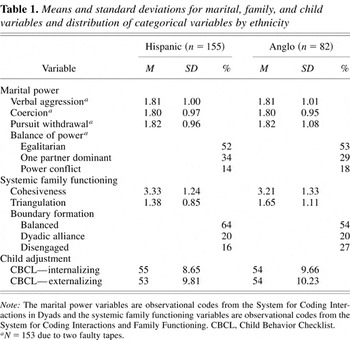
Means and standard deviations for marital, family, and child variables and distribution of categorical variables by ethnicity
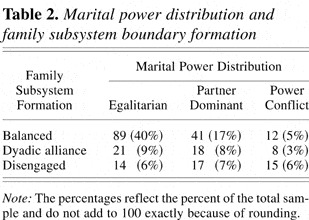
Marital power distribution and family subsystem boundary formation
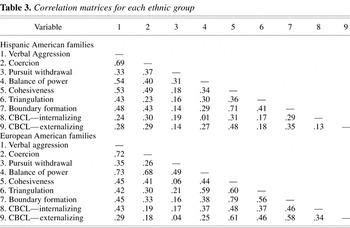
Correlation matrices for each ethnic group
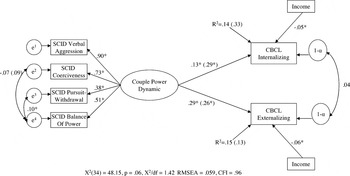
The direct effects model for Hispanic American and European American families. The numbers outside and inside the parentheses represent values for Hispanic American and European American families, respectively. *p < .05.
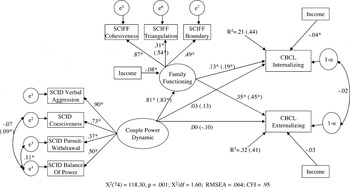
The full model for Hispanic American and European American families. The numbers outside and inside the parentheses represent values for Hispanic American and European American families, respectively. *p < .05.
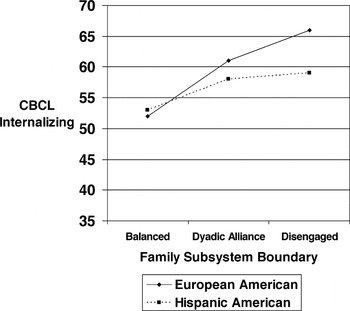
Ethnicity as a moderator of the relation between Family Boundary Formation and CBCL Internalizing scores.
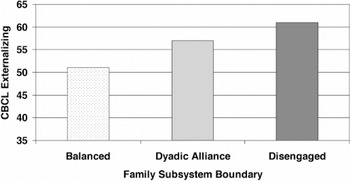
Family Boundary Formation and CBCL Externalizing scores.
 You have
Access
- 28
- Cited by