INTRODUCTION
Since the whaling moratorium, the focus of marine mammal studies has moved away from economic issues related to commercial whaling in favour of species conservation. Sperm whales, Physeter macrocephalus, are a good example of this. Because sperm whales are top-level predators, they play an important role in the ecosystem and can act as an indicator species. Changes in sperm whale populations may indicate significant alterations in the inaccessible deep sea environment. Sperm whales are now exploited as a living resource through whale watching in several countries. This activity generates substantial income on which local communities have come to depend, so conservation of the species is paramount.
Methods traditionally used to identify individual cetaceans included: branding or the attachment of identification tags; these had practical limitations and raised ethical issues (Gope et al., Reference Gope, Kehtarnavaz, Hillman and Würsig2005). Photo-identification is based on recognition of individuals through natural markings which are recorded photographically (Arnbom, Reference Arnbom1987). Whitehead & Gordon (Reference Whitehead and Gordon1986) developed photo-identification techniques as a non-invasive tool for the study of sperm whales based largely on markings in the trailing edge of the animals' flukes. These marks accumulate with age but remain stable (Dufault & Whitehead, Reference Dufault and Whitehead1995), and can be readily photographed at the beginning of dives. This has allowed studies of many aspects of sperm whale behaviour, ecology and life history (Lettevall et al., Reference Letteval, Richter, Jaquet, Slooten, Dawson, Whitehead, Christal and Howard2002; Whitehead, Reference Whitehead2003) and the application of mark–recapture analysis techniques to investigate population size and life history parameters (Hammond, Reference Hammond, Evans and Raga1987; Whitehead, Reference Whitehead2003). Some technical advances have facilitated cetacean photo-identification research. First the development of software has automated the individual recognition process. One of these programs is the Europhlukes Phlex/Match program designed specifically for the study of sperm whales and based on the methodology proposed by Huele et al. (Reference Huele, Udo de Haes, Ciano and Gordon2000). This method was evaluated by Beekmans et al. (Reference Beekmans, Whitehead, Huele, Steiner and Steenbeek2005). A second advance has been the creation of international databases, such as the North Atlantic and Mediterranean Sperm Whale Catalogue (NAMSC) created by the International Fund for Animal Welfare (IFAW) in 1999 and Europhlukes in 2002. These allow easier data exchange between research groups facilitating international cooperation. Even with the development of these tools, there are still many unknowns about the movements of male sperm whales (Whitehead, Reference Whitehead2003).
Sperm whales can be found in all areas of the North Atlantic, as well as the Mediterranean, Gulf of Mexico and the Caribbean. Sperm whales show the greatest sexual dimorphism of any cetacean, with males being three times the mass of females. The sexes also have a different latitudinal distribution and social structure (Connor et al., Reference Connor, Mann, Tyack and Whitehead1998). The distribution of male sperm whales follows a seasonal shift in latitude, ranging from the Equator to the Arctic (Aguilar, Reference Aguilar1985; Whitehead, Reference Whitehead2000), although these migrations may not occur on an annual basis (Martin, Reference Martin1982). The males remain segregated from the female groups, which are stable and remain in low latitudes year round. Commercial whaling records from Spain and the Azores are consistent with this pattern (Aguilar & Sanpera, Reference Aguilar and Sanpera1982).
In the northern hemisphere, males are thought to leave the maternal group when reaching sexual maturity and head northwards. These long distance movements are thought to allow males to feed in productive multi-layered foraging habitats (Teloni et al., Reference Teloni, Johnson, Miller and Madsen2008), such as areas in northern Norway. Males are thought to return to breeding grounds to mate from the age of approximately 27 years (Best, Reference Best, Winn and Olla1979). A study by Oshumi (Reference Oshumi1966) suggested that the migration range might increase with age. However, the frequency and duration of these migrations remains uncertain. It is also unknown if there are geographical links between certain feeding and breeding areas (Whitehead, Reference Whitehead2003). Migration between ‘grounds', such as Norway and the Azores, has been commonly accepted because the whaling industry tended to find large quantities of sperm whales in both areas. Long range movements of individuals between grounds have only rarely been documented, as in the case of photo-identified individuals from the Galápagos, later seen in the Gulf of California (Whitehead et al., Reference Whitehead, Coakes, Jaquet and Lusseau2008), and most recently 3 males made inter-basin movements of between 1600 and 2100 km in the Mediterranean; documented as the result of a mass stranding in the Adriatic Sea (Frantzis et al., Reference Frantzis, Airoldi, Notabartolo-di-Sciara, Johnson and Mazzariol2011). These large scale movements are also reflected in the homogeneity of the genetic structure of this species (Engelhaupt et al., 2009).
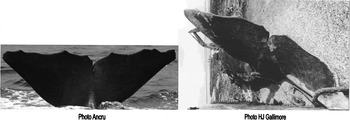
Male sperm whales made up the majority of the catch in the Azorean sperm whale fishery until 1982 (Avila de Melo & Martin, Reference Avilo de Melo and Martin1985). There were also commercial catches off Nova Scotia, Iceland, Norway, Spain and Portugal. Sperm whales were not harvested on a large-scale in the North Atlantic, so their stock structure and distribution in this ocean basin is not well known (Dufault et al., Reference Dufault, Whitehead and Dillon1999). Recoveries of traditional harpoons and tags during commercial whaling have indicated movements from Nova Scotia to Spain (Mitchell, Reference Mitchell1975) and from the Azores to Iceland and Spain (Martin, Reference Martin1982; Aguilar, Reference Aguilar1985). A male marked with a discovery tag off Mauritania was later taken off Cape Town, South Africa (Ivashin, Reference Ivashin1967) demonstrating trans-equatorial movement in the Atlantic. Mark returns have also indicated substantial latitudinal movements along the west coast of southern Africa by both sexes (Best & Ross, Reference Best, Ross, Payne and Crawford1989). In more recent times, using photo-identification, a male sperm whale identified in Norway in 1989 and again in 1992, was matched to a whale that stranded on the west coast of Ireland in 1997 (Steiner, unpublished data, (Figure 1)). Collaboration between researchers working in the Azores and Norway began in 1990, with photographs of males from Norway being matched to the Azorean catalogue.
Male sperm whale stranded in Ireland and as seen in 1992 in Norway.

In this study we provide new information on movements of male sperm whales in the North Atlantic by comparing substantial photo-identification databases collected in the Azores and Norway along with smaller collections from other areas.
MATERIALS AND METHODS
The study sites
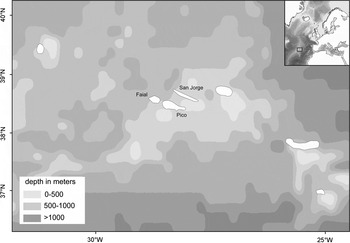
The Azores are centred at 38°N and 28°W, roughly in the middle of the North Atlantic along the Mid-Atlantic Ridge (Figure 2). Most of the study has been conducted in the Central Group of 5 islands, with limited effort in the eastern or western Groups. In Norway, the work was carried out by two groups. Arctic Sea Cruises operated between Malangsgrunnen and the Malangsdjupet along the continental shelf (69°43′ 69°50′N 16°18′16°36′E) while Whalesafari operated in the Bleiksdjupet and along the adjacent shelf (69°15′ 70°00′N 14°50′16°15′E) (Figure 3). These two study areas are separated by 25 nautical miles.
Azores study site.

Norway study site.

The vessels
Several vessels have been used in the Azores over the course of the study. Between 1987 and 1995 research was conducted from the IFAW's RV ‘Song of the Whale' a 14 m sailing ketch. From 1993 to the present this work was continued by Whale Watch Azores during whale watching excursions with two different survey vessels, a 20 m sailing vessel followed by a 12 m catamaran. No data were collected in the Azores in 1992. Whale watching in the Azores occurs mainly between April and October, with most effort from June–August. In Norway, photo-identification was carried out during whale watching tours from May to September. Since 1987, Whalesafari used seven different vessels, such as converted fishing vessels or training ships for officers ranging from of 18 m to 38 m. They also used a 12 m sailing vessel and a 10 m motor-sailor during longer trips between 1990 and 1996. In 2007 and 2008 Arctic Sea Cruises collected data from a 23 m catamaran.
Finding the whales
Two methods have been used to find whales for whale watching in the Azores. Initially all whales were found using a combination of towed and directional hydrophones capable of detecting sperm whale clicks at ranges of 5–7 miles (Whitehead & Gordon, Reference Whitehead and Gordon1986). From 2003 a vigia (lookout) network was established on Faial and Pico. The vigias spot the whales from land through binoculars and direct the vessels to the animals. This is the same method that was used during the whaling era on the islands. Once found, a group of whales would be followed for up to 5–6 hours during a whale watching tour. From 1987–1995 on the RV ‘Song of the Whale' a group of animals would sometimes be followed for a couple of days. In Norway, the vessels leave their respective harbours and make their way to the continental shelf where the sperm whales are usually found. Arctic Sea Cruises located the animals visually and while Whalesafari also located the whales mainly by sight, most vessels were equipped with different kinds of hydrophones to help locate whales. The vessels spend about 2 hours in the area looking for the whales on a typical trip. In all cases the whales are approached slowly from behind and photographs of the fluke were taken usually at ranges of 50 to 100 m. Between 1990 and 1996 some trips lasted 1–3 days in order to follow the whales for a longer period. Both acoustical and visual methods were used to find the whales.
Photographic equipment
In the Azores, a wide variety of Canon cameras have been used to take the ID photographs since 1987. Initially the main camera was a T70 and a 300 mm f4 Canon lens using black and white film. Currently a Canon D50 with a 100–400 mm f4.5–5.6 auto focus Canon lens is used. In Norway, a Nikon FM2 with black and white film was usually used, and equipped with 300 mm/f 4.5 or 35–105 mm/f 3.5–4.5 lenses with black and white film. Also digital cameras such as a Canon 400D and a Nikon D40, both fitted with 70–300 mm auto focus lenses were used.
Matching and cataloguing images
Images taken by Whalesafari from 1990–1996 and 2008 (1997–2007 were not available and have not been included in this analysis) and by Arctic Sea Cruises in 2007 and 2008 were matched to the entire Azores catalogue and to images from the NAMSC taken around the rest of the Atlantic, the Mediterranean and the Gulf of Mexico. Identification photographs were matched by eye using 10.15 × 12.7 cm black and white prints until 2002, when all images were digitized and the Europhlukes semi-automated programs (Phlex and Match) were used to aid matching. Since recognizing the whales depends on the quality, only high quality images were included in the sample (Arborn, 1987).
RESULTS
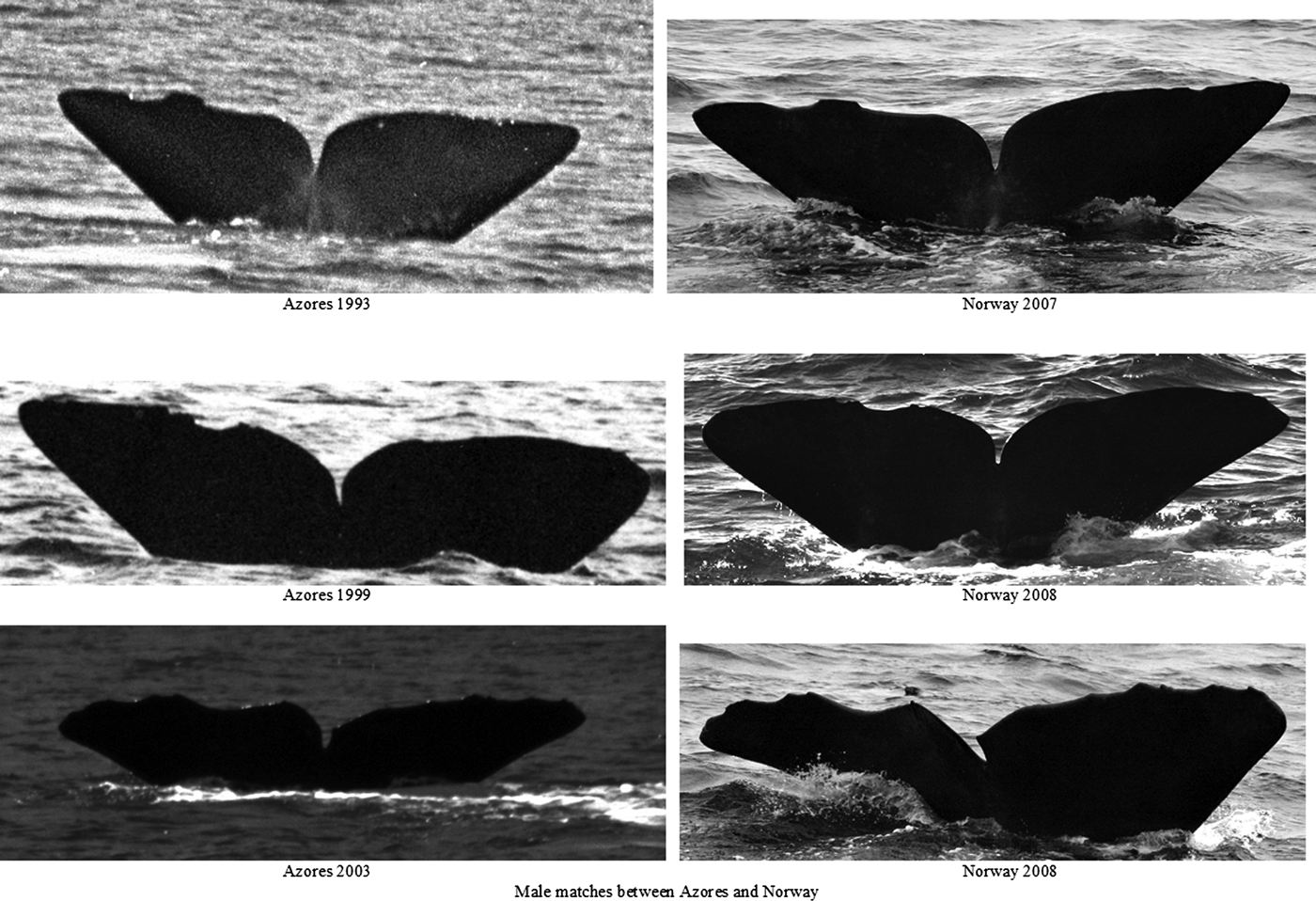
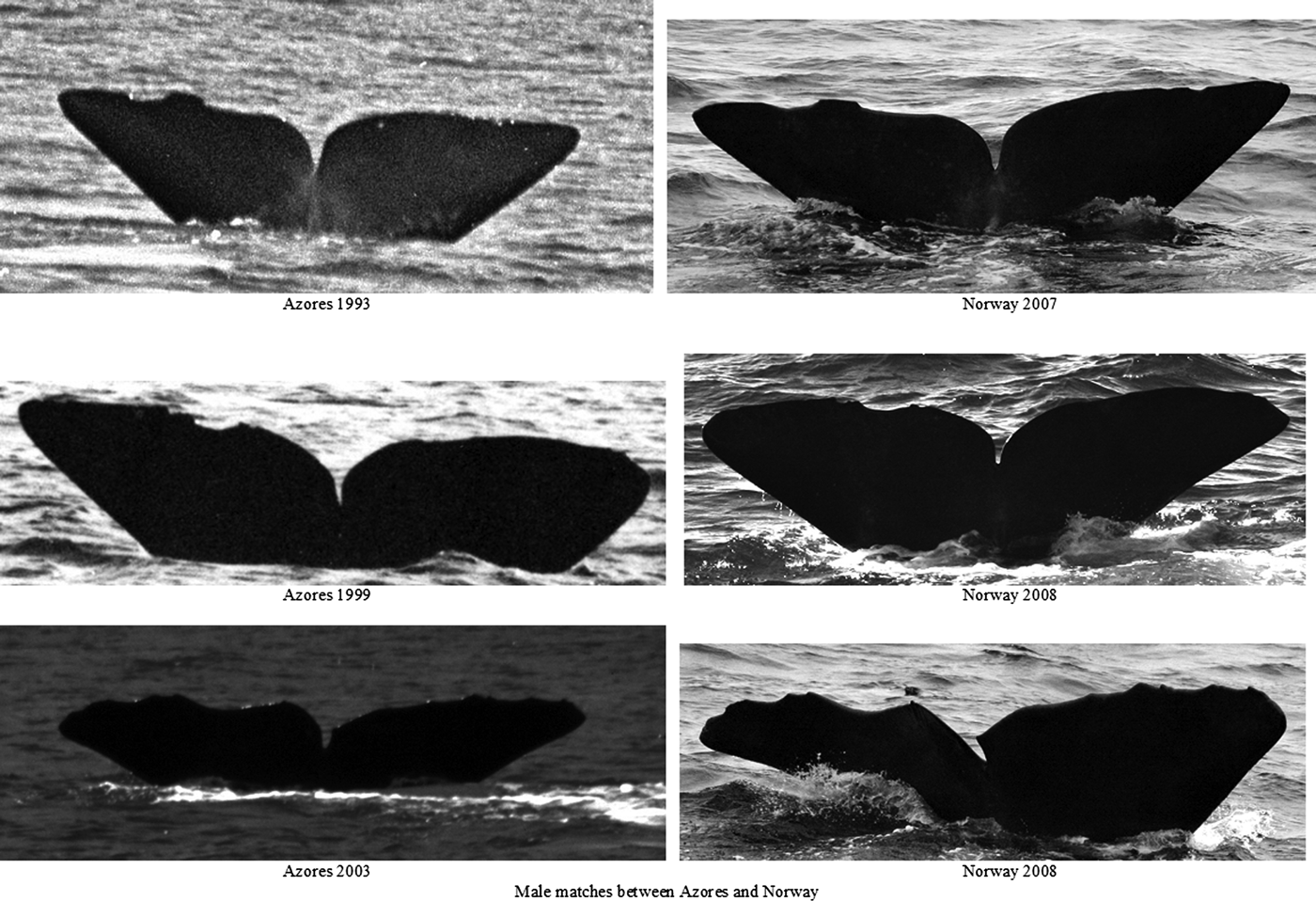
In recent years from 1987 to 2008 mature males (identified by large size and more prominent heads) have accounted for approximately 10% of the identified animals in the Azores with 297 identified males in the Azores collection and 61 unidentified (unmarked animals or poor quality). In Norway all sperm whales encountered are males and there are 459 identified individuals (375 from Whalesafari and 84 by Arctic Sea Cruises) in the Norwegian collection. Table 1 shows all known re-sightings of male sperm whales around the Atlantic. Three male sperm whales were matched from the Azores to the Arctic Sea Cruises' catalogue. One animal, seen in the Azores in 1999 was matched to an animal observed off Norway by Arctic Sea Cruises in 2007. The other 2 animals were matched to the 2008 Arctic Sea Cruise catalogue, one from 1993 and the other from 2003 (Figure 4).
Male photo-identification matches between Azores and Norway.
Re-sightings of male sperm whales between ‘grounds’ in the North Atlantic.

DISCUSSION
Male sperm whales range over large portions of the North Atlantic in their search for receptive females and food. These matches indicate that males can cover wide areas of the ocean basin during their life, maintaining the gene flow and the genetic homogeneity of the populations as seen by Lyrholm et al. (Reference Lyrholm, Leimar, Johannesson and Gyllesten1999). It is noteworthy that the matches between Azores and Norway are all with the Tromsø images rather than the larger Andenes collection and that the ‘direction’ of matches has all been from the Azores to Norway. This may indicate that the males photographed in Azores are mainly younger animals. If breeding occurs during the winter in this population, when there is little photo-identification effort, that could explain why more mature males are not observed and photographed, resulting in only the 3 matches. It is unlikely that other matches exist which were not found. Sperm whale fluke markings are relatively stable over time (Arnbom, Reference Arnbom1987) and mature males tend to have sufficient markings for the programs to work well because they are older animals; over 15 years, the flukes have had time to develop contours. Because few photographs are available from other high latitude grounds for matching, we cannot comment on the relative importance of the migration route between the Azores and Norway. However, there have been matches based on whaler's harpoons between the Azores and Iceland (Martin, Reference Martin1982). Male sperm whales may use the whole of the North Atlantic and maybe also the southern part of the basin (Ivashin, Reference Ivashin1967), as one large home range, utilizing both northern and southern areas for feeding and roaming around lower latitudes looking for receptive females as shown by Engelhaupt et al. (Reference Engelhaupt, Hoelzel, Nicholson, Frantzis, Mesnick, Gero, Whitehead, Rendell, Miller, De Stefanis, Cañadas, Airoldi and Mignucci-Giannoni2009). In addition, according to Lyrholm et al. (Reference Lyrholm, Leimar, Johannesson and Gyllesten1999) inter-oceanic movements may also occur.
This study shows that multinational collaboration is essential when working with animals that cover large distances. It underlines the importance of photo-identification as a tool in these cases. There have been no studies using satellite tags on sperm whales in the Atlantic. So although the tags might speed up the process of tracking movements of this species, they are also costly and invasive to the animal. So until those studies are undertaken, photo-identification from different regions is the only tool we have. Photo-identification has been used to track movements of humpback whales and orcas for decades and is also proving very effective for sperm whales. As more images are added to identification catalogues and more investigators collaborate, it may be possible to gain further insight into the movements of male sperm whales. However, currently, sperm whale research is lagging behind that of other migratory species, mainly due to difficulties in studying an offshore animal. In areas where whale watching takes place, the commercial boats can be used as a means to obtain fluke photographs for on-board researchers or tourists themselves can submit their own photographs to a few websites aimed at collecting photo-identification information from tourists. However in less accessible areas, dedicated effort will be required to gather data. Long term photo-identification catalogues can be used to assess the health of the population and studies are currently being undertaken to analyse these data, which will be published at a later date. More effort is needed for scientists with information regarding sperm whales to join together in order to discover some of the remaining secrets of this deep sea migrant.
ACKNOWLEDGEMENTS
We thank the whale watching clients in the Azores and Norway for making so much of the fieldwork underpinning this work possible. In the Azores, we thank the vigias for locating the whales on many days and also the crew of ‘Physeter'. In Norway, we thank the crew and guides of both Arctic Sea Cruises and Whalesafari for their valuable work on-board. Work in the Azores between 1987 and 1995 was funded by the International Fund for Animal Welfare.