Introduction
Calotropis procera is perennial evergreen milkweed, which belongs to the family Asclepiadaceae. It is adapted to grow under saline soil and dry conditions. The fibre of C. procera is mainly composed of cellulose, hemicellulose and lignin. It is used for making bowstrings, fishing nets and ropes. It has higher tensile strength and water retention capacity than cotton and wool. The fibre exhibits high-insulating features, and has higher crystallinity and breaking strength than kapok. However, its breaking resistance is not strong as cotton (Qi et al., Reference Qi, Xu, Longdi, Ruiyun, Lifang, Wenhong, Beina and Li2018). It is biodegradable and renewable and has the potential to serve as a new member of natural fibre sources in textile industries (Sakthivel et al., Reference Sakthivel, Mukhopadhyay and Palanisamy2005; Cheema et al., Reference Cheema, Bashir, Khatoon, Iqbal, Zafar and Malik2010). Calotropis gigantea is a closely related species to C. procera and produces a similar kind of fibre. Its blend with cotton is patented by Shanghai Palando Textile Technology Development Co., Ltd. (Patent No. CN105887296A, https://patents.google.com/patent/CN105887296A/en). The fibres from its bark and seeds were found to have enough potential to replace or supplement other fibrous raw materials as reinforcing agent (Ashori and Bahreini, Reference Ashori and Bahreini2009) and can also be used in generating natural fibre-reinforced composites (Ga et al., Reference Ga, Kb and Pc2014). Thus, the fibres of C. procera and C. gigantea have great potential in the industrial sector and can serve as an alternative source of fibre. Besides, their latex is widely known for anticancer, antibacterial, antifungal and anti-inflammatory properties (Choedon et al., Reference Choedon, Mathan, Arya, Kumar and Kumar2006; Silva et al., Reference Silva, da Silva, Teixeira, de Sousa, Rondon, Júnior and de Vasconcelos2010; Sobrinho et al., Reference Sobrinho, Tabatinga, Machado and Lopes2013).
The idea of C. procera as a source of high-quality fibre is relatively naive. The economic and medical importance of C. procera allures towards its domestication, which requires identification, and breeding of desired genotypes to develop a variety of appropriate traits. An effective SSR marker resource needs to be developed for this species which could play an important role in germplasm selection during breeding programmes. Besides, these markers could prove useful for elucidation of its genetic diversity base over a landscape. Here, we attempted to design an effective SSR marker resource through an RNAseq approach followed by characterization to assess their polymorphic potential. Furthermore, the polymorphic SSR markers were used to elucidate the genetic diversity of C. procera populations in Indian northwestern plains to recognize the hub areas for germplasm collection. The cross-species transferability of C. procera with C. gigantea was also assessed for the effectiveness of the developed markers in cross-species studies.
Materials and methods
Sample collection and DNA isolation
A total of 79 leaf samples of C. procera were collected from the regions of Indian states of Delhi, Haryana and Punjab, constituting six populations. Eleven samples of C. gigantea were collected from Gorakhpur (Uttar Pradesh), India and used for cross-transferability analysis. These samples constitute the seventh population. The details of sample locations are given in online Supplementary information S1. The genomic DNA was isolated by the Cetyl Trimethyl Ammonium Bromide (CTAB) method (Doyle, Reference Doyle1987). Both the quality and quantity of the isolated DNA were assessed through agarose gel electrophoresis and Nanodrop spectrophotometer (Nanodrop 2000 Thermofisher, USA), respectively.
De novo assembly
Paired-end raw reads were retrieved from the NCBI SRA database (accession: ERX2103344) (Mutwakil et al., Reference Mutwakil, Hajrah, Atef, Edris, Sabir, Al-Ghamdi and El-Domyati2017). Quality checks and trimming of the raw reads were performed through FastQC (Andrews, Reference Andrews2010) and Trim galore (https://github.com/FelixKrueger/TrimGalore), respectively. De novo assembly was generated using Trinity (Grabherr et al., Reference Grabherr, Haas, Yassour, Levin, Thompson, Amit and Chen2011). The removal of redundant sequences and generation of unigenes was performed through CD-HIT-EST (Li and Godzik, Reference Li and Godzik2006) at a sequence similarity threshold of 95%. The quality of the assembly was assessed through read-representation wherein raw reads were mapped back to the assembly using Bowtie2 (Langmead, Reference Langmead2010). The quality was also assessed through Blastx against the SwissProt database for counting the number of full-length transcripts. The completeness assessment of the assembly was performed using BUSCO v2 (Simão et al., Reference Simão, Waterhouse, Ioannidis, Kriventseva and Zdobnov2015).
SSR screening and characterization
Screening of the transcripts for SSR regions was performed using MISA (MicroSAtellite identification tool) (http://pgrc.ipk-gatersleben.de/misa/). The coding sequences (CDS) were identified through ORF predictor v2.3 (Min et al., Reference Min, Butler, Storms and Tsang2005). The positions of the identified SSRs and the ORFs were correlated to find the location of the SSRs within the transcripts using an in-house Python script. The SSRs present at the 5′-UTR region were selected for primer designing. The primers were designed for the selected SSRs using Batch Primer3 (You et al., Reference You, Huo, Gu, Luo, Ma, Hane, Lazo, Dvorak and Anderson2008). Thirty-six primer pairs were synthesized for analysing the polymorphism among the selected accessions. The characterization was performed through a non-denaturing PAGE followed by silver staining (Huang et al., Reference Huang, Deng, Li, Xia, Bai, Siddique and Guo2018). The resulting polymorphic primer pairs were subsequently utilized for genotyping of 79 individuals of C. procera to elucidate its genetic diversity base in northwestern plains of India. The polymorphic markers were also utilized for cross-transferability analysis with C. gigantea.
Data analysis
The polymorphic information content (PIC), Hardy-Weinberg equilibrium (HWE), total number of alleles (N a), the effective number of alleles (N e), Shannon's information index (I), observed heterozygosity (H o), expected heterozygosity (H e), fixation index (F is) and gene flow (N m) were determined by using Cervus 3.0.7 (Kalinowski et al., Reference Kalinowski, Taper and Marshall2007) and GenAlEx v6.5 (Peakall and Smouse, Reference Peakall and Smouse2006, Reference Peakall and Smouse2012). The Mantel's test was used to find a possible link between geographic distance and genetic distance. The genetic structure among the populations was elucidated by a Bayesian approach using STRUCTURE v 2.3.4 (Pritchard et al., Reference Pritchard, Stephens and Donnelly2000). A burn-in period of 10,000 and Markov chain Monte Carlo repeats of 10,000 after the burn-in period were used for 100 iterations per K (K = 1–6) using the admixture model with allele frequency correlated. Structure harvester (Earl, Reference Earl2012) was used to determine the optimal number of genetic pools based on the highest value of delta K. To determine the similarity/dissimilarity, the populations were clustered through principle coordinate analysis (PCoA) in MS excel and Hierarchical Clustering with hclust function in R.
Results
Assembly
The raw reads were de novo assembled into 94,636 transcripts. After filtering off the sequences <500 nt, 39,743 sequences were retained for further analysis. Read representation through Bowtie2 showed an overall alignment rate of 93.7%. Out of 1440 core genes queried, 1068 genes were detected during completeness assessment, thereby showing 74.17% assembly completeness. The mean sequence length of 1465 was observed. N 50, L 50 and GC content were found to be 1820, 10,139 and 40.09% respectively. A total of 4053 sequences representing the full-length transcripts and having an alignment coverage of ⩾80% were obtained during blast against the SwissProt database. A total of 35,917 unigenes were retained for downstream analysis after the removal of sequence redundancy and clustering through CD-HIT EST.
Marker characterization and genetic diversity
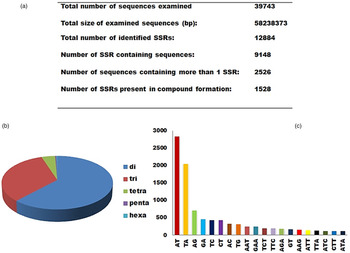
SSR screening revealed 12,884 SSRs distributed among 9148 sequences. Dinucleotide repeat motifs were most abundant followed by trinucleotide repeat motifs. Figure 1 shows the distribution of different repeat types. Within the identified SSRs, AT-motifs were most abundant followed by TA- and AG-motifs. Positional distribution revealed that out of 12,884 SSRs, 4305 were present in the 3′-UTR region, 3448 in 5′-UTR region and 3238 within the CDS region. Out of 36 SSRs selected for characterization, 21 exhibited successful amplification among which twelve showed polymorphism and nine revealed monomorphism. Population genetic analysis was carried out utilizing the twelve polymorphic SSRs. The N a ranged from 2.0 to 5.3 with a mean value of 3.6, N e ranged from 1.34 to 3.81 with a mean value of 2.57. The PIC value ranged from 0.21 to 0.78 with a mean value of 0.57. Six SSRs showed a significant deviation from the HWE. Mean Ho and He was found to be 0.58 and 0.54, respectively (Table 1).
(a) Statistics of SSR screening. (b) Distribution of different SSR types. (c) Top SSR repeats observed.

Characteristics of the polymorphic markers

T a, annealing temperature; N a, number of alleles; N e, number of effective alleles; H o, observed heterozygosity; H e, expected heterozygosity; PIC, polymorphic information content, F, fixation index; HW, Hardy–Weinberg; NS, not significant.
***Significant at 0.1% level, ** at 1% level, * at 5% level.
Population characterization
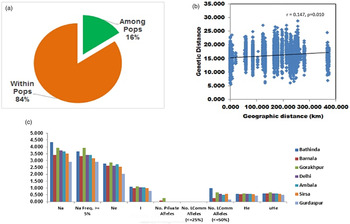
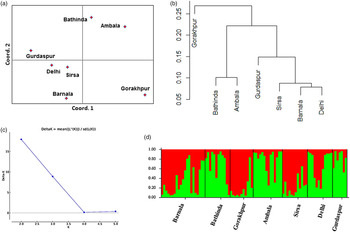
The observed heterozygosity of the individual populations of C. procera ranged from 0.48 (Gurdaspur population) to 0.65 (Sirsa population) with a mean value of 0.58 (Table 2). The observed heterozygosity of C. gigantea was found to be 0.63. Assessment of inbreeding showed that the fixation index of C. procera populations ranged from −0.20 (Sirsa population) to 0.03 (Gurdaspur population) with a mean value of −0.05 per population. The fixation index of C. gigantea was found to be −0.01. The analysis of molecular variance (AMOVA) showed that 84% of the variation lies within the populations and 16% among the populations (Fig. 2(a)). The clustering of populations by PCoA and hierarchical clustering showed similar results, separating the C. procera and C. gigantea into distinct clusters (Fig. 3(a) and (b)). The Bayesian analysis displayed a genetic structure among the sampled populations by clustering them into two distinct genetic pools (Fig. 3(c) and (d)). The mean F st of all the loci across all the populations was observed to be 0.147. The pairwise genetic differentiation assessment (online Supplementary file S2) revealed that the pairwise F st ranged from 0.045 (between Barnala and Delhi populations) to 0.174 (between populations Bathinda and Gorakhpur). The C. gigantea population showed relatively higher F st values with all the population of C. procera (online Supplementary file S2). We observed a significant positive correlation of genetic distance with geographic distance through the Mantel's test with r = 0.147, P = 0.010 (Fig. 2(b)).
(a) Representation of variation within and among populations. (b) Correlation between geographic and genetic distance. (c) Allelic pattern across the populations.

(a) Clustering of populations through PCoA. (b) Dendrogram representing population clustering. (c) Depiction of highest delta K obtained through Structure Harvester. (d) Bar plot showing the number of overall genetic stocks.

Population wise diversity parameters

Discussion
The properties of C. procera fibres are appropriate to use them as a new resource of biodegradable and renewable natural fibres (Tuntawiroon et al., Reference Tuntawiroon, Samootsakorn and Theeraraj1984; Sakthivel et al., Reference Sakthivel, Mukhopadhyay and Palanisamy2005; Ashori and Bahreini, Reference Ashori and Bahreini2009; Cheema et al., Reference Cheema, Bashir, Khatoon, Iqbal, Zafar and Malik2010; Ga et al., Reference Ga, Kb and Pc2014; Qi et al., Reference Qi, Xu, Longdi, Ruiyun, Lifang, Wenhong, Beina and Li2018). Despite its importance, it is still undomesticated. Its emerging role as a new source of natural fibre may turn the attention towards its domestication and selection. The information on genetic variation in natural populations of C. procera is scarce, especially from the northwestern plains of India. An effective polymorphic marker resource was developed to study its genetic diversity in the northern plains of India. The polymorphic SSR marker resource could prove useful to assist in the breeding of C. procera. Furthermore, the assessment of genetic diversity could be beneficial in selecting the area of broad genetic base for germplasm collection during breeding programmes.
We used the RNAseq approach to identify SSR regions. We obtained an alignment rate of 93.7% and detected 74.17% of the core genes during the assembly completeness assessment. A comparable quality of the assembly for SSR discovery was also achieved by Choudhary et al. (Reference Choudhary, Thakur, Najar, Majeed, Singh and Bhardwaj2018). This shows that the quality of our assembly was good for the downstream analysis. The N 50 value of 1820 obtained in this study was better than that of Majeed et al. (Reference Majeed, Singh, Choudhary and Bhardwaj2019), which also aimed at SSR screening in Taxus contorta. A total of 12,884 SSRs were identified from 72.139 Mb transcriptome with an average of 5.5 SSRs/Mb of the sequence. This shows a substantial density of SSRs in the C. procera genome. A total of 25% of the SSRs were located within the CDS region, in contrast to 75% within UTR regions. This higher UTR to CDS ratio is maintained by the selection pressure to avoid Open reading frame (ORF) change within the CDS region, which can cause frameshift mutations. A similar lower CDS to the UTR ratio was also observed by Majeed et al. (Reference Majeed, Singh, Choudhary and Bhardwaj2019) and Qu and Liu (Reference Qu and Liu2013).
Thirty-six SSRs were selected for characterization among which 12 were found to be polymorphic. Around 25% of the SSRs showed monomorphism which is quite obvious in the case of genic markers. A similar higher monomorphic ratio was also observed by Olsson et al. (Reference Olsson, Pinosio, González-Martínez, Abascal, Mayol, Grivet and Vendramin2018), Postolache et al. (Reference Postolache, Leonarduzzi, Piotti, Spanu, Roig, Fady and Vendramin2014) and Majeed et al. (Reference Majeed, Singh, Choudhary and Bhardwaj2019). The mean PIC value of 0.57 revealed that the SSRs are efficient and substantially polymorphic. They showed 100% cross-species transferability with C. gigantea, indicating that markers have some regions linked with the conserved homologous genes (Varshney et al., Reference Varshney, Graner and Sorrells2005). The success of transferability depends on the evolutionary distance, which inversely affect the transferability (Liewlaksaneeyanawin et al., Reference Liewlaksaneeyanawin, Ritland, El-Kassaby and Ritland2004). The 100% transferability between C. procera and C. gigantea indicates that they are evolutionary more related and share a higher degree of sequence conservation. A similar perfect transferability was also achieved between the rubber species, which decreased to only 73% in cross genera experiments (Feng et al., Reference Feng, Li, Huang, Wang and Wu2009). A comparatively lesser percentage (75%) of cross transferability was observed for T. contorta and Taxus baccata (Majeed et al., Reference Majeed, Singh, Choudhary and Bhardwaj2019).
Different marker systems were used to assess the genetic diversity of Calotropis. Priya et al. (Reference Priya, Manimekalai and Ravichandran2015) observed rich genetic diversity along with 84% genetic similarity between white and pink flowered C. gigantea using RAPD markers. A higher level of polymorphism was also observed in Egyptian accessions of C. procera through Random amplified polymorphic DNA (RAPD) (El-Bakry et al., Reference El-Bakry, Hammad and Rafat2014). The isozyme analysis involving superoxide dismutase and peroxidase also showed a high diversity of three populations of C. procera (Pandeya et al., Reference Pandeya, Chandra and Pathak2007). Furthermore, SDS-PAGE of a protein and isozyme successfully discriminated the genotypes of C. procera populations (Hassan et al., Reference Hassan, El-Shawaf, Bekhi, El-Saied and Masoud2008). Moreover, a broad genetic base was observed in West African accessions of C. procera using Amplified fragment length polymorphism (AFLP) markers (Yao et al., Reference Yao, Sprycha, Porembski and Horn2015). Our study showed an overall moderate diversity of C. procera in northern plains of India. The observed heterozygosity of the individual populations ranged from 0.48 to 0.65 with a mean value of 0.58. Thus, the populations of C. procera from the northern plains of India have greater genetic diversity than the African populations analysed by Muriira et al. (Reference Muriira, Muchugi, Yu, Xu and Liu2018) as well as C. gigantea populations analysed from China and Bangladesh by Islam et al. (Reference Islam, Li, Gichira, Alam, Fu, Hu and Chen2019) using EST-SSR markers. In this study, the Sirsa population showed the highest diversity whereas the Gurdaspur population revealed the lowest diversity. The highest numbers of alleles were observed for the Bathinda population, whereas the lowest numbers of alleles were found in the Gurdaspur population. In contrast to our populations, the African populations of C. procera, as well as Chinese and Bangladeshi populations of C. gigantea were observed to have some degree of inbreeding (Muriira et al., Reference Muriira, Muchugi, Yu, Xu and Liu2018; Islam et al., Reference Islam, Li, Gichira, Alam, Fu, Hu and Chen2019). Our study showed that the fixation index of the individual populations ranged from −0.20 (Sirsa population) to 0.03 (Gurdaspur population) with a mean value of −0.05 per population, indicating no inbreeding. This may explain the relatively lower diversity found by Muriira et al. (Reference Muriira, Muchugi, Yu, Xu and Liu2018) and Islam et al. (Reference Islam, Li, Gichira, Alam, Fu, Hu and Chen2019). In our case, only two populations, Gurdaspur and Ambala were found to have a very low positive value of inbreeding coefficients, indicating negligible inbreeding. The population of C. gigantea showed higher genetic diversity (H o = 0.63) than populations of C. procera and no signs of inbreeding (F is = −0.01). The observed heterozygosity of C. gigantea from Gorakhpur was found to be higher than the populations analysed from Nepal, Dongchuan, Honghe and Hainan (Muriira et al., Reference Muriira, Muchugi, Yu, Xu and Liu2018) and those of China and Bangladesh (Islam et al., Reference Islam, Li, Gichira, Alam, Fu, Hu and Chen2019). The allelic pattern across the populations showed that there is one allele (belonging to the locus C30) specific to the Barnala population of C. procera whereas three alleles (belonging to loci C2 and C26) were specific to Gorakhpur population of C. gigantea.
PCoA is often used to show the genetic similarity/dissimilarity among the populations. The results of PCoA revealed that the first three axes explained 75.87% of the variations (online Supplementary file S3). The populations of C. procera formed two sub-clusters with Bathinda and Ambala in one sub-cluster whereas Gurdaspur, Delhi, Sirsa, and Barnala in another sub-cluster. The C. gigantea population was distinct from these sub-clusters, which was also revealed in the dendrogram constructed by hierarchical clustering. This suggests that a distinct genetic structure exists between C. gigantea and C. procera. This finding is corroborated by Muriira et al. (Reference Muriira, Muchugi, Yu, Xu and Liu2018) who also found a distinct genetic pattern between them.
The AMOVA results showed higher within-population genetic variations (84%) than among population diversity (16%). Studies on other Apocynaceae species such as Aspidosperma polyneuron, Mandevilla velutina, Asclepias tuberosa, Asclepias viridis, Asclepias meadii and Asclepias incarnata showed similar results. AMOVA showed the occurrence of genetic structure which was supported by the moderate level of genetic differentiation (F st = 0.147). This genetic differentiation is lower than that of Islam et al. (Reference Islam, Li, Gichira, Alam, Fu, Hu and Chen2019) and Muriira et al. (Reference Muriira, Muchugi, Yu, Xu and Liu2018) for C. procera and C. gigantea. In contrast to Islam et al. (Reference Islam, Li, Gichira, Alam, Fu, Hu and Chen2019) and Muriira et al. (Reference Muriira, Muchugi, Yu, Xu and Liu2018), we observed relatively less impact of physical distance on genetic differentiation (r = 0.147, P = 0.010). The positive relation during Mantel's test provides useful information to select genetically diverse genotypes for future domestication and breeding programme.
The F st value 0.147 across all the loci shows that there is a moderate genetic differentiation of C. procera. The pairwise genetic differentiation assessment (online Supplementary file S2) revealed that the pairwise F st ranged from 0.045 (between Barnala and Delhi populations) to 0.174 (between Bathinda and Gorakhpur populations). The C. gigantea population showed higher F st values with all the population of C. procera (online Supplementary file S3). The genetic structure of a population is determined by the complex interplay of processes such as gene flow, mutation, selection and mating strategy (Schaal et al., Reference Schaal, Hayworth, Olsen, Rauscher and Smith1998). The PCoA, STRUCTURE and hierarchical clustering showed differentiation of C. gigantea with populations of C. procera but the differentiation is not as strong as observed by Muriira et al. (Reference Muriira, Muchugi, Yu, Xu and Liu2018). The possible reason for sharp differentiation may be due to a very large physical distance between the C. procera and C. gigantea genotypes, as the former were mostly sampled from Africa whereas the later from Asia. The Bayesian analysis displayed a genetic structure by clustering the populations into two distinct genetic pools. However, each population was found to have a proportion form each gene pool. This shows that the gene flow is not severely restricted and no intense genetic barrier separate these populations in the northern plains of India. The mean gene flow of 2.9 indicates the significant level of allele sharing and is higher than the other Apocynaceae species like Hancornia speciose and Vincetoxicum atratum (1.463), and Gymnema sylvestre (Jimenez et al., Reference Jimenez, Martins, Montarroyos, Silva Junior, Alzate-Marin and Moraes Filho2015; Rathore et al., Reference Rathore, Madihalli, Hegde, Hegde, Bhagwat, Gupta, Kholkute, Jha and Roy2016; Yamashiro et al., Reference Yamashiro, Yamashiro, Inoue and Maki2016).
Conclusion
We developed a set of informative SSR markers for C. procera which showed perfect cross-transferability with C. gigantea. We revealed a moderate level of genetic diversity in C. procera from the northern plains of India along with its genetic structure. This information will be beneficial in the initial assessment of selecting the germplasm to ensure the maximum genetic diversity can be captured during the domestication process.
Supplementary material
The supplementary material for this article can be found at https://doi.org/10.1017/S1479262120000167.
Acknowledgements
This study was funded by SERB-DST under the grant SR/52/JCB-11/2012.