Introduction
Lipids, including fatty acids (FA, especially saturated FA) are key drivers in the flow of energy in many food webs as they are the densest form of energy available to consumers (Karasov & Martinez del Rio, Reference Karasov and Martinez del Rio2007). They also play key roles in organismal function, health and survival. Polyunsaturated FA (PUFA), for instance, are important constituents of biological cell membranes, and contribute to their stability and function (Brett & Müller-Navarra, Reference Brett and Müller-Navarra1997). Moreover, some PUFA are precursors of bioactive eicosanoid signalling molecules that affect hormonal and neural pathways (Twining et al., Reference Twining, Brenna, Hairston and Flecker2016). This is especially true for essential omega-3 (n-3) long-chain PUFA (LC-PUFA; ≥20 carbons), such as eicosapentaenoic acid (EPA, 20:5n-3) and docosahexaenoic acid (DHA, 22:6n-3). These two LC-PUFA can be biosynthesized in animals from relevant FA precursors (e.g. ɑ-linolenic acid or ALA, 18:3n-3), but generally only at low rates (Das, Reference Das2006). Furthermore, it was previously thought that animals were unable to synthesize 18C PUFA precursors (e.g. ALA and linoleic acid; LNA, 18:2n-6). The conventional wisdom has therefore been that animals preferentially obtain ALA and LNA and their downstream products (EPA, DHA, and arachidonic acid (ARA) 20:4n-6) from their diets as pre-formed molecules (Twining et al., Reference Twining, Brenna, Hairston and Flecker2016). In most food webs, PUFA are transferred from primary producers to higher trophic levels through consumption and accumulation in the biomass of consumers; as such, these PUFA are selectively retained by consumers based on their physiological requirements and food preferences (Kainz et al., Reference Kainz, Arts and Mazumder2004; Gladyshev et al., Reference Gladyshev, Arts, Sushchik, Kainz, Brett and Arts2009).
Several key reactions in n-3 PUFA biosynthesis require specific FA desaturases, i.e. enzymes that facilitate the insertion of double bonds in saturated FA molecules. The delta-9 (Δ9) desaturase inserts the first double bond in the saturated stearic acid (18:0), thereby forming oleic acid (18:1n-9). Methyl-end (ɷx) desaturases then insert double bonds between this first double bond and the methyl-end (-CH3) of the FA molecule (Sperling et al., Reference Sperling, Ternes, Zank and Heinz2003; Castro et al., Reference Castro, Tocher and Monroig2016). Specifically, the omega-6 (ɷ6) desaturase (a.k.a. Δ12 desaturase) converts oleic acid to linoleic acid (LNA, 18:2n-6), and the omega-3 (ɷ3) desaturase (a.k.a. Δ15 desaturase) converts LNA to ALA, which is the main FA precursor for n-3 LC-PUFA (Nichols, Reference Nichols2003; Sperling et al., Reference Sperling, Ternes, Zank and Heinz2003). Most animals carry the necessary Δ9 desaturase, but lack either the ɷ6 or ɷ3 desaturase, thereby limiting their capacity to complete the further reactions in this chain (Sperling et al., Reference Sperling, Ternes, Zank and Heinz2003; Kabeya et al., Reference Kabeya, Fonseca, Ferrier, Navarro, Bay, Francis, Tocher, Castro and Monroig2018). In contrast, microalgae, protists and bacteria (mainly from marine ecosystems) contain various enzymes related to n-3 PUFA biosynthesis. These include the previously mentioned Δ9 and ɷx desaturases, ‘front-end desaturases’ that insert double bonds at the carboxyl (-COOH) end of the FA molecule, and ‘elongase’ enzymes that facilitate chain lengthening (e.g. ALA to EPA and DHA) (Monroig & Kabeya, Reference Monroig and Kabeya2018). Owing to their substantial enzymatic capacity for de novo n-3 PUFA biosynthesis, and their biomass, microorganisms are responsible for most of the natural production of n-3 PUFA globally (Nichols, Reference Nichols2003; Pereira et al., Reference Pereira, Leonard and Mukerji2003; Khozin-Goldberg et al., Reference Khozin-Goldberg, Iskandarov and Cohen2011).
Until recently, the main exceptions for the existence of ɷx desaturases in animals were documented only in the free-living nematode Caenorhabditis elegans (Spychalla et al., Reference Spychalla, Kinney and Browse1997; Peyou-Ndi et al., Reference Peyou-Ndi, Watts and Browse2000) and the arthropod Bemisia argentifolii (Buckner & Hagen, Reference Buckner and Hagen2003). These enzymes have conserved motifs in their protein sequences (as explained in Kabeya et al., Reference Kabeya, Fonseca, Ferrier, Navarro, Bay, Francis, Tocher, Castro and Monroig2018). Thus, they may be used to search for potential ɷx desaturases in other animal taxa. By doing so, Kabeya et al. (Reference Kabeya, Fonseca, Ferrier, Navarro, Bay, Francis, Tocher, Castro and Monroig2018) recently found 121 novel sequences of these enzymes in the genomes of 80 species from six invertebrate phyla. These sequences were associated with three distinct clades: Clade 1 was dominated by Nematoda; Clade 2 was dominated by Cnidaria; and Clade 3 comprised Rotifera, Mollusca, Annelida and Arthropoda. Kabeya et al. (Reference Kabeya, Fonseca, Ferrier, Navarro, Bay, Francis, Tocher, Castro and Monroig2018) also tested the functionality of several putative desaturases from taxa in Clades 2 and 3 using a heterologous yeast expression system and subsequent FA analysis. Since all species exhibited ɷ6 and ɷ3 desaturase activity, these invertebrates were deemed to be capable of playing a significant role in de novo n-3 PUFA production in the ecosystems where they reside.
The ground-breaking study by Kabeya et al. (Reference Kabeya, Fonseca, Ferrier, Navarro, Bay, Francis, Tocher, Castro and Monroig2018) uncovered genes for de novo n-3 PUFA production in a wide variety of animals from six phyla, including several endoparasitic nematodes and an ectoparasitic crustacean arthropod. However, higher taxa composed exclusively of parasites, such as the Neodermata (a clade comprising the classes Trematoda, Cestoda and Monogenea within the phylum Platyhelminthes), were conspicuously absent. We propose three explanations for this. First, de novo synthesis of n-3 PUFA may be truly absent in these groups. This is plausible because neodermatans such as cestodes and digenean trematodes live within the bodies of other animals, often in nutrient-rich tissues, and synthesis of PUFA may thus be unnecessary. Second, the lack of ɷx desaturase genes in neodermatans in Kabeya et al. (Reference Kabeya, Fonseca, Ferrier, Navarro, Bay, Francis, Tocher, Castro and Monroig2018) could result from a lack of sequence data, but some unsequenced taxa may have related genes. Finally, it is possible that already sequenced n-3 PUFA genes in neodermatans were not detected by Kabeya et al. (Reference Kabeya, Fonseca, Ferrier, Navarro, Bay, Francis, Tocher, Castro and Monroig2018). The latter scenario is plausible because the parasitic lifestyle is associated with genetic variations that may affect the success of gene sequence search strategies. Parasitic genomes are often smaller and compacted compared with those of free-living relatives (reviewed by Poulin & Randawa, Reference Poulin and Randhawa2015). For example, the genomes of nine parasitic neodermatans (one aspidogastrean, six digeneans, two cestodes) average 0.77 (SE 0.14) pg of DNA, while those of 48 free-living Rhabditophora (sensu Egger et al., Reference Egger, Lapraz and Tomiczek2015) have a mean of 2.39 (SE 0.51) pg of DNA (Kruskal–Wallis H(1) = 6.0077, P = 0.01424, data from the Animal Genome Size Database, Gregory, Reference Gregory2020; see supplementary table. The mitochondrial genomes of neodermatans also display distinctive nucleotide bias and skew, and codon usage (Min & Hickey, Reference Min and Hickey2007; Bernt et al., Reference Bernt, Bleidorn and Braband2013). While neither genome reduction nor mitochondrial mutation have direct bearing on nuclear genes such as FA desaturases, these tendencies do suggest unique and substantive evolutionary trends in neodermatan genomes. Consequently, it seems plausible that sequence-searching strategies tailored to the neodermatans and their relatives may uncover genes for de novo n-3 PUFA biosynthesis that might be missed by more general approaches.
It is also important to consider the evolutionary history of parasitism within different taxa. While parasitism has been estimated to have independently evolved within the phylum Nematoda up to 18 different times (Viney, Reference Viney2017), there is overwhelming support for the Neodermata to be considered a monophyletic clade with a single ancestral origin for parasitism, and for trematodes (flukes) and cestodes (tapeworms) to comprise a single clade of endoparasites (Park et al., Reference Park, Kim, Kang, Kim, Eom and Littlewood2007; Riutort et al., Reference Riutort, Álvarez-Presas, Lázaro, Solà and Paps2012). Related to this, the considerable genetic and functional variation within phylum Platyhelminthes, reported by various studies, supports selection for traits which benefit either a free-living or parasitic lifestyle (e.g. Chen & Wen, Reference Chen and Wen2011). Considering the very different evolutionary histories for parasites within the phylum Nematoda or Platyhelminthes, it is thus quite possible that putative sequences for ɷ6 and ɷ3 desaturase in nematodes are easier to identify as orthologues to those in free-living invertebrates. Less restrictive search criteria than those used by Kabeya et al. (Reference Kabeya, Fonseca, Ferrier, Navarro, Bay, Francis, Tocher, Castro and Monroig2018) may thus be helpful in determining whether members of the Platyhelminthes have the capacity for de novo n-3 PUFA biosynthesis.
Establishing whether non-nematode helminths potentially have this ability is important because macroparasites are found in all ecosystems, and can influence organisms at multiple trophic levels due to their often complex life cycles (reviewed in Marcogliese, Reference Marcogliese2005; Lafferty et al., Reference Lafferty, Allesina and Arim2008). Importantly, many macroparasites produce large numbers of their free-living infectious stages, particularly the aquatic cercariae of trematodes, thus contributing substantial biomass in certain ecosystems (e.g. Kuris et al., Reference Kuris, Hechinger and Shaw2008; Preston et al., Reference Preston, Orlofske, Lambden and Johnson2013; Rosenkranz et al., Reference Rosenkranz, Lagrue, Poulin and Selbach2018). Consequently, better understanding the nutritional contributions and role(s) of macroparasite infectious stages within ecosystems is critical for explaining the nuances of food web structure and function (reviewed in Marcogliese & Cone, Reference Marcogliese and Cone1997; Marcogliese, Reference Marcogliese2005; Lafferty et al., Reference Lafferty, Allesina and Arim2008; Hatcher et al.,, Reference Hatcher, Dick and Dunn2012). For instance, McKee et al. (Reference McKee, Koprivnikar, Johnson and Arts2020) recently determined that cercariae from the freshwater trematode Ribeiroia ondatrae have appreciable amounts of EPA and DHA, making them a viable dietary source of n-3 PUFA, also finding that dragonfly larvae fed either R. ondatrae cercariae or Daphnia spp. had no significant differences in their FA profiles (e.g. PUFA content).
Trematodes have complex multi-host life cycles, including asexually reproducing parthenitae situated in the digestive gland–gonad (DGG) complex of their molluscan first intermediate hosts (commonly aquatic snails) that either directly absorb nutrients or consume DGG tissue (Kuris, Reference Kuris, Esch, Bush and Aho1990; Esch et al., Reference Esch, Barger and Fellis2002). Cercariae are clonally produced within parthenitae, emerging as a free-living motile stage that seeks out the next host (Esch et al., Reference Esch, Barger and Fellis2002). Owing to their short lifespans and low odds of host encounter, most cercariae are unsuccessful at transmission and have other fates (Morley, Reference Morley2012). It is estimated that ~50–80% of total cercariae biomass is consumed by non-host organisms, or contributes to detritus (Johnson et al., Reference Johnson, Dobson, Lafferty, Marcogliese, Memmott, Orlofske, Poulin and Thieltges2010). Cercariae consumption has been noted in various aquatic taxa, such as copepods (Mironova et al., Reference Mironova, Gopko, Pasternak, Mikheev and Taskinen2019), and insects and fish (e.g. Orlofske et al., Reference Orlofske, Jadin and Johnson2015). Given their size and traits, the ecological roles of trematode cercariae within food webs are thus arguably equivalent to that of other zooplankton (Morley, Reference Morley2012). In terms of nutritional value, trematodes may contain significant quantities of PUFA considering that their parthenitae (and cercariae developing within) obtain nutrients from the DGG complex of snails that often feed on PUFA-rich periphyton. These hosts may also be capable of de novo n-3 PUFA biosynthesis (Kabeya et al., Reference Kabeya, Fonseca, Ferrier, Navarro, Bay, Francis, Tocher, Castro and Monroig2018), which would increase their inherent value as a parasite nutrient source.
Despite their presence, the intrinsic function(s) of PUFA in platyhelminths is not well understood. Researchers have linked cercarial FA to buoyancy, energy reserves and metabolic waste in various trematode species (Schariter et al., Reference Schariter, Pachuski, Fried and Sherma2002; Fried & Toledo, Reference Fried and Toledo2009), as well as the ability of Schistosoma mansoni cercariae to penetrate into host tissues (Furlong, Reference Furlong1991). In addition, adult cestodes and trematodes are capable of using PUFA to synthesize a variety of eicosanoids for within-host immunomodulation and signalling, as are nematodes (Belley & Chadee, Reference Belley and Chadee1995). Select FA also appear to have important functions during larval development for both trematodes and cestodes (e.g. Minematsu et al., Reference Minematsu, Yamazaki, Uji, Okabe, Korenaga and Tada1990; Bexkens et al., Reference Bexkens, Mebius, Houweling, Brouwers, Tielens and van Hellemond2019). Thus, PUFA may play critical roles in helminth transmission success and nutrient contributions within food webs, making it important to understand the origin of these compounds. While certain platyhelminths are able to modify FA precursor molecules (ALA and LNA) obtained from hosts (to produce EPA, DHA and ARA), thus engaging in some degree of PUFA biosynthesis (Smyth & McManus, Reference Smyth and McManus1989; Furlong, Reference Furlong1991; Tielens, Reference Tielens, Fried and Graczyk1997), de novo synthesis capability for 18C PUFA has not been documented in this phylum.
Kabeya et al. (Reference Kabeya, Fonseca, Ferrier, Navarro, Bay, Francis, Tocher, Castro and Monroig2018) determined that ɷx desaturase sequences were present in various invertebrates, including phylum Rotifera. Based on a recent animal phylogenetic tree, phylum Platyhelminthes is closely related to Rotifera; the latter is found within the clade Gnathifera, which is nested within the larger clade Platyzoa, along with Platyhelminthes and Gastrotricha (see Edgecombe et al., Reference Edgecombe, Giribet, Dunn, Hejnol, Kristensen, Neves, Rouse, Worsaae and Sørensen2011). Given their common ancestry, it is possible that ɷx desaturases are shared among these phyla; however, Kabeya et al. (Reference Kabeya, Fonseca, Ferrier, Navarro, Bay, Francis, Tocher, Castro and Monroig2018) did not find putative sequences for these enzymes within Platyhelminthes. We suggest that a revised molecular approach, with less-restrictive sequence search criteria, may be appropriate to determine whether this phylum has ɷx desaturases given that the identification of remote orthologues is likely more challenging for Platyhelminthes (Martín-Durán et al., Reference Martín-Durán, Ryan, Vellutini, Pang and Hejnol2017; International Helminth Genomes Consortium, 2019) than Nematoda owing to their respective evolutionary histories (see above).
As noted earlier, ɷx desaturases have conserved motifs in their protein sequences (see Kabeya et al., Reference Kabeya, Fonseca, Ferrier, Navarro, Bay, Francis, Tocher, Castro and Monroig2018). It is also assumed that protein sequences (or protein-coding genes) with significant functional importance are under strong selective constraints (Assis & Kondrashov, Reference Assis and Kondrashov2014), i.e. they are not lost, and remain functional throughout the evolutionary history of the taxa being considered. These protein sequences should therefore be highly conserved within a phylum and less vulnerable to random mutations. With this in mind, we used protein sequences (for ɷx desaturases) from Rotifera to conduct genomic data searches for homologous sequences in Platyhelminthes (both phyla are in the clade Platyzoa), hypothesizing that sequences required for ɷx desaturase synthesis are actually present in the latter, and could be identified using less-restrictive search criteria than in Kabeya et al. (Reference Kabeya, Fonseca, Ferrier, Navarro, Bay, Francis, Tocher, Castro and Monroig2018). However, we also predicted that only a few taxa within Platyhelminthes would have these sequences given that their distribution is cryptic in Rotifera (Kabeya et al., Reference Kabeya, Fonseca, Ferrier, Navarro, Bay, Francis, Tocher, Castro and Monroig2018), and because the exclusively endoparasitic classes of flatworm could show divergence owing to adaptations associated with this lifestyle.
Materials and methods
We closely followed the approach employed by Kabeya et al. (Reference Kabeya, Fonseca, Ferrier, Navarro, Bay, Francis, Tocher, Castro and Monroig2018), with a few exceptions noted below. Confirmed ɷx desaturase sequences from Rotifera were chosen specifically as ‘template’ sequences for genomic data searches (conducted from December 2018 to September 2020) on homologous sequences in Platyhelminthes (see supplementary table). To start, the relevant FASTA sequences from Rotifera were acquired from NCBI (also known as GenBank®; Clark et al., Reference Clark, Karsch-Mizrachi, Lipman, Ostell and Sayers2016), using sequence identifiers from Kabeya et al. (Reference Kabeya, Fonseca, Ferrier, Navarro, Bay, Francis, Tocher, Castro and Monroig2018) (Adineta vaga, ATV93533.1 and ATV93531.1). These FASTA sequences were inputted into NCBI's Protein BLAST (Protein Basic Local Alignment Search Tool; Altschul et al., Reference Altschul, Madden, Schäffer, Zhang, Zhang, Miller and Lipman1997) for ‘protein to protein’ comparison using the following parameters: Database (non-redundant protein sequences), Organism (Platyhelminthes, Trematoda, Cestoda) and Algorithm (Position-Specific Iterated BLAST, expect threshold = 0.05). Trematoda and Cestoda were of particular interest in our searches, as these are the classes within the Platyhelminthes with the most parasitic taxa relative to the free-living ‘turbellarians’ and Monogenea (Olson & Tkach, Reference Olson and Tkach2005).
To meet our search specifications (see below), sequences found in Platyhelminthes had to be at least 250 AA long. Sequences with greater values for per cent identities (defined as the score for similarity between a pair of aligned sequences; Clark et al., Reference Clark, Karsch-Mizrachi, Lipman, Ostell and Sayers2016) were prioritized, as there would be a higher likelihood for sequence conservation. Further, sequences identified generically as ‘fatty acid desaturases’ were prioritized, while sequences identified as ‘delta-4’, ‘delta-9’ or ‘sphingolipid’ desaturases were exempted. Essentially, these considerations allowed us to narrow the search focus on ɷx desaturases (as per Kabeya et al., Reference Kabeya, Fonseca, Ferrier, Navarro, Bay, Francis, Tocher, Castro and Monroig2018). ‘Hypothetical’ and ‘unnamed’ protein sequences (i.e. proteins whose functions have not yet been formally assigned, due to a lack of experimental evidence), as well as general ‘fatty acid’ desaturases were still considered, as they could have been misclassified in the databases. If there were promising hits from the Protein BLAST searches (i.e. protein sequences that matched the given requirements), then these sequences were inputted back into Protein BLAST to find related sequences, that may not have been captured in initial searches. Additional sequences were also obtained from Protein BLAST searches on WormBase© (Howe et al., Reference Howe, Bolt, Shafie, Kersey and Berriman2017). The FASTA sequences from Rotifera and the Protein BLAST searches were then inputted to NCBI's Translated BLAST to look for additional hits in translated nucleotide databases, using the following parameters: Database (whole genome shotgun contigs, transcriptome shotgun assembly), Organism (Platyhelminthes, Trematoda, Cestoda), Algorithm (expect threshold = 0.05). In total, we considered 31 of the same platyhelminth species as Kabeya et al. (Reference Kabeya, Fonseca, Ferrier, Navarro, Bay, Francis, Tocher, Castro and Monroig2018), as well as an additional 33 species for which potentially informative protein sequences were available, for a total of 64 flatworm species (see supplementary table).
All search hits from NCBI and WormBase© were then scanned for the presence of three specific histidine box motifs (H-box), to characterize the sequences as putative ɷx desaturases (as in Kabeya et al., Reference Kabeya, Fonseca, Ferrier, Navarro, Bay, Francis, Tocher, Castro and Monroig2018). Our search specifications were that (1) H-box1 should have 5 AA in the format HXXXH (where X represents any other amino acid), to exclude the possibility for Δ9 desaturases; (2) H-box2 should have 5 AA in the format HXXHH, to exclude the possibility for other front-end desaturases; (3) the distance between H-box1 and the start of H-box2 should also be ~30–32 AA long; (4) H-box3 should have 5 AA in the format HXXHH; and (5) the distance between H-box2 and the start of H-box3 should be ~120–250 AA long (Kabeya et al., Reference Kabeya, Fonseca, Ferrier, Navarro, Bay, Francis, Tocher, Castro and Monroig2018). The sequences were then inputted to SMART (Simple Modular Architecture Research Tool; Letunic et al., Reference Letunic, Doerks and Bork2015) to filter out sphingolipid desaturases from our results based on the presence of the Pfam protein domain Lipid_DES (PF08557.8) within the sequences (which is typically associated to this desaturase subfamily – see Kabeya et al., Reference Kabeya, Fonseca, Ferrier, Navarro, Bay, Francis, Tocher, Castro and Monroig2018). However, sequences with the general Pfam protein domain FA_desaturase (PF00487.22) were still considered as putative ɷx sequences. By employing SMART, we thus used an alternative procedure to that by Kabeya et al. (Reference Kabeya, Fonseca, Ferrier, Navarro, Bay, Francis, Tocher, Castro and Monroig2018) to distinguish between putative ɷx and sphingolipid desaturase sequences, i.e. this was not based upon the empirical frequency of amino acid occurrence within the histidine boxes of known eukaryotic sequences (Hashimoto et al., Reference Hashimoto, Yoshizawa, Okuda, Kuma, Goto and Kanehisa2008) so as to calculate the probability of a desaturase sequence being assigned to one of these two subfamilies. By doing so, we more widely considered sequences that might represent highly diverged ɷx desaturases within Platyhelminthes, i.e. if these depart from the usual expectations for amino acid frequencies at certain positions.
Finally, the confirmed and putative sequences were inputted as FASTA sequences into CLUSTAL Omega© (version 1.2.4; Sievers et al., Reference Sievers, Wilm and Dineen2011) to conduct a multiple sequence alignment (MSA) analysis. Here, specific characters were used to indicate sequence positions where there were fully conserved amino acids (i.e. with an asterisk), or the conservation of amin acids with strongly or weakly similar properties (i.e. with a colon and a period, respectively) (Sievers et al., Reference Sievers, Wilm and Dineen2011). Using the LG + G + I model of amino acid evolution (selected using the Bayesian Information Criterion in MEGAX, Kumar et al. Reference Kumar, Stecher, Li, Knyaz and Tamura2018), or its nearest equivalent, phylogenetic reconstructions among the confirmed rotifer and putative platyhelminth ɷx desaturase genes were generated using maximum likelihood with 500 booststrapped pseudoreplicates using RAXML (Silvestro & Michalak, Reference Silvestro and Michalak2012; Stamatakis, Reference Stamatakis2014) and Bayesian inference (Ronquist et al. Reference Ronquist, Teslenko, Van Der Mark, Ayres, Darling, Höhna, Larget, Liu, Suchard and Huelsenbeck2012).
Results
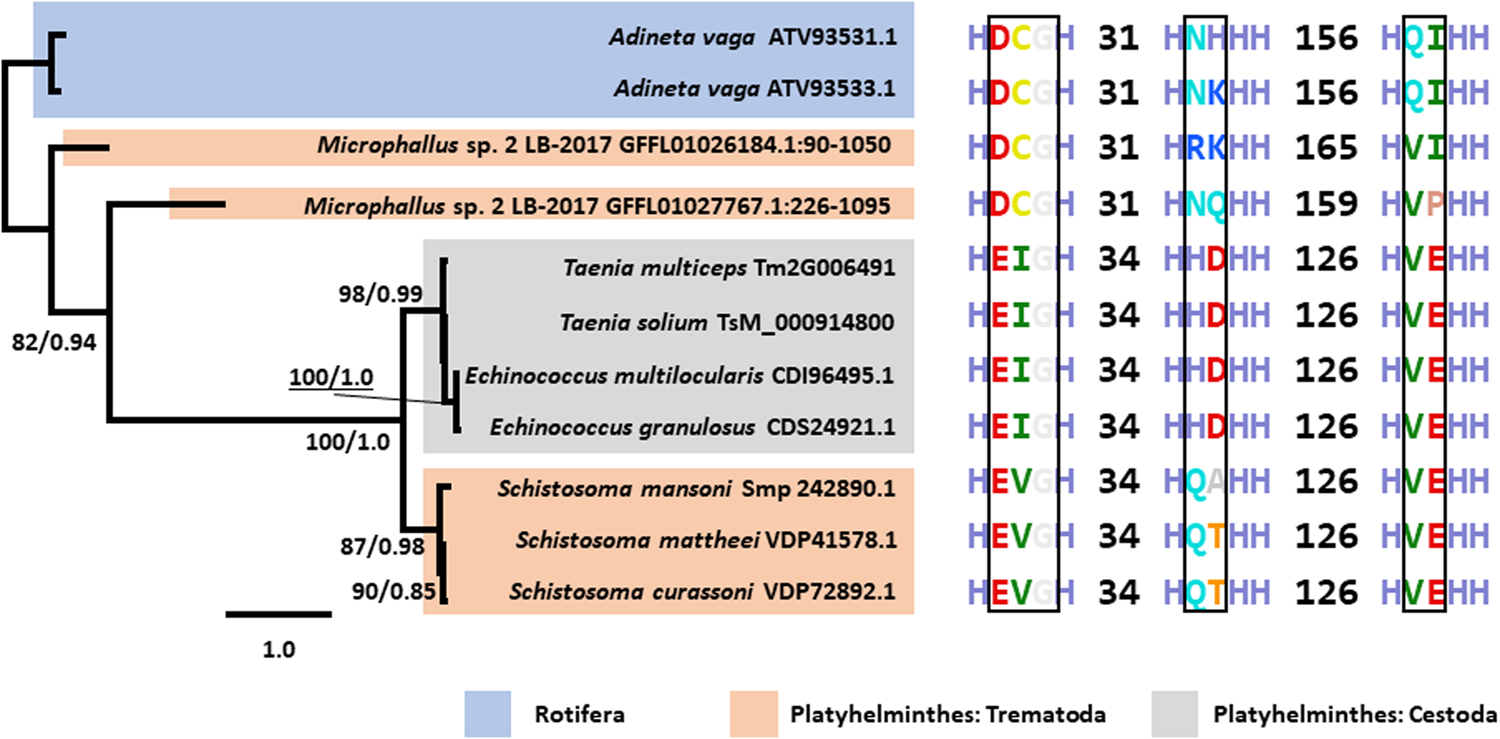
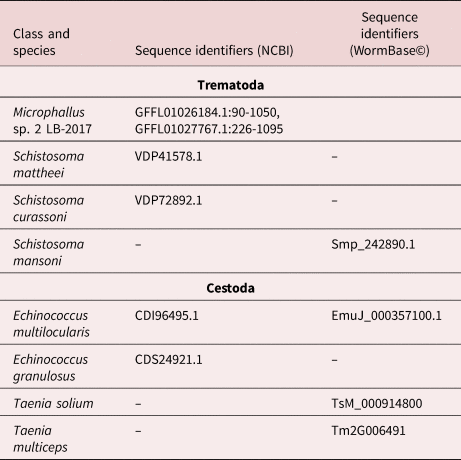
In total, nine sequences with the characteristic H-boxes were found in eight species representing two of the four traditional classes of Platyhelminthes (table 1; also see supplementary table). Specifically, we found these sequences in four cestode species (representing two genera), as well as four trematode species (also representing two genera). The amino acid sequences of the putative ɷx desaturases in Microphallus were phylogenetically closer (fig. 1), and more similar, to confirmed ɷx desaturases of the rotifer A. vaga (mean 29.0, range 24.9–32.1% identity with rotifer sequences) than those of other platyhelminths (mean 13.5, range 12.2–14.7% identity with rotifer sequences). Inspection of aligned sequences revealed suggestive patterns in variable amino acids inside the three H-boxes (fig. 1). Variable sites in all three H-boxes of two sequences from the trematode Microphallus sp. 2 LB. 2017 were highly similar to the confirmed ɷx desaturases of the rotifer A. vaga (fig. 1; also see supplementary table).
Maximum likelihood gene tree of ɷx desaturases in the Rotifera and Platyhelminthes (two confirmed sequences from Rotifer, from Kabeya et al., Reference Kabeya, Fonseca, Ferrier, Navarro, Bay, Francis, Tocher, Castro and Monroig2018, and nine putative homologues from Platyhelminths). Nodes are annotated with per cent support in 500 bootstrap replicates in maximum likelihood and Bayesian posterior probability (before and after slash, respectively), based on an alignment of 179 amino acids stripped of gaps. Histidine box motifs (H-boxes) are colour coded to highlight amino acid functional group similarity, and separated by the number of amino acids between each H-box. The outlined rectangles spanning the H-boxes show alignment sites free to vary according to search criteria.

Putative ɷx desaturase sequences found by genomic data searches for four classes within the phylum Platyhelminthes.Footnote a, Footnote b

See supplementary material for list of all species searched.
a Sequences acquired from NCBI and WormBase© are unique, i.e. there are no exact duplicates in the results from both databases (see ESM for full FASTA sequences). If duplicates were found in the genomic data searches (i.e. same sequence uploaded on both NCBI and WormBase©), then only the sequence identifiers from NCBI were reported (to avoid double counting).
b If multiple sequences are reported for one species, these represent protein sequences from different individuals that may have slight variations, or different sections of a protein sequence from the same individual. Further information can be acquired from the databases using the given sequence identifiers.
In H-box 1 of both the rotifer and all nine platyhelminth sequences, the second amino acid was glutamic acid (E) or aspartic acid (D), both of which are acidic and charged, and the third amino acid was invariant (G). In H-box2, the second position was occupied by an amino acid with a side chain that was either polar and neutral (glutamine, Q; asparagine, N), or basic and charged (histidine, H; arginine, R). The two potentially variable amino acids within H-box 3 were identical within Schistosoma, Taenia and Echinococcus, and the first position was additionally conserved in both Microphallus sequences, one of which shared an amino acid (I) with the rotifer A. vaga in the second variable position.
Amino acids in the variable positions of H-boxes in the nine putative ɷx desaturase sequences found in platyhelminths also shared similarities to those found in 43 eukaryotes by Hashimoto et al. (Reference Hashimoto, Yoshizawa, Okuda, Kuma, Goto and Kanehisa2008). In H-box 1, we observed D or E at the first and C, I or V at the second of these positions, and G at the third, while Hashimoto et al. (Reference Hashimoto, Yoshizawa, Okuda, Kuma, Goto and Kanehisa2008) found D/A and C/A and almost uniformly G in these three respective positions. The presence of G in the third position, notably, excludes the H-box 1 of sphingolipid desaturases, in which Hashimoto et al. (Reference Hashimoto, Yoshizawa, Okuda, Kuma, Goto and Kanehisa2008) recorded only S or T at this position. In H-box 3 of ɷx desaturases, Hashimoto et al. (Reference Hashimoto, Yoshizawa, Okuda, Kuma, Goto and Kanehisa2008) found V to be common in the first variable position, and roughly equal frequencies of L, V, A and I in the second. Similarly, V occupied first variable position in the H-box 3 sequences of all nine platyhelminths, and I occurred in one.
Generally, variable positions in the three H-boxes in the nine putative platyhelminth ɷx desaturases showed similar degrees of conservation as in the H-boxes of 43 ɷx desaturases in Hashimoto et al. (Reference Hashimoto, Yoshizawa, Okuda, Kuma, Goto and Kanehisa2008). For example, in H-box 2, the two variable positions were more heterogeneous across the alignment than the variable positions in H-boxes 1 and 3, as also seen in Hashimoto et al. (Reference Hashimoto, Yoshizawa, Okuda, Kuma, Goto and Kanehisa2008). The most conserved positions (in order of decreasing conservation: H-box 3, variable position 1, H-box 1, variable positions 2 and 3) were the same in our data and in the 43 ɷx desaturases in Hashimoto et al. (Reference Hashimoto, Yoshizawa, Okuda, Kuma, Goto and Kanehisa2008), in which this ranking was not observed in other types of desaturases. Thus, on the whole, the H-box motifs of the nine sequences recovered from platyhelminths shared numerous similarities with ɷx desaturases that Hashimoto et al. (Reference Hashimoto, Yoshizawa, Okuda, Kuma, Goto and Kanehisa2008) found using other methods, including attributes that distinguish them from other types of desaturases.
Discussion
We found evidence of FA desaturase genes within the genomes of eight species within the phylum Platyhelminthes, although experimental characterization of the products of these genes is needed to confirm and further characterize gene functions, and the reasons for the presence of these genes in these particular platyhelminths are unclear. Putative ɷx desaturase sequences were only found in trematodes (flukes) and cestodes (tapeworms), mainly in well-studied species of significance for human and livestock health (Hotez et al., Reference Hotez, Brindley, Bethony, King, Pearce and Jacobson2008; Pottinger & Jong, Reference Pottinger, Jong, Sanford, Jong and PS2017). In trematodes, these sequences were found in the genus Schistosoma, including S. mansoni, a key species linked to human schistosomiasis, as well as in Microphallus sp. In cestodes, sequences were found in Echinococcus spp. and Taenia spp. – species that commonly infect livestock and humans (Machado-Pinto & Laborne, Reference Machado-Pinto, Laborne, Tyring, Lupi and UR2016). The absence of putative sequences in the monogeneans and ‘turbellarians’ considered here may indicate that these genes are not found in all platyhelminths, although the sparse genomic coverage of platyhelminths precludes a definitive statement.
Intriguingly, while the three classes of obligate parasite (Trematoda, Cestoda and Monogenea) within this phylum form a monophyletic clade (Neodermata) with a single ancestral origin for parasitism, there is also strong support for the trematodes and cestodes to comprise a single clade of endoparasites (Park et al., Reference Park, Kim, Kang, Kim, Eom and Littlewood2007; Riutort et al., Reference Riutort, Álvarez-Presas, Lázaro, Solà and Paps2012). Our results thus suggest that the capacity for de novo biosynthesis of PUFA may be limited to a few species in this endoparasitic clade. Kabeya et al. (Reference Kabeya, Fonseca, Ferrier, Navarro, Bay, Francis, Tocher, Castro and Monroig2018) did not identify putative ɷx desaturase sequences from the eight species in which we recovered them, which we attribute to the less-restrictive search criteria we applied based on two considerations. First, unique genomic trends in platyhelminths, particularly neodermatans, suggest that evolutionary divergence could mask the presence of genes in some cases (see Introduction). Second, the wide distribution of ɷx desaturase genes established by Kabeya et al. (Reference Kabeya, Fonseca, Ferrier, Navarro, Bay, Francis, Tocher, Castro and Monroig2018) indicates that alternative search methods are appropriate for large lineages in which these genes were absent, such as Platyhelminthes.
We recovered putative ɷx desaturase sequences from only a few endoparasitic platyhelminths, which may reflect a lack sequences in other taxa in which homologous genes are present, or may approximate the actual distribution of these genes. PUFA are critical for within-host interactions for both trematodes and cestodes, and the ability to synthesize these compounds is therefore likely to be a particular advantage for endoparasites, as opposed to ectoparasitic (monogenean) or free-living (‘turbellarian’) platyhelminths. As noted earlier, cestodes, trematodes and parasitic nematodes are all capable of using various PUFA to synthesize immunomodulatory eicosanoids (Belley & Chadee, Reference Belley and Chadee1995), and ARA is the precursor for various within-host signalling molecules used by trematodes (Tielens, Reference Tielens, Fried and Graczyk1997). Given this role in endohelminth establishment and the putative ɷx desaturase sequences found in parasitic nematodes (Kabeya et al., Reference Kabeya, Fonseca, Ferrier, Navarro, Bay, Francis, Tocher, Castro and Monroig2018), their presence in endoparasitic platyhelminths makes intuitive sense. In addition, FA appear to play important roles in larval development for both trematodes and cestodes (e.g. Minematsu et al., Reference Minematsu, Yamazaki, Uji, Okabe, Korenaga and Tada1990; Bexkens et al., Reference Bexkens, Mebius, Houweling, Brouwers, Tielens and van Hellemond2019). With these critical functions of PUFA for endoparasitic platyhelminths, it is possible that their biosynthesis abilities extend beyond modifying host-derived precursor molecules (Smyth & McManus, Reference Smyth and McManus1989; Furlong, Reference Furlong1991) to de novo production.
Although putative ɷx desaturase sequences were found in the Platyhelminthes, they were uncommon and concentrated in just four genera, and two occurred in a single species. Some of this apparent absence may represent true absence. For example, other than the eight platyhelminth species from which putative ɷx desaturase sequences were recovered here, the genomes of 25 other Platyhelminthes are assembled on WormBase© (Howe et al., Reference Howe, Bolt, Shafie, Kersey and Berriman2017). In this respect, our results parallel the findings of Kabeya et al. (Reference Kabeya, Fonseca, Ferrier, Navarro, Bay, Francis, Tocher, Castro and Monroig2018), who documented ɷx desaturase sequences in few genera or species within much larger phyla. For instance, within Rotifera, relevant sequences were only found in five species (A. vaga and Rotario spp.), and >1 ɷx desaturase was recovered in several species (Kabeya et al., Reference Kabeya, Fonseca, Ferrier, Navarro, Bay, Francis, Tocher, Castro and Monroig2018). Below, we speculate how this distribution of putative genes, and the relationships among them, may either reflect particular life history features in the eight species potentially possessing de novo PUFA biosynthesis ability, or results from missing or incomplete sequence data in this phylum.
The two trematode genera for which putative ɷx desaturase sequences were identified are not closely related (belong to different orders) but share a conspicuous life history feature unusual among trematodes, in that all Schistosoma spp. have a two-host (dixenous) life cycle, as do the majority of Microphallus spp. (Brant & Loker, Reference Brant and Loker2005; Galaktionov & Skirnisson, Reference Galaktionov and Skirnisson2007). Schistosome cercariae penetrate directly into their vertebrate definitive hosts, and seem to be stimulated by essential PUFA found in host skin (mainly LNA and ARA) to produce immunomodulatory eicosanoids (reviewed by Furlong, Reference Furlong1991; Daugschies & Joachim, Reference Daugschies and Joachim2000). The capacity for de novo PUFA biosynthesis could thus be advantageous, although this does not explain why ɷx desaturase sequences would be absent in other schistosomatids, such as Trichobilharzia spp. In addition, the utility of de novo PUFA biosynthesis is unclear for cercariae of Microphallus spp., which encyst in their first intermediate molluscan host. Taenia and Echinococcus are the only two genera in the family Taeniidae (Lavikainen et al., Reference Lavikainen, Haukisalmi, Lehtinen, Henttonen, Oksanen and Meri2008), which is unique among cestodes in requiring two obligate mammalian hosts (Knapp et al., Reference Knapp, Nakao, Yanagida, Okamoto, Saarma, Lavikainen and Ito2011). Similar to trematodes, cestodes can convert PUFA into immunomodulatory eicosanoids (Belley & Chadee, Reference Belley and Chadee1995), thus de novo PUFA biosynthesis could prove highly useful when combatting the defences of two hosts with relatively complex immune responses. However, further work to confirm gene functionality will be critical to confirm the capacity for de novo PUFA synthesis in these species before testing hypotheses regarding their distribution among platyhelminth taxa.
The alignment and phylogenetic analysis of the amino acid sequences of the putative ɷx desaturase genes yielded two apparent groups: (1) rotifers + Microphallus sp.; and (2) Schistosoma spp. + Taeniidae. The overall topology is inconsistent with relationships among these taxa, in that the ɷx desaturase genes of Microphallus (Trematoda) are distant and apparently early divergent from the remaining sequences from both cestodes and trematodes. This might reflect the presence of two genes for two different, but related, proteins within these species, and it may indicate highly uneven rates of protein evolution among these two groups of species. Kabeya et al. (Reference Kabeya, Fonseca, Ferrier, Navarro, Bay, Francis, Tocher, Castro and Monroig2018) also found cases of distinct putative ɷx desaturase genes within species, and evidence of horizontal transfer in some cases, with an overall gene tree presenting marked inconsistency with relationships at high levels (e.g. ɷx desaturase genes of nematodes not grouping with those of arthropods, which were allied with one of two paraphyletic annelid clades) and low levels (e.g. divergent ɷx desaturase genes within Lepeophtheirus salmonis). Additional genomic (particularly nucleotide level) sequence data and broader taxonomic coverage are needed to clarify duplication, loss and transfer of these genes within Platyhelminthes.
Another factor which undoubtedly affects our results is missing sequence data. Out of the 774, 353 protein sequences available for Platyhelminthes on NCBI (as of October 2020) (National Center for Biotechnology Information, 2020), only nine putative sequences were found. This can be attributed to a lack of genomic coverage in NCBI (and equally, WormBase©) for the vast majority of platyhelminths vs. the alternative possibility that ɷx desaturase genes are truly absent from most platyhelminths. Sequencing coverage inevitably overrepresents certain species (e.g. 28 of 31 platyhelminth genomes on WormBase© are from species infecting humans, their companion animals, or host species with importance in agriculture or aquaculture). Recent estimates suggest that NCBI only contains sequences from 3% of the identified species on Earth, with an inevitable bias towards larger and more ‘charismatic’ vertebrates (Mora et al., Reference Mora, Tittensor, Adl, Simpson and Worm2011), and even biodiversity-oriented sequencing efforts lag behind the number of species even in the relatively small number of medically important parasites (Ondrejicka et al., Reference Ondrejicka, Locke, Morey, Borisenko and Hanner2014). This situation greatly impedes estimation of the distribution and evolution of less frequently studied genes such as FA desaturases.
From the MSA analysis, we detected several patterns in amino acids found inside and surrounding the H-box of the two confirmed and nine putative sequences. Based on these patterns, it is plausible that functional aspects of the confirmed sequences are also present in the putative sequences. These H-box amino acids are most likely part of the active sites of the enzymes, which would explain why they are highly conserved in their protein sequence; however, the function of the putative sequences should also be further validated by additional biochemical data, such as that obtained using a heterologous yeast expression system and subsequent FA analysis (as was done in Kabeya et al., Reference Kabeya, Fonseca, Ferrier, Navarro, Bay, Francis, Tocher, Castro and Monroig2018). Future studies could attempt to detect relevant ɷ6 and ɷ3 desaturase activity (i.e. LNA and ALA production) from transformed yeast cells expressing the putative genes, and also supplement the transformed yeast cells with relevant FA precursors to potentially induce other reactions related to n-3 PUFA biosynthesis. For instance, Kabeya et al. (Reference Kabeya, Fonseca, Ferrier, Navarro, Bay, Francis, Tocher, Castro and Monroig2018) supplemented the transformed yeast cells with n-6 PUFA precursors (e.g. LNA and ARA) and detected additional Δ17 desaturase activity (i.e. the conversion of ARA to EPA). Similar protocols have also been used by Ferraz et al. (Reference Ferraz, Kabeya, Lopes-Marques, Machado, Ribeiro, Salaro, Ozório, Castro and Monroig2019) to verify the full enzymatic capacity of the Amazonian fish Colossoma macropomum for LC-PUFA biosynthesis. These methods could therefore confirm the total enzymatic capacity for the taxa in which we identified n-3 PUFA biosynthesis capability.
As mentioned previously, the intrinsic function(s) of PUFA (and by association, n-3 PUFA biosynthesis) in platyhelminths are still not well understood. Beyond modifying host-derived FA to produce immunomodulatory eicosanoids as discussed above, it is not clear whether PUFA contribute to parasite energy resources, as is suspected in certain trematode cercariae (Schariter et al., Reference Schariter, Pachuski, Fried and Sherma2002; Fried & Toledo, Reference Fried and Toledo2009). In addition, host–parasite interactions may affect n-3 PUFA biosynthesis in platyhelminths considering that infected hosts often have considerable lipid resources, and their parasites likely have strategies to obtain these. For instance, trematode parthenitae (sporocysts and rediae) are completely dependent on their snail intermediate host and can manipulate its energy reserves (e.g. lipids) to support their own survival, development and reproductive output (Arakelova et al., Reference Arakelova, Chebotareva and Zabelinskii2004). Related to this, Fried & Sherma (Reference Fried and Sherma1990) and Tunholi-Alves et al. (Reference Tunholi-Alves, Tunholi, Gôlo, Lustrino, Maldonado, Bittencourt, Maria de Lurdes and Pinheiro2011) found that the neutral lipid content of snail hosts (Helisoma trivolvis and Biomphalaria glabrata, respectively) increased after trematode infection (by Echinostoma trivolvis and E. paraensi, respectively). In particular, neutral lipid content increased within the DGG complex of snails where these larval parasites are localized (Esch et al., Reference Esch, Barger and Fellis2002). In both cases, trematodes may have actually contributed to the lipid reserves of snails if they are capable of de novo n-3 PUFA synthesis and transferred some of these lipids to their hosts. If true, then larval trematodes could be considered as ‘conditionally helpful parasites’ (Fellous & Salvaudon, Reference Fellous and Salvaudon2008), as such actions would reduce the costs of infection while simultaneously supporting parasitism in their hosts.
It has been established that trematode cercariae play a role in transferring nutritional PUFA to pelagic consumers within aquatic food webs (McKee et al., Reference McKee, Koprivnikar, Johnson and Arts2020) and a wide range of cercariae consumers have been reported (e.g. Orlofske et al., Reference Orlofske, Jadin and Johnson2015; Mironova et al., Reference Mironova, Gopko, Pasternak, Mikheev and Taskinen2019). Although there are no reports of predation upon cestode larvae within the environment (such as aquatic coracidia) that we are aware of, it is likely that a wide variety of free-living parasite infectious stages are consumed (Johnson et al., Reference Johnson, Dobson, Lafferty, Marcogliese, Memmott, Orlofske, Poulin and Thieltges2010). Confirming the possibility for de novo n-3 PUFA biosynthesis in trematodes and cestodes may therefore adjust our understanding of the nutritional contributions of free-living parasite infectious stages within food webs. Such findings have considerable value given that dietary PUFA are vital for maintaining consumer populations. For instance, many terrestrial animals cannot biosynthesize essential PUFA, and are also unable to obtain sufficient PUFA from their primary terrestrial-based food sources (Gladyshev et al., Reference Gladyshev, Arts, Sushchik, Kainz, Brett and Arts2009). Thus, they rely heavily on PUFA exports from aquatic ecosystems (e.g. shore drift, aquatic insect and amphibian emergence, preying on fish in adjacent water bodies); these aquatic-based PUFA are then transferred to higher trophic levels and are highly conserved within terrestrial food webs (Gladyshev et al., Reference Gladyshev, Arts, Sushchik, Kainz, Brett and Arts2009). The possibility of de novo PUFA biosynthesis in taeniids is particularly interesting, because these worms have terrestrial life cycles.
In aquatic systems, primary PUFA sources are being depleted by a variety of causes, including climate warming (Colombo et al., Reference Colombo, Rodgers, Diamond, Bazinet and Arts2020) and it is unclear whether alternative PUFA producers can fill the void (Arts et al., Reference Arts, Ackman and Holub2001). If supported by further studies indicating gene functionality, our findings indicate that at least some trematodes and terrestrial cestodes may subsidize the natural production of PUFA in ecosystems, in addition to established roles of cercariae transferring host-derived PUFA within aquatic food webs (McKee et al., Reference McKee, Koprivnikar, Johnson and Arts2020). These findings are especially promising given the ubiquity of infectious stages (e.g. Johnson et al., Reference Johnson, Dobson, Lafferty, Marcogliese, Memmott, Orlofske, Poulin and Thieltges2010). For example, Preston et al. (Reference Preston, Orlofske, Lambden and Johnson2013) found that trematodes in pond ecosystems could produce between 14 and 1660 free-living cercariae snail−1 24 h−1 throughout the summer, resulting in a total of 70–220 mg m−2 y−1 of dry cercarial biomass. McKee et al. (Reference McKee, Koprivnikar, Johnson and Arts2020) then used these results to estimate the annual FA contributions of R. ondatrae in such ecosystems and determined that their cercariae may represent up to 337 μg m−2 y−1 of EPA and up to 6.2 μg m−2 y−1 of DHA.
Here we report putative sequences for ɷx desaturases from endoparasites within the phylum Platyhelminthes. Although future work is needed to confirm the function of these genes, our results suggest at least some trematodes and cestodes are capable of de novo n-3 PUFA synthesis. Given that the free-living infectious stages of these helminths may be a good source of PUFA for aquatic consumers, it will be important to examine key genetic sequences in a wider range of platyhelminths in order to determine the extent to which macroparasites are capable of de novo synthesis. In addition, the disruption of desaturase activity in trematodes and cestodes may lead to possible therapeutic compounds, as suggested for FA in other parasites (Gratraud et al., Reference Gratraud, Huws and Falkard2009). Notably, while many antihelmintics target parasite membrane ion channels, some also disrupt enzyme pathways, including those critical for metabolic activity (Martin et al., Reference Martin, Robertson and Bjorn1997). It is thus necessary to understand the extent to which de novo n-3 PUFA biosynthesis is possible by macroparasites, such as those found in the phylum Platyhelminthes.
Supplementary material
To view supplementary material for this article, please visit https://doi.org/10.1017/S0022149X20000954
Acknowledgements
We thank L. Campbell, AR Van Dam and J-C Martínez-Cruzado for advice, as well as L. Lo, L. Orofiamma, and T. Smith for technical help.
Financial support
This work was supported by NSERC Discovery Grants to M.T.A. (grant number 04537-2014) and J.K. (grant number 05566-2015) and by a grant from the National Science Foundation to S.A.L. (DEB grant number 1845021).
Conflict of interest
None.