


Undernutrition is characterised by a complex combination of factors including inadequate or insufficient ingestion of food, deficient intake of essential nutrients, unsatisfactory socio-economic conditions, unhealthy living environment, high frequency of infection and poor health care(Reference Sawaya1, Reference Black, Allen and Bhutta2). Evidently, the longer the exposure to such harmful factors the more damaging the consequences to the nutritional status of the individual. The height-for-age indicator reflects linear growth, and is related to long-term changes in nutritional status and overall health(Reference Waterlow and Tomkins3). A deficit in this index is associated with cumulative growth retardation indicating chronic undernutrition.
The problem of undernutrition is of global concern since, according to the latest FAO estimates, 925 million people ingest insufficient food to meet their minimum energy requirements, of whom 53 million live in Latin America and the Caribbean(4). In developing countries, approximately 112 million children aged 5 years or less are affected by weight-for-age deficit and 32 % of children in this age group worldwide have been diagnosed with height-for-age deficit(Reference Black, Allen and Bhutta2). Indeed, height-for-age deficit is currently considered the most important nutritional problem faced by developing countries.
In Brazil, 6 % of children aged less than 5 years suffer from height-for-age deficit, while the prevalence of this condition is higher (8·2 %) among the poorest sector of the population, i.e. in families with a monthly income less than one-quarter of a minimum salary (US$ 340). Moreover, the prevalence of height-for-age and weight-for-age deficits among children in the 5–9 years age range is 6·8 % and 4·1 %, respectively(5).
In the last three decades, population growth in Brazilian cities has been intense with the poorest communities being concentrated in disorganised areas characterised by precarious housing and sanitation. In the metropolitan areas of Rio de Janeiro and São Paulo, which comprise 11·3 and 18·8 million people, respectively, the rates of population growth in impoverished zones have been much greater than the averages for the urban regions, and presently account for more than 20 % of the inhabitants of Rio de Janeiro and 11–19 % of the inhabitants of São Paulo(Reference Saglio-Yatzimirsky6). This situation has led to increased violence, undernutrition and family breakdown, along with a reduction in the level of schooling. In addition, there is considerable evidence indicating that undernutrition in early life results in harmful consequences over the long term, including obesity, CVD and diabetes(Reference Barker7–Reference Langley-Evans10).
In order to tackle this problem, the Federal University of São Paulo (UNIFESP) created the Centre of Nutritional Recovery and Education (CREN) in 1994 with the objectives of developing: (i) methodologies for the nutritional recovery of children with respect to weight and, in particular, stature; and (ii) approaches for direct intervention in the complex socio-economic and familial situation of impoverished urban areas.
The aim of the present study was to investigate a cohort of children who had received treatment for undernutrition at CREN and to identify the factors associated with their recovery using the methodology of life table analyses. The influence of the duration of treatment on the outcome was also assessed. To the best of our knowledge, no life table studies have been designed to investigate the nutritional recovery profile of undernourished children.
Subjects and methods
CREN protocol
More than 1000 undernourished children are assisted annually by CREN in a day-hospital regime (n 50), in an out-patient clinic (n 700) or directly in the community (n 300) depending on the degree of undernutrition and accessibility of the centre. Treatment and follow-up of the children and their families are carried out by a multidisciplinary team that includes paediatricians, nurses, nutritionists, social carers, psychologists, teachers and auxiliary workers.
Children (aged between 0 and 71 months) accepted into the day-hospital regime originate either from impoverished communities (determined by anthropometric field censuses) or from public health units, and comprise those who have been diagnosed with primary undernutrition and who cannot be rehabilitated in out-patient clinics or by home visits. The routine weekday schedule at CREN comprises five daily meals together with recreational and educational activities (including hygiene practices), sleeping time after lunch and periodical medical examinations. The children are clinically monitored every day through the collection of vital signs (temperature, heart and respiratory rate), recall of food intake, and registry of pathological symptoms such as coughing, sneezing, vomiting, presence of rhinorrhoea, and frequency and consistency of faeces. When inflammatory or parasitic processes are detected, the children are treated accordingly. Evolution of stature is assessed monthly, whereas weight is determined weekly in the morning before the first meal. The five daily meals provided at CREN are made up of components that can be readily acquired by the mothers in local shops. The amount of food prescribed covers 100 % of the energy intake recommended by the Dietary Reference Intake(Reference Otten, Hellwig and Meyers11) appropriate for the age of the child. Furthermore, the children receive protein-rich food that favours the recovery of stature, as well as vitamin supplements (A, C, D and B complex) and prophylactic doses of Fe until they are 24 months old. Children are discharged from CREN and redirected to day nurseries or pre-schools after effective recovery from undernutrition, i.e. when the height-for-age and weight-for-age parameters are normalised (Z-score >−1).
Data collection and anthropometric measurements
Demographic and clinical data were obtained from medical records. Clinical signs were evaluated by a paediatrician, and children presenting other pathologies that contributed to stature deficit were excluded from the study. Data concerning pregnancy, parturition and neonatal incidents were obtained from an anamnesis carried out with the mother. Information regarding gestational age, birth weight and length was obtained from the certificated record of birth provided by the parent or legal guardian. Infants of less than 15 kg body weight were weighed using a Kratos (Embu, SP, Brazil) digital scale with a maximum capacity of 15 kg and a precision of 5 g, while for heavier children a Filizola (São Paulo, SP, Brazil) platform scale with a capacity of 150 kg and a precision of 100 g was employed. The stature of children younger than 24 months was assessed using a horizontal infantometer (Balmak, Limeira, SP, Brazil) with a maximum dimension of 100 cm and precision to the nearest 1 mm. For older children, stature was determined using a wall-mounted vertical stadiometer (Wiso, Curitiba, PR, Brazil) with a maximum dimension of 200 cm and precision to the nearest 0·1 cm. Measurements were taken according to published procedures(Reference Lohman, Roche and Martorell12) with the participants wearing light clothes and with bare feet. The cephalic perimeter was determined using an inextensible tape positioned on the occipital prominence and over the arch of the eyebrows.
Neuropsychomotor development
In order to follow the neurodevelopment of the children, a paediatrician carried out an anamnesis and a physical examination with particular attention to the indicators of child development(Reference Figueiras, de Souza and Rios13). Development was categorised as adequate evolution, delayed progress or slow development at school.
Evaluation of nutritional status
Children were classified with respect to nutritional status on the basis of weight-for-age, height-for-age and BMI-for-age Z-scores (WAZ, HAZ and BMIAZ, respectively; calculated using WHO Anthro 2005(14) software) according to WHO recommendations(15). Depending on the WAZ and HAZ values, the degree of undernutrition was considered to be mild (<−1), moderate (<−2) or severe (<−3).
Study design, population and statistical analysis
The current retrospective longitudinal study was based on information contained in the records of children assisted by CREN during the period 1994 to 2009. Details of the project were submitted to, and approved by, the Committee of Ethics in Research of UNIFESP (protocol no. 0375/09). All of the procedures employed complied with the ethical principles contained in the Declaration of Helsinki as stated by the World Medical Association. Written informed consent was obtained from the parents or legal guardians, where appropriate, prior to the commencement of the study. A total of 250 children aged 0–71 months who had received assistance under the day-hospital regime at CREN during the period 1994–2009 were initially selected for study. However, the sample population was reduced by 8·80 % to 228 owing to either incomplete medical records at admission (nine children) or lack of information regarding the follow-up period (thirteen children). One infant died at the beginning of treatment due to multiple organ failure, septicaemia, bronchopneumonia and acute diarrhoea and was included in the study as non-rehabilitated.
Mean values and standard deviations were calculated for continuous variables, while frequencies and proportions were calculated for categorical characteristics. One-way ANOVA was used in order to compare the mean values of birth weight, length at birth, cephalic perimeter, WAZ, HAZ and BMIAZ between the mildly, moderately and severely undernourished children. The χ 2 test was used to evaluate the association between sex, gestational age and age range at the time of admission and the various degrees of undernutrition. All of the children were followed up until their complete rehabilitation or until they left the programme according to age limitation. The variable of interest (the outcome) was recovery from undernutrition, since this parameter reflects factors related to early detection and effectiveness of the treatment. In order to carry out the analysis, the period between the first attendance at CREN and the occasion of discharge after the rehabilitation had been achieved was taken as the time of recovery, and the status variables were ‘rehabilitated’ or ‘non-rehabilitated’. Children who had been discharged from CREN owing to age limitation, those who abandoned the programme and those who had died were classified within the non-rehabilitated group. Life tables were constructed for all the variables, as well as Kaplan–Meier survival curves and log-rank test. Life table analysis investigated the length of treatment according to different variables, and Kaplan–Meier curves analysed statistical differences among them. Univariate and multivariate Cox regression models were constructed in order to evaluate the independent factors relating to rehabilitation of the children(Reference Kleinbaum16). Sex, age range, degree of undernutrition, neuropsychomotor development and birth weight were considered in the multivariate analysis. In all tests, the level of significance was set at P < 0·005. Descriptive analyses, comparison tests between groups and life tables were evaluated using the statistical software package PASW Statistics 18 (SPSS Inc., Chicago, IL, USA). Kaplan–Meier curves, log-ranks and Cox regression models were analysed using the statistical software package Intercooled STATA 9·2 for Windows (StataCorp, College Station, TX, USA).
Results
Within the sample of 228 children who had received assistance under the day-hospital regime at CREN during the period 1994 to 2009, the male to female ratio was 1 : 1 (Table 1). There was a predominance of girls within the groups presenting mild and moderate undernutrition, while boys predominated within the group exhibiting severe undernutrition (P = 0·002). The differences between the mildly, moderately and severely undernourished groups regarding the mean values of birth weight and length at birth were statistically significant (P = 0·004 for both characteristics). Furthermore, cephalic perimeter of children with severe undernutrition was smaller than those within the other two groups.
Anthropometric characteristics of undernourished children (n 228) from the southern slums of São Paulo, Brazil, treated at CREN during the period 1994–2009

CREN, Centre of Nutritional Recovery and Education.
*Values are presented as n and %.
Significant differences between the three groups were determined by the χ 2 test or ANOVA at P < 0·005: †χ 2 test (P = 0·002); ‡ANOVA (P = 0·004); §ANOVA (P = 0·303); ∣∣χ 2test (P = 0·240); ¶ANOVA (P < 0·001); **ANOVA (P = 0·114); ††ANOVA (P = 0·418); ‡‡ANOVA (P = 0·694).
Comparison of the mean values of WAZ, HAZ and BMIAZ obtained at the time of admission to CREN with those determined at the time of discharge revealed improvements in all undernourished groups, with average increments of 0·667 (sd 0·991), 0·841 (sd 0·983) and 0·184 (sd 1·185), respectively (Table 1). Considering the groups individually, the respective mean increments in WAZ, HAZ and BMIAZ were: (i) 0·192 (sd 0·682), 0·252 (sd 0·854) and 0·138 (sd 1·040) in the mildly undernourished group; (ii) 0·573 (sd 0·772), 0·730 (sd 0·776) and 0·129 (sd 1·061) in the moderately undernourished group; and (iii) 1·041 (sd 1·196), 1·344 (sd 1·027) and 0·276 (sd 1·397) in the severely undernourished group. The differences between the mean increments for the mildly, moderately and severely undernourished groups were statistically significant for WAZ and HAZ (P < 0·001). In all groups, the ages ofthe children showed a tendency to concentrate within the ranges of 12–24 months and ≥24 months, although the differences were not statistically significant (P = 0·694).
Children were followed up for 41·54 (sd 29·54) months on average, although 50 % of the children were followed up for 35·17 months. No differences were found for the follow-up time among the groups with different degrees of undernutrition (Table 2).
Follow-up time of undernourished children (n 228) from the southern slums of São Paulo, Brazil, treated at CREN during the period 1994–2009

CREN, Centre of Nutritional Recovery and Education.
The descriptive life table (Table 3) corresponding to the length of treatment received at CREN until complete rehabilitation had been achieved revealed that 98 % of children remained undernourished after 1 year. The percentage of children remaining undernourished diminished quite considerably after 5 years of treatment (66 %), implying that, at this time, 34 % of the sample population achieved normal weight and stature. The life table, which was also stratified according to the characteristics of the sample population, shows that, in general, the probability of remaining undernourished was lower for girls than for boys. Moreover, the likelihood of rehabilitation varied among the age groups. Thus, after 3 or more years of treatment, the probability of remaining undernourished was lower for children up to 12 months old than for those in the age ranges of 12–23 months and ≥24 months. Moderately undernourished children presented the lowest probability of remaining undernourished after 5 years of treatment, whereas the probabilities were similar in the mildly and severely undernourished groups. Regarding neuropsychomotor development, the probability of remaining undernourished after 5 years of treatment was slightly higher among children presenting adequate advancement in comparison with those presenting delayed progress. The average age of children with delayed neuropsychomotor development (n 33) was 22·81 (sd 16·72) months, and 51·5 % of this group presented a severe degree of undernourishment. The probability of children who received frequent medication to remain undernourished was lower in comparison with those who were not often medicated. The status of the parents and siblings also influenced the probability of a child to remain undernourished, such that the likelihood of undernourishment was higher when close relatives were themselves undernourished.
Life table corresponding to the length of treatment of undernourished children (n 228) from the southern slums of São Paulo, Brazil, treated at CREN during the period 1994–2009

CREN, Centre of Nutritional Recovery and Education.
*Probability could not be determined owing to an insufficient number of cases.
Further analyses were done to investigate statistical differences of the above variables by using the curves of survival analysis constructed according to the product-limit method of Kaplan–Meier (Fig. 1). Statistically significant differences were found in the periods of treatment at CREN between children presenting different degrees of neuropsychomotor development (P = 0·037; log-rank = 6·621). In contrast, there were no significant differences between the recovery from undernutrition curves with respect to sex, gestational age, age range, degree of undernutrition, vaccination, hospital admissions, previous diseases, frequent use of medications or record of family history of undernourishment (data not shown).
Kaplan–Meier survival curves relating the probability of remaining undernourished to the time of treatment at CREN of children presenting different degrees of neuropsychomotor development (–––, adequate evolution; – – –, delayed progress; - - -, slow development at school). Undernourished children (n 228) from the southern slums of São Paulo, Brazil who had received treatment at CREN (Centre of Nutritional Recovery and Education) under a day-hospital regime between the years 1994 and 2009 (log-rank = 6.621; P = 0·037)

The results obtained from multivariate Cox regression analysis are shown in Table 4, in which only the primary variables sex, age, degree of undernutrition, neuropsychomotor development and birth weight are presented since information concerning other variables was incomplete. Children aged ≥24 months at the time of admission exhibited a reduction in the probability of undernutrition at the end of the period of 51 % compared with children aged 0 –< 12 and 12–23 months (P = 0·046). In contrast, children aged between 12 and 23 months at the time of admission showed a probability of recovery of 30 % compared with infants less than 12 months, although the difference in the values of the hazard ratios was not statistically significant. Children with slow development presented a higher probability of rehabilitation (4·48 times more) in comparison with those exhibiting adequate evolution. There were no differences between the groups with respect to birth weight.
Multivariate Cox regression analysis relating to the rehabilitation or non-rehabilitation of undernourished children (n 228) from the southern slums of São Paulo, Brazil, treated at CREN during the period 1994–2009
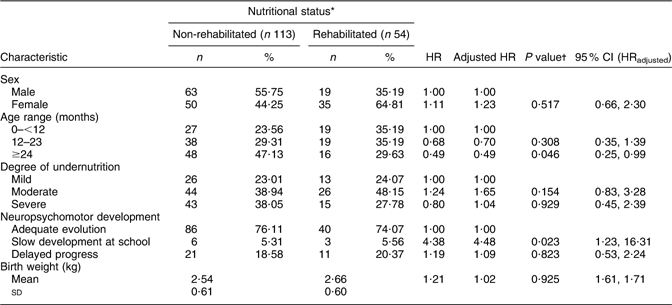
CREN, Centre of Nutritional Recovery and Education; HR, hazard ratio.
*Information available for 167 children.
†Means adjusted for sex, age range, degree of undernutrition, neuropsychomotor development and birth weight.
Discussion
Duration of treatment
Classical studies concerning treatments carried out at nutritional rehabilitation centres in developing countries during the period 1950–1970 revealed that most children taken into such programmes presented severe undernutrition. The average age of the children at admission was 12 months in general, and almost all exhibited marasmus or kwashiorkor. The time required for the nutritional rehabilitation was about 3 months. At that time, the criterion for the diagnosis of nutritional recovery was based on the WAZ index (≥−2) alone(Reference Monckeberg17–Reference Colecraft, Marquis and Bartolucci20) and the aim of the intervention was to reduce mortality rate. However recent studies have underlined that nutritional management during rehabilitation should take into account long-term health and bring about a gain in stature in order to prevent the risk of non-communicable diseases in adulthood(Reference Sawaya1, Reference Weisstaub and Araya21, Reference Neves, Martins and Sesso22). The duration of the treatment at CREN is extended because it includes both stature and weight recovery, as well as educational intervention to the family. In this respect, studies involving children who had been discharged from CREN for at least 3 years showed that rehabilitated individuals presented normal body composition and no alterations in the glucose and insulin metabolism that had been previously described in stunted individuals. In addition, the nutritional education was effective and good food habits persisted after discharge from CREN, even though the families continued to live in poverty(Reference Prader23, Reference Walker and Golden24).
Tanner et al.(Reference Tanner, Whitehouse and Takaishi25) recommend that good measurements of linear growth require intervals of 6 months to 1 year between analyses. Based on this proposal, the status of recovery was estimated only for children who had undertaken treatment at CREN for at least 6 months. The results presented herein demonstrate that the probability of a child remaining undernourished diminished as the length of treatment increased. Additionally, the length of treatment at CREN was based on recovery of stature deficit according to the cut-off point HAZ > −1.
A previous publication involving a smaller sample of undernourished children treated at CREN showed 67·9 % nutritional recovery when both HAZ and WAZ were taken into account and 92·5 % recovery when at least one of these indicators was considered(Reference Goulart, Junior and Souza26). Those results indicated that a high prevalence of recovery can be obtained when children complete the treatment at CREN. In the present study, the totality of individuals assisted by CREN at the day-hospital was investigated and fewer children (34 %) recovered from weight and height deficit. This discrepancy arises because the survival analysis of the dynamic cohort of children assisted by CREN during the period 1994–2009 included censored cases (70·6 %) comprising individuals who had abandoned the programme mainly because they had moved to other locations. A high rate of family instability was also detected and this interfered with the progress of the treatment and its duration.
The present study aimed to assess the progress of the undernourished children assisted by CREN during the 15-year period and is the first study to use the life table methodology to investigate the recovery of undernourished children. There were, however, two important limitations for the study: (i) only a small number of individuals had complete records; and (ii) there was a lack of consistency in the manner in which the questionnaires were completed by the professionals at CREN and this made the data collection difficult.
Age of children
Evidence exists in the literature to suggest that age and nutritional status at the beginning of treatment are determining factors in the promotion of linear catch-up, such that delayed beginning of the treatment reduces the chances of recovering linear growth(Reference Alves-Vieira, Ferraro and do Nascimento-Souza27, Reference Martins, Martins and das Neves28). The present study revealed that at the date of admission to CREN, the average age of the population was 24·45 months, a stage in life in which it is more difficult to reverse stature deficit. In spite of this, it was observed that increases in HAZ were greater than in WAZ. The positive effects were observed even in children aged ≥24 months at the time of admission, although the magnitude of such recovery was inferior to that shown by younger individuals.
Recovery patterns
The present study showed that stature deficit was the most prevalent nutritional challenge among the moderately and severely undernourished children assisted by CREN, confirming the hypothesis proposed by Black et al.(Reference Black, Allen and Bhutta2) who stated that urban poverty impairs linear growth more than weight. On the other hand, the increments in stature and weight of the severely undernourished children were superior to those of children presenting milder forms of undernutrition. These results are in agreement with the findings of Goulart et al.(Reference Goulart, Junior and Souza26) who studied the effects of a food supplementation programme on the recovery of undernourished children and of those at nutritional risk, and found that recovery levels were higher when the initial deficit was greater.
Neuropsychomotor development
Undernutrition is associated with cognitive impairment in children and adolescents, delayed progress at school, gaps in school attendance, incomplete education, decreased productivity, reduced stature and delayed motor development in adulthood(Reference Caulfield, Richard and Rivera29–Reference Victora, Adair and Fall31). Poverty and social vulnerability are also risk factors for delayed language acquisition in children(Reference De Moraes, Weber and Oliveira-Santos32). Children who were undernourished during intra-uterine life tend to perform badly in intelligence tests and to present a lower learning capacity, and such impediment is more accentuated when undernutrition extends into early postnatal life(Reference Grantham-McGregor33). Additionally, according to Landon et al.(Reference Landon, Davison and Breier34), birth weight is positively associated with cognitive abilities in children, although environmental factors may weaken this relationship as time goes by. On the other hand, the beneficial effects of stature rehabilitation during infancy have been observed in a number of studies. In Guatemala, food supplementation during infancy increased the attendance of girls at school by one to two years(Reference Maluccio, Hoddinott and Behrman35), while a study involving a rural population in Zimbabwe established an association between HAZ increment in pre-school children and the level of education in young adults, with an additional 3·4 cm height corresponding to 0·85 additional grades of schooling(Reference Alderman, Hoddinott and Kinsey36). More recently, it has been demonstrated that undernourished children who had recovered in stature exhibited similar language and cognitive performances as non-stunted children(Reference Crookston, Penny and Alder37). These findings show a positive impact of nutritional rehabilitation and linear catch-up on neuropsychomotor development.
The results presented herein demonstrate that undernourished children with delayed neuropsychomotor development rehabilitated faster than those whose progress was adequate. These children exhibited a more severe degree of undernourishment at the time of admission to CREN and were younger. We believe, therefore, that the positive results obtained with children presenting delayed neuropsychomotor development are associated with the greater severity of their nutritional condition as well as their lower age at admission compared with the other groups.
Conclusions
Analysis of child survival revealed that age and neuropsychomotor developmental status at the time of admission to CREN were critical factors in determining the duration of treatment. These findings demonstrate the importance of early nutritional recovery, and indicate that the treatment should preferentially start before the age of 24 months. Linear catch-up has also been achieved for older children at CREN, but at a lower speed and after an extended period of treatment. Further investigations are needed in order to establish the long-term positive impact of nutritional rehabilitation on weight and stature.
Acknowledgements
The work was carried out at the Universidade Federal de São Paulo. The study was supported by CAPES (Coordenação de Aperfeiçoamento de Pessoal de Nível Superior). The authors declare that they have no conflicts of interest. The authors contributed to the work in the following manner: M.B.F.F. was responsible for conducting all of the fieldwork, manuscript preparation and participated in all phases of the study. A.C.M., A.P.G.C. and V.J.B.M. played a lead role in data collection. R.V.M.L. and M.P.A. assisted with statistical analysis of the data and preparing the manuscript. A.L.S. designed the original study, supervised all phases of the study and was responsible for revision of the final manuscript. All authors have approved the publication of the article in its present form. The authors wish to thank the staff at CREN as well as the participants and their families for their important contributions to this study.



