Introduction
Psychotic syndromes may be understood as disorders of adaptation to social context (Van Os et al. Reference Van Os, Kenis and Rutten2010). Accumulating evidence has demonstrated that environmental factors are causally related to onset of psychotic disorders (Van Os et al. Reference Van Os, Kenis and Rutten2010). It has become clear that not only individual experiences, but also the broader social context influences disease risk (Allardyce & Boydell, Reference Allardyce and Boydell2006). Older sociological literature already suggested that societal disorganization (Shaw & McKay, Reference Shaw and McKay1942) or structural imbalance of goals and means in society (Merton, Reference Merton1938) may lead to deviant behavior and illness, including schizophrenia (Faris & Dunham, Reference Faris and Dunham1939). More recently, concepts of social capital (Murayama et al. Reference Murayama, Fujiwara and Kawachi2012), collective efficacy (Sampson, Reference Sampson2012) and inequality (Wilkinson & Pickett, Reference Wilkinson and Pickett2006) have been proposed to understand associations between social context, behavior and health. Neighborhoods have different abilities to provide residents with social structures that enhance well-being and safety. Mutual trust and solidarity are lower in areas with residential instability, low socio-economic level, high degree of urbanization and heterogeneous populations, and informal social control and support are less available (Shaw & McKay, Reference Shaw and McKay1942; McCulloch, Reference McCulloch2003 Sampson, Reference Sampson2012). Lack of these resources in neighborhoods has been related to a range of adverse (mental) health outcomes in many studies (Morenoff, Reference Morenoff2003; Cagney & Browning, Reference Cagney and Browning2004; De Silva et al. Reference De Silva, McKenzie, Harpham and Huttley2005).
In recent years, these and related ideas have been reintroduced in psychosis research as well, in part driven by epidemiological findings of urban birth as a risk factor for psychotic disorders and high rates of psychotic disorders among ethnic minorities (Van Os et al. Reference Van Os, Kenis and Rutten2010). Adverse social experiences over the life course (Morgan et al. Reference Morgan, Charalambides, Hutchinson and Murray2010), growing up in a social minority position (Veling & Susser, Reference Veling and Susser2011) and long-term social exclusion or defeat (Selten et al. Reference Selten, Van der Ven, Rutten and Cantor-Graae2013) have been suggested as explanation for such variation in incidence rates. Patterns of spatial variation in the incidence of psychotic disorders (Kirkbride et al. Reference Kirkbride, Fearon, Morgan, Dazzan, Morgan, Murray and Jones2007a ; March et al. Reference March, Hatch, Morgan, Kirkbride, Bresnahan, Fearon and Susser2008) point towards similar factors. There is some evidence that social characteristics of neighborhoods, including neighborhood deprivation, residential mobility, social fragmentation, social capital, income inequality and ethnic density are related to distribution of non-affective psychotic disorders (Croudace et al. Reference Croudace, Kayne, Jones and Harrison2000; Boydell et al. Reference Boydell, Van Os, McKenzie, Allardyce, Goel, McCreadie and Murray2001; Silver et al. Reference Silver, Mulvey and Swanson2002; Allardyce et al. Reference Allardyce, Gilmour, Atkinson, Rapson, Bishop and McCreadie2005; Kirkbride et al. Reference Kirkbride, Morgan, Fearon, Dazzan, Murray and Jones2007b , Reference Kirkbride, Boydell, Ploubidis, Morgan, Dazzan, McKenzie, Murray and Jones2008, Reference Kirkbride, Jones, Ullrich and Coid2014; Veling et al. Reference Veling, Susser, Van Os, Mackenbach, Selten and Hoek2008). Only a few of these studies (Kirkbride et al. Reference Kirkbride, Morgan, Fearon, Dazzan, Murray and Jones2007b, Reference Veling, Susser, Van Os, Mackenbach, Selten and Hoek2008, Reference Kirkbride, Jones, Ullrich and Coid2014; Veling et al. Reference Veling, Susser, Van Os, Mackenbach, Selten and Hoek2008) were large first-contact incidence studies in single urban areas with high-quality diagnostic procedures and using multi-level statistical techniques, which are needed to investigate both neighborhood- and individual-level factors.
This study uses data of a prospective first-contact incidence study of psychotic disorders over 7 years in The Hague, the Netherlands; the study yielded a large number of incident cases in one geographical area for which reliable, detailed population and neighborhood data are available. In a previous report, we have shown associations between neighborhood ethnic density and incidence rates among immigrant groups (Veling et al. Reference Veling, Susser, Van Os, Mackenbach, Selten and Hoek2008). Here we investigate a broader range of neighborhood social factors and hypothesized that neighborhood social disorganization is related to a higher incidence of psychotic disorders.
Method
Case ascertainment
This was a first-contact incidence study over 7 years (1997–1999 and 2000–2005) that sought to identify and diagnose every citizen of The Hague 15–54 years of age who made a first contact with a physician for a possible psychotic disorder. The study's methods have been detailed elsewhere (Selten et al. Reference Selten, Veen, Feller, Blom, Schols, Camoenie, Oolders, Van der Velden, Hoek, Rivero, Van der Graaf and Kahn2001; Veling et al. Reference Veling, Selten, Veen, Laan, Blom and Hoek2006). There was extensive collaboration with local general practitioners, psychiatrists and psychiatric residents in the effort to identify every possible case. Except in the first 2 years, when the protocol was used primarily for research purposes, patients were being identified for inclusion in an early psychosis treatment service. Patients with possible psychosis were referred to the early psychosis department for evaluation and treatment. They were interviewed by psychiatric residents using the Comprehensive Assessment of Symptoms and History (Andreasen et al. Reference Andreasen, Flaum and Arndt1992), a semi-structured diagnostic interview. Relatives were interviewed by trained nurses using the Instrument for the Retrospective Assessment of the Onset of Schizophrenia (Häfner et al. Reference Häfner, Riecher-Rossler, Hambrecht, Maurer, Meissner, Schmidtke, Fatkenheuer, Loffler and Van der Heiden1992). In addition, the psychiatric residents asked the patients’ physicians for detailed clinical information. Based on data from the interviews and clinical information, the residents compiled a narrative history of each patient's illness. For patients who could not be evaluated in this way (e.g. those who declined to participate in a full diagnostic interview), a history was created with anonymized clinical information. During a diagnostic meeting, two psychiatrists made a consensus Diagnostic and Statistical Manual of Mental Disorders, 4th edition (DSM-IV) diagnosis on the basis of the narrative history. Using this protocol, we identified 678 patients with a probable psychotic disorder over 1 870 408 person-years of observation. Of these, 522 patients (77%) received a full evaluation, and 156 patients (23%) were diagnosed on the basis of anonymized clinical information. Of the patients, 60 were excluded because they had a diagnosis of a substance-induced psychotic disorder, a psychotic disorder due to a somatic condition, or a non-psychotic disorder. Each patient's postal code was documented at first contact.
Population data
The municipality of The Hague provided detailed population data for the study period, including neighborhood number, 5-year age group, sex and ethnicity. Classification of ethnicity was according to the definition of the Netherlands Bureau of Statistics. Dutch ethnicity is assigned to citizens who are Dutch-born and whose parents were also born in the Netherlands (hereafter referred to as Dutch). If a citizen was born abroad, he or she is assigned to the group of people born in the same country. A Dutch-born citizen is considered a second-generation immigrant if at least one parent was born abroad.
On 1 January 2005, The Hague had 472 087 inhabitants. In this study, the population aged 15–54 years was selected, including 277 008 people, of whom 50.7% were of Dutch ethnicity.
Neighborhood characteristics
The Hague consists of 44 neighborhoods, classified according to postal code. The two neighborhoods without inhabitants (city parks) were excluded from the analyses. The mean number of inhabitants in the remaining 42 neighborhoods was 11 240 (range 186–30 033). Data about social characteristics of neighborhoods are provided yearly by the municipality and the Netherlands Bureau of Statistics.
Sociological literature describes several main dimensions of neighborhood social disorganization: an unstable population, low socio-economic level, high degree of urbanization and a (racially/ethnically) heterogeneous population (Shaw & McKay, Reference Shaw and McKay1942; Sampson, Reference Sampson2012). In areas with such characteristics, community structures are too weak to realize the common values of the residents and maintain effective social control. Crime levels are high (Sampson et al. Reference Sampson, Raudenbush and Earls1997), and mutual trust, solidarity and involvement in local issues are low (McCulloch, Reference McCulloch2003). Based on this literature, we selected socio-economic level, residential mobility, ethnic diversity, proportion of single person households, voter turnout at local elections, population density and crime level as indicators of neighborhood social (dis)organization. Neighborhood scores were averaged over the 7 years of the study unless otherwise specified.
Socio-economic level
Socio-economic level was a score calculated by the municipality, based on average income, housing quality, proportion of residents who are long-term unemployed, and mean educational level. Neighborhood socio-economic scores ranged from 3.2 to 51.9.
Residential mobility
Residential mobility was calculated as the proportion of households that moved from the neighborhood during a calendar year. Mean average mobility was 15.7% (range 5.3–32.3%).
Ethnic diversity
An ethnic diversity index (Budescu & Budescu, Reference Budescu and Budescu2012; Flink et al. Reference Flink, Prins, Mackenbach, Jaddoe, Hofman, Verhulst, Tiemeier and Raat2013) was calculated which captures both the number of ethnic groups in the neighborhood as well as the relative representation of these groups:
 $${\rm Dc = 1} - \sum\limits_{i - 1}^g {{\rm pi}^2} $$
Dc represents the level of neighborhood ethnic diversity. Pi is the proportion of residents in the neighborhood who belong to ethnic group i. The pi is summed across g groups in the neighborhood. A higher value on the (0–1) index represents higher ethnic diversity. It can be interpreted as the probability that two randomly selected individuals from the neighborhood belong to different subgroups. Neighborhood ethnic diversity ranged from 0.14 to 0.81.
Single person households
Numbers of single person households were available for 1998–2005. The average percentage of single person households was used, which ranged from 12.6% to 78.9% (mean 46.2%).
Voter turnout
Voter turnout at local elections has been used previously as a measure of the extent to which people are motivated by local-level issues (Kirkbride et al. Reference Kirkbride, Fearon, Morgan, Dazzan, Morgan, Murray and Jones2007 b). Local elections were held in 1998 and 2002, with an average turnout of 48.2% and 44.5%, respectively (range 0.0–73.1%).
Population density
Population density was defined as the number of people per hectare. Mean population density was 75.3 (range 0.6–226.3).
Crime level
As a measure of the neighborhoods’ crime level, we used the total number of reports filed in municipal police records, including both violent and property crimes. Mean crime level in the city was 70.3 crimes per year per neighborhood, with a range from 5.2 to 500.5.
Aspects of social disorganization tend to cluster within neighborhoods. Table 1 shows Pearson's correlation coefficients of the neighborhood social characteristics.
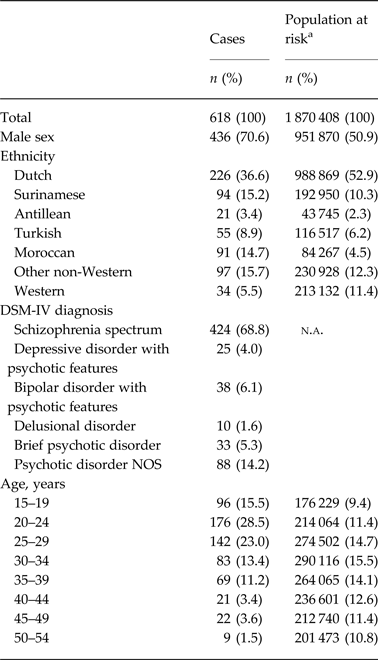
Sociodemographic characteristics and DSM-IV diagnoses of study sample

DSM-IV, Diagnostic and Statistical Manual of Mental Disorders, 5th edition; n.a., not applicable; NOS, not otherwise specified.
a Cumulative person-years, population 15–54 years, The Hague, 1997–2005.
Statistical analyses
We used the XTPOISSON multilevel Poisson regression modeling procedure in the Stata statistical software program (StataCorp, 2005) to take the multilevel ordering of the data (clustering of individuals within neighborhoods) into account. To obtain count data, individual data were aggregated by neighborhood, sex, age group (eight 5-year age groups from 15 to 54 years), ethnicity (Dutch or other) and neighborhood social characteristics (socio-economic level, residential mobility, ethnic diversity, single person households, voter turnout, population density and crime level). The overall incidence rate of psychotic disorders was calculated as the number of cases per 100 000 person-years in the total study population. The multilevel Poisson regression model used in the analysis of neighborhood social characteristics was adjusted for the fixed effects of the individual-level aggregated predictors age, sex, marital status and ethnicity. Incidence rate ratios (IRRs) of psychotic disorders were calculated and main effects were tested for statistical significance by Wald tests. Neighborhood social characteristics were tested in separate regression models. Next, dichotomous measures of neighborhood social characteristics were created, with the median score as cut-off. Thus, for each variable, 21 neighborhoods were classified as high social disorganization and 21 neighborhoods as low disorganization. Scores above the cut-off were coded as 0, below as 1, except for socio-economic level and voter turnout, where higher scores indicate better social organization. Regression analyses were repeated using the dichotomous neighborhood measures. IRRs were calculated with low social disorganization as the reference category. As collinearity of the neighborhood measures was not a significant problem (variance inflation factors all below 4, using the COLLIN command in Stata), neighborhood characteristics were tested not only in separate regression models, but also in a model including all neighborhood characteristics.
We explored whether the associations between individual characteristics (marital status and non-Dutch ethnicity) differ according to relevant neighborhood characteristics (single person households and ethnic diversity) by adding interaction terms between the individual- and neighborhood-level variables.
Finally, since the neighborhood characteristics were selected as measures of interconnected, yet distinct aspects of neighborhood social disorganization, for every neighborhood a cumulative social disorganization score was calculated by adding the dichotomous scores (categories 0–7). IRRs of psychotic disorders for total neighborhood social disorganization categories were calculated, with the lowest category as reference. Scores 0 and 1 as well as 4 and 5 were combined because categories 0 and 4 were too small, containing only 1.6% and 0.1% of the study sample, respectively, whereas all other categories had at least 9.0% of the population. In order to test for a linear trend of the categorical cumulative variable, the fit of two models was compared with a likelihood ratio test: one model using the cumulative variable as a categorical variable (with the xi prefix in Stata), the other with the cumulative variable as a continuous variable (without the xi prefix). Linearity can be concluded when the second model is not worse than the first and the β of the cumulative neighborhood variable is statistically significant in the second model.
Results
During the study period, 618 subjects made first contact for a psychotic disorder. Table 1 shows the sociodemographic characteristics and DSM-IV diagnoses of the study subjects. Of the patients, seven were homeless and thus could not be assigned to a particular neighborhood, leaving 611 patients for analysis. The overall incidence rate for psychotic disorders was 33 [95% confidence interval (CI) 30–36] per 100 000 person-years.
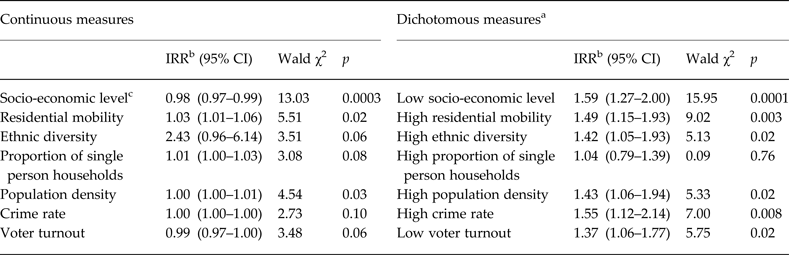
In the multivariate, individual-level (for age, sex, marital status and ethnicity) adjusted analyses, the associations of all neighborhood social characteristics with the incidence of psychotic disorders were in the expected direction. The fixed effects of socio-economic level, residential mobility and population density were statistically significant in the separate regression models (Table 2). Neighborhood socio-economic level (IRR = 0.98, 95% CI 0.97–0.99; Wald χ2 1 = 13.03; p = 0.0003) and residential mobility (IRR = 1.03, 95% CI 1.01–1.06; Wald χ2 1 = 5.51; p = 0.02) had the strongest association with incidence of psychotic disorders, which means that the incidence decreased when neighborhood socio-economic level increased and the incidence increased with percentage of households that moved from the neighborhood, independent of individual-level factors. The magnitude of effects should be compared using the Wald test scores and not the IRRs, as the measures had different scales.
IRRs of psychotic disorders, by indices of neighborhood social disorganization

IRR, Incidence rate ratio; CI, confidence interval.
a Median score used as the cut-off.
b Adjusted for individual-level age, sex, ethnicity and marital status.
c Score based on average income, housing quality, proportion of residents who are long-term unemployed, and mean educational level.
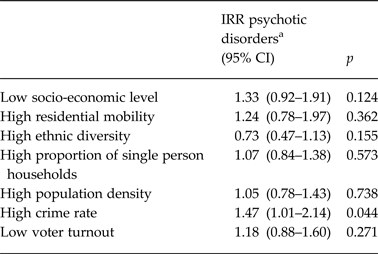
Table 2 lists the IRRs of psychotic disorders for the dichotomous neighborhood measures as well. All but one (proportion of single person households) of the indicators of neighborhood social disorganization were significantly associated with a higher IRR. When all neighborhood measures were included in one regression model, only high crime rate was associated with a significant increase in incidence (IRR = 1.46, 95% CI 1.02–2.09; Tables 3 and 4).
IRRs of psychotic disorders: multi-level regression model including all dichotomous measures of neighborhood variables

IRR, Incidence rate ratio; CI, confidence interval.
a Adjusted for individual-level age, sex, marital status and ethnicity.
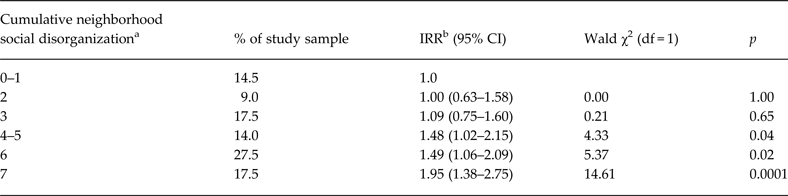
IRRs of psychotic disorders, by degree of neighborhood social disorganization

IRR, Incidence rate ratio; CI, confidence interval; df, degrees of freedom.
a Number of social disorganization indices above median score. Category 0 was combined with 1, and 4 with 5, because these categories contained only 1.6% and 0.1% of the study sample, respectively.
b Fixed neighborhood-level effects in a multilevel Poisson regression model, adjusted for individual-level age, sex, marital status and ethnicity.
We did not find an interaction between individual-level ethnicity and neighborhood ethnic diversity (IRR interaction term, adjusted for age, sex and marital status = 1.00, 95% CI 0.66–1.50, p = 0.989), nor between individual-level single marital status and neighborhood proportion of single person households (IRR interaction term, adjusted for age, sex and ethnicity = 0.92, 95% CI 0.64–1.33, p = 0.673).
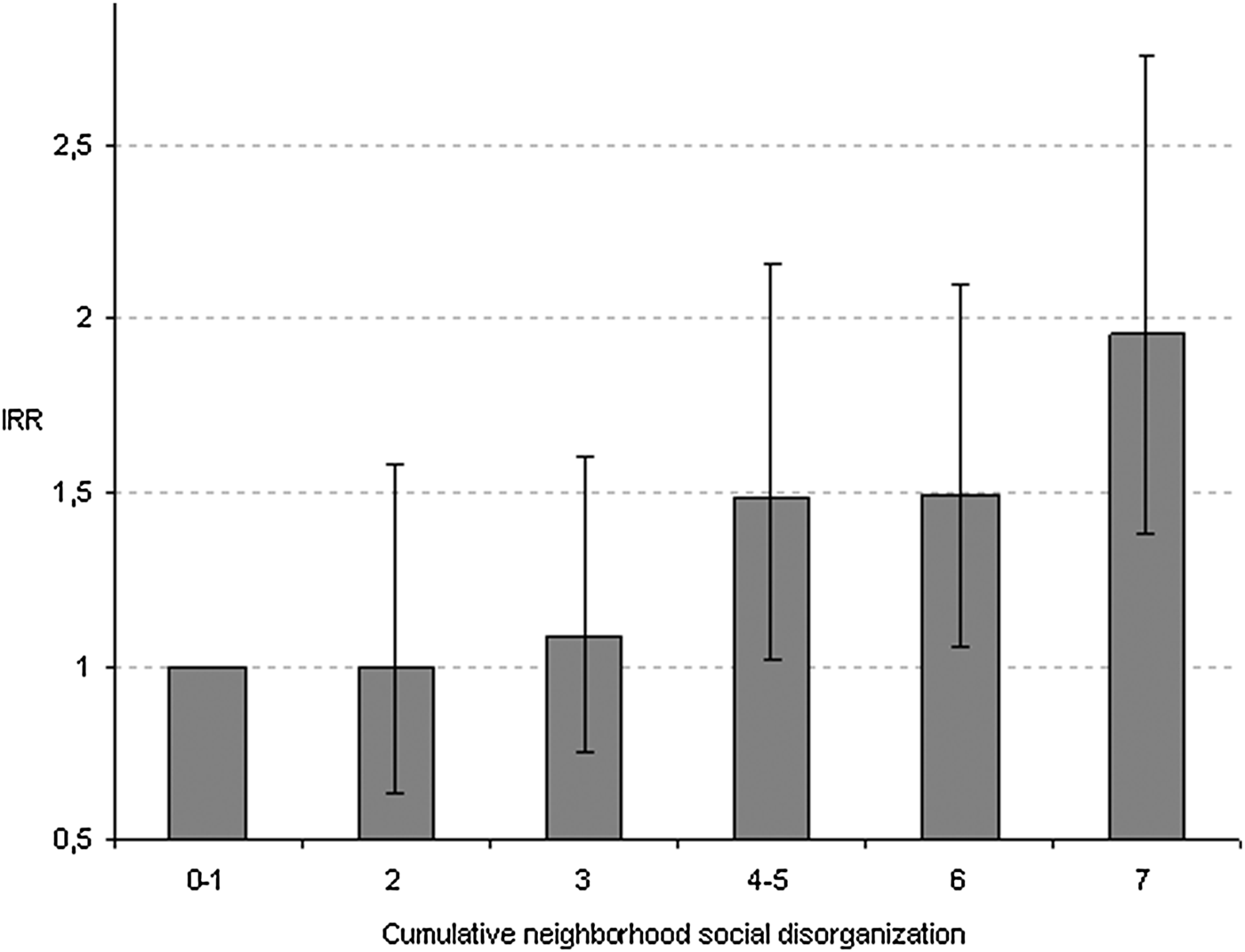
The incidence of psychotic disorders increased with degree of neighborhood social disorganization (Fig. 1). The IRR for people residing in neighborhoods with all seven indicators was 1.95 (95% CI 1.38–2.75) compared with the group with no or only one characteristic of neighborhood social disorganization (Table 4). The overall test of the categorical cumulative neighborhood social disorganization variable was Wald χ2 5 = 25.76 (p = 0.0001). There was a linear trend, as the cumulative measure was statistically significant when included as a continuous variable in a regression model, and the fit of this model was not worse than the model with the cumulative measure as a categorical variable (likelihood ratio test comparing these models was not statistically significant).
Incidence of psychotic disorders by degree of neighborhood social disorganization. Values are incidence rate ratios (IRRs), with 95% confidence intervals represented by vertical bars.

Discussion
Main findings
In this 7-year first-contact incidence study in The Hague, neighborhood social characteristics were statistically significantly associated with the incidence of psychotic disorders, over and above the effects of individual-level age, sex, marital status and ethnicity. Socio-economic level and residential mobility of the neighborhood had the strongest relationship with incidence rates, but high ethnic diversity, crime level, population density and low voter turnout also separately predicted higher incidence. When all neighborhood measures were included in one regression model, only high crime rate was associated with a significant increase in incidence. We did not find interactions between individual-level and neighborhood-level characteristics. There was a strong and linear association between cumulative neighborhood social disorganization and incidence of psychotic disorders.
Neighborhood disorganization
Our results add to the evidence that neighborhood social characteristics contribute to the risk for psychotic disorders and that this association is not entirely confounded by individual risk factors (March et al. Reference March, Hatch, Morgan, Kirkbride, Bresnahan, Fearon and Susser2008). Sociological and epidemiological literature over the past century suggests that mental and physical health of individuals is strongly determined by the social context in which they live. In the 1930s, Faris & Dunham (Reference Faris and Dunham1939) reported high rates of schizophrenia in neighborhoods of Chicago with social disintegration, high residential mobility and conflict. More recently, Allardyce used an index of neighborhood anomie and found an association between social fragmentation and rates of first admission for psychosis in Scotland (Allardyce et al. Reference Allardyce, Gilmour, Atkinson, Rapson, Bishop and McCreadie2005). A study from South Africa reported an association between municipal income inequality and first admissions for schizophrenia (Burns & Esterhuizen, Reference Burns and Esterhuizen2008); another study found such an association in a London district, but only among people living in the most deprived areas (Boydell et al. Reference Boydell, Van Os, McKenzie and Murray2004). Kirkbride and colleagues conducted several studies of neighborhood characteristics and incidence of psychotic disorders in the UK and found associations between the incidence of non-affective psychotic disorders, neighborhood social capital and income inequality (Kirkbride et al. Reference Kirkbride, Morgan, Fearon, Dazzan, Murray and Jones2007b , Reference Kirkbride, Boydell, Ploubidis, Morgan, Dazzan, McKenzie, Murray and Jones2008, 2014).
Based on the same data as used in this study, we previously reported that some immigrant groups had an increased risk for psychotic disorders when they lived in neighborhoods with a low proportion of their own ethnic group (Veling et al. Reference Veling, Susser, Van Os, Mackenbach, Selten and Hoek2008). The measure of neighborhood ethnic diversity in the present study captures a different concept, i.e. ethnic homogeneity of neighborhoods. Ethnically homogeneous neighborhoods may have a better social organization and thus overall lower rates of psychotic disorders, but some ethnic minorities within these neighborhoods may not have equal access to the social resources in the neighborhood when the numbers of their own group are small, as a result of which their risk of illness is higher rather than lower in such a context. In these data, there was no interaction between non-Dutch ethnicity and neighborhood ethnic diversity, suggesting that any effect of ethnic diversity does not only or specifically pertain to ethnic minorities, nor that high ethnic diversity protects ethnic minorities in general. Similarly, we did not find an interaction between single marital status and neighborhood proportion of single person households.
It should be noted that the effect of ethnic diversity was not significant anymore and even reversed after adjustment for other neighborhood characteristics. It appeared to be confounded mainly by socio-economic level, as the effect was attenuated in particular after socio-economic level was added to the regression model. Since we had selected the neighborhood characteristics a priori, we kept ethnic diversity in the cumulative measure. However, after removal of ethnic diversity, the effect of the cumulative measure was stronger (Wald χ2 5 = 31.60, p < 0.001).
The question remains how neighborhood social disorganization makes an impact on individual mental health. In our data, only high neighborhood crime rate remained statistically significant when all neighborhood variables were included in a regression model. The ecological meaning of crime is often related to weak community structures and a consequent lack of effective social control (Sampson, Reference Sampson2012). Social disorganization weakens the community structures that enable residents to live safely and healthily (Sampson, Reference Sampson2012). Social capital, which has previously been associated with increased rates of psychotic disorders (Kirkbride et al. Reference Kirkbride, Boydell, Ploubidis, Morgan, Dazzan, McKenzie, Murray and Jones2008), is lower in such areas (McCulloch, Reference McCulloch2003). It may be more difficult in socially disorganized neighborhoods for individuals with early symptoms of psychosis to keep contact with others and gain access to social support. Social isolation prevents individuals from checking anomalous perceptual experiences and biased thoughts with others, a normalizing experience that might reduce the chances of progression to the development of a psychotic disorder.
Another possibility is that living in a disorganized, deprived neighborhood context with low mutual trust and reciprocity fosters experiences of exclusion, perceived hostility and paranoid thoughts, that may take on psychotic intensity in individuals with vulnerability to psychosis. Social evaluative concerns may evolve into ideas of reference and convictions of severe personal threat (Freeman, Reference Freeman2007). Humans compare themselves with others and are sensitive to social hierarchy (Sapolsky, Reference Sapolsky2004). The health of individuals who feel that they have a lower social position relative to other people in their proximate social environment is generally worse than the health of individuals with higher perceived social rank (Sapolsky, Reference Sapolsky2004; Marmot, Reference Marmot2006; Selten et al. Reference Selten, Van der Ven, Rutten and Cantor-Graae2013). The adverse health effects occur in particular when individuals feel unable to change their social situation, have limited control over the circumstances of daily life and experience stress (Sapolsky, Reference Sapolsky2004; Marmot, Reference Marmot2006; Selten et al. Reference Selten, Van der Ven, Rutten and Cantor-Graae2013). Importantly, the social gradient is larger in socially disorganized areas (Kawachi et al. Reference Kawachi, Kennedy and Wilkinson1999; Sapolsky, Reference Sapolsky2004; Wilkinson & Pickett, Reference Wilkinson and Pickett2006).
It should be noted, however, that the mechanism by which neighborhood disorganization would lead to psychotic disorder might well be other than social. Living in disorganized neighborhoods most likely means higher exposure to toxins, infectious agents and air pollution. These factors have been implicated in the etiology of psychotic disorders (e.g. Opler et al. Reference Opler, Brown, Graziano, Desai, Zheng, Schaefer, Factor-Litvak and Susser2004; Pedersen et al. Reference Pedersen, Raaschou-Nielsen, Hertel and Mortensen2004; Brown & Derkits, Reference Brown and Derkits2010), but have hardly been investigated in relation to spatial variation in rates of psychotic disorders (March et al. Reference March, Hatch, Morgan, Kirkbride, Bresnahan, Fearon and Susser2008).
Methodological considerations
The numerators of the incidence rates were reliable, since the incident cases were derived from all sources of treatment in a defined geographical area and were assessed with a rigorous diagnostic protocol. Still, cases may have been missed. We did not conduct a formal leakage study. Differential case ascertainment could contribute to the results if cases in neighborhoods with high social disorganization would be more likely to be identified than those in neighborhoods with better social structures. This is unlikely, as access to social resources and health-care facilities are probably better in more structured neighborhoods.
We were able to adjust for several individual-level counterparts of the neighborhood-level variables, such as non-Dutch ethnicity (neighborhood ethnic diversity) and single marital status (proportion of single person households in the neighborhood). Individual-level data of the other neighborhood characteristics were unavailable. We could not adjust for individual-level socio-economic position. It might be argued that neighborhood socio-economic level is basically a sum of individuals’ characteristics in the neighborhood, and that the association of neighborhood socio-economic level with incidence rate may therefore represents the effects of individual socio-economic position. Previous studies, however, found variable and modest associations of low individual-level socio-economic position and incidence of psychotic disorders (Wicks et al. Reference Wicks, Hjern, Gunnell, Lewis and Dalman2005; Corcoran et al. Reference Corcoran, Perrin, Harlap, Deutsch, Fennig, Manor, Nahon, Kimhy, Malaspina and Susser2009). Also, it is important to note that some other indicators of neighborhood social disorganization included in this study, such as population density or residential mobility, are not easily reducible to individual characteristics. Still, residual confounding by individual-level factors cannot be ruled out. Individual-level data of experience with crime or having moved recently were not available, In addition, cannabis use, history of childhood trauma and other risk factors for psychotic disorders may cluster in socially disorganized neighborhoods. This was a cross-sectional study, measuring neighborhood characteristics at illness onset. The associations reported here can therefore not be interpreted as causal. Social drift effects may partly explain the pattern of results in this study. Individuals with prodromal symptoms, and as a consequence social dysfunctioning, are more likely to end up in socially disorganized neighborhoods. A longitudinal Swedish study, however, found that individuals brought up in areas with high social fragmentation had an increased adult risk of non-affective psychotic disorders (Zammit et al. Reference Zammit, Lewis, Rasbash, Dalman, Gustafsson and Allebeck2010), a finding arguing against social drift as an explanation for neighborhood effects. Also, in our previously published analyses of neighborhood ethnic density in the same sample, we were able to explore differences between cases who still lived with their parents and those who had left their parental home. We did not find significant differences between both groups in ethnic density, suggesting that social drift cannot explain all neighborhood effects (Veling et al. Reference Veling, Susser, Van Os, Mackenbach, Selten and Hoek2008).
We used median scores to create dichotomous measures of the neighborhood characteristics. This is not necessary meaningful. In order to explore the neighborhood effects in more detail, we analysed the data using quintiles instead of as a dichotomous measure (results not shown, available on request). When the quintile scores were used for creating a cumulative measure, the linear association between incidence and cumulative social disorganization was virtually unchanged. There was a consistent pattern in the data of the separate neighborhood characteristics, with the upper quintiles having a higher IRR of psychotic disorders than the lowest quintiles. Therefore, using dichotomous measures with the median as cut-off seemed to be reasonable.
The neighborhood measures that were used are routinely collected by the municipality and the Netherlands Bureau of Statistics, and were available for every year of the study period. Whether these indicators are a valid measure of relevant social experiences depends on the concept under study. The neighborhood social characteristics included here were summarized under the label of social disorganization, because it can be argued that the seven indicators all represent an aspect of neighborhood societal organization, cohesion and stability.
Conclusions
Our findings suggest that the incidence of psychotic disorders is related to neighborhood social disorganization. These results are consistent with a larger and increasing literature that relates social hierarchy and neighborhood social capital to individual physical and mental health. Longitudinal studies are needed to investigate causality. Future research should combine social epidemiology and neuroscience in order to elucidate how social experiences may lead to the onset of psychotic disorders.
Acknowledgements
This study was funded by the Theodore and Vada Stanley Foundation and the Netherlands Organization for Health Research and Development (grant number 100-002-009).
Declaration of Interest
None.