Introduction
Temporary flooded wetlands can be species-rich and contain several species in need of protection (Balla & Davies, Reference Balla and Davies1995; Tocker et al., Reference Tocker, Schiemer and Ward1998; Gopal & Junk, Reference Gopal, Junk, Gopal, Junk and Davies2000) and are ecosystems desired to conserve (cf. European Community Water Framework Directive). The Chironomidae (chironomids) is often a species-rich organism family in temporarily flooded areas and other kinds of wetlands (Moller Pillot & Buskens, Reference Moller Pillot and Buskens1990; Batzer & Wissinger, Reference Batzer and Wissinger1996; Leeper & Taylor, Reference Leeper and Taylor1998), and many species also thrive well under strongly changeable conditions in flooded wetlands (Armitage et al., Reference Armitage, Cranston and Pinder1995). They often contribute strongly to animal wetland biomass production (Delettre, Reference Delettre1989; Leeper & Taylor, Reference Leeper and Taylor1998; Batzer et al., Reference Batzer, Cooper, Wissinger, Batzer and Sharitz2006) and are thus important food items for birds (Laursen, Reference Laursen1978; Buchanan et al., Reference Buchanan, Grant, Sanderson and Pearce-Higgins2006), bats (Vaughan, Reference Vaughan1997; Encarnação & Dietz, Reference Encarnação and Dietz2006) and frogs (Vignes, Reference Vignes1995).
Here, we have studied the temporal and spatial variation in chironomid species richness over six years in temporary flooded wetlands of the River Dalälven flood-plains, in central Sweden. However, flooded wetlands are also characterized by recurrent massive production of flood-water mosquitoes; and, in this region, Aedes sticticus (Meigen, 1838) is the most prevalent flood-water mosquito causing massive nuisance problems (Schäfer et al., Reference Schäfer, Lundström and Petersson2008). Since 2002, the biological mosquito larvicide Bacillus thuringiensis var. israelensis (Bti) is used in some of the temporary wetlands of the River Dalälven flood-plains to reduce the abundance of these nuisance mosquitoes. Chironomid larvae are the only non-target organisms sometimes affected by Bti in dosages used against mosquito larvae (Boisvert & Boisvert, Reference Boisvert and Boisvert2000). Our evaluation of chironomid production in irregularly flooded wetlands of the River Dalälven flood-plains showed that Bti used in the dosage for flood-water mosquito control has no detectable negative effect on chironomid abundance (Lundström et al., Reference Lundström, Schäfer, Petersson, Persson Vinnersten, Landin and Brodin2009). However, Bti may still have an effect on Chironomidae species richness, and especially the sub-family Chironominae has been shown to be sensitive to Bti (Boisvert & Boisvert, Reference Boisvert and Boisvert2000).
Our aims are to investigate chironomid species richness, and annual turn-over rates of species in temporary wetlands exposed to recurrent but irregular floods, and to evaluate the potential effects on these non-target insects of Bti treatments against mosquitoes in the wetlands.
Material and methods
Study areas and insect sampling
The temporary wetlands in the River Dalälven flood-plains are irregularly flooded both for natural reasons and due to water regulation. The hydrological character changes between extremes, from terrestrial conditions during most of the year to aquatic conditions with several decimetres of water for several months of the year.
Six wetlands were selected for the study of chironomid species richness and diversity. Each wetland had four emergence traps, Mundie′s cone-formed trap (Service, Reference Service1993) modified as described in Lundström et al. (Reference Lundström, Schäfer, Petersson, Persson Vinnersten, Landin and Brodin2009), in operation from early May (week 19) to late September (week 37) 2002–2007. These modified Mundie's emergence traps float on the water during floods and settle on the ground during periods without surface water. Sampling of insects was continuous for the whole vegetation season each year, and the insect samples were collected once a week. During each weekly visit, the water level under each trap was measured; and, based on these measurements, we classified the local environment as aquatic (mean water depth above 1 cm) or terrestrial (mean water depth below 1 cm).
Three of the temporary wetlands (Laggarbo, Nordmyra and Valmbäcken) were dedicated as experimental wetlands, and in these areas Bti was used against larvae of Aedes sticticus and other flood-water mosquitoes when needed to reduce mosquito emergence and, thus, reduce nuisance. Three temporary wetlands (Lusmyren, Fågle and Koversta) were dedicated as reference wetlands, and no mosquito control activities were performed in these areas. A more detailed description of the wetlands is given in Lundström et al. (Reference Lundström, Schäfer, Petersson, Persson Vinnersten, Landin and Brodin2009).
Species identification
Insects sampled with emergence traps were collected in ethylene glycol and transferred to 70% alcohol for storage until sorting. Around 21,000 chironomids were picked out from the general insect samples and transferred to new vials for latter species identification. The majority of males and some of the females were identified to species based on descriptions in the published literature. For most females, literature does not provide enough information for species identification. These females were identified by association with safely identified males from the same sample. Microscope slide preparation was necessary for safe identification of several species. All identifications were done by the author YB.
Statistical analyses
Chironomid species richness was measured as the number of recorded species for each wetland for each vegetation season (week 19 in early May to week 37 in late September). Thus, the annual species richness figure for each wetland is based on 19 weekly samples from four emergence traps, or 72 trap-weeks.
The number of chironomids collected differed widely between wetlands and years, and large abundance variation is known to influence the observed number of species. Rarefaction analysis, in which the expected number of species is simulated at a given number of individuals sampled (typically the number of individuals in the smallest sample size), is one method to correct for differences in sample size on species richness (Krebs, Reference Krebs1999). In addition to performing statistical analysis on the original chironomid data set, we also performed the statistical analysis on the same data set after rarefactions analyses to investigate if the ‘among wetlands’ variation in number of individuals sampled caused or masked variation in species richness. For each wetland and year, we rarefied species richness 1000 times to the abundance of the wetland with the lowest number of chironomids sampled each year. The results of rarefactions are dependent on the relative species abundances; a more skewed abundance distribution will cause a lower rarefied number of species than from a more even distribution. To minimize the effect of variation in abundance of common species, we excluded the three most abundant species (Limnophyes asquamatus, L. minimus and Pseudosmittia angusta, constituting 43% of all sampled individuals) that were present in all wetlands all years. The abundance level (i.e. the number of individuals randomly sampled from each wetland) for the rarefaction analyses each year was set to the minimum number of individuals sampled (excluding the three species above) in a wetland for each year, which was 22 in 2002, 42 in 2003, 126 in 2004, 133 in 2005, 152 in 2006 and 41 in 2007. However, we did not rarefy data when only analysing the subfamily Chironominae, as the variation in number of individuals sampled per wetland was too high (Appendix 1) and the abundance at some occasions was so low that rarefying to such abundance levels is meaningless.
To calculate the chironomid species turn-over rate within wetlands over the years, we used both the Jaccard′s similarity index based on species presence-absence and the Bray Curtis similarity index based on species abundances (Colwell, Reference Colwell2006). When calculating the Jaccard's similarity index of species turn-over between years, variation in number of individuals trapped between years can confound the results. We, therefore, also calculated Jaccard's indices after data had been rarefied to the minimum number of individuals sampled (excluding the three species above) in a wetland for each year. For the analysis of variation between consecutive years, we calculated the mean Jaccard′s index from 1000 rarefied communities each year. The variation in sample size is not as large a problem for Bray-Curtis indices, as these are calculated from abundances and are rather insensitive to rare species.
All statistical analyses were done using the SAS statistical software, version 9.1 (SAS Institute, 2004). Analysis of variance (ANOVA, using PROC GLM) was used for evaluating differences in species richness and species turn-over. ‘Wetlands' ‘years’ and ‘experimental/reference wetlands’ were category variables. To evaluate differences in relation to drought intensity and sample size, drought intensity and sample size were covariates in an analysis of co-variance (ANCOVA, using PROC GLM) with ‘year’ and ‘experimental/reference wetlands’ as class variables. Year was added as a category variable in all ANOVAs and ANCOVAs to account for differences between years. Also, the interaction terms for ′year×experimental/reference wetlands′ and ′year×drought frequency′ were included in the analysis, except when P<0.1.
Results
Species richness
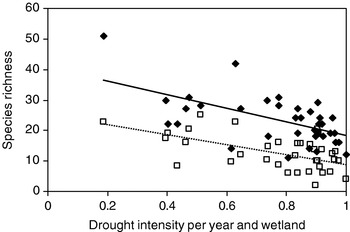
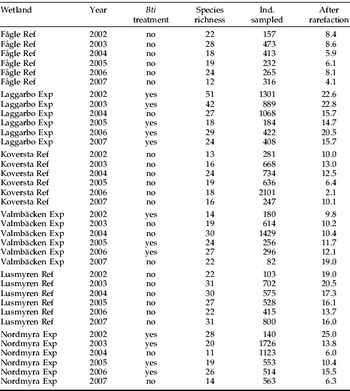
A total of 135 species of Chironomidae were identified from the emergence trap sampling 2002 to 2007 in the temporary wetlands (Appendix 1). The species richness differed significantly and consistently between wetlands over the years (ANOVA: F=3.30, P=0.020, df=5, N=36) and also after rarefaction (ANOVA: F=8.00, P<0.001, df=5, N=36). The reference wetlands provided between 12 and 31 species each year with an average of 21.8 species per year over the six-year period, and the experimental wetlands provided between 11 and 51 species per year with an average of 24.7 species per year (table 1). Species richness did not evidently differ consistently between experimental and reference wetlands (ANOVA: F=1.50, P=0.200, df=1, N=36); but, after rarefaction, more species were found in experimental than reference wetlands (ANOVA: F=4.50, P=0.043, df=1, N=36). The drought intensity, the proportion of sampling occasions when there was less than one centimetre of water, was 0.31 for 2002, 0.63 for 2003, 0.63 for 2004, 0.66 for 2005, 0.75 for 2006 and 0.81 for 2007. The drought intensity differed between wetlands (ANOVA: F=5.25, P=0.002, df=1, N=36), but there was a clear year effect (ANOVA: F=6.20, P<0.001, df=1, N=36), meaning that differences between years were similar between wetlands. Chironomid species richness decreased with increasing drought intensity (ANCOVA: F=20.0, P<0.001, df=1, N=36; fig. 1), which was evident also after rarefaction (ANCOVA: F=12.0, P=0.002, df=1, N=36; fig. 1).
The species richness (♦, solid line) of Chironomidae in temporary flooded wetlands of the River Dalälven flood-plains, central Sweden, in relation to drought intensity, i.e. proportion of occasions with terrestrial conditions in the wetlands. □ and dashed line show species richness after rarefaction.

Chironomidae species richness, the total number of individuals sampled per wetland and year, and the numbers after rarefication, for six temporary flooded wetlands of the River Dalälvens flood-plains, central Sweden, during the years 2002–2007. The experimental wetlands (Exp) were treated with Bacillus thuringiensis var. israelensis (Bti) against flood-water mosquitoes in 2002, 2003, 2005 and 2006 to reduce nuisance, while the reference (Ref) wetlands were untreated.

* no treatment with Bti in the experimental wetlands during 2004 and 2007.
For the subfamily Chironominae, the number of species also differed consistently between sites over the years (ANOVA: F=4.20, P=0.006, df=5, N=36) but was strongly positively correlated to sample size (r p=0.79, P<0.001, N=36). However, neither species richness (ANOVA: F=3.01, P=0.100, df=1, N=36) nor the number of Chironominae sampled (ANOVA: F=0.90, P=0.400, df=1, N=36) differed consistently between experimental and reference wetlands.
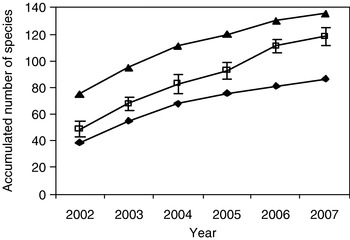
Each year, new species of chironomids occurred in the samples; and, therefore, we constructed diagrams for the accumulated number of species by year for all experimental wetlands combined and for all reference wetlands combined (fig. 2). These results show a continuous annual addition of new species in samples from both experimental and reference wetlands. Interestingly, the accumulated species curve for the reference wetlands is constantly lower than the accumulated species curve for the experimental wetlands.
Accumulated number of Chironomidae species in all six temporary flooded wetlands (▴) of the River Dalälven flood-plains, central Sweden, over six years. The experimental wetlands (□) were treated with Bacillus thuringiensis var. israelensis (Bti) against flood-water mosquitoes in 2002, 2003, 2005 and 2006 to reduce nuisance, while the reference wetlands (♦) were untreated. Due to more individuals being sampled in experimental wetlands, the species richness was rarefied to the same number of individuals as in reference wetlands. The error bars on experimental wetlands show the 99% confidence interval from 1000 randomisations.

Species turn-over
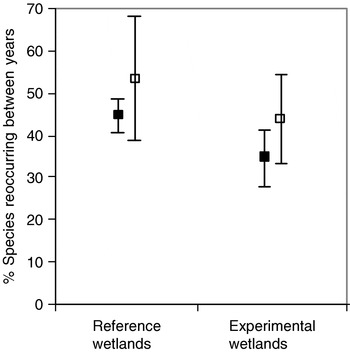
The Jaccard′s index, based on species presence-absence data, showed higher between-year turn-over rates in species composition for the experimental wetlands, than for the reference wetlands (ANOVA: F=25.0, P<0.0001, df=1, N=30, fig. 3). Also, after rarefaction, the species turn-over was significantly higher in experimental than in reference wetlands (ANOVA: F=5.10, P=0.030, df=1, N=30; fig. 3). The species turn-over rates were not coupled to the difference in drought intensity between years, neither when analysed for the original data set (ANCOVA: F=1.00, P=0.300, df=1, N=30) nor when analysed after rarefaction (ANCOVA: F=0.40, P=0.600, df=1, N=30). The quantitative Bray Curtis similarity index did not show any significant difference in diversity changes over the years between experimental and reference wetland (ANOVA: F=0.33, P=0.570, df=1, N=30).
The average (squares) and standard deviation (error bars) of annual Chironomidae species turn-over in temporary flooded wetlands of the River Dalälven flood-plains, central Sweden. The experimental wetlands were treated with Bacillus thuringiensis var. israelensis (Bti) against flood-water mosquitoes in 2002, 2003, 2005 and 2006 to reduce nuisance, while the reference wetlands were untreated. ▪ represent calculated Jaccard′s indices from all observed species, whereas □ represent Jaccard′s indices calculated after rarefaction.

Species dominance
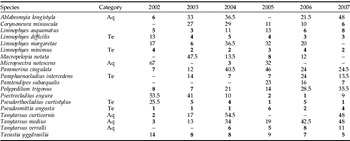
The actual species that dominated numerically in the individual wetlands varied strongly over the six-year study period. This can be illustrated by Micropsectra notescens and Psectrocladius oxyura, which were the markedly most frequent species in a wetland one year but not found another year in the same wetland. The rapid turn-over of the numerically dominating species is also seen when considering the most abundant chironomid species for all six wetlands together (table 2). Only two species, the mainly terrestrial Pseudosmittia angusta and Limnophyes minimus, occurred among the eight most abundant species every year over the six-year period studied. Species among those eight most frequently occurring one year could not be found in another year. This was, for example, the case for the mainly aquatic Tanytarsus curticornis, which was the second most frequently found species in 2002 but for the next five years was absent or rare.
Annual abundance ranking of the eight most abundant Chironomidae species in temporary flooded wetlands of the River Dalälven flood-plains, central Sweden, during the years 2002–2007. Low numbers show high abundance ranking, bold figures show the eight most high-ranking species each year and (–) show that the species was not present in the annual sample. Species with mainly aquatic larvae (Aq) and mainly semi-terrestrial or terrestrial larvae (Te) are indicated under category, while others are blanks.

Discussion
The temporary flooded wetlands of the River Dalälven flood-plains, in central Sweden, had a remarkably rich chironomid fauna with a total of 135 species recorded. In addition, the accumulated chironomid species curves show that more species are to be expected, and we anticipate that several more years of sampling is required to provide an almost complete list of the species in the regional species pool. The 135 species recorded in the temporary flooded wetlands, is higher than reported from any other wetland study known to us and seems, in fact, only to be surpassed by a few rather large or very large European lakes (Reiss, Reference Reiss1968; Tuiskunen & Lindeberg, Reference Tuiskunen and Lindeberg1986). These lakes probably have relatively stable and predictable environmental conditions, whereas the results of our study of the chironomid fauna in the temporary flooded wetlands of the River Dalälven flood-plains show that the high species richness is due to a high degree of species turn-over between years. The importance of the temporal aspect for high chironomid species richness and high diversity is also seen in other markedly unstable habitats, such as newly created lentic waters (Titmus, Reference Titmus1979; Koskenniemi & Paasivirta, Reference Koskenniemi and Paasivirta1987; Dettinger-Klemm, Reference Dettinger-Klemm2003) and rivers experiencing strong water level fluctuations (Reckendorfer et al., Reference Reckendorfer, Keckeis, Winkler and Schiemer1996).
At least 95% of the identified chironomid species sampled in temporary flooded wetlands of the River Dalälven flood-plains are opportunists, judging from their frequent presence in strongly unstable habitats (e.g. Wiederholm et al., Reference Wiederholm, Danell and Sjöberg1977; Koskenniemi & Paasivirta, Reference Koskenniemi and Paasivirta1987; Fillinger, Reference Fillinger1998; Dettinger-Klemm, Reference Dettinger-Klemm2003). Furthermore, they have been found in more than half of European countries (De Jong et al., Reference De Jong, Saether and Spies2008), including Nordic countries (Schnell & Aagaard, Reference Schnell, Aagaard, Limnofauna Norvegica Aagaard and Dolmen1996; Lindegaard, Reference Lindegaard and Nilsson1997; Paasivirta, Reference Paasivirta2009; Brodin & Paasivirta, unpublished), and in many different ecosystems including wetlands, lakes and running waters (Fittkau et al., Reference Fittkau, Schlee, Reiss and Ilies1978).
There was a significant difference in species richness between wetlands, and variation in hydrological conditions (drought intensity) explained, in large part, the variation in species richness. Hydrological conditions in the wetlands can suddenly and unpredictably change from terrestrial to aquatic (with several decimetres of water) and back to terrestrial with more or less moist soils. In the present study, increasing drought intensity seemed to cause a decline in chironomid species richness. The wetland with by far the most chironomid species found over a year was Laggarbo in 2002, which had by far the lowest drought intensity. This can be explained by a large sample size and a high inflow of aquatic species from the adjacent river (table 1). But, after rarefaction, species richness was relatively high here, like in other years. Thus, variation in hydrological condition seemed to explain most variation in species richness.
There was no evident support for a negative Bti treatment effect on chironomid species richness, not even for the subfamily Chironominae, which has been shown to be sensitive to Bti (Boisvert & Boisvert, Reference Boisvert and Boisvert2000). After rarefaction, there was actually a significantly higher species richness in experimental than reference wetlands in the present study. Thus, the Bti treatments, rather, were associated with increased chironomid richness, maybe as an effect of reduced competition from mosquito larvae. Furthermore, species turn-over between years was larger in experimental wetlands than in reference wetlands, and more chironomid species were found in experimental wetlands than in reference wetlands. However, there were no differences between experimental and reference wetlands when using the quantitative Bray-Curtis similarity index, suggesting it is mainly low abundant species that repeatedly colonise and disappear. Also, chironomid species turn-over between years was generally high in all wetlands; and, on average, only 40% of the species in a wetland were sampled in consecutive years. Partly because of a random sampling effect, it is unlikely that all species could be sampled in a wetland in a given year. However, also after controlling for differences in the number of chironomids sampled with rarefactions, there was a significant difference in species turn-over between experimental and reference wetlands. In conclusion, this suggests that there is a higher random colonisation from a regional species pool in the experimental wetlands, rather than some species actually responding directly to the Bti treatment. What causes this larger dynamic among experimental wetlands is not clear. Treatment with Bti against mosquito larvae may have some direct negative effects on chironomids (Boisvert & Boisvert, Reference Boisvert and Boisvert2000), which may increase (pseudo)extinction of low abundant species from Bti-treated wetlands. We, however, do not have evidence of direct effects on chironomid species in the studied wetlands and no overall negative effect on the production of chironomids (Lundström et al., Reference Lundström, Schäfer, Petersson, Persson Vinnersten, Landin and Brodin2009).
There also can be indirect effects from Bti treatments against mosquito larvae on extinctions and colonisations of chironomids. The Bti treatment managed to prevent mosquito mass-emergence by an almost 100% reduction of the mosquito larval populations (Martina L. Schäfer & Jan O. Lundström, unpublished observations). Many of the chironomid species in the temporary flooded wetlands of the River Dalälven flood-plains probably are filter-feeders that utilize about the same food resource as mosquitoes, and this may increase the probability of more chironomid species to successfully emerge to adults in experimental wetlands in comparison with reference wetlands. In line with this assumption, we have shown that abundance of the protozoan prey of mosquito larvae increased fivefold after removal of mosquito larvae by Bti treatment (Östman et al., Reference Östman, Lundström and Persson Vinnersten2008). How the potentially reduced competition from mosquito larvae may have affected colonisations and extinctions of chironomids, however, is not clear.
We have shown that the chironomid fauna is highly diverse in the studied wetlands. This high regional diversity of chironomids depends on very dynamic communities over time, probably driven by recurrent but unpredictable flooding of the wetlands. However, it is important to note that chironomids may not be appropriate indicators for the overall animal diversity of the studied wetlands (Batzer et al., Reference Batzer, Cooper, Wissinger, Batzer and Sharitz2006). Although species richness differed between sites, this could not be attributable to Bti treatments in the wetlands, not even for the most Bti-sensitive subfamily Chironominae. However, a larger part of the regional species pool was found in the experimental wetlands than in the reference wetlands, and species turn-over of generally low abundant species was generally higher in the experimental wetlands.
Acknowledgements
We appreciated the grants from the Swedish Environmental Protection Agency to JOL, and from the Swedish Research Council to ÖÖ. Jan Landin provided invaluable expertise and enthusiastic discussions about study design and trap design; and Björn Forsberg, Axel Berglund, Anna-Sara Liman, Anna Hagelin, Andreas Rudh and Antti Vähäkari contributed with field sampling and identification to taxonomic order and sub-order.
Appendix 1. Chironomidae species and abundances, in temporary flooded wetlands of the River Dalälven flood-plains, during 2002–2007. The experimental wetlands were treated with Bacillus thuringiensis var. israelensis (Bti) against flood-water mosquitoes in 2002, 2003, 2005 and 2006 to reduce nuisance, while the reference wetlands were untreated.