


Introduction
The landscape of psychological service delivery has transformed in recent years with the introduction of IAPT, which was introduced in response to the Depression Report (Layard et al., Reference Layard, Bell, Clark, Knapp, Meacher and Priebe2006) detailing the high prevalence and yet potential treatability of common mental health problems in the UK. The IAPT programme launched in 2008 to enable rapid access to evidence-based psychological therapies for people suffering from common mental health problems (Clark et al., Reference Clark, Layard, Smithies, Richards, Suckling and Wright2009). The IAPT service delivery philosophy is that of the stepped care model whereby patients are treated based on the guiding principles of least restrictive intervention being delivered first, and care being subsequently matched to patient need, via outcome monitoring (Bower and Gilbody, Reference Bower and Gilbody2005). Within step 2 of the stepped care model, psychological wellbeing practitioners deliver guided self-help to patients with mild to moderate anxiety and depression. At step 3, patients have access to a range of more intense psychological interventions according to need or certain diagnosis. The cognitive and behavioural treatments delivered in IAPT at step 3 are based on the CBT Competencies Framework (Roth and Pilling, Reference Roth and Pilling2007), whereby treatments are individualized to the patient, whilst having clear assessment, formulation and treatment protocols. Trainees are taught the disorder specific models and treatment protocols via the high intensity national curriculum (Clark et al., Reference Clark, Layard, Smithies, Richards, Suckling and Wright2009). These protocols have been tested in the randomized controlled trials, upon which the NICE anxiety and depression guidelines are based (Clark et al., Reference Clark, Layard, Smithies, Richards, Suckling and Wright2009).
The presence of HITs delivering the CBT competency framework protocols at step 3 of the stepped care model in Primary Care has necessitated recruiting a new workforce from existing mental health professions. This new workforce has therefore been required to quickly and effectively navigate rapid role transitions. Occupational roles are important as they enable comprehension of organizational goals/structures and recognition of personal contributions (Ashforth, Reference Ashforth1995). Role transition is often complex, due to the degree of learning that needs to take place to psychologically accommodate the new role (Hotho, Reference Hotho2008; Glen and Waddington, Reference Glen and Waddington1998; Nicholson, Reference Nicholson1984). When the new role the person is required to assimilate is that of a cognitive-behavioural (CB) psychotherapist, the change is likely to be additionally demanding, due to the need to rapidly learn novel and complex declarative, procedural and reflective competencies (Bennett-Levy, Reference Bennett-Levy2006). Effective role transition not only requires the rapid mastery of a range of new therapeutic skills, but also a new clinical role working independently in diffuse teams and contributing to an outcomes-driven agenda (IAPT, 2008). The HIT trainee is expected to swiftly learn a new set of conceptual skills alongside a new psychotherapeutic vocabulary (Grant, Townend and Sloan, Reference Grant, Townend and Sloan2008), whilst simultaneously being socialized into a new profession (Scaife, Reference Scaife2001). Although the training experience often promotes the formation of strong peer support structures, if this is done in an attempt to merely “survive” (Buchanan and Huczynski, Reference Buchanan and Huczynski1997), then this can potentially lead to unhelpful and delayed socialization (Sims and Veres, Reference Sims and Veres1987).
Successful professional socialization then is dependent on learning the values, norms and established procedures of the new role, moving from a position of outsider to new member and peer (Bowditch and Buono, Reference Bowditch and Buono2005; Buchanan and Huczynski, Reference Buchanan and Huczynski1997). Clinical practice often highlights the painful realities of the new context and levels of current and expected competences (Bowditch and Buono, Reference Bowditch and Buono2005). This process is characteristically anxiety provoking, as the person has to break ties with old groups and extant identities, whilst assimilating the formal and informal rules, procedures, expectations and culture of the new group (West and Rushton, Reference West and Rushton1989). Leaving behind old roles during transition phases may prove difficult, as old reference groups are broken down and replaced with new ones, symbolically destroying the old self (Buchanan and Huczynski, Reference Buchanan and Huczynski1997). Effective CBP role transitions have been previously shown to be delayed and restricted when trainees cling to former roles and cursorily attempt to “bolt on” newly acquired CB skills (Grant et al., Reference Grant, Townend and Sloan2008). The experience of comfortably demonstrating competence in old roles is suddenly traded with the challenge and uncertainty of the new role, particularly as trainees undergo assessment of clinical competence (Bennet-Levy and Beedie, Reference Bennett-Levy and Beedie2007; Lombardo, Milne and Proctor, Reference Lombardo, Milne and Proctor2009).
Nicholson (Reference Nicholson1984) discriminated between positive and negative occupational role transition. Positive role transition occurs when the person is able to maintain a degree of stability through skills being maintained and transferred into the new context, whilst negative role transition is associated with a sense of skill obsolescence/degeneration, helplessness and stuckness. Effective transition appears to more rapidly occur when curiosity in new challenges enables the nascent development of a new professional identity via internalization of rules, assumptions, competencies, etiquette and approach (Becker and Carper, Reference Becker and Carper1956). How the HIT trainee relates to their new psychotherapy role can exist in the form of a dilemma; they can either feel they are enlarging their clinical and personal capacities or confirming a personal sense of inadequacy (Nicholson, Reference Nicholson1984). The supervisory relationship, particularly the bond and contract, appears crucial in bridging and supporting positive role transition (Bordin, Reference Bordin1983). Glen and Waddington (Reference Glen and Waddington1998) suggested that clinical supervision linked to ongoing education and development facilitates the transfer of existing skills and the development of new clinical competences. However, due to clinical supervisors also holding positional authority and power and acting as “gatekeepers”, the supervisory relationship can be fraught with anxieties and boundary difficulties. Bordin (Reference Bordin1983) identified three main elements to effective supervisory relationships (1) mutual agreement of goals, (2) the tasks of supervision, which facilitates goal achievement, and (3) the bond arising from the shared experience and common enterprise. Bordin (Reference Bordin1983) noted that should any of these factors be neglected or over-worked, the conditions for learning and reflection become compromised, and in the current context effective transition is likely to be slowed.
Training in CBP appears, by definition, personally and professionally challenging (Bennett-Levy and Beedie, Reference Bennett-Levy and Beedie2007), potentially leading to feelings of “competency shame” and the need to conceal struggles, mistakes and dilemmas during supervision for fear of exposure (Gilbert, Reference Gilbert, Gilbert and Leahy2007). Despite HIT training demanding regular live supervision in the form of audio-visual session recordings (Grant, Reference Grant and Henderson2009), the supervisee's “inner world” can only be accessed via mutual supervisory cooperation and discussion (Ward, Friedlander, Schoen and Klein, Reference Ward, Friedlander, Schoen and Klein1985). Ladany, Hill, Corbett and Nutt (Reference Ladany, Hill, Corbett and Nutt1996) found that supervisees frequently withhold such information during supervision particularly personal/relational issues/clinical mistakes and new trainees are identified as a particularly vulnerable group for such avoidance. Heppner and Roehlke (Reference Heppner and Roehike1984) found that new trainees consider skill-building of primary importance, demanding technique and direction from supervisors. Supervisory behaviours therefore need to be carefully matched to developmental levels of competence and confidence across training (Kennard, Stewart and Gluck, Reference Kennard, Stewart and Gluck1987). Should this matching be imperfect, Milne (Reference Milne2009) suggested that the ability to repair-ruptures in the supervisory alliance enables the maintenance of the supervisory bond.
The current research investigates role transition during HIT training from mental health nurse to CB psychotherapist. Mental health nurses were chosen as a representative profession for the study, as they represent over half of all accredited CB psychotherapists (Townend, Iannetta and Freeston, Reference Townend, Iannetta and Freeston2002) and therefore such role transitions are common. Qualitative methods were appropriate for the study as these captured the meanings and processes trainees experienced during transition experiences (Polit and Hungler, Reference Polit and Hungler1995) and are suited to exploring and evaluating aspects of educational experiences (Burnard, Reference Burnard1991). Qualitative methods allow the depiction of areas such as relationships and illuminates common processes across participants’ experiences of transition (Miles and Huberman, Reference Miles and Huberman1994; Polit and Hungler, Reference Polit and Hungler1995; Silverman, Reference Silverman2005). This allows for a deeper understanding and description of such aspects than would be achieved from quantitative data alone (Silverman, Reference Silverman2005).
Method
Participants
A purposive sampling process was used to select participants (Murphy, Dingwall, Greatbatch, Parker and Watson, Reference Murphy, Dingwall, Greatbatch, Parker and Watson1998; Polit and Beck, Reference Polit and Beck2008; Silverman, Reference Silverman2005). Following ethical approval to access HIT trainees, all members of a HIT course cohort that met inclusion criteria were invited to participate in the research. Suitable participants were then recruited following discussion with the researcher (SR) and signing of consent forms. The participant inclusion criteria were (1) to be a mental health nurse, (2) to have prior experience of mental health nursing supervision, (3) to have successfully completed HIT training, and (4) to have engaged in all necessary clinical supervision during the training year (i.e. one hour per week individual supervision with a BABCP accredited cognitive-behavioural psychotherapist and two hours per week group supervision facilitated by a BABCP accredited cognitive-behavioural psychotherapist; both with regular supervision of “live” material). Six participants volunteered from a single university cohort (n = 27), who had undertaken HIT training commencing in October 2008. Three male and three female nurses comprised the research sample, who had previously worked on acute wards, CMHTs and early intervention teams. The mean age of the sample was 34.16 (SD = 3.18), with the mean years of post-nursing qualification clinical experience being 8.50 (SD = 5.45).
Data collection and analysis
Prior to engaging with research participants, a pilot interview with a non-participant who met the inclusion criteria was conducted to ensure the face validity of the interview content and process (Swetnam, Reference Swetnam2004). This pilot identified necessary adjustments to the interview schedule and gave an opportunity to test the methodology (Polit and Hungler, Reference Polit and Hungler1995). The pilot suggested that a greater focus on the supervisory relationship was required and how this impacted on the transition, rather than a broad emphasis on transfer between disciplines. Research data were then collected using a semi-structured interview method (Burnard, Reference Burnard1991; Silverman, Reference Silverman2006; Polit and Beck, Reference Polit and Beck2008). Interviews took place in a location mutually agreed by participant and researcher (SR), this in all cases being on NHS premises. Interviews were recorded and transcribed verbatim. Following each interview, a contact summary sheet was completed enabling salient issues to be noted and used within data analysis (Miles and Huberman, Reference Miles and Huberman1994). Interview data were analyzed using thematic content analysis (TCA; Anderson, Reference Anderson2007; Burnard, Reference Burnard1991). TCA produces a reasonably exhaustive category system, identifying the emergent themes in individual interviews and links these together to enable a description of the participant's shared experience (Burnard, Reference Burnard1991; Silverman Reference Silverman2006).
Individual interview transcripts were engaged with separately, using margins to identify evident themes and to make notes (Miles and Huberman, Reference Miles and Huberman1994). These themes and notes were then transferred to separate sheets, to reduce the data to a more manageable form (Polit and Hungler, Reference Polit and Hungler1995). Initial themes were then re-read alongside the interview transcripts and collated into categories. Such categories were then grouped together by over-arching theme, to produce a final list of common main themes across participants. Transcripts were then again re-read and coded using the identified categories to ensure replication across participants (Burnard, Reference Burnard1991; Miles and Huberman, Reference Miles and Huberman1994). Main and sub-themes were then compared against the extant literature to develop the analysis, giving opportunity to explore the results from different angles and to theorize about the data (Silverman, Reference Silverman2005).
Validity checks
To ensure sufficient credibility of results, established TCA validation procedures were followed (Appleton, Reference Appleton1995; Granheim and Lundman, 2003; Miles and Huberman, Reference Miles and Huberman1994). Validity procedures included using a memo system to evidence code and category development throughout the analysis (Appleton, Reference Appleton1995; Miles and Huberman, Reference Miles and Huberman1994) and utilizing regular research supervision (Swetnam, Reference Swetnam2004). This enabled the establishment of a discernable research decision audit trail (Appleton, Reference Appleton1995). Following development of the category system, these were shared and discussed with participants to enable the verification, authenticity and credibility of the experiences described (Appleton, Reference Appleton1995; Silverman, Reference Silverman2006; Granheim and Lundman, Reference Granheim and Lundman2004; Sandelowski, Reference Sandelowski1986). Granheim and Lundman (Reference Granheim and Lundman2004) suggest validity of eventual results is determined by how well categories and themes cover the data and accurately reflect shared experiences (Appleton, Reference Appleton1995). Participants stated that the themes and sub-themes reflected their shared experience of role transition.
Results
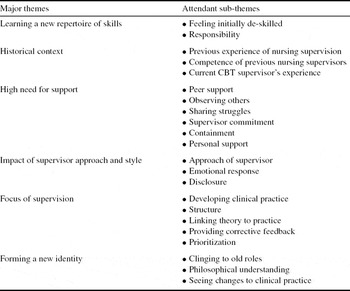
Analysis of interview transcripts found six key separate but interconnected themes, each with a variety of number of sub-themes. Table 1 identifies the themes and sub-themes, which are then subsequently described in detail, with quotes directly from participants to support the findings. Three themes were particularly interconnected and concerned supervision facilitating effective role transitions; the approach and focus of cognitive-behavioural supervision, and the historical context of supervision.
Transition themes and sub-themes from the interviews (n = 6)

The first major theme across participants concerning the transition was the challenge of “learning a repertoire of new clinical skills” and had two sub-themes of treatment responsibility and feeling initially de-skilled. Role change was described as difficult due to feeling that developing skills were being challenged and needing to demonstrate that theory was being consistently integrated with practice. Participants reported a new and greater sense of personal responsibility for the entirety of assessment and treatment during the early stage of the transition, with this being a new and significant change in the focus of clinical practice.
It was loads different, this is very focused and you're their therapist. Always on the ward you would have, what I always found valuable, was the kind of informal time that you would have with patients, where you wouldn't necessarily be doing anything structured. Coming into this and it's very structured and very bound tight and it's not very open and free to kind of talk about music or films or books or sport or what the other conversations that you would used to have with patients.
All participants also reported, to varying degrees, feeling de-skilled during the early stages of training. Participants described moving from a prior position of unconscious competence in nursing roles to a position of conscious incompetence in their new CBP roles, leaving them feeling challenged and exposed:
I don't know if I said it earlier, you have gone from being a competent nurse haven't you and its amazing how different the job is.
Whereas as a nurse I felt quite experienced, but I weren't questioning my practice. Whereas in this CBT, I was constantly questioning my practice and my ability.
The second major theme regarding adaption to the transition was participants’ “high need for support” containing five sub-themes of peer support, observing others, sharing struggles, supervisor commitment/containment and personal support. Support was identified as a key role for service and university supervisors and the university supervision group. Support emerged as important at all stages of the transition, from early in training when adapting to a new psychotherapeutic approach, to later when struggling to truly identify with the psychotherapist role and accepting themselves as novice CB psychotherapists. Group university supervision was crucial in providing peer support with its sense of mutuality regarding the travails of clinical practice and providing emotional support during difficult periods:
It felt like a really close group. A couple of times, you know, if because of the nature of IAPT and someone would come to supervision and they had just failed an essay or they had just failed a tape and they would be quite upset about that and you know we would all support each other through that.
Observing others was reported as supportive across all participants during group supervision. Observation included reciprocally seeing the struggles, triumphs and development in peers’ practice, giving a sense of shared mutual development:
In group supervision, because you get to hear peoples’ struggles and stories and you get this client come to life when you are hearing about her every week, isn't it? Then you get to see them live of course on tape so it's not far behind really. So, I think that that brought it to life.
Sharing struggles to conceptualize cases and observing when clinical supervisors also appeared to be struggling to conceptualize was also helpful to some participants. This enabled participants to measure progress against supervisors held in high esteem and to normalize the complexities of clinical practice:
Being able to say, yeah I am not getting this or not understanding it or I need some help with this bit was quite helpful. And knowing at times the supervisor would struggle with that as well, was quite handy.
Important to all participants in feeling supported was supervisor commitment and containment, with trainees particularly valuing the supervisor's availability. Supervisors were reported to recognize the needs of supervisees, with participants finding this motivating and helpful when building trust in supervisory relationships:
Well it means it's more trusting when it's even more facilitated, cos you know your supervisor is actually taking this seriously, hearing about you and about your clients. If something seems to be taken more seriously and given more value and priority, you feel like you are part of something that is much more important.
All participants valued the emotionally containing aspects of supervision. Containment enabled strong affects to be acknowledged and managed, particularly when participants were struggling clinically or academically. Participants acknowledged the parallel process when in receipt of support from supervisors, with the emotional containment they offered patients in services:
It's a reflective of the relationship with your clients isn't it - they come to you in a bundle not knowing quite often and you have to facilitate and so it's pretty much a mirror of it isn't it. I sometimes would go in tears to my supervisor and say I don't know what the hell is going on here and he will say you do, you just need to slow down and take it all apart and have a look at it. Think how you feel, what you are thinking, what you have heard. So yes, it's supportive therapeutic relationship style really isn't it.
The dual rigors of the academic course and required changes to clinical practice, at times left a personal toll on participants. This was reported to affect self-confidence and personal lives. Personal support was therefore valued by all participants, with this being for some the key feature of the individual supervision:
I felt really comfortable in that relationship. I felt that it was a very kind of open, kind of honest relationship in that I could be very open about how I was feeling. How I was getting on clinically. I felt like I could really trust my supervisor. I felt I got a lot of support from her, both personally and professionally.
The third major transition theme across the training period was the “impact of the supervisor's style”, which had three sub-themes of approach, emotional responses and disclosure. Supervisory relationships with a strong bond were dependant on the supervisor's approach, with the alliance being helpful throughout the training year regarding transition. Some supervisors were seen as very formal in approach, attending only to the tasks of supervision, whilst others were seen as more interpersonal, being more relaxed and informal in their approach:
The supervisor relationships I had were quite different in that my university supervisor was a lot more. . . a little bit more boundaried, in that she would come in and we would have the supervision and then she would go and there was never kind of any talk that wasn't really about the supervision. Whereas my work place supervisor tended to form a closer relationship.
The focus of supervision interacting with need to learn new clinical skills and the personal disposition of supervisees, occasionally led to difficulties for some participants resulting in difficult emotional responses. Participants most frequently used comparison and normalization to manage difficult emotional responses:
I think because I know a lot of other people who had got him as a supervisor, a few of us at college so it was . . . you could almost like . . . talk about him that sounds really bad. But talk about your experiences of supervision and realize that it's not just you that he was being like that with. That actually, that's what he was like for supervision. I mean he made some people cry, but he never made me cry.
Overly challenging or overly technical relationships resulted in less disclosure of both personal and practice issues, with an associated fear of criticism:
At times it was more difficult to actually be honest about things I was struggling with. I would feel that I would just get put down even further, when I was under so much pressure anyway from uni to get things done.
The fourth major transition theme was “focus of supervision” which had the five sub-themes of developing clinical practice, structure, linking theory to practice, providing corrective feedback, and prioritization. Early in training an over-focus on treatment outcomes, was reported to have a de-skilling effect across participants. Developing clinical practice through supervision being explicitly focused on the competent delivery of CBP was a core requirement of role transition:
The CBT supervision was very much about kind of clinical work that you were doing and that's the majority of it, is that you know you would go in and talk about your patients. Where you are at? What's your formulation? Where you going next? Any problems you are having? Problems with therapeutic relationship between your patients?
Most participants found the clinical practice of CBP challenging, due to the need to manage differing models and protocols. Supervision of specific techniques and the supervisory relationship itself was often used as a means to development of clinical practice:
The relationships with both have been valuable because of the skills and knowledge that I have got, I wouldn't have had unless I'd had the individual supervision that was structured and sort of theoretically and very clinically focused, I wouldn't know about different models and feel able to formulate.
All participants identified supervision focus enabling transitions by using an explicit structure, whereby the setting of an agenda and prioritization of focal issues were new supervisory experiences:
So it were time limited, the agenda was set; timings for particular clients that I were discussing.
It's more specific so you're not just talking about anything. It's more structured. It's got different time frames.
All participants endorsed the value of linking theory to practice as a sub-theme of focus within the supervisory relationship facilitating transition. Participants reported frequently needing to demonstrate during supervision a rationale for why and how they were following a particular treatment protocol:
The other side through supervision really which is relevant to specifically what you are doing with somebody, so again once you have read that kind of stuff it gives you more theory-based . . . theory-based practice if you like. Which is perhaps the aim of this and has been in reality.
Providing corrective feedback was described by all participants as focusing clinical care and assisting the development of a new identity. Supervisors needed to balance support and challenge to facilitate the necessary skill development:
So he's quite able to be honest with me, if I was wasting time you know. But also able to say to me “that was excellent, that intervention was really innovative and I can see that you are growing”. So, you know, you got a relationship where you could have that proper feedback. Not just nice reassurance, but proper feedback on what needed sorting out, what needed to stay and what needed to develop.
Half of the participants recognized the priority given to supervision. Regularity, commitment, emphasis and organizational support meant that supervision was highly regarded and viewed as central to developing effective CB practice:
I think it's your supervisor's investment in it. It feels like in CBT, the supervisor's primary role as a part of his job is to facilitate supervision for other therapists sort of thing. He sees that as being as important to patient care within this trust, as he does his own practice. So I think that it's just taken much more seriously, in that sense prioritized a lot more.
However, adapting to the amount of supervision and having two supervisors (clinical service and university) was described as difficult by all participants in terms of transition, when combined with clinical and academic workload:
Well from my training we had group supervision at university with a supervisor which was 2 hours and then supervision one to one with a different supervisor. I struggled a lot with having 4 hours of supervision a week, but with two different people.
The fifth major transition theme labelled “historical context” describes the impact of past supervisory experiences on role transition which had three sub-themes: previous supervisory experiences, competence of previous supervisor and previous knowledge and experience of the current supervisor. Mental health nursing supervision was described as previously having for most a low priority. Participants suggested this was common, with a culture of previous experience of grabbing time, poor boundaries and late cancellations due to competing priorities:
Well as a nurse, it never really happened anyway. You would kind of make time for it and then depending on what was going on, on the ward at the time. That would always be the first thing to go, if there was a lot of clinical activity.
Knowledge regarding effective supervision delivery was reported to have been poor amongst most previous nurse supervisors, with little understanding of core supervisory processes and effective delivery. Participants reported frequent examples of dual and conflicting supervisory and managerial relationships, with supervision relationships also being used for disciplinary purposes:
So that was done, that was called supervision sometimes, but it weren't it, it were a bollocking.
I never really felt, because I didn't know how supervision worked, I never really felt like I sort of confided in him or spoke about this. Because I didn't really understand how it all worked and he didn't. I didn't really have much of it and we never really got into anything.
Exceptions were provided where participants described having received competent previous supervision facilitating current role transition, due to supervisor qualification and experience. This was evident when participants had worked in specialist teams or where clinical supervision was actively promoted for nurses. Access to other professional disciplines such as Clinical Psychologists, CBT therapists or highly qualified nurse specialists positively impacted on previous supervision experiences:
I were supervised by a qualified mental health nurse but she were a PhD student as well and she normally gave me clinical supervision but the content supervision for. . . for my masters as well, so I got a really strong relationship with her. It were focused, like I say, mostly on how to offer a better or a good standard of clinical care. So clinical supervision, rather than managerial supervision.
Most participants suggested that current CBT supervisors having prior mental health nursing experience helped transitions, as this gave confidence that supervisors would have an understanding and feel for the complexities inherent in role change:
With both the supervisors I'm talking about here they both got their first qualification as a mental health nurse, so I feel that when you are supervised by a nurse, by a mental health nurse there's a bond anyway. It's like you know a little bit about each other's journey I suppose and what you have experienced. Whereas maybe with CBT supervision from people that haven't been a mental health nurse they haven't really got any great understanding of what you have experienced.
The sixth and final main transition theme concerned “forming a new identity” which had three sub-themes: clinging to old roles, philosophical understanding, and seeing changes to clinical practice. Forming a new identity was more challenging for participants who found it difficult to discard former nursing roles and reported clinging to the old role. This was particularly challenging for participants who had previously worked in specialist teams and were more experienced:
So if I . . . if I am in a situation where I am unsure, rather than going with an instinct as a therapist because I am inexperienced and because I am questioning my practice, I resort back to being a nurse. Cos that is comfortable for me.
I played safe and I did my nursing bit. I would sit on the fence more, I would resort back to being a nurse because I felt I didn't . . . I hadn't got that confidence to try something different.
Others, however, were able to find greater clarity in distinguishing between old and new identities and roles. These frequently included changes in clinical practice and assimilating the underpinning philosophical differences between nursing and CBP:
I guess as a nurse, you want to stop people from feeling anxious, you wanna stop all that anxiety and depression. But when you are a CBT, you are telling people, right you have got to go out there and do this, you are going to feel anxious, I want you to feel anxious. When actually my nature, I went into nursing because I wanted to help people; whereas now I know this is helping.
Consistently viewing and commenting on changes to clinical practice during supervision linked closely to the formation of a new identity, particularly towards the late stages of training. This was evident when, despite having some difficulties with confidence and viewing themselves as novice CB psychotherapists, participants began to observe an observable change in clinical practice:
So eventually I'd become much more structured, task-oriented and intervention driven. And briefer and quicker.
Seeing the benefits in supervision of keeping it very structured and kind of applying that to my own clinical sessions.
Discussion
This study presented a descriptive analysis of six mental health nurses' experiences of role transition during their training year as HITs. Six themes emerged from the TCA of semi-structured interviews conducted, three of which described how supervisory relationships helped (and at times hindered) role transitions between mental health nursing and CBP. The findings suggest nurses entering HIT training can make successful role transitions, when supported by effective supervisory relationships. Learning new CB skills, high need for support and forming a new identity were also found to be important in the transition. Whereas some themes were important in earlier aspects of transition (e.g. responsibility), others were more important later in the transition (e.g. seeing a change to practice). A high need for support ran across the transition period. It is acknowledged that the emergent themes identified in enabling such transitions were typically interrelated and so influenced and interacted with each throughout transitions over time. The results lend support to the role transition cycle phases (Nicholson, Reference Nicholson1984) of preparation, shock, adjustment and eventual stabilization. This theory states that effective role transition in IAPT would be dependent upon the characteristics of the trainee, the demands of the CBP role and the IAPT organizational context.
The study was informed by Bordin (Reference Bordin1983) where supervisory relationships are supported by three elements; the bond, tasks, and goals. Findings from the present study can be matched to these concepts as being analogous to the bond (support, impact of supervisor style), tasks (the focus of supervision) and goals (learning a new CBT treatment approach and forming a new identity) of supervision. All supervisors in the current study had been practising CBP supervision for a considerable period. Findings suggest a core component of changing practice was adopting the philosophy of CBP as the basic approach to clinical work (Pretorius, Reference Pretorius2006; Rosenbaum and Ronen, Reference Rosenbaum and Ronen1998). Clinical work was demanding as it required participants to manage multiple clinical approaches, based on different CB models and protocols across a range of patient presentations (Ricketts and Donohoe, Reference Ricketts, Donohoe, Lawton and Feltham2000). Supervisors simultaneously required trainees to consistently link theory to practice, often exploring and testing this through the supervisory process, developing both declarative and procedural knowledge (Bennett-Levy, Reference Bennett-Levy2006).
Participants reported the necessary focus on CB practice was achieved within a structured supervisory framework that frequently mirrored the emotional containment aspects of CBP sessions, described as a parallel process (Pretorius, Reference Pretorius2006). These involved using specific supervision techniques such as Socratic dialogue, guided discovery, role play and video feedback taken from work in clinical sessions (Grant, Reference Grant and Henderson2009). These techniques allowed the provision of corrective feedback, often including aspects of praise and constructive criticism, merging the evaluative and training components of supervision (Milne, Reference Milne2009). In the present study for some participants effective disclosure during supervision became difficult due to fear of criticism. Ladany et al. (Reference Ladany, Hill, Corbett and Nutt1996) noted that supervisors who are less interpersonally sensitive and do not manage the relational impact of supervision, risk supervisees failing to disclose important and relevant material.
The transition from experienced mental health nurse to trainee left participants feeling de-skilled, particularly in the early stages of the transition and echoes Bennett-Levy and Proctor's (Reference Bennett-Levy and Beedie2007) comments concerning CBP training being personally and professionally challenging. This presented an unexpected challenge to all participants, but particularly more experienced trainees, who were effectively moving from a position of prior expert to current novice (Bowditch and Buono, Reference Bowditch and Buono2005). Milne (Reference Milne2009) argues that de-skilling is a common and necessary aspect of learning and development in trainees, as it creates room for new ways of thinking about clinical material and situations. This early aspect of the transition therefore seemed to shift participants into what is defined by Grant et al. (Reference Grant, Townend and Sloan2008) as the “conscious incompetence” phase of learning and the anxiety this naturally entails. Trainees at this stage often commit clinical errors and display behaviours leading to negative therapeutic outcomes. This usually precedes movement to the novice level, characterized by the rigid application of rules, but failing to apply effective discretionary and flexible judgement (Grant et al., Reference Grant, Townend and Sloan2008), and a final transition into reflexive competence.
The results suggest that the focus of supervision on clinical practice is interdependent with the style and approach of the supervisor, this having a moderating effect on role transitions. CBP supervisors need to integrate specific, structured and sensitive feedback based on live clinical work, while at the same time linking theory to practice (Bennett-Levy, Reference Bennett-Levy2006). Heppner and Roehlke (Reference Heppner and Roehike1984) found this was important and significant for new trainees, as their initial needs were skill building and direction from the supervisor, rather than reflection and reflexivity. In the present study, supervisory styles that were more formal (Ricketts and Donohoe, Reference Ricketts, Donohoe, Lawton and Feltham2000) appeared to disrupt speed of transition, due to fears regarding criticism. Lack of balance of interpersonal warmth, with structured focused constructive criticism, may result in trainee withdrawal from learning and the necessary engagement in new and often challenging transition experiences (Milne, Reference Milne2009). Group supervision was found to be useful for providing peer support and facilitating transition through peer observation (Bennett-Levy and Beeedie, Reference Bennett-Levy and Beedie2007) and sharing of approach. Townend (Reference Townend2008) noted that group supervision was considered the gold standard for clinical supervision by expert supervisors, due to the opportunities for peer learning and multiple feedback.
More experienced trainees appeared to find the transition difficult, resulting in them resorting back to nursing identities, particularly when struggling clinically. Strongly held identities reinforced through perceived expertise may be more entrenched and difficult to shift (Nicholson, Reference Nicholson1984). Trainees may protect an established sense of expertise and prevent a sense of inadequacy, when incorporating new skills in a surface manner that disables identity change (Armenakis and Bedeian, Reference Armenakis and Bedeian1999). Grant et al. (Reference Grant, Townend and Sloan2008) noted that the IAPT initiative, though an opportunity to disseminate and deliver psychological therapies more widely, requires the re-deployment of existing, but newly trained staff. Nurses recruited into these posts may be expected to drive these initiatives forward within new roles, but may continue to cling to and inhabit old roles and only incorporate new CB skills in a cursory fashion (Grant et al., Reference Grant, Townend and Sloan2008). This may be particularly problematic for trainees who continue to train in the same clinical service in which they held previous nursing roles, as making successful transitions may require sometimes physically leaving behind old contexts, identities and peer groups (Nicholson, Reference Nicholson1984).
Ease of transition partly appeared to depend on the supervisees’ past experience of nursing supervision, with previous supervision experiences being varied. Findings suggest a possible absence of the use of specific mental health nursing supervision models, with clinical supervision being poorly integrated into mental health nursing (Scanlon and Weir, Reference Scanlon and Weir1997; Townend, Reference Townend2008; Yegdich and Cushing, Reference Yegdich and Cushing1998). However, when working in locations such as specialist teams, some participants had access to supervisors from different professional backgrounds and this was reported to enhance the supervisory experience. These supervisors included highly trained nurses, CB psychotherapists or Clinical Psychologists who were able to take an integrative approach, blending generic supervision models with more specialist psychological models, to facilitate access to supervision, which encouraged greater reflection on clinical practice (Schon, Reference Schon1983).
The study has several limitations, with qualitative studies particularly open to researcher bias (Silverman, Reference Silverman2005). Miles and Huberman (Reference Miles and Huberman1994) suggest achieving sufficient validity in qualitative studies requires an inter-rater agreement of 75% when coding data. This was beyond the scope of the current study and therefore other procedures were followed to validate findings and reduce researcher bias. These included meeting with participants to discuss and validate themes and sub-themes, research supervision, the use of a memo system, and keeping a reflective diary (Appleton, Reference Appleton1995; Miles and Huberman, Reference Miles and Huberman1994). The sample size was small, limiting the applicability and generalizability of findings to a wider population. The sample was also limited to group members from a single training cohort and sampling from other courses may have altered the results. The results reflect the thoughts and feelings of participants willing to participate in research and therefore may not necessarily be representative of all trainees. Selection of a different professional group (e.g. social workers) may have thrown up completely differing results. As the research asked participants to review the training year, then the results may have been skewed by memory bias and the methodology could have been improved by interviewing participants longitudinally.
Further research in this area demands larger and longitudinal qualitative and quantitative methodologies, including further studies to look at the transition of different professional groups who also typically enter CBP training (e.g. OTs and social workers), which would enable a comparison of findings. Similarly, role transition for psychological well-being practitioners is worthy of study. Diary methodologies may prove useful in capturing the complexities of role transitions over time. The use of qualitative methods with a small sample in the current study means that the conclusions drawn should be treated with due caution, as results may not generalize to wider training populations. However, it can be tentatively concluded that the supervisory relationship broadly supports role transition from mental health nurse to CB psychotherapist. When a CBP trainee is making a transition from an established profession, then the integration of transition issues into the structure and focus of supervision may be vital.



Comments
No Comments have been published for this article.